
Masujima M. Applied Mathematical Methods in Theoretical Physics
Подождите немного. Документ загружается.


2.1 Introduction to Integral Equations 35
eigenfunctions of the transposed kernel (the kernel with x ↔ y)ofthatparticular
eigenvalue.
As we have seen in Chapter 1, just like a matrix, a kernel and its transpose
have the same eigenvalues. Hence, the homogeneous integral equation with the
transposed kernel has no solution if λ is not equal to an eigenvalue of the kernel.
Hence, if λ is not an eigenvalue, any inhomogeneous term is trivially perpendicular
to all solutions of the homogeneous integral equation with the transposed kernel,
since all of them are trivial. Together with the result in the preceding paragraph,
we arrived at the necessary and sufficient condition for an inhomogeneous integral
equation to have a solution: the inhomogeneous term must be perpendicular to all
solutions of the homogeneous integral equation with the transposed kernel.
There exists another kind of integral equations in which the unknown appears
only in the integrals. Consider one more example of a Fredholm Integral Equation.
Example 2.4. Fredholm Integral Equation of the first kind.
Case (A)
1 =
1
0
xyφ(y)dy,0≤ x ≤ 1. (2.1.19)
Case (B)
x =
1
0
xyφ(y)dy,0≤ x ≤ 1. (2.1.20)
Solution. In both the cases, divide both sides of the equations by x to obtain
Case (A)
1/x =
1
0
yφ(y)dy. (2.1.21)
Case (B)
1 =
1
0
yφ(y)dy. (2.1.22)
In the case of Eq. (2.1.21), no solution exists, while in the case of Eq. (2.1.22),
infinitely many φ(x) are possible. Any function ψ(x) which satisfies
1
0
yψ(y)dy = 0or∞,
can be made a solution to Eq. (2.1.20). Indeed,
φ(x) = ψ(x)/
1
0
yψ(y)dy (2.1.23)

36 2 Integral Equations and Green’s Functions
will do.
Therefore, for the kind of integral equations considered in Example 2.4, we
have no solution for some inhomogeneous terms, while we have infinitely many
solutions for some other inhomogeneous terms.
Next, we shall consider an example of a Volterra Integral Equation of the second
kind with the transformation of an integral equation into an ordinary differential
equation.
Example 2.5. Volterra Integral Equation of the second kind.
φ
(
x
)
= ax + λx
x
0
φ(x
)dx
. (2.1.24)
Solution. Divide both sides of Eq. (2.1.24) by x to obtain
φ
(
x
)
/x = a + λ
x
0
φ
x
dx
. (2.1.25)
Differentiate both sides of Eq. (2.1.25) with respect to x to obtain
d
dx
(φ(x)/x) = λφ(x). (2.1.26)
By setting
u(x) = φ(x)/x,
the following differential equation results:
du(x)/u(x) = λxdx. (2.1.27)
By integrating both sides,
ln u(x) =
1
2
λx
2
+ constant.
Hence the solution is given by
u(x) = Ae
1
2
λx
2
,orφ(x) = Axe
1
2
λx
2
. (2.1.28)
To determine the integration constant A in Eq. (2.1.28), note that as x → 0, based
on the integral equation (2.1.24), φ(x) above behaves as
φ(x) → ax + O(x
3
) (2.1.29)
while our solution (2.1.28) behaves as
φ(x) → Ax + O(x
3
). (2.1.30)

2.2 Relationship of Integral Equations with Differential Equations and Green’s Functions 37
Hence, from Eqs. (2.1.29) and (2.1.30), we identify
A = a.
Thus the final form of the solution is
φ(x) = axe
1
2
λx
2
, (2.1.31)
which is the unique solution for all λ.
We observe three points:
(1) The integral equation (2.1.24) has a unique solution for all values of λ.It
follows that the corresponding homogeneous integral equation, obtained
from Eq. (2.1.24) by setting a = 0, does not have a nontrivial solution.
Indeed, this can be directly verified by setting a = 0 in Eq. (2.1.31). This
means that the kernel for Eq. (2.1.24) has no eigenvalues. This is true for all
square-integrable kernels of the Volterra type.
(2) While the solution to the differential equation (2.1.26) or (2.1.27) contains
an arbitrary constant, the solution to the corresponding integral equation
(2.1.24) does not. More precisely, Eq. (2.1.24) is equivalent to Eq. (2.1.26) or
Eq. (2.1.27) plus an initial condition.
(3) The transformation of Volterra Integral Equation of the second kind to an
ordinary differential equation is possible whenever the kernel of the
Volterra integral equation is a sum of the factored terms.
In the above example, we solved the integral equation by transforming it into
a differential equation. This is not often possible. On the other hand, it is,
in general, easy to transform a differential equation into an integral equation.
However, lest there be any misunderstanding, let me state that we never solve a
differential equation by such a transformation . Indeed, an integral equation is
much more difficult to solve than a differential equation in a closed form. It is
very rare that this can be done. Therefore, whenever it is possible to transform
an integral equation into a differential equation, it is a good idea to do so. On
the other hand, there are advantages in transforming a differential equation into
an integral equation. This transformation may facilitate the discussion of the
existence and uniqueness of the solution, the spectrum of the eigenvalue, and the
analyticity of the solution. It also enables us to obtain the perturbative solution of
the equation.
2.2
Relationship of Integral Equations with Differential Equations and Green’s Functions
To help the sense of bearing of the reader, we shall discuss the transformation of a
differential equation to an integral equation. This transformation is accomplished
with the use of Green’s functions.

38 2 Integral Equations and Green’s Functions
As an example, consider the one-dimensional Schr
¨
odinger equation with
potential U(x):
d
2
dx
2
+k
2
φ(x) = U(x)φ(x). (2.2.1)
It is assumed that U(x) vanishes rapidly as
|
x
|
→∞. Although Eq. (2.2.1) is most
usually thought of as an initial value problem, let us suppose that we are given
φ(0) = a and φ
(0) = b, (2.2.2)
and are interested in the solution for x > 0.
Green’s function: We first treat the right-hand side of Eq. (2.2.1) as an inhomoge-
neous term f (x). Namely, consider the following inhomogeneous problem:
Lφ(x) = f (x)withL =
d
2
dx
2
+ k
2
, (2.2.3)
and the boundary conditions specified by Eq. (2.2.2). Multiply both sides of
Eq. (2.2.3) by g(x, x
) and integrate with respect to x from 0 to ∞.Then
∞
0
g(x, x
)Lφ(x) =
∞
0
g(x, x
)f (x)dx. (2.2.4)
Integrate by parts twice on the left-hand side of Eq. (2.2.4) to obtain
∞
0
(Lg(x, x
))φ(x)dx + g(x, x
)φ
(x)
x=∞
x=0
−
dg(x, x
)
dx
φ(x)
x=∞
x=0
=
∞
0
g(x, x
)f (x)dx. (2.2.5)
In the boundary terms, φ
(0) and φ(0) are known. To get rid of unknown terms, we
require
g(∞, x
) = 0and
dg
dx
(∞, x
) = 0. (2.2.6)
Also, we choose g(x, x
)tosatisfy
Lg(x, x
) = δ(x − x
). (2.2.7)
Then we find from Eq. (2.2.5)
φ(x
) = bg(0, x
) − a
dg
dx
(0, x
) +
∞
0
g(x, x
)f (x)dx. (2.2.8)
Solution for
g(x,x
)
. The governing equation and the boundary conditions are
given by

2.2 Relationship of Integral Equations with Differential Equations and Green’s Functions 39
d
2
dx
2
+ k
2
g(x, x
) = δ(x − x
)onx ∈ (0, ∞)withx
∈ (0, ∞). (2.2.9)
Boundary condition 1:
g(∞, x
) = 0, (2.2.10)
Boundary condition 2:
dg
dx
(∞, x
) = 0. (2.2.11)
For x < x
,
g(x, x
) = A sin kx + B cos kx. (2.2.12)
For x > x
,
g(x, x
) = C sin kx +D cos kx. (2.2.13)
Applying the boundary conditions, (2.2.10) and (2.2.11) above, results in C = D = 0.
Thus
g(x, x
) = 0forx > x
. (2.2.14)
Now, integrate the differential equation (2.2.9) across x
to obtain
dg
dx
(x
+ ε, x
) −
dg
dx
(x
− ε, x
) = 1, (2.2.15)
g(x
+ ε, x
) = g(x
− ε, x
). (2.2.16)
Letting ε → 0, we obtain the equations for A and B.
A sin kx
+ B cos kx
= 0,
−A cos kx
+ B sin kx
= 1/k.
Thus A and B are determined to be
A = (−cos kx
)/k, B = (sin kx
)/k, (2.2.17)
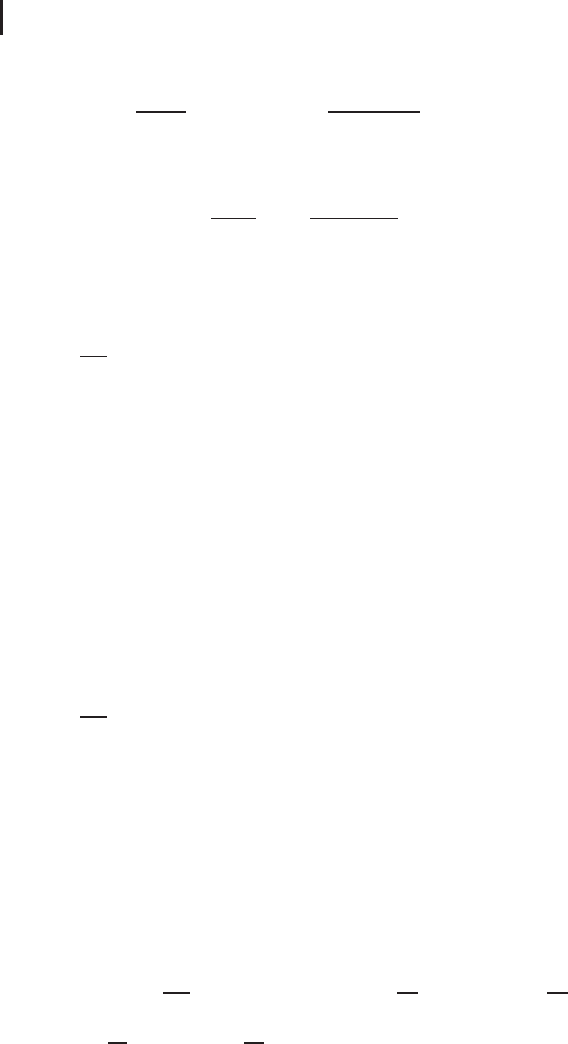
and Green’s function is found to be
g(x, x
) =
(sin k(x
− x))/k for x < x
,
0forx > x
.
(2.2.18)
40 2 Integral Equations and Green’s Functions
Equation (2.2.8) becomes
φ(x
) = b
sin kx
k
+ a cos kx
+
x
0
sin k(x
− x)
k
f (x)dx.
Changing x to ξ and x
to x, and recalling that f (x) = U(x)φ(x), we find
φ(x) = a cos kx + b
sin kx
k
+
x
0
sin k(x − ξ )
k
U(ξ )φ(ξ)dξ , (2.2.19)
which is a Volterra Integral Equation of the second kind.
Next consider the very important scattering problem for the Schr
¨
odinger equation:
d
2
dx
2
+k
2
φ(x) = U(x)φ(x)on −∞< x < ∞, (2.2.20)
where the potential U(x) → 0as
|
x
|
→∞.Assuchwemightexpectthat
φ(x) → Ae
ikx
+ Be
−ikx
as x →−∞,
φ(x) → Ce
ikx
+De
−ikx
as x →+∞.
Now (with an e
−iωt
implicitly multiplying φ(x)), the term e
ikx
represents a wave
going to the right while e
−ikx
is a wave going to the left. In the scattering problem, we
suppose that there is an incident wave with amplitude 1 (i.e., A = 1), the reflected
wave with amplitude R (i.e., B = R) and the transmitted wave with amplitude
T (i.e., C = T). Both R and T are still unknown. Also as x →+∞, there is no
left-going wave (i.e., D = 0). Thus the problem is to solve
d
2
dx
2
+k
2
φ(x) = U(x)φ(x), (2.2.21)
with the boundary conditions
φ(x →−∞) = e
ikx
+Re
−ikx
,
φ(x →+∞) = Te
ikx
.
(2.2.22)
Green’sfunction: Multiply both sides of Eq. (2.2.21) by g(x, x
), integrate with
respect to x from −∞ to +∞,andintegratetwicebyparts.Theresultis
+∞
−∞
φ(x)
d
2
dx
2
+ k
2
g(x, x
)dx + g(∞, x
)
dφ
dx
(∞) − g(−∞, x
)
dφ
dx
(−∞)
−
dg
dx
(∞, x
)φ(∞) +
dg
dx
(−∞, x
)φ(−∞)
=
+∞
−∞
g(x, x
)U(x)φ(x)dx. (2.2.23)
2.2 Relationship of Integral Equations with Differential Equations and Green’s Functions 41
We require that Green’s function satisfies
d
2
dx
2
+ k
2
g(x, x
) = δ(x − x
). (2.2.24)
Then Eq. (2.2.23) becomes
φ(x
) +g(∞, x
)Tike
ikx
− g(−∞, x
)
ike
ikx
− Rike
−ikx
−
dg
dx
(∞, x
)Te
ikx
+
dg
dx
(−∞, x
)
e
ikx
+ Re
−ikx
=
+∞
−∞
g(x, x
)U(x)φ(x)dx. (2.2.25)
We require that terms involving the unknowns T and R vanish in Eq. (2.2.25), i.e.,
dg
dx
(∞, x
) = ikg(∞, x
),
dg
dx
(−∞, x
) =−ikg(−∞, x
).
(2.2.26)
These conditions, (2.2.26), are the appropriate boundary conditions for g(x, x
).
Hence we obtain
φ(x
) =
ikg(−∞, x
) −
dg
dx
(−∞, x
)
e
ikx
+
+∞
−∞
g(x, x
)U(x)φ(x)dx. (2.2.27)
Solution for g(x, x
). the governing equation for g(x, x
)is
d
2
dx
2
+ k
2
g(x, x
) = δ(x − x
),
and the boundary conditions are Eq. (2.2.26). The solution to this problem is found
to be
g(x, x
) =
A
e
ikx
for x > x
,
B
e
−ikx
for x < x
.
At x = x
, there exists a discontinuity in the first derivative
dg
dx
of g with respect to x,
dg
dx
(x
+
, x
) −
dg
dx
(x
−
, x
) = 1, g(x
+
, x
) = g(x
−
, x
).
From these two conditions, A
and B
are determined to be A
= e
−ikx
/2ik and
B
= e
ikx
/2ik. Thus Green’s function g(x, x
) for this problem is given by
g(x, x
) =
1
2ik
e
ik
|
x−x
|
.

42 2 Integral Equations and Green’s Functions
Now, the first term on the right-hand side of Eq. (2.2.27) assumes the following
form:
ikg(−∞, x
) −
dg
dx
(−∞, x
) = 2ikB
e
−ikx
= e
ik(x
−x)
.
Hence Eq. (2.2.27) becomes
φ(x
) = e
ikx
+
+∞
−∞
(e
ik
|
x−x
|
/2ik)U(x)φ(x)dx. (2.2.28)
Changing x to ξ and x
to x in Eq. (2.2.28), we have
φ(x) = e
ikx
+
+∞
−∞
(e
ik
|
ξ−x
|
/2ik)U(ξ )φ(ξ)dξ. (2.2.29)
This is the Fredholm Integral Equation of the second kind.
Reflection:Asx →−∞,
|
ξ − x
|
= ξ − x so that
φ(x) → e
ikx
+ e
−ikx
+∞
−∞
(e
ikξ
/2ik)U(ξ )φ(ξ)dξ.
From this, the reflection coefficient R is found:
R =
+∞
−∞
(e
ikξ
/2ik)U(ξ )φ(ξ)dξ.
Transmission:Asx →+∞,
|
ξ − x
|
= x − ξ so that
φ(x) → e
ikx
1 +
+∞
−∞
(e
−ikξ
/2ik)U(ξ )φ(ξ)dξ
.
From this, the transmission coefficient T is found:
T = 1 +
+∞
−∞
(e
−ikξ
/2ik)U(ξ )φ(ξ)dξ.
These R and T are still unknowns since φ(ξ) is not known, but for
U(ξ )
1
(weak potential), we can approximate φ(x)bye
ikx
. Then the approximate equations
for R and T are given by
R
+∞
−∞
(e
2ikξ
/2ik)U(ξ )dξ and T 1 +
+∞
−∞
(1/2ik)U(ξ)dξ.
Also, by approximating φ(ξ)bye
ikξ
in the integrand of Eq. (2.2.29) on the right-hand
side, we have, as the first approximation,
φ(x) e
ikx
+
+∞
−∞
(e
ik
|
ξ−x
|
/2ik)U(ξ )e
ikξ
dξ.
By continuing to iterate, we can generate the Born series for φ(x).

2.3 Sturm–Liouville System 43
2.3
Sturm–Liouville System
Consider the linear differential operator
L = (1/r(x))
d
dx
p(x)
d
dx
− q(x)
, (2.3.1)
where
r(x), p(x) > 0on0< x < 1, (2.3.2)
together with the inner product defined with r(x) as the weight,
(f , g) =
1
0
f (x)g(x) ·r(x)dx. (2.3.3)
Examine the inner product (g, Lf )byintegralbypartstwicetoobtain
(g, Lf ) =
1
0
dx · r(x) ·g(x)(1/r(x))
d
dx
p(x)
df (x)
dx
− q(x)f (x)
= p(1)
f
(1)g(1) − f (1)g
(1)
− p(0)
f
(0)g(0) − f (0)g
(0)
+ (Lg, f ). (2.3.4)
Suppose that the boundary conditions on f (x)are
f (0) = 0andf (1) = 0, (2.3.5)
and the adjoint boundary conditions on g(x)are
g(0) = 0andg(1) = 0. (2.3.6)
(Many other boundary conditions of the type
αf (0) +βf
(0) = 0 (2.3.7)
also work.) Then the boundary terms in Eq. (2.3.4) disappear and we have
(g, Lf ) = (Lg, f ), (2.3.8)
i.e., L is self-adjoint with the given weighted inner product.
Now examine the eigenvalue problem. The basic equation and boundary condi-
tions are given by
Lφ(x) = λφ(x), with φ(0) = 0andφ(1) = 0,
44 2 Integral Equations and Green’s Functions
i.e.,
d
dx
p(x)
d
dx
φ(x)
− q(x)φ(x) = λr(x)φ(x), (2.3.9)
with the boundary conditions
φ(0) = 0andφ(1) = 0. (2.3.10)
Suppose that λ = 0 is not an eigenvalue (i.e., the homogeneous problem has no
nontrivial solutions) so that Green’s function exists. (Otherwise we have to define
the modified Green’s function.) Suppose that the second-order ordinary differential
equation
d
dx
p(x)
d
dx
y(x)
−q(x)y(x) = 0 (2.3.11)
has two independent solutions y
1
(x)andy
2
(x)suchthat
y
1
(0) = 0andy
2
(1) = 0. (2.3.12)
In order for λ = 0 not to be an eigenvalue, we must make sure that the only C
1
and
C
2
for which C
1
y
1
(0) +C
2
y
2
(0) = 0andC
1
y
1
(1) +C
2
y
2
(1) = 0 are not nontrivial.
This requires
y
1
(1) = 0andy
2
(0) = 0. (2.3.13)
Now, to find Green’s function, multiply the eigenvalue equation (2.3.9) by G(x, x
)
and integrate from 0 to 1. Using the boundary conditions that
G(0, x
) = 0andG(1, x
) = 0, (2.3.14)
we obtain, after integrating by parts twice,
1
0
φ(x)
d
dx
p(x)
dG(x, x
)
dx
− q(x)G(x, x
)
dx = λ
1
0
G(x, x
)r(x)φ(x)dx.
(2.3.15)
Requiring that Green’s function G(x, x
)satisfies
d
dx
p(x)
dG(x, x
)
dx
−q(x)G(x, x
) = δ(x − x
) (2.3.16)
with the boundary conditions (2.3.14), we arrive at the following equation:
φ(x
) = λ
1
0
G(x, x
)r(x)φ(x)dx. (2.3.17)