
Masujima M. Applied Mathematical Methods in Theoretical Physics
Подождите немного. Документ загружается.


398 10 Calculus of Variations: Applications
we will underestimate the value of Eq. (10.6.9). If E is computed from
D [
q(ζ )] exp[I
E
[{
q
j
}
N
j=1
;
q
f
,
q
i
] −I
1
]exp[I
1
]
∼ exp[−E(τ
f
− τ
i
)], (10.6.12)
we know that E exceeds the true E
0
,
E ≥ E
0
. (10.6.13)
If there are any free parameters in I
1
,wechooseasthebestvaluesthosewhich
minimize E.
Since I
E
[{
q
j
}
N
j=1
;
q
f
,
q
i
] − I
1
defined in Eq. (10.6.11) is proportional to τ
f
− τ
i
,
we write
I
E
[{
q
j
}
N
j=1
;
q
f
,
q
i
] −I
1
=s(τ
f
− τ
i
). (10.6.14)
The factor exp[I
E
[{
q
j
}
N
j=1
;
q
f
,
q
i
] − I
1
] in Eq. (10.6.12) is constant and can be
taken outside the integral. We suppose the lowest energy E
1
for the action functional
I
1
is known,
D [
q(ζ )] exp[I
1
] ∼ exp[−E
1
(τ
f
−τ
i
)]asτ
f
− τ
i
−→ ∞ . (10.6.15)
Then we have
E = E
1
− s
from Eq. (10.6.12), with s given by Eqs. (10.6.11) and (10.6.14).
If we choose the following trial action functional:
I
1
=−
1
2
d
q
dτ
2
dτ , (10.6.16)
we have what corresponds to the plane wave Born approximation in standard
perturbation theory. Another choice is
I
1
=−
1
2
d
q
dτ
2
dτ +
V
trial
(
q(τ ))dτ , (10.6.17)
where V
trial
(
q(τ )) is a trial potential to be chosen. This corresponds to the distorted
wave Born approximation in standard perturbation theory.
If we choose a Coulomb potential as the trial potential,
V
trial
(R) = ZR, (10.6.18)

10.6 Feynman’s Variational Principle 399
we vary the parameter Z . If we choose a harmonic potential as the trial potential,
V
trial
(R) =
1
2
kR
2
, (10.6.19)
we vary the parameter k.
A trouble with the trial potential used in Eq. (10.6.17) is that the particle with
the coordinate
q(τ ) is bound to a specific origin. A better choice would be the
interparticle potential of the form
V
trial
(
q(τ ) −
q(σ )).
Polaron Problem: We shall apply Feynman’s variational principle to the polaron
problem. The polaron problem is the following. An electron in an ionic crystal
polarizes the crystal lattice in its neighborhood. When the electron moves in the
ionic crystal, the polarized state must move with the electron. An electron moving
with its polarized neighborhood is called a polaron. The coupling strength of the
electron with the crystal lattice varies from weak to strong, depending on the type
of the crystal. The major problem is to compute the energy and the effective mass
of such an electron. We assume for the sake of mathematical simplicity that
(1) the crystal lattice acts much like a dielectric medium, and
(2) all the important phonon waves have the same frequency.
The trial action functional of the form specified by
I
1
=−
1
2
β
0
d
q
dτ
2
dτ −
1
2
C
β
0
dτ
β
0
dσ
q(τ ) −
q(σ )
2
exp[−w
|
τ − σ
|
]
was used in the polaron problem by Feynman, after the phonon degrees of freedom
were path-integrated out, leaving the electron degrees of freedom for the variational
calculation of the ground state energy and the effective mass of the electron in a
polar crystal. We shall use the simpler trial action functional with w = 0,
I
1
=−
1
2
β
0
d
q
dτ
2
dτ −
1
2
C
β
0
dτ
β
0
dσ
q(τ ) −
q(σ )
2
,
to simplify the mathematics involved considerably.
For the polaron problem, i.e., for a slow electron in a polar crystal, we usually
choose the following action functional:
I
1
=−
1
2
d
q
dτ
2
dτ −
1
2
C
q(τ ) −
q(σ )
2
exp[−w
|
τ − σ
|
]dτ dσ ,
(10.6.20)
as the trial action functional with C and w as the adjustable parameters for the
variational calculation.

400 10 Calculus of Variations: Applications
We begin with the Lagrangian for the electron–phonon system in a polar
crystal and path-integrate out the phonon degrees of freedom. We then apply the
Feynman’s variational principle to the electron degrees of freedom.
We write the Lagrangian for the electron–phonon system in a polar crystal as
L =
1
2
m
−→
˙
q
2
+
1
2
d
3
k
(2π)
3
{
˙
q
2
k
− ω
2
q
2
k
}−
d
3
k
(2π)
3
V
k
q
k
exp[i
k ·
q], (10.6.21)
where
q is the coordinate of the electron, q
k
is the mode of the phonon with
momentum
k, V
k
is given by
V
k
=
ω
k
2mω
14
(4πα)
12
, (10.6.22)
and α is the coupling constant given by
α ≡
1
2
1
ε
∞
−
1
ε
e
2
ω
2mω
12
. (10.6.23)
We note that ε
∞
and ε are the dielectric constants of the vacuum and the medium,
respectively. We now employ the unit system in which = m = ω = 1. In this unit
system, we have
V
k
2
=
4πα
√
2
k
2
and α ≡
e
2
√
2
1
ε
∞
−
1
ε
. (10.6.24)
Path-integrating out the phonon degrees of freedom, after a little algebra, we have
the reduced density matrix ρ(
q
f
,
q
i
) for the electron degrees of freedom as
ρ(
q
f
,
q
i
) =
D [
q]exp[I
E
[
q]], (10.6.25)
where the trial action functional I
E
[
q]isgivenby
I
E
[
q] =−
1
2
β
0
d
q
dτ
2
dτ + α
β
0
dτ
β
0
dσ
cosh[−
|
τ − σ
|
+ β2]
2
32
sinh[β2]
q(τ ) −
q(σ )
(10.6.26)
which contains the retardation factor cosh[−
|
τ − σ
|
+ β2] to account for the
effect of the interaction with the phonon degrees of freedom in the original
problem.
As a trial action functional, Feynman used the trial action functional, (10.6.20).
To simplify the mathematics involved, we apply the following simpler action
functional:
I
1
=−
1
2
β
0
d
q
dτ
2
dτ −
1
2
C
β
0
dτ
β
0
dσ
q(τ ) −
q(σ )
2
, (10.6.27)

10.6 Feynman’s Variational Principle 401
which is the w = 0 version of (10.6.20). We recall from the previous section that
E = E
1
−s. (10.6.28)
Thus we have
s = A + B, (10.6.29)
where
A =
α
2
32
β
β
0
dτ
β
0
dσ
1
q(τ ) −
q(σ )
exp[−
|
τ − σ
|
], (10.6.30)
B =
C
2β
β
0
dτ
β
0
dσ
q(τ ) −
q(σ )
2
, (10.6.31)
with
F
given by
F
=
3
F exp[I
1
]D [
q]
3
exp[I
1
]D [
q]
. (10.6.32)
To compute A,wenote
1
q(τ ) −
q(σ )
=
1
2π
2
exp[i
k · (
q(τ ) −
q(σ ))]
k
2
d
3
k. (10.6.33)
It is sufficient to compute
exp[i
k · (
q(τ ) −
q(σ ))]
=
3
exp[i
k · (
q(τ ) −
q(σ ))] exp[I
1
]D [
q]
3
exp[I
1
]D [
q]
. (10.6.34)
Writing the numerator of the right-hand side of (10.6.34) as J,wehave
J =
exp
−
1
2
β
0
d
q
dτ
2
dτ −
1
2
C
β
0
dτ
β
0
dσ
q(τ ) −
q(σ )
2
+
β
0
f (τ ) ·
q(τ )dτ
D [
q], (10.6.35)
where
f (ς ) = i
k[δ(ς − τ ) −δ(ς − σ )]. (10.6.36)
We note that J is factorized to the form J = J
x
J
y
J
z
,andweareconcernedwithJ
x
for the time being. We observe that the exponent of J
x
is quadratic in q
x
(τ )which
we write as
q
x
(τ ) = X(τ ) +δq
x
(τ ), (10.6.37)

402 10 Calculus of Variations: Applications
where X(τ ) extremizes the exponent of (10.6.35). The δq
x
(τ ) path-integral is
Gaussian and we write the result as N
x
.Wethenhave
J
x
= N
x
exp[−
1
2
β
0
dX
dτ
2
dτ −
1
2
C
β
0
dτ
β
0
dσ
X(τ ) −X(σ )
2
+
β
0
f
x
(τ )X(τ )dτ ], (10.6.38)
where
f
x
(ς) = ik
x
[δ(ς − τ ) − δ(ς − σ )]. (10.6.39)
SincewehaveN
x
both in the numerator and the denominator of (10.6.34), we
can set N
x
= 1 without loss of generality. As the maximization condition of the
exponent of (10.6.35), we obtain the integro-differential equation for X(ς)as
d
2
X(ς)
dς
2
= 2C
β
0
[X(ς) − X(σ )]dσ − f
x
(ς), (10.6.40)
with the boundary conditions specified as
X(0) = X(β) = 0. (10.6.41)
With (10.6.40), we have
J
x
= exp
1
2
β
0
f
x
(τ )X(τ )dτ
. (10.6.42)
For the later convenience, we set
v
2
≡ 2Cβ. (10.6.43)
Writing
F ≡
β
0
X(σ )dσ , (10.6.44a)
and
Y(ς) ≡ X(ς) −
2CF
v
2
, (10.6.44b)
we can reduce the given integro-differential equation for X(ς) to the second-order
ordinary differential equation for Y(ς)as
d
2
dς
2
Y(ς) = v
2
Y(ς) −f (ς). (10.6.45)

10.6 Feynman’s Variational Principle 403
Observing that
d
2
dς
2
− v
2
exp[−v
|
ς − σ
|
] =−2vδ(ς − σ ),
we obtain the general solution for Y(ς)as
Y(ς) = X(ς) −
2CF
v
2
= P exp[−vς] +Q exp[vς]
+
1
2v
β
0
f (σ )exp[−v
|
ς − σ
|
]dσ. (10.6.46)
We shall determine the integration constants for X(ς) from the boundary conditions
of X(ς)intermsofF as
P + Q =−
2CF
v
2
−
ik
v
{exp[−vτ] − exp[−vσ]},
P exp[−vβ] +Q exp[vβ] =−
2CF
v
2
−
ik
v
{exp[−v(β − τ )] − exp[−v(β − σ )]}.
From this, we obtain
Q =−
CF (1 −exp[−vβ])
v
2
sinh vβ
−
ik exp[−vβ](sinh vτ −sinh vσ)
2v sinh vβ
,
P =−
2CF
v
2
−
ik
v
(exp[−vτ] −exp[−vσ]) −Q.
In order to determine F from the definition for β →∞,wefirstobservethatQ = 0
as β →∞, and hence we have
P =−
2CF
v
2
−
ik
v
(exp[−vτ] − exp[−vσ]) as β −→ ∞ , (10.6.47)
so that
P +
1
2
∞
0
dς
∞
0
dηik[δ(η − τ ) −δ(η − σ )] exp[−v
|
ς − η
|
] = 0.
Carrying out the integral above and comparing with the expression for P as β →∞
given above, we obtain
P =−
ik
2v
(exp[−vσ] −exp[−vτ]) and
2CF
v
2
=
ik
v
(exp[−vσ] −exp[−vτ]),
so that
X(ς) =
ik
v
(exp[−vσ] −exp[−vτ]) −
ik
2v
(exp[−vσ] −exp[−vτ]) exp[−vς]
+
1
2v
∞
0
f
x
(σ )exp[−v
|
ς − σ
|
]dσ. (10.6.48)

404 10 Calculus of Variations: Applications
From (10.6.42), we have
J
x
= exp
ik
x
2
(X(τ ) −X(σ )
.
From (10.6.48), we have
X(τ ) −X(σ ) = ik
x
(exp[−vτ] −exp[−vσ])
2
2v
+
1 −exp[−v
|
τ − σ
|
]
v
.
We have the identical results for J
y
and J
z
with the replacement of k
x
with k
y
and
k
z
, respectively. Thus we obtain
exp[i
k · (
q(τ ) −
q(σ ))]
= exp
−
k
2
(exp[−vτ] −exp[−vσ])
2
4v
+
1 −exp[−v
|
τ − σ
|
]
2v
.
(10.6.49)
Substituting (10.6.49) into (10.6.33) and carrying out the integral over
k,weobtain
1
q(τ ) −
q(σ )
=
1
2π
2
exp[i
k · (
q(τ ) −
q(σ ))]
k
2
d
3
k
=
1
π
12
(exp[−vτ] −exp[−vσ])
2
4v
+
1 −exp[−v
|
τ − σ
|
]
2v
−1/2
. (10.6.50)
From (10.6.30), we have
A =
α
√
2πβ
β
0
dτ
β
τ
dσ
×
(exp[−vτ] − exp[−vσ])
2
4v
+
1 −exp[−v
|
τ − σ
|
]
2v
−1/2
× exp[−(σ − τ )]. (10.6.51)
Setting
σ = τ + x,
we find that the first term inside the square bracket above is negligible in the limit
β −→ ∞ (v −→ ∞ )
so that we have
A = α
4
v
π
∞
0
exp[−x]dx
(1 −exp[−vx])
1/2
. (10.6.52)

10.6 Feynman’s Variational Principle 405
To compute B, we expand both sides of (10.6.49) in power of
k
2
and equate the
coefficient of the
k
2
term. Noting
(X(τ ) −X(σ ))
2
=
1
3
(
q(τ ) −
q(σ ))
2
,
we have
1
6
(
q(τ ) −
q(σ ))
2
=
(exp[−vτ] −exp[−vσ])
2
4v
+
1 −exp[−v
|
τ − σ
|
]
2v
,
and from (10.6.31), we obtain
B =
3v
4
.
To compute E
1
, we take the logarithm of the following expression:
D [
q]exp[I
1
] ∼ exp[−E
1
β]asβ −→ ∞ , (10.6.53)
and take the derivative with respect to C to obtain
C
dE
1
dC
=
C
2β
β
0
dτ
β
0
dσ
q(τ ) −
q(σ )
2
= B =
3v
4
.
We integrate this equation with the boundary condition
E
1
= 0forC = 0,
obtaining
E
1
=
3v
2
.
Sincewehaveobtaineds = B + A = (3v4) +A,wehave
E = E
1
−s =
3v
2
−
3v
4
+ A
=
3v
4
− A. (10.6.54)
As an application of (10.6.54), we consider the case v 1. In this case, we can
ignore exp[−vx] term in (10.6.52), resulting in
A ≈ α
4
v
π
∞
0
exp[−x]dx = α
4
v
π
.
With this A,wehaveE as
E =
3v
4
−α
4
v
π
, (10.6.55)
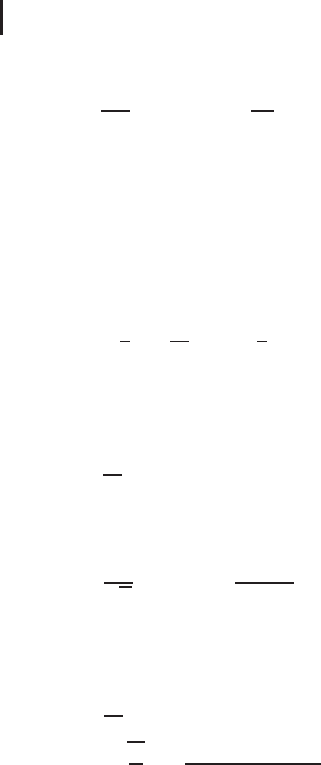
406 10 Calculus of Variations: Applications
attaining the minimum at
v =
4α
2
9π
with E =−
α
2
3π
.
We observe that
v = 4α
2
9π 1 ⇒ α 1.
Hence we have the strong coupling result.
Feynman employed the trial action functional,
I
1
=−
1
2
d
q
dτ
2
dτ −
1
2
C
q(τ ) −
q(σ )
2
exp[−w
|
τ − σ
|
]dτ dσ.
What we discussed so far corresponds to the case w = 0. We can perform similar
but lengthy calculation to obtain
E =
3
4v
(v − w)
2
−A, (10.6.56)
with
A =
αv
√
π
∞
0
w
2
x +
v
2
− w
2
v
(1 −exp[−vx])
−1/2
exp[−x]dx. (10.6.57)
Here v and w are the variational parameters. If we set w = 0 in (10.6.56) and
(10.6.57), we recover our results,
E =
3v
4
− A,
A = α
4
v
π
∞
0
exp[−x]dx
(1 −exp[−vx])
12
.
We can compute the effective mass m
∗
(α) and the mobility of the polaron as well.
The polaron problem has a long history. It was introduced for the first time
by Landau in 1933. Feynman showed the essence of this problem in 1950 by
performing similar calculations in QED. The polaron problem to this day still
attracts considerable attention due to the existence of the large number of different
physical problems with the same conceptual origin. Others in this category include
problems in electrodynamics, gravitation, quark models of hadrons, and so on. The
method of collective coordinates, which is used in quantum statistical mechanics
and quantum field theory, was developed in conjunction with the polaron problem.
The general feature of the polaron problem was explained by Adler in 1982,
who considered the two fields, a ‘‘light field’’ and a ‘‘heavy field.’’ If it is somehow
possible to path-integrate out the heavy field, the problem of evaluation of the
transformation function is reduced to that of path integral over the light field with

10.7 Poincare Transformation and Spin 407
a rather complicated effective action functional for the light field. The distinction
between the light field and the heavy field refers to the bulk masses of the physical
system under consideration.
The treatment of the polaron problem in Feynman’s variational principle in
quantum statistical mechanics is based on the particle trajectory picture. The
particle trajectory picture was once abandoned in 1920s at the time of the birth
of quantum mechanics. It was subsequently resurrected in 1942 by Feynman in
his formulation of quantum mechanics based on the notion of the sum over all
possible histories. It was then applied to the polaron problem in 1955 by Feynman
by path-integrating out the phonon degrees of freedom and retaining the electron
degrees of freedom for the variational calculation. In relativistic quantum field
theory, the particle trajectory technique was originally applied to the pseudoscalar
meson theory in 1956, and recently applied for the Monte Carlo simulation of the
scalar meson theory in 1996.
Back in 1983, the direct path-integral treatment of the polaron problem was
carried out, after the phonon degrees of freedom was path-integrated out, by
Fourier transforming the electron coordinate and Laplace transforming the elec-
tron time in the evaluation of the transformation function . The result is the
standard many-body graphical perturbation theory. The ground state energy and
the effective mass of the polaron were obtained perturbatively in the limit of weak
coupling.
As for the details of Feynman’s variational principle in quantum statistical
mechanics and its application to the polaron problem, we refer the reader to the
monographs by R.P. Feynman and A.R. Hibbs, Quantum Mechanics and Path
Integrals, and R.P. Feynman, Statistical Mechanics.
10.7
Poincare Transformation and Spin
The operator
ˆ
ψ(x)actsinHilbertspaceand
|
φ
is the state vector in Hilbert space.
Under Poincar´e transformation,
x
µ
−→ x
µ
=
µ
ν
x
ν
+ a
µ
,
the state vector
|
φ
transforms as
φ
−→
φ
= U(, a)
φ
,
where U(, a)isaunitary operator of Poincar´egroupin Hilbert space.
Transformation law of the wavefunction is given by, with the use of the unitary
representation matrix L() of space–time rotation upon ψ(x)as
ψ(x) −→ ψ
(x
) = L()ψ(x ).