
Molina-Par?s C., Lythe G. (editors) Mathematical Models and Immune Cell Biology
Подождите немного. Документ загружается.

15 IL-2, Helper and Regulatory CD4
C
T Cells 323
Local Versus Global Regulation
Perhaps the most relevant theoretical aspect of the models presented in this chapter
is that the introduction of IL-2 in T cell dynamics breaks the local/specific character
of interaction in the original crossregulation model. In the cross regulation model
all the interactions required co-localizations of helper T cells, regulatory T cells and
APCs. The locality of these interactions implies at least partial specificity, because
T cell clones recognizing APCs that present different sets of antigens will never
interfere with each other. However in the models analyzed here, since IL-2 is shared
inside the lymph node, different T cell clones in the same lymph node will use it
in common and therefore will interfere with each other’s dynamics. To study the
implication of the mixture of local/specific and non-local/unspecific interactions in
the models, this section explores the situation of two set of APCs (A1 and A2)
recognized by two different clones containing both helper and regulatory T cells
(E1; R1 and E2;R2) which share the same lymph node. That is sharing the same
pool of IL-2 in the lymph node. In particular, we simulate a system were R1 and
R2 cells are set to initially control the E1 and E2 populations (in their respective
tolerant states), but the number of APCs of type 1 (A1) is abruptly increased. We
analyze them, how responses induced by a perturbation directed towards antigens
on APCs of type 1 might influence the response to antigens on APCs of types 2.
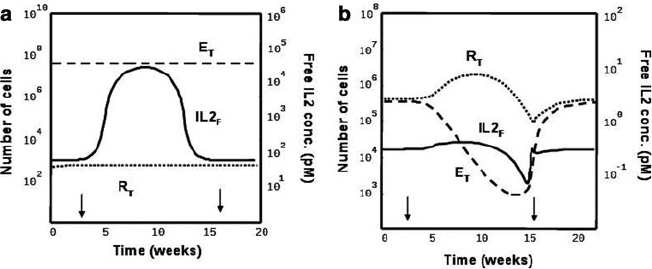
In the first model variant, where regulation is mediated only by competition for
IL-2 (case D 0), the response to APCs of type 1 and of type 2 are fully coupled
to each other. Therefore it is impossible to break tolerance expanding an immune
response to APCs of type 1, without breaking tolerance in response to APCs of type
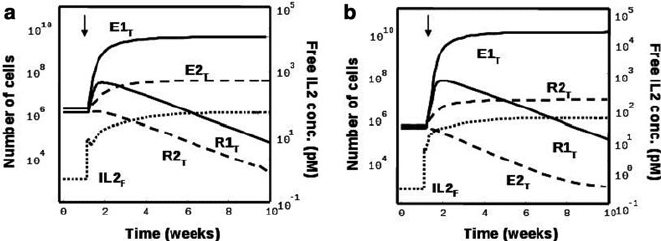
2. An illustration of such coupling is given on Fig. 15.5a, where an abrupt increase in
A1 values is shown to induce the expansion of both E1 and E2 cells, with a conse-
quent elimination of both R1 and R2 cells. The absolute character of this dynamical
coupling was formally proved on [29]. On biological grounds this dynamical cou-
pling will mean that all clones inside a given lymph node will have to be in the
same dynamical state. If one particular clone expands the helper T cells, reaching
the immune state, then all the other clones in the same lymph node will also have
to reach the immune state. Moreover, to keep one clone in the tolerant state, domi-
nated by regulatory T cells, every clone in the same lymph node will have to be in
the same state. Therefore, this sort of global coupling of the response of different
clonal specificities is obviously unrealistic, since tolerance and immunity do coexist
toward different antigens in the real immune system. An argument to overcome this
problem is to claim further locality on the use of IL-2 inside the lymph nodes. Cy-
tokines does not diffuse instantaneously and therefore might be preferentially used
close to its initial production site. However, it is difficult to defend such argument,
in this model variant, because competing for the paracrine IL-2 is precisely what the
regulatory T cells inside a given clone do to control their helper T cell counterpart.
Thus unless one find a way to argue a sorting in small local clusters inside the lymph
node of the APCs presenting different sets of antigens, the latter argument would be
unrealistic.
324 K. Le´on and K. Garc´ıa-Mart´ınez
Fig. 15.5 Simulations of lymph nodes containing two sets of APCs (A1 and A2) recognized by
two different T cell clones (fE1; R1g and fE2;R2g). Figures shows the characteristic kinetic
outcomes obtained from simulations were R1 and R2 cells are set to initially control the E1 and
E2 cell populations (i.e. in their respective tolerant states), and the number of APCs of type 1 (A1)
is abruptly increased. (a) Result of simulation for model variant D 0, where the breakdown of
tolerance for clone 1 is always followed by a breakdown of tolerance for clone 2. (b)Resultof
simulation for model variant D 1, where tolerance can be broken for clone 1 keeping, and even
reinforcing, tolerance in clone 2. In these particular simulations the number of APCs of type 1
increase from it basal value 5:10
4
to 5:10
6
(a)and10
7
(b), while the number of APCs of type 2
is maintained constant in 5:10
4
. In both graphs, the kinetics of free IL-2 is indicated by a dotted
curve, and the number of T cells of type 1 and 2 with continuous and dashed curves respectively.
Vertical arrow inserted in (a)and(b) indicates the starting-point of the increase of APCs of type 1
In the second model variant, which include, additionally to competition for IL-2,
a direct regulation of helper T cell activation by regulatory T cells (case D 1),
the response to APCs of type 1 and of type 2 also influence each other. How-
ever in this case one can easily get mixed responses, such as the one illustrated
in Fig. 15.5b, where an abrupt increase of A1 values is shown to induce the ex-
pansion of E1 cells with a consequence elimination of R1 cells, but retaining an
expanded dominant population of R2 cells. Interestingly, as can be also observed
in Fig. 15.5b, the expansion of E1 cells reinforce the tolerance to antigens in APCs
of type 2, since it leads to a net increase of R2 cells, with a concomitant reduc-
tion of the E2 cells (this second T cell clone falls into a reinforced tolerant state
such as the one showed in Fig. 15.3c). Therefore, on biological grounds, for this
second model variant T cell clones inside the same lymph node interfere with each
others, but mixed immune and tolerant responses can be achieved. This property
solves the problem posed to the first model variant, suggesting the requirement of
some local/specific suppressive interaction between helper and regulatory T cells
for a biologically reasonable model behaviour. Moreover, in this model variant the
existence of an expanded immune response of a given clone could reinforce the tol-
erant state of other T cell clones in the same lymph node. This property does not
exist in the original crossregulation model and it is a direct consequence of the mix-
ture of local/specific suppressive interactions with non-local/unspecific interaction
in this model variant. This property is, in our view, biologically relevant since it
might help to focus an immune reaction in the immune system to some undesirable
foreign antigen, avoiding damage to some concomitant self-antigens that needs to
15 IL-2, Helper and Regulatory CD4
C
T Cells 325
be tolerated. Nevertheless a complete study of the implication of this new property
in the theoretical framework of this model will require a more complete study, in-
cluding in the model perhaps several T cell clones, allowing some crossreactivity
on their recognition of different APCs sets and taking into account the variability
of lymph node volume with the T cell content. Future studies might address this
issue, which could be intuitively expected to explain phenomena like epitope domi-
nance in immunity, antigen spreading in some cases of autoimmunity, which are all
phenomena that can not be explained by the original crossregulation model.
Overall the latter analysis suggests that suppression exerted by regulatory T cells
over the helper T cells can not be reduced to competition for IL-2 (case D 0).
It further requires that the regulatory T cells inhibit helper T cell activation by
a mechanism involving some locality and therefore some level of specificity
(case D 1). However, this conclusion does not mean that competition for IL-2
is irrelevant. It is quite probable that in some experimental system, the observed
suppression can be explained by such competition for IL-2. This notion might
reconcile some in vitro studies [7,8] which have claimed an unspecific suppression
by regulatory T cells, with the bulk of data supporting the specificity of T cells
mediated suppression [72]. Interestingly, the analysis in this work further suggests
that the combination of competition for IL-2 with some local/specific inhibition of
helper T cell activation might confer some biologically relevant properties to the
modelled system.
The Effect of IL-2 Modulating Therapies
In this section, the effects of IL-2 modulating therapies are studied in the second
model variant ( D 1), which according to the analysis in previous sections exhibits
a more realistic behaviour. Two classes of therapies are studied:
1. Therapies where IL-2 activity is increased, by injecting an excess of this cytokine
into the system. Such type of therapy is simulated by increasing the external
source of IL-2 molecules in the model (increasing the value of model parameter
i
).
2. Therapies that limit IL-2 activity, by effectively reducing the availability of this
cytokine in the system, for instance, by using drugs that sequester IL-2 in circu-
lation or simply block its binding to the IL-2 receptor. This latter type of therapy
is simulated by increasing the degradation rate of IL-2 in the model (increasing
the value of model parameter K
d
).
In the following subsections, the effects of these therapies are explored in two par-
ticular treatment scenarios: Long term continuous treatments and acute (transient)
treatments. In each case, the impact of the dose of the applied treatment is deter-
mined, and the implications of the obtained results are discussed.
326 K. Le´on and K. Garc´ıa-Mart´ınez
The Effect of Long-Lasting Modulation of IL-2
The effect of long term (continuous) treatments, which modulate IL-2 activity, are
simulated as a permanent change in the parameter values,
i
or K
i
d
,forthetwo
different types of therapies studied here. We explore whether changes in these
parameters compromise the existence and/or the stability of model steady states
equilibrium. In particular, those ones interpreted, in previous sections, as the tolerant
(Fig. 15.3b) and the immune/autoimmune (Fig. 15.3a) states of the modelled sys-
tem. To this end, the bifurcation diagrams of model steady states with the parameter
i
and K
i
d
, were computed in a broad, but reasonable, range of values for the
remaining model parameters. The typical (robust) structure found on these bifur-
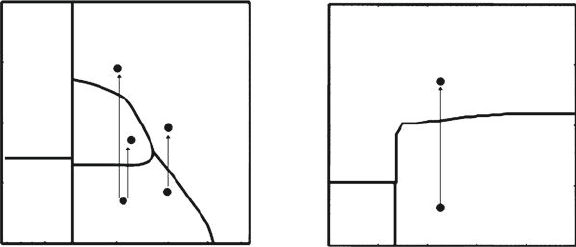
cation diagrams is shown in Fig. 15.6. There, different regions of the parameter
space, defined according to the subset of model stable steady states that exist
in the system, are identified and labelled. The region labelled B corresponds to
parameter values leading to a bistable regime, with a stable tolerant state and a
stable immune/autoimmune state. This parameter regime, following the discussion
300
p1
p1
p2
p2
p3
p4
p5
200
10
4
10
3
10
2
10
1
10
8
10
6
10
4
10
2
500
0.1 1 10 100 1000 10000
B
B1
B
I
IIa IIa
K
d
i
(h
-1
)
C1
T
I
O
G
i
ab
Fig. 15.6 Two dimensional bifurcation diagrams for model steady states, with the value of
treatment-related parameters K
i
d
(a)and
i
(b) versus the parameter IL-˛. Continuous lines in
the graphs demark regions of parameter values, which differ on the set of stable steady states exist-
ing in the modelled system. Region label B is a parameter region of bistable behaviour where the
tolerant (TS) and the immune (IS) steady states exists; Region label I is a parameter region where
only the immune (IS) steady state exists; Region label T is a parameter region where only the toler-
ant (TS) steady state exists; Region label B1 is a parameter region of bistable behaviour, where the
reinforce tolerant (rTS) and the immune (IS) steady states exists; Region label C1 is a parameter
region of bistable behaviour, where the trivial (OS) and the immune (IS) steady states exists; and
Region label O is a parameter region, where only the trivial (OS) state exist. The specific graphs
given in (a)and(b) were computed, using the default set of parameter provided in Table 15.2,
except for the parameters indicated in the axes. They show the typical form/structure observed in
these bifurcation diagrams for many other parameter values computed. The small arrows in the
graphs indicate transitions in parameter space induced by specific treatment as discussed in the
main text
15 IL-2, Helper and Regulatory CD4
C
T Cells 327
in previous sections, is the expected situation in normal immune systems in the
absence of perturbation, treatment or diseases. Thus, the model system is assumed
to be parameterized inside this region before the application of any treatment. Other
parameter regions in Fig. 15.6 could be only reached in the model by perturbations
(like the one induced by long lasting treatments) which modify particular parameter
values, conditioning certain types of responses as result in the system. In particu-
lar, interesting cases could be, (1) Perturbations taking the system into parameter
region label T, which lead to reinforcement or reestablishment of tolerance, since
inside this parameter region only the tolerant state or the reinforced tolerant state
exist and/or are stable; and (2) Perturbations taking the system into parameter re-
gion label I, which unavoidably lead to immune reaction, since in this region the
immune/autoimmune state is the only stable steady state.
Based on the diagrams of Fig. 15.6, the effect of long-lasting treatments modulat-
ing IL-2 activity can be analyzed. It can be seen, that IL-2 depletion treatments have
a strong, dose-dependent impact on the system dynamics, by changing the structure
of possible steady states. This treatment could lead, at intermediate doses (the dose
being assumed proportional to the magnitude of the increment in K
i
d
value), to the
unavoidable reinforcement or reestablishment of tolerance, by taking the system into
parameter region T (see transition p1–p2 in Fig. 15.6a). However, at higher doses
(see transition p1–p3 in Fig. 15.6a) this treatment leads to immunity/autoimmunity,
by taking the system into parameter region I. The latter dependence, is the case
for low values of IL-˛ (transitions p1–p2–p3 in Fig. 15.6a), because for larger
values of IL-˛ the study treatment could only induce immunity, with a direct tran-
sition between parameter regions B and I, without ever passing through region T
(transition p4–p5 in Fig. 15.6a). In sharp contrast to the latter case, treatments in-
creasing IL-2 activity have a negligible impact on the structure of steady states of
the system. They could at most take the system, at high dose, into region B1 (see in
Fig. 15.6b transition p1–p2), where the system remains bistable, with a stable im-
mune state (as in region B) and a stable state of reinforced tolerance (very similar to
the tolerant state of region B,seeFig.15.3c). This result suggests, in practical terms,
that this latter type of treatment would neither break tolerance inducing immunity
nor reestablish tolerance in ongoing immune/autoimmune response. It must likely
further expand the preexistent class of response in the system either tolerance or
immunity.
The bifurcation analysis carried out in this section provides intuition on the po-
tential effect of different treatments in the modelled system. It predicts a strong
impact of IL-2 depletion treatments, which could forcedly take the system into the
tolerant or the immune/autoimmune steady state, depending on the treatment dose
and exact model parameterization (values of IL-˛). It predicts, in contrast, a dis-
crete, rather negligible, effect of IL-2 addition treatments, which most likely left the
system in their starting steady state, either the tolerant or the immune/autoimmune
state. Despite its general value, bifurcation analysis, only give a rough approxima-
tion of the effect of desired treatments. They could hide kinetics effects of treatments
applications and, they only approximate long term effect of treatments that induce
permanent or long lasting change on model parameters. Real treatments, however,
typically induce a transient effect over the system. They transiently affect the value
328 K. Le´on and K. Garc´ıa-Mart´ınez
of some relevant parameter, which sooner or later returns back to its original value.
In the next sections, these limitations are overcome by simulating the effect of treat-
ment as transient perturbations in model parameters.
The Effect of Transient IL-2 Depletion Treatments
The effects of treatments that transiently reduce IL-2 activity are simulated here,
by a sudden (instantaneous) increase in the value of model parameter K
i
d
(to take
the values K
i
d
+ DosS), which is followed by its exponential decay, towards its ini-
tial value K
i
d
. Such exponential decay, on treatment effect, is assumed to account
for the clearance of the used drugs and it is controlled in the simulations by pa-
rameter K
a
(which set the rate of this decay). For instance, let’s say the drug is an
antibody, which sequesters IL-2 on circulation, then once injected into the system
this antibody will be cleared from it, with a typical clearance rate, K
a
. The latter
treatment is applied in simulation, where the model has been parameterized inside
the parameter regime B of Fig. 15.6 and has been initialized either in the tolerant
or the immune/autoimmune steady state. The overall goal in these simulations is
to explore, if the applied treatment can trigger a switch of system steady state: a
switch from tolerant state to immune/autoimmune state or vice versa. The results
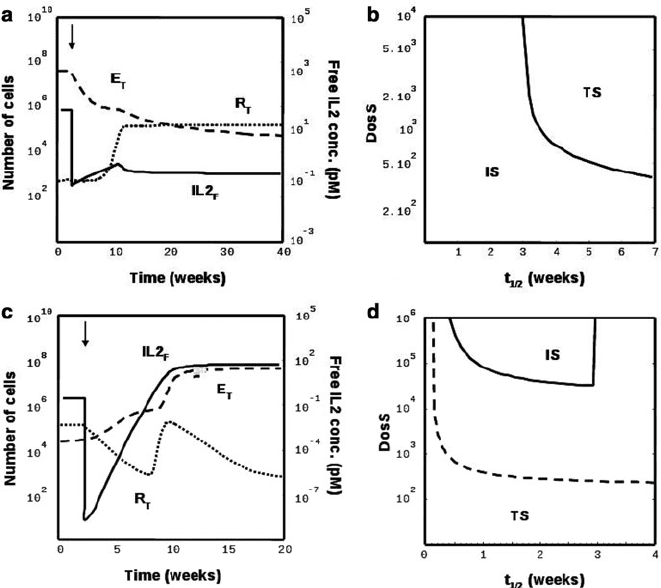
are illustrated on Fig. 15.7.
IL-2 depletion treatment applied in the context of an ongoing immune/ auto-
immune reaction (model initialized in the immune state) could reestablish tolerance
(Fig. 15.7a), if the dose of the treatment (value of DosS) is large enough and the rate
of drug clearance (K
a
) is low enough (Fig. 15.7b). This result can be qualitatively
explained using the bifurcation analysis of the previous section. Note that, this treat-
ment could take the system (by increasing parameter K
i
d
) transiently into region T
(Fig. 15.6a), where tolerant state is the only steady state of the system. Thus, if the
clearance rate K
a
is small enough, the perturbed system, will spend enough time
in region T, as to reach tolerant steady state. Then by the time the drug is fully
cleared, the system will be already locked into tolerant equilibrium. In consonance
with the latter analysis, the tolerating effect of IL-2 depletion is observed, only, for
low values of IL-˛.
IL-2 depletion treatments applied in the context of immune tolerance (model
set in the tolerant state), can breakdown this preexistent tolerance, inducing an im-
mune/autoimmune reaction (Fig. 15.7c). This effect is observed in a broad range
of parameter IL-˛ values, but with different dependencies of treatment efficacy
with the drug clearance rate K
a
(Fig. 15.7d). For high values of parameter IL-˛,
the treatment requires a sufficiently slow clearance rate K
a
to be effective (dashed
line Fig. 15.7d), but for lower values of IL-˛, its effectiveness is further restricted
to a window of intermediate K a values (solid line Fig. 15.7d). These treatment
effects and parameter dependencies can be explained from the bifurcation analysis
in previous sections. Note that, an increase in K
i
d
values can take the system into
the region label I (where only the immune steady state exists), for a broad range
15 IL-2, Helper and Regulatory CD4
C
T Cells 329
Fig. 15.7 Result of numerical simulations of the effect of transient IL-2 depletion treatments.
The panels (a, c) show examples of kinetic evolution of the number of E cells, the number of R
cells and the concentration of free IL-2 (IL2
F
) in model simulations, where the system is pa-
rameterized inside region B of Fig. 15.6 and initialized either in the immune steady state (a)or
the tolerant steady state (c), being then perturbed by transient increase of the value of model pa-
rameter K
i
d
(see main text for details). Panel (a) illustrate the case in which the applied treatment
(DosS D 10
3
;t
1=2
D 7:6 weeks), induce a switch from the immune steady state to the tolerant
steady state. i.e. it reverts a pre-existence immune/autoimmune state, re-establishing tolerance.
Panel (c) illustrates the case, in which the applied treatment (DosS D 2:10
6
;t
1=2
D 5 days),
induces a switch from the tolerant steady state to the immune steady state. i.e. it induces an
immune/autoimmune response in an initially tolerant system. The panels (b)and(d) show the
dependence of treatment effects with the parameter DosS (proportional to the dose of the applied
drug) and t
1=2
(proportional to drug clearance rate, K
a
D ln2=t
1=2
), which control treatment ap-
plication in the simulations. These panels shows parameter conditions leading, upon treatment
application, either to immunity or to tolerance in a system initialized in the immune state (panel
b) or the tolerant state (panel d). In panel (d)thesolid line divide parameter condition leading to
immunity or tolerance for a system with a low value of IL-˛ (D250)andthedashed line dose so
for a system with a higher value of IL-˛ (D400)
of IL-˛ values (Fig. 15.6a). However, for large values of K
a
, the applied drug is
cleared so fast, that it does not affect T cell population dynamics, setting up a gen-
eral upper limit for the K
a
values, which are compatible with effective treatment.
330 K. Le´on and K. Garc´ıa-Mart´ınez
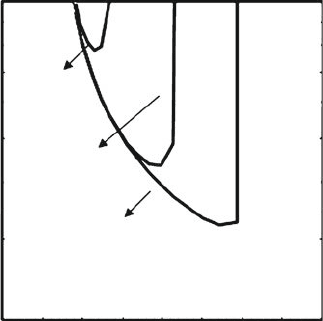
Interestingly, for low values of IL-˛ treatment takes the system into parameter
region I (Fig. 15.6a transition p1–p3), but, it always pass through region T while the
drug is cleared (transition p3 to p2 in Fig. 15.6a). Therefore, if drug clearance is slow
enough, tolerance state is always reached inside regions T, setting up an additional
lower limit for K
a
in this parameter case. Other relevant parameter dependence for
the predicted efficacy of IL-2 depletion treatments to induced immune/autoimmune
responses is obtained with the parameters
E
,
R
, which sets the size of thymic
output in the model (Fig. 15.8). As thymic output is increased (keeping
E
,
R
constants) the effectiveness of the treatment is dramatically reduced (Fig. 15.8).
Actually, if thymic output became large enough, treatment effect is completely lost.
Such parameter dependence derives, qualitatively, from the dependence with
E
,
R
values of the amount of regulatory T cells, remaining in the system in the absence of
IL-2 induced by depletion therapy. The higher the size of thymic output, the higher
the number of R cells remaining in the system, and therefore the higher their ca-
pacity to prevent a driving of the system towards the immune state, once the acute
effect of IL-2 depletion has stopped.
Summarizing, the results here confirm those of the previous section, predict-
ing that IL-2 depletion treatments could be used in appropriate conditions both to
break a preexistent tolerant state, inducing immune/autoimmune reactions and to
012
G
T =
10
−8
G
T =
10
−6
G
T =
10
−4
2.10
4
3.10
4
5.10
4
7.10
4
10
5
3
TS
IS
DOSS
4
t
1/2
(weeks)
Fig. 15.8 The effect of thymus, on preventing the induction of an immune/autoimmune response
in an initially tolerant system, by IL-2 depletion treatment. The panel shows parameter conditions
(value of DosS and K
a
) leading, upon IL-2 depletion treatment, either to immunity or to tolerance
in a system initialized in the tolerant steady state. The solid lines in the graph corresponds to
different interfaces between the immune and the tolerant outcome regions, for simulation which
differ on the indicated value of parameter
T
D
E
D
R
. This parameter set the size of thymic
output in the model simulations. Thus, the graph shows, that the larger the size of thymic output
in the modelled system the smaller the region where immunity/autoimmunity could be induced by
treatment application
15 IL-2, Helper and Regulatory CD4
C
T Cells 331
render tolerant a preexistent immune/autoimmune system. These results, apparently
counter-intuitive and of potential practical implication, derive from the highly non-
linear relationship of IL-2 with CD4
C
T cell dynamics in the immune system.
Interestingly, these model predictions are indeed compatible with existent experi-
mental observations. On the one hand, the predicted capacity of treatments blocking
IL-2 activity to promote immunity, explains observations where monoclonal anti-
bodies, against IL-2, have been shown to promote effective immune responses to
tumors [13] and to induce autoimmune disease in mice [73]. In both cases, the
model explains the observed effects as being associated to the treatment capacity
to weaken regulatory cell activity, as argued by their original authors. Moreover, the
model explains the requirement of thymectomy in the induction of autoimmunity
as reported in [73], suggesting that the apparent tolerating effect of thymic output is
rooted in system dynamics, and might not be easily overcome by increasing the dose
of anti-IL-2 MAbs. Relevantly the model, further, predicts an ideal IL-2 depletion
scheme to enhance/optimize this treatment immune stimulatory capacity. This ideal
scheme will require sustaining a high constant concentration of the IL-2 depleting
drug in the system, for an initial long enough period of time, clearing it fast from
the system afterwards (as fast as possible).
On the other hand, the model predicted capacity of IL-2 blocking therapies to
reestablish tolerance in the context of ongoing immune/autoimmune reactions, is
less well documented in the literature. This prediction might explains experimental
data, supporting the use for the therapy [74, 75] of autoimmune diseases and some
instance of allograft rejection of non-depleting antibodies against CD25 (the ˛ chain
of IL-2 receptor), which do block IL-2 signalling in vivo. Moreover, this prediction
could also explain some experimental data, which show a positive effect of anti-IL-2
antibodies in the treatment of atherosclerosis (a disease of elderly people involving
inflammation in the arteries). However, one must be aware, that in none of the latter
observations a direct participation of regulatory T cells, as proposed by the model
here, has been proved. In any case this second model prediction is very interesting
from the practical perspectives for the treatment of autoimmune diseases. In partic-
ular, the fact the predicted treatment effect only occurs, in the model, for high drugs
doses and low degradation rates, provides interesting guidelines for its practical im-
plementation.
Simulating the Effect of IL-2 Injection Treatments
Treatments that transiently increase IL-2 levels in the system are simulated here as a
sudden, but transient increase of the value of model parameter
i
, which stands for
an external source of IL-2. Two parameters are used to control treatment application.
The parameter DosI, which sets the total amount of IL-2 injected and the parameter
T
i
, which sets the length of the time period in which the sets total amount of IL-2 is
administered. The study of this treatment, in model simulations, confirms the result
of previous sections, predicting that it is unable to induce a switch of preexistent
332 K. Le´on and K. Garc´ıa-Mart´ınez
Fig. 15.9 Result of numerical simulations of the effect of transient IL-2 addition treatments. The
panels (a, b) show examples of kinetic evolution of the number of E cells, the number of R cells
and the free IL-2 concentration (IL2
F
) in model simulations, where the system is parameterized
inside region B of Fig. 15.6 and initialized either in the immune steady state (a)orthetolerant
steady state (b), being then perturbed by transient increase of the value of model parameter
i
(see
main text for details). Panel (a) illustrates how the applied treatment (DosS D 10
4
; td D 20 weeks),
slightly reinforce the pre-existent immune steady state, being unable to switch the system into the
tolerant steady state. Panel (b) illustrate, how the applied treatment (DosS D 10
3
; td D 20 weeks),
reinforces the pre-existent tolerant steady state, being unable to switch the system into the tolerant
steady state
steady state at any dose (DosI) or timing T
i
. When this treatment was applied in a
system with a preexistent immune reaction (initialized in the immune state), it was
unable, to revert the system to the tolerant state. Furthermore it promotes a tran-
sient slight expansion of helper T cells (Fig. 15.9a). Moreover, when the treatment
was applied to a previously tolerant system (initialized in the tolerant state) it tran-
siently, but significantly, reinforces the preexistent tolerant state, further expanding
the regulatory T cell population (Fig. 15.9b). The length of the transient effect in-
duced by the treatment relates directly to the timing of treatment application (value
of T
i
) as soon as the treatment is stopped the reinforcement effect is rapidly lost.
The latter results are somehow counter-intuitive, since, in this model where IL-2
is the key molecule in immune regulation, its external addition to the system appears
with little, or almost irrelevant, dynamical effect. However, the specific model pre-
dictions for this type of treatment are indeed compatible with existing experimental
observations and further provide a guide for its further practical application. On
one hand, the first model prediction, the reinforcement of ongoing immune reac-
tions by IL-2 addition, explains classical observations on in vivo animal models,
where IL-2 has been shown to augment immune reactions to viral infection [2]
and to well-adjuvated vaccines [3–5]. In these systems the immune response, in-
duced to the involved foreign antigens, which are controlled weakly if at all by
regulatory T cell activity, is further promoted by the injected IL-2. Furthermore,
the observed enhancement of immunity, in these experimental systems, might not
rely only on the model predicted expansion of helper CD4
C
T cells. It might also