
Muga G. Time in Quantum Mechanics - Vol. 2
Подождите немного. Документ загружается.

8 Experiments on Quantum Transport of Ultra-Cold Atoms in Optical Potentials 223
fluorescence [arb. units]
position [mm]
(a)
(b)
–6 –4 –2 0 2
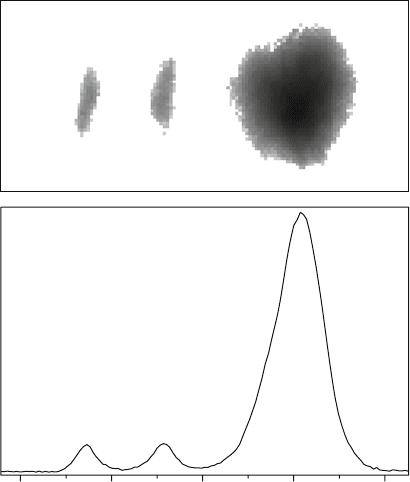
Fig. 8.9 Part (a) shows a fluorescence image from an atomic distribution acquired after a time of
ballistic expansion. Part (b) shows the distribution integrated in the vertical direction. The large
peak on the right is the part of the atomic cloud that was not trapped during the initial acceleration.
The center peak indicates the atoms that were initially trapped in the first band but were driven
out by the modulation. The left peak corresponds to atoms that remained trapped during the entire
sequence. The survival probability is the area under the left peak normalized by the sum of the
areas under the left and center peak
trapped in the first band, which was obtained by summing the contributions of class
(2) and class (3).
To observe the temporal evolution of the fundamental band population, we
repeated the sequence in Fig. 8.8 for various modulation durations, holding the
probe frequency ν
p
and amplitude m fixed. These studies resulted in the observa-
tion of Rabi oscillations between Bloch bands [13]. For large amplitudes of the
modulation, we observed a dynamical suppression of the band structure, effectively
turning off Bloch tunneling [28].
To obtain a spectrum of the Wannier–Stark states, we applied the modulation
during a period of constant acceleration and repeated the sequence for various probe
modulation frequencies, holding the modulation amplitude m and the duration fixed.
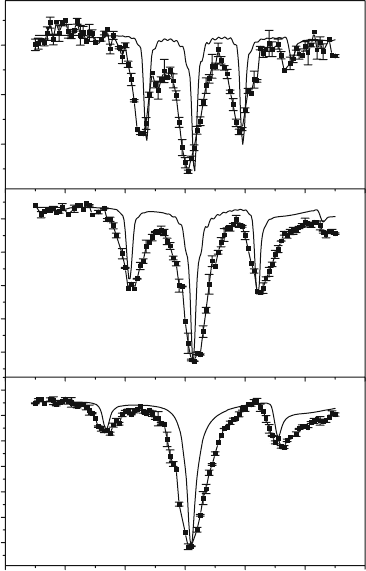
Figure 8.10 shows three measured spectra for the accelerations of 947, 1260, and
1680 m/s
2
, which correspond to the Bloch frequencies ω
B
/2π = 16.0, 21.4, and
28.5 kHz, respectively. The spectra were obtained at a fixed well depth of V
0
/h =
91.6 kHz and a fixed probe modulation amplitude of m = 0.05. For a well depth
224 M.C. Fischer and M.G. Raizen
40 60 80 100 120 140
160
(c)
probe frequency [kHz]
(b)
survival probability
0.2
0.3
0.4
0.5
0.6
0.7
0.8
0.3
0.4
0.5
0.6
0.7
0.3
0.4
0.5
(a)
Fig. 8.10 Wannier–Stark ladder resonances for a well depth of V
0
/h = 91.6 kHz and accelera-
tions of (a) 947 m/s
2
,(b) 1260 m/s
2
,and(c) 1680 m/s
2
, which correspond to the Bloch frequencies
ω
B
/2π = 16.0, 21.4, and 28.5 kHz, respectively. For the chosen well depth, the average band
spacing is
¯
E
g
/h = 104 kHz which is in good agreement with the location of the central resonance.
The points are connected by thin solid lines for clarity. The thick solid lines show the results of
numerical simulations using the experimental parameters. Figure from [29]; Copyright 1999 by the
American Physical Society
of V
0
/h = 91.6 kHz, the average band spacing is
¯
E
g
/h = 104 kHz, which is in
good agreement with the location of the central resonance in the three spectra of
Fig. 8.10.
Also shown in Fig. 8.10 is the result of a numerical integration of the time-
dependent Schr
¨
odinger equation using the experimental parameters. We believe
that phase noise in the interaction beams prevented the survival probability from
reaching unity, when the probe was far from resonance, and reduced the depth
of the spectral features by a constant factor. For this reason, the y-values of the
theory curves were shifted and scaled to match the baseline and amplitude of the
central resonance. In addition, the value for the probe modulation amplitude m was

8 Experiments on Quantum Transport of Ultra-Cold Atoms in Optical Potentials 225
adjusted in the numerical simulations from 0.05 to 0.035 to reproduce the relative
peak heights.
The spectral width of the resonances is fundamentally determined by the finite
lifetime of the Wannier–Stark states due to tunneling. However, a number of exper-
imental mechanisms (e.g., phase noise in the standing wave beams, variations in the
well depth, or the finite transverse extent of the optical potential) contributed to the
measured width being substantially broader than that predicted by the simulations.
8.5 Quantum Tunneling
In the previous section we studied the spectral features of Bloch states and Wannier–
Stark states by driving transitions between those states. These inter-band transitions
were imposed externally by a modulation of the potential. Without modulation the
band index was conserved. The accelerations that transported the atoms through
reciprocal space were small enough to preserve the validity of the semiclassical
equations of motion. In this section we investigate the effect of a large accelera-
tion of the optical potential. In this case the semiclassical equations no longer hold
and inter-band tunneling can occur. The atoms can leave the trapping potential via
tunneling into the continuum of free states. The system is therefore unstable and
the number of trapped atoms decays with time. By adjusting the acceleration the
stability of the system can be altered dynamically and the decay rates vary over
a wide range. In this system, short-time deviations from the universal exponential
decay law are observed [42]. In addition, we study the fundamental effects of mea-
surements on the decay rate and report on the first observation of the quantum Zeno
and anti-Zeno effects in an unstable system [12].
8.5.1 Classical Limit
As derived in Sect. 8.4, atoms in an accelerated standing wave are subject to a
potential
V (x) = V
0
cos(2k
L
x) + Max . (8.33)
This potential is stated in the reference frame accelerated with the potential as given
in Eq. (8.27). For a small enough acceleration a particle can be classically trapped
within the wells of this “washboard” potential. In this case the particle will accel-
erate along with the potential. For a larger acceleration the potential wells become
increasingly asymmetric up to a point where the particle is no longer confined by
the potential. The critical acceleration a
c,class
, for which the potential loses its abil-
ity to confine the particle, can be found by solving for extrema of the potential in
Eq. (8.33), which only exists for
|a| < a
c,class
=
2k
L
V
0
M
. (8.34)
226 M.C. Fischer and M.G. Raizen
For accelerations smaller than a
c,class
the particle gets accelerated along with the
potential whereas for larger accelerations there are no local potential minima.
8.5.2 Landau–Zener Tunneling
8.5.2.1 Tunneling Rates
In this section we provide a short description of the Landau–Zener tunneling process
based on diabatic transitions in momentum space [35, 44]. An alternative description
can be derived in the position representation [26, 45]. As a starting point we consider
the semiclassical equations of motion describing the time evolution of the quasi-
momentum in reciprocal space. In order to allow for inter-band transitions, we must
now abandon the condition that the band index be a constant of motion. The shape
of the Bloch bands and the time evolution equation for the quasi-momentum are still
assumed to be valid. The stationary periodic potential causes the free particle energy
levels to undergo a level repulsion. This shift is most pronounced at the edges of the
Brillouin zone. A particle approaching the avoided level crossing might not be able
to follow the dispersion curve adiabatically, in which case it continues its motion
and diabatically changes levels across the energy gap. In 1932 Zener derived an
expression for the probability P of diabatic transfer between two repelled levels [44]
P = exp
&
−
π
2
E
2
g
d
dt
(ε
1
−ε
2
)
'
, (8.35)
where E
g
is the minimum energy separation of the perturbed levels and ε
1,2
are
the unperturbed energy eigenvalues of level 1 and 2, respectively. In our case the
unperturbed energy curve is simply the free particle kinetic energy dispersion E
p
=
p
2
/2M. Using the semiclassical equation of motion for the quasi-momentum, we
obtain for the probability of transfer
P = e
−a
c
/a
, (8.36)
where the critical acceleration a
c
is given by
a
c
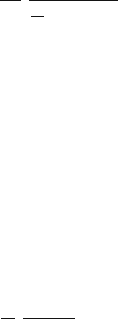
=
π
4
E
2
g
n
2
k
L
. (8.37)
We let N denote the number of particles populating the lowest band within the first
Brillouin zone. The rate of atoms crossing the band gap is equal to the rate of atoms
approaching the transition region times the probability of tunneling if we assume the
band to be uniformly populated. We obtain an exponential decay of the population
N in the band under consideration as
N = N
0
e
−Γ
LZ
t
, (8.38)

8 Experiments on Quantum Transport of Ultra-Cold Atoms in Optical Potentials 227
with the Landau–Zener (LZ) decay rate Γ
LZ
given by
Γ
LZ
=
a
2v
r
e
−a
c
/a
. (8.39)
Experimental studies of the tunneling rates out of the lowest band were performed
in our group and the decay rates were compared to the Landau–Zener prediction [3,
27].
8.5.2.2 Deviations from Landau–Zener Tunneling
The expression for the LZ tunneling rate derived above is based on a single transit
of the atom through the region of an avoided crossing. However, for small tunneling
probability the atom can undergo Bloch oscillations within a given band, leading to
multiple passes through the Brillouin zone. The tunneling amplitudes can interfere
constructively or destructively depending on the rate at which the atom traverses
the Brillouin zone. This mechanism is responsible for the formation of tunneling
resonances. For small accelerations the tunneling rate is small and the atoms can
perform many Bloch oscillations before leaving the band. Therefore large deviations
from the Landau–Zener prediction for the tunneling rate are to be expected. For a
larger acceleration the atom leaves the band quickly and the interference effects are
less pronounced. For those cases the LZ prediction is a good approximation for the
actual tunneling rate. These statements are in agreement with the observed tunneling
rates [3, 27].
8.5.3 Non-exponential Decay
8.5.3.1 Theoretical Description
An exponential decay law is the universal hallmark of unstable systems and is
observed in all fields of science. This law is not, however, fully consistent with
quantum mechanics and deviations from exponential decay have been predicted for
short as well as long times [20, 43, 14]. In 1957 Khalfin showed that if H has a
spectrum bounded from below, the survival probability is not a pure exponential but
rather of the form
lim
t→∞
P(t) ≈ exp(−ct
q
) q < 1, c > 0 . (8.40)
Later Winter examined the time evolution in a simple barrier-penetration prob-
lem [43]. He showed that the survival probability begins with a non-exponential,
oscillatory behavior. Only after this initial time does the system start to evolve
according to the usual exponential decay of an unstable system. Finally, at very long
times, it decays like an inverse power of the time. The initial non-exponential decay
behavior is related to the fact that the coupling between the decaying system and the
228 M.C. Fischer and M.G. Raizen
reservoir is reversible for short enough times. Moreover, for these short times, the
decayed and undecayed states are not yet resolvable, even in principle.
A simple argument will illustrate this point. We assume that the system is initially
in the undecayed state |Ψ
0
at t = 0, and that the state evolves under the action of
the Hamiltonian H,
|Ψ (t)=e
−iHt/
|Ψ
0
=A(t)|Ψ
0
+|Φ(t) , (8.41)
where A(t) is the probability amplitude for remaining in the undecayed state and
the state |Φ(t) denotes the decayed state with Ψ
0
|Φ(t)=0. The probability of
survival P in the undecayed state is therefore P(t) =|A(t)|
2
. Acting with the time
evolution operator e
−iH(t+t
)/
on the state |Ψ
0
yields
A(t + t
) = A(t)A(t
) +Ψ
0
|e
−iHt
/
|Φ(t) . (8.42)
If it were not for the last term, the equation above would generate the characteristic
exponential decay law of an unstable system. However, the term under consideration
describes the possibility for the decayed state |Φ(t) to re-form the initial state |Ψ
0
under the time evolution operator for time t
.
For very short times we can make a general prediction about the time evolution of
the survival probability P. Given that the mean energy of the decaying state is finite
and that H has a spectrum that is bounded from below, one can show following the
arguments of Fonda et al. [14] that
dP(t)
dt
t→0
= 0 . (8.43)
As outlined by Grotz and Klapdor [18] we can expand A(t) in a power series
A(t) = 1 −i
t
Ψ
0
|H|Ψ
0
−
t
2
2
2
Ψ
0
|H
2
|Ψ
0
+O(t
3
) . (8.44)
Using this expansion results in an expression for the survival probability
P(t) =
|
A(t)
|
2
= 1 −
t
2
2
Ψ
0
|(H −
¯
E)
2
|Ψ
0
+O(t
4
) , (8.45)
where
¯
E =Ψ
0
|H|Ψ
0
. This form indicates a population transfer beginning with a
flat slope and suggests an initial quadratic time dependence.
The results stated here are general properties independent of the details of the
interaction. However, the timescale over which the deviation from exponential
behavior is apparent depends on the particular timescales of the decaying system.
Greenland and Lane point out a number of timescales which are relevant [17]. The
first timescale τ
e
is given by the time that it takes the decay products to leave the
bound state region. This time can be estimated as

8 Experiments on Quantum Transport of Ultra-Cold Atoms in Optical Potentials 229
τ
e
=
E
0
, (8.46)
where E
0
is the energy released during the decay. It determines the amount of time
required to pass before the decayed and undecayed states can be resolved. The sec-
ond timescale τ
w
is related to the bandwidth ΔE of the continuum to which the state
is coupled
τ
w
=
ΔE
. (8.47)
The phases of all states in the continuum evolve at a rate corresponding to their
energy. Thus after the time τ
w
the phases of these states have spread over such a
wide range as to prevent the reformation of the initial undecayed state. After this
dephasing time, the coupling is essentially irreversible.
Although these predictions are of general nature and applicable in every unstable
system, deviations from exponential decay have not been observed experimentally
in any other system than the one described here [42]. The primary reason is that
these characteristic timescales in most naturally occurring systems are extremely
short. For the decay of a spontaneous photon, the time τ
e
it takes a photon to tra-
verse the bound state size is approximately an optical period, 10
−15
s. For a nuclear
decay this timescale is orders of magnitude shorter, about 10
−21
s. By contrast, the
dynamical timescale for an atom bound in an optical lattice is just the inverse band
gap energy, which in our experiments is on the order of several microseconds.
Niu and Raizen [34] performed a more detailed investigation of a two-band
model of our system. They find an initial non-exponential regime that starts with
a quadratic time dependence, then becomes a damped oscillation, and finally settles
into an exponential decay. The timescale for which the coherent oscillations damp
out and the exponential decay behavior sets in is identified as the crossover time t
c
equal to
t
c
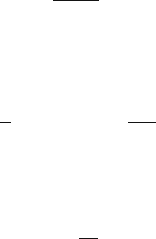
=
E
g
a
1
2k
L
. (8.48)
For a typical value for the acceleration of a = 10, 000 m/s
2
and a band gap of
E
g
/h = 80 kHz, the crossover time calculates to t
c
= 2 μs.
8.5.3.2 Experimental Realization
The preparation of the initial state was done as described previously. After turning
on the interaction beams, a small acceleration of a
trans
= 2000 m/s
2
was imposed to
separate those atoms projected into the lowest band from the rest of the distribution.
After reaching the velocity v
0
= 35 v
r
, the acceleration was suddenly increased to
a value a
tunnel
where appreciable tunneling out of the first band occurred. Unlike
in the band spectroscopy experiments no phase modulation was added to induce
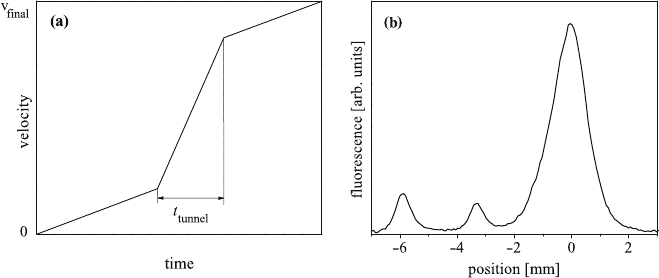
230 M.C. Fischer and M.G. Raizen
transitions between the bands. The large acceleration a
tunnel
was maintained for a
period of time t
tunnel
, after which time the frequency chirping continued again at the
decreased rate corresponding to a
trans
. This separated in momentum space the atoms
that were still trapped in the lowest band from those in higher bands. After reaching
a final velocity of v
final
= 80 v
r
, the interaction beams were switched off suddenly.
A diagram of the velocity profile versus time is shown in Fig. 8.11(a).
Fig. 8.11 Part (a) shows a diagram of the acceleration sequence to study tunneling out of the
lowest band. Part (b) shows a typical integrated spatial distribution of atoms after ballistic expan-
sion. The large peak on the right is the part of the atomic cloud that was not trapped during the
initial acceleration. The center peak indicates the atoms that tunneled out of the potential during
the fast acceleration period. The leftmost peak corresponds to atoms that remained trapped during
the entire sequence. Figure from [12]; Copyright 2001 by the American Physical Society
In the detection phase we determined the number of atoms that were initially
trapped and what fraction remained in the first band after the tunneling sequence.
After an atom tunneled out of the potential during the sequence, it would maintain
the velocity that it had at the moment of tunneling. During the period of free bal-
listic expansion the difference in final velocity between trapped and tunneled atoms
led to their spatial separation (Fig. 8.11(b)). To observe the temporal evolution of
the fundamental band population, we repeated a sequence such as in Fig. 8.11(a)
for various tunneling durations t
tunnel
, holding the other parameters of the sequence
fixed.
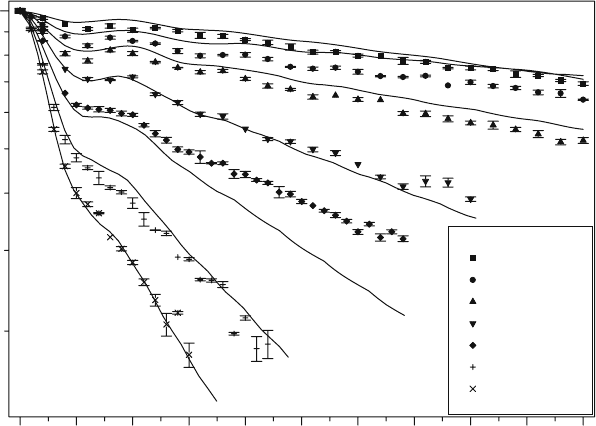
Figure 8.12 shows the probability of survival in the accelerated potential as a
function of the duration of tunneling for various values of the tunneling acceleration
a
tunnel
between 6000 and 20,000 m/s
2
. The value for the well depth for all curves
was V
0
/h = 92 kHz. Initially, the survival probability shows a flat region, owing
to the reversibility of the decay process for short times. At intermediate times the
decay shows a damped oscillation that for long times evolves into the characteris-
tic exponential decay law. By this time the coupling is essentially irreversible and
reformation of the undecayed state is prohibited. As a comparison we also show the
results of quantum mechanical simulations of the entire experimental sequence as
solid lines in the same graph. The tunneling rates depend strongly on the well depth
8 Experiments on Quantum Transport of Ultra-Cold Atoms in Optical Potentials 231
0 5 10 15 20 25 30 35 40 45 50
0.2
0.3
0.4
0.5
0.6
0.7
0.8
0.9
1
a =6,000m/s
2
a = 20,000 m/s
2
a = 17,000 m/s
2
a = 15,000 m/s
2
a = 12,000 m/s
2
a = 10,000 m/s
2
a =8,000m/s
2
survival probability
tunneling time [µs]
Fig. 8.12 Probability of survival in the accelerated potential as a function of duration of the tun-
neling acceleration. Data points for different values of the large acceleration a
tunnel
are shown. Each
point represents the average of five experimental runs, and the error bar denotes the error of the
mean. These data were recorded for a well depth of V
0
/h = 92 kHz and have been normalized to
unity at t
tunnel
= 0 to compare to the quantum mechanical simulations (shown in solid lines with
no adjustable parameters)
of the potential. Considering the uncertainty of 10% in the calibration of the power
in the interaction beams, the simulations match the observed data quite well.
8.5.4 Quantum Zeno and Anti-Zeno Effects
The universal phenomenon of non-exponential decay of unstable systems led Misra
and Sudarshan in 1977 to the prediction that frequent measurements during this
non-exponential period could inhibit decay entirely [33, 5, 41]. They named this
effect the quantum Zeno effect after the Greek philosopher, famed for his paradoxes
and puzzles. In his most famous paradox, Zeno considers an arrow flying through the
air. The time of flight can be subdivided into infinitesimally small intervals during
which the arrow moves only by infinitesimal amounts. Assuming the summation of
infinitesimal terms amounts to nothing led Zeno to believe that motion is impossi-
ble and is merely an illusion. The version put forth by Misra and Sudarshan is the
quantum mechanical version of the paradox.
To illustrate their main point, we consider the time evolution of a system in
the non-exponential regime, where the probability of remaining in the undecayed
232 M.C. Fischer and M.G. Raizen
state is given by Eq. (8.45). We now subdivide the time t into n time intervals of
length τ and perform a measurement of the system after each interval. Each mea-
surement redefines a new initial condition and effectively resets the time evolution.
The system must therefore start the evolution again with the same non-exponential
decay features. The probability of remaining in the undecayed state at time t
(after n measurements at intervals τ ) is therefore P(t) =
[
P(τ )
]
n
, which we can
approximate as
P(t) = exp
−n τ
2
H
2
2
= e
−γ t
, (8.49)
where the decay rate γ is given by
γ = τ
H
2
2
. (8.50)
The time evolution of the system that is repeatedly measured is therefore an expo-
nential decay. The remarkable fact is that the decay rate depends on the measure-
ment interval τ and tends to zero as τ goes to zero. Reviews of the quantum Zeno
effect can be found in modern textbooks of quantum mechanics [39]. Even though
measurement-induced suppression of the dynamics of a two-state driven system has
been observed [19, 24], no such effect was ever measured on an unstable system.
Whereas in the previous section we established the non-exponential time depen-
dence, the focus of this section is the effect of measurements on the system decay
rate. The quantity to be measured was the number of atoms remaining trapped in
the potential during the tunneling segment. This measurement could be realized by
suddenly interrupting the tunneling duration by a period of reduced acceleration
a
interr
, as indicated in Fig. 8.13(a). During this interruption tunneling was negligible
and the atoms were therefore transported to a higher velocity without being lost out
of the well. This separation in velocity space enabled us to distinguish the remaining
atoms from the ones having tunneled out up to the point of interruption, as can be
seen in Fig. 8.13(b). By switching the acceleration back to a
tunnel
, the system was
then returned to its unstable state. The measurement of the number of atoms that
remained trapped defined a new initial state with the remaining number of atoms as
the initial condition. The requirements for this interruption section were very similar
to those during the transport section, namely the largest possible acceleration while
maintaining negligible losses for atoms in the first band. Hence a
interr
was chosen to
be the same as a
trans
.
Figure 8.14 shows the dramatic effect of frequent measurements on the decay
behavior. The hollow squares indicate the decay curve without interruption. The
solid circles in Fig. 8.14 depict the measurement of the survival probability in which
after each tunneling segment of 1 μs an interruption of 50 μs duration was inserted.
Only the short tunneling segments contribute to the total tunneling time. The sur-
vival probability clearly shows a much slower decay than the corresponding system
measured without interruption. Care was taken to include the limited time response