
Muga G. Time in Quantum Mechanics - Vol. 2
Подождите немного. Документ загружается.

7 Causality in Superluminal Pulse Propagation 193
Similarly, Bob will measure V whenever Alice measures H. In this configuration,
the polarizing beam splitters and single-photon detectors perform measurements in
what we call the “linear” basis.
Alice and Bob can also perform measurements in the “circular” basis, where
the analysis apparatus will determine whether the photons are left circular (LC)
polarized or right circular (RC) polarized. This measurement can be performed by
placing a quarter-wave plate in front of the polarizing beam splitters, where the
optical axis of the plate is orientated at 45
◦
to the axis of the linear polarizing beam
splitter. With the wave plate in the system, Bob is assured to measure RC (LC)
whenever Alice measures RC (LC).
The hypothetical superluminal communication scheme is based on a change of
measurement basis. By inserting the wave plate into the setup or not, Alice can
force Bob’s photon to be either linearly or circularly polarized (more precisely, she
can force Bob’s photon to be an eigenstate of either linear or circular polarization).
Thus, it appears as if Alice can transmit binary information to Bob by inserting or
not inserting the wave plate into her apparatus. All Bob has to do is to determine
with certainty whether Alice was using the linear or circular basis. The first problem
with this scheme is a well-known classical result: it is only possible to measure
whether an optical beam is linear or circular polarized by analyzing it both with
linear and circular polarizers. In other words, Bob would have to send the photon
through the linear-basis apparatus and the circular-basis apparatus. Unfortunately,
one apparatus destroys the incident photon as a result of the measurement and hence
it is unavailable to send on the other.
One way around this problem is for Bob to “clone” the incident photon so that
there are two copies, where one copy will be sent to a linear-basis apparatus and
the other is sent to a circular-basis apparatus [58, 59]. The process of stimulated
emission of radiation can in a sense clone an incident photon, so one might think that
an optical amplifier in the path of the photon would be useful for this communication
scheme. Unfortunately, an optical amplifier adds additional photons to the beam
path via the process of spontaneous emission. These additional photons have an
arbitrary state of polarization [61]. They destroy the benefits of the amplifier and
hence prevent Alice from communicating with Bob via the nonlocal characteristics
of quantum mechanics.
The problem with the superluminal communication scheme is much deeper that
it appears from this discussion. The very linearity of quantum mechanics prevents
the cloning of an arbitrary quantum state, a result of the no-cloning theorem [62, 63].
Thus, any device – not just an optical amplifier – fails to clone the incident photon
and hence the communication scheme fails.
Other researchers have wondered whether an imperfect copy of the incident pho-
ton would be sufficient for superluminal communication. The best or optimal quan-
tum copying machine has been identified; even with the best possible copying appa-
ratus, the quantum communication scheme just barely fails. This failure is nicely
summarized by N. Gisin [64] in his 1998 paper: “Once again, quantum mechanics is
right at the border line of contradicting relativity, but does not cross it. The peaceful
coexistence between quantum mechanics and relativity is thus re-enforced.”

194 R.W. Boyd et al.
7.7 Numerical Studies of Propagation Through Fast-Light Media
In order to explore further some of the features of fast-light propagation described
above, we have performed numerical studies of the propagation of optical pulses
through fast-light media. For these studies, we assume that the medium consists
of a single Lorentzian absorption line set on a broad gain background. We assume
the presence of the broad gain background to prevent the transmitted pulse from
becoming so weak as to be immeasurable. The absorption coefficient of the material
is thus taken to be of the form
α(δ) = α
b
+
α
l
1 + (δ
2
/γ
2
)
. (7.2)
Here α
b
is the value of the background absorption coefficient (assumed negative),
α
l
is the line-center absorption coefficient of the absorption line, γ is its linewidth,
and δ is the frequency detuning from line center. According to the Kramers–Kronig
relations, the refractive index associated with this absorption is given by
n(δ) = n
b
+
α
1
λ
4π
γ/δ
1 + (δ
2
/γ
2
)
, (7.3)
where λ is the optical wavelength and n
b
is the background refractive index, which
we shall subsequently set equal to unity. From this result, we then find that the group
index n
g
= n +ω dn/dω is given by
n
g
= 1 +
α
1
c
2γ
1 + (δ
2
/γ
2
)
1 + [(δ
2
/γ
2
)]
2
. (7.4)
The expression for the group velocity ν
g
= c/n
g
then follows directly.
The input pulse is taken to be a transform-limited Gaussian pulse of the form
A(z, t) = A
0
e
−t
2
/T
2
. (7.5)
Here T is the pulse width defined as the amplitude half-width to 1/e or the inten-
sity half-width to 1/e
2
. Equivalently, we can describe the pulse in the frequency
domain as
˜
A(z,ω+δ) =
˜
A
0
e
−δ
2
/ξ
2
, (7.6)
where ξ = 2/T is the frequency-domain pulse width. This pulse will be advanced
compared to vacuum propagation as it passes through the medium. Neglecting
dispersion in the group velocity and the fact that the frequency-varying absorp-
tion will cause spectral reshaping of the pulse, the amount of pulse advancement
ΔT = L/v
g
− L/c resulting from propagation through a length L of the medium is
found to be

7 Causality in Superluminal Pulse Propagation 195
ΔT =−
α
1
L
2γ
1 + (δ
2
/γ
2
)
1 + [(δ
2
/γ
2
)]
2
. (7.7)
As can be seen, the amount of pulse advancement increases with increasing absorp-
tion α
l
L and also with decreasing linewidth γ . However, a line that is too narrow
compared to the spectral width of the input pulse will lead to pulse distortion either
by group velocity dispersion or by spectral reshaping of the pulse [65–67]. In the
cases studied here, pulse narrowing by spectral reshaping is the dominant effect.
If the limit on pulse narrowing is set so that to the first order the pulse duration
becomes infinitesimally small, we find by means of the procedure described in [66]
that the following inequality must be satisfied:
2α
l
L ≤ (γ T)
2
. (7.8)
The allowable total integrated absorption α
l
L is limited by two factors. First, in
order to be able to detect the output pulse, the transmission at the center frequency
of the pulse must not be too small. Second, in order to avoid instabilities, the gain of
the background must not be too large. Taking (somewhat arbitrarily) the minimum
allowable transmission at the center frequency of the pulse to be e
−32
and the maxi-
mum allowable gain to be e
32
, we find that the maximum relative pulse advancement
ΔT/T that can be obtained in the system studied here is given according to Eqs.
(7.7) and (7.8) by
ΔT/T = 2
√
2 . (7.9)
This maximum pulse advancement is obtained when the line-center absorption of
the absorption line is set equal to e
−64
and the gain of the broadband background is
set equal to e
32
. Other authors have deduced similar limits on the maximum possible
pulse advancement [68].
A more detailed description of the propagation of the optical pulses through
the material medium can be obtained by performing a numerical simulation of the
propagation process. Because we are considering the situation in which the material
responds linearly to the optical pulse, we model the propagation by means of the
following procedure. The input pulse is decomposed into a Fourier integral, and each
frequency component is allowed to propagate through the medium, acquiring phase
and amplitude modifications in accordance with its frequency-dependent refractive
index (Eq. 7.3) and absorption coefficient (Eq. 7.2). The time evolution of the output
pulse is then obtained by performing the inverse Fourier transform on the output
spectrum.
Some of the results of this procedure are shown in Fig. 7.8. The parameters
for the advanced pulse were chosen to give the maximum possible advancement
in that sense that according to the first-order analytic model the pulse duration
would shrink to zero. We see that the pulse has narrowed but not as much as the
first-order theory would predict. In addition, the amount of pulse advancement is
12% smaller that predicted by Eq. (7.9). For comparison, in this figure we also
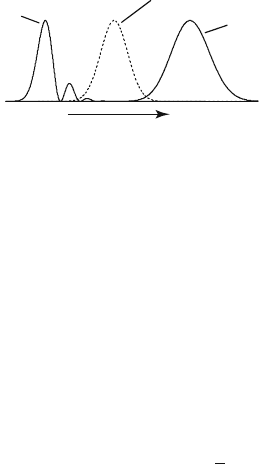
196 R.W. Boyd et al.
Delayed pulse
Time
Input/reference pulse
Advanced pulse
Fig. 7.8 Pulse advancement in a medium consisting of an absorption line with a total attenuation
of e
−64
set on a broad gain background with a gain of e
64
. The ratio between the width γ (half-width
at half maximum) of the Lorentzian line to the spectral width ξ (half-width to 1/e in amplitude)
of the input pulse is 5.7. The input/reference pulse shows what the output pulse would be if the
medium were replaced by an equal length of vacuum. Also shown for comparison is the pulse delay
that experienced upon propagation through a slow-light medium consisting of an e
64
gain line set
on a broad e
−32
absorptive background. Note that pulses tend to compress in time for fast-light
propagation and broaden in time for slow-light propagation
give an example of pulse propagation through a slow-light medium. In the con-
figuration studied here, there is no fundamental limit on how strong the broad
absorptive background could be, and therefore there is no limit on how much the
pulse can be delayed [66]. In choosing the parameters for this example, we required
that the pulse broaden by no more than a factor of
√
2. Other configurations using
multiple lines and operating far from line center can also give rise to large delays
[65, 67, 69].
No other choice of line strengths and linewidths has been found that gives sig-
nificantly more pulse advancement than that shown in Fig. 7.8. The reason for this
behavior is that fast light occurs when the center frequency of the light pulse is at a
local minimum of the transmission. Therefore, if one tries to obtain a larger pulse
advancement, either the transmission at the center frequency will be too low for
detection of the pulse at the output or the gain away from the center frequency will
be so high that it leads to instabilities [19, 68].
The fact that the peak arrives at the output earlier than it would have arrived had
the medium been replaced by an equal length of vacuum suggests that the peak of
the pulse travels faster in the medium than the speed of light in vacuum. A situation
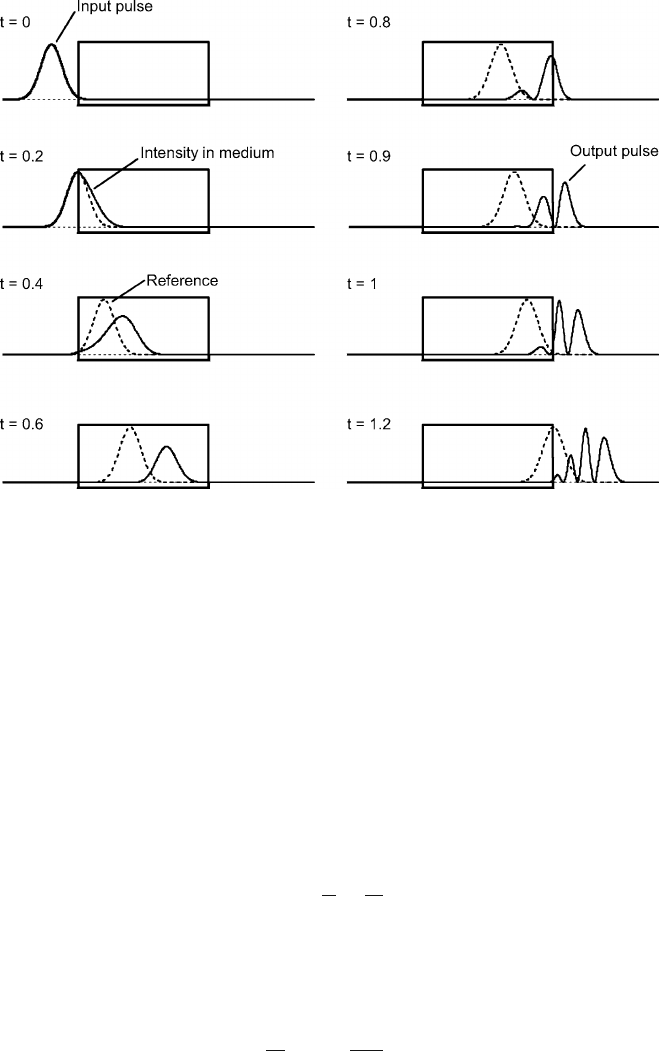
of this sort is shown in Fig. 7.9. Here the material parameters are chosen such that
the group velocity from first-order theory is twice the speed of light in vacuum. As
can be seen, at t = 0.4 (in all of our numerical work we normalize the time in
units of the vacuum transit time through the medium) the pulse peak has traveled
approximately twice as far as the reference pulse. Due to spectral reshaping of the
pulse by the frequency-varying absorption, the apparent pulse velocity then begins
to slow down and pulse distortion starts to occur. This simulation is performed with
a ratio of the width γ of the absorption line to the spectral width ξ of the input
pulse of 4. For this ratio, we have found that the maximum allowable integrated line
strength (that is, exp(−α
l
L)) before the occurrence of significant pulse distortion
by spectral reshaping is e
32
. The integrated line strength of the example shown in
Fig. 7.9 is e
48
and consequently after propagating approximately two-thirds of the
7 Causality in Superluminal Pulse Propagation 197
Fig. 7.9 A sequence of frames showing a Gaussian pulse propagating through a fast-light medium.
The medium is comprised of a Lorentzian absorption line of integrated line strength e
−48
set on
a broad gain background with a gain of e
45.3
chosen to give an output pulse equal in amplitude
to the input pulse. The ratio γ/ξ of the width of the absorption line to the spectral width of the
input pulse is 4. For comparison we also show as the dashed curve how the pulse would propagate
through an equal length of vacuum
way through the medium (at t = 0.8) severe pulse distortion sets in and the pulse
breaks up into several parts.
The advancement ΔT in units of input pulse width T depends only on the inte-
grated line strength exp(α
l
L) and on the linewidth γ but not on the physical length of
the medium. Through use of the concept of group velocity, the pulse advancement
shown in Fig. 7.8 can be considered to be the difference in the transit times of a
pulse moving at c and of a pulse moving through the medium at the effective group
velocity ν
g
such that
ΔT =
L
c
−
L
v
g
. (7.10)
This effective group velocity is, in general, different from the group velocity ν
g
given by first-order theory. Solving this equation for the effective group velocity, we
find that
c
v
g
= 1 −
ΔT
L/c
. (7.11)
198 R.W. Boyd et al.
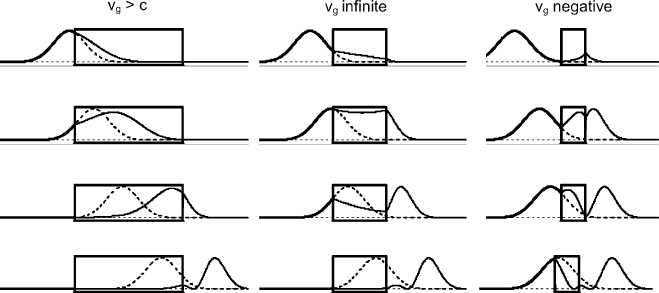
Fig. 7.10 Pulse advancement in a medium consisting of a Lorentzian absorption line of integrated
line strength e
−32
set on a broad gain background of gain e
30.7
. Depending on the length of the
medium compared to the spatial advancement of the pulse, the pulse advancement can be consid-
ered to be the result of a larger-than-c, infinite, or negative group velocity as shown in the left,
middle,andright columns, respectively
When the length L of the medium lies in the range cΔT < L < ∞, ΔT will
be positive and hence the group velocity will be larger than the speed of light in
vacuum, for cΔT = L, the group velocity becomes infinite, and when L is smaller
than cΔT the group velocity is negative. Examples of these three situations are
shown in Fig. 7.10.
When the group velocity is larger than c but finite, the pulse propagation takes the
form of a distinct pulse that moves through the medium at a superluminal velocity.
When the group velocity is infinite, the propagation through the medium occurs
instantaneously in the sense that the peak at the output occurs at the same time
that the peak of the input pulse reaches the input face of the medium. For nega-
tive group velocities, a well-defined pulse moves backward through the medium,
as has been observed experimentally [24]. In this case the peak of the output pulse
actually leaves the medium before the input pulse enters. For the three cases shown
in Fig. 7.10, the group velocities obtained from the numerical simulation and from
Eq. (7.11) are very close to the group velocity predicted by the first-order theory.
In the simulations described above, the strength of the broad gain background
has been chosen such that the peak intensities of the input and output pulses are
equal. When this is the case, we observe a distinct pulse propagating through the
medium. We can then think of the pulse advancement as occurring as a result of
superluminal pulse propagation. However, in many experimental situations, a large
net absorption is experienced in passing through the medium. An example of such
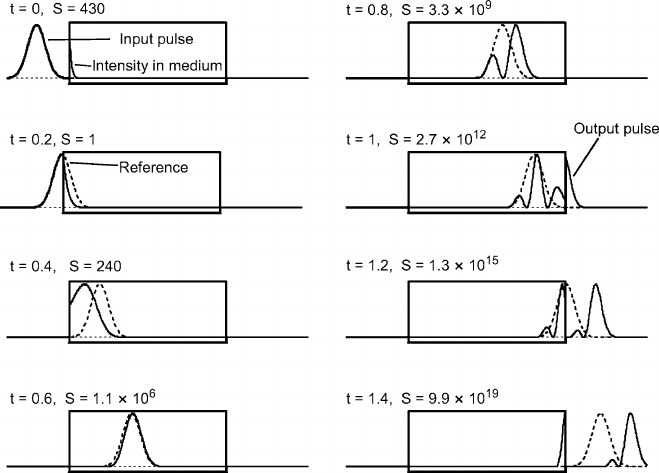
behavior is shown in Fig. 7.11. Here we assume the presence of an absorption line
of integrated line strength e
−32
and no gain background.
In this case the pulse decays approximately exponentially as it propagates through
the medium, and the output peak is approximately e
32
times smaller than that of
the input. In order to make the pulse visible in the plots, the pulse intensities are
7 Causality in Superluminal Pulse Propagation 199
Fig. 7.11 Pulse propagation through a fast-light medium with large net absorption consisting of a
absorption line of integrated line strength e
−32
. In each panel the intensity is normalized to fill the
vertical scale. The group velocity is 1.2 times c, but as a result of large absorption the peak in the
medium lags behind the peak of the reference pulse until t = 0.6. For each panel the scale factor
S gives the value by which the pulse intensity within the medium has been multiplied to ensure
that it fills the entire vertical scale. The output pulse intensity has been multiplied by a factor of
2.1 ×10
13
in all cases
normalized in each panel to fill the vertical scale. The intensity inside the medium
initially decays exponentially, as would be expected because of the large absorption.
Later, a clear pulse is formed. However, until t = 0.6 the pulse lags behind the ref-
erence pulse and in a sense propagates with a group velocity smaller than c. Later
there are multiple peaks within the medium, and only at the output does a clear,
relatively undistorted, advanced pulse appear. In this case the pulse advancement
cannot be regarded as occurring as the result of superluminal propagation because
there is no well-formed pulse propagating faster than c within the medium. Rather,
the apparent superluminal behavior occurs as the result of spectral reshaping.
The appearance of an undistorted output pulse that propagates faster than the
vacuum speed of light c might initially seem to imply a violation of the laws of
the special theory of relativity. One can even find situations in which the peak of
the output pulse leaves the medium before the peak of the input pulse reaches the
medium, apparently violating causality.
The next two figures illustrate this sort of behavior. In Fig. 7.12 we show that
the moderately distorted output pulse is not the result of the peak of the input pulse
propagating faster than the speed of light in the medium, but rather is the result of
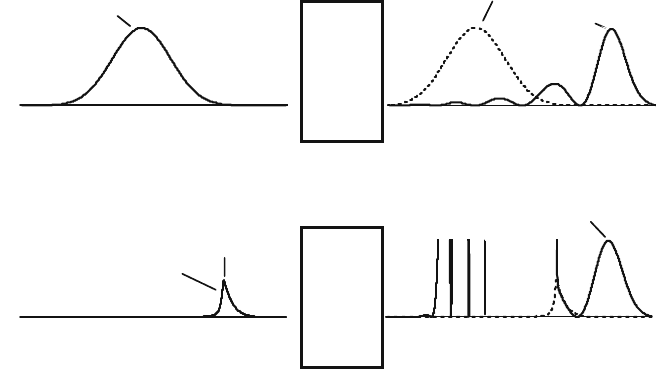
200 R.W. Boyd et al.
Output
Output
Input
Input x 50
Reference
Fast-light
medium
(a)
(b)
Turn off
of input
pulse
Fig. 7.12 (a) The propagation of a Gaussian pulse through a medium consisting of an absorption
line of integrated line strength e
−44
on a gain e
41.6
background. The output peak arrives before
the reference peak, indicating superluminal propagation. (b)Sameasin(a), but in this case only
the very leading edge of the Gaussian pulse is launched into the medium. There is still an output
peak identical to the peak in (a) showing that this peak is not caused by the peak in the Gaussian
input pulse propagating faster than the vacuum speed of light c, but is the result of distortion and
amplification of the leading edge of the pulse, a fully causal process
distortion and amplification of the early part of the input pulse. We first note that the
Gaussian input pulse in Fig. 7.12(a) has, in principle, been in existence for all times,
even if it falls off very rapidly as we move away from the peak. The second point to
note is that we have been very careful in placing the center frequency of the input
pulse at a frequency where the transmission through the medium is at a minimum
and has the value 9%. Close to this frequency, the gain is very large, on the order
of 10
18
. Third, we note that, like previous workers, we use Gaussian input pulses.
Gaussian pulses have the property of having a clear peak in the time domain while
at the same time being well contained in the frequency domain. In Fig. 7.12(b) we
show the result of launching only the very early parts of the input pulse. Up until
the time labeled “turn off of input pulse” the input in Fig. 7.12(b) is the same as the
Gaussian input in Fig. 7.12(a). After this point the Gaussian input is rapidly ramped
down to zero as shown. On the output side of the medium, we see that the peak of
Fig. 7.12(a) is still present, unchanged. This result indicates that this peak occurs as
the result of the unchanged part of the input pulse, the leading edge, being amplified
and distorted [42, 70]. Thus there is no causal connection between the peak of the
output pulse and the peak of the input pulse. The relative gain required to turn the
weak leading edge into the output peak shown is only 10
7
, much below the 10
18
gain that is available. The turning-off of the input pulse in Fig. 7.12(b) introduces
frequency components on the input that are far from line center and see high gain
7 Causality in Superluminal Pulse Propagation 201
on propagating through the medium, resulting in the later parts of the output going
off scale in the plot shown.
From the type of simulation shown in Fig. 7.9, it is tempting to regard the pulse
advancement as occurring as the result of the peak of the pulse propagating faster
than c, moving gradually ahead of the reference pulse while suffering very little
pulse distortion. This picture leads to concern about how this behavior can be consis-
tent with the special theory of relativity. The resolution of this concern is that this is
a very misleading picture. It is more correct to regard what happens on propagation
as a continuous distortion of the pulse that moves the peak of the distorted pulse
ahead of the peak of the undistorted reference pulse.
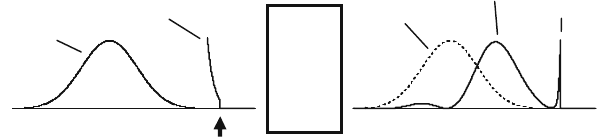
The information velocity can be considered to be the velocity at which the out-
come of some “choice travels.” In many circumstances the information velocity
is, for practical purposes, equal to the group velocity. The simulation shown in
Fig. 7.13 demonstrates that this is certainly not the case in a fast-light system. Here,
the input vanishes up to the point marked “pulse front.” Then a decision is made
to launch a pulse into the medium with the shape and peak position as shown. The
information velocity is the velocity within the medium at which this information
travels. The decision to launch the pulse forces the input to jump from zero up to a
value that is consistent with the rest of the pulse being Gaussian. This jump forms
the pulse front [70, 42].
Input
Input x 1000
Front arriving at c
Pulse front
Peak arriving at
v
g
>c
Reference
Fast light
medium
Fig. 7.13 Up to the point marked “pulse front,” the input vanishes. At that point a decision is made
to launch the pulse. The jump in pulse amplitude at this point forms the pulse front. This pulse front
arrives at the output after propagating through the medium with velocity c and heralds the fact that
the pulse has been launched. The subsequent arrival of the peak carries no new information, even
though it can be thought of as arriving after superluminal propagation. These numerical results are
consistent with the conceptual picture presented in Fig. 7.5
Under these conditions, we see that there are two peaks in the output, the “nor-
mal” advanced pulse and a second feature labeled “front.” In this numerical simula-
tion, the various parameters have been chosen such that these two peaks have equal
amplitude. The first peak marks the arrival of the pulse front. This peak arrives
with the same speed as the reference pulse, the speed of light in vacuum. Later the
advanced pulse arrives. This peak arrives earlier than the peak of the pulse would
have arrived had the medium been replaced by an equal length of vacuum. It can,
therefore, be regarded as consequence of the group velocity being greater than c.

202 R.W. Boyd et al.
But this peak carries no new information, as we already know from the arrival of
the front that the rest of the pulse must arrive. The arrival of the superluminal pulse
does, therefore, not violate causality.
7.8 Summary
We have reviewed recent theoretical and experimental research that establishes that
pulses can propagate through material systems with superluminal or even negative
group velocities. Nonetheless, these exotic propagation effects are fully compatible
with established notion of causality.
At a fundamental level, the nature of slow and fast light seems fairly well under-
stood. But there still may be some surprises on the horizon. We noted in the body of
this chapter that there seems to be no fundamental limit on how much one can delay
a light pulse using slow-light methods, and in fact pulse delays as great as 80 pulse
lengths have been observed [29]. Conversely, there seem to be severe limitations
that limit the amount of advancement for a fast-light system to at most several pulse
widths [71].
1
But can these limitations be overcome? This is an intriguing question
that merits further examination.
Acknowledgments RWB and DJG gratefully acknowledge support from the DARPA/DSO Slow
Light Program, and RWB from the NSF.
References
1. M. Fayngold, Special Relativity and Motions Faster than Light (Wiley-VCH Verlag GmbH,
Weinheim, 2002) 175
2. J.A. Zensus, T.J. Pearson, (eds.), Superluminal Radio Sources (Cambridge University Press,
Cambridge, 1987) 175
3. H. Winful, Phys. Rep. 436, 1 (2006) 176
4. R. Smith, Am. J. Phys. 38, 978 (1970) 176, 178
5. P.W. Milonni, Fast Light, Slow Light, and Left-Handed Light (Institute of Physics Publishing,
Bristol, 2005) 176
6. R. Loudon, J. Phys. A 3, 233 (1970) 177
7. M. Lisak, J. Phys. A 9, 1145 (1976) 177
8. G.C. Sherman, K.E. Oughstun, Phys. Rev. Lett. 47, 1451 (1981) 177
9. G.C. Sherman, K.E. Oughstun, J. Opt. Soc. Am. B 12, 229 (1995) 177
10. J. Aaviksoo, J. Lipmaa, J. Kuhl, J. Opt. Soc. Am. B 8, 1631 (1988) 178
11. R.Y. Chiao, A.M. Steinberg, in Progress in Optics 37, E. Wolf (ed.) (Elsevier, Amsterdam,
1997). 178
12. J.Peatross,S.A.Glasgow,M.Ware,Phys.Rev.Lett.84, 2370 (2000) 178
13. N.A. Cartwright, K.E. Oughstun, J. Opt. Soc. Am. A 21, 439 (2004) 178
14. W.R. Hamilton, Proc. R. Irish Acad. 1, 341 (1839) 178
1
N. of E.: Sect. 2.4.4 of Volume 1 discusses causal bounds for the negative time delays in the
context of potential scattering, see also references therein.