
Muga G. Time in Quantum Mechanics - Vol. 2
Подождите немного. Документ загружается.


3 Post-Pauli’s Theorem 51
that is, the vectors with the smallest number of expansion coefficients. Let k
0
, k
1
,
k
2
, and k
3
be any integer, with k
i
= k
j
for i = j. Then the vector
ϕ(q) = ϕ
k
0
φ
(γ )
k
0
(q) +ϕ
k
1
φ
(γ )
k
1
(q) +ϕ
k
2
φ
(γ )
k
2
(q) +ϕ
k
3
φ
(γ )
k
3
(q) (3.67)
belongs to the domain of the Hamiltonian. We can fix ϕ
k
0
and determine the three
other coefficients for ϕ(q) to belong to the canonical domain. Equations (3.66) then
yield the system of equations in matrix form
⎛
⎝
(−1)
k
1
(−1)
k
2
(−1)
k
3
(−1)
k
1
k
1
(−1)
k
2
k
2
(−1)
k
3
k
3
(−1)
k1
k
1
π+γ
(−1)
k
2
k
2
π+γ
(−1)
k
3
k
3
π+γ
⎞
⎠
⎛
⎝
ϕ
k
1
ϕ
k
2
ϕ
k
3
⎞
⎠
= (−1)
k
0
+1
ϕ
k
0
⎛
⎝
1
k
0
1
πk
0
+γ
⎞
⎠
(3.68)
that determines the coefficients ϕ
k
1
, ϕ
k
2
, and ϕ
k
3
in terms of ϕ
k
0
.
For a given ϕ
k
0
, the coefficients ϕ
k
1
, ϕ
k
2
, and ϕ
k
3
are determined if the determinant
of the matrix
C =
⎛
⎝
(−1)
k
1
(−1)
k
2
(−1)
k
3
(−1)
k
1
k
1
(−1)
k
2
k
2
(−1)
k
3
k
3
(−1)
k1
k
1
π+γ
(−1)
k
2
k
2
π+γ
(−1)
k
3
k
3
π+γ
⎞
⎠
(3.69)
does not vanish. The determinant is given by
det C = (−1)
k
1
+k
2
+k
3
π
2
(k
3
−k
2
)(k
1
−k
3
)(k
1
−k
2
)
(πk
3
+ g)(πk
2
+ g)(πk
1
+ g)
, (3.70)
which does not vanish for different positive integers k
1
, k
2
, and k
3
. Hence the canon-
ical domain of the pair H
γ
and T
γ
is non-trivial and is in fact infinite dimensional.
The above method of constructing the basic vectors of the canonical domain
holds for an arbitrary confined time of arrival operator. In showing for the non-
triviality of the canonical domain, one needs only to construct the matrix C from
the boundary conditions and show that the determinant does not vanish. We will use
this procedure in what follows.
3.5.3.2 Periodic Boundary Condition
For the periodic case, the canonical domain is not only determined by the free kernel
factor but also by the kernel B(q, q
), which is obtained from Eq. (3.50) and is given
by B(q, q
) = (q
2
−q
2
)/4. Given T (q, q
) and B(q, q
), we have the relevant vectors
and kernel φ
TB
(q
) = q
/2, ϕ
TB
(q
) = 0, and
q
|
B
q
=−
2
/2μ, respectively.
Then the canonical domain reduces to

52 E.A. Galapon
D
can
([H
0
, T
0
]) =
ϕ(q) ∈ D
H
0
: ϕ(∂) = 0,ϕ
(∂) = 0,
l
−l
q
ϕ(q
)dq
= 0,
l
−l
ϕ(q
)dq
= 0
. (3.71)
The condition
%
l
−l
ϕ(q
)dq
= 0, which follows from the requirement that ϕ(q)
must belong to the null space of B, restricts the canonical domain to those ϕ(q)
with coefficient ϕ
0
= 0, ϕ(q) =
k=0
ϕ
k
ϕ
(γ )
k
(q), with ϕ
k
=
%
l
−l
ϕ
(0)∗
k
(q)ϕ(q)dq;
and since ϕ(q) must belong to the domain of the Hamiltonian, the coefficients must
also satisfy the requirement
k
k
4
|
ϕ
k
|
2
. The rest of the conditions on the canonical
domain read
k=0
(−1)ϕ
k
= 0,
k=0
(−1)
k
kϕ
k
= 0,
k=0
(−1)
k
k
ϕ
k
= 0 . (3.72)
The conditions (3.72) again determine three of the coefficients in terms of the rest
of the coefficients. For three different integers, k
1
, k
2
, and k
3
, the matrix of the
coefficients is given by
C =
⎛
⎝
(−1)
k
1
(−1)
k
2
(−1)
k
3
(−1)
k
1
k
1
(−1)
k
2
k
3
(−1)
k
3
k
3
(−1)
k
1
k
1
(−1)
k
2
k
2
(−1)
k
3
k
3
⎞
⎠
. (3.73)
The determinant of C can be calculated to yield
det C = (−1)
k
1
+k
2
+k
3
(k
2
−k
1
)(k
1
−k
3
)(k
2
−k
3
)
k
1
k
2
k
3
, (3.74)
which does not vanish for different non-zero k
j
’s. Hence the canonical domain is
not trivial and is infinite dimensional.
3.6 Dynamics of the Eigenfunction of the Confined Time
of Arrival Operators
3.6.1 CTOA Operator Eigenvalue Problem
Let us first summarize the properties of the eigenfunctions and eigenvalues of the
CTOA operators. The immediate properties of the CTOA operators follow from
their being compact self-adjoint operators. This implies that they have a complete
orthogonal set of (square integrable) eigenfunctions with corresponding discrete
eigenvalues. Moreover, their compactness implies that their eigenvalues are bounded
and they get denser as they approach the value zero. The boundary condition

3 Post-Pauli’s Theorem 53
T (q, q) = q/2 dictates that the trace of T
γ
vanishes, Tr[T
γ
] =
%
l
−l
"
q
T
γ
q
dq ∝
%
l
−l
T (q, q)dq = 0. This implies that the sum of the eigenvalues of T
γ
is zero,
which means that T
γ
has positive and negative eigenvalues.
For a fixed γ , the relationship between eigenfunctions corresponding to positive
and negative eigenvalues can be established from the following symmetry of the
kernels:
q
|
T
γ
q
=−
−q
|
T
γ
−q
∗
,
q
|
T
γ
q
=−
q
|
T
γ
q
∗
, (3.75)
where 0 <
|
γ
|
<π/2 and
|
γ
|
= 0,π/2. These symmetries correspond to the
respective symmetries of the confined time of arrival operators
Π
−1
Θ
−1
T
γ
ΘΠ =−T
γ
,Θ
−1
T
γ
Θ =−T
γ
. (3.76)
If ϕ
τ,γ
is an eigenfunction of T
γ
with the eigenvalue τ , then the first symmetry
dictates that the vector ΘΠϕ
τ,γ
is an eigenfunction of T
γ
with the corresponding
eigenvalue −τ .Alsoifϕ
τ,γ
is an eigenfunction of T
γ
with the eigenvalue τ , then
the second symmetry dictates that Θϕ
τ,γ
is an eigenfunction of T
γ
with the corre-
sponding eigenvalue −τ . This is consistent with the above result that the eigenvalues
sum to zero.
Analytical calculations for the non-interacting case [24, 25] and numerical com-
putations for the interacting case [22]
5
show that the confined time of arrival opera-
tors are non-degenerate, and they come in pairs of positive and negative eigenvalues,
in accordance with the above results. In particular, the eigenfunctions can be written
in the form ϕ
±
γ,n
, n = 1, 2, 3,..., where T
γ
ϕ
±
γ,n
=±τ
γ,n
ϕ
±
γ,n
, with τ
γ,n
> 0. The
eigenvalues are ordered according to τ
γ,1
>τ
γ,2
>τ
γ,3
>.... From the above symme-
tries, we have the relationships ϕ
−
γ ,n
(q) = [ϕ
+
γ ,n
(−q)]
∗
and ϕ
−
γ ,n
(q) = [ϕ
+
γ ,n
(q)]
∗
.
The eigenfunctions are classifiable into nodal (vanishing at some point in [−l, l]) or
non-nodal (non vanishing anywhere in [−l, l]). The eigenfunctions further come in
pairs of nodal and non-nodal ones, i.e.,
P
k
=
,
ϕ
±
γ,2k+1
,ϕ
±
γ,2k+2
-
, (3.77)
for k = 0, 1, 2,..., with corresponding pair of eigenvalues τ
±
k
=
τ
±
2k+1
,τ
±
2k+2
(except perhaps for the first two largest eigenvalue–eigenfunctions), such that τ
±
2k+1
and τ
±
2k+2
have neighboring values. The significance of this pairing is best
5
Due to the intractability of solving the kernel factor for non-linear systems, the CTOA operator
eigenvalue problem for these systems has been investigated using the leading term of the kernel
factor, which is known for any potential. We expect that the results are already representative of
the exact results because the corrections to the leading term differ from the largest correction by a
factor of
2
in the classical limit. On the other hand, the full solution for linear systems have been
used in the numerical investigation. The reader is referred to [22] for a detailed discussion of the
numerical computations.

54 E.A. Galapon
appreciated in the limit for arbitrarily large l, which we will consider later. Nodal
and non-nodal eigenfunctions alternate.
3.6.2 Dynamics of the CTOA Operator Eigenfunctions
Using symmetry arguments, it can be established that the negative eigenvalue–
eigenfunctions have exactly the same dynamics as those of the positive eigenvalue–
eigenfunctions in the time-reversed direction. It is then sufficient for us to consider
in detail the dynamical behaviors of the positive eigenvalue–eigenfunctions. Our
analysis is based on the numerical evaluation of ϕ
+
γ,n
(q, t) = (e
−iH
γ
t/
ϕ
+
γ,n
)(q).
Our numerical simulation shows remarkable similarity of the time evolutions of
the eigenfunctions across the set of potentials considered, which included V (q) =
{0, q, q
2
/2, q
2
/2 + q} for linear systems and V (q) ={q
4
, sin q, e
−q
2
/2
} for non-
linear systems [22]. Foremost, the uncertainty of the position operator with respect
to the evolved eigenfunction ϕ
+
γ,n
(q, t), which is given by
(
Δq
)
(t) =
"
ϕ
+
γ,n
(t)
q
2
ϕ
+
γ,n
(t)
−
"
ϕ
+
γ,n
(t)
|
q
|
ϕ
+
γ,n
(t)
2
, (3.78)
obtains its minimum value at the time equal to the eigenvalue corresponding to the
eigenfunction ϕ
+
γ,n
(q). Moreover, the minimum uncertainty decreases with increas-
ing n so that the eigenfunctions become increasingly localized at the origin at their
eigenvalues with n. For eigenfunctions that are not eigenfunctions of the parity
operator, the expectation value of the position operator evolves such that it crosses
the origin at their respective eigenvalues; these eigenfunctions arise in general for
γ = 0,π/2. The non-nodal eigenfunctions evolve such that the probability den-
sity is maximum at the origin at their eigenvalues. On the other hand, the nodal
eigenfunctions evolve with the probability density having two peaks approaching
the origin, with the time of closest approach at their eigenvalues.
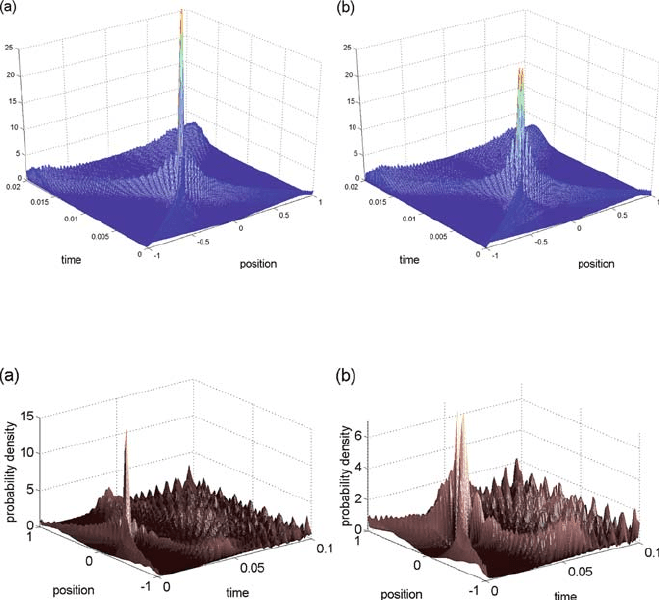
In short, the CTOA-operator eigenfunctions (within numerical accuracy) evolve
according to Schr
¨
odinger’s equation such that the event of the position expectation
value assuming zero and the event of the position uncertainty being minimum occur
at the same instant of time equal to their corresponding eigenvalues. Figures (3.1)
and (3.2) show these behaviors for non-interacting and harmonic oscillator cases,
respectively.
We have referred to this dynamical property of the eigenfunctions as their unitary
arrival at the arrival point at their respective eigenvalues, unitary arrival because
they exhibit the dynamical behavior during their unitary time evolution according to
Schr
¨
odinger equation. The unitary arrival of the eigenfunctions support the interpre-
tation that the confined time of arrival operators are first time of arrival operators,
the corresponding eigenvalues being the first unitary time of arrival of the eigen-
functions. This dynamical behavior of the eigenfunctions is important because it
gives an instance in which the time of occurrence of a quantum event – in our case
unitary arrival at a certain point in the configuration space – is solved in the form of
3 Post-Pauli’s Theorem 55
Fig. 3.1 (Color online) Non-interacting case: (a) n = 20 and (b) n = 21 evolved eigenprobability
densities,
|
ϕ
n
(q, t)
|
2
,forγ = 0.01, with = l = m = 1. Both symmetrically collapse at the origin
at their respective eigenvalues, 0.0081 and 0.0079. (Reprinted from [24])
Fig. 3.2 (Color online) Harmonic oscillator: The evolved eigenprobability densities,
|
ϕ
n
(q, t)
|
2
,
for the (a) 9 th non-nodal (γ = 0) and (b) 8 th nodal (γ = π/2) positive eigenvalue–eigenfunctions
of the harmonic oscillator CTOA operator for l = 1. The eigendensities take their maximum values
at the arrival point at their respective eigenvalues. The eigendensities become more localized at the
arrival point at the eigenvalue as n increases. (Reprinted from [22])
an eigenvalue problem of a self-adjoint operator, which is conjugate to the system
Hamiltonian, with the eigenfunctions as the states exhibiting the event at a later time
equal to their respective eigenvalues.
3.7 Dynamical Behaviors in the Limit of Large Confining
Lengths and the Appearance of Particle
3.7.1 Properties of the Eigenfunctions and Eigenvalues for Large
Confining Lengths
We now describe the dynamical behavior of the CTOA-operator eigenfunctions as
the confining length l gets arbitrarily large [26, 23]. The representative potentials

56 E.A. Galapon
V (q)={0, q
2
/2, q
4
/4}have been used in the numerical computations, with V (q)=0
considered in [26] and the rest of the potentials in [23].
First, let us consider the behavior of the eigenvalues as l increases, obtained
by a numerical study of the CTOA-operator eigenvalue problem for increasing l.
Since the positive and negative eigenvalue–eigenfunctions are related by a symmetry
relation, it is sufficient for us to consider only positive eigenvalues. For any given
time τ>0, we can find a sufficiently large confining length l
0
such that τ is less than
the largest eigenvalue of the CTOA operator corresponding to l
0
. For any such l
0
,we
can find a pair of nodal and non-nodal eigenfunctions P
k
such that their eigenvalues
τ
2k+1
and τ
2k+2
are closest to τ (see description above of the eigenfunctions and
eigenvalues). Consider a sequence of increasing l’s, l
0
< l
1
< l
2
< l
3
< ···.
Then there will be a k
1
corresponding to l
1
such that τ
k
1
is closest to τ ; and a k
2
corresponding to l
2
such that τ
k
2
is closest to τ ; and so on. Our computation indicates
that as l gets larger, τ
2k+1
approaches τ
2k+2
. That is, the pair of eigenfunctions P
k
becomes degenerate. Our computation likewise indicates that the eigenvalues in the
neighborhood of τ get denser as the confining length tends toward infinity, so that,
for a given τ , τ
k
r
for a given l
r
converges to τ . This indicates that the spectrum of
the CTOA operator tends to the continuum, which implies that the eigenfunctions
will eventually become non-square integrable. These results are consistent with the
known properties of the eigenfunctions of the free time of arrival operator in the
entire configuration space [14].
But what is the behavior of the pair P
k
of eigenfunctions corresponding to the pair
of eigenvalues closest to the given time τ as l gets arbitrarily large? We know from
our earlier results that the width of an evolving CTOA eigenfunction is minimum
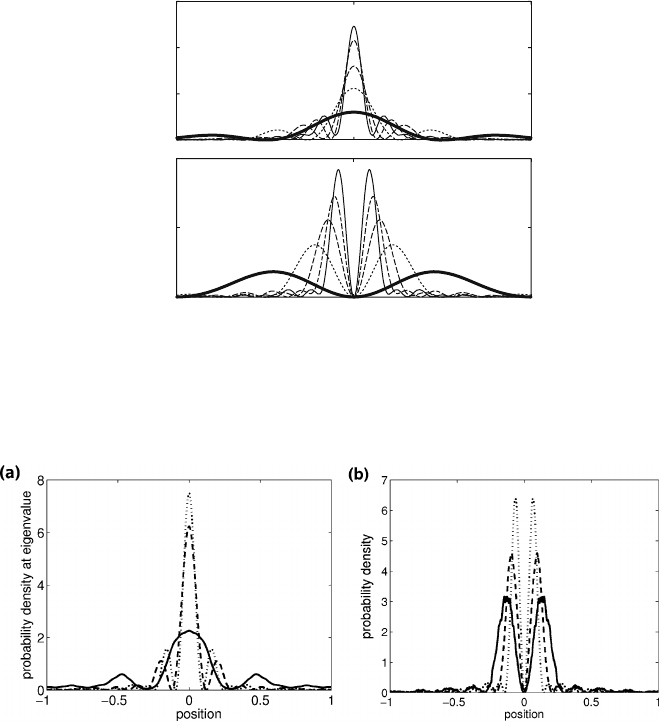
at time equal to its corresponding eigenvalue. Figure 3.4 shows that the modulus
square of the evolved pair of eigenfunctions tends to the Dirac delta with support
at the arrival point as l
r
tends to infinity. Then the CTOA eigenfunctions evolve to
a singular support at the arrival point at their respective eigenvalues in the limit; in
particular |ϕ
n
r
(q,τ
k
r
)|
2
tends to the position eigenfunction at the arrival point (see
Figs. 3.3 and 3.4). These numerical observations are consistent for all the potentials
considered, suggesting that the behaviors of the CTOA operators in the limit of
arbitrarily large l are the same.
3.7.2 The Appearance of Particle
The limiting dynamical behavior described above gives us the picture of quantum
arrival within standard quantum mechanics as that of unitarily evolving CTOA
eigenfunction to a localized support at the arrival point.
6
If we accept the dogma
that particles are wave packets of singular support, then the CTOA eigenfunctions
for arbitrarily large l’s are particles at their respective eigenvalues. This endorses
a mechanism for the localization of the wave function in space and in time at the
6
This and the following sections are excerpts from [23].
3 Post-Pauli’s Theorem 57
−0.05 0 0.05
x (a.u.)
|ϕ
n
(t)|
2
(a.u.)
0
50
100
0
50
100
150
a)
b)
Fig. 3.3 Non-interacting case: Probability density |ϕ
n
(τ )|
2
versus position at the corresponding
closest eigenvalue τ
n
to t = 0.01, for the even (upper figure) and odd (lower figure) eigenfunctions.
The different lines are associated with l = 1(thick solid line), l = 2(dashed line), l = 3(long-
dashed line), l = 4(dotted-dashed line), and l = 5(thin solid line). (Reprinted from [26])
Fig. 3.4 Harmonic oscillator: (a) The evolved eigenprobability densities at their respective eigen-
values corresponding to the non-nodal eigenfunctions with eigenvalues nearest to τ = 0.11 for
lengths l = 1(solid line), l = 2(dashed line), and l = 3(dotted line), for the harmonic oscillator
CTOA operator T
0
.(b) The corresponding nodal eigenfunctions for lengths l = 2(solid line),
l = 3(dashed line), and l = 4(dotted line). Peak increases with l. (Reprinted from [23])
registration of the particle: Consider a quantum particle prepared in some initial
state ψ
0
. Without loss of generality, we can assume that ψ
0
has a compact support.
We can then enclose the system by a box of very large length (for all practical
purposes infinite), with the support of ψ
0
lying completely in the box. Since the
CTOA eigenfunctions are complete we can decompose ψ
0
in terms of these eigen-
functions. Now if we presuppose that particle detectors somehow respond only to a
localized wave packet or localized energy, then registration or arrival of the particle
at the arrival point at time τ can be interpreted as the detection of the component
58 E.A. Galapon
eigenfunction whose eigenvalue is τ , that is, unitarily arriving (essentially collaps-
ing for arbitrarily large l) at the arrival point. This implies that the appearance or
arrival of the particle is a combination of a collapse of the initial wavefunction into
one of the eigenfunctions of the time of arrival operator right after the preparation
of the initial state followed by a unitary evolution of the eigenfunction.
The emergent interpretation contrasts with the standard interpretation of the col-
lapse of the spatial wavefunction on the appearance of particle. In standard quantum
mechanics, when a quantum object is prepared in some initial state ψ
0
and when an
observable of the object is measured at a later time T , then the state at the moment
of measurement, which is ψ(T ) = U
T
ψ
0
, where U
t
is the time evolution opera-
tor, collapses randomly into one of the eigenfunctions of the observable. Now the
consensus is that the appearance of particle is a position measurement, so that the
appearance at point q
0
at some time T is the projection of the evolved wavefunc-
tion ψ(q, T ) = U
T
ψ
0
(q) to the eigenfunction δ(q − q
0
) of the position operator.
But according to our quantum arrival description, the collapse occurs much earlier
than the appearance of the particle, with the initial state collapsing to one of the
eigenfunctions of the time of arrival operator right after the preparation and with
the particle appearing later at the moment the eigenfunction has evolved to a state
of localized support at the arrival point. The appearance of particles then (at least
within the context of quantum arrival) does not arise out of position measurement
but rather out of time measurement.
One may, however, question the validity of our interpretation when there was no
initial intention to observe the arrival of the particle. If from the very start the instru-
ment has been set up to detect the arrival of the particle, it can be argued that the
setup is already a measurement that has caused the initial state to collapse into one
of the CTOA eigenfunctions, then evolve until observed. But this reasoning appears
untenable when the decision to observe arrival is deferred, because the initial state
has been evolving according to Schr
¨
odinger equation, assuming that no other obser-
vation is made. But not quite. Quantum mechanics is inherently non-local in time
[64]. And that means “the description of the past must bear actions of the present”
[37]. The collapse right after the preparation (when arrival measurement is to be
made) and the Schr
¨
odinger evolution right after the preparation (when some other
measurement is to be made) are two potentialities that are simultaneously true for
the system, which one is realized depends on the decision what to do with the system
at the moment. Temporal non-locality then replaces the spatial non-locality inherent
in the spontaneous localization of the wavefunction in the standard interpretation.
3.8 Quantum Time of Arrival Distribution
3.8.1 The Formalism
In [26] it is shown that the well-known time of arrival distribution for a quantum-
free particle due to Kijowski [46] can be extracted from the confined time of arrival
operators for the non-interacting case in the limit of infinite confining length.
3 Post-Pauli’s Theorem 59
This indicates that the time of arrival distribution in the entire real line can be
approximated by the time of arrival distribution from the compact confined time
of arrival operators [23]. This is important as solving for the eigenvalue problem
for the time of arrival operator T (in the entire real line) is intractable, at least,
at the moment. Once the kernel factor for a given interaction is already known,
the eigenvalue problem for a confined time of arrival operator can be readily
computed numerically [13, 62]. For linear systems, the kernel factor T
lin
(q, q
)
is readily available because it equals T
0
(q, q
) which is expressible only in terms
of the interaction potential. On the other hand, for non-linear systems, the kernel
factor is difficult to solve exactly. However, the kernel factor for such systems
has the expansion T
nli
(q, q
) = T
0
(q, q
) + T
1
(q, q
) +···. Since the succeed-
ing terms contribute to the time of arrival operator in powers of
2
, the leading
term can approximate the kernel factor, T (q, q
) ≈ T
0
(q, q
), in the non-linear
case.
Let us for the moment assume that the initial state of the quantum particle, ψ
0
(q),
has a compact support. We now enclose the support of ψ
0
(q) by a very large box
centered at the arrival point. Since the CTOA operator T
γ =0
satisfies the same time
reversal symmetry as that of the time of arrival operator T in the unbounded space,
we use T
γ =0
to approximate T or we take T
γ =0
as coarse-grained version of T [23].
We then construct the confined time of arrival operator T
γ =0
for the given box. Once
T
0
is constructed, compute
P
ψ
0
(x, t) =
τ
l
0,s
≤t
ϕ
l
0,s
|ψ
0
2
, (3.79)
where ϕ
l
0,s
and τ
l
0,s
are the eigenfunctions and eigenvalues of T
0
. The overlap
"
ϕ
l
0,s
|ψ
0
is the probability amplitude that the initial state will collapse into the sth
eigenfunction right after the preparation. With this interpretation of the overlap,
P
ψ
0
(x, t), in the limit of infinite l, can be naturally interpreted as the probability that
one of the components of the eigenfunctions with corresponding eigenvalues less
than or equal to t shall have unitarily evolved to a localized wavefunction at the
arrival point x. If our detector is what we have presupposed above, then P
ψ
0
(x, t)
is the probability of detection or arrival at x after some time t.GivenP
ψ
0
(x, t)the
time of arrival probability density is found by differentiation with respect to time,
Π
ψ
0
(x, t) = ∂
t
P
ψ
0
(x, t). The peaks of Π
ψ
0
(x, t) determine the most likely times of
arrival at the given arrival point.
If the initial state has infinite tails, we can always approximate it with arbi-
trary accuracy by a function ψ
l
whose support lies entirely in the interval [−l, l]
such that ψ
l
→ψ
0
as l →∞. Then P
ψ
0
(x, t) is computed as above. The whole
process can be implemented numerically by choosing the confining length to be
large enough. The probability density can then be obtained by numerical inter-
polation and differentiation. Caveat – this procedure is meaningful only when
the time of arrival operator T has completely continuous spectrum in the Hilbert
space H
∞
.
60 E.A. Galapon
3.8.2 Example: The Harmonic Oscillator Time of Arrival Problem
Let us consider the harmonic oscillator time of arrival problem [23] at the ori-
gin. We choose our initial states to be particular Gaussians of the form ϕ(q) =
Ne
−(q−q
0
)
2
/(4δq
2
)+ip
0
q/
. We compare the time of arrival distribution Π
ϕ
(x = 0, t)
computed using our algorithm above with the classical time of arrival T (q
0
, p
0
) =
−ω
−1
tan
−1
(q
0
/ωp
0
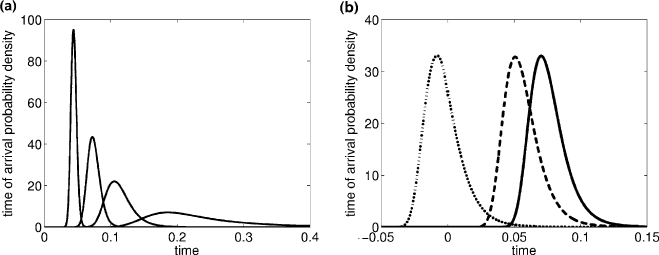
). Figure 3.5a shows the computed time of arrival distribution
for a fixed average position q
0
and for varying average momentum p
0
. Evidently the
time of arrival distribution becomes localized with increasing average momentum.
In fact the most likely time of arrival approaches the classical time of arrival as aver-
age momentum increases; that is, the quantum time of arrival distribution becomes
increasingly localized at the classical time of arrival. This implies that the quantum
first time of arrival distribution approaches the classical distribution for arbitrarily
large momenta or for high-energy oscillators. For small momenta, the most likely
time of arrival is shorter than the classical time of arrival, so that quantum oscillators
are, on the average, faster than their classical counterparts.
Fig. 3.5 (a) The probability density for q
0
= 2.25 and p
0
= 10, 20, 30, 50. (b) Evidence for
covariance in the limit of infinite l. The probability densities corresponding to times t = 0(solid
line), t = 0.02 (dashed line), t = 0.08 (dotted line)forp
0
=−30, q
0
= 2.25, = m = σ = 1.
(Reprinted from [23])
One desirable property of the time of arrival distribution is covariance; that is,
translation in time should not affect the distribution. Covariance has been a pri-
mary requirement on time operators, and it is the lack of covariance of the CTOA
operators (they being compact) that their introduction has been initially doubted
upon. Figure 3.5b gives evidence of covariance of the distribution for times smaller
than the period of the harmonic oscillator time evolution operator. The given initial
state is evolved through different times. These evolved states are used as the initial
states in the computation for the TOA distribution. If the distribution is covariant,
the resulting distributions must be translations of each other. This is evident in the
figure. Thus while the CTOA operators are non-covariant, covariance may naturally
emerge in the limit of infinite confining length.