
Muga G. Time in Quantum Mechanics - Vol. 2
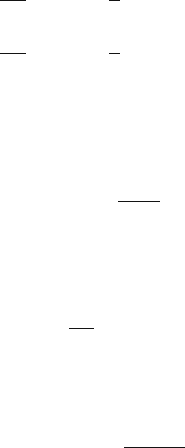
Подождите немного. Документ загружается.

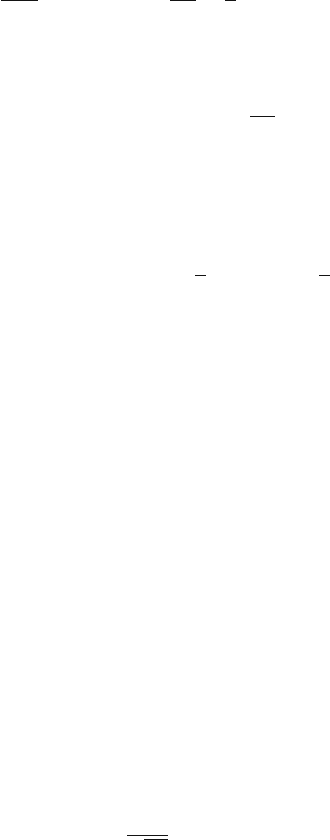
72 A. Ruschhaupt et al.
The two-dimensional equation (4.6) can be transformed into an effective one-
dimensional one by inserting the ansatz
χ(x, y) =
φ
(1)
(x)e
ik
y
y
φ
(2)
(x)e
i(k
y
+k
L
)y
.
Then we get
2
k
2
x
2m
φ
(1)
(x)
φ
(2)
(x)
=
p
2
x
2m
+
2
0 Ω(x)
Ω(x) −2Δ − iγ
φ
(1)
(x)
φ
(2)
(x)
,
where
Δ = Δ
L
−
2m
(2k
y
k
L
+k
2
L
)
is an effective detuning which includes Doppler and recoil terms. We have thus
reduced the original problem to a one-dimensional equation with effective
Hamiltonian
H
c
=.p
2
/2m +
2
0
0
0
−iγ
+
2
0
Ω(x)
Ω(x)
−2Δ
. (4.7)
(The x subindex is dropped in the momentum operator since only effective one-
dimensional equations in the x-direction are considered hereafter.) We shall con-
centrate now on the on-resonance (Δ = 0) case that may be achieved by normal
incidence (k
y
= 0) and by adjusting the laser detuning to cancel the recoil frequency
k
2
L
/(2m).
4.2.1.1 Stationary Scattering Eigenfunctions
Let us first solve the eigenvalue equation
H
c
Φ
k
= EΦ
k
, where Φ
k
(x) ≡
φ
(1)
k
(x)
φ
(2)
k
(x)
and E =
2
k
2
/2m , (4.8)
for waves incident from the left in the ground state (dropping the subindex x in k
too). In the simplest solvable model Ω(x) = Θ(x)Ω, which corresponds to a sharp
laser beam boundary at x = 0 and a semi-infinite field extension. If the atoms are
slow enough the result of the experiment should not depend on the beam width
beyond a minimal length necessary for detection.
For x < 0, left-incoming states must be of the form
Φ
k
(x) =
1
√
2π
e
ikx
+ R
1
e
−ikx
R
2
e
−iqx
, x < 0, k > 0 ,

4 Detector Models for the Quantum Time of Arrival 73
where q satisfies
E +iγ/2 =
2
q
2
/2m ,
with Im q > 0 for boundedness, while R
1
and R
2
are the reflection amplitudes.
Note that although E is real, the complete wave functions will not be orthogonal, in
accordance with the non-hermiticity of H
c
.
To obtain the form of Φ
k
(x)forx ≥ 0, we denote by |λ
+
and |λ
−
the eigen-
states of the matrix
1
2
0
Ω
Ω
−iγ
!
corresponding to the eigenvalues λ
±
,
λ
±
=−
i
4
γ ±
i
4
/
γ
2
−4Ω
2
,
|λ
±
=
1
2λ
±
/Ω
.
Note that |λ
±
are not orthogonal and have not been normalized. Nevertheless one
can write Φ
k
as a superposition of the form
√
2πΦ
k
(x) = C
+
|λ
+
e
ik
+
x
+C
−
|λ
−
e
ik
−
x
, x ≥ 0 .
From the eigenvalue equation (4.8), one obtains for x ≥ 0
k
2
±
= k
2
−2mλ
±
/ = k
2
+iγ m/2 ∓im
/
γ
2
−4Ω
2
/2 ,
with Im k
±
> 0 for boundedness. From the continuity of Φ
k
(x) and its derivative at
x = 0 one gets R
1
, R
2
, C
±
and the wave functions explicitly [31].
4.2.1.2 Wavepackets
Wavepackets Ψ =
ψ
(1)
ψ
(2)
are treated as superpositions of the stationary eigen-
functions. This is easy for an initial ground state wave packet
ψ
(1)
(x,t
0
)
0
coming in
from the far left side and with t
0
in the remote past. Indeed, if
0
ψ(k) denotes the
momentum amplitude the wave packet would have as a freely moving packet at
t = 0, then
Ψ (x, t) =
∞
0
dk
0
ψ(k) Φ
k
(x)e
−ik
2
t/2m
. (4.9)
The normalization is chosen such that ||Ψ (t
0
)||
2
= 1, for t
0
in the remote past. The
probability, N(t), of no photon detection for a wave packet from t
0
up to time t is
given by
N(t) =||e
−iH
c
(t−t
0
)/
Ψ (t
0
)||
2
,

74 A. Ruschhaupt et al.
and the probability density, Π(t), for the first-photon detection by
Π(t) =−
dN
dt
=
i
Ψ (t)|H
c
− H
†
c
|Ψ (t) .
Since H
c
− H
†
c
=−iγ |22|, the first-photon probability density is given by
Π(t) = γ
∞
−∞
dx |ψ
(2)
(x, t)|
2
.
4.2.1.3 The Reflection Problem and the No-Detection Probability
The probability of no photon detection at all is N(t =∞). Only ψ
(1)
contributes to
this and, because Ω(x) = ΩΘ(x), only for x < 0, since, for x > 0, the ground state
part will eventually be pumped by the laser to the excited state. So we get
N(t =∞) = 1 −
∞
t
0
dt
Π(t
) =
∞
0
dk |R
1
(k)|
2
|
0
ψ(k)|
2
.
As a consequence, Π(t) is, in general, not normalized to 1.
|R
1
|
2
and therefore the probability for missing an atom increases with Ω,the
strength of the laser driving. On the other hand, for k →∞reflection becomes
negligible. Hence for faster atoms reflection does not pose a problem. For later
purposes we also consider increasingly large γ , the other parameters kept fixed.
In this case the state vector for x > 0 becomes simply the plane wave with wave
number k in the ground state. This means that for increasing γ there is less and less
reflection, but also less and less absorption, i.e., photon detection, so that the effect
of the laser on the atom decreases. Moreover, if both γ and Ω go to infinity with
γ/Ω kept fixed, then R
1
→−1 and all atoms are reflected without having been
detected.
6
Depending on the parameters, the delay and reflection problem may be
either very relevant or negligible [31].
4.2.2 The Connection to an Idealized Arrival Time Distribution
We have just seen that avoiding reflection by weak driving, Ω/γ 1, would cause
a severe delay problem since the laser would take more time to pump the atom to
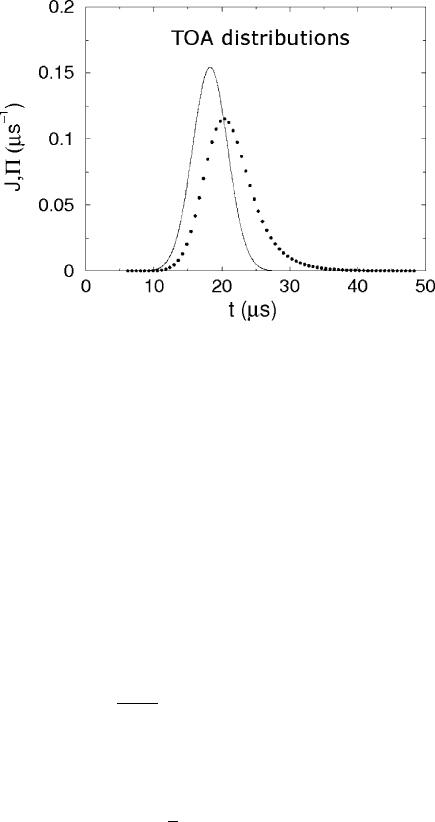
the excited state, see Fig. 4.3.
Should it not be possible to somehow compensate the delay in Π(t) by that of
the atom at rest and thus arrive, in some limit, at a delay-free ideal distribution? To
6
More precisely, if Ω and γ are of the same order of magnitude and γ
k
m
k or, alternatively, if
Ω/γ 1andΩ
2
/γ
k
m
k,thenR
1
≈−1. Physically, both conditions mean that the distance
traveled by the atom in the time it takes for a photon to be scattered is much less than the de Broglie
wavelength.
4 Detector Models for the Quantum Time of Arrival 75
Fig. 4.3 Time-of-arrival distributions: Flux J (solid line, here indistinguishable from Kijowski’s
Π
K
)andΠ (first photon, dots). Note the delay in Π. The initial state is a minimum-uncertainty-
product Gaussian for the center-of-mass motion of a single Cesium atom in the ground state with
v=9.0297 cm/s, x=−1.85 μm, and Δx = 0.26 μm; Ω = 0.0999γ ; all figures are for the
transition 6
2
P
3/2
–6
2
S
1/2
of Cesium with γ = 33.3MHz
achieve this, we assume the “experimental” arrival time distribution Π (t)tobethe
convolution of a hypothetical ideal distribution, Π
id
, with the detection probability
density W (t) for an atom at rest [56], which is put in the laser field in the ground
state,
Π = Π
id
∗ W,
W(t) =
γΩ
2
4|S|
2
e
−γ t/2
|e
St/2
−e
−St/2
|
2
Θ(t) ,
where
S =
1
2
(γ
2
−4Ω
2
)
1/2
.
The delay in Π is then contained in W and the hypothetical ideal distribution Π
id
is
obtained by deconvolution from
0
Π
id
=
0
Π/
0
W, where the tildes denote the Fourier
transforms, e.g.,
0
Π(ν) =
%
dte
−iνt
Π(t). One finally obtains, using (4.9) and taking
the γ →∞limit [31],
Π
id
(t) → J(0, t) ,
which is the flux for the free wave function ψ
f
(x, t)atx = 0, i.e., the one evolving
without laser, see also Fig. 4.4. This is an extremely interesting result since J is a
76 A. Ruschhaupt et al.
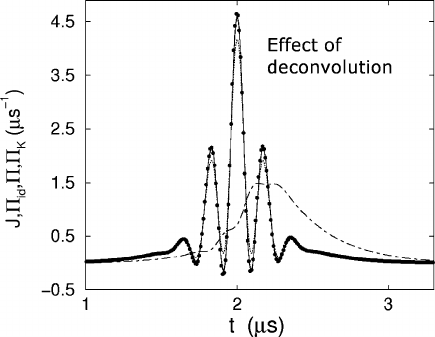
Fig. 4.4 Excellent agreement between Π
id
(filled circles)andJ (solid line); deviations from Π
K
(dotted line)andΠ (dot-dashed line). The initial wave packet is a coherent combination ψ =
2
−1/2
(ψ
1
+ ψ
2
) of two Gaussian states for the center-of-mass motion of a single Cesium atom
that become separately minimal uncertainty packets (with Δx
1
= Δx
2
= 0.021 μm and average
velocities v
1
= 18.96 cm/s, v
2
= 5.42 cm/s) at x = 0andt = 2 μs; Ω = 0.37γ
natural candidate for the arrival time distribution. We note that J is normalized to 1
for a wave function which has only positive-momentum components.
4.2.3 Generalizations of the Atom-Laser Model
Different generalizations of the atom-laser model have been worked out:
In [32] the effects of a finite laser width (in contrast to the semi-infinite laser
described before) are examined. In that setting, the flux can again be obtained from
the probability density for the arrival of the first photon in a given limit.
In [45] the three-dimensional formulation of the atom-laser model is investigated
in detail. It is shown that within typical conditions for optical transitions the results
of the simple one-dimensional version are generally valid. Differences that may
occur are consequences of Doppler and momentum-transfer effects. Ways to mini-
mize these are discussed.
In [82] the idea of the atom-laser model is transferred to an ionization model. A
method to achieve perfect detection of ultra-cold atoms at fixed incident velocity is
proposed.
4.3 Complex Potentials
Allcock [4–6] modeled the arrival detector by a local and energy-independent com-
plex potential, i.e., he put forward a simplified operational approach for arrival
times. The operational (unnormalized) time-of-arrival distribution Π is then identi-
fied as the absorption rate
4 Detector Models for the Quantum Time of Arrival 77
Π =−dN/dt ,
where N is the decreasing norm of the quantum wave packet for the undetected
particle. Later, Muga and coworkers used more complicated functional forms for
the complex potential, including a real part, to show that the reflections induced
by the step model could be partially avoided [65, 75]. Imaginary potentials have
also been used in the phenomenological event-enhanced quantum theory (EEQT)
of Blanchard and Jadczyk [18, 20, 19] to simulate time-of-arrival and traversal time
measurements [21, 75, 78–80], and Halliwell [44] derived the imaginary step poten-
tial used by Allcock from an abstract two-level detector model.
The agreement between the deconvolution performed by Allcock with a weak
imaginary step potential and the deconvolution of Sect. 4.2.2, in the short lifetime
(weak driving) limit, suggests that there must be a connection. Indeed, the laser-
atom model can be reduced to a local and energy-independent complex potential
model in the weak driving regime. To see this first at a heuristic and intuitive level,
let us write the stationary Schr
¨
odinger equation for the effective Hamiltonian (4.7)
in components, putting Δ = 0,
Eφ
(1)
(x) =
.p
2
2m
φ
(1)
(x) +
2
Ω(x)φ
(2)
(x) , (4.10)
Eφ
(2)
(x) =
.p
2
2m
φ
(2)
(x) +
2
Ω(x)φ
(1)
(x) −iγ/2 φ
(2)
(x) . (4.11)
If γ is much larger than the rest of energies in (4.11), we can approximate φ
(2)
from this equation as
φ
(2)
(x) ≈
Ω(x)
iγ
φ
(1)
(x) .
Putting this into Eq. (4.10) we get
Eφ
(1)
(x) ≈
.p
2
2m
φ
(1)
(x) −iV
0
(x)φ
(1)
(x) , (4.12)
where
V
0
(x) =
Ω(x)
2
2γ
, (4.13)
i.e., there results a local, purely imaginary, and energy-independent potential for
state 1.
For a wavepacket with stationary components satisfying (4.12), ψ
(1)
(t) satisfies
the one-dimensional Schr
¨
odinger equation

78 A. Ruschhaupt et al.
i
d
dt
ψ
(1)
(t) ≈
1
.p
2
/2m − iV
0
(.x)
2
ψ
(1)
(t) . (4.14)
Since ψ
(2)
(t) → 0, one has
N(t) ≈||ψ
(1)
(t)||
2
,
and so
Π(t) =−
dN
dt
≈
2
∞
−∞
dxV
0
(x)
ψ
(1)
(x, t)
2
.
Therefore, in the simple semi-infinite laser case Ω(x) = ΩΘ(x), we get
Π(t) ≈
2V
0
∞
0
dx |ψ
(1)
(x, t)|
2
, (4.15)
where V
0
= Ω
2
/2γ is now a constant. Equations (4.14) and (4.15) relate the
atom-laser model to the complex potential model of Allcock, see also [44].
An interesting case is the limit of the delta potential V
0
(x) =−iV
0
δ(x), for which
the signal Π(t) provides the probability density,
Π(t) ≈
2V
0
ψ
(1)
(0, t)
2
.
However, this is not the probability density for the freely moving wave unless the
additional limit V
0
→ 0 is taken.
4.3.1 Complex Potential from Feshbach’s Theory
A more rigorous and systematic derivation of the complex potential follows from
using Feshbach’s projector techniques [37, 38, 61]. They let us obtain an exact
generalized, non-local and energy-dependent, complex potential treatment for laser
and atom parameters that cannot be described with the simple local and energy-
independent approach and also set its conditions of validity.
We shall now include detuning, as in (4.7),
H
c
= K1 + V =
1
2m
.p
2
0
0
.p
2
+
2
0
Ω(x)
Ω(x)
−(2Δ + iγ )
,
where K = .p
2
/2m is the kinetic energy operator and 1 =|11|+|22|
the unit operator in the internal state subspace. We want to solve the eigenvalue

4 Detector Models for the Quantum Time of Arrival 79
equation (4.8). Therefore, we may apply the complementary projectors
P =|11|, Q =|22| ,
to write, using the standard manipulations of the partitioning technique [37, 38, 61],
an exact integro-differential equation for the ground state amplitude φ
(1)
k
,
Eφ
(1)
k
(x) = K φ
(1)
k
(x) +
∞
−∞
dx
x, 1|V
opt
(E)|x
, 1φ
(1)
k
(x
) ,
where the exact complex non-local and energy-dependent “optical” potential is
V
opt
(E) = PV
opt
(E)P = PV P + PVQ(E + i0 − QHQ)
−1
QV P ,
and its coordinate representation is given by
x, 1|V
opt
(E)|x
, 1=−
mi
4
e
i|x−x
|q
q
Ω(x)Ω(x
) ,
with q =
√
2mE
(1 + μ)
1/2
,Imq ≥ 0, and μ =
2Δ+iγ
2E/
. The exact equation for the
excited state is
φ
(2)
k
(x) =−
im
2
∞
−∞
dx
e
i|x−x
|q
q
Ω(x
)φ
(1)
k
(x
) .
If we set Ω(x) = Ω
M
ω(x), where Ω
M
is the maximum of |Ω(x)|, we get by partial
integration
∞
−∞
dx
e
i|x−x
|q
q
ω(x
) f (x
) =
1
μ
i
2
mE
ω(x) f (x) +O
1
μ
2
, (4.16)
for some function f (x) and 2E/ being constant.
Let us now examine the limit μ →∞keeping 2E/ and Ω
M
constant. To
apply perturbation theory, we assume an asymptotic expansion of φ
(1)
k
in powers of
1/μ and compare equal powers of 1/μ on both sides taking (4.16) into account. It
follows that
Eφ
(1)
k
= Kφ
(1)
k
(x) +W (x)φ
(1)
k
(x) +O
1
μ
2
,
where
W(x) =
Ω(x)
2
2(2Δ + iγ )
, (4.17)

80 A. Ruschhaupt et al.
i.e., there results a local and energy-independent approximation W (x) to the exact
optical potential. For the excited state, we get
φ
(2)
k
(x) =
1
2Δ + iγ
Ω(x)φ
(1)
k
(x) +O
1
μ
2
, (4.18)
i.e., the population of the excited state is very small compared to the ground state
population when the local potential applies.
Note that (4.17) includes real and imaginary parts that can be modified by modu-
lating the laser intensity and/or detuning. This may be used to control and optimize
the atom dynamics and detection with quantum optical means [71].
Another interesting limit which yields the same effective potential is μ →∞
while 2E/ and Ω
2
M
/μ remain constant [81].
The time-dependent two-component state vector for the undetected atom Ψ is
obtained by solving the time-dependent Schr
¨
odinger equation corresponding to H.
For the atom incident from the left in the ground state, Ψ is given by a linear super-
position of the stationary waves. If the local and energy-independent potential W(x)
is a good approximation for all stationary waves composing the wavepacket, then
the ground state component satisfies a closed time-dependent Schr
¨
odinger equation
i
∂
∂t
ψ
(1)
(x, t) ≈
.p
2
2m
ψ
(1)
(x, t) +W (x)ψ
(1)
(x, t) ,
whereas the excited state component becomes
ψ
(2)
(x, t) ≈
1
2Δ + iγ
Ω(x)ψ
(1)
(x, t) .
As a consequence the photon detection rate, or operational arrival time distribution,
is given by
Π =−
dN
dt
≈−
∂
∂t
∞
−∞
dx
1 +
Ω
2
(x)
(2Δ + iγ )
2
|ψ
(1)
(x, t)|
2
≈−
∂
∂t
∞
−∞
dx|ψ
(1)
(x, t)|
2
.
For Δ = 0 this result corresponds to the phenomenological one-channel models that
make use of an imaginary potential [4–6, 21, 78–80], which can now be physically
interpreted as W
Δ=0
(x) =−iV
0
(x) where V
0
(x) is given by Eq. (4.13). The phys-
ical significance of these approximations may also be understood by applying the
Markovian limit in the time-dependent version of the partitioning technique due to
Zwanzig [91].

4 Detector Models for the Quantum Time of Arrival 81
4.3.2 Multiple Photon Case
In general the atom will emit many photons in consecutive fluorescence cycles and
the distribution of the photon detection times may be of interest. The multiple pho-
ton case can also be studied by the quantum jumps approach. In this section we shall
assume that the following conditions are satisfied: Δ = 0, γ Ω
M
and the energy
is assumed to be small, i.e., E γ/2, but large with respect to the recoil energy.
This simplifies the resetting of the wave function after a photon has been detected.
With the abbreviation g(x) =
Ω(x)
√
γ
the effective ground state potential becomes
W(x) =−i
2
g(x)
2
and, using the above assumptions, the quantum jump algorithm
takes the following form:
(1) Start with an atom in the ground state.
(2) In each time step (δt γ,Ω
M
) evaluate the detection probability δ P between
t and t +δt,
δ P = γ
3
3
ψ
(2)
(t)
3
3
2
δt =
3
3
g · ψ
(1)
(t)
3
3
2
δt .
(3) Choose uniformly a random number r ∈ [0, 1].
(4a) If r >δP then no detection occurs and the wave function of the atom at
time t +δt is given by
ψ
(1)
(x, t + δt) =
1
√
1 − δP
1 −
i
δt
.p
2
2m
−i
2
g(x)
2
ψ
(1)
(x, t) ,
ψ
(2)
(x, t + δt) =−
i
√
γ
g(x)ψ
(1)
(x, t + δt) .
(4b) If r <δP then a photon is detected and the wave function collapses and is
given at time t + δt by
ψ
(1)
(x, t + δt) =
1
3
3
ψ
(2)
(t)
3
3
ψ
(2)
(x, t) =−i
1
3
3
g · ψ
(1)
(t)
3
3
g(x)ψ
(1)
(x, t) ,
ψ
(2)
(x, t + δt) = 0 .
(For a more general treatment including the effect of recoil see [72].)
(5) Let t + δt → t and go to (2) for possible further detections until a certain
maximum propagation time is reached. This would complete one “trajectory” with
a record of photon emissions at a sequence of time steps. For obtaining averaged
statistical results many trajectories starting at step (1) must be run.
It is remarkable that only the ground state ψ
(1)
has to be taken into account for
this algorithm, i.e., for dealing with the multiple-photon case, under these approxi-
mations.
Note that this algorithm is also essentially coincident with the “PDP algorithm”
of phenomenological “event-enhanced quantum theory” (EEQT) applied for arrival
times using one complex potential detector (see, for example, [78, 20]). While the