
Muga G. Time in Quantum Mechanics - Vol. 2
Подождите немного. Документ загружается.

82 A. Ruschhaupt et al.
function g(x) has only the abstract meaning of a “detector sensitivity” in EEQT, it
has a precise physical content in the framework of the fluorescence model, namely
g(x) =
Ω(x)
√
γ
, and we have also provided the conditions for the validity of the phe-
nomenological model.
4.4 Quantum Arrival Times and Operator Normalization
This and the following two sections will deal with the cases disregarded by Allcock
because of mathematical or physical difficulties, corresponding to strong interac-
tions (driving) in the continuous case and to short pulses in the discrete measurement
model. The good news is that these limits may indeed provide information on several
local densities of the freely moving atom when harnessed with different treatments
of the measured signal or the initial state. This section, in particular, provides an
operational interpretation of Kijowski’s distribution, which had remained elusive
for a long time [63, 31], in the physically attractive limit of strong laser field and
fast spontaneous emission. The trick is to compensate for the undetected atoms by
modifying the initial state with the “operator normalization” technique proposed by
Brunetti and Fredenhagen [24].
4.4.1 Operator-Normalized Arrival Times
For certain observables not all repetitions of the experiment give a measurement
result. When detecting the atom’s arrival at a laser region, there may be reflection or
transmission without detection.
It is possible to normalize “by hand,”
Π
N
(t):=
Π(t)
%
Π(t
)dt
,
where
Π(t) =−dN/dt =ψ
in
(0)|
.
Π
t
|ψ
in
(0) ,
.
Π
t
=−
d
.
N
dt
,
.
N = U
c
†
(t, −∞)U
c
(t, −∞), (4.19)
and
U
c
(t, t
0
) = e
−iH
c
(t−t
0
)/
e
−iH
0
t
0
/
. (4.20)
Note that we have taken the average over incoming, asymptotic, and freely moving
states.
4 Detector Models for the Quantum Time of Arrival 83
The alternative is to normalize at the level of operators. For that end let us define a
detection probability operator assuming for simplicity a complex potential treatment
and a semi-infinite laser (the more general two-channel case or finite-width lasers
may be handled similarly [47]),
.
B =
∞
−∞
dt
.
Π
t
= 1 −
.
N
t→∞
= 1 −
.
S
†
.
S .
Here
.
S is the scattering operator which connects incoming and outgoing freely
moving asymptotic states, ψ
out
=
.
Sψ
in
. The expectation value for the incoming
asymptote is
P
detection
=ψ
in
|
.
B|ψ
in
=1 −ψ
out
|ψ
out
.
For a semi-infinite laser, and left incidence,
P
detection
= 1 −
∞
0
dp |φ
in
(p)|
2
|R(p)|
2
,
p|
.
B|p
=(1 −|R(p)|
2
)δ(p − p
) .
Then we normalize at the “operator level” as follows:
.
Π
ON
t
=
.
B
−1/2
.
Π
t
.
B
−1/2
.
The corresponding distribution Π
ON
(t) =ψ
in
|
.
Π
ON
t
|ψ
in
is, by construction, nor-
malized to 1. The physical meaning of this formal operation is to modify ψ
in
by
the operators
.
B
−1/2
to compensate the detection losses. In the example of the semi-
infinite laser, in p-representation,
ψ
in
(p) → ψ
(p) = ψ
in
(p)[1 −|R(p)|
2
]
−1/2
/C ,
where C is a normalization constant. This preparatory “filtering” operation previous
to the time measurement can be performed in principle by passing the initial cloud
through a potential with the adequate scattering amplitude. However, the unbounded
nature of the operator
.
B
−1/2
restricts such a method to states with a low-energy
cutoff or which vanish at p = 0 fast enough.
4.4.2 Kijowski Distribution as a Limiting Case
If the complex potential model is applicable, the distribution in Eq. (4.15) is again
not normalized to 1, and it is, therefore, natural to employ an operator normalization.
Now the operator-normalized distribution is obtained as

84 A. Ruschhaupt et al.
Π
ON
(t) =
2V
0
∞
0
dx
dkdk
˜
ψ(k)
˜
ψ(k
)
×(1 −|R(k)|
2
)
−
1
2
(1 −|R(k
)|
2
)
−
1
2
× T (k)T (k
)e
i(k
2
−k
2
)t/2m
e
−i(κ−κ
)x
.
In the limit of strong interaction, V
0
→∞, this goes to Kijowski’s distribution,
Π
ON
(t) → Π
K
(t)forV
0
→∞. (4.21)
The advantage of the one-channel model is that it provides a simple calculational
tool for further, more complicated arrival time problems and that, by simple limits
and operator normalization, it is related to the operational fluorescence approach as
well as to the axiomatic distribution of Kijowski.
Nevertheless, even in the general two-channel model, the operator-normalized
distribution Π
ON
(t) approaches Kijowski’s axiomatic distribution for large γ and Ω,
with γ
2
/Ω
2
= constant.
Π
ON
(t) → Π
K
(t)forγ →∞,γ
2
/Ω
2
= const . (4.22)
Experimentally, Ω is easier to adjust than γ .
7
Therefore we also consider the limit of
large Ω, with γ held fixed. For γ →∞one again obtains Kijowski’s distribution,
but for finite γ there is a delay in the arrival times. We can try to eliminate this, as
before, by a deconvolution with the first-photon distribution, W(t), of an atom at
rest in the laser field, making the ansatz
Π
ON
(t) = Π
id
(t) ∗W (t) (4.23)
for an ideal distribution Π
id
(t). For any value of γ and in the limit of strong driving
[47],
Π
id
(t) → Π
K
(t)forΩ →∞,γ= const . (4.24)
4.4.3 Operator-Normalized Quantum Arrival Times for Two-Sided
Incidence and in the Presence of Interactions
An obvious limitation of the semi-infinite models (with the laser in explicit form
or with a complex potential) is that one cannot study the arrival at a point, x = 0,
say, for a state incident from both sides, x > 0 and x < 0 [59, 69]. Similarly,
if one is interested in the arrivals within an interaction region, the semi-infinitely
extended measurement will severely affect the dynamics of the unperturbed system
7
γ may also be adjustable though, in particular when it is an effective decay rate resulting from
some forced driving into a rapidly decaying state.
4 Detector Models for the Quantum Time of Arrival 85
on one side. It is possible to apply, instead of the semi-infinite interaction, a weak
and narrow, minimally perturbing, absorbing potential combined with “operator nor-
malization” to these two more elusive arrival time problems.
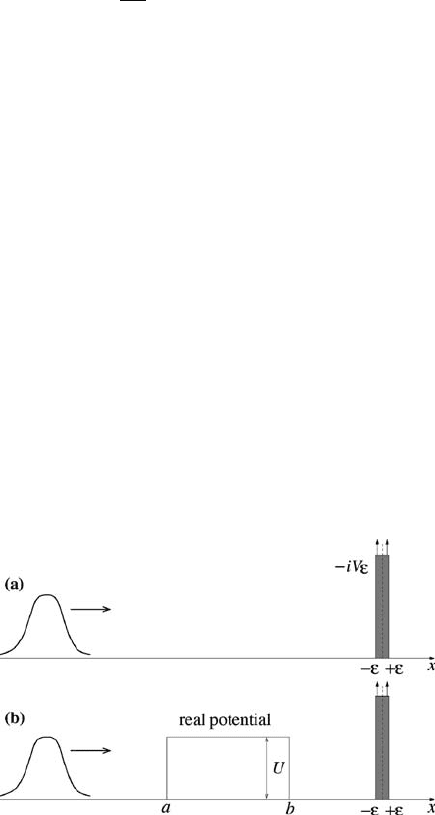
Let us consider an asymptotically free, moving wave packet impinging on a
potential −iV
ε
located in −ε ≤ x ≤ ε and a real potential U localized between
a and b. The Hamiltonian is given by
H
c
=
.p
2
2m
−iV
ε
χ
[−ε,ε]
+Uχ
[a,b]
(.x) , (4.25)
where χ
[a,b]
is one in [a, b] and zero elsewhere. In the atom-laser model we have
V
ε
= Ω
2
/2γ . For the limit ε → 0 we consider two cases:
(a) V
ε
∼ ε
−1
,
(b) V
ε
∼ ε
−α
, 0 <α<1 .
In the limit ε → 0, case (a) yields an imaginary delta-function potential whereas
case (b) implies a weaker and less perturbing measurement.
4.4.3.1 Free Wave Packet
The easiest case is a free incoming wave packet of positive momenta, see Fig. 4.5a.
Its Hamiltonian is given by Eq. (4.25) with U = 0. Imposing standard matching
conditions, in the limit ε
(a)
→ 0 one obtains the same result as for an imaginary δ-like
potential. In the limit ε
(b)
→ 0 the measurement region obviously has no effect on
the motion of the atoms. However, by operator normalization a finite distribution is
obtained in both limits,
Π
ON
→ Π
K
. (4.26)
Fig. 4.5 Measurement scheme for the arrival time distribution at x = 0 of a wave packet coming
from the left. (a) Free wave packet. (b) Tunneling wave packet

86 A. Ruschhaupt et al.
Now let us look at the case of general states with U = 0. The Hamiltonian H
c
in Eq. (4.25) commutes with the parity operator and, as a consequence, so does the
operator
.
Π
t
. Therefore, its matrix elements between symmetric and antisymmetric
states vanish, so that the operator normalization of
.
Π
t
can be performed in the sub-
spaces of symmetric and antisymmetric states independently by expanding in sym-
metric and antisymmetric eigenfunctions, respectively. Although for antisymmetric
states the wave function vanishes at x = 0, the operator normalization preserves
a finite arrival time distribution even when the width of the measurement region
contracts to 0. A state ψ can be written in terms of its symmetric and antisymmetric
part, and in the limit ε
(a)
→ 0 and ε
(b)
→ 0 one obtains
Π
ON
ψ
(t) =
2πm
±
∞
0
dk
˜
ψ(±k)
√
k e
−ik
2
t/2m
2
. (4.27)
This expression has been proposed in Refs. [55, 69] on more heuristic grounds as a
generalization of the distribution from left (or right) incoming states to general free
states.
4.4.3.2 Effect of a Real Barrier
When the real barrier is present, U = 0, see Fig. 4.5b, the operator-normalized
arrival time distribution of a tunneled particle takes, with ε
(b)
→ 0, the form
Π
ON
pot
(t) =
2πm
dk
˜
ψ(k)e
−ik
2
t/2m
√
k
T (k)
|T (k)|
2
.
The effect of the additional potential is the introduction of a phase factor which
comes from the transmission amplitude T (k) of the real potential. This means that
the Hartman effect can be observed [46] in the arrival time distribution, i.e., the
arrival time peak becomes independent of the barrier width.
In the above setup an incoming free particle was prepared far to the left and
then interacted with an external real potential. If one includes the real potential as
part of the preparation procedure through which the particle passes far away on the
left, the incident state for operator normalization purposes would be the normalized
transmitted wave packet. For the positive results, i.e., transmissions, the normalized
incoming free state is then characterized by T (k)
˜
ψ(k)/(
%
dk |T (k)
˜
ψ(k)|
2
)
1/2
instead
of
˜
ψ(k). Applying Kijowski’s distribution to the incoming free state thus prepared
gives
Π
T
K
(t) =
2πm
dk
˜
ψ(k)e
−ik
2
t/2m
√
kT(k)
2
×
dk |T (k)
˜
ψ(k)|
2
−1
. (4.28)
This expression coincides with the proposal of Refs. [60, 69, 13, 15].
4 Detector Models for the Quantum Time of Arrival 87
4.5 Kinetic Energy Densities
In this section we continue exploring the strong interaction limit, first via “normal-
ization by hand” in Sect. 4.5.1 and then by deconvolution in Sect. 4.5.2. This will
produce a kinetic energy density that is approximately related to the other local
densities in Sect. 4.5.3 by expanding over the momentum width.
4.5.1 Kinetic Energy Density, Fluorescence, and Atomic
Absorption Rate in an Imaginary Potential Barrier
In the complex potential model and for large V
0
, V
0
2
k
2
/2m, one has in leading
order (the barrier is now located between 0 and L and the wavepacket comes from
the left)
Π(t)
2
πm
√
mV
0
∞
0
dk
∞
0
dk
0
ψ
∗
(k)
0
ψ(k
)e
i(k
2
−k
2
)t/2m
kk
.
This expression is independent of the barrier length L as a result of the large V
0
limit, so the same result is obtained with an imaginary step potential −iV
0
Θ(.x)or
with a very narrow barrier as in the previous section.
The normalization constant is given by
%
Π(t)dt 2k
0
(mV
0
)
−1/2
, where the
mean wave vector reads k
0
=
%
|
0
ψ(k)|
2
k dk, and the normalized absorption rate
(“normalization by hand”) is
Π
N
(t)
2πmk
0
∞
0
dk
∞
0
dk
0
ψ
∗
(k)
0
ψ(k
)e
i(k
2
−k
2
)t/2m
kk
. (4.29)
With the freely moving wave packet ψ
f
(x, t), this can finally be rewritten in the
form
Π
N
(t)
mk
0
ψ
f
(t)|
.
kδ(.x)
.
k|ψ
f
(t) . (4.30)
Now, the right-hand side is just the expectation value at time t of the kinetic energy
density operator corresponding to Eq. (4.3) (we shall call it .τ
(1)
, and similarly .τ
(2,3)
correspond to Eqs. (4.4) and (4.5)
8
) evaluated at the origin! Thus, if p
0
= k
0
is the
initial average momentum we have, in the limit V
0
→∞,
lim
V
0
→∞
Π
N
(t) =
2
p
0
.τ
(1)
(x = 0)
t
. (4.31)
8
These three operators lead to the three versions of the kinetic energy density commonly found in
applications [9, 23, 27, 11, 10, 86, 87, 66].

88 A. Ruschhaupt et al.
Note that the averages are computed with the freely moving wave function.
The results are different from the ones obtained by operator normalization as
applied in the previous section, i.e., by normalizing Π
ON
to 1. It is possible, however,
to get the same kinetic energy density in (4.31) by using p
0
/2 as normalization
constant [48].
4.5.2 Kinetic Energy Density from First-Photon Measurement
and Deconvolution
If the atom-laser model is used to implement the complex potential V
0
, then V
0
=
Ω
2
/2γ , with γ much larger than the kinetic energy. The limit V
0
→∞implies
a simultaneous change of Ω and γ but, experimentally, the Rabi frequency Ω is
easier to adjust than γ . To overcome this problem, we describe now a procedure
that allows to keep the value of γ fixed.
We again consider the atom-laser model but now for the limit Ω →∞and
γ = const. In that case, the simplified description of the evolution of the wave
function by means of the imaginary potential is not feasible, and one has to solve
the full two-channel problem. This has been done in Refs. [31, 47] and “normalizing
by hand” with a constant the resulting photon detection rate Π
N
(t) becomes
Π
N
(t)
2πmk
0
∞
0
dkdk
0
ψ
∗
(k)
0
ψ(k
)e
i(k
2
−k
2
)t/2m
γ kk
γ +i(k
2
−k
2
)/m
.
For γ large compared to the kinetic energy of the incident atom, Eq. (4.29) is
recovered, but for finite γ there is a delay in the detection rate. This can be elim-
inated by means of a deconvolution with the first-photon distribution W(t) for an
atom at rest [31, 47]. Using the ansatz
Π(t) = Π
id
(t) ∗W (t) ,
and deconvolution,
Π
id
(t)
2
p
0
.τ
(1)
(x = 0)
t
holds as before.
4.5.3 Relations Between Different Local Densities
Here we briefly discuss a formal connection between the arrival time distribution of
Kijowski (4.1) and the kinetic energy densities .τ
(1)
(x = 0)
t
and .τ
(2)
(x = 0)
t
.
For wave packets peaked around some k
0
in momentum space, the operator
.
k
1/2
acting on ψ
f
in Eq. (4.1) can be expanded in terms of (
.
k −k
0
),

4 Detector Models for the Quantum Time of Arrival 89
.
k
1/2
= k
1/2
0
+
1
2
k
−1/2
0
(
.
k −k
0
) −
1
8
k
−3/2
0
(
.
k − k
0
)
2
+O
(
.
k −k
0
)
3
. (4.32)
We take k
0
to be the first moment of the momentum distribution, k
0
=
%
|
0
ψ(k)|
2
k dk.
Inserting the expansion in Eq. (4.32) into Eq. (4.1) yields in zeroth order a very
simple result,
Π
K
(t) = v
0
|ψ
f
(0, t)|
2
+O(
.
k − k
0
) ,
i.e., the particle density times the average velocity v
0
= k
0
/m. In first order in
(
.
k −k
0
) one obtains the flux at x = 0,
Π
K
(t) = J(0, t) +O
(
.
k − k
0
)
2
,
and to second order the expression
Π
K
(t) = J(0, t) +
1
2p
0
Δ(0, t) +O
(
.
k − k
0
)
3
,
where
Δ(0, t) =.τ
(1)
(x = 0)
t
−.τ
(2)
(x = 0)
t
.
For states with positive momentum, which we are considering here, the first order,
namely the flux, is correctly normalized to 1 and so is the second order since the time
integral over Δ is easily shown to vanish. This difference only provides a local-in-
time correction to J that averages out globally. Its quantum nature can be further
appreciated by the more explicit expression
1
2p
0
Δ =
2
8mp
0
∂
2
|ψ
f
(0, t)|
2
∂x
2
.
4.6 Disclosing Hidden Information Behind the Quantum Zeno
Effect: Pulsed Measurement of the Quantum Time of Arrival
This section completes our analysis of the strong interaction regime and deals with
pulsed measurements simulated by instantaneous projections as in Fig. 4.2. When
they are performed very frequently the wave packet is totally reflected. The first
discussions of the Zeno effect, understood as the hindered passage of the system
between orthogonal subspaces because of frequent instantaneous measurements,
emphasized its problematic status and regarded it as a failure to simulate or define
quantum passage-time distributions [4–6, 62]. We shall see, however, that in fact
there is a “bright side” of the effect: by normalizing the little bits of norm removed
at each projection step,

90 A. Ruschhaupt et al.
Π
Zeno
= lim
δt→0
−δN/δt
1 − N(∞)
,
a physical time distribution defined for the freely moving system emerges,
9
the same
kinetic energy density found in the previous section [33].
4.6.1 Zeno Time Distribution
To find Π
Zeno
we shall put the parallelism hinted by Allcock between the pulsed
measurement and the continuous measurement on a firmer, more quantitative basis.
We shall define formally the pulsed and continuous measurement models as well as
an intermediate auxiliary model [7] that will be a useful bridge between the two.
The “chopping process” amounts to a periodic projection of the wave function
onto the x < 0 region at instants separated by a time interval δt. The wave func-
tions immediately after and before the projection at the instant t
j
are related by
10
ψ(x, t
j
+
) = ψ(x, t
j
−
)Θ(−x).
The wave at x > 0 may also be canceled with a “kicked” imaginary poten-
tial
.
V
k
=
.
V δtF
δt
(t), where the subscript “k” stands for “kicked” and F
δt
(t) =
∞
j=−∞
δ(t − jδt),
.
V =−i
.
V
I
=−iV
0
Θ(.x) , (4.33)
provided
V
0
δt . (4.34)
The general (and exact) evolution operator is obtained by repetition of the basic unit
.
U
k
(0,δt) = e
−i
.
H
0
δt/
e
−i
.
V δt/
, (4.35)
where
.
H
0
=−(
2
/2m)∂
2
/∂x
2
.
For the continuous model, the evolution under the imaginary potential (4.33) is
given by
.
U(0,δt) = e
−i(
.
H
0
+
.
V )δt/
= e
−i
.
H
0
δt/
e
−i
.
V δt/
+O(δt
2
[
.
V ,
.
H
0
]/
2
) .
Comparing with Eq. (4.35) we see that the kicked and continuous models agree
when
9
There are other “positive” uses of the Zeno effect, such as reduction of decoherence in quantum
computing, see, e.g., [73, 36].
10
Experimental realizations of repeated measurements will rely on projections with a finite fre-
quency and pulse duration that provide approximations to the ideal result. Feasible schemes may
be based on pulsed localized resonant laser excitation [85] or sweeping with a detuned laser [29].
4 Detector Models for the Quantum Time of Arrival 91
δt
2
|[
.
V ,
.
H
0
]|/
2
1 . (4.36)
At first sight a large V
0
δt/, see Eq. (4.34), seems to be incompatible with this
condition so that the three models would not agree [33]. In fact the numerical cal-
culations show a better and better agreement between the continuous and pulsed
models as V
0
→∞when δt and V
0
are linked by some predetermined (large)
constant α, δt = α/V
0
.
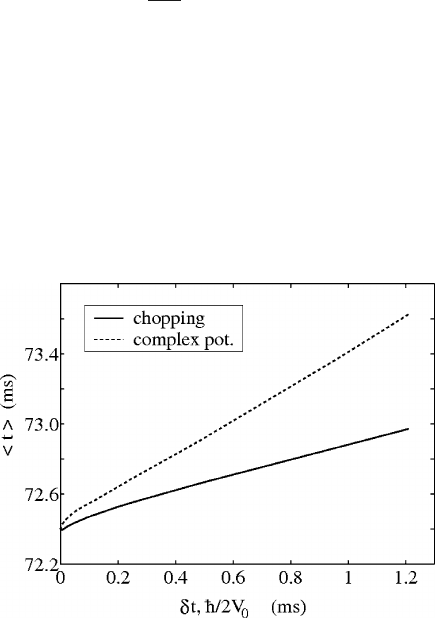
Figures 4.6 and 4.7 illustrate this agreement: in Fig. 4.6 the average absorption
time, t=
%
∞
0
(−dN/dt)tdt/[1−N(∞)], is shown versus δt (chopping) and /2V
0
(complex potential) for a Gaussian wave packet sent from the left toward the origin.
The lines bend at high coupling because of reflection. The normalized absorption
distribution as V
0
→∞has been derived in Sect. 4.5.1, see Eq. (4.30):
Π
N
(t) =
mk
0
ψ
f
(t)|
.
kδ(.x)
.
k|ψ
f
(t) , (4.37)
where k
0
is the initial average momentum. Figure 4.7 shows for a more challenging
state, a combination of two Gaussians, that this ideal distribution becomes indistin-
guishable from the normalized chopping distribution when δt is small enough. Even
the minor details are reproduced and differ from J and Π
k
,alsoshown.
To understand the compatibility “miracle” of the inequalities (4.34) and (4.36),
we apply the Robertson–Schr
¨
odinger (generalized uncertainty principle) relation,
[
.
V ,
.
H
0
]
≤ 2|ΔV
I
|ΔH
0
,
Fig. 4.6 Average absorption times evaluated from −dN/dt (normalized) for the projection method
and the continuous (complex potential) model. The initial state is a minimum uncertainty product
Gaussian for
23
Na atoms centered at x
0
=−500 μm with Δx = 23.5 μm and average velocity
0.365 cm/s. In all numerical examples negative momentum components of the initial state are
negligible