
Muga G. Time in Quantum Mechanics - Vol. 2
Подождите немного. Документ загружается.

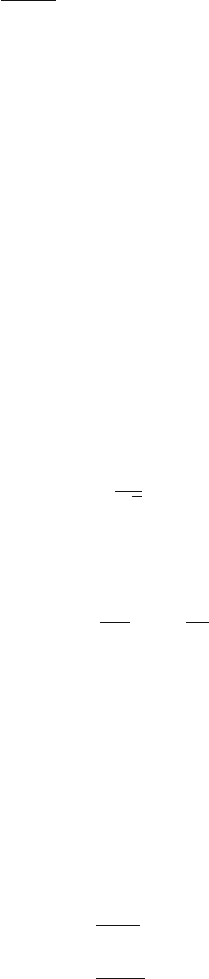
102 J. Mu
˜
noz et al.
"
.
T
2
D
=
∞
0
dk(T
2
)
kk
|k|ψ
in
|
2
=
∞
0
dk(|T
kk
|
2
+|T
k−k
|
2
)|k|ψ
in
|
2
=
∞
0
dk
4π
2
m
2
2
k
2
×
x
2
x
1
dx |φ
k
(x)|
2
!
2
+
x
2
x
1
dx φ
∗
k
(x)φ
−k
(x)
2
|k|ψ
in
|
2
, (5.13)
with a term without classical counterpart.
5.3 The Free Particle Case
In order to get a better grasp of the abstract results, it is adequate to illustrate them
with the explicitly solvable free particle case for a region D that extends from
x
1
= 0tox
2
= L. Indeed the humble freely moving particle turns out to be
rather interesting and surprisingly complex with regard to the dwell time. The free
particle Hamiltonian is doubly degenerate; we can choose the degeneracy indices to
coincide with the sign of the momentum, and, on computation, with due attention
to the different normalization of the energy and the momentum eigenfunctions, we
find the following generalized eigenfunctions of the free dwell-time operator:
|t
±
(k), D=
1
√
2
1
|k±e
ikL
|−k
2
, (5.14)
where
t
±
(k) =
mL
k
1 ±
1
kL
sin kL
(5.15)
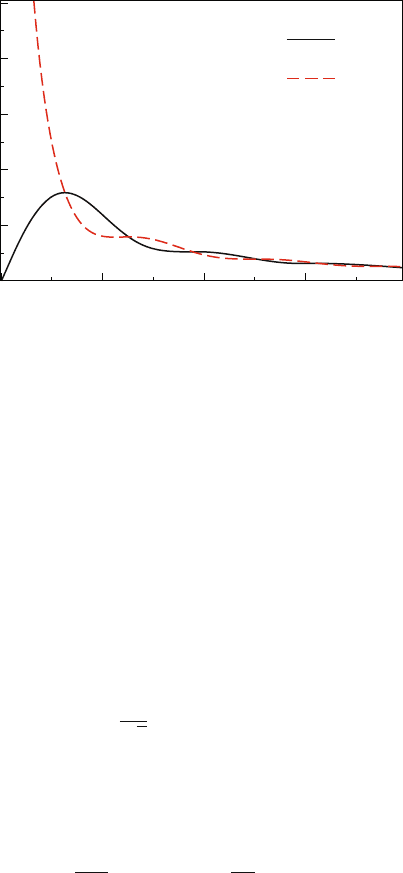
are the corresponding eigenvalues, in clear contrast to the classical time t
class
=
mL/(|k|), see Fig. 5.1. It is important to notice that the inverse function is mul-
tivalued. Due to this multivaluedness we have kept generalized eigenfunctions with
the dimensionality of |k, instead of normalizing them to the delta function in dwell
times. With this normalization it is easy to check that the resolution of the identity
has the form (5.9).
Interestingly, t
−
(k) tends to 0 as k → 0, one more very nonclassical effect that is
better understood from the coordinate representation of the eigenvectors,
x|t
+
=
e
ikL/2
π
1/2
cos[k(x − L/2)] ,
x|t
−
=
ie
ikL/2
π
1/2
sin[k(x − L/2)] , (5.16)
5 Dwell-Time Distributions in Quantum Mechanics 103
0
5
10
15
q
0.2
0.4
0.6
0.8
1.0
t
–
t
+
Fig. 5.1 (Color online) Eigenvalues of the dwell-time operator as a function of q = kL, in units
mL
2
/, for a freely moving particle in a region of length L
symmetric and antisymmetric with respect to the interval center. x|t
−
vanishes at
L/2, so the particle density tends to vanish in D with longer wavelengths as k → 0.
The dwell-time operator for an interval D
= [a, a +L] is obtained from the one
above by translation:
.
T
D
= e
−ia
.
k
.
T
D
e
ia
.
k
, (5.17)
and, as a consequence, the eigenvalues are not modified, while the new eigenfunc-
tions are easily computed as
|t
±
(k), D
=e
−ia
.
k
|t
±
(k), D
=
1
√
2
1
e
−iak
|k±e
ik(a+L)
|−k
2
. (5.18)
It is straightforward to compute directly the action of
.
T
D
in the wavenumber
representation,
k|
.
T
D
|ψ=
mL
|k|
0
ψ(k) +e
−ikL
1
kL
sin
(
kL
)
0
ψ(−k)
, (5.19)
where
0
ψ(k) =k|ψ. This allows us to study the functional aspects of the opera-
tor. In particular, it is easy to check, using the requirement of normalizability, that
the domain of the operator is given by functions such that
0
ψ(k)/k→0ask→0. The
requirement of symmetry does not add further limitations to the domain. As to the
deficiency indices, they are computed to be (0, 0). These computations are carried
out for the interval D = [0, L], but, given the unitary equivalence of other intervals
104 J. Mu
˜
noz et al.
of the same length (see Eq. 5.17), the same results carry over for regions composed
of an arbitrary number of closed intervals.
It should come as no surprise that functions in the domain of the (free particle)
dwell-time operator must vanish at k = 0 fast enough, since the characteristic evo-
lution of a generic wavefunction is dictated by the free propagator, with its t
−1/2
temporal behavior. This entails the divergence of the dwell time unless the state has
no k = 0 component and the amplitude decay is faster than k as k → 0(fora
simple analysis, see [10]). The divergence of the average dwell time for states with
nonvanishing k = 0 components also occurs for ensembles of classical particles.
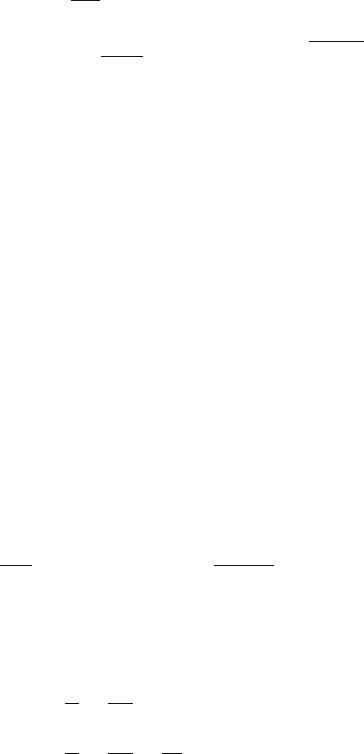
To calculate the distribution Π
ψ
(t), see Eqs. (5.10) and (5.11), we have in this
case the characteristic function
f
ψ
(ω) =
∞
−∞
dk e
iωmL/(|k|)
cos
#
ωm
k
2
sin(kL)
$
|
0
ψ(k)|
2
+i
∞
−∞
dk e
iωmL/(|k|)
sin
ωm
|k|k
sin(kL)
e
−ikL
0
ψ(k)
0
ψ(−k) .
(5.20)
The distribution Π
ψ
(t) has support only on the positive semi-axis, as can be seen
from the explicit expression for the eigenvalues. This, in turn, is a nontrivial check
of the correctness of the definition.
A further initially surprising result of this analysis is that for highly monochro-
matic wavepackets (i.e., highly concentrated in one point in the momentum repre-
sentation), the probability density for dwell times is generically bimodal because of
the two eigenvalues t
±
(k) expounded in Eq. (5.15). An experimental verification of
the eigenvalues and of the quantum nature of the dwell time, could be realized with
the aid of a matter wave mirror located at a point X > L, reflecting an incident
plane wave |k. The resulting standing wave would take the form, up to a global
phase factor,
|ψ
X
=|k−e
−2ikX
|−k . (5.21)
We may now compute the average dwell time between 0 and L,
ψ
X
|T|ψ
X
=T
kk
+T
−k−k
−2Re(e
−2ikX
T
k−k
)
= 2
Lm
|k|
1 − cos[k(L +2X)]
sin(kL)
kL
, (5.22)
which oscillates between the maximum and minimum values 2t
±
, see (5.15); they
occur at specific locations of the mirror, namely
X
−
=−
L
2
+
πn
k
, (5.23)
X
+
=−
L
2
+
πn
k
+
π
2k
(5.24)

5 Dwell-Time Distributions in Quantum Mechanics 105
(n integer such that X > L), for which the standing wave |ψ
X
becomes proportional
to |t
±
. The proportionality factor 2
1/2
accounts for the fact that the extrema corre-
spond to twice the eigenvalues. This is easy to interpret physically with reference
to a classical particle which, under similar circumstances, would traverse the region
twice, first rightward and then leftward. For any X between the privileged values X
±
given above, |ψ
X
is a linear superposition of the dwell-time eigenvectors and thus
the resulting average dwell time lies in a continuum between twice the eigenvalues.
In a proposed experiment a highly monochromatic continuous beam would be sent
toward the mirror and the particle density could be measured between 0 and L by
fluorescence or other means. The oscillations of the signal as a function of X would
be in sharp contrast to the classical case, for which the beam density and dwell time
would remain unaffected by a change of the mirror’s position.
5.3.1 A Comparison with Classicality
We have already noticed some of the peculiarities of the quantum dwell time com-
pared to the classical dwell time. Here we elaborate this comparison further. Con-
sider a classical ensemble of free particles, described by the initial probability den-
sity on phase space, F(x, p). The dwell-time distribution for this case is given by
Π
class
(t) =
dx dp δ
t −
mL
|p|
F(x, p)
=
mL
t
2
dx
F
x,
mL
t
+ F
x,
mL
−t
, (5.25)
that is to say, the marginal momentum distribution evaluated at mL/t and −mL/t
and multiplied by the normalization factor mL/t
2
. On the other hand, distribution
(5.11) obtained from Eq. (5.20) includes effects of interferences between positive
and negative momentum components in two different ways. In the first place, there
is the obvious interference of the last line of (5.20); but in addition to this, the
argument of the cosine also reveals these effects. In order to see better this point, let
us examine a different operator,
.
t
D
:=
.
λ
+
.
T
D
.
λ
+
+
.
λ
−
.
T
D
.
λ
−
= mL/|.p| , (5.26)
where
.
λ
±
are the projectors onto the positive/negative momentum subspaces. Notice
that
.
λ
±
do not commute with
.
T
D
. The last form in Eq. (5.26), specific of free motion,
is particularly transparent and reproduces the one of the classical dwell time. The
eigenfunctions are |±k, k > 0, and the corresponding eigenvalues are twofold
degenerate and equal to the classical time, mL/|k|. The distribution of dwell times
for this operator, and for positive-momentum states, is given by
106 J. Mu
˜
noz et al.
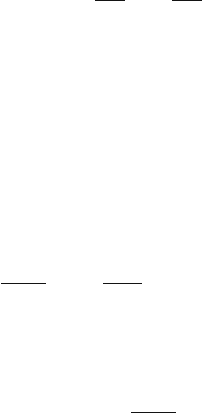
π
ψ
(τ ) =
mL
τ
2
0
ψ
mL
τ
2
, (5.27)
which coincides with the classical distribution for initial wave functions whose sup-
port is limited to positive momenta. In this manner we see that distribution (5.11)
incorporates interferences even if only positive momenta are present. To be even
more explicit, observe that, for a state ψ with only positive momentum components,
the second moment of the dwell-time distribution for operator (5.1) is given by
"
.
T
2
D
=
∞
0
dk(T
2
)
kk
|
0
ψ(k)|
2
=
∞
0
dk(|T
kk
|
2
+|T
k−k
|
2
)|
0
ψ(k)|
2
=
∞
0
dk
m
2
L
2
k
2
2
1 +
1
k
2
L
2
sin
2
(
kL
)
0
ψ(k)
2
, (5.28)
which contrasts with
"
.
t
2
D
=
∞
0
dk
m
2
L
2
k
2
2
0
ψ(k)
2
, (5.29)
thus indicating that indeed the second term is due to quantum interference.
As said above, there is another rather striking way of seeing this point by consid-
ering a highly monochromatic wavepacket. The classical distribution would have a
very sharply defined peak around mL/ p
0
, where p
0
is the central momentum of the
wavefunction, p
0
= k
0
; on the other hand, the quantum distribution would have
two sharp peaks centered on t
+
(k
0
) and t
−
(k
0
). The distance between peaks goes to
0asp
0
increases, as was to be expected in the classical limit.
The on-the-energy-shell version of
.
t
D
, t, is also worth examining. By factoring
out an energy delta function as in Eq. (5.4) we get for a plane wave |k the average
t
kk
= mL/(k), which is equal to T
kk
, but the second moment differs, (t
2
)
kk
=
(t
kk
)
2
= (T
kk
)
2
≤ (T
2
)
kk
; in other words, the variance on the energy shell is 0 since
only one eigenvalue is possible for t. Contrast this with the extra term in Eq. (5.28),
which again emphasizes the nonclassicality of the dwell-time operator
.
T
D
and its
quantum fluctuation.
5.4 The Scattering Case
Let us now study the dwell time in a potential barrier or well without bound states,
that is, the dwell time in an interval which coincides with the finite support of the
potential V (x), which presents no bound states. For simplicity, we shall assume as
before that this interval starts at point x = 0 and has length L.Weshallusethe
complete basis of incoming scattering stationary states,
k
+
, with the following
position representation, for k > 0,
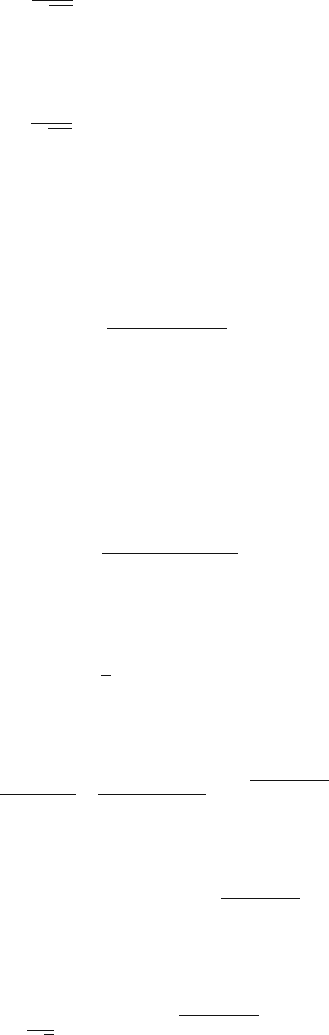
5 Dwell-Time Distributions in Quantum Mechanics 107
"
x
k
+
=
1
√
2π
e
ikx
+ R
l
(k)e
−ikx
for x < 0
T
l
(k)e
ikx
. for x > L
, (5.30)
whereas, for k < 0, we have
"
x
k
+
=
1
√
2π
T
r
(−k)e
ikx
for x < 0
e
ikx
+ R
r
(−k)e
−ikx
for x > L
(5.31)
(the superscripts l, r in T
l
, R
l
and T
r
, R
r
stand for left and right incidence, respec-
tively). We have omitted any explicit expression in the interval [0, L] because of the
potential dependence. The eigenvalues and eigenstates of the dwell-time operator
can be formally computed using
.
H
k
+
= (k
2
2
/2m)
k
+
. To that end define
ξ(k) =
"
k
+
χ
D
(.x)
k
+
2σ (k)
, (5.32)
where
σ (k) =
"
−k
+
χ
D
(.x)
k
+
(5.33)
and
e
iϕ(k)
=
"
−k
+
χ
D
(.x)
k
+
σ (k)
. (5.34)
Additionally, for the sake of compactness in later formulae, let
μ(k) =
1
2
[
ξ(−k) −ξ(k)
]
. (5.35)
We then have that the eigenvalues of the dwell-time operator are given by
t
±
(k) =
2πmσ (k)
|k|
ξ(k) +ξ(−k)
2
±
/
1 + μ
2
(k)
, (5.36)
while the eigenfunctions are
|t
±
(k)=N
±
,
k
+
+e
iϕ(k)
#
μ(k) ±
/
1 + μ
2
(k)
$
−k
+
-
(5.37)
and the normalization is given by
N
±
=
1
√
2
#
1 + μ
2
±μ
/
1 + μ
2
(k)
$
−1/2
. (5.38)
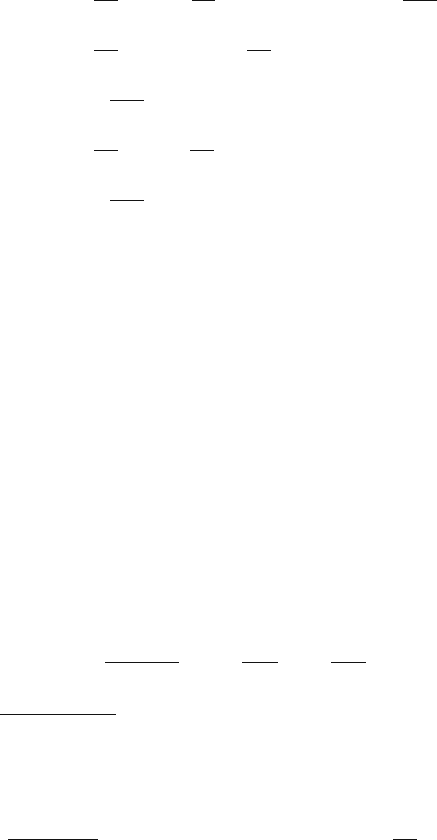
108 J. Mu
˜
noz et al.
In fact, we can relate the quantities ξ(k), σ (k), and ϕ(k) to scattering data whenever
the support of the scattering potential is completely included in the region D.Let
¯χ
D
(x) be the complementary function to χ
D
(x). We can compute
"
k
+
¯χ(.x)
k
+
explicitly, and using unitarity and the conditions this imposes on the scattering
amplitudes, we are led to the following expressions (where we omit the arguments
of the scattering amplitudes, since all are evaluated at k, and denote derivative with
respect to k as ∂
k
):
"
k
+
χ
D
(.x)
k
+
=
L
2π
T
l
2
+
i
2π
1
R
l
∂
k
¯
R
l
+ T
l
∂
k
¯
T
l
2
+
i
4πk
1
¯
R
l
− R
l
2
,
"
−k
+
χ
D
(.x)
−k
+
=
L
2π
#
1 +
R
r
2
$
+
i
2π
1
R
r
∂
k
¯
R
r
+ T
r
∂
k
¯
T
r
2
+
i
4πk
1
e
−2ikL
¯
R
r
−e
2ikL
R
r
2
,
"
−k
+
χ
D
(.x)
k
+
=
L
2π
T
l
¯
R
r
+
i
2π
1
R
l
∂
k
¯
T
r
+ T
l
∂
k
¯
R
r
2
+
i
4πk
1
¯
T
r
−e
2ikL
T
l
2
. (5.39)
Notice that the second term of each of the previous expressions can be identified
with the corresponding on-shell matrix elements of −(im/k)S
†
∂
k
S. That is, with
Smith’s delay time.
5.4.1 The Square Barrier
For the specific case of a square barrier in which V (x) = V
0
[θ(x − L) −θ(x)], with
θ(x) being Heaviside’s unit step function, we can put to good use the symmetries
of the Hamiltonian, namely x → L − x and k →−k. These are realized on the
scattering states as
L − x|k
+
=e
ikL
x
−k
+
, (5.40)
whence ξ(k) = ξ (−k) and μ(k) = 0. Furthermore,
"
k
+
χ
D
(.x)
k
+
=
L
|
T (k)
|
2
2πκ
2
k
2
−
mV
0
2
1 +
1
2κ L
sin
(
2κ L
)
, (5.41)
where κ =
/
k
2
−2mV
0
/
2
, real and positive for positive above-the-barrier momenta
and with positive imaginary part for tunneling momenta. After some cumbersome
algebra, one readily obtains
t
±
(k) =
|
T (k)
|
2
mL
2
|
k
|
κ
2
1
k
2
+κ
2
±
κ
2
−k
2
cos κ L
2
1 ±
1
kL
sin kL
, (5.42)
5 Dwell-Time Distributions in Quantum Mechanics 109
which is to be compared with (5.15) namely the free particle result gets modulated
by the transmission amplitude and a potential-dependent oscillatory factor. For high
energies the modulating term tends to 1, and we recover the free particle case, as one
should. For small momenta, both eigenvalues tend linearly to 0 with the momentum,
unlike the free case where one of them diverges. It is also relevant that the dwell-time
eigenvalues are bounded above, and therefore the average value is also bounded! In
order to have a better grasp of this result, it is convenient to express the eigenvalues
in dimensionless terms (k = q/L, V
0
=
2
Q
2
/(2mL
2
)):
t
±
(k) =
2mL
2
q ±
q
√
q
2
−Q
2
sin
/
q
2
− Q
2
2q
2
− Q
2
± Q
2
cos
/
q
2
− Q
2
, (5.43)
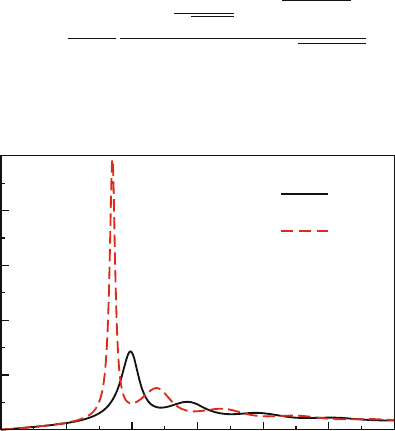
see Fig. 5.2.
0
5
10
15
20
25
30
q
0.0
0.2
0.4
0.6
0.8
1.0
t
–
t
+
Fig. 5.2 (Color online) Dwell-time eigenvalues for the square barrier, in units of mL
2
/,forQ = 8
5.4.2 Average Dwell Time from Fluorescence Measurements
In this section we shall model the measurement of the average dwell time τ
D
=
.
T
D
of an ultra-cold atom at a square barrier created by a laser shining perpendicular to
its motion with homogeneous intensity between 0 and L.
Consider a two-level system coupled in a spatial region to an off-resonance laser
with large detuning, Δ γ,Ω, where Δ is defined as the laser frequency minus
the frequency of the atomic transition, γ is the decay constant (inverse lifetime or
Einstein’s coefficient), and Ω is the Rabi frequency.
The amplitude for the atomic ground state up to the first photon detection is
governed then by the following effective potential, see [25, 36] or Chap. 4:

110 J. Mu
˜
noz et al.
V (x) = V
R
−iV
I
=
Ω
2
4Δ
−i
γΩ
2
8Δ
2
, (5.44)
so that the average detection delay (lifetime of the ground state if the atom at rest
is put in the laser-illuminated region) is, see, e.g., [34], 4Δ
2
/Ω
2
γ . Whereas γ is
fixed for the atomic transition, Ω and Δ may be controlled experimentally, and
the ratio Ω
2
/Δ can always be chosen so that the real part of V remains constant.
This still leaves some freedom to fix their exact values which we may use to set
the imaginary part. If we do so making sure that at most one fluorescence photon
is emitted per atom, i.e., τ
D
4Δ
2
/Ω
2
γ , the fluorescence signal produced by
an atomic ensemble will be proportional to the absorption probability A. This signal
provides, after calibration to take into account the detector solid angle and efficiency,
an approximation for the derivative (5.46) and therefore the average dwell time for
the potential (5.44) is
τ
D
≈ A/(2V
I
) . (5.45)
This follows by integrating −dN/dt = (2V
I
/)ψ(t)|χ
D
(.x)|ψ(t) over time, N
being the surviving norm, and A=1−N the absorption (fraction of atoms detected).
In the limit V
I
→ 0 and for highly monochromatic incidence, the average (station-
ary) dwell time at the real potential is obtained:
T
kk
= lim
V
I
→0
(/2)∂
V
I
A(k) , (5.46)
where A(k) is the total absorption probability for incident wavenumber k. The equiv-
alence of this quantity with (t
+
(k) +t
−
(k))/2 can readily be checked.
One may think of relaxing the one-photon condition to get a proxy for the dwell
time of an individual atom of the ensemble from the photons detected in an idealized
one-atom-at-a-time experiment. For V
R
negligible versus E, it could be expected
that for some regime this distribution of emitted photons would also be bimodal.
For the bimodality to be observed, the characteristic interval between modes (/E,
where E is the particle’s energy) should be greater than the characteristic inter-
val between successive emission of fluorescence photons, but these conditions and
Δ>γ are not compatible, and similar difficulties are found for on-resonance exci-
tation. A pending task is the application of (deconvolution or operator normaliza-
tion) techniques which have been successfully applied to the arrival time, at least in
theory.
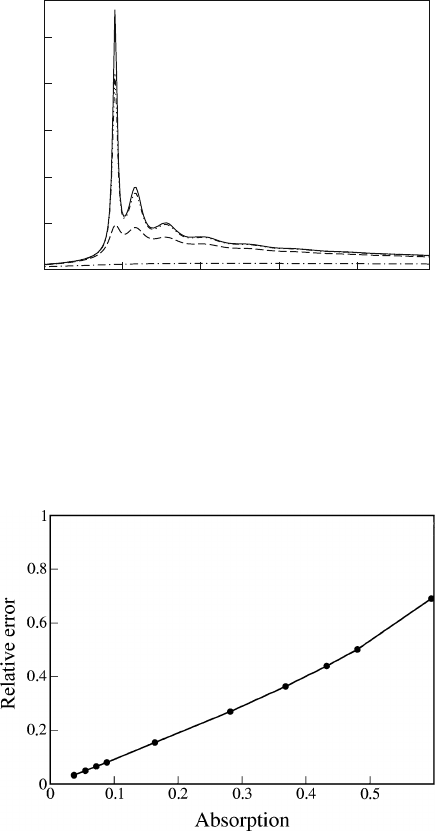
Figure 5.3 shows the exact dwell time and approximations for several values of
V
I
calculated for a transition of Cs atoms (the details are in the figure caption). A
larger V
I
implies larger errors but also a stronger signal. In practice the minimal
signal requirements will determine the accuracy with which the dwell time can be
measured. Figure 5.4 shows the relative error of the dwell-time maxima versus the
corresponding absorption probability. In these figures the beam is monochromatic.
We can check the reality of the quantum prediction at hand differing from the clas-
sical one, namely that for all ingoing waves the quantum mechanical dwell time is
bounded, unlike the classical one.
5 Dwell-Time Distributions in Quantum Mechanics 111
0.2 0.3 0.4
0.5
0.6
v(cm/s)
1
2
3
4
5
τ
D
(ms)
Fig. 5.3 Exact average dwell time (solid line) for Cs atoms crossing a square barrier of width 2 μm
and height 8.2674 × 10
3
s
−1
(in velocity units, 0.28 cm/s) versus incident velocity. Approxima-
tions are calculated with Eq. (5.45) for V
I
= 3.307 s
−1
= V
1
(indistinguishable from the exact
result, Δ = 2500γ , Ω = 1.57γ ), 10 V
1
(double dotted–dashed line, Δ = 250γ , Ω = 0.5γ ), 10
2
V
1
(dashed line, Δ = 25γ , Ω = 0.16γ ), and 10
3
V
1
(dotted–dashed line, Δ = 2.5γ , Ω = 0.05γ ).
The transition is at 852 nm with γ = 33.3×10
6
s
−1
; Δ and Ω are obtained from Eq. (5.44)
Fig. 5.4 Relative errors, calculated from the maxima of exact and approximate results, |τ
D
(exact)−
τ
D
(approx)|/τ
D
(exact), versus the absorption (i.e., detection) probability used to calculate
τ
D
(approx) at the maximum. Same system as for the previous figure
5.5 Some Extensions
In this section we present miscellaneous extensions of the previous formalism and
results: for bound states, for dwelling into states rather than in a spatial region, and
for multiparticle systems.