
Nelson V. Wind Energy. Renewable Energy and the Environment
Подождите немного. Документ загружается.

Wind Turbines 97
NREL has a site for hybrid systems for village power, Renewables for Sustainable Village
Power (RSVP). The RSVP Village Power Project Database contained around 150 projects (wind
is part of 50 projects) from over 30 countries. Project information included basic, technological,
economic, nancial, host country, lessons learned, pictures and graphics, and contact information.
The database is now archived and is not available online, and there have been a large number of
projects installed since 2004. For example, China now has over 700 village installations (capacity,
16 MW) powered by mini hydro, PV, or wind/PV hybrid systems [26]. China has also installed a
few wind/PV/diesel systems [27].
5.10.5 SUMMARY
Applications will be considered in more detail after more is learned about design and construction
of wind turbines. Wind power for generating electricity is the most used application. The problem of
load matching in pumping water for irrigation has to be part of the design consideration.
5.11 STORAGE
Of course if a way could be found to cheaply store energy, then there would not be a need to con-
struct new electrical power plants for some time. In addition, the economics of renewable energy,
including wind systems, would improve and wind farms could provide rm power. Batteries are
used with stand-alone systems and hybrid systems, and even provide load leveling for short-term
uctuations. XCEL Energy will begin a demonstration project consisting of 1 MW of battery stor-
age to store energy from wind farms [28]. There will be 20 battery modules (50 kW each) that will
store around 72 MWh. Other storage ideas have been to change the electrical energy to chemical
energy, such as the production of hydrogen or fertilizer. Village power systems that include wind
turbines and the production of hydrogen are now on the market. Another idea would be to store the
energy in ywheels, which would be a good load match between the wind turbine and the load.
Compressed air, pumped water storage, and superconducting magnets have all been considered,
and some prototype systems with wind turbine input have even been constructed. In general, the
efciency of storage systems is around 60 to 70%.
LINKS
Compressed air energy storage, State Energy Conservation Ofce, Texas, www.seco.cpa.state.tx.us/re_
wind-reserve.htm.
Global Village Energy Partnership International, www.gvepinternational.org.
Renewables for Sustainable Village Power, www.nrel.gov/villagepower.
WindCAD performance models, Bergey Windpower. www.bergey.com/Technical.htm. Spreadsheet.
REFERENCES
1. E. F. Lindsey. 1974. Windpower. Popular Science, July, 54.
2. B. Kocivar. 1977. Tornado turbine. Popular Science, January, 78.
3. V. Chase. 1978. 13 wind machines. Popular Science, September, 70.
4. J. Schefter. 1983. 5 wild windmills. Popular Science, June, 76.
5. B. Juchau. 1983. 650-foot power tower. Popular Science, July, 68.
6. J. Schefter. 1983. Barrel-bladed windmill—Power from the Magnus effect. Popular Science, August, 70.
7. G. Lorente. 1982. Nuevo concepto de generador elctro-eólico. Metalurgia y Elctricidad, Numero 532,
Marzo, 51.
8. SERI Second Wind Energy Innovative Systems Conference, December 3–5, 1980. SERI/CP-635-938
and SERI/CP-635-1051, Vols. I and II.
© 2009 by Taylor & Francis Group, LLC
98 Wind Energy: Renewable Energy and the Environment
9. Proceedings—Fifth Biennial Wind Energy Conference & Workshop (WWV), October 5–7, 1981. SERI/
CP-635-1340, Vol. I, p. 415.
10. Proceedings—Sixth Biennial Wind Energy Conference and Workshop, 1983. American Solar Energy
Society.
11. D. Scott. 1983. Tip-vane windmill doubles output efciency. Popular Science, September, 78.
12. S. Kidd and D. Garr. 1972. Electric power from windmills? Popular Science, November, 70.
13. Selsam. www.selsam.com.
14. V. Nelson, N. Clark, and R. Foster. 2004. Wind water pumping. CD, Alternative Energy Institute, West
Texas A&M University. www.windenergy.org.
15. V. Nelson, N. Clark, R. Foster, and A. Romero. 2005. Bombeo de agua con energía eólica. CD,
Alternative Energy Institute, West Texas A&M University. www.windenergy.org.
16. Conservation and Production Research Laboratory, Agricultural Research Service, U.S. Department of
Agriculture. www.cprl.ars.usda.gov. Alternative Energy Institute, www.windenergy.org. Both websites
have numerous publications on wind power for water pumping, mechanical, wind-assist (both electri-
cal and mechanical), and wind-electric autonomous systems.
17. R. E. Chilcott and E. B. Lake. 1966. Proposal for the establishment of a 10hp windmill water pumping
pilot plant in Nevis, West Indies. Brace Research Institute Publication I.45, April.
18. T. A. Lawand. 1968. Proposal no. II: The evaluation of a windmill water pumping irrigation system.
Brace Research Institute Publication I.58, June.
19. W. W. Gunkel et al. 1981. Wind energy for direct water heating. Report DOE/SEA-3408-20691/81/2.
Available from NTIS.
20. D. H. Lacey and W. W. Gunkel. 1980. Operating performance and observed performance of a SWECS
for direct water heating. In Proceedings, National Conference, ed. V. Nelson, p. 96.
21. M. Rolland and D. Cromack. 1980. Wind driven uid devices for water heating. In Proceedings,
National Conference, ed. V. Nelson, p. 93.
22. M. Edds. 1980. UMASS wind furnace performance and analysis. In Proceedings, National Conference, ed.
V. Nelson, p. 142.
23. R. Hunter and G. Elliot, eds. 1994. Wind diesel systems, a guide to the technology and its implementa-
tion. Cambridge, UK: Cambridge University Press.
24. L. Flowers et al. 1993. Decentralized wind electric applications for developing countries. In Proceedings,
Windpower ’93, p. 421.
25. L. Flowers et al. 2000. Renewables for sustainable village power. In Proceedings, Windpower 2000.
CD. Also available at RSVP website.
26. C. Dou and J. Graham, eds. 2005. China village power project development guidebook. CD, in Chinese
and English.
27. C. Dou, ed. 2008. Capacity building for rapid commercialization of renewable energy in China.
Chemical Industrial Press. CPR/97/G31, UNDP/6EF, Beijing: PR China.
28. XCEL energy. News release, February 28, 2008.
PROBLEMS
1. Estimate the difference in the amount of material in the rotor for a giromill and a Savonius
rotor with H 10 m, D 10 m.
2. A wind turbine is rated at 300 kW. Estimate annual energy production using the genera-
tor size method.
3. For a 1.5 MW wind turbine, estimate the annual energy production for a good site using
the generator size method.
4. For a conventional HAWT, radius of 50 m, estimate annual energy output for a good wind
region (use class 4, 5, or 6) from U.S. wind power map.
5. For a Darrieus unit, 34 m diameter by 42.5 m height, estimate annual energy output for
two different regions from European wind map.
6. For a giromill, H 10 m, D 12 m, estimate annual energy output for two different
regions from U.S. wind power map.
7. From manufacturer’s curve (use Figure 5.16) for annual energy, estimate the annual
energy production for a region where the average wind speed is 9 m/s.
© 2009 by Taylor & Francis Group, LLC
Wind Turbines 99
8. Calculate the power from Figure 5.13 at 20 m/s for the VAWT for the following condi-
tions. Remember, rpm has to be converted to rad/s.
a. Wind turbine is operating at 160 rpm (line A).
b. Wind turbine is operating at maximum power coefcient (line B).
c. Wind turbine is operating at constant torque (line C) of 6,000 Nm.
9. From Figure 5.13, the design wind speed is 12.5 m/s (where lines A, B, and C cross).
What is the torque? What is the rpm? What is the power?
10. Calculate the wind speed frequency distribution for the data in Table 5.1.
11. Calculate the annual energy production for a mean wind speed of 8.2 m/s, average air
density 1.1 kg/m
3
. Use the Rayleigh distribution to obtain a wind speed histogram. Use
the power curve from Table 5.1.
12. Refer to Figure 5.15. What is the cut-in and rated wind speed for the 1,000 kW unit?
13. Refer to Figure 5.15. What is the cut-in and rated wind speed for the 400 kW unit?
14. For large wind turbines, what is the primary method of control for power output?
15. For large wind turbines, what is the primary method of control for shutdown for high
winds?
16. For loss of load, fault on the utility line, how much time is available for shutdown of the
wind turbine?
17. Are there any wind hybrid systems for village power in your country? If yes, select one
project; briey describe location, project power rating, main components (wind, PV, die-
sel, batteries), and approximate output, kWh/day.
18. Under innovative wind turbines, what would be two or three major problems with a teth-
ered wind turbine?
© 2009 by Taylor & Francis Group, LLC

101
6
Design of Wind Turbines
6.1 INTRODUCTION
The design of wind turbines has developed from a background of work on propellers, airplanes,
and helicopters. Computer codes developed for analyzing aerodynamics, forces, and vibration have
been modied for wind turbines. Theory and experimental procedures are well developed, and no
scientic breakthroughs are needed for wind turbines. However, there are problems of predicting
loads from unsteady aerodynamics. These loads lead to fatigue and less life than predicted by the
design codes. Part of the time, wind turbine blades operate in regions of large attack angles, which
is quite different than for airplane wings.
Someone made the comment that you could use brooms for blades and the rotor would turn.
Of course, the efciency would be low, control would be a problem, and the strength would not be
adequate. A large number of airfoils were developed for wings on planes and sailplanes, which were
later used for wind turbine blades.
In the beginning the aerospace industry thought that the design of wind turbines and their con-
struction would simply be the transfer of technical knowledge from airplanes and helicopters.
However, this was an erroneous conclusion. One big difference is that airplanes and helicopters
move in response to large loads from wind gusts, whereas a wind turbine is tied to the ground.
Because power in the wind increases as the cube of the wind speed, the blades must have the
strength and exibility to withstand the high variable loads, and then there must be a control mecha-
nism for shedding power in high winds.
There has been a lot of research and development, primarily by national labs and universities, and
later by the manufacturers of wind turbines, which has resulted in today’s wind industry. The design
of wind turbines requires a broad cross section of knowledge: aerodynamics, mechanical engineer-
ing, electrical engineering, electronics, materials and industrial engineering, civil engineering, and
meteorology. The design process is iterative from rst concept to the nal design. Remember, it is
easier to x problems at the design stage than to have the cost of retrots in the eld.
6.2 AERODYNAMICS
The analysis of aerodynamic performance begins with a disk or area in a stream ow of air.
Conservation of energy and momentum are used to determine the limit on the amount of extract-
able energy.
Forces of lift and drag on airfoils are measured experimentally in wind tunnels. As previous
measurements were for use with airplanes, a lot of airfoil data [1] are available from national labs.
Almost any shape can serve as an airfoil, even a at plate, and the design of airfoils is almost an
art. As wind turbine blades operate in different wind speeds than airplane wings, airfoil data with
low Reynolds numbers [2] became available. Most of the lift and drag data were limited to attack
angles up to stall and a few degrees pass stall, because after the stall point, the airplane loses lift,
stalls out, and falls. Lift and drag data for attack angles up to 180° were only available for a few
airfoils. Airfoils, which had a large ratio of lift to drag, were developed for sailplanes. Which air-
foils are used for wind turbines depends on a number of factors, not just the ratio of lift to drag. As
the requirements are different for wind turbines, starting in the late 1980s airfoils were designed
specically for wind turbines. A major change was to design airfoils that were less sensitive to
surface roughness.
© 2009 by Taylor & Francis Group, LLC

102 Wind Energy: Renewable Energy and the Environment
Different theories (strip theory, circulation, vortex shedding) and experimental data on airfoils
are used to predict the rotor performance of wind turbines. This theoretical performance can be
checked against the measured output of models in wind tunnels, truck testing for small-diameter
units, or eld testing (atmospheric) of wind turbines. At one time, a railroad at car was used for
controlled speed testing, as a somewhat larger turbine could be mounted. Overall efciencies include
those of the rotor, drive train, and energy converter (generator, etc.). The complete analysis on design
of wind turbines, primarily rotors and structures, can be found in more advanced texts [3–12]; how-
ever, beginning physics can be used for a qualitative understanding of rotor performance.
6.3 MATHEMATICAL TERMS
Momentum of a particle is the mass times the velocity. Boldface in an equation indicates that it is
a vector, which has both magnitude and direction. In two dimensions, it takes two components to
dene a vector, and in three dimensions, three components. In an analytical representation the vec-
tor can be represented by its components along two axes (perpendicular or orthogonal axes for this
presentation).
pv m
(6.1)
Any particle can be treated as a single particle with the mass, M, concentrated at a point (center
of mass, R). Position vector is indicated by r.
MR r r rmm m
11 22
.....
ii
(6.2)
Forces on particles make them accelerate. Newton’s second law describes the dynamics or
motion; force is the change in momentum over the change in time. In other words, to change the
momentum of a particle requires a force. That could mean a change in speed or a change in direction
of the motion of the particle. There is also a force if there is a change in mass, but for this discussion,
mass is constant.
F
p
$
$t
, newton (N) (6.3)
Torque makes a particle turn around some point, which can be thought of as the lever arm times
the force. A larger torque can be obtained by increasing the length of the lever arm or by increasing
the force.
TrFr
, Nm (6.4)
where the cross-product means that two vectors produce a vector whose direction is perpendicular
to the plane of the two vectors.
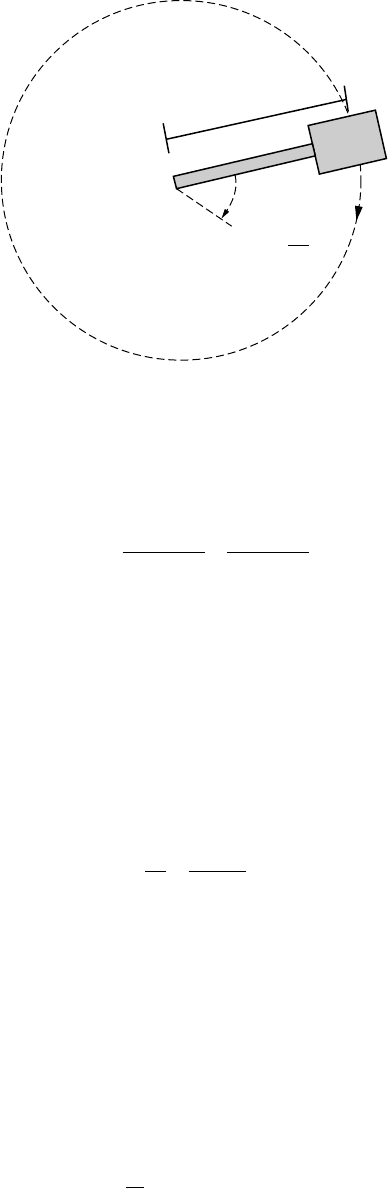
If a mass is attached to a rod, which is free to rotate about its end (Figure 6.1), and a force is applied,
the torque will make the mass rotate, and there will be power available. The amount of power is the
product of the torque and angular velocity (Equation 5.1). That power is available at the shaft. Most
operations of transferring shaft power try to have a large q because of structural considerations.
P T q, W (6.5)
Also, the rotating object will have rotational kinetic energy.
KE
rot
0.5 m v
2
0.5 m r
2
q
2
, J (6.6)
where the speed of the rotating mass depends on the radius, v q*r.
© 2009 by Taylor & Francis Group, LLC
Design of Wind Turbines 103
The power coefcient is the power delivered by the device divided by the power available in the
wind. Since the area cancels out, the power coefcient, C
P
, is
C
v
P
power out
power in
power out
0.5
3
R
(6.7)
The work or energy to move an object is the force times the distance through which it moves. Remember,
work is a scalar (it has only a value, no direction). Also note, if the force is perpendicular to the motion,
there is no work done (no gain or loss of energy). An example is the motion of the moon around the earth.
W
fi
u u FrFrr$ () (6.8)
The dot between the vectors means only the parallel component of the F is used (W F cosk Δr),
where Δr nal position – initial position, and k is the angle between F and r.
Divide both sides of Equation 6.8 by time:
W
tt
uFr$
Thus, the power is
P uFv (6.9)
6.4 DRAG DEVICE
The power from a drag device (see Figure 5.1) can be calculated from the force on the device and
the velocity of the device, u. From Equation 6.9, P F * u, since force and speed are in the same
direction. The force/area of the air on a stationary object in a wind speed, v, is
F
A
vC
D
0.5
2
R
(6.10)
FIGURE 6.1 Mass rotating about a point.
© 2009 by Taylor & Francis Group, LLC

104 Wind Energy: Renewable Energy and the Environment
where C
D
is the drag coefcient. Drag coefcients, C
D
, for different shapes are given in Marks’
Handbook [13], but the simplest procedure is to use C
D
1 for round pipes and wires and for at
plates perpendicular to the wind. Flat plates at an angle to the wind will experience some lift and
drag like an airfoil, and these data are available.
The force/area is also the pressure, so the wind blowing against an object creates a pressure. If
the winds are high enough, as in hurricanes and tornadoes, the pressure will destroy buildings and
topple trees and power poles.
From Equations 6.9 and 6.10, the power loss due to drag from struts can be calculated. Notice
that it is proportional to velocity cubed:
P vCAv vCA
DD
0.5 0.5
23
RR
(6.11)
The power loss from struts for a 4 kW giromill was so large that the struts were redesigned to an
airfoil shape to reduce drag. Notice that fuel efciency for vehicles can be improved by reducing the
drag coefcient for vehicles and by slowing down.
The power coefcient for a drag device can be calculated from the relative wind speed, as seen
by the drag device and the speed of the device. The relative velocity of the wind as measured by a
sensor mounted on the drag device is
vvu
r
0
again, where v
0
is the wind speed and u is the speed of the device. Then the power per unit area
from Equation 6.9 is
P
A
vC u v u C u
rD D
0.5 = 0.5
2
0
2
RR
()
(6.12)
Notice that at u 0 and u v
0
, the power is zero. In other words, there is no power output
if the drag device is not moving, and the drag device cannot move faster than the wind. From
Equations 6.7 and 6.12, the maximum power coefcient for a drag device can be calculated. The
maximum power coefcient, C
P(max)
4/27 0.15, which occurs when the drag device is moving
at u 1/3 the wind speed. This maximum power coefcient is for a drag coefcient around 1.
Some drag devices can have a drag coefcient greater than 1, so the maximum power coefcient
could be as high as 20%. The maximum power coefcient can be found using calculus or can be
estimated from a spreadsheet or graph of P/A versus wind speed (Equation 6.12) for various val-
ues of u, from 0 to v
0
. Low efciency is another reason there are not commercial drag devices for
generating electricity.
6.5 LIFT DEVICE
A lift device can produce on the order of 100 times the power per unit surface area of blade versus
a drag device. See Rohatgi and Nelson [14, chap. 6] for more details.
EXAMPLE 6.1
Suppose we have a two-blade wind turbine, each blade is 5 m long, 0.1 m wide. As a drag device, the
capture cross section is 1 m
2
. As a lift device in a HAWT, its capture cross-sectional area is 78.5 m
2
.
If the difference in efficiencies is included, the ratio of the power out per blade area for the lift device
over the drag device is over 300.
© 2009 by Taylor & Francis Group, LLC
Design of Wind Turbines 105
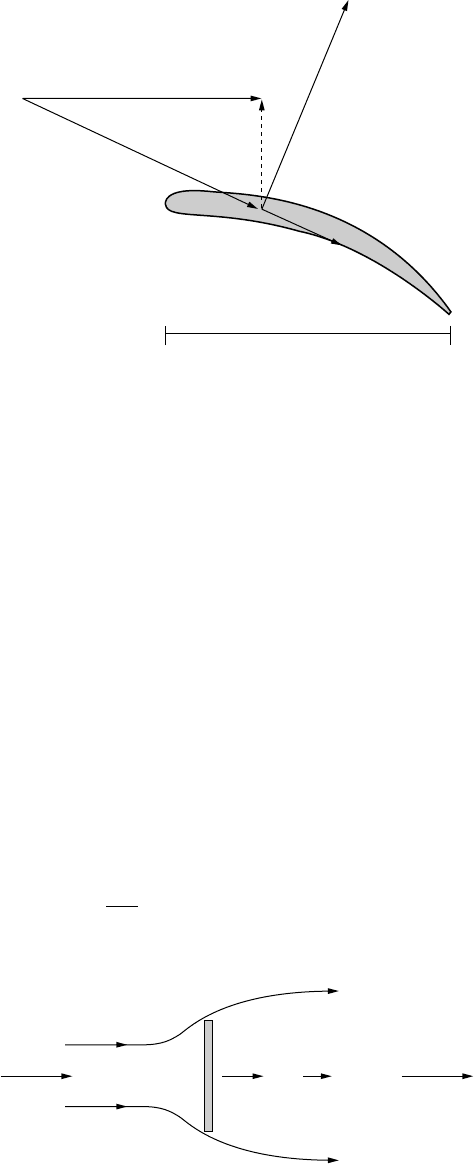
An example of a lift device is a sailboat, a lift translator (Figure 6.2), where the sails form an
airfoil. Notice that a sailboat moving downwind (a drag device) moves much slower than a sailboat
as it moves perpendicular to the wind (a lift device). Besides sailing ships, there have been propos-
als to use lift translators for generating power. The problems are the large speeds of the devices,
as lift devices can move faster than the wind, the proximity to the ground, and the necessity for
having a predominant wind direction. Some lift translators were actually built, but never operated
successfully.
The simple analysis for a lift device assumes streamline ow (irrotational, incompressible uid)
and conservation of energy and momentum. The wind speed interacts with the disk (propeller, rotor,
screw, or whatever), and there is a pressure drop across the disk (Figure 6.3). The thrust (force) load-
ing, T, is uniform across the disk. Also, there is no friction or drag force. At large distances behind
the disk, the wind speed and pressure will have the same values as at a long distance in front of the
disk. As stated earlier, the pressure, p, is the force/area.
From conservation of momentum, momentum in momentum out. The mass ow, Δm/Δt, across
any area is constant. Across the area of the disk, the mass ow is the product of air density (l), area
(A), and wind speed; so for the three regions
$
$
m
t
Av Au Av
RRR
00 2 2
Lift
V
0
V
V
r
Drag
S
FIGURE 6.2 Lift translator. Direction of motion, V, is perpendicular to the ground wind, V
0
. S is length of the
cross-sectional area of the blade or sail.
V
0
P
0
V
0
P
0
P
+
P
–
u
V
2
FIGURE 6.3 Wind speeds and pressures at innity, at the disk, and behind the disk.
© 2009 by Taylor & Francis Group, LLC

106 Wind Energy: Renewable Energy and the Environment
Use Equation 6.3:
T
p
t
m
T
vv Auvv
$
$
$
$
()()
02 02
R
(6.13)
Also, the thrust loading on the disk due to the pressure difference across the disk is
TAp p
()
(6.14)
Bernoulli’s theorem relates the velocity and pressures in streamline ow (kinetic energy and
pressure are constants for horizontal ow). If the velocity increases, then the pressure decreases;
the two are related through conservation of energy and momentum. The wind speed and pressure
upstream and downstream of the disk are related by:
Upstream Disk Downstream
0.5 0.5
0
2
0
2+
RR
vp up 0.5 0.5
2
2
2
0
RR
up vp
From the two equations, take the pressure difference (p
p
) and substitute into Equation 6.14:
TAvv
0.5
R
0
2
2
2
(6.15)
The thrusts are equal, so set Equation 6.13 equal to Equation 6.15:
RRR
Auvv Avv Avvvv() ()(
02 020
0.5 0.5
0
2
2
2
22
)
(6.16)
From Equation 6.14 the wind speed at the disk is the average of the wind speeds before and after
the disk (wake).
u 0.5 (v
0
v
2
)(6.17)
The axial interference factor is dened by what ratio the wind speed is reduced by the disk.
A
vu
v
u
v
0
00
1
or
uv
0
1()
A
(6.18)
Substitute into Equation 6.17 and the wake wind speed is
vv
vv
v
20
02
0
(1 ) or
2
2
AA
(6.19)
If the disk or rotor absorbs all the energy, v
2
0 and ] 0.5. That is physical nonsense, as all the
mass would pile up at the rotor. The power is equal to the change in kinetic energy from upstream
to downstream:
P
KE
t
KE KE
t
m
t
v
m
t
vAuv
$
us ds
0.5 0.5 0.5
0
2
2
2
R
00
2
2
2
v
© 2009 by Taylor & Francis Group, LLC
Design of Wind Turbines 107
and the value of the axial interference factor is substituted into the equation to obtain the power/
area for a lift device:
P
A
v0.5 1
0
3
RA A
4
2
()
(6.20)
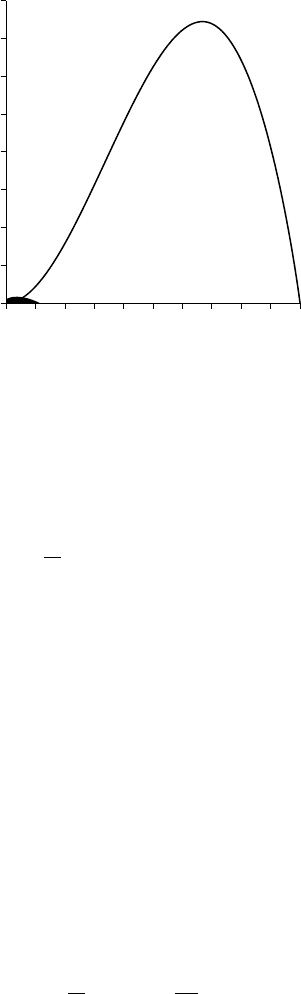
A lift device can produce much more power per area of blade than a drag device (Figure 6.4).
Notice the small black line is for the drag device, which reaches a maximum of around 0.22 at a
speed ratio 0.3. The maximum for the lift device is around 15 at the speed ratio 2/3 of the ratio of
lift to drag coefcients. For this example, the power per area of blade was calculated for the drag
device with a drag coefcient of 1.5, and for the lift device, the ratio of lift coefcient to drag coef-
cient was 10. Thus, the lift device can easily produce fty times the power per blade area—another
reason drag devices are not used to produce electricity, although a company in South Africa has a
farm windmill that has an option for an electric generator.
6.5.1 MAXIMUM THEORETICAL POWER
The maximum power/area can be found by plotting the curve P/A versus ] (Equation 6.20) or by
using calculus. The answer is ] 1/3 or 1. Of course, ] 1 means that there is no reduction of wind
speed and the disk does not take out any power. For ] 1/3, the maximum power is
P
A
v 0.5
16
27
0
3
R
(6.21)
Therefore, the maximum power coefcient, from Equation 6.6, is C
P
16/27 0.59. Real rotors
will have smaller power coefcients due to drag, tip and hub losses, losses due to rotation of the
wake, and frictional losses; however, measured values can reach 50% (which includes drive train
and generator). This is another reason lift devices are used to generate electricity, compared to drag
devices, as the maximum theoretical power coefcients are 50% versus 20%. However, the farm
windmill, which has some of the same characteristics as a drag device (large solidity, low tip speed
ratio) is well designed for the application of pumping low volumes of water.
16
14
12
10
8
6
4
2
0
0 1 23456 789 10
Power/Area
Speed Ratio
FIGURE 6.4 Comparison of power/area for a translating drag device (small solid curve) and a translating lift
device versus speed ratio of the device to the wind.
© 2009 by Taylor & Francis Group, LLC