
Neubauer A., Freudenberger J., Kuhn V. Coding theory: algorithms, architectures and applications
Подождите немного. Документ загружается.

176 TURBO CODES
node b
i
to a check node c
j
must not take into account the message sent in the previous
round from c
j
to b
i
. For example, the L-value L(b
1
) ≈ 12.4 contains the message L
e
(b
1
) =
L(b
2
⊕ b
5
) = 7.5 from the first check node. If we continue the decoding, we have to
subtract this value from the current L-value to obtain the message L(b
1
) − L(b
2
⊕ b
5
) =
L(r
1
) + L(b
3
⊕ b
7
) ≈ 4.6 from the message node to the first check node. Similarly, we
obtain L(b
1
) − L(b
3
⊕ b
7
) = L(r
1
) + L(b
2
⊕ b
5
) ≈ 13.1 for the message to the second
check node. These messages are indicated in Figure 4.8.
The reason for these particular calculations is the independence assumption. For the first
iteration, the addition at the message node of the received L-value and the extrinsic L-values
from check nodes is justified, because these values resulted from statistically independent
observations. What happens with further iterations? This depends on the neighbourhood
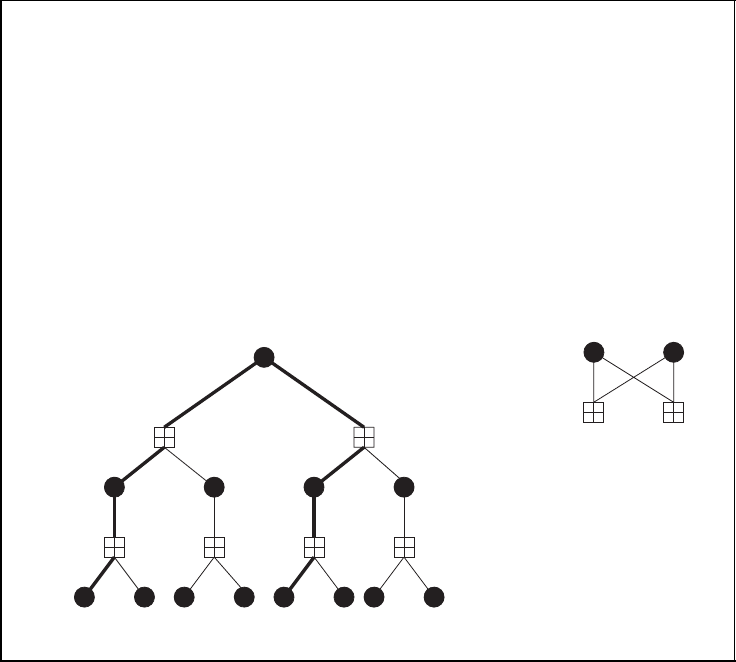
of the message nodes. Consider, for example, the graph in Figure 4.9 which illustrates
the neighbourhood of the first message node in our example. This graph represents the
message flow during the iterative decoding process. In the first iteration we receive extrinsic
The independence assumption
■ The independence assumption is correct for l iterations of the algorithm if
the neighbourhood of a message node is a tree up to depth l.
■ The graph below is a tree up to depth l = 1.
■ At depth l = 2 there are several nodes that represent the same code bit.
This causes cycles as indicated for the node b
4
.
■ The shortest possible cycle has a length of 4.
b
1
b
2
b
3
b
4
b
4
b
5
b
6
b
6
b
7
b
8
b
8
b
9
b
9
(a) neighbourhood of b
1
(b) shortest possible cycle
Figure 4.9: The independence assumption

TURBO CODES 177
information from all nodes of depth l = 1. In the second iteration we receive messages from
the nodes of depth l = 2, and so on.
The messages for further rounds of the algorithm are only statistically independent if
the graph is a so-called tree.
5
In particular, if all message nodes are unique. In our simple
example this holds only for l = 1. At depth l = 2 there are several nodes that represent the
same code bit. This causes cycles
6
as indicated for the node b
4
. However, for longer codes
we can apply significantly more independent iterations. In general, if the neighbourhood
of all message nodes is a tree up to depth l, then the incoming messages are statistically
independent and the update equation correctly calculates the corresponding log-likelihood
based on the observations.
In graph theory, we call the length of the shortest cycle the girth of a graph. If the graph
has no cycles, its girth is defined to be infinite. According to figure (b) in Figure 4.9, the
girth is at least 4. In our example graph the girth is 8. The girth determines the maximum
number of independent iterations of belief propagation. Moreover, short cycles in the Tanner
graph of a code may lead to a small minimum Hamming distance. Therefore, procedures
to construct Tanner graphs maximising the girth were proposed. However, in practice it is
not clear how the girth actually determines the decoding performance. Most methods to
analyse the performance of belief propagation are based on the independence assumption,
and little is known about decoding for graphs with cycles.
4.2 A First Encounter with Code Concatenation
In this section we introduce the notion of code concatenation, i.e. the concept of constructing
long powerful codes from short component codes. The first published concatenated codes
were the product codes introduced by Elias (Elias, 1954). This construction yields a block
code of length n × n based on component codes of length n. We will consider product
codes to introduce the basic idea of code concatenation and to discuss the connection to
Tanner graphs and LDPC code. Later, in Section 4.6, we will consider another kind of
product code. These so-called woven convolutional codes were first introduced by H
¨
ost,
Johannesson and Zyablov (H
¨
ost et al., 1997) and are product codes based on convolutional
component codes.
4.2.1 Product Codes
Code concatenation is a method for constructing good codes by combining several simple
codes. Consider, for instance, a simple parity-check code of rate R = 2/3. For each 2-nit
information word, a parity bit is attached so that the 3-bit code word has an even weight,
i.e. an even number of 1s. This simple code can only detect a single error. For the Binary
Symmetric Channel (BSC) it cannot be used for error-correction. However, we can con-
struct a single error-correcting code combining several simple parity-check codes. For this
construction, we assume that the information word is a block of 2 ×2 bits, e.g.
u =
01
10
.
5
A tree is a graph in which any two nodes are connected by exactly one path, where a path in a graph is a
sequence of edges such that from each of its nodes there is an edge to the next node in the sequence.
6
A cycle is a path where the start edge and the end edge are the same.
178 TURBO CODES
We encode each row with a single parity-check code and obtain
B
o
=
011
101
.
Next, we encode column-wise, i.e. encode each column of B
o
with a single parity-check
code and have the overall code word
b =
011
101
110
.
The overall code is called a product code, because the code parameters are obtained from
the products of the corresponding parameters of the component codes. For instance, let k
i
and k
o
denote the dimension of the inner and outer code respectively. Then, the overall
dimension is k = k
i
k
o
. Similarly, we obtain the overall code length n = n
i
n
o
, where n
i
and n
o
are the lengths of the inner code and outer code respectively. In our example, we
have k = 2 ·2 = 4 and n = 3 ·3 = 9. Moreover the overall code can correct any single
transmission error. By decoding the parity-check codes, we can detect both the row and
the column where the error occurred. Consider, for instance, the received word
r =
011
0 01
110
.
We observe that the second row and the first column have odd weights. Hence, we can
correct the transmission error at the intersection of this row and column.
The construction of product codes is not limited to parity-check codes as component
codes. Basically, we could construct product codes over an arbitrary finite field. However,
we will restrict ourselves to the binary case. In general, we organise the k = k
o
k
i
informa-
tion bits in k
o
columns and k
i
rows. We apply first row-wise outer encoding. The code bits
of the outer code words are then encoded column-wise. It is easy to see that the overall
code is linear if the constituent codes are linear. Let G
o
and G
i
be the generator matrices of
the outer and the inner code respectively. Using the Kronecker product, we can describe the
encoding of the k
i
outer codes by G
o
⊗ I
k
i
, where I
k
i
is a k
i
× k
i
identity matrix. Similarly,
the encoding of the k
o
inner codes can be described by I
k
o
⊗ G
i
with the k
o
× k
o
identity
matrix I
k
o
. The overall generator matrix is then
G = (G
o
⊗ I
k
i
)(I
k
o
⊗ G
i
).
The linearity simplifies the analysis of the minimum Hamming distance of a product code.
Remember that the minimum Hamming distance of a linear code is equal to the minimum
weight of a non-zero code word. The minimum weight of a non-zero code word of a product
code can easily be estimated. Let d
o
and d
i
denote the minimum Hamming distance of the
outer and inner code. First, consider the encoding of the outer codes. Note that any non-
zero information word leads to at least one non-zero outer code word. This code word has
at least weight d
o
. Hence, there are at least d
o
non-zero columns. Every non-zero column
results in a non-zero code word of the inner code with a weight of at least d
i
. Therefore,
a non-zero code word of the product code consists of at least d
o
non-zero columns each
TURBO CODES 179
Product codes
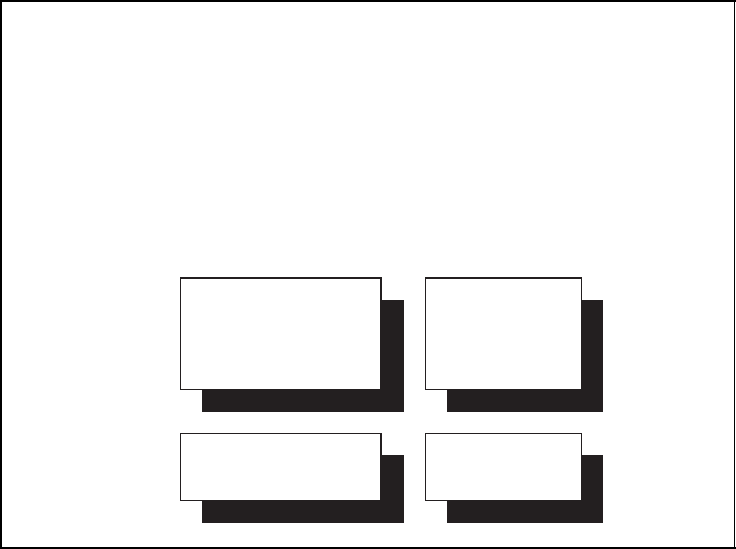
■ A binary product code B(n = n
o
n
i
,k = k
o
k
i
,d = d
o
d
i
) is a concatenation of
k
i
binary outer codes B
o
(n
o
,k
o
,d
o
) and k
o
binary inner codes B
i
(n
i
,k
i
,d
i
).
■ To encode a product code, we organise the k = k
o
k
i
information bits in k
o
columns and k
i
rows. We apply first row-wise outer encoding. The code
bits of the outer code words are then encoded column-wise. This encoding
is illustrated in the following figure.
horizontal
vertical
parity
parity
parity
parity of
block
information
Figure 4.10: Encoding of product codes
of at least d
i
non-zero symbols. We conclude that the minimum Hamming distance of the
overall code
d ≥ d
o
d
i
.
We can also use product codes to discuss the concept of parallel concatenation, i.e. of turbo
codes. We will consider possibly the most simple turbo code constructed from systematically
encoded single parity-check codes B(3, 2, 2). Take the encoding of the product code as
illustrated in Figure 4.10. We organise the information bits in k
o
columns and k
i
rows and
apply first row-wise outer and then column-wise inner encoding. This results in the parity
bits of the outer code (horizontal parity) and the parity bits of the inner code, which can be
divided into the parity bits corresponding to information symbols, and parity of outer parity
bits. Using two systematically encoded single parity-check codes B(3, 2, 2) as above, this
results in code words of the form
b =
u
0
u
1
p
−
0
u
2
u
3
p
−
1
p
|
0
p
|
1
p
|
2
,
where p
−
i
denotes a horizontal parity bit and p
|
i
denotes a vertical parity bit.
180 TURBO CODES
A product code is a serial concatenation as we first encode the information with the
outer code(s) and apply the outer code bits as information to the inner encoder(s). With
the parallel concatenated construction, we omit the parity bits of parity. That is, we simply
encode the information bits twice, once in the horizontal and once in the vertical direction.
For our example, we obtain
b =
u
0
u
1
p
−
0
u
2
u
3
p
−
1
p
|
0
p
|
1
.
Note that the encoding in the horizontal and vertical directions is independent and can
therefore be performed in parallel, hence the name.
4.2.2 Iterative Decoding of Product Codes
We will now use the log-likelihood algebra to discuss the turbo decoding algorithm. We
will use this algorithm to decode a product code B(9, 4, 4) with code words
b =
u
0
u
1
p
−
0
u
2
u
3
p
−
1
p
|
0
p
|
1
p
|
2
,
as described in the previous section. However, now we will use soft decoding, i.e. soft chan-
nel values. For this particular product code, we could use the belief propagation algorithm
as discussed in Section 4.1.4. In fact, the Tanner graph given in Figure 4.3 on page 167 is
a representation of the code B(9, 4, 4). To see this, note that the first check node in the
Tanner graph represents the parity equation of the first row of the product code. Similarly,
c
4
and c
6
represent the second and third row. The column constraints are represented by
the check nodes c
2
, c
3
and c
5
.
In practice, a so-called turbo decoding algorithm is used to decode concatenated codes.
This is also an iterative message-passing algorithm similar to belief propagation. The itera-
tive decoding is based on decoders for the component codes that use reliability information
at the input and provide symbol-by-symbol reliability information at the output. In the
case of a simple single parity-check code, this is already performed by executing a single
boxplus operation. When we use more complex component codes, we apply in each itera-
tion a so-called soft-in/soft-out (SISO) decoding algorithm. Such an algorithm is the Bahl,
Cocke, Jelinek, Raviv (BCJR) algorithm discussed in Section 3.5. Commonly, all symbol
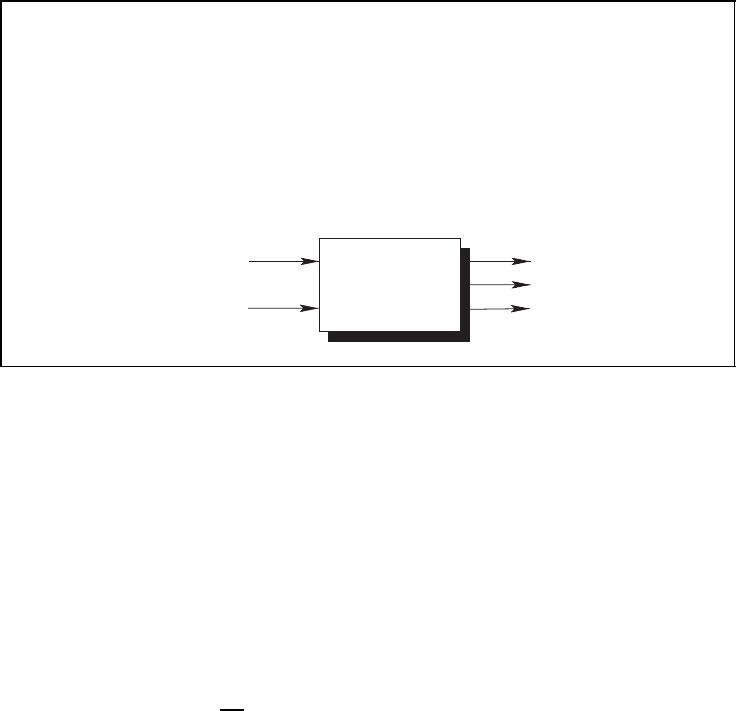
reliabilities are represented by log-likelihood ratios (L-values). In general, a SISO decoder,
such as an implementation of the BCJR algorithm, may expect channel L-values and a-
priori information as an input and may produce reliabilities for the estimated information
symbols L(u
i
|r), the extrinsic L-value for code L
e
(b
j
|r) and information bits L
e
(u
i
|r)
(see Figure 4.11). The turbo decoding algorithm determines only the exchange of sym-
bol reliabilities between the different component decoders. In the following we discuss
this turbo decoding, considering the parallel concatenated code with single parity-check
component codes. The same concept of message passing applies to more complex codes,
as we will see later on.
TURBO CODES 181
Soft-in/soft-out decoder
■ In general, a soft-in/soft-out (SISO) decoder, such as an implementation
of the BCJR algorithm, may expect channel L-values and a-priori informa-
tion as an input and may produce reliabilities for the estimated information
symbols L(u
i
|r), the extrinsic L-value for code L
e
(b
j
|r) and information
bits L
e
(u
i
|r)
L(r
i
)
L
a
(u
i
)
L(u
i
|r)
L
e
(u
i
|r)
L
e
(b
j
|r)
SISO
decoder
Figure 4.11: Soft-in/soft-out decoder
Suppose that we encode the information block u = (0, 1, 1, 1) and use binary phase
shift keying with symbols from {+1, −1}. The transmitted code word is
b =
+1 −1 −1
−1 −1 +1
−1 +1
.
For this particular code word we may obtain the following channel L-values after trans-
mission over a Gaussian channel
4
E
s
N
0
· r =
5.6 −10.2 −7.5
0.70.512.2
−8.56.9
.
Again, we assume that no a-priori information is available. Hence, we have L
a
(u
i
) = 0 for
all information bits. Let us start with decoding the first row. On account of the parity-check
equation we have L
−
e
(u
0
) = L(u
1
) L(p
−
0
) ≈ 7.5 and L
−
e
(u
1
) = L(u
0
) L(p
−
0
) ≈−5.6.
Similarly, we can evaluate the remaining extrinsic values of L
−
e
(u) and obtain
L
−
e
(u) =
7.5 −5.6
0.50.7
.
Now, we use this extrinsic information as a-priori knowledge for the column-wise decoding,
i.e. we assume L
a
(u) = L
−
e
(u). As we use systematic encoded component codes and the
log-likelihood values are statistically independent, we can simply add up the channel and
extrinsic values for the information bits
L
ch
· r + L
−
e
(u) · r =
13.1 −15.8 −7.5
1.21.212.2
−8.56.9
.

182 TURBO CODES
These values are the basis for the second decoding step, i.e. column-wise decoding. For the
first column we have L
|
e
(u
0
) = L(u
2
) L(p
|
0
) ≈−1.2 and L
e
(
|
u
2
) = L(u
0
) L(p
|
0
) ≈
−8.5. Hence, we obtain
L
|
e
(u) =
−1.2 −1.2
−8.5 −6.9
.
If we wish to continue the iterative decoding, we use L
|
e
(
ˆ
u) as a-priori information for a
new iteration. Hence, we calculate
L
ch
· r + L
|
e
(u) · r =
4.4 −11.4 −7.5
−7.8 −6.412.2
−8.56.9
as input for the next iteration of row-wise decoding.
When we stop the decoding, we use L(
ˆ
u) = L
ch
· r + L
|
e
(u) + L
−
e
(u) as output of the
iterative decoder. After the first iteration we have
L(
ˆ
u) =
11.9 −17
−7.3 −5.7
.
4.3 Concatenated Convolutional Codes
To start with concatenated convolutional codes, it is convenient to consider their encoding
scheme. We introduce three different types of encoder in this section: the original turbo
encoder, i.e. a parallel concatenation, and serially and partially concatenated codes.
4.3.1 Parallel Concatenation
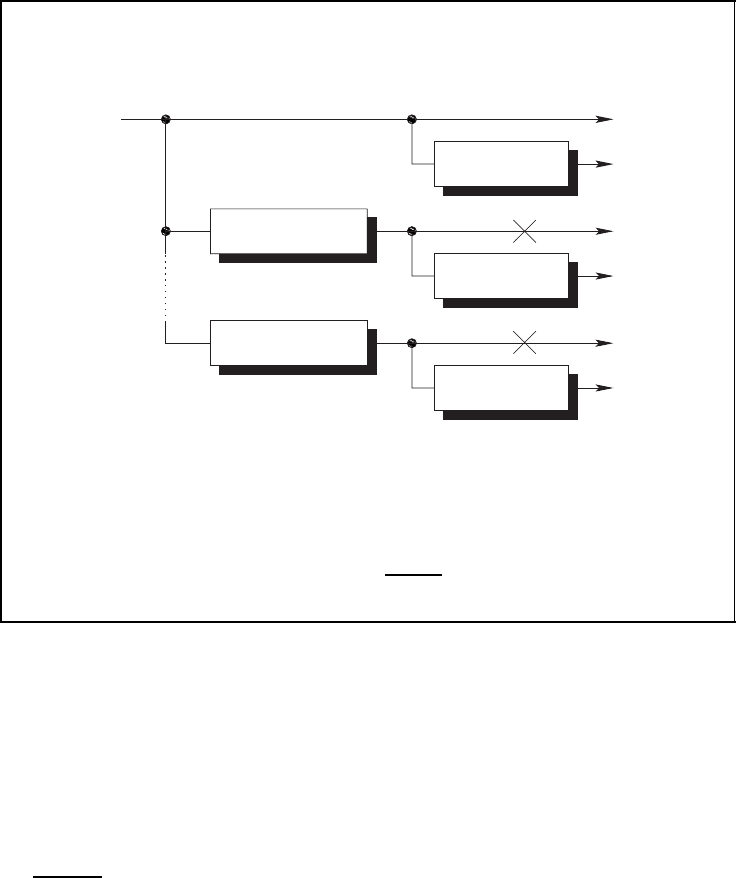
As mentioned above, turbo codes result from a parallel concatenation of a number of
systematic encoders linked by interleavers. The general encoding scheme for turbo codes
is depicted in Figure 4.12. All encoders are systematic. The information bits are interleaved
after encoding the first component code, but the information bits are only transmitted once.
With two component codes, the code word of the resulting code has the structure
b =
(
u, uA
1
,π(u)A
2
)
,
where π(·) denotes a permutation of the information bits and A
j
denotes a submatrix of
the systematic generator matrix G
j
= (I
k
A
j
).
As we see, the parallel concatenation scheme can easily be generalised to more than
two component codes. If not mentioned otherwise, we will only consider turbo codes with
two equal component codes in the following discussion. The rate of such a code is
R =
R
c
2 − R
c
,
where R
c
is the rate of the component codes.
Although the component codes are usually convolutional codes, the resulting turbo
code is a block code. This follows from the block-wise encoding scheme and the fact that
convolutional component codes have to be terminated.
TURBO CODES 183
Encoder scheme for turbo codes
u
b
(1)
1
b
(2)
1
b
(1)
2
b
(2)
2
b
(1)
j
b
(2)
j
encoder
1
encoder
2
encoder
j
interleaver
1
interleaver
j−1
■ Most commonly, turbo codes are constructed from two equal component
codes of rate R
c
.
■ In this case, the rate of the overall code is
R =
R
c
2 − R
c
(4.9)
Figure 4.12: Encoder scheme for turbo codes
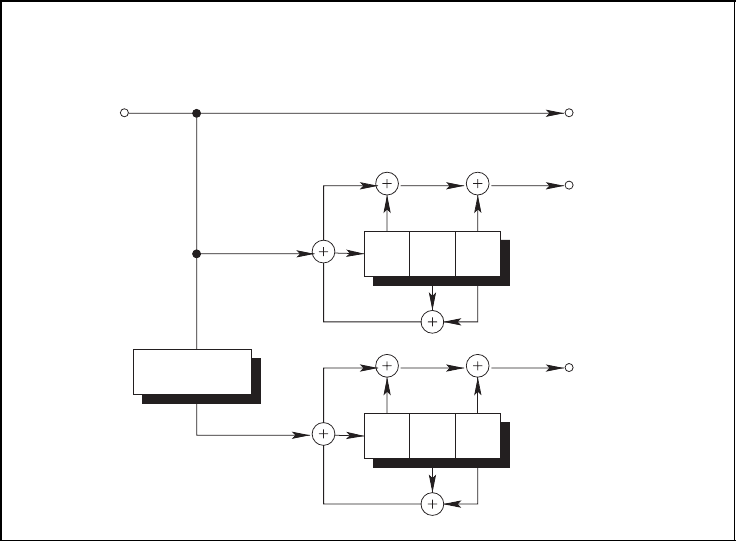
4.3.2 The UMTS Turbo Code
As an example of a turbo code we will consider the code defined in the Universal Mobile
Telecommunications System (UMTS) standard. The corresponding encoder is shown in
Figure 4.13. The code is constructed from two parallel concatenated convolutional codes
of memory m = 3. Both encoders are recursive and have the generator matrix G(D) =
1,
1+D+D
3
1+D
2
+D
3
. In octal notation, the feedforward generator is (15)
8
and the feedback gen-
erator is (13)
8
. The information is encoded by the first encoder in its original order. The
second encoder is applied after the information sequence is interleaved. The information is
only transmitted once, therefore the systematic output of the second decoder is omitted in
the figure. Hence, the overall code rate is R = 1/3.
According to the UMTS standard, the length K of the information sequence will be
in the range 40 ≤ K ≤ 5114. After the information sequence is encoded, the encoders are
forced back to the all-zero state. However, unlike the conventional code termination, as
discussed in Section 3.1.4, the recursive encoders cannot be terminated with m zero bits.
The termination sequence for a recursive encoder depends on the encoder state. Because the
184 TURBO CODES
Encoder for the UMTS turbo codes
u
b
(1)
b
(2)
b
(3)
interleaver
Figure 4.13: Encoder for the UMTS turbo codes
states of the two encoders will usually be different after the information has been encoded,
the tails for each encoder must be determined separately. An example of this termination
is given in Figure 3.8 on page 106. The tail bits are then transmitted at the end of the
encoded code sequence. Hence, the actual code rate is slightly smaller than 1/3.
4.3.3 Serial Concatenation
At high signal-to-noise ratio (SNR), turbo codes typically reveal an error floor, which
means that the slope of the bit error rate curve declines with increasing SNR (see, for
example, Figure 4.18 on page 189). In order to improve the performance of parallel con-
catenated codes for higher SNR, Benedetto and Montorsi applied iterative decoding to
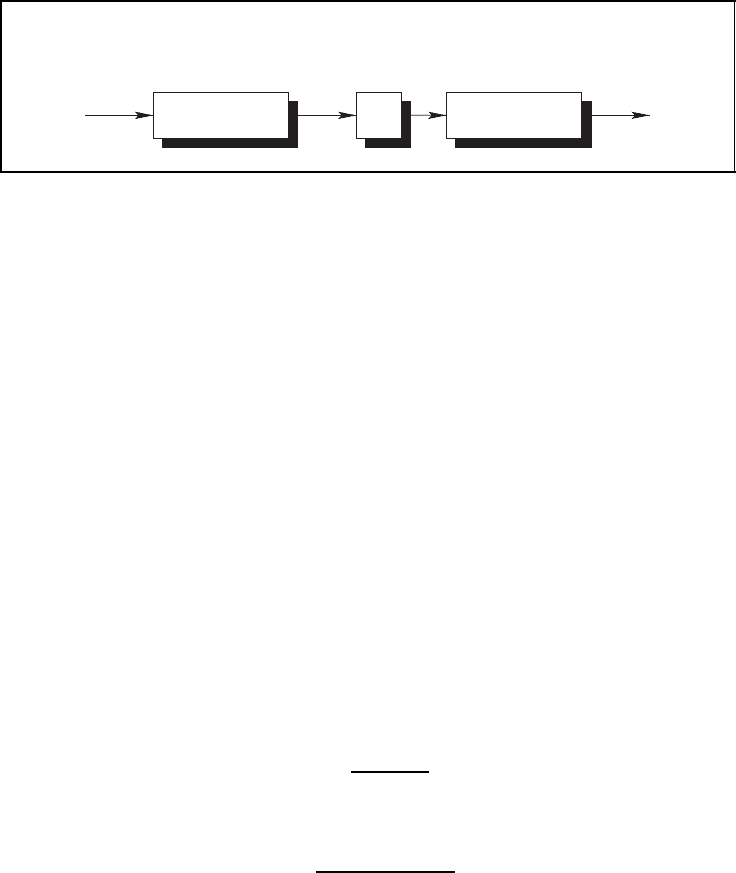
serially concatenated convolutional codes (SCCC) with interleaving (Benedetto and Mon-
torsi, 1998). The corresponding encoders (see Figure 4.14) consist of the cascade of an
outer encoder, an interleaver permuting the outer code word and an inner encoder whose
input words are the permuted outer code bits.
The information sequence u is encoded by a rate R
o
= k
o
/n
o
outer encoder. The outer
code sequence b
o
is interleaved and then fed into the inner encoder. The inner code has
rate R
i
= k
i
/n
i
. Hence, the overall rate is
R = R
i
R
o
.
TURBO CODES 185
Serial concatenation with interleaving
u
b
o
u
i
b
π
outer encoder
inner encoder
Figure 4.14: Serial concatenation with interleaving
4.3.4 Partial Concatenation
We will consider the partially concatenated convolutional encoder as depicted in
Figure 4.15. Such an encoder consists of one outer and one inner convolutional encoder. In
between there are a partitioning device and an interleaver, denoted by P and π respectively.
The information sequence u is encoded by a rate R
o
= k
o
/n
o
outer encoder. The outer code
sequence b
o
is partitioned into two so-called partial code sequences b
o,(1)
and b
o,(2)
. The
partial code sequence b
o,(1)
is interleaved and then fed into the inner encoder. The other
symbols of the outer code sequence (b
o,(2)
, dashed lines in Figure 4.15) are not encoded
by the inner encoder. This sequence, together with the inner code sequence b
i
, constitutes
the overall code sequence b.
Similarly to the puncturing of convolutional codes, we describe the partitioning of the
outer code sequence by means of a partitioning matrix P. Consider a rate R
o
= k
o
/n
o
outer
convolutional code. P is a t
p
× n
o
matrix with matrix elements p
s,j
∈{0, 1}, where t
p
≥ 1
is an integer determining the partitioning period. A matrix element p
s,j
= 1 means that the
corresponding code bit will be mapped to the partial code sequence b
o,(1)
, while a code
bit corresponding to p
s,j
= 0 will appear in the partial code sequence b
o,(2)
. We define the
partial rate R
p
as the fraction of outer code bits that will be encoded by the inner encoder.
With
#
s,j
p
s,j
, the number of 1s in the partitioning matrix, and with the total number of
elements n
o
t
p
in P, we have
R
p
=
#
s,j
p
s,j
n
o
t
p
.
Finally, we obtain the rate of the overall code
R =
R
o
R
i
R
p
+ R
i
(1 − R
p
)
,
where R
i
is the inner code rate.
Clearly, if R
p
= 1, this construction results in a serially concatenated convolutional
code (Benedetto and Montorsi, 1998). If we choose R
p
= R
o
, and use systematic outer and
inner encoding, such that we encode the information sequence with the inner encoder, we
obtain a parallel (turbo) encoder. Besides these two classical cases, partitioning provides
a new degree of freedom for code design.
Throughout the following sections we give examples where the properties of different
concatenated convolutional codes are compared. Therefore, we will refer to the codes