
Neubauer A., Freudenberger J., Kuhn V. Coding theory: algorithms, architectures and applications
Подождите немного. Документ загружается.

186 TURBO CODES
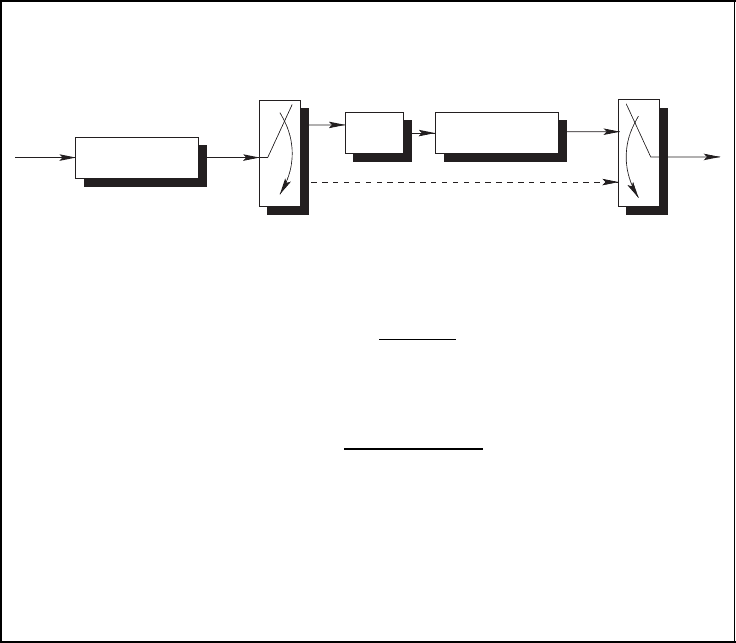
Partially concatenated convolutional encoder
PP
u
b
o
b
o,(1)
b
o,(2)
b
i
b
π
outer encoder
inner encoder
■ The partial rate R
p
is the fraction of outer code bits that will be encoded by
the inner encoder
R
p
=
#
s,j
p
s,j
n
o
t
p
(4.10)
■ The rate of the overall code is
R =
R
o
R
i
R
p
+ R
i
(1 − R
p
)
(4.11)
where R
i
and R
o
are the rate of the inner code and outer code respectively.
■ R
p
= 1 results in a serially concatenated convolutional code.
■ R
p
= R
o
and systematic outer and inner encoding result in a parallel
concatenated convolutional code.
Figure 4.15: Partially concatenated convolutional encoder
constructed in Figure 4.16. Those codes are all of overall rate R = 1/3, but with different
partial rates. There are classical parallel R
p
= 1/2 and serially concatenated convolutional
codes R
p
= 1, as well as partially concatenated convolutional codes.
4.3.5 Turbo Decoding
All turbo-like codes can be decoded iteratively with a message-passing algorithm similar
to belief propagation. The iterative decoding is based on symbol-by-symbol soft-in/soft-out
(SISO) decoding of the component codes, i.e. algorithms that use reliability information
at the input and provide reliability information at the output, like the BCJR algorithm
which evaluates symbol-by-symbol a-posteriori probabilities. For the following discussion,
all symbol reliabilities are represented by log-likelihood ratios (L-values).
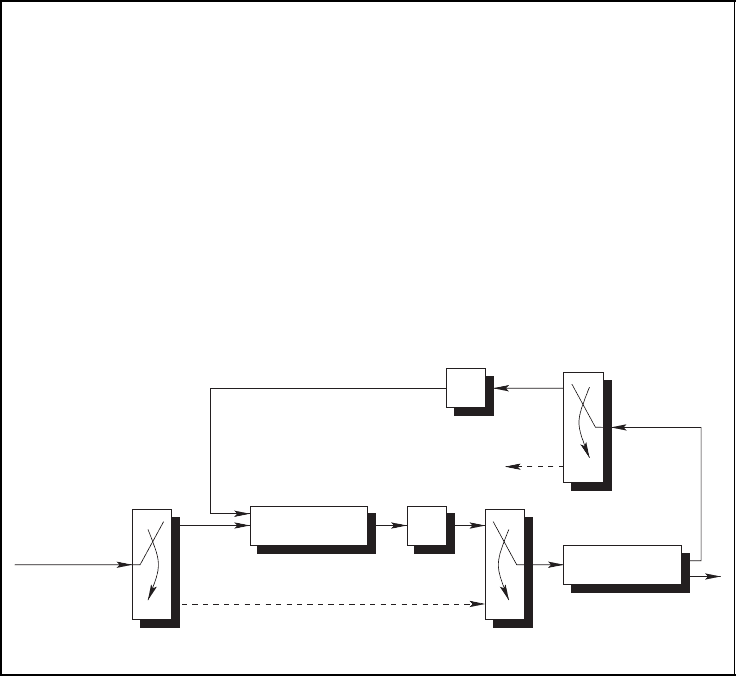
We consider only the decoder structure for partially concatenated codes as given in
Figure 4.17. Decoders of parallel and serial constructions can be derived as special cases
from this structure. The inner component decoder requires channel L-values as well as

TURBO CODES 187
Example of concatenated convolutional codes
■ We construct different concatenated codes of overall rate R = 1/3. For
the inner encoding we always employ rate R
i
= 1/2 codes with generator
matrix G
i
(D) = (1,
1+D
2
1+D+D
2
).
■ For outer encoding we employ the mother code with generator matrix
G(D)= (1 +D + D
2
, 1 + D
2
), but we apply puncturing and partitioning to
obtain the desired overall rate.
■ We consider:
– Two parallel concatenated codes: both with partial rate R
p
= R
o
= 1/2,
but with different partitioning schemes (P = (1, 0), P = (0, 1) ).
– A serially concatenated code with R
p
= 1, R
o
= 2/3.
– Two partially concatenated constructions with R
o
= 3/5, R
p
=
4/5 and P = (0, 1, 1, 1, 1) and with R
o
= 4/7, R
p
= 5/7 and P =
(1, 1, 0, 1, 1, 0, 1). Note that here the partitioning matrices are obtained
by optimising the partial distances (see Section 4.6.2).
Figure 4.16: Example of concatenated convolutional codes
a-priori information for the inner information symbols as an input. The output of the inner
decoder consists of channel and extrinsic information for the inner information symbols.
The outer decoder expects channel L-values and provides extrinsic L-values L
e
(b
o
) for
the outer code symbols and estimates
ˆ
u for the information symbols. Initially, the received
sequence r is split up into a sequence r
(1)
which is fed into the inner decoder and a sequence
r
(2)
which is not decoded by the inner decoder. Moreover, the a-priori values for the inner
decoder L
a
(u
i
) are set to zero.
For each iteration we use the following procedure. We first perform inner decoding. The
output symbols L(u
i
) of the inner decoder are de-interleaved (π
−1
). This de-interleaved
sequence and the received symbols r
(2)
are multiplexed according to the partitioning scheme
P. The obtained sequence L(r
o
) is regarded as the channel values of the outer code,
i.e. it is decoded by the outer decoder. The outer decoder provides extrinsic L-values
for the outer code bits L
e
(b
o
) and an estimated information sequence ˆu. For the next
round of iterative decoding, the extrinsic output L
e
(b
o
) is partitioned according to P into
L
e
(b
o,(1)
) and L
e
(b
o,(2)
), whereas the sequence L
e
(b
o,(2)
) is not regarded any more, because
b
o,(2)
was not encoded by the inner encoder. L
e
(b
o,(1)
) is interleaved again such that the
resulting sequence L
a
(u
i
) can be used as a-priori information for the next iteration of inner
decoding.
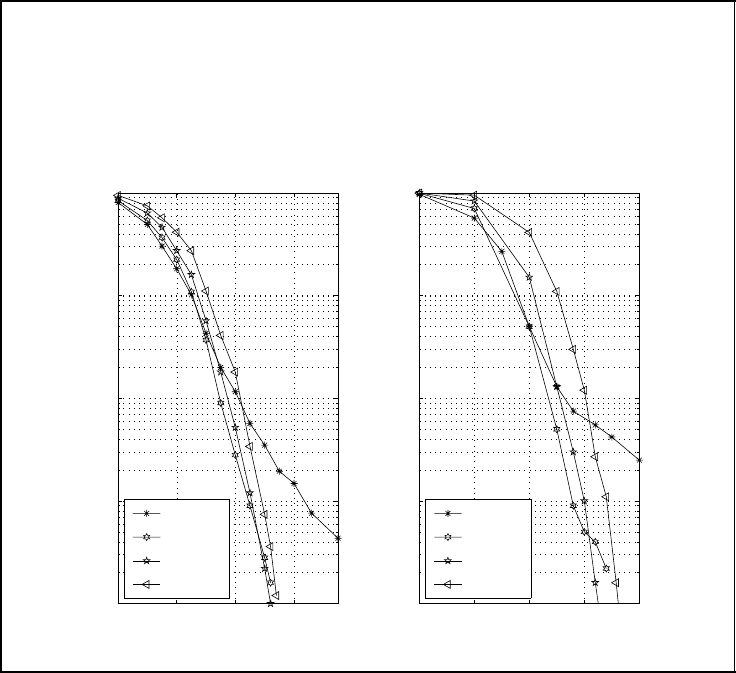
Finally, we give some simulation results for the AWGN channel with binary phase shift
keying. All results are obtained for ten iterations of iterative decoding, where we utilise the
188 TURBO CODES
Decoding structure
For each iteration we use the following procedure:
■ Perform inner decoding. The output symbols L(u
i
) of the inner decoder
are de-interleaved (π
−1
), and the received symbols r
(2)
are multiplexed
according to the partitioning scheme P.
■ The obtained sequence L(b
o
) is decoded by the outer decoder. The
extrinsic output L
e
(b
o
) is partitioned according to P into L
e
(b
o,(1)
) and
L
e
(b
o,(2)
),whereL
e
(b
o,(2)
) is discarded.
■ L
e
(b
o,(1)
) is interleaved again such that the resulting sequence L
a
(b
i
) can
be used as a priori information for the next iteration of inner decoding.
inner decoder
outer decoder
ˆ
u
L(u
i
)
L
a
(u
i
)
L
e
(b
o
)
L
e
(b
o,(1)
)
L
e
(b
o,(2)
)
r
L(r
o
)
π
r
(1)
r
(2)
π
−1
P
PP
Figure 4.17: Decoding structure
max-log version of the BCJR algorithm as discussed in Section 3.5.2. Simulation results
are depicted in Figure 4.18, where the figures presents the Word Error Rate (WER) for
codes of length n = 600 or n = 3000 respectively. The component codes are as given in
Figure 4.16. The two partially concatenated codes outperform the serial concatenated code
for the whole considered region of WER. At high SNR we notice the typical error floor
of the turbo code (P = (1, 0)). Here, the partially concatenated codes achieve significantly
better performance. Simulation results regarding the bit error rate are similar.
4.4 EXIT Charts
For the analysis of the iterative decoding algorithm we utilise the EXtrinsic Information
Transfer (EXIT) characteristics as proposed by ten Brink (ten Brink, 2000; see also ten
Brink, 2001). The basic idea of the EXIT chart method is to predict the behaviour of
TURBO CODES 189
Simulation results
■ The figure depicts word error rates (WER) for n = 600 and n = 3000 respect-
ively.
0 1 2 3
10
Ŧ4
10
Ŧ3
10
Ŧ2
10
Ŧ1
10
0
E
b
/N
0
WER
R
p
=1/2
R
p
=5/7
R
p
=4/5
R
p
=1
0 0.5 1 1.5 2
10
Ŧ4
10
Ŧ3
10
Ŧ2
10
Ŧ1
10
0
E
b
/N
0
WER
R
p
=1/2
R
p
=5/7
R
p
=4/5
R
p
=1
Figure 4.18: Simulation results
the iterative decoder by looking at the input/output relations of the individual constituent
decoders.
4.4.1 Calculating an EXIT Chart
We assume that a-priori information can be modelled by jointly independent Gaussian
random variables. The decoder can then be characterised by its transfer function where
the mutual information at the output is measured depending on the a-priori information
and the channel input. All considerations are based on the assumptions in Figure 4.19.
These assumptions are motivated by simulation results, which show that with large inter-
leavers the a priori values remain fairly uncorrelated from the channel values. More-
over, the histograms of the extrinsic output values are Gaussian-like. This is indicated
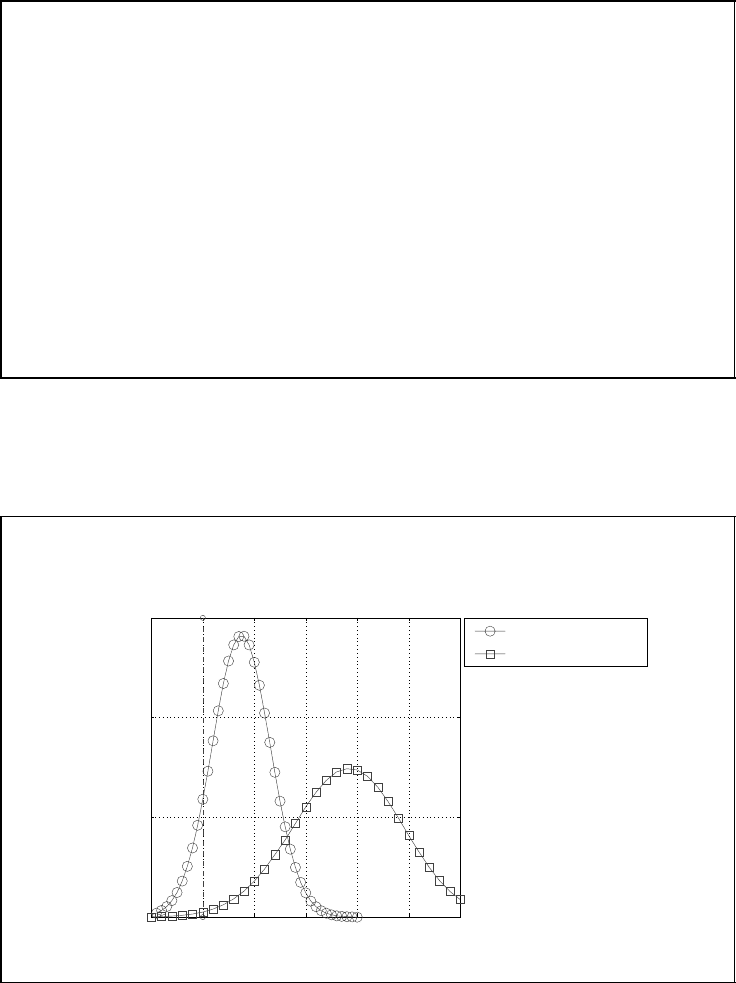
in Figure 4.20 which depicts the distribution of the L-values at the input and output of
the Soft-Input Soft-Output (SISO) decoder. For this figure we have simulated a transmitted
190 TURBO CODES
Basic assumptions of the EXIT charts method
(1) The a-priori values are independent of the respective channel values.
(2) The probability density function p
e
(·) of the extrinsic output values is the
Gaussian density function.
(3) The probability density function p
e
(·) fulfils the symmetry condition (Divsalar
and McEliece, 1998)
p
e
(ξ|X = x) = p
e
(−ξ |X = x) · e
xξ
(4.12)
where the binary random variable X denotes a transmitted symbol (either
outer code symbol or inner information symbol) with x ∈{±1}.
Figure 4.19: Basic assumptions of the EXIT charts method
Distribution of L-values before and after decoding
Ŧ5 0 5 10 15 20 25
0
0.05
0.1
decoder input
decoder output
relative frequency
L-value
Figure 4.20: Distribution of the L-values at the decoder input and output

TURBO CODES 191
all-zero code sequence of the (75) convolutional code over a Gaussian channel with binary
phase shift keying. The Gaussian distribution of the input values is a consequence of
the channel model. The distribution of the output L-values of the SISO decoder is also
Gaussian-like. Note that the area under the curve on the right of the axis L = 0 determines
the bit error rate. Obviously, this area is smaller after decoding, which indicates a smaller
bit error rate.
4.4.2 Interpretation
Let L
a
denote the a-priori L-value corresponding to the transmitted symbol X . Based on
the assumptions in Figure 4.19, the a-priori input of the SISO decoders is modelled as
independent random variables
L
a
= µ
a
· X +N
a
,
where µ
a
is a real constant and N
a
is a zero-mean Gaussian distributed random variable
with variance σ
2
a
. Thus, the conditional probability density function of the a-priori L-values
is
p
a
(ξ|X = x) =
1
√
2πσ
a
e
−
(ξ−µ
a
x)
2
2σ
2
a
.
Moreover, the symmetry condition (4.12) implies
µ
a
=
σ
2
a
2
.
The mutual information I
a
= I(X ;L
a
) between the transmitted symbol X and the corres-
ponding L-value L
a
is employed as a measure of the information content of the a-priori
knowledge
I
a
=
1
2
x∈{−1,1}
-
∞
−∞
p
a
(ξ|X = x)
×log
2
2 · p
a
(ξ|X = x)
p
a
(ξ|X =−1) + p
a
(ξ|X = 1)
dξ.
With Equation (4.13) and µ
a
=
σ
2
a
2
we obtain
I
a
= 1 −
1
√
2πσ
a
-
∞
−∞
e
−
(ξ−
σ
2
a
2
x)
2
2σ
2
a
log
2
(1 + e
−ξ
)dξ.
Note that I
a
is only a function of σ
a
. Similarly, for the extrinsic L-values we obtain
I
e
= I(X;L
e
) =
1
2
x∈{−1,1}
-
∞
−∞
p
e
(ξ|X = x)
×log
2
2 · p
e
(ξ|X = x)
p
e
(ξ|X =−1) + p
e
(ξ|X = 1)
dξ.

192 TURBO CODES
Calculating an EXIT chart
■ The a-priori input of the SISO decoders is modelled as independent
Gaussian random variables L
a
with variance σ
2
a
. The conditional probability
density function of the a-priori L-values is
p
a
(ξ|X = x) =
1
√
2πσ
a
e
−
(ξ−
σ
2
a
2
x)
2
2σ
2
a
(4.13)
■ The mutual information I
a
= I(X ;L
a
) between the transmitted symbol
X and the corresponding L-value L
a
is employed as a measure of the
information content of the a-priori knowledge. I
a
is only a function of σ
a
I
a
= 1 −
1
√
2πσ
a
-
∞
−∞
e
−
(ξ−
σ
2
a
2
x)
2
2σ
2
a
log
2
(1 + e
−ξ
)dξ (4.14)
■ The mutual information I
e
= I(X ;L
e
) between the transmitted symbol X
and the corresponding extrinsic L-value L
e
is employed as a measure of
the information content of the code correlation
I
e
= I(X;L
e
) =
1
2
x∈{−1,1}
-
∞
−∞
p
e
(ξ|X = x)
×log
2
2 · p
e
(ξ|X = x)
p
e
(ξ|X =−1) + p
e
(ξ|X = 1)
dξ (4.15)
where p
e
(·) is estimated by means of Monte Carlo simulations.
Figure 4.21: Calculating an EXIT chart
Note that it is not possible to express I
a
= I(X ;L
a
) and I
e
= I(X ;L
e
) in closed form.
However, both quantities can be evaluated numerically. In order to evaluate Equation (4.15),
we estimate p
e
(·) by means of Monte Carlo simulations. For this purpose, we generate
independent random variables L
a
according to Equation (4.13) and apply them as a-priori
input to the SISO decoder. We obtain a similar distribution p
e
(·) to Figure 4.20. With this
distribution we can calculate I
e
= I(X ;L
e
) numerically according to Figure 4.21. I
a
=
I(X ;L
a
) is also evaluated numerically according to Equation (4.14).
In order to analyse the iterative decoding algorithm, the resulting extrinsic information
transfer (EXIT) characteristics I
e
= T(I
a
,E
b
/N
0
) of the inner and outer decoder are plotted
into a single diagram, where for the outer decoder the axes of the transfer characteristic are
swapped. An example of an EXIT chart is given in Figure 4.22. This EXIT chart can be
TURBO CODES 193
Interpretation of an EXIT chart
0 0.2 0.4 0.6 0.8 1
0
0.2
0.4
0.6
0.8
1
inner code
outer code
I
i
a
= I
o
e
I
o
a
= I
i
e
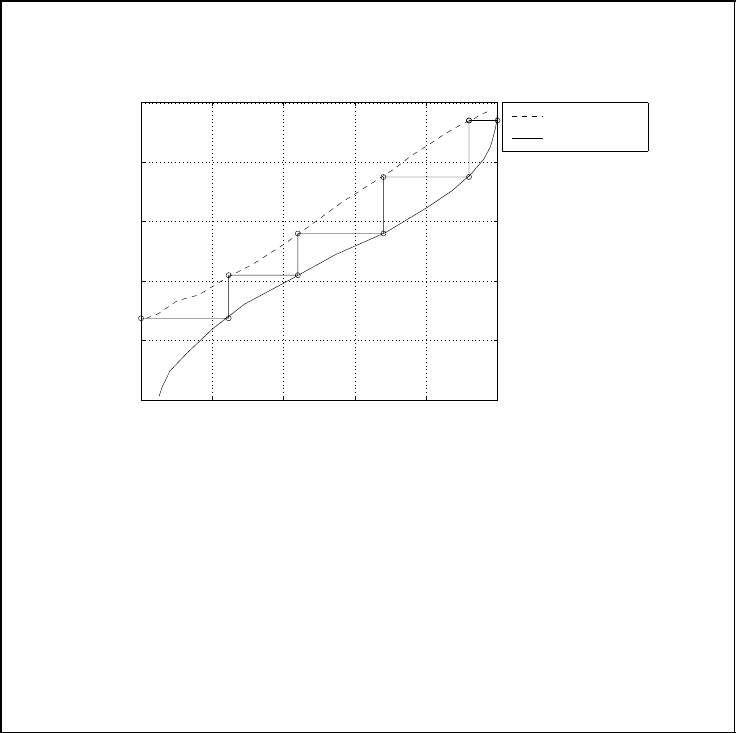
■ The resulting extrinsic information transfer (EXIT) characteristics I
e
=
T(I
a
,E
b
/N
0
) of the inner and outer decoder are plotted into a single
diagram, where for one decoder the axes of the transfer characteristic is
swapped.
■ During the iterative decoding procedure the extrinsic output values of one
decoder become the a-priori values of the other decoder. This is indicated
by the line between the transfer functions.
■ Each line indicates a single decoding step of the iterative decoding proce-
dure.
Figure 4.22: Interpretation of an EXIT chart
interpreted as follows. During the iterative decoding procedure, the extrinsic output values
of one decoder become the a-priori values of the other decoder. This is indicated by the
line between the transfer functions, where each line indicates a single decoding step of one
of the constituent decoders (a half-iteration of the iterative decoding procedure).
EXIT charts provide a visualisation of the exchange of extrinsic information between
the two component decoders. Moreover, for very large interleaver sizes, EXIT charts
make it possible to predict the convergence of the iterative decoding procedure accord-
ing to Figure 4.23. Convergence is only possible if the transfer characteristics do not
intersect. In the case of convergence, the average number of required decoding steps
can be estimated. Furthermore, the EXIT chart method make it possible to predict the
so-called waterfall region of the bit error rate performance. This means that we observe
194 TURBO CODES
Convergence of iterative decoding
0 0.5 1
0
0.2
0.4
0.6
0.8
1
I
A
i
=I
E
o
I
A
o
=I
E
i
E
b
/N
0
=0.1dB
0 0.5 1
0
0.2
0.4
0.6
0.8
1
I
A
i
=I
E
o
I
A
o
=I
E
i
E
b
/N
0
=0.3dB
0 0.5 1
0
0.2
0.4
0.6
0.8
1
I
A
i
=I
E
o
I
A
o
=I
E
i
E
b
/N
0
=0.8dB
0 0.2 0.4
10
4
10
2
10
0
E
b
/N
0
BER →
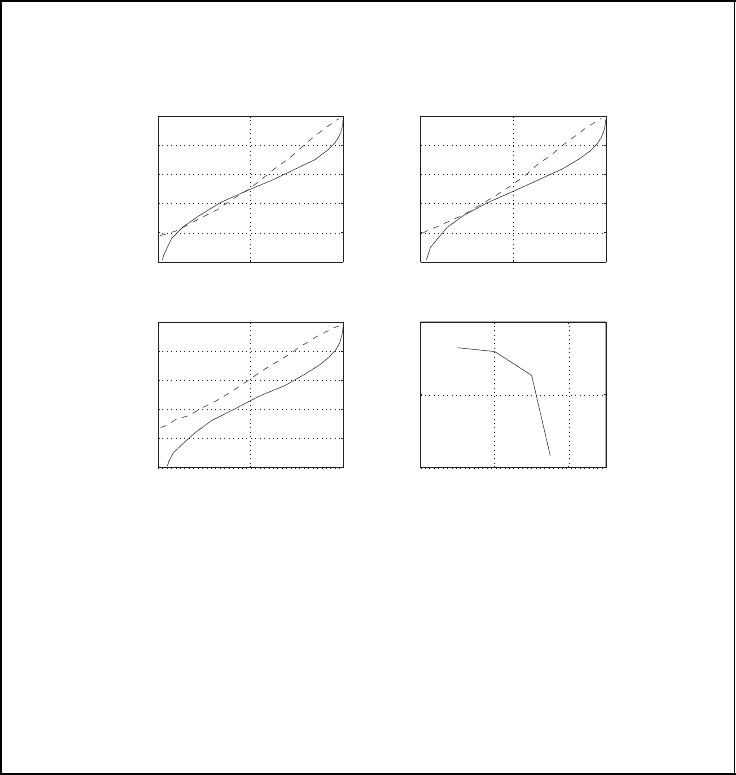
These EXIT charts can be interpreted as follows:
■ Pinch-off region: the region of low signal-to-noise ratios where the bit
error rate is hardly improved with iterative decoding.
■ Bottleneck region: here the transfer characteristics leave a narrow tunnel.
During the iterative decoding the convergence towards low bit error rates
is slow, but possible.
■ Wide-open region: region of fast convergence.
Figure 4.23: EXIT charts and the simulated bit error rate (BER) for a serially
concatenated code with overall rate R = 1/3
an E
b
/N
0
-decoding threshold that corresponds to the region of the EXIT charts where
the transfer characteristics leave a narrow tunnel. For this signal-to-noise ratio, the iter-
ative decoding algorithm converges towards low bit error rates with a large number of
iterations. Therefore, this region of signal-to-noise ratios is also called the bottleneck
region. The region of low signal-to-noise ratios, the pinch-off region, is characterised by
an intersection of the transfer characteristics of the two decoders. Here, the bit error rate
is hardly improved with iterative decoding. Finally, we have the region of fast conver-
gence, where the signal-to-noise ratio is significantly larger than the decoding threshold. In
TURBO CODES 195
the so-called wide-open region the decoding procedure converges with a small number of
iterations.
For instance, we construct a serially concatenated code. For the inner encoding we
employ a rate R
i
= 1/2 code with generator matrix G
i
(D) = (1,
1+D
2
1+D+D
2
). For the outer
encoding we employ the same code, but we apply puncturing and partitioning to obtain
the outer rate R
o
= 2/3 and the desired overall rate R = 1/3. For this example, the EXIT
charts for different values of E
b
/N
0
are depicted in Figure 4.23. The bottleneck region
corresponds to a signal-to-noise ratio E
b
/N
0
≈ 0.3 dB. For the code of rate R = 1/3 and
length n = 100 000, the required signal-to-noise ratio in order to obtain a bit error rate
of 10
−4
is less than 0.1 dB away from the predicted threshold value, where the iterative
decoding procedure was run for 30 iterations.
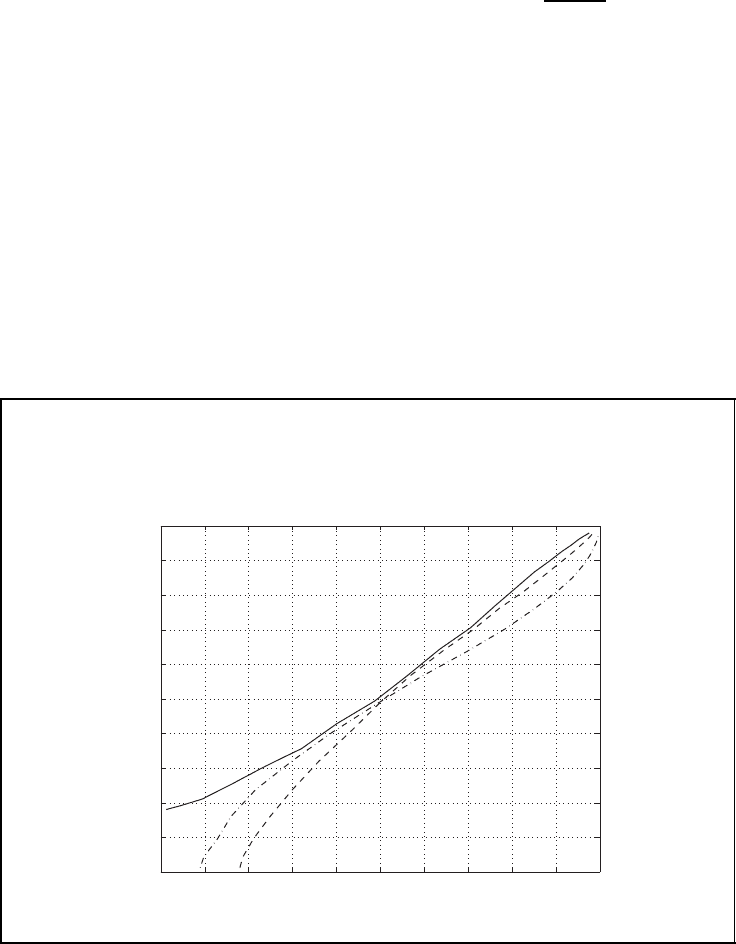
Now, consider our running example with the codes from Figure 4.16. The corres-
ponding EXIT charts for a signal-to-noise ratio E
b
/N
0
= 0.1 dB can be found in
Figure 4.24. The solid line is the transfer characteristic of the inner code. The two other
charts correspond to the parallel concatenation (R
p
= 1/2) with the partitioning matrix
P = (1, 0) and the partially concatenated code with R
p
= 5/7. For the parallel concatenation
the EXIT chart leaves a narrow tunnel. Thus, the iterative decoding should converge towards
low bit error rates. Similarly, with R
p
= 5/7 the convergence of the iterative decoding is
EXIT charts for different partial rates
0 0.1 0.2 0.3 0.4 0.5 0.6 0.7 0.8 0.9 1
0
0.1
0.2
0.3
0.4
0.5
0.6
0.7
0.8
0.9
1
I
A
i
=I
E
o
I
A
o
=I
E
i
E
b
/N
0
=0.1dB
R
o
=4/7, R
p
=5/7
R
p
=1/2, P=(1 0)
Figure 4.24: EXIT charts for the codes from Figure 4.16 for E
b
/N
0
= 0.1dB