
Neubauer A., Freudenberger J., Kuhn V. Coding theory: algorithms, architectures and applications
Подождите немного. Документ загружается.


196 TURBO CODES
slow, but possible. In comparison with P = (1, 0), we observe a wider tunnel for the
R
p
= 5/7 construction. Therefore, the iterative decoding should converge with a smaller
number of iterations. Note that the choice of the partitioning pattern is also important. The
parallel construction with P = (0, 1) gets stuck at values > 0.5. Likewise, the EXIT charts
for the serially concatenated code as well as for R
p
= 4/5 get instantly stuck, so no bit
error rate reduction is expected at this signal-to-noise ratio. These curves are omitted in
Figure 4.24.
For large interleaver sizes the EXIT chart method allows accurate prediction of the
waterfall region. For interleavers of short or moderate length bounding techniques that
include the interleaving depth are more appropriate, particularly if we also consider the
region of fast convergence, i.e. if we wish to determine possible error floors.
4.5 Weight Distribution
We have seen in Section 3.3.6 that the performance of a code with maximum likelihood
decoding is determined by the weight distribution, of the code. If we know the weight
distribution, we can bound the word error rate using, for example, the union bound.
However, for concatenated codes, even of moderate length, it is not feasible to evaluate
the complete weight distribution. It is usually not even possible to determine the mini-
mum Hamming distance of a particular code. A common approach in coding theory to
overcome this issue, and to obtain at least some estimate of the code performance with
maximum likelihood decoding, is to consider not particular codes but an ensemble of
codes.
In the context of turbo codes, this approach was introduced by Benedetto and Mon-
torsi (Benedetto and Montorsi, 1998). They presented a relatively simple method for
calculating the expected weight distribution of a concatenated convolutional code from
the weight distributions of the component codes. The expected weight distribution is the
average over the weight distributions of all codes in the considered ensemble, where the
ensemble is defined by the set of all possible interleavers. In this section we will utilise
the concept introduced by Benedetto and Montorsi. (Benedetto and Montorsi, 1998) to
derive the expected weight distribution
A
w
for partially concatenated convolutional codes.
Then, we will use
A
w
to bound the expected code performance with maximum likelihood
decoding.
4.5.1 Partial Weights
For further consideration of partially concatenated convolutional codes it is necessary not
only to regard the overall weight of the outer encoder output but also the partial weights.
These partial weights distinguish between the weight w
1
of the code sequence being fed
into the inner encoder and the weight w
2
of the code sequence not being encoded by the
inner encoder.
By analogy with the extended weight enumerator function discussed in Section 3.3.3,
we introduce the labels W
1
and W
2
instead of W so that we can determine the partial
weight enumerator function A
PEF
(W
1
,W
2
) as described in Section 3.3.4.
TURBO CODES 197
For further calculations, assuming b
1
is fed into the inner encoder and b
2
is not encoded,
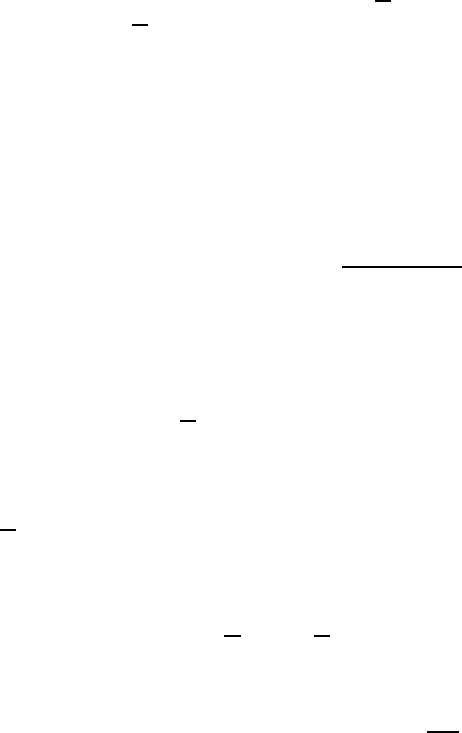
the matrix A from the above examples is modified as
˜
A =
10W
1
W
2
0
W
1
W
2
010
0 W
1
0 W
2
0 W
2
0 W
1
.
The modification of A can be done by introducing labels V
1
,...,V
n
which represent the
output weight of each output of the encoder so that A contains polynomials A
ij
(V
1
,...,V
n
).
Then the polynomials
˜
A
ij
(W
1
,W
2
) can be easily obtained by replacing V
k
(k = 1,...,c)
with W
1
or W
2
according to the partitioning scheme. In this context, A
ij
marks the element
in row i and column j of matrix A.
4.5.2 Expected Weight Distribution
Now we derive the expected weight distribution A
w
for partially concatenated convolu-
tional codes, where
A
w
denotes the expected number of code words with weight w.We
restrict ourselves to randomly chosen permutations of length N and terminated convolu-
tional component codes. First, we evaluate the expected number of code words E{A
i
w
2
, ˜w
}
with weight ˜w at the output of the inner encoder conditioned on the weight w
2
of the partial
outer code sequence v
o,(2)
. Let A
i
w
1
, ˜w
denote the number of code words generated by the
inner encoder with input weight w
1
and output weight ˜w (Benedetto and Montorsi, 1998).
Let A
o
w
1
,w
2
denote the number of code words with partial weights w
1
and w
2
corresponding
to the outer encoder and its partitioning. We have
E{A
i
w
2
, ˜w
}=
N
w
1
=0
A
o
w
1
,w
2
· A
i
w
1
, ˜w
N
w
1
.
This formula becomes plausible if we note that the term A
i
w
1
, ˜w
/
N
w
1
is the probability that
a random input word u
i
to the inner encoder of weight w
1
will produce an output word b
i
of weight ˜w. With w =˜w + w
2
we obtain
A
w
= E{A
w
}=
w
2
≤w
E{A
i
w
2
,(w−w
2
)
}.
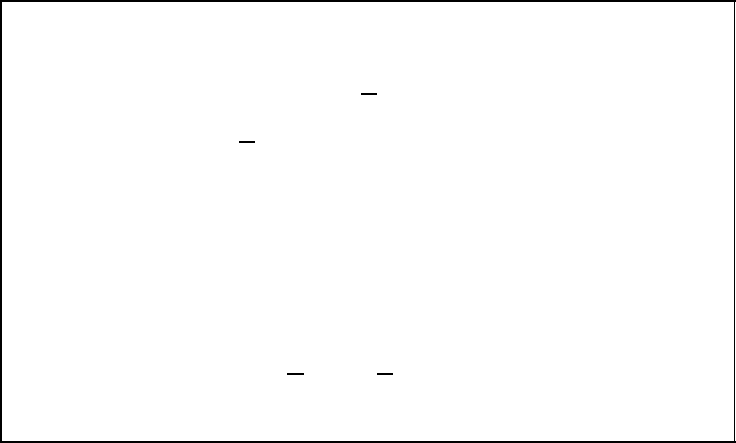
This is summarized in Figure 4.25. formula (4.16) can be used for bounding the average
maximum likelihood performance of the code ensemble given by all possible permutations.
Let
P
W
denote the expected word error rate and n the overall code length. Using the
standard union bound for the additive white Gaussian noise (AWGN) channel with binary
phase shift keying, we have
P
W
≤
n
w=1
A
w
e
−w·R·E
b
/N
0
.
We consider the codes as given in Figure 4.16. However, for inner encoding we use the inner
rate R
i
= 1/2 code with generator matrix G
i
(D) = (1,
1
1+D
). With code length n = 300
198 TURBO CODES
Expected weight distribution
■ The expected weight distribution A
w
for a partially concatenated convolu-
tional code is
A
w
= E{A
w
}=
w
2
≤w
E
A
i
w
2
,(w−w
2
)
(4.16)
where E{A
i
w
2
, ˜w
} is the expected number of code words with weight ˜w at
the output of the inner encoder conditioned on the weight w
2
of the partial
outer code sequence.
■ Using the standard union bound for the AWGN channel with Binary Phase
Shift Keying (BPSK), we can bound the expected word error rate
P
W
≤
n
w=1
A
w
e
−w·R·E
b
/N
0
(4.17)
Figure 4.25: Expected weight distribution
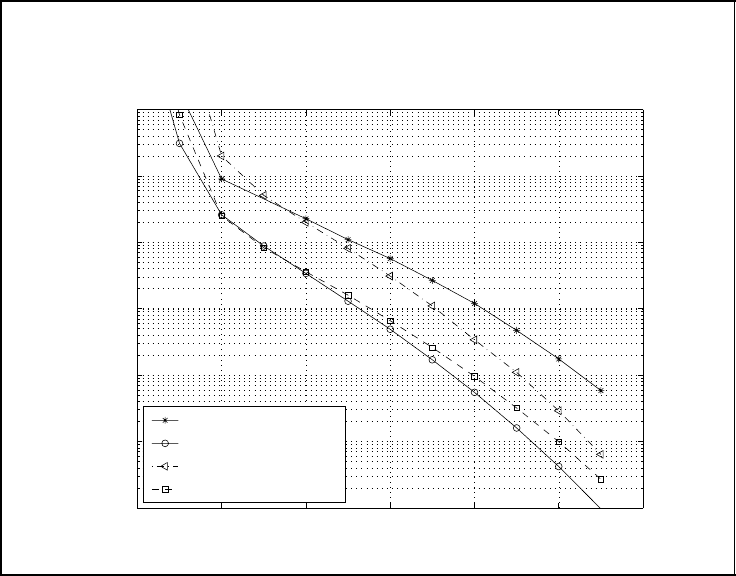
we obtain similar overall rates R ≈ 1/3. The results for bounding the word error rate by
the union bound in inequality (4.17) are depicted in Figure 4.26. R
p
= 1 corresponds to
a serially concatenated convolutional code, and R
p
= 1/2 to a turbo code. For a partially
concatenated code with R
p
= 4/5 we use a rate R
o
= 3/5 punctured outer code. With
the partitioning period t
p
= 1 there exist five different partitioning schemes. The results
for the schemes with best and worst performance are also given in Figure 4.26. The per-
formance difference between P = (1, 1, 1, 1, 0) and P = (0, 1, 1, 1, 1) indicates that the
particular choice of the partitioning scheme is important. In this example the partially con-
catenated code with P = (0, 1, 1, 1, 1) outperforms the serially and parallel concatenated
constructions.
4.6 Woven Convolutional Codes
In this section we concentrate on the minimum Hamming distance of the constructed con-
catenated code. With respect to the minimum Hamming distance of the concatenated code,
especially for codes of short lengths, the choice of the particular interleaver is very impor-
tant. With turbo-like codes, the use of designed interleavers is motivated by the asymptotic
coding gain, which is the gain in terms of transmit power that can be achieved with coding
compared with the uncoded case for very low residual error rates. For unquantised channels
the asymptotic coding gain is (Clark and Cain, 1988)
G
a
= 10 log
10
(R · d)dB,
TURBO CODES 199
Union bound on the word error rate
2 3 4 5 6 7 8
10
Ŧ6
10
Ŧ5
10
Ŧ4
10
Ŧ3
10
Ŧ2
10
Ŧ1
10
0
E
b
/N
0
WER
R
p
=4/5, P=(1,1,1,1,0)
R
p
=4/5, P=(0,1,1,1,1)
R
p
=1/2, P=(1,0)
R
p
=1, P=(1,1,1)
Figure 4.26: Union bound on the word error rate for rate R = 1/3 codes (code length
n = 300) with different partial rates (cf. Figure 4.16)
where R is the rate and d is the minimum Hamming distance of the code. This formula
implies that for fixed rates the codes should be constructed with minimum Hamming dis-
tances as large as possible, in order to ensure efficient performance for high signal-to-noise
ratios.
We start our discussion by introducing the class of woven convolutional codes. Woven
code constructions yield a larger designed minimum Hamming distance than ordinary
serial or parallel constructions. In the original proposal (H
¨
ost et al., 1997), two types
of woven convolutional code are distinguished: those with outer warp and those with
inner warp. In this section we consider encoding schemes that are variations of woven
codes with outer warp. We propose methods for evaluating the distance characteristics of
the considered codes on the basis of the active distances of the component codes. With
this analytical bounding technique, we derive lower bounds on the minimum (or free)
distance of the concatenated code. These considerations also lead to design criteria for
interleavers.
Note that some of the figures and results of this section are reprinted, with permission,
from Freudenberger et al. (2001), 2001 IEEE.
200 TURBO CODES
4.6.1 Encoding Schemes
With binary woven convolutional codes, several convolutional encoders are combined in
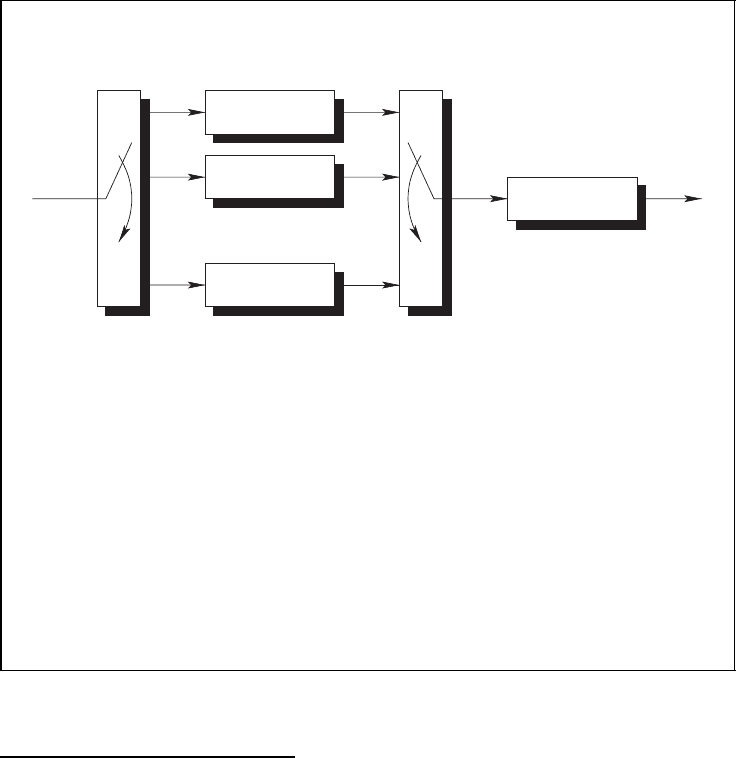
such a way that the overall code is a convolutional code. The basic woven convolutional
encoder with outer warp is depicted in Figure 4.27. It consists of l
o
outer convolutional
encoders which have the same rate R
o
= k
o
/n
o
and a single inner encoder.
7
The informa-
tion sequence u is divided into l
o
subsequences u
o
l
with l = 1,...,l
o
. These subsequences
u
o
l
are encoded with the outer encoders. The resulting outer code sequences b
o
1
,...,b
o
l
o
are
written row-wise into a buffer of l
o
rows. The binary code bits are read column-wise from
this buffer. The resulting sequence constitutes the input sequence u
i
of the single inner rate
R
i
= k
i
/n
i
convolutional encoder. After inner encoding, we obtain the final code sequence
b of the Woven Convolutional Code (WCC). The resulting woven convolutional code has
overall rate R = R
i
R
o
.
Woven encoder with outer warp
b
b
o
1
b
o
2
b
o
l
o
.
.
.
u
u
o
1
u
o
2
u
o
l
o
u
i
outer encoder
1
outer encoder
2
outer encoder
l
o
inner encoder
■ A woven convolutional encoder with outer warp consists of l
o
outer convo-
lutional encoders that have the same rate R
o
= k
o
/n
o
.
■ The information sequence u is divided into l
o
subsequences u
o
l
with l =
1,...,l
o
.
■ The outer code sequences b
o
1
,...,b
o
l
o
are written row-wise into a buffer
of l
o
rows. The binary code bits are read column-wise and the resulting
sequence constitutes the input sequence u
i
of the single inner rate R
i
=
k
i
/n
i
convolutional encoder.
■ The resulting woven convolutional code has the overall rate
R = R
i
R
o
.
Figure 4.27: Woven encoder with outer warp
7
In contrast, a woven encoder with inner warp has a single outer and several inner encoders.
TURBO CODES 201
Woven turbo encoder
b
b
o,(1)
1
b
o,(2)
1
b
o,(1)
2
b
o,(2)
2
b
o,(1)
l
o
b
o,(2)
l
o
.
.
.
P
P
P
u
u
o
1
u
o
2
b
o,(2)
u
o
l
o
u
i
b
i
outer encoder
1
outer encoder
2
outer encoder
l
o
inner encoder
■ The overall woven turbo code has the rate
R =
R
o
R
i
R
p
+ R
i
(1 − R
p
)
,
where R
p
is the fraction of outer code bits that will be encoded by the inner
encoder.
■ The partitioning of the outer code sequences into two partial code
sequences b
o,(1)
l
and b
o,(2)
l
is described by means of a partitioning matrix P.
Figure 4.28: Woven turbo encoder
The concept of partial concatenation as discussed in Section 4.3.4 was first introduced
by Freudenberger et al. (Freudenberger et al., 2000a, 2001) in connection with woven turbo
codes. Woven turbo codes belong to the general class of woven convolutional codes.
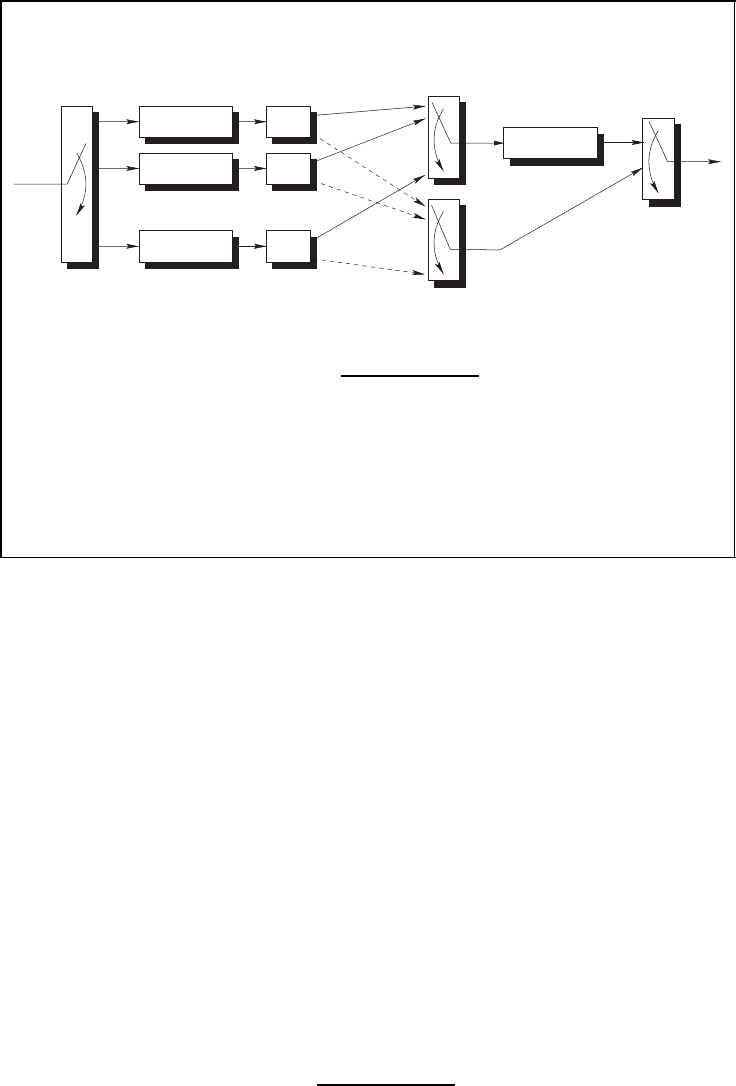
Figure 4.28 presents the encoder of a Woven Turbo Code (WTC). Like an ordinary woven
encoder, a woven turbo encoder consists also of l
o
outer convolutional encoders and one
inner convolutional encoder. The information sequence u is subdivided into l
o
sequences
which are the input sequences to the l
o
rate R
o
= k
o
/n
o
outer encoders.
Parts of the symbols of the outer code sequences (b
o,(1)
l
), which are located in the same
bit positions, are multiplexed to the sequence u
i
. The sequence u
i
is the input sequence
of the inner encoder. The other symbols of the outer code sequences (b
o,(2)
l
, dashed lines
in Figure 4.28) are not encoded by the inner encoder. These sequences b
o,(2)
l
form the
sequence b
o,(2)
which, together with the inner code sequence b
i
, constitutes the overall
code sequence b.
As with partially concatenated codes, the partitioning of the outer code sequences into
two partial code sequences b
o,(1)
l
and b
o,(2)
l
is described by means of a partitioning matrix
P. Furthermore, the overall code rate is
R =
R
o
R
i
R
p
+ R
i
(1 − R
p
)
,
202 TURBO CODES
Woven encoder with row-wise interleaving
b
b
o
1
b
o
2
b
o
l
o
.
.
.
u
u
o
1
u
o
2
u
o
l
o
u
i
outer encoder
1
outer encoder
2
outer encoder
l
o
inner encoder
π
1
π
2
π
l
o
Figure 4.29: Woven encoder with row-wise interleaving
where R
p
is the fraction of outer code bits that will be encoded by the inner encoder as
defined in Section 4.3.4.
Up to now, we have only considered woven constructions without interleavers. These
constructions lead to overall convolutional codes. Usually, when we employ interleaving,
we use block-wise interleavers and terminated convolutional codes so that the resulting
concatenated code is actually a block code. This is possibly also the case with woven
codes for most applications.
However, there are a number of interesting aspects of the construction without inter-
leaving, e.g. a sliding window decoding algorithm for WCC can be introduced (Jordan
et al., 2004a). This algorithm requires no code termination and might be interesting for
applications where low-latency decoding is required. In the following we will mainly con-
sider constructions with interleaving, in particular row-wise interleaving as indicated in
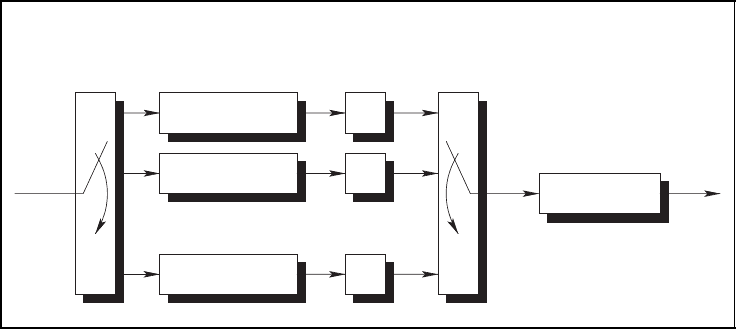
Figure 4.29. Here, each outer code sequence b
o
l
is interleaved by arbitrary and independent
interleavers. The interleaved sequences are fed into the inner encoder. Of course, the same
interleaver concept can also be applied to woven turbo codes.
4.6.2 Distance Properties of Woven Codes
Now, we investigate the distance properties of the considered codes on the basis of the
active distances of the component codes. With this analytical bounding technique, we derive
lower bounds on the minimum (or free) distance of the concatenated code.
Below, we define the generating tuples of an input sequence u(D) of a convolutional
encoder. Then, we show that each generating tuple generates at least d
g
non-zero bits in
the encoded sequence b(D), where d
g
is some weight in the region β
b
≤ d
g
≤ d
free
.
Consider a convolutional encoder and its active burst distance (cf. Section 3.3.2 on
page 122). We call a segment of a convolutional code sequence burst if it corresponds to
an encoder state sequence starting in the all-zero state and ending in the all-zero states
and having no consecutive all-zero states in between which correspond to an all-zero input

TURBO CODES 203
Generating tuples
■ Let d
g
be an integer with β
b
≤ d
g
≤ d
free
. We define the generating length
for d
g
as
j
g
=
2d
g
− β
b
α
(4.18)
i.e. j
g
is the minimum j for which the lower bound on the active burst
distance satisfies αj + β
b
≥ 2d
g
.
■ Let t
1
be the time index of the first non-zero tuple u
t
= (u
(1)
t
,u
(2)
t
,...,u
(k)
t
)
of the sequence u.Lett
2
be the time index of the first non-zero tuple with
t
2
≥ t
1
+ j
g
, and so on. We call the information tuples u
t
1
, u
t
2
,...generating
tuples.
■ Let u be the input sequence of a convolutional encoder with N
g
generating
tuples with generating length j
g
. Then the weight of the corresponding
code sequence b satisfies
wt(b) ≥ N
g
d
g
(4.19)
Figure 4.30: Definition of generating tuples
tuple of the encoder. Note that a burst of length j + 1 has at least weight a
b
(j), where
length is defined in n-tuples and the corresponding number of bits is equal to n(j + 1).
For an encoder characterised by its active burst distance, we will now bound the weight
of the generated code sequence given the weight of the corresponding information sequence.
Of course, this weight of the code sequence will depend on the distribution of the 1s in the
input sequence. In order to consider this distribution, we introduce the notion of generating
tuples as defined in Figure 4.30. Let d
g
be an integer satisfying β
b
≤ d
g
≤ d
free
. Remember
that d
free
is the free distance of the code and β
b
is a constant in the lower bound of the
active burst distance defined in Equation (3.11). We define the generating length for d
g
as
j
g
=
2d
g
− β
b
α
,
where α is the slope of the lower bound on the active distances. The generating length j
g
is the minimum length j for which the lower bound on the active burst distance satisfies
αj +β
b
≥ 2d
g
, i.e. j
g
is the length of a burst that guarantees that the burst has at least
weight 2d
g
.
Now consider an arbitrary information sequence u. We call the first non-zero k-tuple
u
t
= (u
(1)
t
,u
(2)
t
,...,u
(k)
t
) a generating tuple, because it will generate a weight of at least
d
free
in the code sequence b. But what happens if there are more non-zero input bits? Now
the definition of the generating tuples comes in handy. Let t
1
be the time index of the first

204 TURBO CODES
generating tuple, i.e. of the first non-zero tuple u
t
= (u
(1)
t
,u
(2)
t
,...,u
(k)
t
) in the sequence u.
Moreover, let t
2
be the time index of the first non-zero tuple with t
2
≥ t
1
+ j
g
, and so on.
We call the information tuples u
t
1
, u
t
2
,... generating tuples. If the number of generating
tuples is N
g
, then the weight of the code sequence is at least N
g
· d
g
.
Why is this true? Consider an encoder with generating length j
g
according to Equation
(4.18). The weight of a burst that is started by a generating tuple of the encoder will be
at least d
free
if the next generating tuple enters the encoder in a new burst, and at least
2d
g
if the next generating tuple enters the encoder inside the burst. This approach can be
generalised. Let N
i
denote the number of generating tuples corresponding to the ith burst.
For N
i
= 1 the weight of the ith burst is greater or equal to d
free
, which is greater or equal
to d
g
. The length of the ith burst is at least (N
i
− 1)j
g
+ 1 for N
i
> 1 and we obtain
wt(burst
i
) ≥˜a
b
(N
i
− 1)j
g
≥ α(N
i
− 1)j
g
+ β
b
.
With Equation (4.18) we have αj
g
≥ 2d
g
− β
b
and it follows that
wt(burst
i
) ≥ (N
i
− 1)(2d
g
− β
b
) + β
b
≥ N
i
d
g
+ (N
i
− 2)(d
g
− β
b
).
Taking into account that d
g
≥ β
b
, i.e. d
g
− β
b
≥ 0, we obtain
wt(burst
i
) ≥ N
i
d
g
∀ N
i
≥ 1.
Finally, with N
g
=
#
i
N
i
we obtain
wt(b) ≥
i
wt(burst
i
) ≥
i
N
i
d
g
= N
g
d
g
.
We will now use this result to bound the free distance of a WCC. Consider the encoder
of a woven convolutional code with outer warp as depicted in Figure 4.29. Owing to the
linearity of the considered codes, the free distance of the woven convolutional code is given
by the minimal weight of all possible inner code sequences, except the all-zero sequence.
If one of the outer code sequences b
o
l
is non-zero, then there exist at least d
o
free
non-
zero bits in the inner information sequence. Can we guarantee that there are at least d
o
free
generating tuples? In fact we can if we choose a large enough l
o
. Let d
g
be equal to the free
distance d
i
free
of the inner code. We define the effective length of a convolutional encoder
as
l
eff
= k
2d
free
− β
b
α
.
Let l
i
eff
be the effective length of the inner encoder. If l
o
≥ l
i
eff
holds and one of the
outer code sequences b
o
l
is non-zero, then there exist at least d
o
free
generating tuples in
the inner information sequence that generate a weight greater or equal to d
i
free
. Conse-
quently, it follows from inequality (4.19) that d
WCC
free
≥ d
o
free
d
i
free
. This result is summarised
in Figure 4.31.

TURBO CODES 205
Free distance of woven convolutional codes
■ We define the effective length of a convolutional encoder as
l
eff
= k
2d
free
− β
b
α
(4.20)
■ Let l
i
eff
be the effective length of the inner encoder. The free distance of the
WCC with l
o
≥ l
i
eff
outer convolutional encoders satisfies the inequality
d
WCC
free
≥ d
o
free
d
i
free
(4.21)
Figure 4.31: Free distance of woven convolutional codes
For instance, let us construct a woven encoder employing l
o
outer codes. For outer
codes we use the punctured convolutional code defined in Section 3.1.5 with the generator
matrix
G
o
(D) =
1 + D 1 + D 1
D 01+ D
.
This code has free distance d
o
free
= 3. The generator matrix of the inner convolutional
code is G
i
(D) = (1,
1+D
2
1+D+D
2
), i.e. d
i
free
= 5. The lower bound on the active burst distance
of the inner encoder is given by ˜a
b,i
(j) = 0.5j + 4 and we have l
i
eff
= 12. Then, with
l
o
= l
i
eff
= 12, we obtain the free distance d
WCC
free
= 15. The rate of the overall code is
R = R
i
R
o
=
1
3
.
4.6.3 Woven Turbo Codes
We will now analyse the free distance of a woven turbo code. In Section 4.6.2 we have
used the concept of generating tuples and the fact that any non-zero outer code sequence
in a woven convolutional encoder has at least weight d
o
free
.
With woven turbo codes, however, the number of non-zero bits encoded by the inner
encoder will be smaller than d
o
free
. We will now define a distance measure that enables us
to estimate the free distance in the case of partitioned outer code sequences. We call this
distance measure the partial distance.
The partitioning matrix P determines how a code sequence b is partitioned into the two
sequences b
(1)
and b
(2)
. Note that, using the notion of a burst, we could define the free
distance as the minimum weight of a burst. Analogously, we define the partial distance as
the minimum weight of partial code sequence b
(2)
[0,j]
. However, we condition this value on
the weight of the partial code sequence b
(1)
[0,j]
. The formal definition is given in Figure 4.32.