
Norman D.A. Emotional Design: Why We Love (Or Hate) Everyday Things
Подождите немного. Документ загружается.

x
Contents
6
Emotional Machines
161
7
The
Future
of
Robots
195
Epilogue:
We Are All
Designers
2 1 3
Personal
Reflections
and
Acknovledgments
229
Notes
235
References
243
Index
249
TLFeBOOK
Emotional
Design
TLFeBOOK
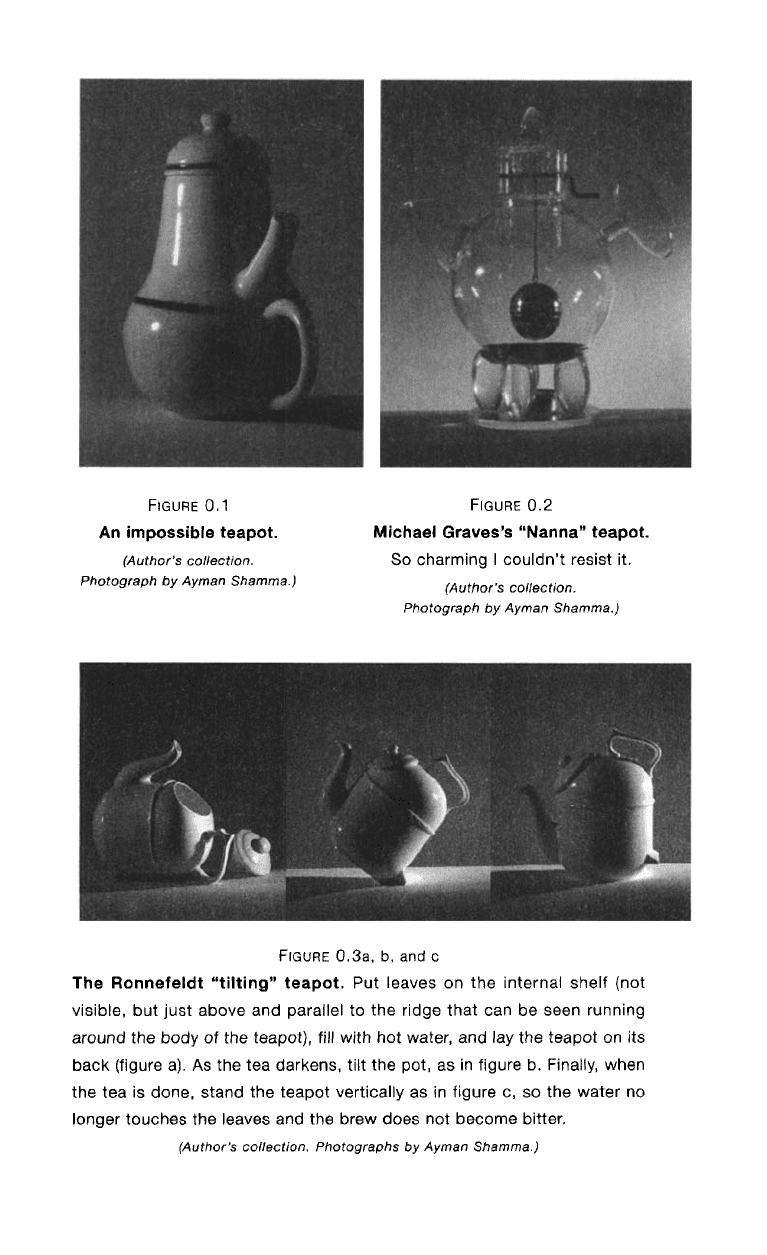
FIGURE
0.1
An
impossible
teapot.
(Author's
collection.
Photograph
by
Ayman Shamma.)
FIGURE
0.2
Michael Graves's "Nanna" teapot.
So
charming
I
couldn't resist
it.
(Author's
collection.
Photograph
by
Ayman Shamma.)
FIGURE
0.3a,
b, and c
The
Ronnefeldt "tilting" teapot.
Put
leaves
on the
internal shelf (not
visible,
but
just above
and
parallel
to the
ridge that
can be
seen running
around
the
body
of the
teapot),
fill
with
hot
water,
and lay the
teapot
on its
back (figure
a). As the tea
darkens, tilt
the
pot,
as in
figure
b.
Finally, when
the tea is
done, stand
the
teapot vertically
as in
figure
c, so the
water
no
longer touches
the
leaves
and the
brew does
not
become
bitter.
(Author's
collection.
Photographs
by
Ayman Shamma.)
TLFeBOOK
Three
Teapots
If
you
want
a
golden
rule that
will
fit
everybody,
this
is it:
Have nothing
in
your houses that
you
do not
know
to be
useful,
or
believe
to be
beautiful.
—William
Morris
"The
Beauty
of
Life," 1880
I
HAVE
A
COLLECTION
OF
TEAPOTS.
One of
them
is
completely unusable—the handle
is on the
same side
as the
spout.
It
was
invented
by the
French artist Jacques Carelman,
who
called
it a
coffeepot:
a
"coffeepot
for
masochists."
Mine
is a
copy
of the
original.
A
picture
of it
appears
on the
cover
of my
book
The
Design
of
Everyday
Things.
The
second item
in my
collection
is the
teapot called Nanna, whose
unique squat
and
chubby nature
is
surprisingly appealing.
The
third
is
a
complicated
but
practical
"tilting"
pot
made
by the
German
firm
Ronnefeldt.
The
Carelman
pot is, by
intent, impossible
to
use.
The
Nanna
teapot, designed
by the
well-known architect
and
product designer
3
PROLOGUE
TLFeBOOK
4
Emotional Design
Michael
Graves, looks clumsy
but
actually works rather well.
The
tilt-
ing
pot, which
I
discovered while enjoying high
tea at the
Four
Seasons Hotel
in
Chicago,
was
designed with
the
different
stages
of
tea
brewing
in
mind.
To use it, I
place
the tea
leaves
on a
shelf (out
of
sight
in the
pot's interior)
and lay the pot on its
back while
the
leaves
steep.
As the
brew approaches
the
desired strength,
I
prop
the pot up
at
an
angle, partially uncovering
the tea
leaves. When
the tea is
ready,
I set the pot
upright,
so
that
the
leaves
are no
longer
in
contact with
the
tea.
Which
one of
these teapots
do I
usually use? None
of the
above.
I
drink
tea
every morning.
At an
early hour,
efficiency
comes
first.
So,
upon awakening,
I pad
into
my
kitchen
and
push
the
button
on a
Japanese
hot pot to
boil water while
I
spoon
cut tea
leaves into
a
little
metal brewing ball.
I
drop
the
ball
into
my
cup,
fill
it
with
boiling
water,
wait
a few
minutes
for it to
steep,
and my tea is
ready
to
drink.
Fast,
efficient,
easy
to
clean.
Why am I so
attached
to my
teapots?
Why do I
keep them
out on
display,
in the
alcove
formed
by the
kitchen window? Even when they
are
not in
use, they
are
there, visible.
I
value
my
teapots
not
only
for
their
function
for
brewing tea,
but
because
they
are
sculptural artwork.
I
love standing
in
front
of the
window, comparing
the
contrasting shapes, watching
the
play
of
light
on
the
varied surfaces. When
I'm
entertaining guests
or
have time
to
spare,
I
brew
my tea in the
Nanna teapot
for its
charm
or in the
tilting
pot for its
cleverness.
Design
is
important
to me, but
which design
I
choose depends
on the
occasion,
the
context,
and
above all,
my
mood.
These
objects
are
more than utilitarian.
As
art, they
lighten
up
my
day. Perhaps more important, each conveys
a
personal meaning:
each
has its own
story.
One
reflects
my
past,
my
crusade against
unusable
objects.
One
reflects
my
future,
my
campaign
for
beauty.
And the
third represents
a
fascinating mixture
of the
functional
and
the
charming.
The
story
of the
teapots illustrates several components
of
product
design: usability
(or
lack thereof), aesthetics,
and
practicality.
In
ere-
TLFeBOOK
Prologue:
Three
Teapots
5
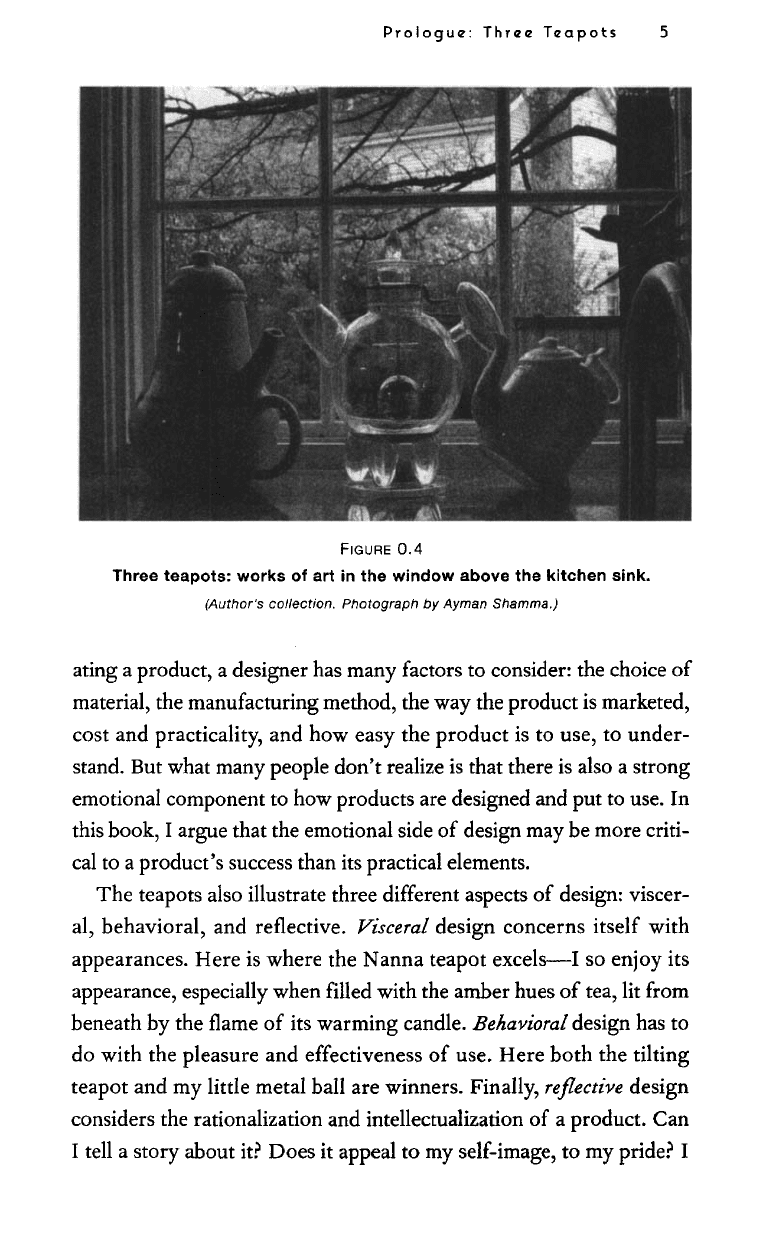
FIGURE
0.4
Three teapots:
works
of art in the
window above
the
kitchen sink.
(Author's
collection.
Photograph
by
Ayman Shamma.)
ating
a
product,
a
designer
has
many factors
to
consider:
the
choice
of
material,
the
manufacturing method,
the way the
product
is
marketed,
cost
and
practicality,
and how
easy
the
product
is to
use,
to
under-
stand.
But
what many people
don't
realize
is
that there
is
also
a
strong
emotional component
to how
products
are
designed
and put to
use.
In
this
book,
I
argue that
the
emotional side
of
design
may be
more criti-
cal
to a
product's success than
its
practical elements.
The
teapots also illustrate three
different
aspects
of
design:
viscer-
al,
behavioral,
and
reflective.
Visceral
design
concerns itself with
appearances. Here
is
where
the
Nanna teapot excels—I
so
enjoy
its
appearance,
especially when
filled
with
the
amber hues
of
tea,
lit
from
beneath
by the flame of its
warming candle. Behavioral design
has to
do
with
the
pleasure
and
effectiveness
of
use. Here both
the
tilting
teapot
and my
little metal ball
are
winners. Finally,
reflective
design
considers
the
rationalization
and
intellectualization
of a
product.
Can
I
tell
a
story about
it?
Does
it
appeal
to my
self-image,
to my
pride?
I
TLFeBOOK
6
Emotional Design
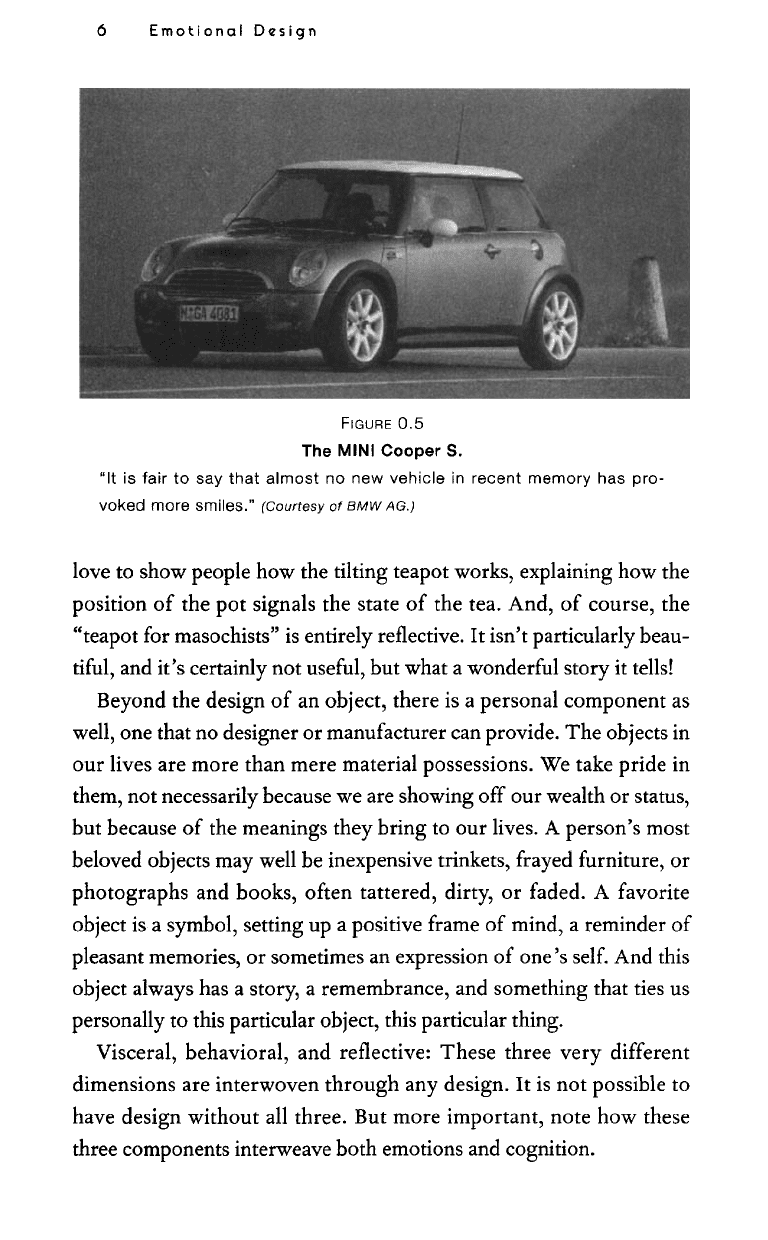
FIGURE
0.5
The
MINI Cooper
S.
"It is
fair
to say
that almost
no new
vehicle
in
recent memory
has
pro-
voked more smiles."
(Courtesy
of
BMW
AG.)
love
to
show people
how the
tilting teapot works, explaining
how the
position
of the pot
signals
the
state
of the
tea. And,
of
course,
the
"teapot
for
masochists"
is
entirely reflective.
It
isn't
particularly beau-
tiful,
and
it's
certainly
not
useful,
but
what
a
wonderful story
it
tells!
Beyond
the
design
of an
object, there
is a
personal component
as
well,
one
that
no
designer
or
manufacturer
can
provide.
The
objects
in
our
lives
are
more than mere material possessions.
We
take pride
in
them,
not
necessarily because
we are
showing
off our
wealth
or
status,
but
because
of the
meanings they bring
to our
lives.
A
person's
most
beloved objects
may
well
be
inexpensive trinkets,
frayed
furniture,
or
photographs
and
books,
often tattered, dirty,
or
faded.
A
favorite
object
is a
symbol, setting
up a
positive
frame
of
mind,
a
reminder
of
pleasant memories,
or
sometimes
an
expression
of
one's
self.
And
this
object
always
has a
story,
a
remembrance,
and
something that ties
us
personally
to
this particular object, this particular thing.
Visceral, behavioral,
and
reflective:
These
three very
different
dimensions
are
interwoven
through
any
design.
It is not
possible
to
have
design
without
all
three.
But
more important, note
how
these
three components interweave both emotions
and
cognition.
TLFeBOOK
Prologue:
Three
Teapots
7
This
is so
despite
the
common tendency
to pit
cognition against
emotion. Whereas emotion
is
said
to be
hot, animalistic,
and
irra-
tional, cognition
is
cool, human,
and
logical.
This
contrast comes
from
a
long
intellectual tradition that prides itself
on
rational, logical
reasoning. Emotions
are out of
place
in a
polite, sophisticated society.
They
are
remnants
of our
animal
origins,
but we
humans must learn
to
rise above them.
At
least, that
is the
perceived wisdom.
Nonsense! Emotions
are
inseparable
from
and a
necessary part
of
cognition. Everything
we do,
everything
we
think
is
tinged with emo-
tion, much
of it
subconscious.
In
turn,
our
emotions change
the way
we
think,
and
serve
as
constant guides
to
appropriate behavior, steer-
ing us
away
from
the
bad, guiding
us
toward
the
good.
Some
objects evoke strong, positive emotions such
as
love, attach-
ment,
and
happiness.
In
reviewing BMW's
MINI
Cooper
car
[figure
0.5],
the New
York
Times
observed: "Whatever
one may
think
of the
MINI
Cooper's dynamic attributes, which range
from
very
good
to
marginal,
it is
fair
to say
that almost
no new
vehicle
in
recent memory
has
provoked more smiles."
The car is so
much
fun to
look
at and
drive that
the
reviewer suggests
you
overlook
its
faults.
Several
years ago,
I was
taking part
in a
radio show along with
designer
Michael
Graves.
I had
just
criticized
one of
Graves's cre-
ations,
the
"Rooster"
teapot,
as
being pretty
to
look
at, but
difficult
to
use—to
pour
the
water
was to
risk
a
scalding—when
a
listener
called
in who
owned
the
Rooster.
"I
love
my
teapot,"
he
said.
"When
I
wake
up in the
morning
and
stumble across
the
kitchen
to
make
my cup of
tea,
it
always makes
me
smile."
His
message seemed
to be: "So
what
if
it's
a
little
difficult
to
use?
Just
be
careful.
It's
so
pretty
it
makes
me
smile,
and
first
thing
in the
morning,
that's
most
important."
One
side
effect
of
today's technologically advanced world
is
that
it
is
not
uncommon
to
hate
the
things
we
interact with. Consider
the
rage
and
frustration
many people
feel
when they
use
computers.
In an
article
on
"computer
rage,"
a
London newspaper
put it
this way:
"It
starts
out
with slight annoyance, then
the
hairs
on
your neck start
to
TLFeBOOK
8
Emotional Design
prickle
and
your hands begin
to
sweat. Soon
you are
banging your
computer
or
yelling
at the
screen,
and you
might well
end up
belting
the
person sitting next
to
you."
In the
1980s,
in
writing
The
Design
of
Everyday
Things•,
I
didn't
take
emotions into account.
I
addressed utility
and
usability,
function
and
form,
all in a
logical, dispassionate way—even though
I am
infu-
riated
by
poorly designed objects.
But now
I've changed. Why?
In
part
because
of new
scientific advances
in our
understanding
of the
brain
and of how
emotion
and
cognition
are
thoroughly intertwined.
We
scientists
now
understand
how
important emotion
is to
everyday
life,
how
valuable. Sure, utility
and
usability
are
important,
but
with-
out fun and
pleasure,
joy and
excitement,
and
yes, anxiety
and
anger,
fear
and
rage,
our
lives would
be
incomplete.
Along with emotions, there
is one
other point
as
well: aesthetics,
attractiveness,
and
beauty. When
I
wrote
The
Design
of
Everyday
Things,
my
intention
was not to
denigrate aesthetics
or
emotion.
I
simply
wanted
to
elevate usability
to its
proper place
in the
design
world, alongside beauty
and
function.
I
thought that
the
topic
of
aes-
thetics
was
well-covered elsewhere,
so I
neglected
it. The
result
has
been
the
well-deserved criticism
from
designers:
"If we
were
to
fol-
low
Norman's prescription,
our
designs would
all be
usable—but they
would
also
be
ugly."
Usable
but
ugly.
That's
a
pretty harsh judgment. Alas,
the
critique
is
valid. Usable designs
are not
necessarily
enjoyable
to
use. And,
as
my
three-teapot story indicates,
an
attractive design
is not
necessarily
the
most
efficient.
But
must these attributes
be in
conflict?
Can
beauty
and
brains, pleasure
and
usability,
go
hand
in
hand?
All
these questions propelled
me
into action.
I was
intrigued
by the
difference
between
my
scientific
self
and my
personal
life.
In
science,
I
ignored aesthetics
and
emotion
and
concentrated
on
cognition.
Indeed,
I was one of the
early workers
in the
fields
that today
are
known
as
cognitive
psychology
and
cognitive
science.
The
field
of
usability
design takes root
in
cognitive
science—a
combination
of
cognitive psychology, computer science,
and
engineering,
analytical
TLFeBOOK
Prologue:
Three
Teapots
9
fields
whose members pride themselves
on
scientific
rigor
and
logical
thought.
In my
personal
life,
however,
I
visited
art
galleries, listened
to and
played
music,
and was
proud
of the
architect-designed home
in
which
I
lived.
As
long
as
these
two
sides
of my
life
were separate,
there
wasn't
any
conflict.
But
early
in my
career,
I
experienced
a
sur-
prising challenge
from
an
unlikely source:
the use of
color monitors
for
computers.
In
the
early years
of the
personal computer, color displays were
unheard
of.
Most
of the
display screens were black
and
white. Sure,
the
very
first
Apple Computer,
the
Apple
II,
could display
color,
but
for
games:
any
serious work done
on the
Apple
II was
done
in
black
and
white, usually white text
on a
black background.
In the
early
1980s,
when color screens were
first
introduced
to the
world
of
per-
sonal computers,
I had
trouble understanding their appeal.
In
those
days, color
was
primarily used
to
highlight text
or to add
superfluous
decoration
to the
screen. From
a
cognitive point
of
view, color added
no
value that shading could
not
provide.
But
businesses insisted
on
buying color monitors
at
added cost, despite their having
no
scientific
justification.
Obviously, color
was
fulfilling
some need,
but one we
could
not
measure.
I
borrowed
a
color monitor
to see
what
all the
fuss
was
about.
I was
soon convinced that
my
original assessment
had
been correct: color
added
no
discernible value
for
everyday work.
Yet I
refused
to
give
up
the
color display.
My
reasoning told
me
that color
was
unimportant,
but
my
emotional reaction told
me
otherwise.
Notice
the
same phenomenon
in
movies, television,
and
newspa-
pers.
At
first,
all
movies were
in
black
and
white.
So,
too,
was
televi-
sion. Movie makers
and
television
manufacturers
resisted
the
introduction
of
color because
it
added huge costs with little dis-
cernible gain.
After
all,
a
story
is a
story—what
difference
does color
make?
But
would
you go
back
to
black-and-white
TV or
movies?
Today,
the
only time something
is
filmed
in
black
and
white
is for
artistic, aesthetic reasons:
The
lack
of
full
color makes
a
strong emo-
TLFeBOOK