
Norman D.A. Emotional Design: Why We Love (Or Hate) Everyday Things
Подождите немного. Документ загружается.

30
Emotional
Design
heights,
sudden, unexpected loud sounds
or
bright lights,
"looming"
objects (objects that appear
to be
about
to hit the
observer),
extreme
hot or
cold,
darkness,
extremely bright lights
or
loud sounds,
empty,
flat
terrain (deserts),
crowded dense
terrain
(jungles
or
forests),
crowds
of
people,
rotting smells, decaying
foods
bitter tastes,
sharp
objects,
harsh, abrupt sounds,
grating
and
discordant sounds,
misshapen
human bodies,
snakes
and
spiders,
human
feces
(and
its
smell),
other people's body
fluids,
vomit.
These
lists
are my
best guess about what might
be
automatically
programmed
into
the
human system. Some
of the
items
are
still under
dispute;
others will probably have
to be
added. Some
are
politically
incorrect
in
that they appear
to
produce value judgments
on
dimen-
sions society
has
deemed
to be
irrelevant.
The
advantage human
beings have over other animals
is our
powerful
reflective
level that
enables
us to
overcome
the
dictates
of the
visceral, pure biological
level.
We can
overcome
our
biological heritage.
Note that some biological mechanisms
are
only predispositions
rather than
full-fledged
systems.
Thus,
although
we are
predisposed
to be
afraid
of
snakes
and
spiders,
the
actual
fear
is not
present
in all
people:
it
needs
to be
triggered through experience. Although human
language comes
from
the
behavioral
and
reflective levels,
it
provides
a
TLFeBOOK
One: Attractive
Things
Work
Better
31
good example
of how
biological predispositions
mix
with experience.
The
human brain comes ready
for
language:
the
architecture
of the
brain,
the way the
different
components
are
structured
and
interact,
constrains
the
very nature
of
language. Children
do not
come into
the
world
with language,
but
they
do
come predisposed
and
ready. That
is
the
biological part.
But the
particular language
you
learn,
and the
accent
with which
you
speak
it, are
determined through experience.
Because
the
brain
is
prepared
to
learn language, everyone does
so
unless they have severe neurological
or
physical deficits. Moreover,
the
learning
is
automatic:
we may
have
to go to
school
to
learn
to
read
and
write,
but not to
listen
and
speak. Spoken language—or signing,
for
those
who are
deaf—is natural. Although languages
differ,
they
all
follow
certain universal regularities.
But
once
the
first
language
has
been learned,
it
highly
influences
later language acquisition.
If you
have ever tried
to
learn
a
second language beyond your teenage years,
you
know
how
different
it is
from
learning
the
first,
how
much harder,
how
reflective
and
conscious
it
seems compared
to the
subconscious,
relatively effortless experience
of
learning
the
first language. Accents
are
the
hardest thing
to
learn
for the
older language-learner,
so
that
people
who
learn
a
language later
in
life
may be
completely
fluent
in
their speech, understanding,
and
writing,
but
maintain
the
accent
of
their
first
language.
Tinko
and
losse
are two
words
in the
mythical language Elvish,
invented
by the
British philologist
J. R. R.
Tolkien
for his
trilogy,
The
Lord
of the
Rings. Which
of the
words
"tinko
" and
"losse
"
means
"metal," which "snow"?
How
could
you
possibly know?
The
surprise
is
that when forced
to
guess,
most people
can get the
choices
right,
even
if
they have never read
the
books, never experienced
the
words.
Tinko
has two
hard, "plosive" sounds—the
"t" and the
"k."
Losse
has
soft,
liquid sounds, starting with
the "1" and
continuing through
the
vowels
and the
sibilant "ss." Note
the
similar pattern
in the
English
words where
the
hard
"t" in
"metal" contrasts with
the
soft
sounds
of
"snow."
Yes,
in
Elvish,
tinko
is
metal
and
losse
is
snow.
The
Elvish demonstration points
out the
relationship between
the
TLFeBOOK
32
Emotional Design
sounds
of a
language
and the
meaning
of
words.
At
first
glance, this
sounds nonsensical—after all, words
are
arbitrary.
But
more
and
more
evidence piles
up
linking sounds
to
particular general meanings.
For
instance, vowels
are
warm
and
soft:
feminine
is the
term frequently
used. Harsh sounds are, well, harsh—just like
the
word "harsh" itself
and
the
"sh" sound
in
particular. Snakes hiss
and
slither;
and
note
the
sibilants,
the
hissing
of the "s"
sounds. Plosives, sounds caused when
the
air is
stopped briefly, then released—explosively—are hard,
metallic;
the
word "masculine"
is
often applied
to
them.
The "k" of
"mosquito"
and the "p" in
"happy"
are
plosive.
And, yes, there
is
evi-
dence
that word choices
are not
arbitrary:
a
sound symbolism governs
the
development
of a
language. This
is
another instance where artists,
poets
in
this case, have long known
the
power
of
sounds
to
evoke
affect
and
emotions within
the
readers of—or, more accurately, listen-
ers
to—poetry.
All
these prewired mechanisms
are
vital
to
daily
life
and our
inter-
actions
with people
and
things. Accordingly, they
are
important
for
design. While designers
can use
this knowledge
of the
brain
to
make
designs more
effective,
there
is no
simple
set of
rules.
The
human
mind
is
incredibly complex,
and
although
all
people have basically
the
same
form
of
body
and
brain, they also have huge individual
differ-
ences.
Emotions, moods,
traits,
and
personality
are all
aspects
of the
differ-
ent
ways
in
which people's minds work, especially along
the
affective,
emotional
domain. Emotions change behavior over
a
relatively short
term,
for
they
are
responsive
to the
immediate events. Emotions last
for
relatively short periods—minutes
or
hours. Moods
are
longer last-
ing, measured perhaps
in
hours
or
days.
Traits
are
very
long-lasting,
years
or
even
a
lifetime.
And
personality
is the
particular collection
of
traits
of a
person that last
a
lifetime.
But all of
these
are
changeable
as
well.
We all
have multiple personalities, emphasizingsome traits when
with
families,
a
different
set
when with
friends.
We all
change
our
operating parameters
to be
appropriate
for the
situation
we are in.
TLFeBOOK
One:
Attractive
Things
Work
Better
33
Ever watch
a
movie with great enjoyment, then watch
it a
second
time
and
wonder what
on
earth
you saw in it the
first
time?
The
same
phenomenon occurs
in
almost
all
aspects
of
life,
whether
in
interac-
tions with people,
in a
sport,
a
book,
or
even
a
walk
in the
woods.
This
phenomenon
can
bedevil
the
designer
who
wants
to
know
how to
design something that will appeal
to
everyone:
One
person's
accept-
ance
is
another
one's
rejection. Worse, what
is
appealing
at one
moment
may not be at
another.
The
source
of
this complexity
can be
found
in the
three levels
of
processing.
At the
visceral level, people
are
pretty much
the
same
all
over
the
world.
Yes, individuals vary,
so
although almost everyone
is
born with
a
fear
of
heights, this
fear
is so
extreme
in
some people
that they cannot
function
normally—they have acrophobia.
Yet
oth-
ers
have only mild
fear,
and
they
can
overcome
it
sufficiently
to do
rock climbing, circus acts,
or
other jobs that have them working high
in
the
air.
The
behavioral
and
reflective levels, however,
are
very sensitive
to
experiences, training,
and
education. Cultural views have huge impact
here: what
one
culture
finds
appealing, another
may
not. Indeed,
teenage culture seems
to
dislike things solely because adult culture
likes
them.
So
what
is the
designer
to do? In
part, that
is the
theme
of the
rest
of
the
book.
But the
challenges should
be
thought
of as
opportunities.
Designers will never lack
for
things
to do, for new
approaches
to
explore.
TLFeBOOK

This page intentionally left blank
TLFeBOOK
CHAPTER TWO
The
Multiple
Faces
of
Emotion
and
Design
AFTER DINNER, WITH
A
GREAT
FLOURISH,
my
friend
Andrew brought
out a
lovely leather box.
"Open
it,"
he
said, proudly,
"and tell
me
what
you
think."
I
opened
the
box. Inside
was a
gleaming stainless-steel
set of old
mechanical
drawing instruments: dividers, compasses, extension arms
for
the
compasses,
an
assortment
of
points, lead holders,
and
pens that
could
be
fitted
onto
the
dividers
and
compasses.
All
that
was
missing
was
the T
square,
the
triangles,
and the
table.
And the
ink,
the
black
India
ink.
"Lovely,"
I
said.
"Those
were
the
good
old
days, when
we
drew
by
hand,
not by
computer."
Our
eyes misted
as we
fondled
the
metal pieces.
"But
you
know,"
I
went
on, "I
hated
it. My
tools always slipped,
the
point moved before
I
could
finish
the
circle,
and the
India
ink—ugh,
the
India
ink—it
always blotted before
I
could finish
a
diagram.
Ruined
it! I
used
to
curse
and
scream
at it. I
once spilled
the
whole bot-
35
TLFeBOOK
36
Emotional Design
tie all
over
the
drawing,
my
books,
and the
table. India
ink
doesn't
wash
off.
I
hated
it.
Hated
it!"
"Yeah," said Andrew, laughing,
"you're
right.
I
forgot
how
much
I
hated
it.
Worst
of all was too
much
ink on the
nibs!
But the
instru-
ments
are
nice, aren't they?"
"Very nice,"
I
said,
"as
long
as we
don't
have
to use
them."
THIS
STORY
shows
the
several levels
of the
cognitive
and
emotion-
al
system—visceral, behavioral,
and
reflective—at work, fighting
among themselves. First,
the
most basic visceral level responds with
pleasure
to
seeing
the
well-designed leather case
and
gleaming
stainless-
steel
instruments
and to
feeling their comfortable
heft.
That
visceral
response
is
immediate
and
positive, triggering
the
reflective
system
to
think back about
the
past, many decades
ago, "the
good
old
days,"
when
my
friend
and I
actually used those tools.
But the
more
we
reflect
upon
the
past,
the
more
we
remember
the
actual negative experiences,
and
herein lies
the
conflict
with
the
initial visceral reaction.
We
recall
how
badly
we
actually performed,
how the
tools were
never completely under control, sometimes causing
us to
lose hours
of
work.
Now,
in
each
of us,
visceral
is
pitted against reflection.
The
sight
of the
classic tools
is
attractive,
but the
memory
of
their
use is
negative. Because
the
power
of
emotion
fades
with time,
the
negative
affect
generated
by our
memories doesn't overcome
the
positive
affect
generated
by the
sight
of the
instruments themselves.
This
conflict
among
different
levels
of
emotion
is
common
in
design: Real products provide
a
continual
set of
conflicts.
A
person
interprets
an
experience
at
many levels,
but
what appeals
at one may
not at
another.
A
successful
design
has to
excel
at all
levels.
While
logic might imply,
for
example, that
it is bad
business
to
scare
cus-
tomers, amusement
and
theme parks have many customers
for
rides
and
haunted houses designed
to
scare.
But the
scaring occurs
in a
safe,
reassuring environment.
The
design requirements
for
each level
differ
widely.
The
visceral
TLFeBOOK
Two:
The
Multiple
Faces
of
Emotion
and
Design
37
FIGURE
2.1
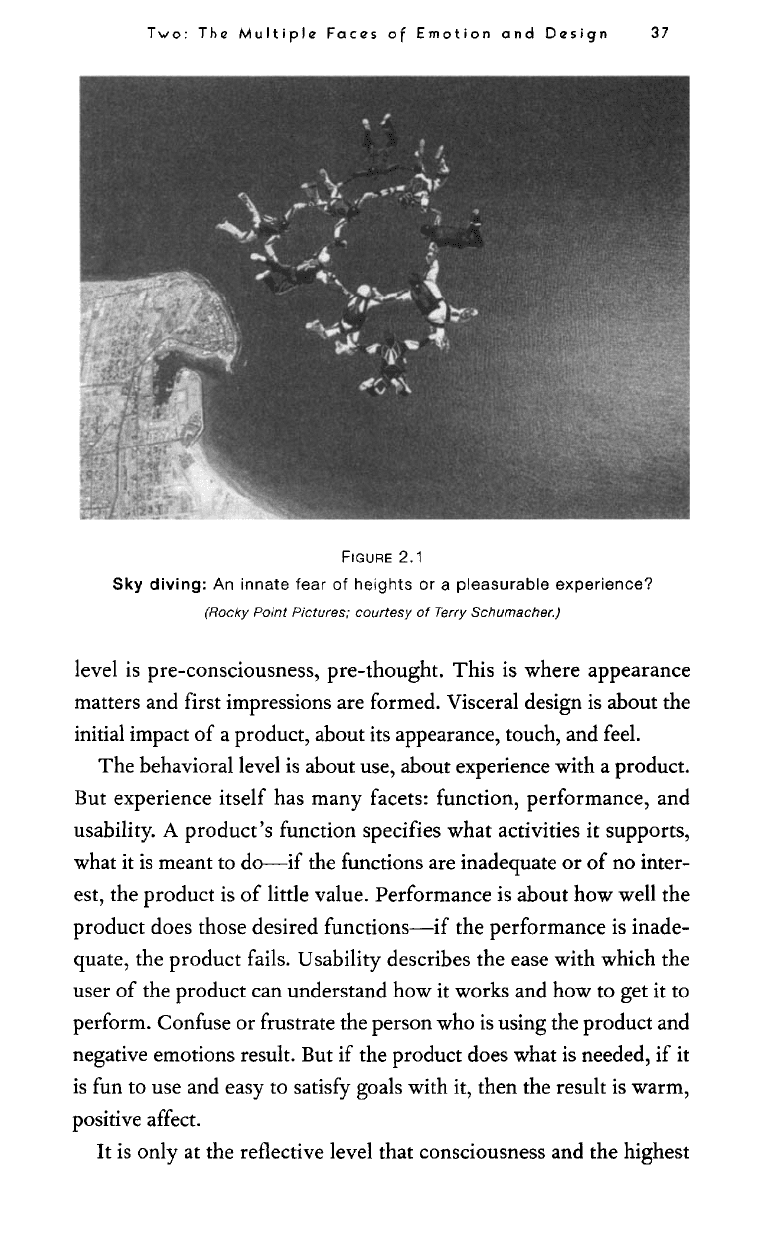
Sky
diving:
An
innate fear
of
heights
or a
pleasurable experience?
(Rocky
Point Pictures; courtesy
of
Terry
Schumacher.)
level
is
pre-consciousness,
pre-thought.
This
is
where
appearance
matters
and
first
impressions
are
formed. Visceral design
is
about
the
initial
impact
of a
product, about
its
appearance, touch,
and
feel.
The
behavioral level
is
about use, about experience with
a
product.
But
experience itself
has
many facets: function, performance,
and
usability.
A
product's function specifies what activities
it
supports,
what
it is
meant
to
do—if
the
functions
are
inadequate
or of no
inter-
est,
the
product
is of
little value. Performance
is
about
how
well
the
product does those desired functions—if
the
performance
is
inade-
quate,
the
product
fails.
Usability describes
the
ease with which
the
user
of the
product
can
understand
how it
works
and how to get it to
perform.
Confuse
or
frustrate
the
person
who is
using
the
product
and
negative emotions result.
But if the
product does what
is
needed,
if it
is
fun to use and
easy
to
satisfy
goals with
it,
then
the
result
is
warm,
positive
affect.
It is
only
at the
reflective level that consciousness
and the
highest
TLFeBOOK
38
Emotional Design
levels
of
feeling, emotions,
and
cognition reside.
It is
only here that
the
full
impact
of
both thought
and
emotions
are
experienced.
At the
lower visceral
and
behavioral levels, there
is
only
affect,
but
without
interpretation
or
consciousness. Interpretation, understanding,
and
reasoning
come
from
the
reflective
level.
Of the
three levels,
the
reflective
one is the
most vulnerable
to
vari-
ability
through culture, experience, education,
and
individual
differ-
ences.
This
level
can
also override
the
others. Hence,
one
person's
liking
for
otherwise
distasteful
or
frightening visceral experiences that
might repel others,
or
another's intellectual dismissal
of
designs
oth-
ers
find
attractive
and
appealing. Sophistication
often
brings with
it a
peculiar
disdain
for
popular appeal, where
the
very aspects
of a
design
that
make
it
appeal
to
many people distress some intellectuals.
There
is one
other
distinction
among
the
levels:
time.
The
visceral
and
behavioral levels
are
about
"now,"
your feelings
and
experiences
while
actually seeing or using the product. But the reflective level
extends
much longer—through
reflection
you
remember
the
past
and
contemplate
the
future.
Reflective design, therefore,
is
about long-
term relations, about
the
feelings
of
satisfaction produced
by
owning,
displaying,
and
using
a
product.
A
person's self-identity
is
located
within
the
reflective level,
and
here
is
where
the
interaction between
the
product
and
your identity
is
important
as
demonstrated
in
pride
(or
shame)
of
ownership
or
use.
Customer interaction
and
service
matter
at
this level.
Working
with
the
Three
Levels
The
ways
in
which
the
three levels interact
are
complex. Still,
for
purposes
of
application,
it is
possible
to
make some very
useful
sim-
plifications.
So,
although
the
scientist
in me
protests that what
I am
about
to say is far too
simple,
the
practical, engineering, designer side
of me
says that
the
simplification
is
good enough,
and,
more impor-
tant,
useful.
TLFeBOOK
Two:
The
Multiple
Faces
of
Emotion
and
Design
39
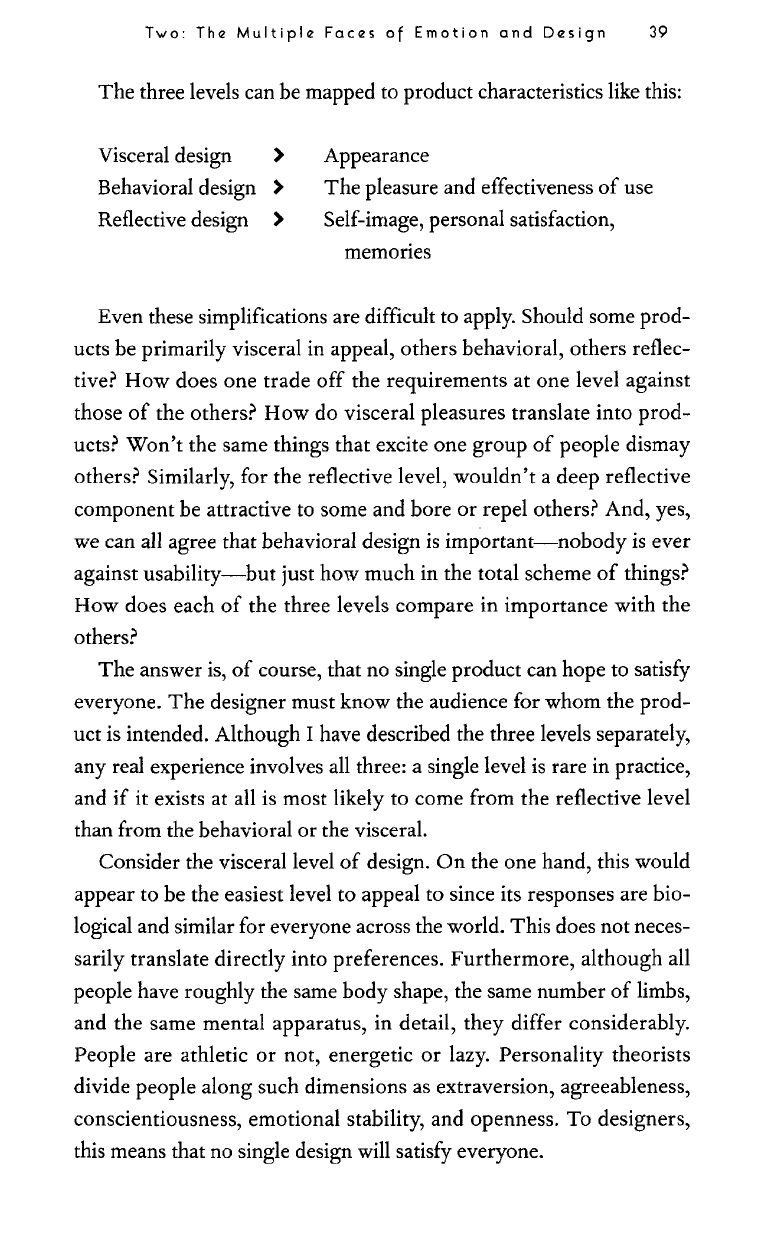
The
three levels
can be
mapped
to
product characteristics like this:
Visceral
design
>
Appearance
Behavioral design
> The
pleasure
and
effectiveness
of use
Reflective
design
>
Self-image, personal satisfaction,
memories
Even these simplifications
are
difficult
to
apply. Should some
prod-
ucts
be
primarily visceral
in
appeal, others behavioral, others
reflec-
tive?
How
does
one
trade
off the
requirements
at one
level against
those
of the
others?
How do
visceral pleasures translate
into
prod-
ucts?
Won't
the
same things that excite
one
group
of
people dismay
others? Similarly,
for the
reflective
level, wouldn't
a
deep
reflective
component
be
attractive
to
some
and
bore
or
repel others? And, yes,
we can all
agree
that
behavioral
design
is
important—nobody
is
ever
against usability—but
just
how
much
in the
total scheme
of
things?
How
does each
of the
three levels compare
in
importance with
the
others?
The
answer
is, of
course, that
no
single product
can
hope
to
satisfy
everyone.
The
designer must know
the
audience
for
whom
the
prod-
uct is
intended. Although
I
have described
the
three levels separately,
any
real experience involves
all
three:
a
single level
is
rare
in
practice,
and if it
exists
at all is
most likely
to
come
from
the
reflective level
than
from
the
behavioral
or the
visceral.
Consider
the
visceral level
of
design.
On the one
hand, this would
appear
to be the
easiest level
to
appeal
to
since
its
responses
are
bio-
logical
and
similar
for
everyone across
the
world.
This
does
not
neces-
sarily
translate directly into preferences. Furthermore, although
all
people have roughly
the
same body shape,
the
same number
of
limbs,
and
the
same mental apparatus,
in
detail, they
differ
considerably.
People
are
athletic
or
not, energetic
or
lazy. Personality theorists
divide people along such dimensions
as
extraversion, agreeableness,
conscientiousness, emotional stability,
and
openness.
To
designers,
this
means that
no
single design will
satisfy
everyone.
TLFeBOOK