
Norman D.A. Emotional Design: Why We Love (Or Hate) Everyday Things
Подождите немного. Документ загружается.

50
Emotional Design
around,
I was
most attracted
to
souvenirs
of
places
I had
myself
vis-
ited, perhaps because they brought back memories
of
those visits.
Had
any one
been emotionally negative,
however,
I
would have
quickly moved past
it to
escape—not
the
object
but the
memories
it
called
forth
in me.
PHOTOGRAPHS,
MORE
than almost anything else, have
a
spe-
cial
emotional appeal: they
are
personal, they tell stories.
The
power
of
personal photography lies
in its
ability
to
transport
the
viewer back
in
time
to
some socially relevant event. Personal photographs
are
mementos, reminders,
and
social instruments, allowing memories
to
be
shared across time, place,
and
people.
In the
year 2000, there were
about
200
million cameras
in the
United States alone,
or
around
two
cameras
per
household; with these cameras people took around
20
bil-
lion photographs. With
the
advent
of
digital cameras,
it is no
longer
possible
to
know
just
how
many pictures
are
being taken,
but
probably
a
lot
more.
Although pictures
are
loved
for the
memories they maintain,
the
technologies
of
digital picture transmission, printing,
file
sharing,
and
display
are
sufficiently
complex
and
time-consuming
as to
prevent
many people
from
saving, retrieving,
and
sharing
the
pictures they
cherish.
Numerous
studies have shown that
the
work required
to
transform
a
picture
in the
camera into
a
print that
can be
shared defeats many
people. Thus, while lots
of
pictures
are
taken,
not all the
film
gets
developed.
Of the
film
that
is
developed, some
of it is
never looked
at.
Of
the
pictures that
are
looked
at,
many
are
simply
put
back into
the
envelope
and
then
filed
away
in a
box,
never
to be
looked
at
again.
(People
in the
photography industry
call
these "shoe boxes," because
the
storage
is
often
within
the
cardboard boxes
in
which shoes come.)
Some
people
carefully
arrange their pictures
in
photo albums,
but
many
of us
have unused photo albums stored
in
closets
or
bookcases.
One of the
most precious resources
of the
modern household
is
time,
and the
effort
to
take care
of all
those
wonderful
photographs
TLFeBOOK
Two:
The
Multiple
Faces
of
Emotion
and
Design
51
defeats
their value. Even though taking photographs
out of an
envelope
and
organizing
them
in
photograph
albums
is
about
as
simple
a way of
doing this
job as can be
imagined, most people don't
do it. I
don't.
Digital cameras change
the
emphasis,
but not the
principle.
It is
rel-
atively easy
to
take digital photographs, easy
to
share them
from
the
display
on the
camera itself.
It is
more
difficult
to
print
the
pictures
or
email them
to
friends
and
acquaintances.
Despite
the
power
of the
personal computer, paper prints
of
photographs
are
easier
to
take care
of and
display than
are
electronic versions. With electronic pictures
comes
the
problem
of
storing them
in
some
way
that
you can
find
them again later.
Thus,
although
we
like
to
look
at
photographs,
we do not
like
to
take
the
time
to do the
work required
to
maintain them
and
keep them
accessible.
The
design
challenge
is to
keep
the
virtues
while removing
the
barriers: make
it
easier
to
store, send, share.
Make
it
easier
to find
just
the
desired pictures years
after
they have been taken
and put
into
storage.
These
are not
easy problems,
but
until they
are
overcome,
we
will
not
reap
the
full
benefits
of
photography.
Portraits
of
family,
though,
are
different. Wander
through
many
places
of
work,
and
you'll
see on
desk, bookcase,
and
walls
framed
photographs
of a
person's
family: husband, wife, son, daughter—
family
portraits,
family
snapshots—and occasionally parents. Yes,
there
are
also ceremonial pictures
of the
person with
the
company
president
or
other dignitaries, pictures
of
awards, and,
in
academic
offices,
conference photographs, where
all the
participants have gath-
ered
together
sometime during
the
conference
for the
ritual
photo-
graph, which ends
up
published
in the
conference proceedings
and
posted
on
walls.
But,
I
hasten
to
add, this personal display
is
very culture-sensitive.
Not all
cultures display such personal symbols.
In
some countries,
the
display
of
personal photographs
in the
office
is
extremely rare,
and in
the
home
it can be
infrequent. Instead, visitors
are
shown
the
photo-
graph album, with each
photograph
lovingly
pointed
at and
described.
Some
cultures prohibit photographs altogether. Still,
the
major
TLFeBOOK
52
Emotional Design
nations
of the
world
on all
continents take billions
of
photographs,
so
that
even
if
they
are not on
public display, they serve
a
powerful emo-
tional
role.
Photographs
are
clearly important
to
people's
emotional
lives.
People have been known
to
rush back into burning homes
to
save
treasured
photographs. Their comforting presence maintains
family
bonds even when
the
people
are
separated.
They
assure permanence
of
the
memories
and are
often
passed
from
generation
to
generation.
In
the
days
before
photography, people hired portrait painters
to
cre-
ate
images
of
loved
or
respected ones.
The
task required long sittings
and
produced more formal
results.
Painting
had the
virtue
that
the
artist
could change people's appearance
to fit
their desires rather than
be
restricted
to the
reality
of the
photograph. (Nowadays, with digital
tools readily available, photographs,
too,
are
easily doctored.
I
plead
guilty
to
altering
a
family
group photograph, replacing
the
scowling
face
of one
family
member with
a
happy, smiling
face
from
a
photo-
graph
of
that person
at a
different
occasion. Nobody
has
ever noticed
the
modification,
not
even
the
person
who was
modified.)
Today,
even
with
the
ubiquity
of
personal cameras, portrait photographers
maintain
a
lively business,
in
part because only professionals usually
have
the
skills required
for
lighting
and
framing
the
shot
so as to
pro-
duce
a
high-quality picture.
Photographs
can
bring back only sights,
not
sounds. David
Frohlich,
a
research scientist
at the
Hewlett Packard Laboratories
in
Bristol, England,
has
been developing
a
system
he
calls
"audiophotog-
raphy," photographs that combine
an
audio track, capturing
the
sounds
on the
scene surrounding
the
instant when
the
picture
was
taken.
(Yes,
the
recording
can
start before
the
photograph
is
taken,
one
of the
magical possibilities
of
modern technology.)
Amy
Cowen,
who
wrote about Frohlich's work, described
its
importance this way:
"With
every photo there
is a
story,
a
moment,
a
memory.
As
time
passes, however,
the
user's
ability
to
recall
the
details needed
to
evoke
the
moment
the
picture records
fades.
Adding sound
to a
photo
can
help
keep
the
memories intact."
TLFeBOOK
Two:
The
Multiple
Faces
of
Emotion
and
Design
53
Frohlich points
out
that today's technology allows
us
both
to
cap-
ture
the
sounds occurring around
the
time
a
photograph
is
being taken
and
also
to
play them back while
it is
being shown
in an
album.
The
sounds capture
the
emotional setting
in a far
richer
way
than
can the
image itself. Imagine
a
family
group photograph where,
in the
twenty
seconds
prior
to the
taking
of the
picture,
the
voices
of
family mem-
bers joshing among themselves ("Mary, stop scowling"
and
"Henry,
quick,
stand
between
Frank
and
Uncle
Oscar")
are
also
recorded—
possibly followed
by
giggling
and
relief
in the
twenty seconds
after
the
photo
was
taken. Frohlich describes
the
possibilities this way:
"Ambient sounds recorded around
the
moment
of
image capture pro-
vide
an
atmosphere
or
mood that
can
really help
you
remember
the
original event better. Nostalgic music
set to a
photo
can
evoke more
feelings
and
memories
of the era in
which
the
photo
was
taken,
and a
spoken story
can
help others
to
interpret
the
meaning
of the
photo,
especially
in the
absence
of the
photographer."
Feelings
of
Self
Memories reflect
our
life
experiences.
They
remind
us of
families
and
friends,
of
experiences
and
accomplishments.
They
also serve
to
rein-
force
how we
view
ourselves.
Our
self-image plays
a
more important
role
in our
lives than
we
like
to
admit. Even those
who
deny
any
inter-
est
in how
others view them actually
do
care,
if
only
by
making sure
that
everyone else understands that they
don't.
The way we
dress
and
behave,
the
material objects
we
possess, jewelry
and
watches, cars
and
homes,
all are
public expressions
of our
selves.
The
concept
of
self appears
to be a
fundamental
human attribute.
It
is
difficult
to
imagine
how it
could
be
otherwise, given what
we
know
of the
mechanisms
of
mind
and the
roles that consciousness
and
emo-
tion
play.
The
concept
is
deeply rooted
in the
reflective level
of the
brain
and
highly dependent upon cultural norms.
It is,
therefore,
diffi-
cult
to
deal with
in
design.
TLFeBOOK
54
Emotional
Design
In
psychology,
the
study
of the
self
has
become
a big
industry, with
books,
societies, journals,
and
conferences.
But
"self"
is a
complex
concept:
It is
culturally specific.
Thus,
Eastern
and
Western
notions
of
self
vary considerably, with
the
West placing more emphasis
on the
individual,
the
East
on the
group. Americans tend
to
want
to
excel
as
individuals, whereas Japanese wish
to be
good
members
of
their
groups
and for
others
to be
satisfied
with their contributions.
But
even
these characterizations
are too
broad
and
oversimplified.
In
fact,
on
the
whole, people behave very similarly, given
the
same situation.
It is
culture
that presents
us
with
different
situations. Thus, Asian cultures
are
more likely
to
establish
a
sharing, group attitude than
are the
cul-
tures
of
Europe
and the
Americas, where individualistic situations
are
more common.
But put
Asians
in an
individualistic situation
and
Europeans
or
Americans
in a
social, sharing situation,
and
their
behaviors
are
remarkably similar.
Some
aspects
of
self seem
to be
universal, such
as the
desire
to be
well-thought-of
by
others, even
if the
behavior others praise
differs
across cultures.
This
desire holds
both
in the
most individualistic
soci-
eties, which admire deviance,
and in the
most group-oriented soci-
eties, which admire conformance.
The
importance
of
other
people's
opinions
is, of
course, well
known
to the
advertising industry, which tries
to
promote products
through association. Take
any
product
and
show
it
alongside happy,
contented
people.
Show people
doing
things that
an
intended purchas-
er
is
likely
to
fantasize
about, such
as
romantic vacations, skiing, exot-
ic
locations, eating
in
foreign lands. Show
famous
people, people
who
serve
as
role models
or
heroes
to the
customers,
to
induce
in
them,
through association,
a
sense
of
worthiness. Products
can be
designed
to
enhance these aspects.
In
clothing fashion,
one can
have clothes that
are
neat
and
trim
or
baggy
and
nondescript, each deliberately induc-
ing a
different
image
of
self. When company
or
brand logos
are
imprinted
on
clothes, luggage,
or
other objects,
the
mere appearance
of
the
name speaks
to
others about your sense
of
values.
The
styles
of
objects
you
choose
to buy and
display
often
reflect
public opinion
as
TLFeBOOK
Two:
The
Multiple
Faces
of
Emotion
and
Design
55
much
as
behavioral
or
visceral elements. Your choice
of
products,
or
where
and how you
live, travel,
and
behave
are
often
powerful state-
ments
of
self, whether intended
or
not,
conscious
or
subconscious.
For
some,
this external manifestation compensates
for an
internal,
personal lack
of
self-esteem. Whether
you
admit
it or
not,
approve
or
disapprove,
the
products
you buy and
your lifestyle
both
reflect
and
establish your self-image,
as
well
as the
images others have
of
you.
One of the
more
powerful
ways
to
induce
a
positive sense
of
self
is
through
a
personal sense
of
accomplishment.
This
is one
aspect
of a
hobby, where people
can
create things that
are
uniquely theirs,
and,
through
hobby
clubs
and
groups,
share their achievements.
From
the
late
1940s
through
the
mid-1980s
the
Heathkit Company
sold electronic kits
for the
home handyperson.
Build
your
own
radio,
your
own
audio system, your
own
television
set.
The
people
who
con-
structed
the
kits
felt
immense pride
in
their accomplishments
as
well
as
a
common bond with
other
kit
builders. Putting together
a kit was a
personal
feat:
the
less skilled
the kit
builder,
the
more that special
feel-
ing. Electronic experts
did not
take such pride
in
their
kits;
it was
those
who
ventured
forth
without
the
expertise
who
felt
so
satisfied.
Heathkit
did
an
excellent
job of
aiding
the
first-time builder with what,
in my
opinion, were
the
best instruction manuals ever written.
Mind
you,
the
kits
were
not
much less expensive than equivalent commercial
elec-
tronic devices. People bought
the
kits
for
their high quality
and for the
feeling
of
accomplishment,
not to
save money.
In
the
early
1950s,
the
Betty Crocker Company introduced
a
cake
mix
so
that people could readily make excellent tasting cakes
at
home.
No
muss,
no
fuss:
just
add
water,
mix,
and
bake.
The
product
failed,
even though taste tests confirmed that people liked
the
result. Why?
An
after-the-fact
effort
was
made
to
find
the
reasons.
As the
market
researchers Bonnie Goebert
and
Herma Rosenthal
put it:
"The
cake
mix
was a
little
too
simple.
The
consumer
felt
no
sense
of
accomplish-
ment,
no
involvement with
the
product.
It
made
her
feel
useless, espe-
cially
if
somewhere
her
aproned
mom was
still whipping
up
cakes
from
scratch."
TLFeBOOK
56
Emotional Design
Yes,
it was too
easy
to
make
the
cake. Betty Crocker solved
the
problem
by
requiring
the
cook
to add an egg to the
mix, thereby put-
ting
pride back into
the
activity. Clearly, adding
an egg to a
prepared
cake
mix is not at all
equivalent
to
baking
a
cake "from scratch"
by
using individual ingredients. Nonetheless, adding
the egg
gave
the act
of
baking
a
sense
of
accomplishment, whereas
just
mixing water into
the
cake
mix
seemed
too
little,
too
artificial. Goebert
and
Rosenthal
summarized
the
situation: "The real problem
had
nothing
to do
with
the
product's
intrinsic value,
but
instead represented
the
emotional
connection that links
a
product
to its
user."
Yes, it's
all
about emotion,
about pride, about
the
feeling
of
accomplishment, even
in
making
a
cake
from
a
prepared mix.
The
Personality
of
Products
As
we
have seen,
a
product
can
have
a
personality.
So,
too,
can
compa-
nies
and
brands. Consider
my
proposed transformation
of the
video
game device discussed earlier
in
this chapter.
In one
version,
the
machine would
be a
fast,
powerful
tool
for
exciting, visceral experi-
ences: loud booming sounds
and
fast-paced adventure.
In a
different
version,
it
would
be a
cooking assistant: animated,
but
informative,with
menus
for
meals
and
videos that demonstrate
just
how to
prepare
the
food.
In
still another,
it
might
be
calm,
but
authoritative, guiding repair
work
on an
automobile
or
construction
of
woodworking projects.
In
each manifestation,
that
product's
personality
would
change.
The
product would
look
and
behave
differently
in the
different
set-
tings
appropriate
to use and
target audience.
The
style
of
behavioral
interaction could
differ:
filled
with slang
and
informal
language
in the
game
setting;
polite
and
formal
for the
kitchen.
But
like human per-
sonality, once established,
all
aspects
of a
design must support
the
intended personality structure.
A
mature cooking tutor should
not
suddenly
start spouting obscenities.
A
shop assistant should probably
not
discuss
the
philosophical implications
of
quality
in
automobile
TLFeBOOK
Two:
The
Multiple
Faces
of
Emotion
and
Design
57
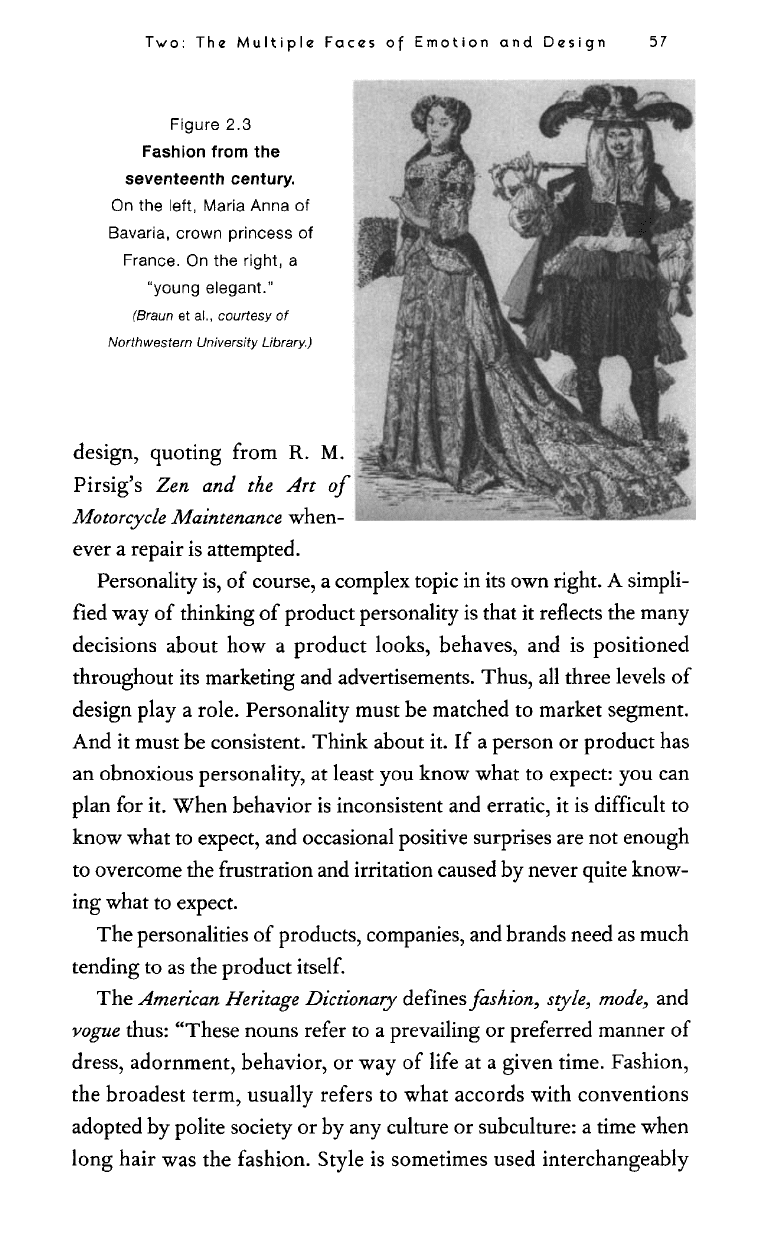
Figure
2.3
Fashion
from
the
seventeenth century.
On
the
left,
Maria Anna
of
Bavaria,
crown princess
of
France.
On the
right,
a
"young
elegant."
(Braun
et
al.,
courtesy
of
Northwestern University
Library.)
design,
quoting
from
R. M.
Pirsig's
Zen and the Art of
Motorcycle
Maintenance when-
ever
a
repair
is
attempted.
Personality
is, of
course,
a
complex topic
in its own
right.
A
simpli-
fied
way of
thinking
of
product personality
is
that
it
reflects
the
many
decisions about
how a
product looks, behaves,
and is
positioned
throughout
its
marketing
and
advertisements.
Thus,
all
three levels
of
design play
a
role. Personality must
be
matched
to
market segment.
And it
must
be
consistent. Think about
it. If a
person
or
product
has
an
obnoxious personality,
at
least
you
know what
to
expect:
you can
plan
for it.
When behavior
is
inconsistent
and
erratic,
it is
difficult
to
know what
to
expect,
and
occasional positive surprises
are not
enough
to
overcome
the
frustration
and
irritation caused
by
never quite know-
ing
what
to
expect.
The
personalities
of
products, companies,
and
brands need
as
much
tending
to as the
product itself.
The
American
Heritage
Dictionary defines fashion, style, mode,
and
vogue
thus:
"These
nouns
refer
to a
prevailing
or
preferred manner
of
dress, adornment, behavior,
or way of
life
at a
given time. Fashion,
the
broadest term, usually refers
to
what accords with conventions
adopted
by
polite society
or by any
culture
or
subculture:
a
time when
long hair
was the
fashion. Style
is
sometimes used interchangeably
TLFeBOOK
58
Emotional Design
with fashion,
but
like mode
often
stresses adherence
to
standards
of
elegance: traveling
in
style; miniskirts that were
the
mode
in the
late
sixties. Vogue
is
applied
to
fashion
that prevails widely
and
often
sug-
gests
enthusiastic
but
short-lived acceptance:
a
video game that
was in
vogue
a few
years
ago."
The
very
existence
of the
terms
fashion,
style, mode,
and
vogue
demonstrates
the
fragility
of the
reflective
side
of
design. What
is
liked
today
may not be
tomorrow. Indeed,
the
reason
for the
change
is
the
very
fact
that something
was
once liked: When
too
many people
like
something,
then
it is no
longer deemed appropriate
for the
leaders
of
a
society
to
partake
of it.
After
all,
goes
the
thinking,
how can one
be a
leader unless
one is
different,
doing
today what others will
do
tomorrow,
and
doing tomorrow what they will
be
doing
after
that?
Even
the
rebellious have
to
change continually,
carefully
noticing
what
is in
fashion
so as not to be
following
it,
carefully
creating their
own
fashion
of
counterfashion.
How
does
a
designer cope with popular taste
if it has
little
to do
with substance? Well,
it
depends upon
the
nature
of the
product
and
the
intentions
of the
company producing
it. If the
product
is
some-
thing
fundamental
to
life
and
well-being, then
the
proper response
is
to
ignore continual
shifts
in
popular sentiment
and aim for
long-last-
ing
value. Yes,
the
product must
be
attractive. Yes,
it
should
be
pleas-
urable
and
fun.
But it
must also
be
effective,
understandable,
and
appropriately
priced.
In
other words,
it
must strive
for
balance among
the
three levels
of
design.
In
the
long
run,
simple style with quality construction
and
effective
performance
still
wins.
So a
business that manufactures
office
machines,
or
basic home appliances,
or web
sites
for
shipping,
com-
merce,
or
information, would
be
wise
to
stick
to the
fundamentals.
In
these cases,
the
task dictates
the
design: make
the
design
fit the
task,
and
the
product works more smoothly
and is
bound
to be
more
effec-
tive across
a
wide range
of
users
and
uses. Here
is
where
the
number
of
different
products
is
determined
by the
nature
of
particular tasks
and
the
economics.
TLFeBOOK
Two:
The
Multiple
Faces
of
Emotion
and
Design
59
There
is a set of
products, however, whose goals
are
entertainment,
or
style,
or
perhaps enhancement
of a
person's
image.
Here
is
where
fashion
comes into play. Here
is
where
the
huge individual
differences
in
people
and
cultures
are
important. Here
the
person
and
market
seg-
ment dictate
the
design.
Make
the
design
appropriate
to the
market
segment that
forms
the
target audience.
It is
probably necessary
to
have multiple versions
of the
design
for
different
market segments.
And
it is
probably necessary
to do
rapid changes
in
style
and
appear-
ance
as the
market dictates.
Designing
for the
whims
of
fashion
is
tricky. Some designers
may
see it as a
difficult
challenge, others,
as an
opportunity.
In
some sense,
the
division
often
breaks between large
and
small companies,
or
between market leaders
and the
competition.
To the
market leader,
the
continual
changes
in
people's fashion,
and the
wide variety
of
prefer-
ences
for the
same product across
the
world,
are
huge challenges.
How
can
the
company ever keep
up? How
does
it
track
all the
changes
and
even anticipate them?
How
does
it
keep
the
many necessary product
lines
effective?
To the
competitive companies, however,
the
same
issues represent
an
opportunity. Small companies
can be
nimble,
mov-
ing
rapidly into areas
and
using approaches that
the
more conservative
larger companies hesitate
to
try.
Small companies
can be
outrageous,
different,
and
experimental.
They
can
exploit
the
public's
interests,
even
if the
product
is
initially purchased
by
only
a
few. Large compa-
nies attempt
to
experiment
by
spinning
off
smaller, more nimble divi-
sions, sometimes with unique names that make them appear
to be
independent
of
their parent.
All in
all,
this
is the
ever-changing,
con-
tinual
battleground
of the
consumer marketplace, where fashion
can
be as
important
as
substance.
IN
THE
world
of
products,
a
brand
is an
identifying mark,
the
sym-
bol
that represents
a
company
and its
products. Particular brands
pro-
duce
an
emotional
response
that draws
the
consumer
toward
the
product
or
away
from
it.
Brands have taken
on the
emotional repre-
TLFeBOOK