
Oren Michael B. Six Days of War. June 1967 and the Making of the Modern Middle East
Подождите немного. Документ загружается.

172 SIX DAYS OF WA R
Riyad, in turn, relayed the information to Defense Minister Shams Badran in
Cairo, and there it remained, indecipherable. The Egyptians had changed their
encoding frequencies the previous day, but without updating the Jordanians. The
Israelis had also altered their frequencies, leaving ‘Ajlun’s observers to wonder
whether the blips were IAF planes or foreign aircraft—British or American—
launched from carriers at sea. They watched as the radar suddenly showed a
diversion eastward, toward Sinai, and then cabled the code word repeatedly.
But even if those messages could have been read, Badran was not present
to read them. The defense minister had gone to bed only a few hours before,
leaving strict orders not to be disturbed. Similarly absent were Col. Mas‘ud al-
Junaydi, in charge of decoding, and Air Operations Chief General Gamal ‘Afifi.
At his subsequent trial for incompetence, ‘Afifi claimed, “I was out of the army
for ten years before that, and less than six months in that job. Thank God I
wasn’t there, for the man who was at least knew who to call and what to do.
Had I been there, the situation would have been much worse.” Air force intel-
ligence also reported extensively on the Israeli attack, but the officers at Su-
preme Headquarters, devoted to ‘Amer and distrustful of Nasser loyalists in
the air force, ignored them.
2
For the Israelis, those minutes were pivotal. “The suspense was incred-
ible,” Ezer Weizman recounted. He had not resigned in the end, swallowing
his pride and remaining chief of operations. But Weizman cared little about
ground battles; his main concern was the air force and the Focus plan he had
helped originate. “For five years I had been talking of this operation, explain-
ing it, hatching it, dreaming of it, manufacturing it link by link, training men to
carry it out. Now, in another quarter of an hour, we would know if it was only
a dream, or whether it would come true.”
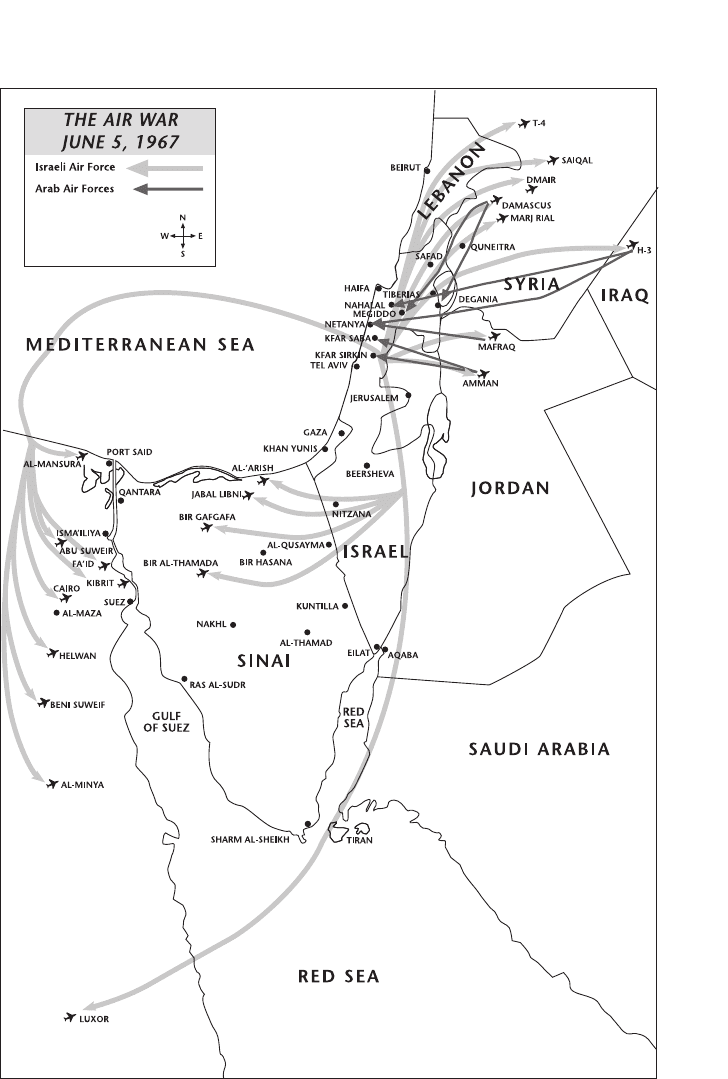
The plan, requiring dozens of squadrons from different bases to rendez-
vous silently over eleven targets between twenty and forty-five minutes’ flying
time away, was labyrinthine in its complexity, and exceedingly hazardous. All
but twelve of the country’s jets were thrown into the attack—American foot-
ball fans would call it a Hail Mary—leaving the country’s skies virtually de-
fenseless. Innumerable practice runs had convinced IAF commanders that the
Egyptian air force could be destroyed, even if it managed to get off the run-
ways, in as little as three hours. Yet Rabin continued to entertain doubts, and
even ordered commando units to prepare for nocturnal attacks on enemy air-
strips in the event that Focus failed.
3
Now Rabin, along with Dayan, waited in IAF headquarters with Weizman
and the anxious commander of Israel’s air force. “The first forty-five minutes
felt like a day,” said Hod, on whose shoulders fell the immediate responsibility
for the attack. A lean, taciturn former kibbutznik, Hod had smuggled Holo-
caust survivors into Palestine after World War II and then, prior to the War of
Independence, smuggled in a British Spitfire as well. Throughout the battles
of 1948 and 1956, he had earned a reputation as a skilled and cool-headed pilot,
Day One: June 5 173
174 SIX DAYS OF WA R
less known for brilliance than for his resourcefulness and grit. Cincinnatus-like,
his strongest desire was to return to farming, but Weizman had insisted that Hod
replace him as air force chief early in 1966. Since then, he had concentrated on
refining Focus, reducing the turnaround time for refueling and rearming jets to
less than eight minutes. The Egyptian turnaround rate, by comparison, was eight
hours. “He may not be able to quote [the Hebrew poet] Bialik or Shakespeare,”
Weizman said of Hod, “but he will screw the Arabs in plain Hebrew.”
Sweating, guzzling pitchers of water—“like a giant radiator,” Weizman
observed—Hod waited for news of the opening wave of attack. The lead for-
mations had now passed over the sea where, using electronic jamming equip-
ment, they were able to elude detection by Soviet vessels. At 7:30 Israel time,
the first targets came into view. In the huge bases of Fa’id and Kibrit, for ex-
ample, which Egyptian intelligence had erroneously concluded were out of
Israel’s range, the jets were parked on the aprons, in rows or in semicircular
revetments. Many airfields had only one runway—block it and the planes sup-
posed to use it were doomed.
4
In the sky, the visibility was excellent, the wind factor close to zero. Condi-
tions were optimal for attack. The Israeli jets now swooped up sharply to as
high as 9,000 feet, exposing themselves to Egyptian radar and sending Egyp-
tian pilots out to the tarmac, scrambling. Few would reach their planes.
The jets dove. They approached in foursomes and attacked in pairs, each
making three passes—four, if time permitted—the first for bombing and the
rest to strafe. Priority was to be given to destroying the runways, then to the
long-range bombers that threatened Israeli cities, and then to the jet fighters,
the MiG’s. Last to be raided were missile, radar, and support facilities. Each
sortie was to take between seven and ten minutes. With a twenty-minute re-
turn flight, an eight-minute refueling time, and ten minutes’ rest for the pilot,
the planes would be in action again well within an hour. During that hour,
moreover, the Egyptian bases would be under almost uninterrupted attack.
“The sky gradually cleared as we approached the target,” remembered Avihu
Bin-Nun, a captain commanding a formation of Mystères over Fa’id. “As I
dived and released my bombs, I saw four MiG-21’s at the end of the runway
lining up to take off. I pulled the bomb release, began firing and hit two of the
four, which went up in flames.”
The bombs Bin-Nun dropped were Durendals, a top-secret device devel-
oped jointly with the French, who had named it after Roland’s sword. Once
released, the 180-pound bomb was stabilized by a retro-rocket and a parachute
until it was directly over its target and pointed downwards at 60 degrees, at
which point a booster rocket drove it deep into the pavement. The Durendals
left craters 5 meters wide and 1.6 meters deep, rendering runways unusable.
Nor could they be repaired, as delayed fuses on many of the bombs continued
exploding. Over one hundred of the devices were dropped on Abu Suweir alone,
in less than one hour. Bin-Nun continued, “We destroyed sixteen of the forty
Day One: June 5 175
MiG’s scattered around the field, and paralyzed a SAM-2 battery on our way
back. We could see all the other Egyptian airfields in flames.”
Below, the Egyptian pilots were in a state of shock, incredulous of Israel’s
ability to penetrate their defenses, to catch them so totally off-guard. “I stood
on the runway, at exactly 9:00
A.M., ready to leave with the training sortie,”
recalled Brig. Gen. Tahsin Zaki, commander of the Malis base. “I heard the
noise of jet planes, at the very same moment, and I looked toward the direction
of the noise and saw two gray Super Mystère planes. They dropped two bombs
at the beginning of the runway. Two additional planes were behind them, and
they dropped two bombs in the middle of the runway, and the last two planes
dropped two bombs at the end of the runway. After a couple of minutes, the
whole runway was bombed. It was a complete surprise.”
5
The Egyptian planes were inextricably trapped, easy prey for the 30-mm
cannons and heat-seeking rockets that next raked them. At the Beni Suweif and
Luxor airfields west of the Canal, colossal Topolov-16 bombers and their ten-
ton payloads exploded with such force that one of the attacking jets was liter-
ally blown out of the sky. In Sinai, mixed formations of Mirage and Mystère
fighters hit the forward bases at Jabal Libni, Bir al-Thamada, and Bir Gafgafa,
strafing the scores of parked MiG’s and incinerating the few that attempted to
take off. Only at al-‘Arish was the runway spared, in the assumption that it
would soon be serving Israeli transports.
By the end of that first wave, 8:00 Israel time, an average of twenty-five
sorties had been carried out against Cairo West, Fa’id, and Abu Suweir bases.
Four airfields in Sinai and two in Egypt had been entirely knocked out. The
main communication cable linking Egyptian forces in Sinai with Supreme Head-
quarters had been severed. The most devastating damage, though, was done to
the air force itself. In little over half an hour, the Egyptians had lost 204 planes—
half of their air force—all but nine of them on the ground.
The Israelis were stunned. No one had ever imagined that a single squad-
ron could neutralize an entire air base, and that Focus’s kill ratio would exceed
expectations by almost 100 percent. Those expectations had taken into account
the possibility that Egyptians would soon overcome their initial shock and rally,
shooting down as many as a quarter of their attackers’ planes. Indeed, Israeli
pilots were ordered to reserve five minutes of their combat fuel and a third of
their ammunition for dogfights. None occurred, however, nor was there sig-
nificant ground fire. All of Egypt’s 100 anti-aircraft batteries, its 27 SAM-2
missiles sites, had been issued no-fire orders by ‘Amer, who feared they might
mistake his plane for one of Israel’s. Only in Cairo did the anti-aircraft units try
to repel the planes, shooting wildly at the delta-wing aircraft overhead. “We
were on high alert, with more than enough ammunition, but we received no
orders to shoot,” attested Sa‘id Ahmad Rabi‘, the major commanding the guns.
“Finally, I opened fire myself, and thought I’d be courtmartialed for it. But
instead I received a medal for valor, and have kept my job ever since.”
176 SIX DAYS OF WA R
Rabi‘ claimed to have downed several Israeli jets. In all, the IAF lost eight
aircraft in the first wave, and five pilots. One of the planes, damaged but unable
to break radio silence, was destroyed by Israeli Hawk missiles after it strayed
over Dimona.
Only now, with the first strike completed, were the results made known to
headquarters. These seemed too fantastic to believe, and it was not until Hod
had personally debriefed his pilots that he could confirm their remarkable suc-
cess. “A stone—just one, but of agonizing weight—rolled off the heart,” Dayan
wrote. Yet that same stone would remain on the Israeli public. The extent of
the IAF’s success would be kept secret for as long as possible, delaying a UN-
imposed cease-fire while Israeli tanks rolled into Sinai. At 8:15, Dayan issued
the Red Sheet password. The ground war was about to begin.
The second wave of fighters, meanwhile, reached its destinations: fourteen
enemy bases, nearly half of them west of the Canal, and all of Egypt’s radar sites.
Though the Israelis no longer enjoyed the element of surprise, and no longer
observed radio silence, resistance from these facilities was moderate and largely
confined to anti-aircraft fire. The IAF carried out 164 sorties in just over 100
minutes and destroyed another 107 planes, while suffering only nine losses. Of
the 420 combat aircraft in Egypt’s arsenal that morning, 286 were destroyed—30
Topolev-16’s, 27 Ilyushin-28 medium bombers, 12 Sukhoi-7 fighter-bombers, 90
MiG-21 interceptors, 20 MiG-19’s, 75 MiG-17’s, 32 transport planes and helicop-
ters—and almost a third of their pilots killed. Thirteen bases were rendered inop-
erable, along with twenty-three radar stations and anti-aircraft sites. At 10:35, Hod
turned to Rabin and reported, “The Egyptian air force has ceased to exist.”
6
As the picture of the battlefield became clear in Israel, in Egypt and the rest of
the Arab world it grew deeply obfuscated. Officers at the ravaged air bases
were aware that a terrible tragedy had transpired. The pilot Hashim Mustafa
Hassan, stationed at Bir al-Thamada, described the feeling:
Some 30 seconds from the end of the [first] attack, a second wave of planes
arrived . . . We ran about the desert, looking for cover, but the planes didn’t
shoot. They merely circled, their pilots surprised that the base was completely
destroyed and that no targets remained. We were the only targets . . . weak
humans scurrying in the desert with handguns as our only means of self-
defense. It was a sad comedy . . . pilots of the newest and best-equipped jets
fighting with handguns. Five minutes after the beginning of the attack the
[Israeli] planes disappeared and a silence prevailed that encompassed the desert
and the noise of the fire that destroyed our planes and the airbase and the
squadron. They completed their assignment in the best way possible, with a
ratio of losses–100 percent for us, 0 percent for them.
Brig. Zaki had a similar experience. Helplessly he had watched as Husayn
al-Shaf’i‘s plane, having barely managed to land on a secondary airstrip, was
strafed by enemy Mirages. The crew and passengers managed to escape, but
Day One: June 5 177
those in an accompanying craft proved less fortunate; all died on the runway.
“Israel spent years preparing for this war, whereas we prepared for parades,” he
testified later. “The drills for the annual Revolution Day parade went on for
weeks . . . but there were no preparations for war.”
Surrounded by what Sidqi Mahmud called “a forest of Israelis jets,” ‘Amer’s
plane could not land at all. It circled from base to burning base for nearly ninety
minutes before touching down at Cairo’s International Airport. There, Col.
Muhammad Ayyub, ‘Amer’s air force liaison officer, was waiting with a drawn
pistol, convinced that a coup had been staged against his boss. “You want to
murder him, you dogs!” Ayyub shouted as the other officers present also pulled
out their guns. Sidqi Mahmud stepped between them, though, averting a firefight.
“Fools,” he scolded them, “put your guns away! Israel is attacking us!”
Lacking military transportation, ‘Amer took a taxi to Supreme Headquar-
ters. Only thirty-seven of his MiG’s were still flightworthy and he had nearly
been shot out of the sky, but ‘Amer was nevertheless elated. The war had fi-
nally begun. He promptly commanded Sidqi Mahmud to provide air cover for
the conquest of Israel’s coast (Operation Leopard) and to deploy Egypt’s new-
est Sukhoi jets, if necessary with their Russian instructors. ‘Amer then called
Damascus and Baghdad and requested that they execute Operation Rashid—
the bombing of Israeli airfields—at once. The Iraqis consented, but then com-
plained of “technical delays.” The Syrians claimed that their planes were
presently engaged in a training exercise.
Such disappointments did little to dampen the mood in Egypt’s Supreme
Headquarters which seemed to the Soviet attaché S. Tarasenko, “tranquil, al-
most indifferent, the officers merely listening to the radio and drinking cof-
fee.” Throughout the capital, however, the citizenry was celebrating. “The
streets were overflowing with demonstrators,” remembered Eric Rouleau,
Middle East correspondent for Le Monde. “Anti-aircraft guns were firing. Hun-
dreds of thousands of people were chanting, ‘Down with Israel! We will win
the war!’” But Rouleau, together with other foreign journalists, was not al-
lowed near the front. All international phone lines were cut. The sole source of
information was the government’s communiqué: “With an aerial strike against
Cairo and across the UAR, Israel began its attack today at 9:00. Our planes
scrambled and held off the attack.”
The accounts of that counterstrike were promising. A total of eighty-six
enemy planes were reportedly shot down, including an American bomber.
Egypt’s losses were put at two. “There is a good deal [of] effervescence and
clapping at this news,” American ambassador Nolte reported. “The radio [is]
playing patriotic songs interspersed with calls for a return to Palestine and
rendezvous in Tel Aviv.” ‘Amer wired Gen. Riyad in Amman with the news
that, in spite of their initial surprise, the Israelis had lost 75 percent of their
air power. The Egyptian army was hitting back and mounting an offensive
from Sinai.
7

178 SIX DAYS OF WA R
Not present at Supreme Headquarters when the news of the Israeli air
strikes arrived, Nasser also welcomed the opening of hostilities and believed
the tide would soon turn. Nevertheless, by 10:00—the height of the second
wave—when the air force claimed to have downed 161 Israeli bombers, Nasser
became suspicious. He tried contacting ‘Amer, but received no reply; Sidqi
Mahmud was also unreachable. One of the few men who would have told him
the truth, Anwar Sadat, had secluded himself at home. Entering headquarters
at 11:00, Sadat heard from Soviet ambassador Pojidaev and from other senior
officers of the full extent of Egypt’s disaster. “I just went home and stayed in
for days,” he wrote, unable to watch the “crowds . . . chanting, dancing, and
applauding the faked-up victory reports which our mass media put out hourly.”
But Nasser remained in the dark, not the least because no one in the army
or the government dared enlighten him. All went along with the version, broad-
cast on Cairo Radio, that “our airplanes and our missiles are at this moment
shelling all Israel’s towns and villages,” that called on “every Arab to avenge the
dignity lost in 1948, to advance across the Armistice line to the den of the gang
itself, to Tel Aviv.”
8
Secretly advanced during the night, camouflaged, and observing radio silence,
Israeli forces on the Egyptian border had watched as successive waves of Israeli
planes soared overhead. Then, at 7:50
A.M., the Red Sheet password arrived
and the columns moved out. Gen. Tal’s Ugdah—an IDF division expanded for
specific tasks—composed of 250 tanks, 50 guns, a paratrooper brigade, and a
reconnaissance unit, crossed the border at two points, opposite Nahal Oz and
south of Khan Yunis. They proceeded swiftly, holding their fire to prolong the
element of surprise. Ahead lay the Rafah Gap, a seven-mile stretch containing
the shortest of the three main routes through Sinai to al-Qantara and the Suez
Canal. For this reason, Egypt positioned a full four divisions in the area, rein-
forcing a warren of minefields, pillboxes, underground bunkers, hidden gun
emplacements, and trenchworks. For the attacking Israelis, there was little choice
but to break through these defenses; the terrain on either side of the road, sand
and ravines, was impassable.
Yet that was precisely the Israeli plan, to hit the enemy at selected key
points and with a “mailed fist” of concentrated armor. A hardened veteran of
World War II and the two previous Arab-Israeli wars, Tal had commanded the
armored corps since 1964, turning it into a highly disciplined and mobile force.
Tested in earlier skirmishes with the Syrians—Tal, himself, had been wounded—
the corps was to crack Egypt’s strongest defenses, sowing confusion and de-
moralization, precipitating a domino-like retreat. Upon completing his prebattle
Day One: June 5 179
briefing, Tal had reminded his officers that wars were rarely fought according
to plan. They only had to follow one principle: “Everyone attacks, everyone
penetrates, without looking sideways or back.” The armored corps had broken
through the same area in 1956 in just over thirty-six hours. This time they had
twenty-four.
9
For Tal’s division, the going at first was easy. Leading the thrust was Israel’s
finest armored brigade, the 7th, under Col. Shmuel Gonen. Swinging south of
Gaza, Gonen’s column was greeted by Egyptian soldiers who mistook its tanks
for their own. Similarly, the commanders of Egypt’s 11th Brigade, equipped
with Stalin tanks—the Middle East’s biggest—allowed Israeli paratroopers of
the 35th Brigade to slog relatively unmolested through the dunes as they made
their frontal assault. “Apparently someone in heaven was watching over us,”
remarked the commander, Rafael (Raful) Eytan, after the war, “Every unin-
tended action they took and every unintended action we took always turned
out to our advantage.” But Israeli advances were more than a product of luck.
Egyptian intelligence had concluded that enemy movements in the sector were
merely diversions for the main axis of attack, opposite Rafah and Khan Yunis.
Gonen (Gorodish), 37, an upholsterer’s son who left his religious studies
at age thirteen to join the Haganah, was a prepossessing officer, staunch and
bullish. The day before he had assured his men that “we will thrash them [the
Egyptians] as we did in 1948 and 1956,” that the Israelis would “wash their feet
in the Canal” and topple Nasser in Cairo. But he also reminded them that “if
we do not win, we will have nowhere to come back to,” and cautioned them to
conserve ammunition. The goal was not to attack Rafah directly—that was left
to the paratroopers—but to outflank it from Khan Yunis in the north. An axis
was chosen farthest from the Egyptian guns and downwind of the sea, to avoid
poison gas. From the south, 60th Brigade, under Col. Menachem Aviram with
eighty-six Sherman and AMX tanks, would enclose Khan Yunis in an iron vise.
Though he fielded a formidable arsenal, including fifty-eight Centurions
and sixty-six Pattons, Gonen entrusted the breakthrough at Khan Yunis to a
single tank battalion. This advanced on the town, encountering only scant op-
position. Then, “suddenly all hell opened up,” recalled Ori Orr, an officer in
the reconnaissance unit, half of whose men became casualties. “Artillery shells,
machine guns, anti-tank guns—everything fired at us . . . Along the whole area,
Egyptian T-34 tanks took their positions and fired. An [Israeli] half-track was
hit by a shell before it could get off the road. All eight soldiers inside were
killed.” Another tank battalion was brought up and this, too, was pummeled.
Some of the fiercest resistance came from the 20th Palestinian Division, not
considered a first-rate unit, under the command of Gen. Muhammad ‘Abd al-
Mun‘im Husni, Gaza’s military governor.
Gonen’s six lead tanks were quickly knocked out and thirty-five of his of-
ficers killed. Aviram’s force became bogged down in the sand, while the dunes
created a navigational nightmare for the paratroopers.
180 SIX DAYS OF WA R
“This is a battle for life and death,” Tal had told his men, “We will attack
all the time, no matter what the cost in casualties.” The Israelis’ casualties were
indeed high as they fought their way through antitank ditches, roadside pill-
boxes, and stone terraces that forced them off the main axes and into a maze of
alleys. And yet their progress was remarkable. In little over four hours, Gonen’s
brigade reached the Khan Yunis railway junction and then covered, in twin
columns, the nine remaining miles to Rafah.
Rafah, with its sprawling military camps, was in fact to be circumvented,
the main target being the Egyptian defenses at Sheikh Zuweid, eight miles to
the southwest. These were held by two brigades of the 7th Division, a unit
created three weeks before in anticipation of Operation Dawn and Egypt’s con-
quest of the Negev. Led by the commandant of the army’s infantry school,
Maj. Gen. ‘Abd al-‘Aziz Suliman, most of the division’s officers were also in-
structors and, as such, ill prepared for the Israelis’ unconventional approach
from the sea and through the sands. Nor, with their twenty guns and sixty-six
largely antiquated tanks, were the Egyptians a match for the larger Israeli force
of more modern Centurions and Pattons. “We were exposed to a heavy armor
attack on several axes, with the sea to our backs in the north, and constant
aerial and artillery bombardment,” recalled battalion commander ‘Izzat ‘Arafa.
“We had almost no communications with other headquarters in the sector, and
no knowledge of what was happening on the battlefield.”
Yet, deeply entrenched and camouflaged, the defenders exacted a painful
price. “The [Egyptian] artillery positions were dug in low,” Gonen later told
reporters. “They fired ten rounds at a time and with each volley a tank went up
in flames. We left many of our dead soldiers at Rafah, and many burnt-out
tanks.” Heavy artillery and air strikes had to be called in to enable the lead
Israeli elements to break through. Suliman and several of his staff were killed.
Leaderless, many Egyptian troops abandoned their positions, leaving behind
forty tanks and some 2,000 dead and wounded.
The battle turned into a rout, complete except for Aviram’s battalion which,
having misjudged the enemy’s flank, found itself pinned between strongholds.
Extricating the force took several hours, yet by nightfall, the Israelis had fin-
ished mopping up. Thousands of Egyptian soldiers, hundreds of jeeps and trucks,
streamed past the attackers as they regrouped on the road to al-‘Arish.
That road was now open to the IDF. Already by late afternoon, elements
of the IDF’s 79th Armored Battalion had charged through the seven-mile-long
Jiradi defile, a narrow pass through shifting dunes. Its well-emplaced defend-
ers, troops of the 112th Infantry Brigade, mistook the Israeli tanks for their
own. The effect, later described by an IDF internal report, was eerie:
On both sides of the road were dug-in tanks, antitank guns, mortar pits and
machine-gun nests all linked by trenches and surrounded with mines. The
longest distance between any two positions was 50 meters. The Egyptians
were so surprised [by the Israeli column] that they did not shoot. The [Israeli]
Day One: June 5 181
commander thought the Egyptians had fled and so told his men to hold their
fire. Only when the column reached the midway point was it revealed that the
Egyptians had not fled.
The pass changed hands several times before the Israelis finally cleared it
and emerged at its western end, having advanced over twenty miles in a single
afternoon. Just beyond lay the outskirts of al-‘Arish, a town of 40,000 and the
administrative hub of Egypt’s army in Sinai. “We reached our objective at 10:00
in the evening, in the pitch darkness,” wrote Lt. Yossi Peled, “Egyptian tanks
were burning for as far as we could see, and Egyptian soldiers lying between
them. But many of our tanks were also ablaze, and the Israelis lying beside
them were no longer alive.” In all, the Israelis lost twenty-eight tanks; ninety-
three men were wounded and sixty-six killed.
10
However costly, Israel’s offensive was proceeding well ahead of schedule—
so much so that a combined sea and airborne assault on al-‘Arish planned for
the next day was canceled, and the paratroopers preparing for it were diverted
to Jerusalem. Though the war was far from decided, a crucial battle had been
won and under circumstances in which the antagonists were generally well
matched and in which air power—Focus still preoccupied the IAF—played only
a minor role.
A similar balance prevailed farther to the south, in the heavily fortified
area, six miles deep and two wide, of Umm Qatef. This was the first line of
Egypt’s Conqueror strategy, and its defenses were a microcosm of Sinai’s: three
‘linear dispositions’—trench systems, minefields, antitank and machine-gun po-
sitions, 80 guns, 90 tanks, and 16,000 men—between which the enemy could
be crushed. Guarding the vital Abu ‘Ageila junction leading into the peninsula’s
interior, to the Mitla Pass and Isma‘iliya, the stronghold had withstood re-
peated Israeli onslaughts in 1956, surrendering only when its supplies were
exhausted. Since then, Umm Qatef had been further buttressed by powerful
redoubts at Ruwafa Dam and at nearby al-Qusayma. Manning these positions
were troops of the 2nd Infantry Division who, though battle-ready, were com-
manded by Maj. Gen. Sa‘di Nagib, a political appointee best known as one of
‘Amer’s drinking mates.
Facing Nagib was Arik Sharon. At 39, Sharon cut a dashing, if controver-
sial, figure who had earned both censure and encomium for his role in the
retaliation raids of the 1950s and the bloody Mitla Pass battle in the Sinai cam-
paign. In his previous position as IDF director of training, Sharon had thor-
oughly studied Umm Qatef’s defenses, and was determined not to repeat Israel’s
mistakes of the previous war. Sharon’s plan was to cross the sand wastes deemed
impassable by the Egyptians and to deliver an armored thrust from the north.
Simultaneously, from the west, his tanks would engage the Egyptian bastions
on the Umm Qatef ridge, and block any reinforcements they might receive
from Jabal Libni or al-‘Arish. Israeli infantrymen would clear the three 3,000-
yard trenches while, a mile behind them, heliborne paratroopers would silence