
Oren Michael B. Six Days of War. June 1967 and the Making of the Modern Middle East
Подождите немного. Документ загружается.

62 SIX DAYS OF WA R
at a reception at the home of Venezuelan millionaire Miles Sherover. Egyptian
forces were taking up positions according to the Conqueror plan, well known
to the Israelis, and Gen. Fawzi had flown to Damascus. Though the IDF was
deployed along the lines of Anvil, ready to stem Arab invasion from any front,
the plan presupposed a prior warning of forty-eight hours—a period that Eshkol
could not be sure he had. Asked by his wife, Miriam, why he seemed so preoc-
cupied, Eshkol snapped, “Don’t you realize that there’s going to be a war?”
His anxieties would mount higher the following day. While waiting inside
the King David Hotel for the parade to begin, Eshkol listened as Rabin recom-
mended beefing up Israel’s small armored units in the Negev, mining the bor-
der area, and calling up a brigade or two of reserves.
Rabin was aware of the situation’s delicacy, and exceedingly wary of Nasser.
He had actually met the man once, at the end of the 1948 war when Rabin helped
negotiate the withdrawal of besieged Egyptian soldiers from the Negev. The
future Egyptian president had told him, “Our main enemy is the British . . .
We should be fighting the colonial power rather than you,” and had impressed
the young Israeli officer. Since achieving power, though, Nasser had proved
himself an implacable and unpredictable opponent. Rabin had to prepare for
the worst.
“Had we failed to react—giving the Egyptians the impression that we were
either unaware of their moves or complacent about them—we might be invit-
ing attack on grounds of vulnerability,” Rabin later recorded. “On the other
hand, an overreaction on our part might nourish the Arabs’ fears that we had
aggressive intentions and thus provoke a totally unwanted war.” The latter
scenario seemed the more treacherous, Eshkol felt. While he approved a first-
level alert for the army, and the transfer of several tank companies southward,
he refused to mobilize reserves.
Throughout the rest of that day, during a national Bible quiz and an Israel
Air Force ball, news from Sinai continued to filter in. Two Egyptian divisions
had moved into fortified areas of Jabal Libni and Bir Hasana, Rabin informed
Eshkol; the advance was well planned and organized. The only good news was
that the 4th Armored Division, Nasser’s best, had yet to leave Cairo. Rabin was
sure that Egypt’s maneuvering was merely for show—Washington confirmed
the assessment—and counseled caution. Eshkol agreed, but remained anxious.
What if Nasser’s action encouraged the Syrians to release more terrorists? he
wondered. What if the Syrians pushed Nasser to close the Straits of Tiran?
1
The prime minister pondered these questions while Israeli diplomats went
into action. The State Department, the British Foreign Office—any channel
to Nasser, even U Thant—was utilized in assuring Nasser that Israel had no
warlike intentions and warning him of Syrian chicanery. Chief UN observer
Odd Bull was invited to tour the north and verify the absence of IDF concen-
trations while, abroad, Israeli emissaries were instructed to impress upon their
host governments the seriousness of Egypt’s moves. Mossad head Meir Amit
tried to renew communications with Gen. ‘Azm al-Din Mahmud Khalil, his
The Crisis 63
one-time Egyptian liaison. The Lebanese were also secretly contacted and told
of the terrible explosion liable to erupt if the terrorist attacks continued.
2
Yet none of these responses could substitute for activating at least some re-
serves, Rabin explained. As Egyptian infantry advanced in rapidly increasing num-
bers, Cairo Radio exulted, “our forces are in a complete state of readiness for
war.” Nasser, in a statement released on Palestine Day—a day of mourning
throughout the Arab world, lamenting Israel’s independence—exhorted, “Broth-
ers, it is our duty to prepare for the final battle in Palestine.” While Rabin did not
believe that Nasser wanted war, a momentum was gathering that could seriously
erode Israel’s deterrence power, to the point where the Arabs felt free to attack.
3
That danger seemed to skyrocket between the nights of May 15 and 16.
Initial IDF estimates had put the size of the Egyptian buildup at one division,
the 5th—this in addition to the 30,000 troops already stationed in Sinai and the
10,000 man Palestine Liberation Army division maintained in Gaza. But then
the numbers jumped threefold. The 2nd and 7th Infantry Divisions had also
crossed the Canal, and the 6th Armored was not far behind. Significantly, the
4th Division under the command of Maj. Gen. Sidqi al-Ghul had crossed the
Canal and dug in at Bir al-Thamada. Each of these units comprised 15,000 men,
close to 100 T-54 and T-55 tanks, 150 armored personnel carriers, and a range
of Soviet artillery: howitzers, heavy mortars, Katyusha rockets, SU-100 anti-tank
guns. Along with these forces came vast amounts of ammunition, MiG-17 and
21 fighters, and—IDF intelligence believed—canisters of poison gas.
4
Rabin was baffled. The Egyptian deployment, though still defensive, with
tanks and troops digging in, had surpassed the dimensions of a mere power
display. With the 4th Division on the move and heavy bombers transferred to
the forward base at Bir al-Thamada, the enemy could be preparing to invade
the Negev or to bomb the Dimona reactor. Cairo’s tenor was bellicose—“If
Israel now tries to set the region on fire, then Israel itself will be completely
destroyed in this fire, thus bringing about the end of this aggressive racist base”—
and was duly echoed by Damascus: “The war of liberation will not end except
by Israel’s abolition.” Syrian troops were also reportedly advancing, though
Israel could not match their buildup without then justifying Egypt’s. The IDF’s
hands were tied; al-Fatah could attack at will.
“Israel faces a new situation,” Rabin told the general staff on May 17.
“Nasser never initiates anything—he only reacts and then he gets himself into
trouble as he did in Yemen.” There was a need to transfer troops to the south-
ern border, to bolster the air defenses around Dimona, but to do so quietly,
under darkness if possible. Later, locating Eshkol at a reception for a visiting
African dignitary, Rabin requested the call-up of at least two brigades, as many
as 18,000 men. Eshkol agreed, reluctantly, and advised Rabin to refrain from
provocative rhetoric. “This week has had its fill of threats and warnings,” he
said. For Col. Lior, writing in his diary, the moment was decisive. “It was clear
to all of us that we had reached the point of no return,” he recorded, “The lot
had been cast.”
5

64 SIX DAYS OF WA R
In their political struggle with Egypt, the Syrians threatened to make war on
Israel. Then, when Israel responded by asserting itself in the DZ’s, the Syrians
unleashed guerrilla attacks that provoked the Israelis to plan a reprisal. This
the Soviets told Nasser, meant invasion. Such was the strange concatenation
that had brought Egypt’s forces into Sinai. Yet that outcome would in turn
launch another chain of events as Egyptian leaders deliberated over what to do
with those forces, where to put them and how to command them, and whether
they should be there at all.
Gen. Muhammad Fawzi, austere and by-the-book, had commanded the
Egyptian Military Academy for seventeen years before being named chief of
the general staff by his former academy classmate, Nasser. That appointment
had far less to do with Fawzi’s military prowess than his unwavering loyalty to
the president, who saw in him a means—albeit frail—of limiting ‘Amer’s power.
That same trust had prompted Nasser to dispatch Fawzi to Damascus, where
he arrived on May 14. He found the capital in a state of high agitation—not
because of the Israelis, but because of an anti-Islamic article that had appeared
in the official military magazine Army of the People (Jaysh al-Sha‘b) dismissing
Allah as an “embalmed toy in the museums of history.” Though the regime
quickly disclaimed the piece as an imperialist conspiracy and sentenced its au-
thor to life imprisonment, 20,000 protesters took to the streets. Exacerbating
this upheaval were renewed tensions between rival factions in the junta, and
the growing resentment of merchants whose businesses had been confiscated
by the government. America’s Ambassador Smythe observed wryly that “such
machinations can go on while the country is allegedly facing serious external
threat [is a] sign of [the] times in present day Syria.”
6
One thing Fawzi did not find was evidence of unusual Israeli troop move-
ments. He conferred with Syrian Chief of Staff Ahmad Suweidani and closely
studied aerial photographs of the border area taken the previous day. Then, in
a private plane, he surveyed the border himself. There was no sign of IDF
concentrations anywhere. The Syrian army was not even on a state of alert.
Fawzi reported his findings to Nasser. “There is nothing there. No mass-
ing of forces. Nothing.” A similar assessment arrived from the chief of Egypt’s
military intelligence, Lt. Gen. Muhammad Ahmad Sadiq, who sent several Is-
raeli Arabs to reconnoiter Northern Galilee. “There are no force concentra-
tions,” Sadiq deduced. “Nor is there justification, tactical or strategic, for such
concentrations.”
The U.S. embassy in Cairo corroborated these conclusions, as did the CIA.
Alone among foreign observers, only Gen. Bull gave even the slightest cre-
dence to the charge that Israel was poised to invade. “We have no reports, thus
far, of any buildup,” he admitted, but then cautioned that “Israel does not have
to concentrate her forces in any one area in order to mount an attack.”
7
The Crisis 65
Fawzi’s report could only have meant that the Soviet alarm was false, and yet
the Egyptian president preferred to overlook these repudiations and to proceed
as if the Israelis were indeed about to attack.
8
The reasons were not difficult to
fathom. A major share of the army was already in Sinai; to call it back now would
be humiliating in the extreme at a time when Nasser could ill afford further
humiliations. Continuing the buildup, on the other hand, could greatly enhance
his status. Reactions to the move throughout the Arab world were enthusiastic,
even ecstatic; years had passed since Nasser had been so hailed. Finally, the ab-
sence of a manifest threat to Syria was welcome news. Egypt could remilitarize
Sinai, and reap the credit for it, without actually risking a war.
The situation seemed to be no-lose, and not only to Nasser; ‘Amer was
excited as well. Enlightened by Fawzi as to the true situation up north, ‘Amer
showed no reaction. “I began to believe that the question of Israeli concentra-
tions, from his [‘Amer’s] point of view, was not the only or the chief reason for
the mobilization and deployments we were undertaking so quickly,” Fawzi wrote.
The reason was yet another opportunity to expand the field marshal’s power.
He swiftly exploited the situation by placing cronies in key operational jobs.
First among these was fifty-nine-year-old Lt. Gen. ‘Abd al-Muhsin Kamil
Murtagi, chief of the Ground Forces Command, which ‘Amer had created in
1964 to bypass Chief of Staff Fawzi. Murtagi, who had served as a political
commissar in Yemen but had no operational experience, became head of all
ground forces in Sinai. Under him, in command of the Eastern Front, ‘Amer
placed Gen. Ahmad Isma’il ‘Ali and under him, twelve new division and bri-
gade commanders. With Sidqi Mahmud and Adm. Suliman ‘Izzat, the air force
and navy chiefs since 1953, personally answerable to him, ‘Amer completed his
grip on the army. “You can be my chief of staff,” he told Murtagi, “and we can
have nothing more to do with Supreme Headquarters.”
9
Fulfilling ‘Amer’s political ends meant more than appointing yes-men,
however; it also required erasing the 1956 disgrace and leading Egypt to vic-
tory. But the field marshal could not initiate offensive action against Israel as
long as the army adhered to Conqueror. Devised by the Soviets in 1966, this
plan provided for three deeply entrenched lines running on a north-south axis
across Sinai. The first line, from Rafah to Abu ‘Ageila, was to be lightly de-
fended and to serve as bait for luring the Israelis into a frontal assault. Advanc-
ing, enemy forces would soon find themselves deep in the desert, cut off from
supplies and facing the second line—the Curtain (al-Sitar)—massively forti-
fied, stretching across a triangle inscribed by the bases at al-‘Arish, Jabal Libni,
and Bir Hassana. Having broken themselves on these defenses, Israeli armor
and infantry would then be prey for a counterstrike from the second line to-
gether with forces from the third, in the Mitla and Giddi passes, protecting the
approaches to the Canal. This “shield and sword” strategy culminated in a “com-
prehensive attack, drawing on tactical and strategic reserves, that will shift the
battle onto enemy territory, hitting its vital areas.”
10
66 SIX DAYS OF WA R
Construction of all the fortifications and infrastructure for Conqueror had
yet to be completed by 1967, and many officers familiar with the plan had been
replaced by others beholden to ‘Amer. Moreover, Conqueror could not be imple-
mented with so many of Egypt’s frontline troops far away in Yemen, an army
report of December 1966 warned. Repeatedly over the first half of 1967, the
general staff complained of the lack of funds necessary to defend Sinai, and strongly
recommended against any further military confrontations. “There can be no war
with Israel,” Gen. Fawzi declared, “the budget simply won’t allow it.”
Such admonitions failed to deter the field marshal, however. ‘Amer not
only believed the army capable of repulsing an Israeli first strike, but insisted
on mounting an offensive. His plan was Operation Lion (al-Asad), in which
combined infantry, armored, and commando units would penetrate Israel and
cut across the Negev to the Jordanian border, detaching the entire Eilat sa-
lient. The Egyptian navy would blockade the port from the south and prevent
any reinforcements from the sea. Other plans stipulated an armored thrust east-
ward along the Israeli coast—Operation Leopard (Fahd)—and Operation Ar-
row (Sahm), the aerial bombing of Israeli settlements opposite Gaza.
11
As early as May 14, a battle order, number 67-5, was issued to forward air
bases in Sinai. These cited specific targets—port facilities, power and radar
stations—to be bombed over a sixteen-hour period upon receipt of the pass-
word “Lion.” Also distributed were aerial photographs of the area, most of
which had been taken in World War II. One pilot, Hisham Mustafa Husayn,
described pressing his commander on whether the objective of the attack was
merely to destroy Eilat or the Jewish state in general:
A worried look came over the squadron commander’s face. He said that we
must carry out the assignment without asking questions, and that it was im-
perative that we trust the supreme commanders who have a clear operational
plan, and that because of issues of security and confidentiality, he cannot di-
vulge anything else.
12
The acquisition of a Negev land bridge was a long-standing goal of Egypt,
as was the elimination of Eilat. In his al-Ahram editorials, Heikal often called
for the conquest of Eilat as a step toward Israel’s destruction. But any attempt
to seize parts of southern Israel would almost certainly be frustrated by UNEF.
For that reason, ‘Amer wanted the force disbanded completely, and not merely
removed from the border, as Nasser preferred. He planned to put offensive
forces in Gaza, and to position troops on the shores of Tiran as well. Accord-
ingly, the field marshal ordered paratrooper commander Gen. ‘Abd al-Mun‘im
Khalil to quietly fly his units into Sharm al-Sheikh and be ready to take control
of the area by May 20. Senior generals—Fawzi, Murtagi, and Sidqi Mahmud—
argued that such moves would force Egypt to close the Straits and incite the
Israelis to war, but ‘Amer ignored their advice. “The High command has al-
ready decided to occupy Sharm al-Sheikh,” he insisted, “and it’s the army’s job
to implement that decision.”
13

The Crisis 67
On the morning of May 16, as ‘Amer inspected Egyptian armor rolling
into Sinai, Dr. Mahmoud Fawzi presented his draft of what was to be Gen.
Fawzi’s letter to Rikhye:
To your information, I gave my instructions to all UAR armed forces to be
ready for action against Israel, the moment it might carry out any aggressive
action against any Arab country. Due to these instructions our troops are al-
ready concentrating in Sinai along our eastern border. For the sake of complete
security of all UN troops which install Observation Posts along our borders, I
request that you give orders to withdraw all of these troops immediately.
According to Heikal, the president found discrepancies between the Ara-
bic and English versions of the letter, and replaced the word “withdraw” with
“redeploy” and crossed out the “all” before “these troops.” His purpose, al-
Ahram’s editor explained, was to prevent any misunderstanding regarding the
continued presence of UNEF in Gaza and in Sharm al-Sheikh. Nasser pur-
portedly asked ‘Amer to insert these changes into the final letter, only to be
told that the letter was already being delivered, and that efforts would be made
to intercept the courier. ‘Amer’s reply upset the president, though not unduly;
ambiguities in the text could always be clarified with U Thant.
14
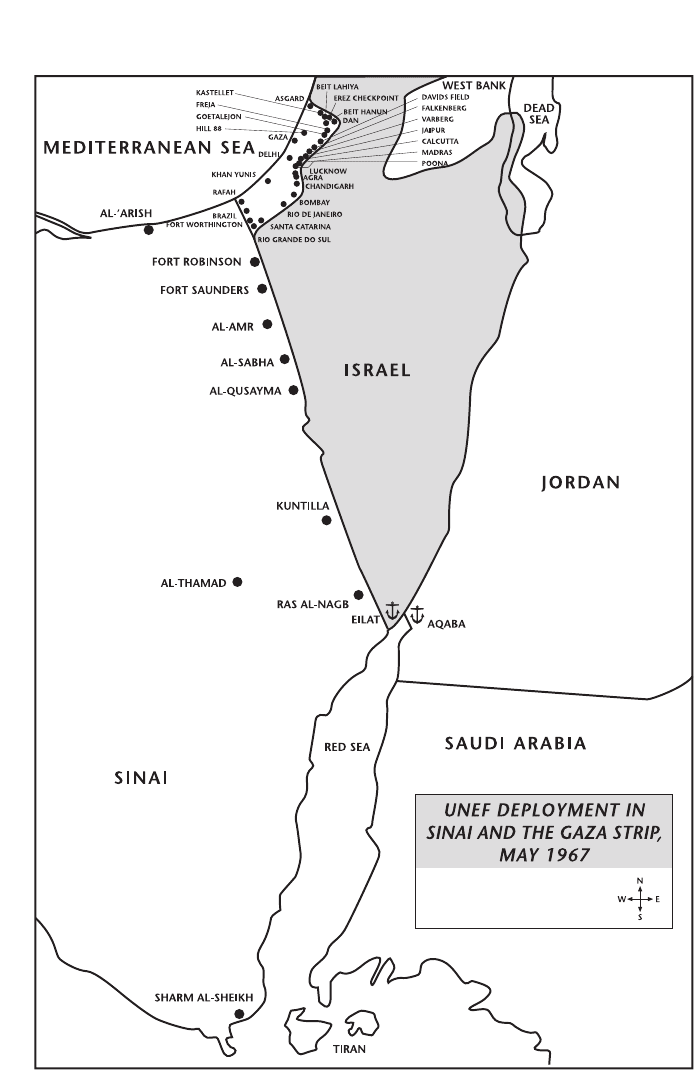
Occupying forty-one observation posts along the international border, in Sharm
al-Sheikh and in Gaza, the United Nations Emergency Force numbered 4,500
men—Indians, Canadians, Yugoslavs, Swedes, Brazilians, Norwegians, and
Danes—about half of its original contingent. Since 1957, UNEF had been sub-
ject to severe cutbacks in budget and personnel, together with skepticism from
Western states disaffected by the UN’s increasingly pro-Soviet stance. Follow-
ing the failure of other peacekeeping efforts, most notably in the Congo, little
faith attended UNEF’s ability to prevent Egypt-Israeli hostilities, for indeed
the force could only observe them once they broke out. Yet, for all its handi-
caps, the mere presence of UNEF had sufficed to deter warfare during periods
of intense Arab-Israeli friction, to keep infiltrators from exiting Gaza and en-
sure free passage through the Straits of Tiran.
15
That presence, however, hung on a legal fiction. The “good-faith agree-
ment” forged by Dag Hammarskjold in 1957, according to which Egypt would
consult with the General Assembly and the UNEF Advisory Council before
altering the force’s mandate, was in no way binding. The Egyptians could, in
fact, dismiss UNEF whenever they chose. This prerogative could be qualified
only by arguing that the state of belligerency that UNEF restrained had never
ceased to exist. In the words of India’s former UN ambassador, “a demand for
withdrawal of the Force in order to battle effectively with the adversary was in
68 SIX DAYS OF WA R
The Crisis 69
direct opposition to . . . the creation of the Force and its deployment in the
area.” But even this reasoning was not expected to hold should Nasser decide
on eviction. In his talks with both Egyptian and Israeli leaders, U Thant had
been bluff: the option was solely Nasser’s.
16
This was the assumption when, at ten o’clock on the sultry night of May
16, Brig. Gen. Ibrahim Sharqawy, Egypt’s military liaison to UNEF, informed
Gen. Rikhye that a special courier had arrived from Cairo. Rikhye had already
received reports of unusual troop movements over the Suez Canal, but had
thought nothing of them. “It was the season for an exchange of verbal threats,
demonstrations, parades . . . high tension.” Entering, the visitor introduced
himself as Brig. Gen. ‘Izz al-Din Mukhtar, and promptly produced the letter
drafted by Dr. Fawzi and signed by Gen. Fawzi. “I would like to have your
reply at once,” Mukhtar said, and explained that UN forces would have to evacu-
ate al-Sabha, a vital junction on the Israeli border, as well as Sharm al-Sheikh,
that very night. Egyptian troops were already en route to those destinations, he
warned, and attempts by UNEF to stop them could result in “clashes.”
Rikhye, forty-eight years old and from a Brahmin nationalist family in
Lahore, had a rich and distinguished record of service with the British army in
World War II and then with the UN in the Congo, New Guinea, and the
Dominican Republic. He had also spent long periods in the Middle East, knew
that UNEF’s mandate was “flimsy at best,” and that an Arab-Israeli war could
erupt momentarily. Only weeks before, he had written U Thant a detailed
memorandum urging him to undertake an emergency mediation mission. He
never received an answer. Yet not even that snub was as shocking as Fawzi’s
letter, which Rikhye took as a personal and professional blow. He asked the
Egyptian brigadiers if they were aware of the consequences of their act.
“Oh, yes, sir!” Sharqawy replied, beaming, “We have arrived at this deci-
sion after much deliberation and are prepared for anything. If there is war, we
shall next meet in Tel Aviv.”
Rikhye was also confused as to the exact nature of Egypt’s demands; the
letter made no mention of either al-Sabha or Sharm al-Sheikh. It appeared as
though Egypt wanted UNEF to remain in Gaza while pulling away from the
border and the Straits of Tiran. He decided to play for time, telling his guests
that he had no authority to order UNEF’s removal; it was not a military matter
between generals, but a legal issue to be settled between Nasser and U Thant.
UNEF’s chief then telegraphed the letter to UN headquarters in New York,
and phoned the commanders of the battalions in al-Sabha and Sharm al-Sheikh,
ordering them to stay in their posts for as long as possible but to refrain from
using force, even if evicted.
17
With the delay and the change in time zones, Fawzi’s letter reached U Thant’s
desk early in the evening. With him was Ralph Bunche, no longer the dynamic
mediator of the 1940s, now ill with cancer and diabetes, but still the international
organization’s leading expert on Middle East diplomacy. His initial reaction to
70 SIX DAYS OF WA R
the crisis was optimism, assuring Goldberg that “there’s a great deal of face and
political maneuvering involved, but with careful handling we might yet pre-
serve the situation and UNEF’s role.” But Bunche fully adhered to the secre-
tary-general’s position that Egypt had a sovereign right to dismiss UNEF,
however imprudent that decision might be. Unfortunately for him, that con-
sideration was not reciprocated by the Egyptians, who viewed Bunche as
Washington’s lackey—an “agent of imperialism,” in Nasser’s words.
At 6:45, U Thant and Bunche summoned the Egyptian ambassador to the
secretary-general’s office. “Dour and rigid,” according to one observer, gaunt
and bald, Mohammad Awad El Kony had been a diplomat for forty of his sixty
years, and, since the Egyptian Revolution, a staunch supporter of Nasser. “A
noble man from a noble family, of high character,” Syria’s ambassador Tomeh
described his Egyptian colleague, “he hated the thought of war.” But El Kony
made no secret of his aversion to Bunche, and directed his attention to what U
Thant, alone, had told him.
U Thant told him that Egypt had erred in treating UNEF as a military
rather than a diplomatic issue; it was a matter to be settled between Nasser and
the secretary-general. Nor could the force’s mandate be summarily altered or
whittled down.
“UNEF cannot be asked to stand aside in order to enable the two sides to
resume fighting,” he explained, “A request for the temporary withdrawal of
UNEF would be considered tantamount to a request for the complete with-
drawal of UNEF from Gaza and Sinai, since this would reduce UNEF to inef-
fectiveness.”
The good-faith agreement was mentioned repeatedly, as were the dangers
of dismantling the force. There was no evidence of any impending Israeli at-
tack, U Thant stressed. Having listed all these caveats, the secretary-general
then arrived at his crux: “If it was the intention of the Government of the UAR
to withdraw the consent which it gave in 1956 for the stationing of UNEF on
UAR territory and in Gaza it is, of course, entitled to do so.”
18
While insisting that it was not a good idea, the secretary-general had up-
held Egypt’s right to evict UNEF peremptorily, and Nasser was swift to exer-
cise it. He communicated his decision to Marshal Tito of Yugoslavia and India’s
Indira Ghandi, both of whom, as predicted, agreed to pull their contingencies
from Sinai. At dawn the next morning, May 17, a troop of thirty Egyptian
soldiers and three armored cars circumvented the Yugoslavian-manned obser-
vation post at al-Sabha and proceeded to the border. Rikhye protested this
development to Sharqawy and in reply received another letter from Gen. Fawzi,
advising him to remove all UN personnel from al-Sabha within twenty-four
hours, and from Sharm al-Sheikh within forty-eight. And still the Egyptians
came. By 1:00 that afternoon, the Egyptian contingent at al-Sabha had swelled
to 100, with thirty vehicles, while a forward element had reportedly reached
Kuntilla, in the south, as well.
19
The Crisis 71
UNEF had been circumvented—at key points it was no longer observing
the border but the Egyptian soldiers’ backs—and then hamstrung by two of its
main contributors. Appraised of these developments, U Thant was more than
ever reluctant to resist Nasser’s decision. He could not, he felt, go to the Gen-
eral Assembly, where the Communist and African-Asian blocs were certain to
back Egypt, nor to the Security Council, paralyzed by Soviet and American
vetoes. He feared that any attempt to hinder the Egyptian army could endan-
ger the safety of UNEF personnel, and jeopardize future peacekeeping opera-
tions elsewhere. Though his own legal counsel firmly advised against taking
the “radical action” of bending to Egypt’s ultimatum before consulting the
relevant UN bodies, U Thant’s mind was made up. “It is inconceivable to me
that once UAR consent for the presence of the Force was withdrawn, there
could be any decision other than compliance with the request . . . ” he later
wrote, “In fact, the question of compliance was moot once the consent was
terminated.” Among the greatest obstacles to UNEF’s survival, it seemed, was
the secretary-general himself.
20
In a meeting that afternoon with the UNEF Advisory Committee, while
Western ambassadors argued strenuously for postponing a final decision, U
Thant sided with the Pakistani and Indian delegates in upholding Egypt’s right
to dismiss the force unilaterally. “It was generally supposed [in 1957] that UNEF
would be stationed there for only a few months,” he told the committee, claim-
ing that the “good-faith” agreement related only to removal of forces from
Sinai—a goal long since achieved. “If the consent of the UAR ceases to exist,
then UNEF has to be withdrawn; there is no alternative,” he insisted. Similar
reasoning would inform the aide-mémoire sent to Nasser that evening, in which
the secretary-general reiterated his recognition of Egyptian rights, and a note
reminding Rikhye that his troops were in Sinai at Egypt’s discretion.
21
Egypt had an unassailable right to evict UNEF, though by doing so it
risked igniting regional, if not global, war—that was the paradoxical position of
the man charged with maintaining world peace. “Emotionless and moon-faced
. . . rather simple-minded,” in the view of one of his closest advisers, the fifty-
eight-year-old U Thant was a former high school headmaster turned journalist
and government press secretary who, in 1957, became Burma’s permanent rep-
resentative to the UN. Notwithstanding a penchant for schoolboy jokes, he
was a tense and quiet man—“a Buddhist in every sense of the word,” said George
Tomeh, “it was very difficult to anticipate his reactions”—and, apart from che-
roots and spicy Burmese food, viceless. Four years later, after Hammarskjold’s
death in a plane crash in the Congo, U Thant, then chairman of the UN’s
Congo Conciliation Commission, was chosen to complete the late secretary-
general’s term of office. Reappointed by the Security Council in December
1966, he earned a reputation as a patient, if parochial, statesman.
“He had strong views of right and wrong,” Brian Urquhart, a UN under-
secretary, remembered, “[his] moral sense overrode his political sense and caused