
Quinn J.J., Yi K.-S. Solid State Physics: Principles and Modern Applications
Подождите немного. Документ загружается.


Uncorrected Proof
BookID 160928 ChapID 12 Proof# 1 - 29/07/09
374 12 Many Body Interactions: Green’s Function Method
the polarization part. This RPA approximation for W is exactly equivalent to 256
V (q)
ε(q,ω)
,whereε(q,ω) is the Lindhard dielectric function. The key role of the 257
electron self-energy in studying electron–electron interactions in a degenerate 258
electron gas was initially emphasized by Quinn and Ferrell.
1
In their paper, 259
the simplest GW approximation to Σ was used. G
(0)
was used for the Green’s 260
function and
V (q)
ε(q,ω)
, the RPA screened interaction (equivalent to Lindhard 261
screened interaction) was used for W. 262
12.5 Green’s Function Approach 263
to the Electron–Phonon Interaction 264
In this section we apply the Green’s function formalism to the electron–phonon 265
interaction. The Hamiltonian H is divided into three parts: 266
H = H
e
+ H
N
+ H
I
, (12.63)
where
267
H
e
=
i
p
2
i
2m
+
l
U(r
i
− R
0
l
)
, (12.64)
268
H
N
=
l
P
2
l
2M
+
l>m
V (R
l
− R
m
)
, (12.65)
and
269
H
I
=
i>j
e
2
r
ij
−
i,l
u
l
·∇U(r
i
− R
0
l
). (12.66)
Here, U(r
i
−R
l
)andV (R
l
−R
m
) represent the interaction between an elec- 270
tron at r
i
and an ion at R
l
and the interaction potential of the ions with 271
each other, respectively. Let us write R
l
= R
0
l
+ u
l
for an ion where R
0
l
is 272
the equilibrium position of the ion and u
l
is its atomic displacement. The 273
electronic Hamiltonian H
e
is simply a sum of one-electron operators, whose 274
eigenfunctions and eigenvalues are the object of considerable investigation for 275
energy band theorists. To keep the calculations simple, we shall assume that 276
the effect of periodic potential can be approximated to sufficient accuracy for 277
our purpose by the introduction of an effective mass. The nuclear or ionic 278
Hamiltonian H
N
has already been analyzed in normal modes in earlier chap- 279
ters. It should be pointed out that the normal modes of (12.65) are not the 280
usual sound waves. The reason for this is that V (R
l
− R
m
) is a “bare” ion– 281
ion interaction, for a pair of ions sitting in a uniform background of negative 282
charge, not the true interaction which is screened by the conduction electrons. 283
We can express (12.64)–(12.66) in the usual second quantized notation as 284
1
J.J. Quinn, R.A. Ferrell, Phys. Rev 112, 812 (1958).

Uncorrected Proof
BookID 160928 ChapID 12 Proof# 1 - 29/07/09
12.5 Green’s Function Approach to the Electron–Phonon Interaction 375
H
e
=
k
¯h
2
k
2
2m
∗
c
†
k
c
k
, (12.67)
285
H
N
=
α
¯hω
α
b
†
α
b
α
+
1
2
, (12.68)
and
286
H
I
=
k,k
,q
4πe
2
Ωq
2
c
†
k+q
c
†
k
−q
c
k
c
k
+
k,α,G
γ(α, G)(b
α
− b
†
−α
)c
†
k+q+G
c
k
. (12.69)
The c
k
and b
α
are the destruction operators for an electron in state k and a 287
phonon in state α =(q,μ), respectively.
2
The creation and annihilation oper- 288
ators satisfy the usual commutation (phonon operators) or anticommutation 289
(electron operators) rules. The coupling constant
4πe
2
Ωq
2
is simply the Fourier 290
transform of the Coulomb interation, and γ(α, G)isgivenby 291
γ(α, G)=−i(q + G)ε
α
¯hN
2Mω
α
1/2
U(q + G), (12.70)
where U(q + G) is the Fourier transform of U(r −R). For simplicity we shall
292
limit ourselves to normal processes (i.e., G = 0), and take U(r − R)asthe 293
Coulomb interaction −
Ze
2
|r−R|
between an electron of charge −e and an ion of 294
charge Ze. With these simplifications γ(α, G) reduces to 295
γ(q)=i
4πZe
2
q
¯hN
2Mω
q
1/2
(12.71)
for the interaction of electrons with a longitudinal wave, and zero for interac-
296
tion with a transverse wave. Furthermore, when we make these assumptions, 297
the longitudinal modes of the “bare” ions all have the frequency 298
ω
q
= Ω
p
, (12.72)
where Ω
p
=
4πZ
2
e
2
N
M
1/2
is the plasma frequency of the ions. 299
We want to treat H
I
as a perturbation. The brute-force application of 300
perturbation theory is plagued by divergence difficulties. The divergence arise 301
from the long range of the Coulomb interaction, and are reflected in the behav- 302
ior of the coupling constants as q tends to zero. We know that in the solid, the 303
Coulomb field of a given electron is screened because of the response of all the 304
other electrons in the medium. This screening can be taken into account by 305
2
We should really be careful to include the spin state in describing the electrons.
We will omit the spin index for simplicity of notation, but the state k should
actually be understood to represent a given wave vector and spin: k ≡ (k,σ).

Uncorrected Proof
BookID 160928 ChapID 12 Proof# 1 - 29/07/09
376 12 Many Body Interactions: Green’s Function Method
pertubation theory, but it requires summing certain classes of terms to infinite 306
order. This is not very difficult to do if one makes use of Green’s functions 307
and Feynman diagrams. Before we discuss these, we would like to give a very 308
quanlitative sketch of why a straightforward perturbation approach must be 309
summed to infinite order. 310
Suppose we introduce a static positive point charge in a degenerate electron 311
gas. In vacuum the point charge would set up a potential Φ
0
. In the electron 312
gas the point charge attracts electrons, and the electron cloud around it con- 313
tributes to the potential set up in the medium. Suppose that we can define 314
a polarizability factor α such that a potential Φ acting on the electron gas 315
will distort the electron distribution in such a way that the potential set up 316
by the distortion is αΦ. We can then apply a perturbation approach to the 317
potential Φ
0
. Φ
0
distorts the electron gas: the distortion sets up a potential 318
Φ
1
= αΦ
0
.ButΦ
1
further distorts the medium and this further distortion sets 319
up a potential Φ
2
= αΦ
1
, etc. such that Φ
n+1
= αΦ
n
. The total potential Φ 320
set up by the point charge in the electron gas is 321
Φ = Φ
0
+ Φ
1
+ Φ
2
+ ···= Φ
0
(1 + α + α
2
+ ···)
= Φ
0
(1 − α)
−1
. (12.73)
We see that we must sum the straightforward perturbation theory to infinite
322
order. It is usually much simpler to apply “self-consistent” perturbation the- 323
ory. In this approach one simply says that Φ
0
will ultimately set up some 324
self-consistent field Φ. Now, the field acting on the electron gas and polariz- 325
ing it is not Φ
0
but the full self-consistent field Φ. Therefore, the polarization 326
contribution to the full potential should be αΦ:thisgives 327
Φ = Φ
0
+ αΦ, (12.74)
which is the same result obtained by summing the infinite set of perturbation
328
contributions in (12.73). 329
We want to use some simple Feynman propagation functions or Green’s 330
functions, so we will give a very quick definition of what we must know to use 331
them. If we have the Schr¨odinger equation 332
i¯h
∂Ψ
∂t
= HΨ, (12.75)
and we know Ψ(t
1
), we can determine Ψ at a later time from the equation 333
Ψ(x
2
,t
2
)=
d
3
x
1
G
0
(x
2
,t
2
; x
1
,t
1
)Ψ(x
1
,t
1
). (12.76)
By substitution, one can show that G
0
satisfies the differential equation 334
i¯h
∂
∂t
2
− H(x
2
)
G
0
(2, 1) = i¯hδ(t
2
− t
1
)δ(x
2
− x
1
), (12.77)

Uncorrected Proof
BookID 160928 ChapID 12 Proof# 1 - 29/07/09
12.5 Green’s Function Approach to the Electron–Phonon Interaction 377
where (2, 1) denotes (x
2
,t
2
; x
1
,t
1
). One can easily show that G
0
(2, 1) can be 335
expressed in terms of the stationary states of H.Thatis,if 336
Hu
n
= E
n
u
n
, (12.78)
then G
0
(2, 1) can be shown to be 337
G
0
(2, 1) =
n
u
n
(x
2
)u
∗
n
(x
1
)e
−iE
n
t
21
/¯h
, if t
21
> 0,
=0 otherwise. (12.79)
If we are considering a system of many Fermions, we can take into account
338
the exclusion principle in a very simple way. We simply subtract from (12.79) 339
the summation over all states of energy less than the Fermi energy E
F
. 340
G
0
(2, 1) =
E
n
>E
F
u
n
(x
2
)u
∗
n
(x
1
)e
−iE
n
t
21
/¯h
, if t
21
> 0,
= −
E
n
<E
F
u
n
(x
2
)u
∗
n
(x
1
)e
−iE
n
t
21
/¯h
, if t
21
< 0. (12.80)
We always represent a Fermion propagator by a directed solid line. A negative
341
(relative to the last filled state E
F
) energy Fermion propagates backward in 342
time. This corresponds to the propagation of a hole in a normally filled state. 343
For free electrons the functions u
n
(x) are plane waves. We are often interested 344
in G
0
(q, ω), the Fourier transform of G
0
(2, 1): 345
G
0
(2, 1) =
d
3
qdω
(2π)
4
G
0
(q, ω)e
iq·x
21
−iωt
21
. (12.81)
The single particle propagator G
0
(q, ω) for a system of free electrons is 346
G
0
(q, ω)=
i
ω −E(q)(1 − iδ)
, (12.82)
where E(q)=
¯h
2
2m
(q
2
−k
2
F
) is the energy measured relative to the Fermi energy 347
and takes on both positive and negative values. k
F
is the Fermi wave number, 348
and δ is a positive infinitesimal. 349
In the language of second quantization G
0
(2, 1) can also be expressed as 350
the ground state expectation value of the time ordered product of two electron 351
field operators 352
G
0
(2, 1) = GS | T {Ψ(2)Ψ
†
(1)}|GS. (12.83)
353
In this expression, Ψ(2) = Ψ(x
2
,t
2
) is the electron field operator and Ψ
†
(2) 354
is its conjugate. These operators satisfy the usual Fermion anticommutation 355
relations. T is the chronological operator. It should be pointed out that people 356
often define G
0
(2, 1) with an additional factor of i on the right hand side of 357
Uncorrected Proof
BookID 160928 ChapID 12 Proof# 1 - 29/07/09
378 12 Many Body Interactions: Green’s Function Method
(12.83). This arbitrariness in defining the propagation functions is compen- 358
sated for by slight differences in the rules for calculating the amplitudes of 359
the Feynman diagrams which appear in perturbation theory. 360
We can also define a propagation function for the instantaneous Coulomb 361
interaction
e
2
r
21
δ(t
21
) between electrons at two points in space time. We shall 362
use i times the Fourier transform of
e
2
r
21
δ(t
21
) as the bare Coulomb propagator 363
V (q, ω) 364
V (q, ω)=
4πe
2
i
Ωq
2
. (12.84)
If we define the phonon field operator Φ(x) by the equation
365
Φ(x)=
q
γ(q)e
iq·x
(b
†
q
− b
−q
) (12.85)
then we can define the space time representation for the phonon propagator
366
in the usual way 367
P
0
(2, 1) = iGS | T {Φ(x
2
,t
2
)Φ
†
(x
1
,t
1
)}|GS (12.86)
368
where Φ(x
2
,t
2
)=e
−iHt
2
Φ(x
2
)e
iHt
2
. The Fourier transform of (12.86) is 369
P
0
(q, ω), the wave vector frequency space representation of P
0
. For the phonon 370
system of (12.71) and (12.72), P
0
(q, ω)isgivenby 371
P
0
(q, ω)=
2iΩ
p
γ
2
(q)
ω
2
− Ω
2
p
. (12.87)
It is quite convenient to use Feynman diagrams to keep track of the various
372
terms in perturbation theory. The rules for constructing diagrams are quite 373
simple.Eachelectroninanexcitedstate is represented by a solid line directed 374
upward. Each hole in a normally filled state is represented by a solid line 375
directed downward. The instantaneous Coulomb interaction is represented by 376
a horizontal dotted line connecting the two particles undergoing a virtual 377
scattering, and propagation of a phonon is represented by a wavy line. 378
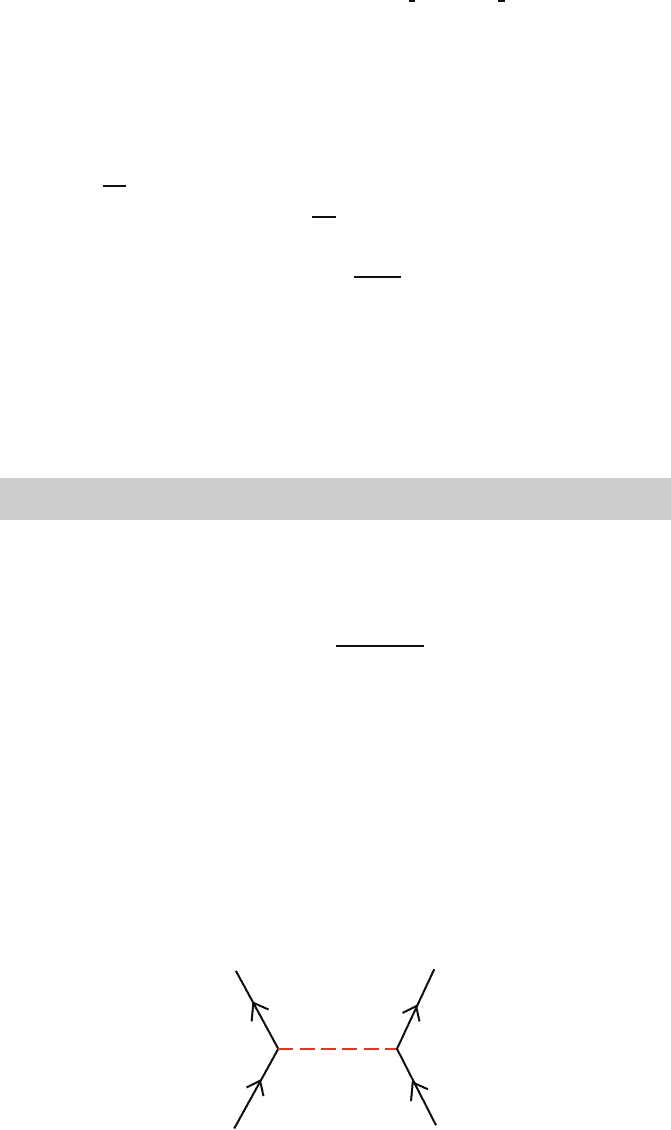
Consider the scattering of two electrons. In vacuum they can scatter by the 379
exchange of one virtual photon (Coulomb line) in only one way, which is shown 380
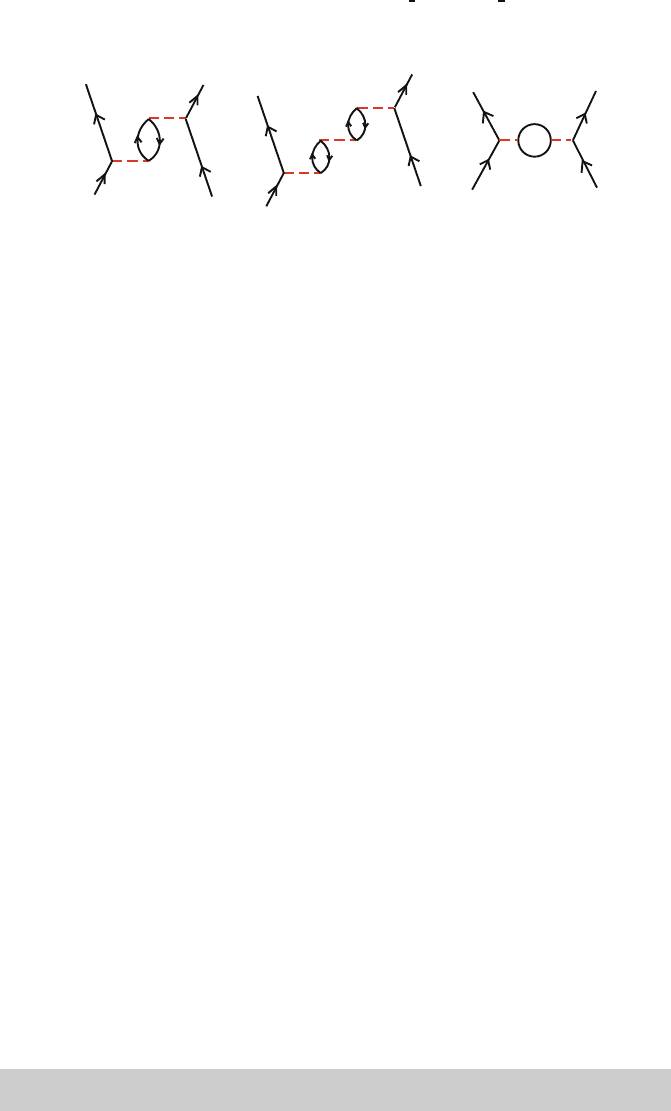
in Fig. 12.5. Now consider the Coulomb interaction in the medium. The set of 381
Fig. 12.5. Diagrammatic expression of the exchange of virtual photon
Uncorrected Proof
BookID 160928 ChapID 12 Proof# 1 - 29/07/09
12.5 Green’s Function Approach to the Electron–Phonon Interaction 379
(a) (b) (c)
Fig. 12.6. Diagrammatic expressions of representative polarization parts in pair
approximation
diagrams, of which Fig. 12.6a and b are representative, are additional processes 382
which can not occur in the absence of the polarizable medium. In Fig. 12.6c, 383
the circle represents any possible part of a diagram which is connected to 384
the remainder by two Coulomb interaction lines only. All such parts of a gen- 385
eral diagram are called polarizable parts , because they obviously represent the 386
response or screening of the polarizable medium. The effective Coulomb inter- 387
action between two particles should be the sum of all the possible polarization 388
parts (the bare intraction can be thought of as the zeroth order polarization 389
part). Actually we can not sum all the possible polarization parts, but we can 390
sum the class of which Fig. 12.6a and b are representative, that is, the chain 391
of bubbles. The approximation of replacing the effective interaction by the 392
sum of all bubble graph is called the pair approximation. Before looking at 393
the sum we will write down the rules for calculating the amplitude associated 394
with a given Feynman diagram which appears in perturbation theory. The 395
amplitude for a given diagram contains a product of 396
(i) a propagation function G
0
(k, ω) for each internal electron–hole line of 397
wave vector k and frequency ω. 398
(ii) a propagation function P
0
(k, ω) for each phonon line of wave vector q 399
and frequency ω. 400
(iii) a propagation function V (q, ω) for each Coulomb line of wave vector q. 401
(iv) afactor(−1) for each closed loop. 402
(v) (−i/¯h)
n
for the nth-order term in perturbation theory. 403
(vi) delta functions conserving energy, momentum, and spin at each vertex. 404
(vii) Finally, we must integrate over the wave vectors and frequencies of all 405
internal lines. 406
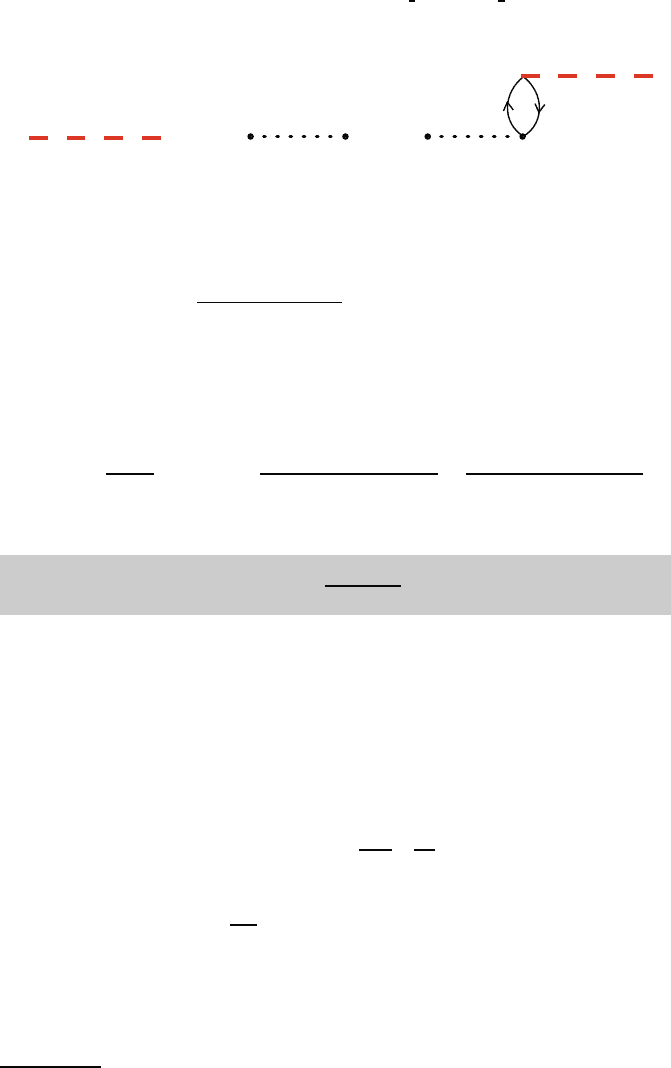
The set of diagrams we would like to sum in order to obtain the effec- 407
tive Coulomb propagator W (q,ω) can easily be seen to be the solution of the 408
equation given pictorially by Fig. 12.7. This equation can be written 409
W (q, ω)=V (q, ω) − V (q, ω)Q
0
(q, ω)W (q, ω), (12.88)
410
Uncorrected Proof
BookID 160928 ChapID 12 Proof# 1 - 29/07/09
380 12 Many Body Interactions: Green’s Function Method
=+
Fig. 12.7. Diagrammatic expression of Dyson equation for the effective Coulomb
propagator W = V + V ΠW
where 411
Q
0
(q, ω)=2(−1)
d
3
k
1
dω
1
d
3
k
2
dω
2
(2π)
8
G
0
(k
1
,ω
1
)G
0
(k
2
,ω
2
)δ(ω
1
− ω
2
+ ω)
×δ(k
1
− k
2
+ q) (12.89)
is the propagation function for the electron–hole pair. The factor of two is
412
introduced to account for the two possible spin orientations. Using the electron 413
propagation functions defined by (12.82) and integrating gives 414
Q
0
(q, ω)=
−2i
(2π)
3
k<k
F
d
3
k
1
E(k + q)−E(k)+ω
+
1
E(k + q)−E(k) − ω
.
(12.90)
The solution of (12.88) is simply
415
W =
V
1+VQ
0
(12.91)
416
and using (12.90) one can easily see that 1 + VQ
0
is just the Lindhard dielec- 417
tric function ε(q, ω). This dielectric function is discussed at some length in 418
the previous chapter, and the reader is referred to Lindhard’s paper
3
for a 419
complete treatment. For our purposes we must note two things: first ε(q, ω) 420
is complex, the imaginary part being proportional to the number of electrons 421
which can be excited to an unoccupied state by addition of a momentum 422
¯hq whose energy change is equal to ¯hω. The second point is that for zero 423
frequency ε(q, 0) is given by 424
ε(q)=1+F
q
2k
F
k
2
s
q
2
, (12.92)
where k
s
is the Fermi–Thomas screening parameter and k
F
is the Fermi wave 425
number. The function F
q
2k
F
is the function sketched in Fig. 11.12. F (x)is
426
equal to unity for x equal to zero, approaches zero as x approaches infinity, 427
and has logarithmic singularity in slope at x =1. 428
Now, let us return to our “model solid” which contains longitudinal 429
phonons as well as electrons. Two electrons can scatter via the virtual 430
exchange of phonons. In fact, anywhere a Coulomb interaction line has 431
3
J. Lindhard, Kgl. Danske Videnskab. Selskab, Mat.-Fys. Medd. 28, No. 8 (1954);
ibid., 27, No. 15 (1953).

Uncorrected Proof
BookID 160928 ChapID 12 Proof# 1 - 29/07/09
12.5 Green’s Function Approach to the Electron–Phonon Interaction 381
appeared previously, a phonon line may equally well appear. If we call D
0
(q,ω) 432
the sum of P
0
(q,ω)andV (q,ω) we can just replace V and W by D
0
and D 433
in Eq.(12.88). D(q,ω) then represents the propagation function for the total 434
interaction, i.e., the sum of the Coulomb interaction and the interaction due 435
to virtual exchange of phonons. It is apparent that 436
D(q,ω)=
D
0
(q,ω)
1+D
0
(q,ω)Q
0
(q,ω)
. (12.93)
437
By substituting into (12.92) the expressions for the propagation functions and 438
using the fact that 1 + VQ
0
= ε(q, ω), one can obtain 439
D(q,ω)=
4πe
2
i
q
2
ε(q, ω) − Ω
2
p
/ω
2
. (12.94)
The propagation function D as a pole at
440
ω
2
=
Ω
2
p
ε(q, ω)
. (12.95)
The solutions of this equation are our “renormalized” phonons. From the long
441
wavelength, zero frequency dielectric constant we get the approximate solution 442
ω
q
=
Ω
p
k
s
q. (12.96)
For most metals,
Ω
p
k
s
is within about 15–20% of the velocity of longitudinal 443
sound waves. If we look at the derivative of ω
2
q
with respect to q we see a 444
logarithmic singularity at q =2k
F
. This is responsible for the Kohn effect, 445
which has been observed by neutron scattering. If we take account of the 446
imaginary as well as the real part of the dielectric constant, the solution of 447
(12.95) has both real and imaginary part. If we write ω = ω
1
+iω
2
,thenω
2
448
turns out to be 449
ω
2
≈
π
4
k
2
s
k
2
s
+ q
2
c
s
v
F
ω
1
, (12.97)
where c
s
is the velocity of sound and v
F
the Fermi velocity. The coefficient 450
of attenuation of the sound wave (due to excitation of conduction electrons) 451
is simply
ω
2
c
s
. This result agrees with the more standard calculations of the 452
attenuation coefficient. 453
Finally, if we wish to define the effective interaction between electrons due 454
to virtual exchange of phonons, or the effective phonon propagator ,wecan 455
simply subtract from D(q, ω) that part which contains no phonons, namely 456
W (q, ω). If we call the resultant effective phonon propagator P (q, ω), we 457
obtain 458
P (q, ω)=
2iω
q
| γ
eff
q
|
2
ω
2
− ω
2
q
, (12.98)
459

Uncorrected Proof
BookID 160928 ChapID 12 Proof# 1 - 29/07/09
382 12 Many Body Interactions: Green’s Function Method
where ω
q
is given by (12.96) and 460
| γ
eff
q
|=
4πZe
2
qε(q, ω
q
)
N
2Mω
q
1/2
. (12.99)
Replacing ε(q, ω
q
) by its long wavelength, zero frequency limit
1+
k
2
s
q
2
,
461
reduces (12.99) to the result of Bardeen and Pines
4
for the effective electron– 462
electron interaction. 463
12.6 Electron Self Energy 464
The Dyson equation for the Green’s function can be written 465
G(k, ω)=G
(0)
(k, ω)+G
(0)
(k, ω)Σ(k, ω)G(k, ω). (12.100)
Dividing by GG
(0)
gives 466
Σ(k, ω)=[G
(0)
(k, ω)]
−1
− [G(k, ω)]
−1
. (12.101)
The energy of a quasiparticle can be written
467
E
p
= ε
p
+Σ(p, ω) |
ω=E
p
. (12.102)
468
E
p
and ε
p
, the kinetic energy, are usually measured relative to E
F
,theFermi 469
energy. Knowing how Σ(p, ω) depends on p, ω,andr
s
allows one to calculate 470
almost all the properties of an electron gas that are of interest. Some results 471
of interest are worth mentioning. 472
(1) Σ(p, E
p
) has both a real and an imaginary part. 473
Σ(p, E
p
)=Σ
1
(p, E
p
)+iΣ
2
(p, E
p
). (12.103)
474
The imaginary part is related to the lifetime of the quasiparticle excitation. 475
476
(2) The spectral function A(p, ω) is defined by 477
A(p, ω)=
−2Σ
2
(p, ω)
[ω −ε
p
− Σ
1
(p, ω)]
2
+[Σ
2
(p, ω)]
2
. (12.104)
For noninteracting electrons A(p, ω)hasaδ function singularity at ω = ε
p
, 478
the energy of the excitation. The δ function is broadened by Σ
2
(p, ω). If 479
A(p, ω) has a pole in a region where Σ
2
(p, ω) is zero, the strength of the 480
pole is decreased by a renormalization factor Z(p). 481
A(p, ω)=2πZ(p)δ (ω − ε
p
− Σ
1
(p, ω)) (12.105)
4
John Bardeen and David Pines, Phys. Rev. 99, 1140 (1955).

Uncorrected Proof
BookID 160928 ChapID 12 Proof# 1 - 29/07/09
12.7 Quasiparticle Interactions and Fermi Liquid Theory 383
and 482
Z(p)=
1
1 −
∂
∂ω
Σ
1
(p, ω)
ω=E
p
. (12.106)
(3) The quasiparticle excitations at the Fermi surface have an effective mass
483
m
∗
given by 484
m
m
∗
=
1+
∂Σ
1
(k,ω)
∂ε
k
1 −
∂Σ
1
(k,ω)
∂ω
k=k
F
ω=0
. (12.107)
(4) Properties like the spin susceptibility, the specific heat, the compressibil-
485
ity, and the ground state energy can be evaluated from a knowledge of 486
Σ(k, ω). But, we do not have time to go through these in any detail. 487
(5) The self-energy approach leads very naturally to an understanding of the 488
Landau theory of a Fermi liquid. We will describe a very brief and intuitive 489
explanation of the theory. 490
12.7 Quasiparticle Interactions and Fermi Liquid Theory 491
Instead of describing the interacting ground state and excited states of an 492
electron gas, we can think of simply describing how many quasiparticles are 493
present in some excited state. Let us start by noting that if we begin with a 494
filled Fermi sphere of noninteracting electrons (i.e., the Sommerfeld model) 495
and adiabatically turn on the electron–electron interaction, we will generate at 496
t = 0 the exact interacting ground state. Now consider the noninteracting state 497
described by a filled Fermi sphere plus one electron of momentum p outside 498
the Fermi sphere (or one hole of momentum p inside the Fermi sphere). When 499
interactions are adiabatically turned on, this is a single quasiparticle state. 500
The energy of this quasielectron (or quasihole) is written by 501
E
p
= ε
p
+Σ(p,E
p
). (12.108)
If E
p
is much larger than Σ
2
(p,E
p
), then the quasiparticles have long life- 502
times. It is much simpler to describe a state by saying how many quasielectrons 503
and quasiholes are present. Then, the energy of the state can be written as 504
E = E
0
+
pσ
δn
pσ
E
pσ
+
1
2
p, p
σ, σ
f
σσ
(p, p
)δn
nσ
δn
p
σ
. (12.109)
505
The first term on the right is the ground state energy, the second is the quasi- 506
particle energy E
pσ
multiplied by the quasiparticle distribution function, and 507
the third represents the interactions of the quasiparticles with one another. 508
Σ(p,E
p
) represents the interaction of a quasiparticle of momentum p with 509
the ground state of the interacting electron gas. But if the electron gas is 510