
Quinn J.J., Yi K.-S. Solid State Physics: Principles and Modern Applications
Подождите немного. Документ загружается.


Uncorrected Proof
BookID 160928 ChapID 11 Proof# 1 - 29/07/09
344 11 Many Body Interactions – Introduction
P(x,t)=
d
3
x
dt
χ(x − x
,t− t
)E(x
,t
). (11.192)
Causality requires that χ(x −x
,t−t
) = 0 for all t<t
. That is, the polariz- 574
able material can not respond to the field until it is turned on. A well-known 575
theorem from the theory of complex variables tells us that the Fourier trans- 576
form of χ(t − t
) is analytic in the upper half plane since e
i(ω
1
+iω
2
)t
becomes 577
e
iω
1
e
−ω
2
t
. 578
Theorem 1. Given a function f(z) such that f(z)=0for all z<0, then the 579
Fourier transform of f(z) is analytic in the upper half plane. 580
Take the Fourier transform of the equation for P(x,t) 581
P(q,ω)=
d
3
x dt P(x,t)e
iωt−iq·x
. (11.193)
Then
582
P(q,ω)=
"
d
3
x dt
"
d
3
x
dt
χ(x − x
,t− t
)E(x
,t
)e
iωt−iq·x
=
"
d(x − x
)d(t − t
) χ(x − x
,t− t
)e
iω(t−t
)−iq·(x−x
)
×
"
d
3
x
dt
E(x
,t
)e
iωt
−iq·x
.
Therefore, we have
583
P(q,ω)=χ(q,ω)E(q,ω). (11.194)
Here, χ(q,ω) is the electrical polarizability (see (8.14)). The dielectric con-
584
stant ε(q,ω) is related to the polarizability χ by 585
ε(q,ω)=1+4πχ(q,ω) (11.195)
The theorem quoted above tells us that χ(ω) is analytic in the upper half ω-
586
plane. From here on we shall be interested only in the frequency dependence 587
of χ(q,ω), so for brevity we shall omit the q in χ(q,ω). Cauchy’s theorem 588
states that 589
χ(ω)=
1
2πi
C
χ(ω
)
ω
− ω
dω
, (11.196)
where the contour C must enclose the point ω and must lie completely in the
590
region of analyticity of the complex function χ(ω
). We choose the contour 591
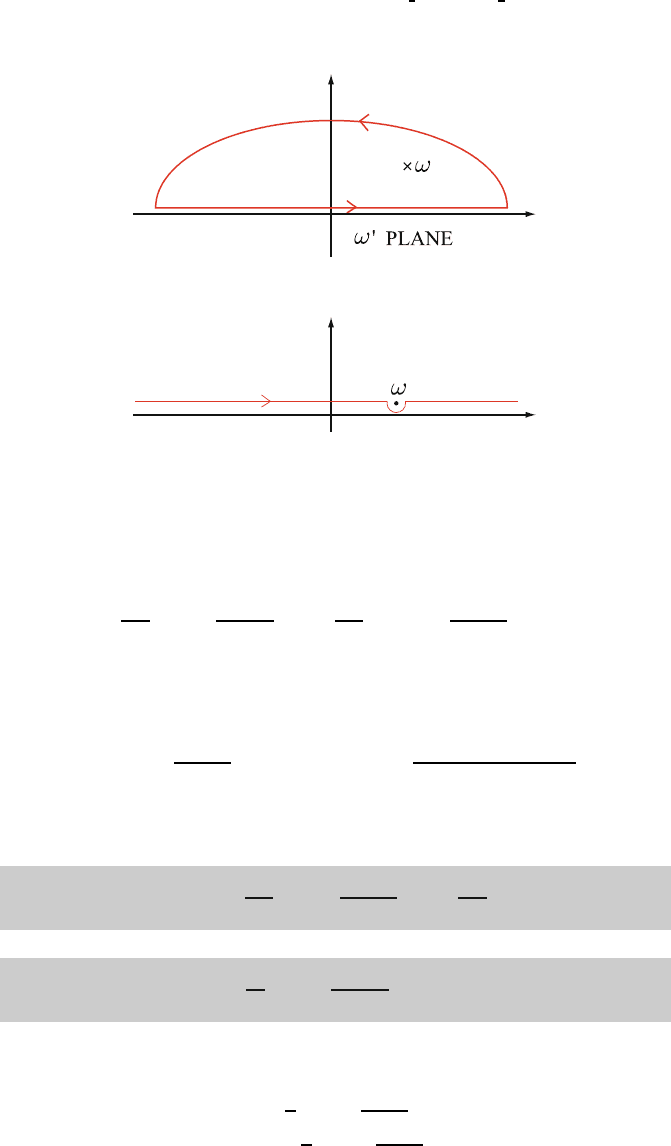
lying in the upper half plane as indicated in Fig. 11.9. 592
As |ω|→∞, χ(ω) → 0 since the medium can not follow an infinitely 593
rapidly oscillating disturbance. This allows us to discard the integral over the 594
semicircle when its radius approaches infinity. Thus, we have 595
χ(ω)=
1
2πi
∞
−∞
χ(ω
)
ω
− ω
dω
. (11.197)
We are interested in real frequencies ω, so we allow ω to approach the real
596
axis. In doing so we must be careful to make sure that ω is enclosed by the 597
Uncorrected Proof
BookID 160928 ChapID 11 Proof# 1 - 29/07/09
11.6 Lindhard Dielectric Function 345
Fig. 11.9. The contour C appearing in (11.196)
Fig. 11.10. Relevant contour C when ω approaches the real axis
original contour. One can satisfy all the conditions by deforming the contour 598
as shown in Fig. 11.10. 599
Then, we have 600
χ(ω)=
1
2πi
P
∞
−∞
χ(ω
)
ω
− ω
dω
+
1
2πi
small
semicircle
χ(ω
)
ω
− ω
dω
, (11.198)
where P denotes the principal part of the integral. We integrate the second
601
term in (11.198) by setting ω
− ω = ρe
iφ
and letting ρ → 0 602
small
semicircle
χ(ω
)
ω
− ω
dω
= lim
ρ→0
π/2
−π/2
χ(ω + ρe
iφ
)ρe
iφ
idφ
ρe
iφ
=iπχ(ω).
Thus, we have
603
χ(ω)=
1
2πi
P
∞
−∞
χ(ω
)
ω
− ω
dω
+
1
2πi
iπχ(ω)
604
or 605
χ(ω)=
1
πi
P
∞
−∞
χ(ω
)
ω
− ω
dω
. (11.199)
606
This is the Kramers–Kronig relation.Bywritingχ(ω)=χ
1
(ω)+iχ
2
(ω), we 607
can use the Kramers–Kronig relation to obtain 608
χ
1
(ω)=
1
π
P
"
∞
−∞
χ
2
(ω
)
ω
−ω
dω
χ
2
(ω)=−
1
π
P
"
∞
−∞
χ
1
(ω
)
ω
−ω
dω
,
(11.200)

Uncorrected Proof
BookID 160928 ChapID 11 Proof# 1 - 29/07/09
346 11 Many Body Interactions – Introduction
or in terms of ε 609
ε
1
(ω)=1+
1
π
P
"
∞
−∞
ε
2
(ω
)
ω
−ω
dω
ε
2
(ω)=−
1
π
P
"
∞
−∞
ε
1
(ω
)−1
ω
−ω
dω
,
(11.201)
where ε
2
=4πχ
2
. Here, we note that the reality requirement on the fields E 610
and P imposes the conditions χ
1
(ω)=χ
1
(−ω)andχ
2
(ω)=−χ
2
(−ω). This 611
allows us to write 612
ε
1
(ω)=1+
2
π
P
∞
0
ω
ε
2
(ω
)
ω
2
− ω
2
dω
. (11.202)
613
11.7 Effect of Collisions 614
In actual experiments, the conductivity of a metal (normal metal) is not infi- 615
nite at zero frequency because the electrons collide with lattice imperfections 616
(phonons, defects, impurities). Experimenters find it convenient to account 617
for collisions by use of a phenomenological relaxation time τ. When collisions 618
are included, the equation of motion of the density matrix becomes 619
∂ρ
∂t
+
i
¯h
[H, ρ]
−
=
∂ρ
∂t
c
. (11.203)
620
The assumption of a relaxation time is equivalent to saying that 621
∂ρ
∂t
c
= −
ρ − ˜ρ
0
τ
. (11.204)
622
Here, ˜ρ
0
is a local equilibrium density matrix. We shall see that ˜ρ
0
must be cho- 623
sen with care or the treatment will be incorrect.
7
There are two requirements 624
that ˜ρ
0
must satisfy 625
1. ˜ρ
0
must transform properly under change of gauge 626
2. Because collisions cannot alter the density at any point in space, ˜ρ
0
must 627
be chosen such that ρ and ˜ρ
0
correspond to the same density at every 628
point r
0
629
It turns out that the correct choice for ˜ρ
0
which satisfies gauge invariance and 630
conserve particle number in collisions is 631
˜ρ
0
(H, η)=
1
e
H−η
Θ
+1
. (11.205)
Here, H is the full Hamiltonian including the self-consistent field and η is the
632
local chemical potential.Wecandetermineη by requiring that 633
7
See, for eample, M.P. Greene, H.J. Lee, J.J. Quinn, S. Rodriguez, Phys. Rev. 177,
1019 (1969).
Uncorrected Proof
BookID 160928 ChapID 11 Proof# 1 - 29/07/09
11.7 Effect of Collisions 347
Tr {[ρ − ˜ρ
0
(H, η)] δ(r − r
0
)} =0. (11.206)
634
This condition implies that the local equilibrium distribution function ˜ρ
0
635
toward which the nonequilibrium distribution function ρ is relaxing has 636
exactly the same density at every position r
0
as the nonequilibrium dis- 637
tribution function does at r
0
. Of course, the local chemical potential is 638
η(r,t)=ζ
0
+ ζ
1
(r,t), and the value of ζ
1
is obtained by solving (11.206). 639
To understand this, think of the gauge in which the scalar potential φ(r) 640
vanishes. Then, the Hamiltonian, including the self-consistent field can be 641
written as 642
H
Kinetic
=
1
2m
p +
e
c
A
2
=
1
2
mv
2
.
For any gauge transformation A
= A + ∇χ and φ
= φ −
1
c
˙χ, we can define 643
H
Kinetic
= H
−
e
c
˙χ.HereH
is the sum of H
KINETIC
and −eφ
with 644
H
Kinetic
=e
−
ieχ
¯hc
H
Kinetic
e
ieχ
¯hc
. (11.207)
By choosing ˜ρ
0
to depend on H
Kinetic
we guarantee that 645
˜ρ
0
=e
−
ieχ
¯hc
˜ρ
0
e
ieχ
¯hc
transforms exactly as ρ itself transforms. There are two extreme cases: 646
1. H = H
Kinetic
− eφ, η = constant = ζ
0
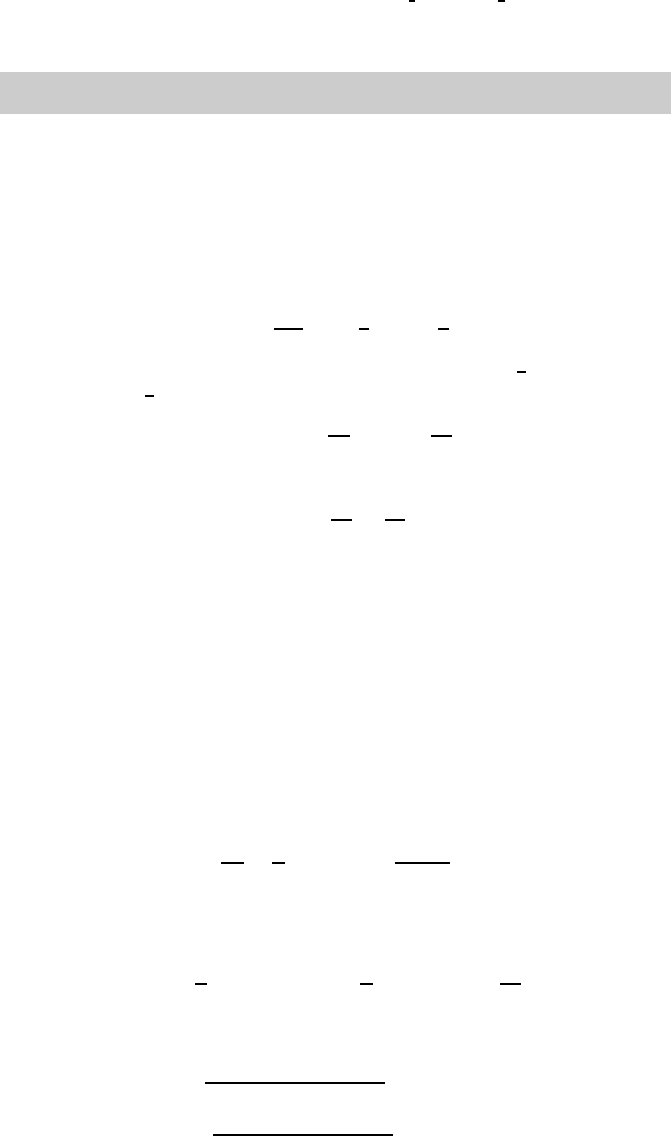
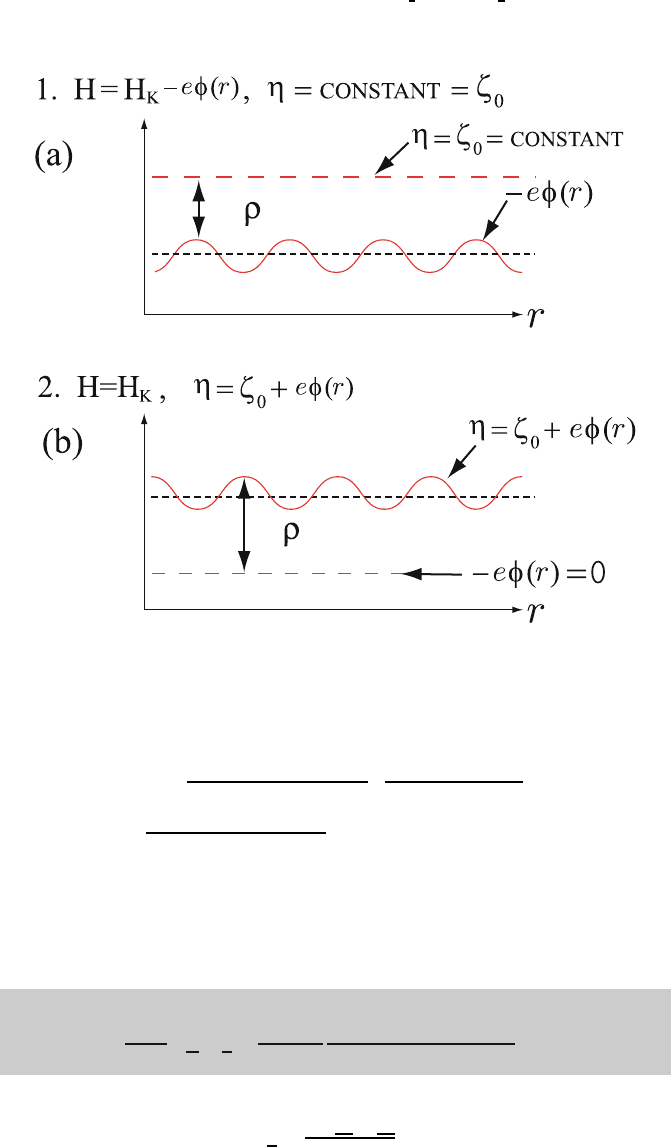
(see Fig. 11.11a) 647
2. H = H
Kinetic
, η = ζ
0
+ eφ (see Fig. 11.11b) 648
Neither H nor η is gauge invariant, but their difference H −η is.Thisisthe 649
quantity that appears in ˜ρ
0
.Ifweletη(r,t)=ζ
0
+ ζ
1
(r,t)whereζ
0
is the 650
actual overall equilibrium chemical potential and ζ
1
(r,t) is the local deviation 651
of η from ζ
0
,thenwecanwrite 652
˜ρ
0
(H, η)=ρ
0
(H
0
,ζ
0
)+ρ
2
. (11.208)
The equation of motion of the density matrix is
653
∂ρ
∂t
+
i
¯h
[H, ρ]
−
= −
ρ − ˜ρ
0
τ
(11.209)
where ˜ρ
0
= ρ
0
(H
0
,ζ
0
)+ρ
2
.Wecanwriteρ =˜ρ
0
+ρ
1
,whereρ
1
is the deviation 654
from the local thermal equilibrium value ˜ρ
0
. Then (11.209) becomes 655
iω(ρ
1
+ ρ
2
)+
i
¯h
[H
0
,ρ
1
+ ρ
2
]
−
+
i
¯h
[H
1
,ρ
0
]
−
= −
ρ
1
τ
. (11.210)
Take matrix elements as before and solve for k|ρ
1
|k
;thisgives 656
k|ρ
1
|k
=
i¯h/τ
ε
k
− ε
k
− ¯hω +i¯h/τ
− 1
k|ρ
2
|k
+
f
0
(ε
k
) − f
0
(ε
k
)
ε
k
− ε
k
− ¯hω +i¯h/τ
k|H
1
|k
.
(11.211)
Uncorrected Proof
BookID 160928 ChapID 11 Proof# 1 - 29/07/09
348 11 Many Body Interactions – Introduction
ygrenE
ygrenE
2/3
()r∝
2/3
()r∝
Fig. 11.11. Local chemical potential η and local density matrix ρ(r). (a) η =
constant(= ζ
0
), (b) η(r)=ζ
0
+ eφ(r)
Using the result of Problem in this chapter for k|ρ
2
|k
in this equation gives 657
k|ρ
1
|k
=
−1+
i¯h/τ
ε
k
− ε
k
− ¯hω +i¯h/τ
f
0
(ε
k
) − f
0
(ε
k
)
ε
k
− ε
k
k|H
1
− ζ
1
|k
+
f
0
(ε
k
) − f
0
(ε
k
)
ε
k
− ε
k
− ¯hω +i¯h/τ
k|H
1
|k
.
(11.212)
The parameter ζ
1
appearing in (11.212) is determined by requiring that 658
Tr {ρ
1
δ(r − r
0
)} =0. (11.213)
The final result (after a lot of calculation) is
659
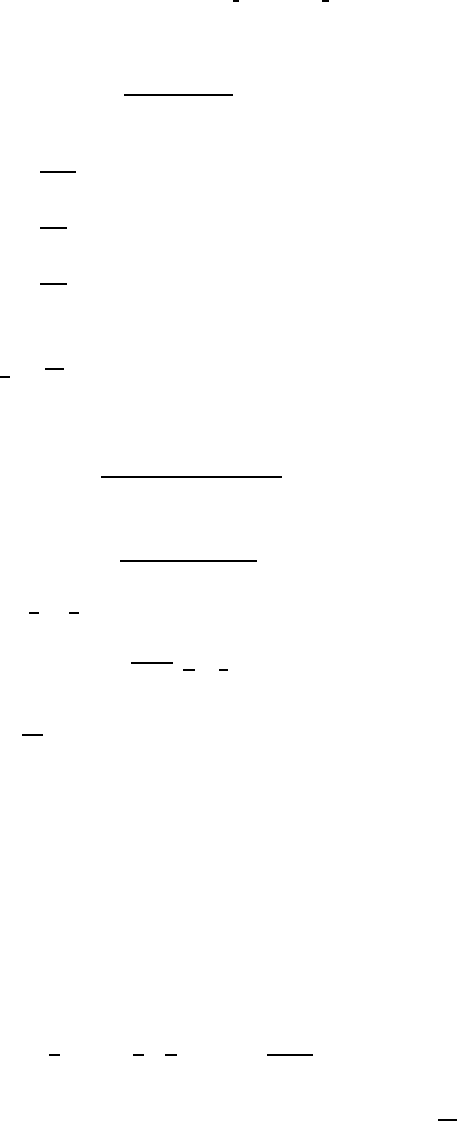
j(q,ω)=
ω
2
p
4πiω
#
1
+ I −
iωτ
1+iωτ
(K
1
− K
2
)(K
1
− K
2
)
L
1
+iωτL
2
$
·E, (11.214)
660
whereweusedthenotations 661
I =
iωτI
1
+ I
2
1+iωτ
, (11.215)
Uncorrected Proof
BookID 160928 ChapID 11 Proof# 1 - 29/07/09
11.8 Screening 349
K =
iωτK
1
+ K
2
1+iωτ
, (11.216)
662
L
i
=
mc
2
N
kk
Λ
(i)
k
k
|k
|e
iq·r
|k|
2
, (11.217)
K
i
=
mc
N
kk
Λ
(i)
k
k
k
|V
q
|kk
|e
iq·r
|k
∗
, (11.218)
K
i
=
mc
N
kk
Λ
(i)
k
k
k
|e
iq·r
|kk
|V
q
|k
∗
, (11.219)
and
663
I
i
=
m
N
kk
Λ
(i)
k
k
k
|V
q
|kk
|V
q
|k
∗
. (11.220)
The subscript (or superscript) i takes on the values 1 and 2, and
664
Λ
(1)
k
k
=
f
0
(ε
k
) − f
0
(ε
k
)
ε
k
− ε
k
− ¯hω +i¯h/τ
(11.221)
and
665
Λ
(2)
k
k
=
f
0
(ε
k
) − f
0
(ε
k
)
ε
k
− ε
k
. (11.222)
In the limit as τ →∞, I
→ I
1
and K → K
1
, hence 666
j(q,ω) →
ω
2
p
4πiω
[1
+ I
1
] · E, (11.223)
exactly as we had before. For ωτ finite, there are corrections to this collisionless 667
result that depend on
1
ωτ
. 668
11.8 Screening 669
Our original objective in considering linear response theory was to learn more 670
about screening since we found that the long range of the Coulomb interaction 671
was responsible for the divergence of perturbation theory beyond the first 672
order exchange. Later on, when we mention Green’s functions and the electron 673
self energy, we will discuss some further details on dynamic screening, but for 674
now, let us look at static screening effects. 675
If we set ω → 0 in (11.166), we can write 676
1+I
zz
(z,u)=−
3
2
u
2
1+
1
2
1
z
− z
ln
1+z
1 − z
. (11.224)
Here, z = q/2k
F
and u = ω/qv
F
. Substituting this result into ε
(l)
=1−
ω
2
p
ω
2
(1+ 677
I
zz
)gives 678
Uncorrected Proof
BookID 160928 ChapID 11 Proof# 1 - 29/07/09
350 11 Many Body Interactions – Introduction
ε
(l)
(q, 0) = 1 +
3ω
2
p
q
2
v
2
F
F (z), (11.225)
where
679
F (z)=
1
2
+
1
4
1
z
− z
ln
1+z
1 − z
. (11.226)
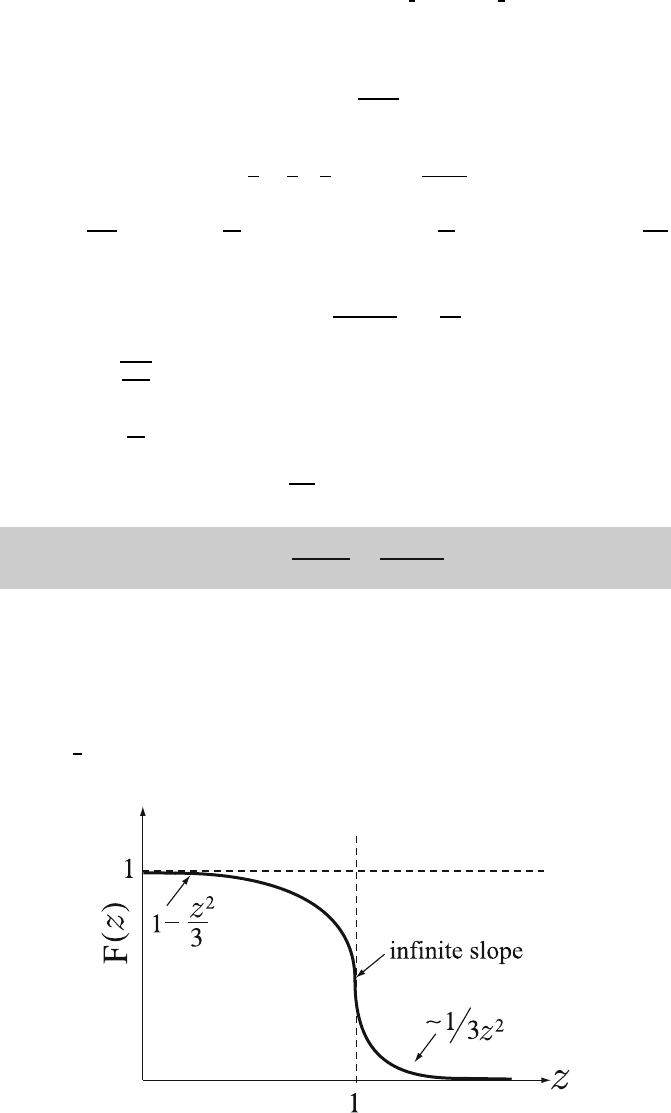
Since ln
1+z
1−z
2z(1 +
z
2
3
+ ···), F (z) −→
z→0
1 −
z
2
3
.Forz 1, F (z)
1
3z
2
680
(see Fig. 11.12). For very long wave lengths, we have 681
ε
(l)
(q)
1 −
1
3πa
0
k
F
+
k
2
s
q
2
, (11.227)
where k
s
=
2
4k
F
πa
0
is called the Thomas–Fermi screening wave number.Athigh 682
density 3πa
0
k
F
1 so the constant term is usually approximated by unity. 683
ε
TF
(q)=1+
k
2
s
q
2
is called the Thomas–Fermi dielectric constant..Onecan 684
certainly see that screening eliminates the divergence in perturbation theory 685
that resulted from the φ
0
(q)=
4πe
q
2
potential. We would write for the self- 686
consistent screened potential by 687
φ(q)=
φ
0
(q)
ε
TF
(q)
=
4πe
q
2
+ k
2
s
. (11.228)
688
This potential does not diverge as q → 0. 689
11.8.1 Friedel Oscillations 690
If F (z) were identically equal to unity, then a point charge would give rise 691
to the screened potential given by (11.228), which is the Yukawa potential 692
φ(r)=
e
r
e
−k
s
r
in coordinate space. However, at z =1(orq =2k
F
) F (z) 693
Fig. 11.12. Function F (z) appearing in (11.225)
Uncorrected Proof
BookID 160928 ChapID 11 Proof# 1 - 29/07/09
11.8 Screening 351
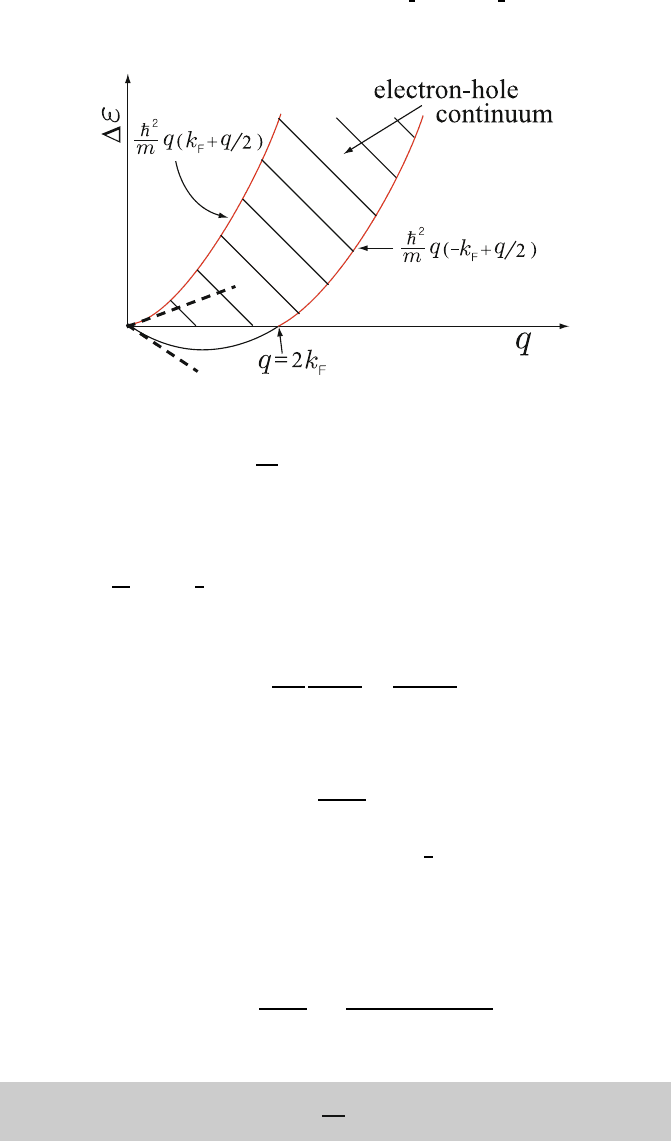
Fig. 11.13. Electron–hole pair excitation energies as a function of wave number q
drops very abruptly. In fact,
dF
dz
has infinite slope at z = 1 (see, for example, 694
Fig. 11.12). The ability of the electron gas to screen disturbances of wave 695
vector q drops abruptly at q =2k
F
. This is the result of the fact that pair 696
excitations of zero energy can be created if q<2k
F
, but every pair excitation 697
must have finite energy if q>2k
F
. This is apparent from a plot of Δε = 698
ε
k+q
− ε
k
=
¯h
2
m
q(k
z
+
q
2
)versusq for k
z
= ±k
F
(see Fig. 11.13). The hatched 699
area is called the electron–hole continuum.IfF (z) were replaced by unity, 700
the self-consistent potential φ(q) would be written as 701
φ(q)=
4πe
q
2
1
ε
(l)
(q)
4πe
q
2
+ k
2
s
.
The Fourier transform φ(r)isgivenby
702
φ(r)=
d
3
q
(2π)
3
e
iq·r
φ(q) (11.229)
and one can show that this is equal to φ(r)=
e
r
e
−k
s
r
, a Yukawa potential. 703
Because F (z) is not equal to unity, but decreases rapidly around z =1,the 704
potential φ(r) and the induced electron density n
1
(r) are different from the 705
results of the simple Thomas–Fermi model. In the equation for φ(r)wemust 706
replace k
2
s
by k
2
s
F (z)sothat 707
φ(r)=
d
3
q
(2π)
3
e
iq·r
4πe
q
2
+ k
2
s
F (q/2k
F
)
. (11.230)
The induced electron density is given by
708
n
1
(q)=
k
2
s
4π
F (z)φ(q). (11.231)
709

Uncorrected Proof
BookID 160928 ChapID 11 Proof# 1 - 29/07/09
352 11 Many Body Interactions – Introduction
This can be obtained from
∂ρ
∂t
+ ∇·j =0,wherej = σ ·E =(ε
(l)
−1)
iω
4π
(+iqφ) 710
and ε
(l)
=1+
k
2
s
q
2
F (z). After a little algebra one can show that the Fourier 711
transform of n
1
(q)isgivenby 712
n
1
(r)=
12n
0
πa
0
k
F
∞
0
sin 2k
F
rz
2k
F
rz
F (z)
1+F (z)/(πa
0
k
F
z
2
)
dz. (11.232)
Thiscanbewritteninasimplerformusing
713
F (z)
1+F (z)/(πa
0
k
F
z
2
)
= F (z) −
F
2
(z)
πa
0
k
F
z
2
+ F (z)
. (11.233)
Then, n
1
(r) becomes 714
n
1
(r)=
12n
0
πa
0
k
F
∞
0
sin 2k
F
rz
2k
F
rz
F (z)dz −
∞
0
sin 2k
F
rz
2k
F
rz
F
2
(z)
πa
0
k
F
z
2
+ F (z)
dz
.
(11.234)
In the high density limit πa
0
k
F
1. Therefore in the region where F (z) 715
deviates appreciably from unity, i.e. for z ≥ 1, πa
0
k
F
z
2
F (z), and we make 716
a small error by replacing F (z) in the second term of (11.234) by unity. This 717
high-density approximation gives 718
n
1
(r)=
12n
0
πa
0
k
F
∞
0
sin 2k
F
rz
2k
F
rz
F (z)dz −
∞
0
sin 2k
F
rz
2k
F
rz
dz
πa
0
k
F
z
2
+1
.
(11.235)
The first integral can be evaluated exactly in terms of known functions
719
∞
0
sin 2k
F
rz
2k
F
rz
F (z)dz
=
π
2
#
1
2k
F
r
−
1
4k
F
r
sin 2k
F
r
2k
F
r
+cos2k
F
r
+
1
2
π
2
− Si(2k
F
r)
$
≡
π
2
f(2k
F
r),
(11.236)
where Si(x)=
"
x
0
sin t
t
dt is the sine integral function. For very large values of 720
x, the function f (x) in (11.236) behaves 721
f(x)
1
x
+
cos x
x
3
+ O
higher orders of
1
x
. (11.237)
The second integral in (11.235) becomes
722
∞
0
sin 2k
F
rz
2k
F
rz
dz
πa
0
k
F
z
2
+1
=
π
4k
F
r
1 − e
−
r
√
πa
0
k
F
. (11.238)
Therefore, for high density limit (πa
0
k
F
1) and large distances from the 723
point charge impurity, the induced electron density is given by 724
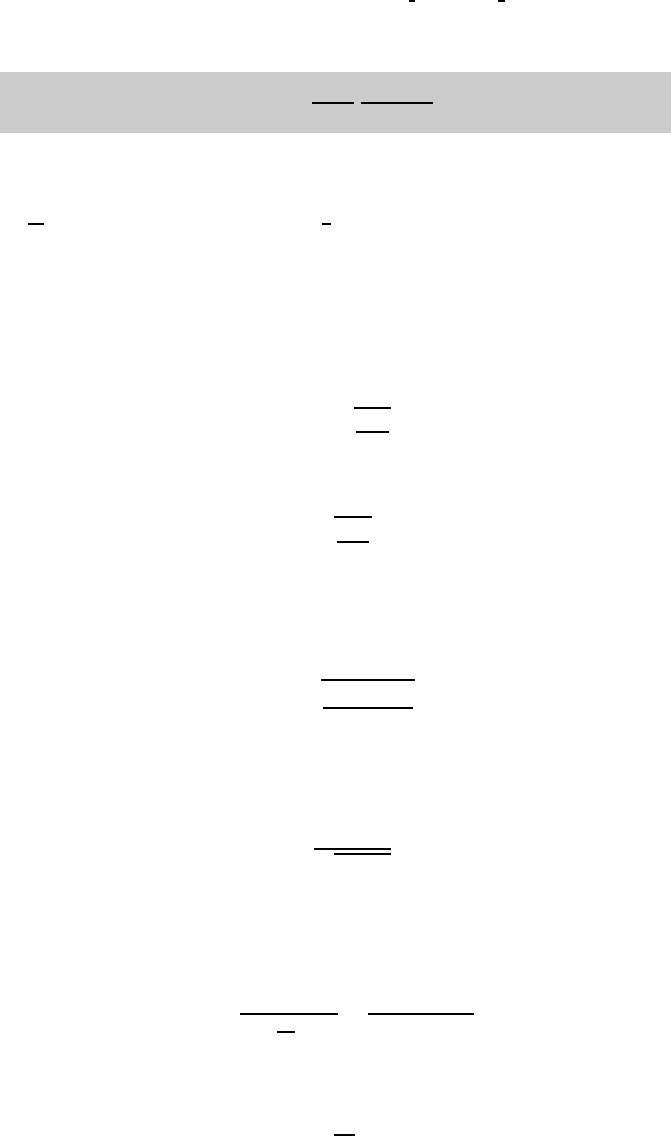
Uncorrected Proof
BookID 160928 ChapID 11 Proof# 1 - 29/07/09
11.8 Screening 353
n
1
(r)=
6n
0
a
0
k
F
cos 2k
F
r
(2k
F
r)
3
. (11.239)
725
The oscillating behavior of the induced electron density at a wave vector 726
q =2k
F
is known as a Friedel oscillation. Notice that the electron density 727
induced by the presence of the point charge impurity falls off in amplitude 728
as
1
r
3
. For a Yukawa potential (φ =
e
r
e
−k
s
r
), the fall in the induced electron 729
density is exponential. 730
11.8.2 Kohn Effect 731
When we discussed the Sommerfeld model we found a result for s
l
the velocity 732
of a longitudinal sound wave that could be written 733
ω
2
= s
2
l
q
2
8
zm
3M
v
F
2
q
2
. (11.240)
In other words the longitudinal sound velocity was given by
734
s
l
=
8
zm
3M
v
F
, (11.241)
where z is the valence (charge on the positive ions), M is the ionic mass, and
735
v
F
the Fermi velocity. 736
This result can easily be obtained by saying that the positive ions have a 737
bare plasma frequency 738
Ω
p
=
8
4πN
I
(ze)
2
M
, (11.242)
where N
I
is the number of ions per unit volume. However, the electrons will 739
screen the charge fluctuations in the ion density, so that the actual frequency 740
of a longitudinal sound wave of wave vector q will be 741
ω =
Ω
p
ε(q, ω)
, (11.243)
where ε(q, ω) is the dielectric function of the electron gas. Because the acoustic
742
frequency is much smaller than the electron plasma frequency and ω s
l
q 743
qv
F
, we can approximate ε(q, ω)byε(q, 0) in the first approximation 744
ω
2
=
Ω
2
p
1+
k
2
s
q
2
F (z)
q
2
Ω
2
p
q
2
+ k
2
s
F (z)
. (11.244)
Let us assume k
2
s
q
2
.IfwetakeF (z) 1, we obtain 745
ω
2
q
2
k
2
s
Ω
2
p
. (11.245)