
Quinn J.J., Yi K.-S. Solid State Physics: Principles and Modern Applications
Подождите немного. Документ загружается.

Uncorrected Proof
BookID 160928 ChapID 13 Proof# 1 - 29/07/09
13.1 Bloch Electrons in a dc Magnetic Field 395
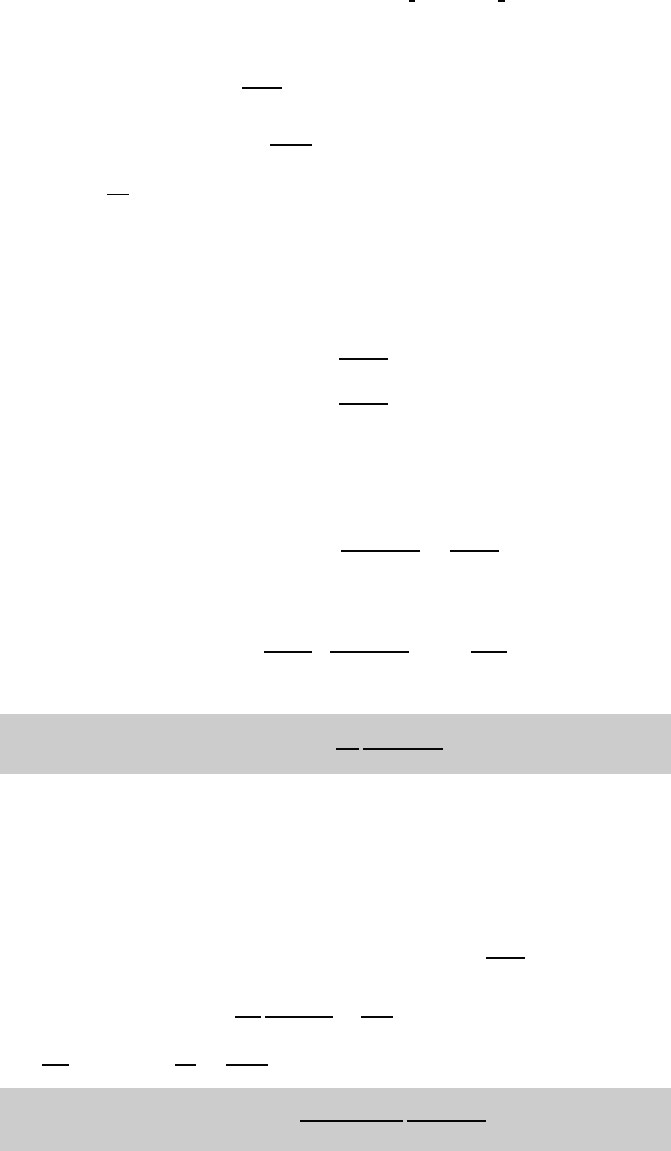
Setting this result equal to
2πeB
¯hc
(n + γ) and solving for energy ε gives 67
ε =
¯h
2
k
2
z
2m
+¯hω
c
(n + γ), (13.15)
where ω
c
=
eB
mc
is the cyclotron frequency. 68
13.1.3 Cyclotron Effective Mass 69
In the absorption of radiation direct transitions between energy levels (Landau 70
levels) occur. If we make a transition from ε
n
(k
z
)toε
n+1
(k
z
), we can write 71
S(ε
n
(k
z
),k
z
)=
2πeB
¯hc
(n + γ),
S(ε
n+1
(k
z
),k
z
)=
2πeB
¯hc
(n +1+γ).
(13.16)
We define the energy difference ε
n+1
(k
z
) − ε
n
(k
z
)as¯hω
c
,whereω
c
(ε, k
z
)is 72
the cyclotron frequency associated with the orbit {ε, k
z
}. By subtracting the 73
first equation of (13.16) from the second we can obtain 74
[ε
n+1
(k
z
) − ε
n
(k
z
)]
∂S(ε, k
z
)
∂ε
=
2πeB
¯hc
and from this, we obtain
75
ω
c
(ε, k
z
)=
2πeB
¯h
2
c
∂S(ε, k
z
)
∂ε
−1
=
eB
m
∗
c
(13.17)
or
76
m
∗
(ε, k
z
)=
¯h
2
2π
∂S(ε, k
z
)
∂ε
. (13.18)
77
13.1.4 Velocity Parallel to B 78
Consider two orbits that have different values of k
z
separated by Δk
z
. Then, 79
for the same ε
n
we have 80
S [ε
n
(k
z
+Δk
z
),k
z
+Δk
z
] − S [ε
n
(k
z
),k
z
] = 0 (13.19)
because both orbits have cross-sectional area equal to
2πeB
¯hc
(n + γ). We can 81
write (13.19) as 82
∂S
∂ε
∂ε
n
(k
z
)
∂k
z
+
∂S
∂k
z
=0. (13.20)
But
∂ε
∂k
z
=¯hv
z
and
∂S
∂ε
=
2πm
∗
¯h
2
giving 83
v
z
(ε, k
z
)=−
¯h
2πm
∗
(ε, k
z
)
∂S(ε, k
z
)
∂k
z
. (13.21)
84
Uncorrected Proof
BookID 160928 ChapID 13 Proof# 1 - 29/07/09
396 13 Semiclassical Theory of Electrons
Example For the free electron gas model, we have S = π
2m
∗
ε
¯h
2
− k
2
z
.
85
Therefore,
∂S
∂k
z
= −2πk
z
and, hence, 86
v
z
(ε, k
z
)=−
¯h
2πm
∗
(−2πk
z
)=
¯hk
z
m
∗
.
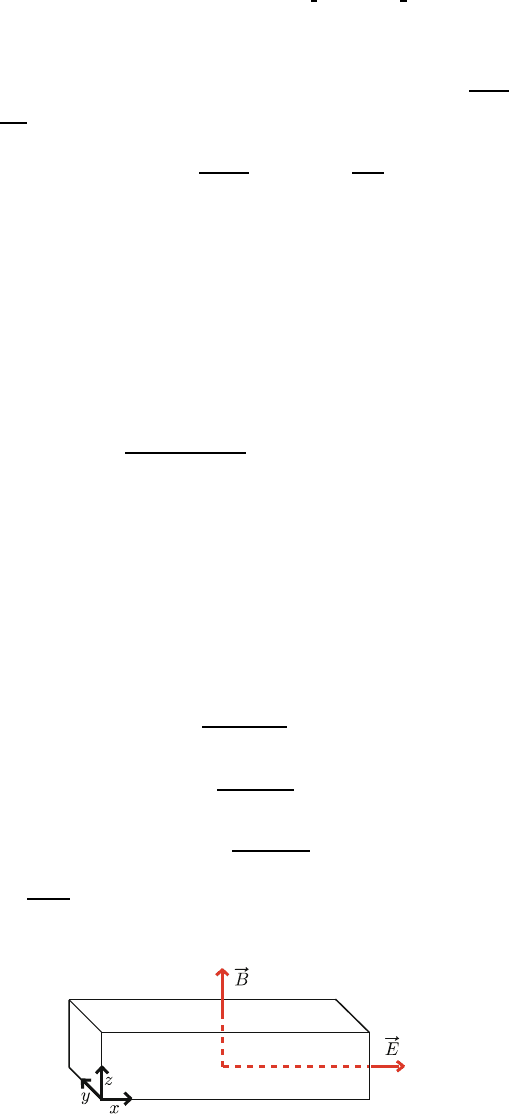
13.2 Magnetoresistance 87
The study of the change in resistivity of a metal as a function of the strength 88
of an applied magnetic field is very useful in understanding certain properties 89
of the Fermi surface of a metal or semiconductor. The standard geome- 90
try for magnetoresistance measurements is shown in Fig. 13.5. Current flows 91
only in the x direction. Usually B is in the z direction and the transverse 92
magnetoresistance is defined as 93
R(B
z
) − R(0)
R(0)
=ΔR(B
z
). (13.22)
Sometimes people also study the case where B is parallel to E and measure
94
the longitudinal magnetoresistance. 95
It might seem surprising that anything of interest arises from studying 96
the magnetoresistance, because, as we described, for the simple free electron 97
model ΔR(B
z
) = 0. This resulted from the equation 98
j
x
= σ
xx
E
x
+ σ
xy
E
y
j
y
= −σ
xy
E
x
+ σ
xx
E
y
=0.
(13.23)
Combining these gives
99
j
x
=
σ
2
xx
+ σ
2
xy
σ
xx
E
x
. (13.24)
But for free electrons
100
σ
xx
=
σ
0
1+ω
2
c
τ
2
,
σ
xy
= −
ω
c
τσ
0
1+ω
2
c
τ
2
,
(13.25)
where σ
0
=
n
0
e
2
τ
m
is the dc conductivity. Using (13.25) in (13.24) gives 101
j
x
= σ
0
E
x
, independent of B so that the magnetoresistance vanishes. 102
Fig. 13.5. Standard geometry for magnetoresistance measurements

Uncorrected Proof
BookID 160928 ChapID 13 Proof# 1 - 29/07/09
13.3 Two-Band Model and Magnetoresistance 397
Experimental Results 103
Before discussing other models than the simple one band free electron model, 104
let us discuss briefly the experimental results. The following types of behaviors 105
are common: 106
1. The magnetoresistance is nonzero, but it saturates at very high magnetic 107
fields at a value that is several times larger than the zero field resistance. 108
2. The magnetoresistance does not saturate, but continues to increase with 109
increasing B in all directions. 110
3. The magnetoresistance saturates in some crystal directions but does not 111
saturate in other directions. 112
Simple metals like Na, Li, In, and Al belong to the type (1). Semimetals like 113
Bi and Sb belong to type (2). The noble metals (Cu, Ag, and Au), Mn, Zn, 114
Cd, Ga, Sn, and Pb belong to type (3). One can obtain some understanding 115
of magnetoresistance by using a two-band model. 116
13.3 Two-Band Model and Magnetoresistance 117
Let us consider two simple parabolic bands with mass, cyclotron frequency, 118
charge, concentration, and collision time given by m
i
, ω
ci
, e
i
, n
i
,andτ
i
, 119
respectively, where i = 1 or 2. Each band has a conductivity σ
i
, and the total 120
current is simply the sum of j
1
and j
2
121
j
T
=(σ
1
+ σ
2
) ·E. (13.26)
122
But 123
σ
i
=
n
i
e
2
i
τ
i
/m
i
1+ω
2
ci
τ
2
i
⎛
⎝
1 ω
ci
τ
i
0
−ω
ci
τ
i
10
001+ω
2
ci
τ
2
i
⎞
⎠
. (13.27)
124
Note that we are taking ω
ci
=
e
i
B
m
i
c
which is negative for an electron; this is 125
why the σ
xy
has a plus sign. At very high magnetic fields |ω
ci
τ
i
|1forboth 126
types of carriers. Therefore, we can drop the 1 in 1 + ω
2
ci
τ
2
i
: 127
σ
i
n
i
e
i
c
B
⎛
⎜
⎜
⎜
⎝
1
ω
ci
τ
i
10
−1
1
ω
ci
τ
i
0
00ω
ci
τ
i
⎞
⎟
⎟
⎟
⎠
, (13.28)
and
128
σ
T
c
B
⎛
⎜
⎜
⎝
n
1
e
1
ω
c1
τ
1
+
n
2
e
2
ω
c2
τ
2
n
1
e
1
+ n
2
e
2
0
−(n
1
e
1
+ n
2
e
2
)
n
1
e
1
ω
c1
τ
1
+
n
2
e
2
ω
c2
τ
2
0
00n
1
e
1
ω
c1
τ
1
+ n
2
e
2
ω
c2
τ
2
⎞
⎟
⎟
⎠
, (13.29)
Uncorrected Proof
BookID 160928 ChapID 13 Proof# 1 - 29/07/09
398 13 Semiclassical Theory of Electrons
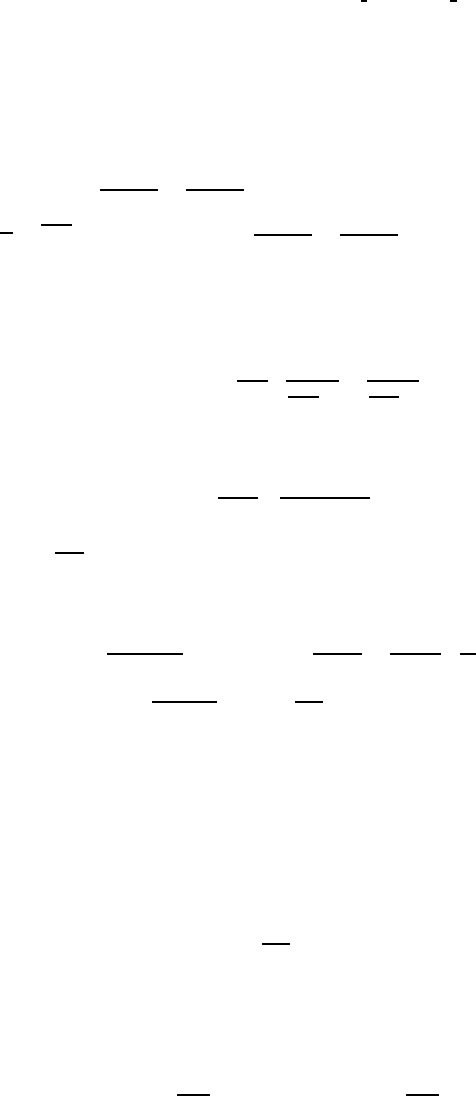
Now, suppose that n
1
= n
2
= n and e
1
= −e
2
= e. This corresponds to 129
a semimetal with an equal number of electrons and holes. Then, (13.29) 130
reduces to 131
σ
nec
B
⎛
⎜
⎜
⎜
⎝
1
|ω
c1
τ
1
|
+
1
|ω
c2
τ
2
|
00
0
1
|ω
c1
τ
1
|
+
1
|ω
c2
τ
2
|
0
00|ω
c1
τ
1
|+ |ω
c2
τ
2
|
⎞
⎟
⎟
⎟
⎠
,
The Hall field vanishes since σ
xy
=0and 132
j
x
= σ
xx
E
x
=
nec
B
1
eB
m
1
c
τ
1
+
1
eB
m
2
c
τ
2
E
x
. (13.30)
The resistivity is the ratio of E
x
to j
x
giving 133
ρ =
B
2
nec
2
|μ
1
||μ
2
|
|μ
1
| + |μ
2
|
, (13.31)
where μ
i
=
e
i
τ
i
m
i
is the mobility of the ith type. Thus, we find for equal numbers 134
of electrons and holes the magnetoresistance does not saturate, but continues 135
to increase as B
2
. The arguments can be generalized to two bands described 136
by energy surfaces ε
i
(k), but we will not bother with that much detail. If 137
n
e
= n
h
, σ
xy
−
(n
e
−n
h
)ec
B
while σ
xx
=
n
e
|ω
ce
|τ
e
+
n
h
|ω
ch
|τ
h
ec
B
.For|ω
ci
τ
i
|1, 138
σ
xy
σ
xx
and ρ =
σ
2
xx
+σ
2
xy
σ
xx
−1
σ
2
xy
σ
xx
−1
. This saturates to a constant 139
because σ
xy
∝ B
−1
while σ
xx
∝ B
−2
. 140
Influence of Open Orbits 141
For the sake of concreteness we will first consider a model which is extremely 142
simple and has open orbits to see what happens. Suppose there is a section 143
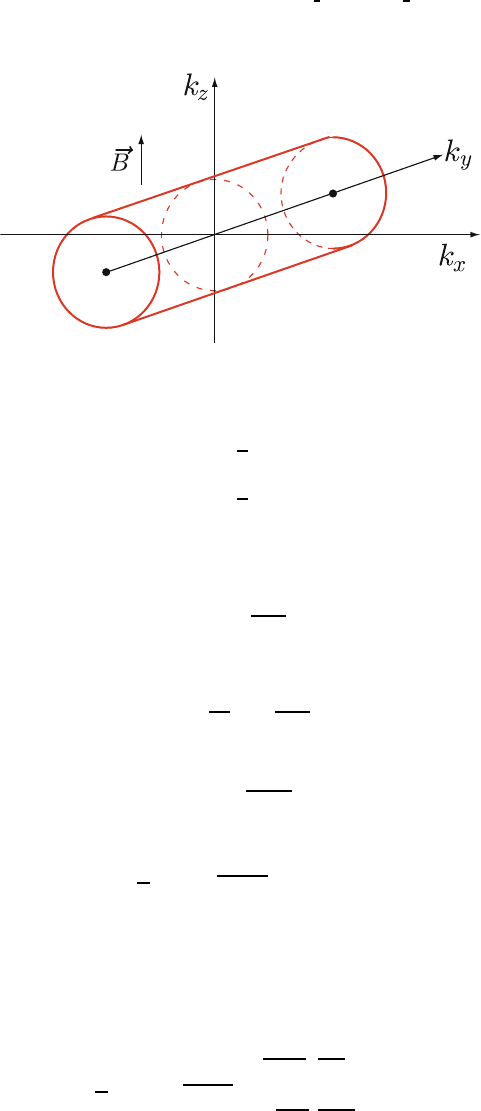
of the Fermi surface with energy given by 144
ε(k)=
¯h
2
2m
(k
2
x
+ k
2
z
), (13.32)
i.e. ε(k) is independent of k
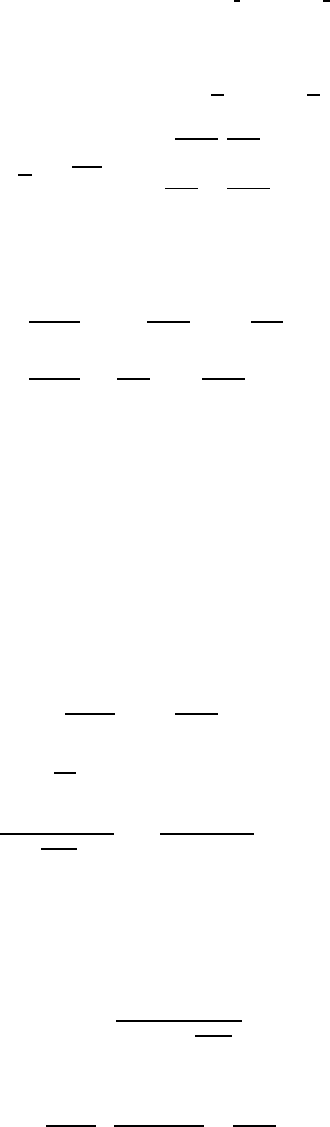
y
as is shown in Fig. 13.6. Again take the magnetic 145
field in the z-direction. Then the orbits are all open orbits, and run parallel 146
to the cylinder axis. Note that 147
v
x
=
¯hk
x
m
,v
y
=0, and v
z
=
¯hk
z
m
. (13.33)
Uncorrected Proof
BookID 160928 ChapID 13 Proof# 1 - 29/07/09
13.3 Two-Band Model and Magnetoresistance 399
Fig. 13.6. A model energy surface with open orbits
Look at equations of motion in the presence of B
z
and E =(E
x
,E
y
, 0): 148
¯h
˙
k
x
= −e(E
x
+
1
c
v
y
B
z
)=−eE
x
,
¯h
˙
k
y
= −e(E
y
−
1
c
v
x
B
z
), (13.34)
¯h
˙
k
z
=0.
The equation of motion for ¯h
˙
k
x
can be written as 149
˙v
x
= −
eE
x
m
. (13.35)
We have completely neglected collisions so far; they can be added by simply
150
writing 151
˙v
x
+
v
x
τ
= −
eE
x
m
. (13.36)
Then in the steady-state we have
152
v
x
= −
eE
x
τ
m
. (13.37)
If n
o
is the number of open orbit states per unit volume, then 153
σ
Open
=
n
o
e
2
τ
m
10
00
. (13.38)
Here, we have used σ
yy
= σ
xy
= σ
yx
= 0; this is correct because j
x
depends 154
only on E
x
and v
y
must be zero since the mass in the y direction is infinite. 155
Now, suppose there is another piece of Fermi surface that contains n
c
156
electrons per unit volume all in closed orbit states. We can approximate the 157
contribution of these electrons to the conductivity by 158
σ
Closed
=
n
c
e
2
τ
m
⎛
⎜
⎜
⎝
1
ω
2
c
τ
2
1
ω
c
τ
−
1
ω
c
τ
1
ω
2
c
τ
2
⎞
⎟
⎟
⎠
. (13.39)
Uncorrected Proof
BookID 160928 ChapID 13 Proof# 1 - 29/07/09
400 13 Semiclassical Theory of Electrons
The total conductivity is simply the sum of σ
Open
and σ
Closed
: 159
σ
T
=
e
2
τ
m
⎛
⎜
⎝
n
o
+
n
c
ω
2
c
τ
2
n
c
ω
c
τ
−
n
c
ω
c
τ
n
c
ω
2
c
τ
2
⎞
⎟
⎠
. (13.40)
Let n
o
, the concentration of open orbit electrons, be equal to a number S 160
times n
c
, the concentration of closed orbit electrons. Then 161
j
x
=
n
c
e
2
τ
m
#
(S +
1
ω
2
c
τ
2
)E
x
+
1
ω
c
τ
E
y
$
,
j
y
=
n
c
e
2
τ
m
#
−
1
ω
c
τ
E
x
+
1
ω
2
c
τ
2
E
y
$
. (13.41)
We can investigate two different cases:
162
1. In the standard geometry j
x
is nonzero but j
y
is zero. 163
2. In the standard geometry j
y
is nonzero but j
x
is zero. 164
Case 1: 165
j
y
= 0 implies that 166
E
y
= ω
c
τE
x
. (13.42)
Therefore, j
x
is given by 167
j
x
=
n
c
e
2
τ
m
S +
1
ω
2
c
τ
2
+1
E
x
. (13.43)
The magnetoresistivity is
E
x
j
x
giving 168
ρ =
m/(n
c
e
2
τ)
S +
1
ω
2
c
τ
2
+1
−→
m/(n
c
e
2
τ)
S +1
as B →∞. (13.44)
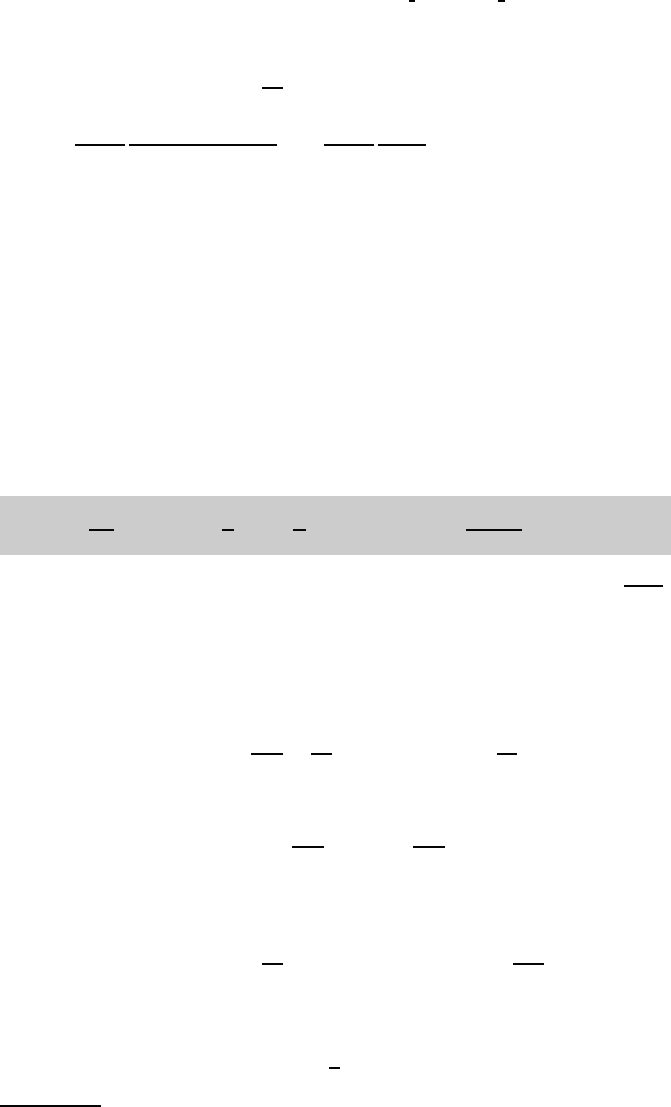
Thus, in this geometry the magnetoresistance saturates as B tends to infinity.
169
Case 2: 170
j
x
= 0 implies that 171
E
x
= −
1
ω
c
τ(S +
1
ω
2
c
τ
2
)
E
y
. (13.45)
This means that
172
j
y
=
n
c
e
2
τ
m
1
ω
2
c
τ
2
S +1
+
1
ω
2
c
τ
2
E
y
. (13.46)
Uncorrected Proof
BookID 160928 ChapID 13 Proof# 1 - 29/07/09
13.4 Magnetoconductivity of Metals 401
But the magnetoresistivity is
E
y
j
y
and it is given by 173
ρ =
m
n
c
e
2
τ
ω
2
c
τ
2
(ω
2
c
τ
2
S +1)
ω
2
c
τ
2
(S +1)+1
−→
m
n
c
e
2
τ
S
S +1
ω
2
c
τ
2
as B →∞. (13.47)
Since ρ is proportional to ω
2
c
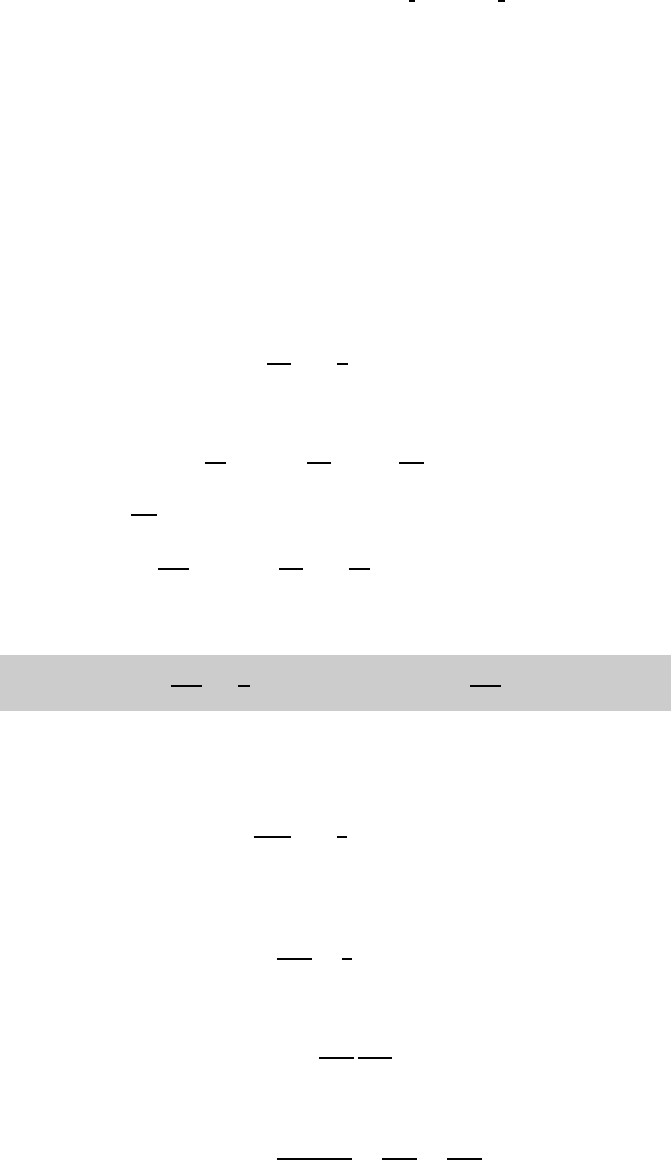
, the magnetoresistance does not saturate but 174
increases as B
2
as long as S is finite. 175
13.4 Magnetoconductivity of Metals 176
We consider an electron gas for which the energy is an arbitrary function of 177
k. We introduce a uniform dc magnetic field B
0
, and an ac electric field E of 178
the form 179
E ∝ e
iωt−iq·r
. (13.48)
The Boltzmann equation is
180
∂f
∂t
+ v ·∇f −
e
¯h
E +
v
c
× B
0
·∇
k
f = −
f −
¯
f
0
τ
. (13.49)
181
As we shall see later, some care must be taken in the collision term −
f−
¯
f
0
τ
, 182
to choose
¯
f
0
to be the proper local equilibrium distribution toward which the 183
electrons relax.
1
For now, we shall just put
¯
f
0
= f
0
, the actual thermal equi- 184
librium function for the system. This gives the conduction current correctly, 185
but omits a diffusion current which is actually present. We put f = f
0
+ f
1
186
and then the Boltzmann equation becomes 187
iωf
1
− iq · vf
1
− eE · v
∂f
0
∂ε
−
e
¯hc
(v × B
0
) ·∇
k
f
1
+
f
1
τ
=0. (13.50)
Here, we have used the fact that
188
∇
k
f
0
=
∂f
0
∂ε
∇
k
ε =¯hv
∂f
0
∂ε
, (13.51)
and have linearized with respect to the ac field. We can write the Boltzmann
189
equation as 190
(1 + iωτ − iq · vτ )f
1
−
eτ
¯hc
(v × B
0
) ·∇
k
f
1
= eτE · v
∂f
0
∂ε
. (13.52)
From the equation of motion, we remember, when the ac fields are E =0=B,
191
that 192
¯h
˙
k = −
e
c
v × B
0
, (13.53)
1
See, for eample, M.P. Greene, H.J. Lee, J.J. Quinn, S. Rodriguez, Phys. Rev. 177,
1019 (1969).
Uncorrected Proof
BookID 160928 ChapID 13 Proof# 1 - 29/07/09
402 13 Semiclassical Theory of Electrons
and we were able to show that 193
1. The orbit of an electron in k space is along the intersection of a surface of 194
constant energy and a plane of constant k
z
. 195
2. The motion in k space is periodic either because the orbit is closed, or 196
because an open orbit is actually periodic in k space also. 197
We introduce a parameter s with the dimension of time which describes the 198
position of an electron on its orbit of constant energy and constant k
z
.By 199
this, we mean that if s = 0 is a point on the orbit, s = T corresponds to the 200
same point, where T is the period. The equation of motion can be written 201
¯h
dk
ds
= −
e
c
v × B
0
, (13.54)
and the rate of change of ε is
202
dε
ds
= ∇
k
ε ·
dk
ds
=¯hv ·
dk
ds
=0.
Now, consider
∂f
1
∂s
as 203
∂f
1
∂s
= ∇
k
f
1
·
dk
ds
= −
e
¯hc
(v × B
0
) ·∇
k
f
1
. (13.55)
This is exactly one of the terms in our Boltzmann equation which can be
204
written 205
∂f
1
∂s
+(
1
τ
+iω − iq · v)f
1
= eE · v
∂f
0
∂ε
. (13.56)
206
Closed Orbits: 207
Let us consider closed orbits first. We can write 208
¯h
dk
⊥
ds
= −
e
c
v
⊥
× B
0
, (13.57)
where v
⊥
is the component of v perpendicular to B
0
.Letk
N
and k
T
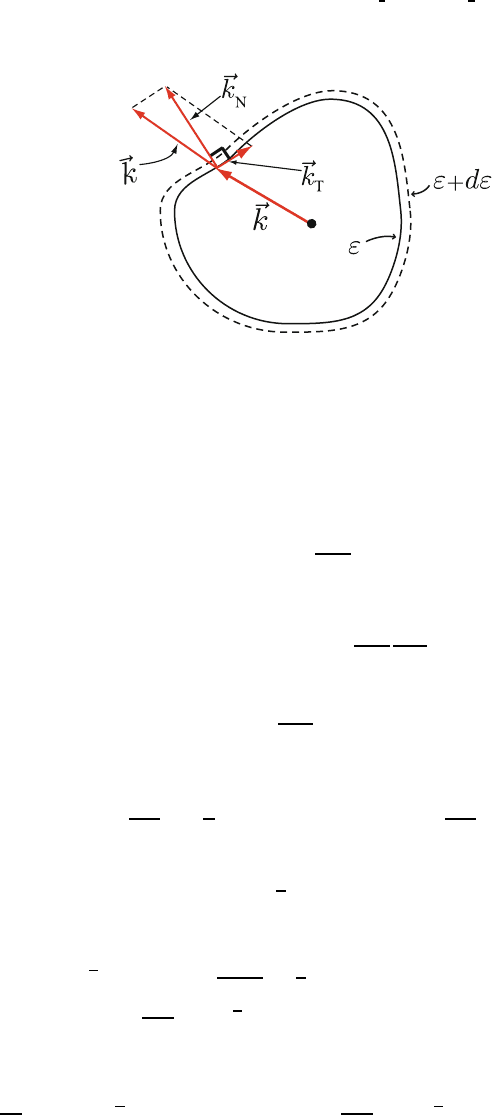
be the 209
normal and tangential components of k
⊥
as shown in Fig. 13.7. Then 210
¯h
dk
T
ds
=
e
c
v
⊥
B
0
, (13.58)
because v
⊥
is in the direction of k
N
.Solvingfords gives 211
ds =
¯hc
eB
0
dk
T
v
⊥
. (13.59)
Thus, the period is given by
212
T (ε, k
z
)=
2π
ω
c
(ε, k
z
)
=
¯hc
eB
0
3
dk
T
v
⊥
. (13.60)
Uncorrected Proof
BookID 160928 ChapID 13 Proof# 1 - 29/07/09
13.4 Magnetoconductivity of Metals 403
^
^
Fig. 13.7. A closed orbit in k space
From now on, we shall use the independent variables ε, k
z
,ands to describe 213
thelocationofanelectronink space. 214
dε = ∇
k
ε · dk
N
=¯hv
⊥
dk
N
, (13.61)
and hence
215
dk
N
=
dε
¯hv
⊥
. (13.62)
Now, the volume element in k space is given by
216
d
3
k =dk
z
dk
N
dk
T
=dk
z
dε
¯hv
⊥
ev
⊥
¯hc
B
0
ds,
hence
217
d
3
k =
eB
0
¯h
2
c
dk
z
dεds. (13.63)
Now, let us return to the differential equation given by (13.56)
218
∂f
1
∂s
+
1
τ
+iω − iq · v
f
1
= eE · v
∂f
0
∂ε
. (13.64)
Multiply by
219
e
"
s
0
dt
[
1
τ
+iω−iq·v(t
)
]
. (13.65)
Then, we have
220
e
"
s
0
dt
[
1
τ
+iω−iq·v(t
)
]
∂f
1
(s)
∂s
+[
1
τ
+iω − iq · v(s)]f
1
(s)
= eE · v(s)
∂f
0
∂ε
e
"
s
0
dt
[
1
τ
+iω−iq·v(t
)
]
.
(13.66)
Notice that the left-hand side can be simplified to write
221
∂
∂s
f
1
e
"
s
0
dt
(
1
τ
+iω−iq·v(t
)
)
= eE · v(s)
∂f
0
∂ε
e
"
s
0
dt
(
1
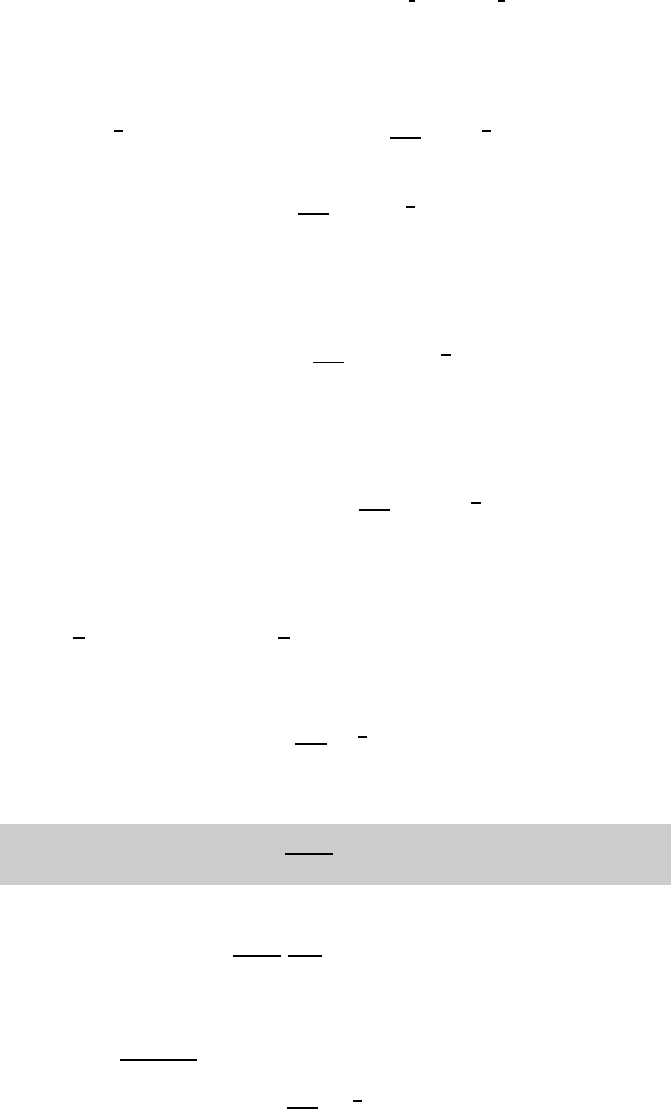
τ
+iω−iq·v(t
)
)
. (13.67)
Uncorrected Proof
BookID 160928 ChapID 13 Proof# 1 - 29/07/09
404 13 Semiclassical Theory of Electrons
Integrate and get 222
f
1
(s)e
"
s
0
dt
(
1
τ
+iω−iq·v(t
)
)
=
s
−∞
dteE ·v(t)
∂f
0
∂ε
e
"
t
0
dt
(
1
τ
+iω−iq·v(t
)
)
, (13.68)
or
223
f
1
(s)=
s
−∞
dteE · v(t)
∂f
0
∂ε
e
−
"
s
t
dt
(
1
τ
+iω−iq·v(t
)
)
. (13.69)
Note that the lower limit t = −∞ is chosen in the integration over t foravery
224
important reason. f
1
(k
z
,ε,s) must be a periodic function of s with period T . 225
Consider the function f
1
(s + T ) for an arbitrary lower limit (LL) 226
f
1
(s + T )=
s+T
LL
dteE · v(t)
∂f
0
∂ε
e
−
"
s+T
t
dt
(
1
τ
+iω−iq·v(t
)
)
. (13.70)
Now, let w = t −T ,sothatt = s + T −→ w = s and t =LL−→ w =LL−T .
227
We know v(t) is a periodic function of t with period T . Likewise, if we let 228
t
= w
+ T , we can get 229
f
1
(s + T )=
s
LL−T
dweE · v(w)
∂f
0
∂ε
e
−
"
s
w
dw
[
1
τ
+iω−iq·v(w
)
]
.
It is obvious f
1
(s + T )=f
1
(s)ifLL−T = LL. This is valid for LL = −∞ as 230
we have chosen. Now, look at the exponential 231
s
t
dt
1
τ
+iω − iq · v(t
)
=
1
τ
+ iω
(s−t)−dq·[R(ε, k
z
,s) − R(ε, k
z
,t)] ,
(13.71)
so that
232
f
1
(ε, k
z
,s)=
s
−∞
ds
eE ·v(s
)
∂f
0
∂ε
e
−(
1
τ
+iω)(s−s
)+iq·
[
R(ε,k
z
,s)−R(ε,k
z
,s
)
]
.
(13.72)
The current density is given by
233
j(r,t)=
2
(2π)
3
(−e)vf
1
d
3
k. (13.73)
234
Or, substituting the result of (13.63) for d
3
k,wehave 235
j(r,t)=−
2e
(2π)
3
eB
0
¯h
2
c
dεdk
z
dsvf
1
(ε, k
z
,s). (13.74)
Now, substitute the solution f
1
(ε, k
z
,s) given by (13.72) to obtain 236
j(r,t)=−
2e
2
B
0
(2π)
3
¯h
2
c
"
∞
0
dε
"
∞
−∞
dk
z
"
T (ε,k
z
)
0
ds v
×
"
s
−∞
ds
eE · v(s
)
∂f
0
∂ε
e
−(
1
τ
+iω)(s−s
)+iq·
[
R(ε,k
z
,s)−R(ε,k
z
,s
)
]
.
(13.75)