
Quinn J.J., Yi K.-S. Solid State Physics: Principles and Modern Applications
Подождите немного. Документ загружается.


Uncorrected Proof
BookID 160928 ChapID 12 Proof# 1 - 29/07/09
364 12 Many Body Interactions: Green’s Function Method
This gives that 62
Ψ
I
(t) − Ψ
I
(t
0
)=−i
t
t
0
dt
H
I
(t
)Ψ
I
(t
). (12.22)
This is an integral equation for Ψ
I
(t) that we can try to solve by iteration. Let 63
us write 64
Ψ
I
(t) ≡ Ψ
(0)
I
(t)+Ψ
(1)
I
(t)+···+ Ψ
(n)
I
(t)+··· . (12.23)
Here
65
Ψ
(0)
I
(t)=Ψ
I
(t
0
),
Ψ
(1)
I
(t)=−i
"
t
t
0
dt
H
I
(t
)Ψ
(0)
I
(t
),
Ψ
(2)
I
(t)=−i
"
t
t
0
dt
H
I
(t
)Ψ
(1)
I
(t
),
.
.
.
Ψ
(n)
I
(t)=−i
"
t
t
0
dt
H
I
(t
)Ψ
(n−1)
I
(t
).
(12.24)
This result can be expressed as
66
Ψ
I
(t)=S(t, t
0
)Ψ
I
(t
0
), (12.25)
67
where S(t, t
0
) is the so-called S matrix is given by 68
S(t, t
0
)=1− i
"
t
t
0
dt
1
H
I
(t
1
)+(−i)
2
"
t
t
0
dt
1
"
t
1
t
0
dt
2
H
I
(t
1
)H
I
(t
2
)+···
=
∞
n=0
(−i)
n
"
t
t
0
dt
1
"
t
1
t
0
dt
2
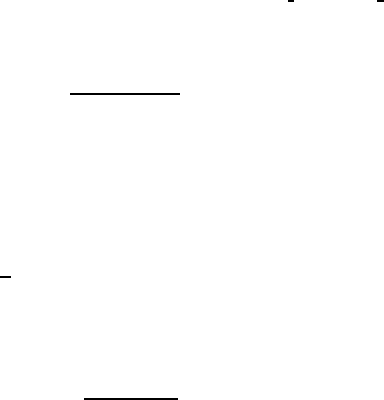
···
"
t
n−1
t
0
dt
n
H
I
(t
1
)H
I
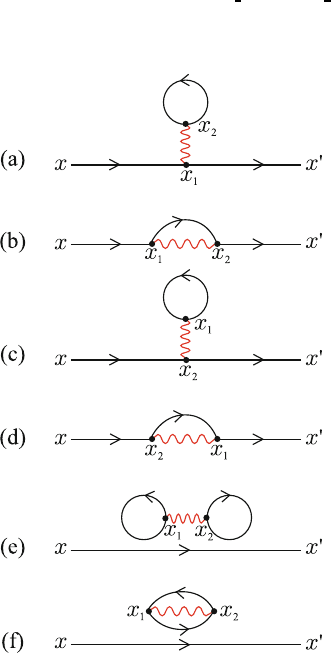
(t
2
) ···H
I
(t
n
)
.
(12.26)
Let us look at the third term involving integration over t
1
and t
2
69
I
2
=
t
t
0
dt
1
t
1
t
0
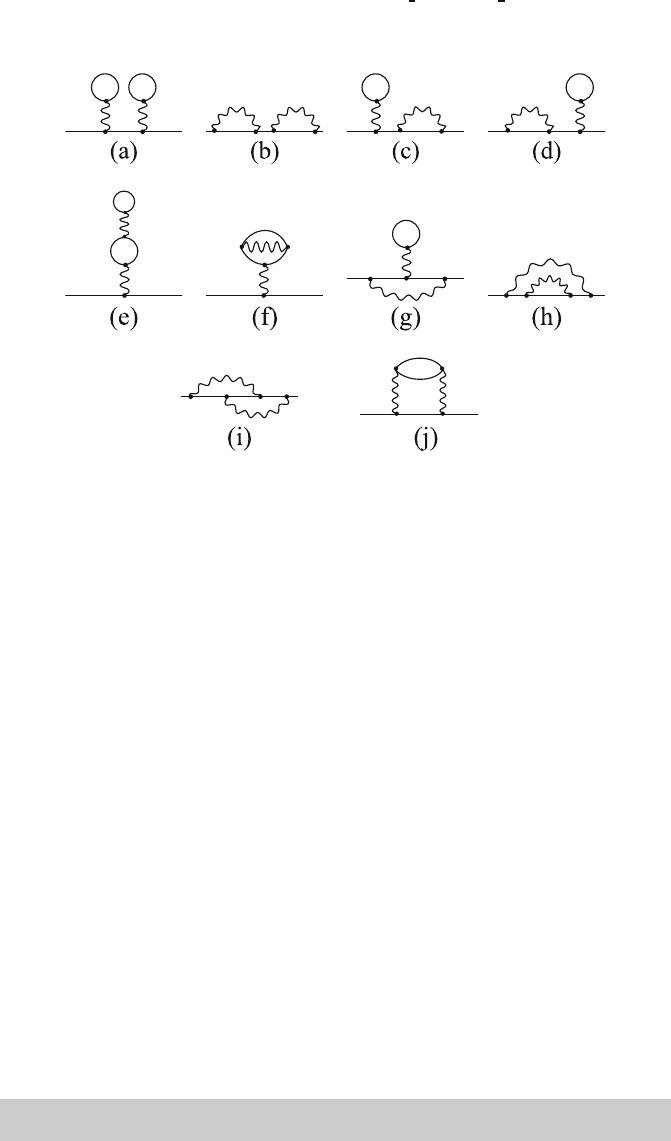
dt
2
H
I
(t
1
)H
I
(t
2
)=
1
2
I
2
+
1
2
I
2
. (12.27)
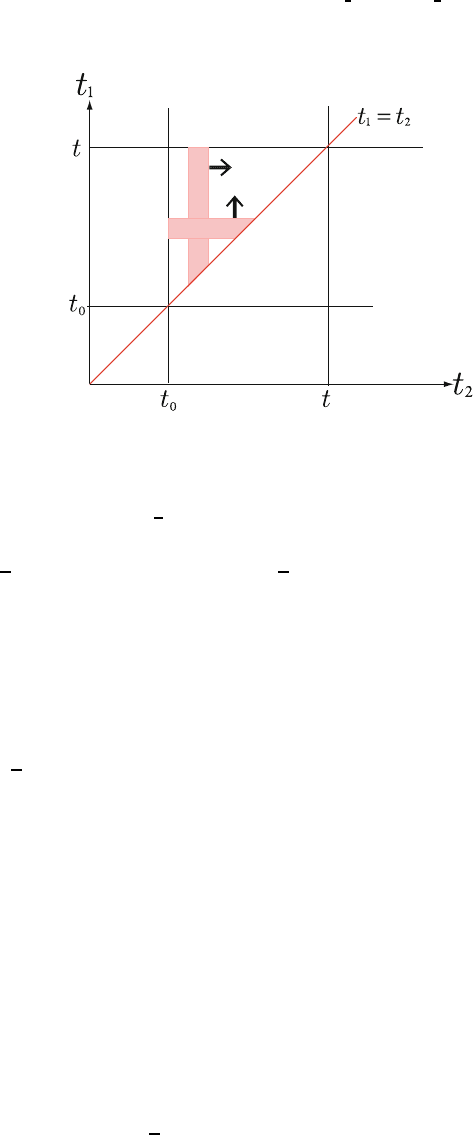
In the second
1
2
I
2
, let us reverse the order of integration (see Fig. 12.1). We 70
first integrated over t
2
from t
0
to t
1
,thenovert
1
from t
0
to t. Inverting the 71
order gives 72
t
t
0
dt
1
t
1
t
0
dt
2
⇒
t
t
0
dt
2
t
t
2
dt
1
,
Therefore, we have
73
1
2
I
2
=
1
2
t
t
0
dt
1
t
1
t
0
dt
2
H
I
(t
1
)H
I
(t
2
)=
1
2
t
t
0
dt
2
t
t
2
dt
1
H
I
(t
1
)H
I
(t
2
).
(12.28)
But t
1
and t
2
are dummy integration variables and we can interchange the 74
names to get 75
1
2
I
2
=
1
2
t
t
0
dt
1
t
t
1
dt
2
H
I
(t
2
)H
I
(t
1
). (12.29)
Uncorrected Proof
BookID 160928 ChapID 12 Proof# 1 - 29/07/09
12.1 Formulation 365
Fig. 12.1. Order of integration I
2
appearing in (12.27)
Adding this term to the
1
2
I
2
that was left in its original form gives 76
I
2
=
1
2
t
t
0
dt
1
t
1
t
0
dt
2
H
I
(t
1
)H
I
(t
2
)+
1
2
t
t
0
dt
1
t
t
1
dt
2
H
I
(t
2
)H
I
(t
1
). (12.30)
We are integrating over a square of edge Δt = t − t
0
in the t
1
t
2
-plane. The 77
second term, with t
2
>t
1
, is just an integral on the lower triangle shown 78
in Fig. 12.1. The first term, where t
1
>t
2
, is an integral on the upper tri- 79
angle. Therefore, we can combine the time integrals and write the limits of 80
integration from t
0
to t. 81
I
2
=
1
2
t
t
0
dt
1
t
t
0
dt
2
[H
I
(t
1
)H
I
(t
2
)θ(t
1
− t
2
)+H
I
(t
2
)H
I
(t
1
)θ(t
2
− t
1
)] .
(12.31)
The thing we have to be careful about here, however, is that H
I
(t
1
)andH
I
(t
2
) 82
do not necessarily commute. We can get around this difficulty by using the 83
time ordering operator T. The product of functions H
I
(t
j
) that follows the 84
operator T must have the largest t values on the left. In the first term of 85
(12.31), t
1
>t
2
, so we can write the integrand as 86
H
I
(t
1
)H
I
(t
2
)=T{H
I
(t
1
)H
I
(t
2
)}.
In the second term, with t
2
>t
1
,wemaywrite 87
H
I
(t
2
)H
I
(t
1
)=T{H
I
(t
1
)H
I
(t
2
)}.
Equation (12.31) can, thus, be rewritten as
88
I
2
=
1
2
t
t
0
dt
1
t
t
0
dt
2
T {H
I
(t
1
)H
I
(t
2
)}. (12.32)

Uncorrected Proof
BookID 160928 ChapID 12 Proof# 1 - 29/07/09
366 12 Many Body Interactions: Green’s Function Method
For the general term we have 89
I
n
=
"
t
t
0
dt
1
"
t
1
t
0
dt
2
···
"
t
n−1
t
0
dt
n
H
I
(t
1
)H
I
(t
2
) ···H
I
(t
n
)
=
"
dt
1
dt
2
···dt
n
H
I
(t
1
)H
I
(t
2
) ···H
I
(t
n
)witht ≥ t
1
≥ t
2
≥···≥t
n
,
and it is not difficult to see that the same technique can be applied to give
90
I
n
=
1
n!
t
t
0
dt
1
t
t
0
dt
2
···
t
t
0
dt
n
T{H
I
(t
1
)H
I
(t
2
) ···H
I
(t
n
)}. (12.33)
Note that
91
T{H
I
(t
1
)H
I
(t
2
) ···H
I
(t
n
)} = H
I
(t
1
)H
I
(t
2
) ···H
I
(t
n
)ift
1
≥ t
2
≥···≥t
n
.
Making use of (12.33), the S matrix can be written in the compact form
92
S(t, t
0
)=T
e
−i
"
t
t
0
H
I
(t
)dt
, (12.34)
93
where it is understood that in the nth term in the expansion of the exponential, 94
(12.33) holds. We note that, at t = 0, the wave functions Ψ
S
, Ψ
I
coincide, 95
Ψ
S
(0) = Ψ
I
(0) = S(0,t
0
)Ψ
I
(t
0
)=S(0,t
0
)e
iH
0
t
0
Ψ
S
(t
0
),
wherewehaveusedΨ
I
(t)=e
iH
0
t
Ψ
S
(t)andΨ
I
(t)=S(t, t
0
)Ψ
I
(t
0
). 96
12.2 Adiabatic Approximation 97
Suppose that we multiply H
I
by e
−β|t|
where β ≥ 0, and treat the resulting 98
interaction as one that vanishes at t = ±∞. Then, the interaction is slowly 99
turned on from t = −∞ up to t = 0 and slowly turned off from t = 0 till 100
t =+∞.WecanwriteH(t = −∞)=H
0
, the noninteracting Hamiltonian, 101
and 102
Ψ
I
(t = −∞)=Ψ
H
(t = −∞)=Φ
H
. (12.35)
Here, Φ
H
is the Heisenberg state vector of the noninteracting system. We know 103
that eigenstates of the interacting system in the Heisenberg, Schr¨odinger, and 104
interaction representation are related by 105
Ψ
H
(t)=e
iHt
Ψ
S
(t)and Ψ
I
(t)=e
iH
0
t
Ψ
S
(t). (12.36)
Therefore, at time t = 0,
106
Ψ
I
(t =0)=Ψ
H
(t =0)=Ψ
H
. (12.37)
Henceforth, we will use Ψ
H
to denote the state vector of the fully interacting 107
system in the Heisenberg representation. We can express Ψ
H
as 108

Uncorrected Proof
BookID 160928 ChapID 12 Proof# 1 - 29/07/09
12.2 Adiabatic Approximation 367
Ψ
H
= S(0, −∞)Φ
H
, (12.38)
where S is the S matrix defined in (12.34). Because Ψ
I
(t =0)=Ψ
H
we can 109
write 110
Ψ
I
(t)=S(t, 0)Ψ
H
= S(t, −∞)Φ
H
. (12.39)
In the last step, we have used S(t
2
, −∞)=S(t
2
,t
1
)S(t
1
, −∞). If we write 111
|Ψ
I
(t) = S(t, 0)|Ψ
H
and Ψ
I
(t)| = Ψ
H
|S
−1
(t, 0), then for some operator F 112
Ψ
I
(t)|F
I
|Ψ
I
(t) = Ψ
H
|S
−1
(t, 0)F
I
S(t, 0)|Ψ
H
= Ψ
H
(t)|F
H
|Ψ
H
(t). (12.40)
But this must equal Ψ
H
|F
H
|Ψ
H
. Therefore, we have 113
F
H
= S
−1
(t, 0)F
I
S(t, 0). (12.41)
Now, look at the expectation value in the exact Heisenberg interacting state
114
Ψ
H
of the time ordered product of Heisenberg operators 115
Ψ
H
|T{A
H
(t
1
)B
H
(t
2
) ···Z
H
(t
n
)}|Ψ
H
.
If we assume that the t
i
’s have been arranged in the order t
1
≥ t
2
≥ t
3
≥ 116
···≥t
n
,thenwecanwrite 117
Ψ
H
|T{A
H
(t
1
)B
H
(t
2
)···Z
H
(t
n
)}|Ψ
H
Ψ
H
|Ψ
H
=
Φ
H
|S(∞,0)S
−1
(t
1
,0)A
I
(t
1
)S(t
1
,0)S
−1
(t
2
,0)B
I
(t
2
)S(t
2
,0)S
−1
(t
3
,0)···S
−1
(t
n
,0)Z
I
(t
n
)S(t
n
,0)S(0,−∞)|Φ
H
Φ
H
|S(∞,0)S(0,−∞)|Φ
H
.
118
(12.42)
But from S(t
1
, 0) = S(t
1
,t
2
)S(t
2
, 0) we can see that 119
S(t
1
, 0)S
−1
(t
2
, 0) = S(t
1
,t
2
). (12.43)
Using this in (12.42) gives
120
Ψ
H
|T{A
H
(t
1
)B
H
(t
2
)···Z
H
(t
n
)}|Ψ
H
Ψ
H
|Ψ
H
=
Φ
H
|S(∞,t
1
)A
I
(t
1
)S(t
1
,t
2
)B
I
(t
2
)S(t
2
,t
3
)···Z
I
(t
n
)S(t
n
,−∞)|Φ
H
Φ
H
|S(∞,−∞)|Φ
H
.
(12.44)
We note that, in (12.44), the operators are in time-ordered form, i.e. t
n
≥−∞, 121
t
1
≥ t
2
, ∞≥t
1
, so the operators 122
S(∞,t
1
)A
I
(t
1
)S(t
1
,t
2
)B
I
(t
2
)S(t
2
,t
3
) ···Z
I
(t
n
)S(t
n
, −∞)
are chronologically ordered, and hence we can rewrite (12.44) as
123
Ψ
H
|T{A
H
(t
1
)B
H
(t
2
)···Z
H
(t
n
)}|Ψ
H
Ψ
H
|Ψ
H
=
Φ
H
|T{S(∞,−∞)A
I
(t
1
)B
I
(t
2
)···Z
I
(t
n
)}|Φ
H
Φ
H
|S(∞,−∞)|Φ
H
. (12.45)
124
125

Uncorrected Proof
BookID 160928 ChapID 12 Proof# 1 - 29/07/09
368 12 Many Body Interactions: Green’s Function Method
12.3 Green’s Function 126
We define the Green’s function G
αβ
(x, x
), where x = {r,t} and α, β are spin 127
indices, by 128
G
αβ
(x, x
)=−i
Ψ
H
|T{ψ
H
α
(x)ψ
H†
β
(x
)}|Ψ
H
Ψ
H
|Ψ
H
. (12.46)
129
Here, ψ
H
α
(x) is an operator (particle field operator) in the Heisenberg repre- 130
sentation. 131
By using Eq.(12.45) in Eq.(12.46), we obtain 132
G
αβ
(x, x
)=−i
Φ
H
|T{S(∞, −∞)ψ
I
α
(x)ψ
I†
β
(x
)}|Φ
H
Φ
H
|S(∞, −∞)|Φ
H
. (12.47)
The operator ψ
I
α
(x) is now in the interaction representation. If we write out 133
the expansion for S(∞, −∞) in the numerator and are careful to keep the 134
time ordering, we obtain 135
G
αβ
(r,t,r
,t
)=−
i
S(∞,−∞)
∞
n=0
(−i)
n
n!
"
∞
−∞
dt
1
dt
2
···dt
n
×Φ
H
|T{ψ
I
α
(r,t)ψ
I†
β
(r
,t
)H
I
(t
1
) ···H
I
(t
n
)}|Φ
H
.
(12.48)
12.3.1 Averages of Time-Ordered Products of Operators
136
If F
1
(t)andF
2
(t
) are Fermion operators, then by T{F
1
(t)F
2
(t
)} we mean 137
T{F
1
(t)F
2
(t
)} = F
1
(t)F
2
(t
)ift>t
= −F
2
(t
)F
1
(t)ift<t
.
(12.49)
In other words, we need a minus sign for every permutation of one Fermion
138
operator past another. For Bosons no minus sign is needed. 139
In G
αβ
we find the ground state average of products of time-ordered oper- 140
ators like T{ABC ···}. Here, A, B, ... are field operators (or products of field 141
operators). When the entire time ordered product is expressed as a product of 142
ψ
†
’s and ψ’s, it is useful to put the product in what is called normal form, in 143
which all annihilation operators appear to the right of all creation operators. 144
For example, the normal product of ψ
†
(1)ψ(2) can be written 145
N{ψ
†
(1)ψ(2)} = ψ
†
(1)ψ(2) while N{ψ(1)ψ
†
(2)} = −ψ
†
(2)ψ(1). (12.50)
The difference between a T product and an N product is called a pairing or
146
a contraction. For example, the difference in the T ordered product and the 147
N product of AB is given by 148
T(AB) − N(AB)=A
c
B
c
. (12.51)
149

Uncorrected Proof
BookID 160928 ChapID 12 Proof# 1 - 29/07/09
12.3 Green’s Function 369
We note that the contraction of a pair of operators is the anticommutator we 150
omit when we formally reorder a T product of a pair of operators to get an N 151
product. The contractions are c-numbers for the operators we are interested 152
in. 153
12.3.2 Wick’s Theorem 154
The Wick’s theorem states that T product of operators ABC ··· can be 155
expressed as the sum of all possible N products with all possible pairings. 156
By this we mean that 157
T(ABCD ···XY Z)
=N(ABCD ···XY Z)
+N(A
c
B
c
CD ···XY Z)+N(A
c
BC
c
D ···XYZ)+N(A
c
BCD
c
···XY Z)
+ ···+N(ABCD ···XY
c
Z
c
)
+N(A
c
B
c
C
a
D
a
···XYZ)+···+N(ABCD ···W
c
X
c
Y
a
Z
a
)
.
.
.
+N(A
c
B
c
C
a
D
a
···Y
b
Z
b
)+N(A
c
B
a
C
c
D
a
···Y
b
Z
b
)+ all other pairings.
(12.52)
158
In evaluating the ground state expectation value of (12.52) only the term in 159
which every operator is paired with some other operator is nonvanishing since 160
the normal products that contain unpaired operators must vanish (they anni- 161
hilate excitations that are not present in the ground state). In the second and 162
third lines on the right, in each term we bring two operators together by anti- 163
commuting, but neglecting the anticommutators, then replace the pair by its 164
contraction, and finally take the N product of the remaining n −2 operators. 165
We do this with all possible pairings so we obtain
n(n−1)
2
terms, each term 166
containing an N product of the n −2 remaining operators. In the fourth line 167
on the right, we choose two pairs in all possible ways, replace them by their 168
contractions, and leave in each term an N products of the n − 4 remaining 169
operators. We repeat the same procedure, and in the last line on the right, 170
every operator is paired with some other operator in all possible ways leaving 171
no unpaired operators. Only the completely contracted terms (last line on 172
the right of (12.52)) give finite contributions in the ground-state expectation 173
value. That is, we have 174
T(ABCD ···XY Z)
0
= T(AB)T(CD)···T(YZ)±T(AC)T(BD)···T(YZ)
± All other pairings.
(12.53)
Here,wehaveusedA
c
B
c
=T(AB) −N(AB) and noted that N(AB) =0,so 175
the ground state expectation value of A
c
B
c
= T(AB).Nowletusreturn 176
to the expansion of the Green’s function. The first term in the sum over n in 177
(12.48) is 178
Uncorrected Proof
BookID 160928 ChapID 12 Proof# 1 - 29/07/09
370 12 Many Body Interactions: Green’s Function Method
G
(0)
(r,t,r
,t
)=−
i
S(∞, −∞)
Φ
∗
H
| T{ψ
I
(r,t)ψ
†
I
(r
,t
)}|Φ
H
0
, (12.54)
where, now, the operators ψ(r,t)andψ
†
(r,t) are in the interaction repre- 179
sentation. G
(0)
is the noninteracting Green’s function (i.e., it is the Green 180
function when H
= 0). Here we shall take the interaction to be given, in 181
second-quantized form, by 182
H
=
1
2
d
3
r
1
d
3
r
2
ψ
†
(r
1
)ψ
†
(r
2
)U(r
1
− r
2
)ψ(r
2
)ψ(r
1
). (12.55)
Now, introduce a function V (x
1
−x
2
) ≡ U(r
1
−r
2
)δ(t
1
−t
2
) to write the first 183
correction due to interaction as (let x = r,t) 184
δG
(1)
(x, x
)=−
i
2S(∞,−∞)
"
d
4
x
1
d
4
x
2
V (x
1
− x
2
)
×T{ψ(x)ψ(x
)ψ
†
(x
1
)ψ
†
(x
2
)ψ(x
2
)ψ(x
1
)}
0
.
(12.56)
The time-ordered product of the six operators (3 ψ’s and 3ψ
†
’s) can be written 185
out by using (12.53) 186
T{ψ(x)ψ
†
(x
)ψ
†
(x
1
)ψ
†
(x
2
)ψ(x
2
)ψ(x
1
)}
0
= T(ψ(x)ψ
†
(x
1
))T(ψ
†
(x
2
)ψ(x
2
))T(ψ(x
1
)ψ
†
(x
))
−T(ψ(x)ψ
†
(x
1
))T(ψ
†
(x
2
)ψ(x
1
))T(ψ(x
2
)ψ
†
(x
))± all other pairings.
(12.57)
But T(ψ(x
i
)ψ
†
(x
j
)) is proportional to G
(0)
(x
i
,x
j
). Therefore, the first term 187
on the right hand side of (12.57) is proportional to 188
G
(0)
(x, x
1
)G
(0)
(x
2
,x
2
)G
(0)
(x
1
,x
). (12.58)
It is simpler to draw Feynman diagram for each of the possible pairings. There
189
are six of them in δG
(1)
(x, x
) because there are six ways to pair one ψ
†
with 190
one ψ. The diagrams are shown in Fig. 12.2. Note that x
1
and x
2
are always 191
connected by an interaction line V (x
1
− x
2
). An electron propagates in from 192
x and out to x
.Ateachx
1
and x
2
theremustbeoneG
(0)
entering and one 193
leaving. 194
In a standard book on many body theory, such as Fetter–Walecka(1971), 195
Mahan(1990), and Abrikosov–Gorkov–Dzyaloshinskii(1963), one can find 196
1. Rules for constructing the Feynman diagrams for the n
th
order correction 197
and 198
2. Rules for writing down the analytic expression for δG
(n)
associated with 199
each diagram. 200
Let us give one simple example of constructing diagrams. For the n
th
order cor- 201
rections, there are n interaction lines and (2n + 1) directed Green’s functions, 202
G
(0)
’s. The rules for the nth-order corrections are as follows: 203
Uncorrected Proof
BookID 160928 ChapID 12 Proof# 1 - 29/07/09
12.3 Green’s Function 371
Fig. 12.2. Feynman diagrams in the first-order perturbation calculation
1. Form all connected, topologically nonequivalent diagrams containing 2n ver- 204
tices and two external points. Two solid lines and one wavy line meet at 205
each vertex. 206
2. With each solid line associate a Green’s function G
(0)
(x, x
)wherex and 207
x
are the coordinates of the initial and final points of the line. 208
3. With each wavy line associate V (x − x
)=U(r − r
)δ(t − t
)forawavy 209
line connecting x and x
. 210
4. Integrate over the internal variables d
4
x
i
=d
3
r
i
dt
i
for all vertex coordi- 211
nates (and sum over all internal spin variables if spin is included). 212
5. Multiply by i
n
(−)
F
,whereF is the number of closed Fermion loops. 213
6. Understand equal time G
(0)
’s to mean, as δ → 0
+
, 214
G
(0)
(r
1
t, r
2
t) → G
(0)
(r
1
t, r
2
t + δ).
The allowed diagrams contributing to δG
(2)
(x, x
) are shown in Fig. 12.3. 215
Uncorrected Proof
BookID 160928 ChapID 12 Proof# 1 - 29/07/09
372 12 Many Body Interactions: Green’s Function Method
Fig. 12.3. Feynman diagrams in the second order perturbation calculation
12.3.3 Linked Clusters 216
In writing down the rules, we have only considered linked (or connected ) dia- 217
grams, but diagrams (e) and (f) in Fig. 12.2 are unlinked diagrams. By this we 218
mean that they fall into two separate pieces, one of which contains the coordi- 219
nates x and x
of G(x, x
). It can be shown (see a standard many body text like 220
Abrikosov–Gorkov–Dzyaloshinskii (1963).) that when the contributions from 221
unlinked diagrams are included, they simply multiply the contribution from 222
linked diagrams by a factor S(∞, −∞). Since this factor appears in denom- 223
inator of G
αβ
(x, x
) in (12.48), it simply cancels out. Furthermore, diagrams 224
(a) and (c) in Fig. 12.2 are identical except for interchange of the dummy 225
variables x
1
and x
2
, and so too are (b) and (d). The rules for constructing 226
diagrams for δG
(n)
(x, x
) take this into account correctly and one can find the 227
proof in standard many body texts mentioned above. 228
12.4 Dyson’s Equations 229
If we look at the corrections to G
(0)
(x, x
) we notice that for our linked cluster 230
diagrams the corrections always begin with a G
(0)
(x, x
1
), and this is followed 231
by something called a self energy part. Look, for example, at the figures labeled 232
(a) or (b) in Fig. 12.2 or (j) in Fig. 12.3. The final part of the diagram has 233
another G
(0)
(x
n
,x
). Suppose we represent the general self energy by Σ. Then 234
we can write 235
G = G
(0)
+ G
(0)
ΣG. (12.59)
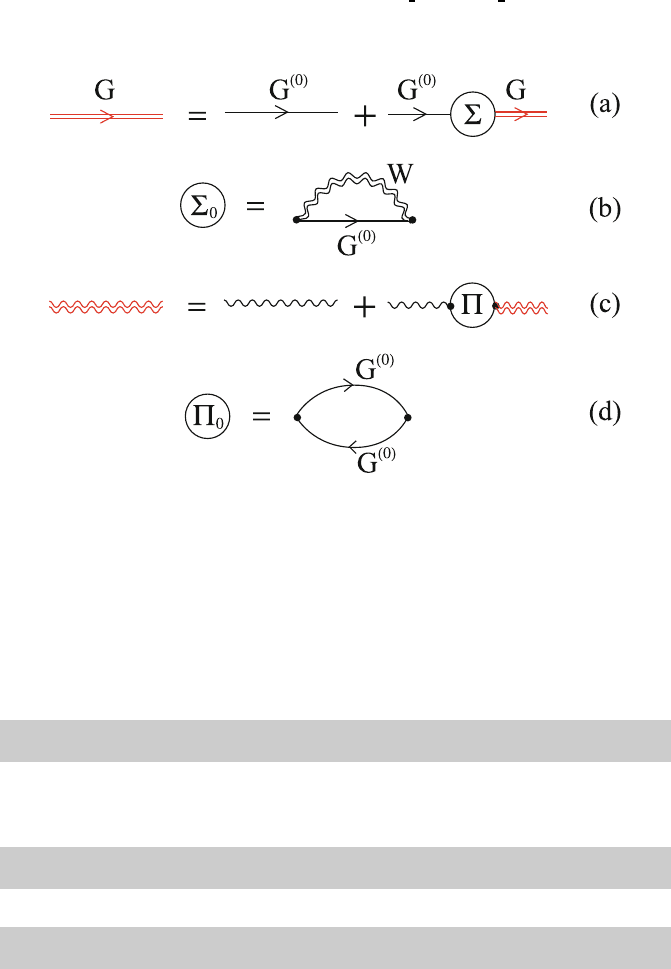
236
Uncorrected Proof
BookID 160928 ChapID 12 Proof# 1 - 29/07/09
12.4 Dyson’s Equations 373
Fig. 12.4. Diagrammatic expressions of (a) Dyson equation G = G
(0)
+ G
(0)
ΣG,
(b)selfenergyΣ
0
,(c) Dyson equation W = V + V ΠW ,(d) polarization part
Π
0
= G
(0)
G
(0)
This equation says that G is the sum of G
(0)
and G
(0)
followed by Σ which 237
in turn can be followed by the exact G we are trying to determine. We can 238
express (12.59) in diagrammatic terms as is shown in Fig. 12.4a. The simplest 239
self-energy part that is of importance in the problem of electron interactions 240
in a degenerate electron gas is Σ
0
,where 241
Σ
0
= G
(0)
W. (12.60)
242
In diagrammatic terms this is expressed as shown in Fig. 12.4b, where the dou- 243
ble wavy line is a screened interactionandwecanwriteaDysonequationfor 244
it by 245
W = V + V ΠW. (12.61)
246
The Π is called a polarization part ; the simplest polarization part is 247
Π
0
= G
(0)
G
(0)
, (12.62)
248
the diagrammatic expression of which is given in Fig. 12.4d. Of course, in 249
(12.60) and (12.62) we could replace G
(0)
by the exact G to have a result 250
that includes many terms of higher order. Approximating the self energy by 251
the product of a Green’s function G and an effective interaction W is often 252
referred to as the GW approximation to the self-energy. The simplest GW 253
approximation is the random phase approximation (RPA). In the RPA, the 254
G is replaced by G
(0)
and W is the solution to (12.61) with (12.62) used for 255