
Quinn J.J., Yi K.-S. Solid State Physics: Principles and Modern Applications
Подождите немного. Документ загружается.

Uncorrected Proof
BookID 160928 ChapID 14 Proof# 1 - 29/07/09
14.2 Skin Effect in the Absence of a dc Magnetic Field 425
which can be written 44
−
c
2
q
2
ω
2
+ ε(q,ω)0 0
0 −
c
2
q
2
ω
2
+ ε(q,ω)0
00ε(q,ω)
=0. (14.13)
Here, we have introduced the dielectric function
45
ε(q,ω)=1 −
4πi
ω
σ
(q,ω), (14.14)
andwehaveassumedthatε is diagonal (this is true for an electron gas in the 46
absence of a dc magnetic field). The transverse electromagnetic waves which 47
can propagate in the medium are solutions of the equation 48
c
2
q
2
= ω
2
ε(q,ω). (14.15)
In addition, there is a longitudinal wave which is the solution of the equation
49
ε(q,ω)=0. (14.16)
Normal Skin Effect
50
In the absence of a dc magnetic field, the local theory of conduction gives 51
σ =
σ
0
1+iωτ
=
ω
2
p
τ/4π
1+iωτ
. (14.17)
Therefore, we have
52
ε(q,ω)=1−
iω
2
p
τ/ω
1+iωτ
(14.18)
or
53
ε(q,ω)=
1+(ω
2
− ω
2
p
)τ
2
1+ω
2
τ
2
− i
ω
2
p
τ
2
ωτ(1 + ω
2
τ
2
)
(14.19)
Usually in a good metal ω
p
10
16
/s, a frequency in the ultraviolet. Therefore, 54
in the optical or infrared range ω
p
ω. The parameter τ can be as small as 55
10
−14
sec or as large as 10
−9
s in very pure metals at very low temperatures. 56
Letusfirstconsiderthecaseωτ 1. Then, since ω
p
ω,wehave 57
ε(q,ω) −
ω
2
p
ω
2
. (14.20)
Substituting this result into the wave equation c
2
q
2
= ω
2
ε(q, ω)gives 58
q = ±i
ω
p
c
= ±
i
δ
. (14.21)
We choose the well-behaved solution q = −
i
δ
so that the field in the metal is 59
of the form 60

Uncorrected Proof
BookID 160928 ChapID 14 Proof# 1 - 29/07/09
426 14 Electrodynamics of Metals
E(z,t)=E
0
e
iωt−z/δ
. (14.22)
61
What we find is that electromagnetic waves do not propagate in the metal 62
(for frequencies lower than ω
p
), and that the electric field in the solid drops 63
off exponentially with distance from the surface. The distance δ =
c
ω
p
is called 64
the normal skin depth. 65
If ωτ 1, (this is usually true at rf frequencies, even at low temperatures 66
with pure materials) we have 67
ε(q,ω) 1 − i
ω
2
p
τ
ω
∼−i
ω
2
p
ωτ
ω
2
when ω
p
ω. (14.23)
The solution of the wave equation is given by 68
q = ±
ω
p
c
ωτ
2
1/2
(1 − i), (14.24)
so that the field E is of the form 69
E(z,t)=E
0
e
iωt
e
−(i+1)
ω
p
c
(
ωτ
2
)
1/2
z
. (14.25)
Thus, the skin depth is given by
70
δ =
c
ω
p
2
ωτ
1/2
. (14.26)
Ifthemeanfreepathl is much greater than the skin depth, l δ, then the
71
local theory is not valid. In good metals at low temperatures, it turns out that 72
l v
F
τ 10
7
nm and δ 10nm, so that l δ, and we must use the nonlocal 73
theory. 74
Anomalous Skin Effect 75
The normal skin effect was derived under the assumption that the q depen- 76
dence of σ was unimportant. Remember that this assumption is valid if 77
ql = qv
F
τ 1. We have found that the electric field varies like e
−z/δ
.If 78
δ turns out to be smaller than l = v
F
τ, our initial assumption was certainly 79
incorrect. The skin depth δ is of the order of 80
δ
c
ω
p
. (14.27)
Therefore, if
81
ωc
ω
p
v
F
<ωτ, (14.28)
the theory is inconsistent because the field E(z) changes appreciably over a
82
mean free path l contradicting the assumption that the q dependence of σ can 83
be neglected. The theory for this case in which the q dependence of σ must 84
Uncorrected Proof
BookID 160928 ChapID 14 Proof# 1 - 29/07/09
14.3 Azbel–Kaner Cyclotron Resonance 427
be included is called the theory of the anomalous skin effect. In the nonlocal 85
theory, we can write, (we take the y-axis to be perpendicular to the metal’s 86
surface), 87
j
e
(y)=
dy
σ(y, y
) ·E(y
), (14.29)
88
which is true for an infinite medium. However, we have to take into account 89
the surface of the metal here. We shall do this by using the formalism for the 90
infinite medium, and imposing appropriate boundary conditions, namely, the 91
method of images. 92
14.3 Azbel–Kaner Cyclotron Resonance 93
The theory of the anomalous skin effect in the presence of a dc magnetic 94
field aligned parallel to the surface is the theory of Azbel–Kaner cyclotron 95
resonance in metals. We shall present a brief treatment of this effect, and 96
leave the problem of the anomalous skin effect in the absence of a dc magnetic 97
field as an exercise. 98
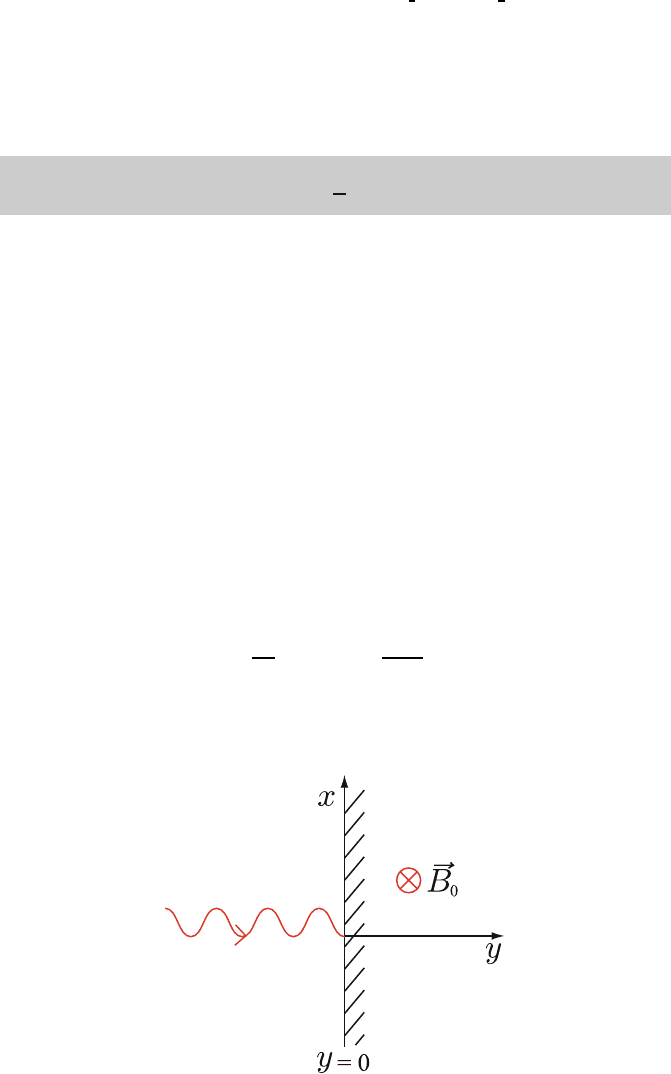
Let us choose a Cartesian coordinate system with the y-axis normal to the 99
surface, and the z-axis parallel to the dc magnetic field (see Fig. 14.1). For a 100
polarization in which E(r,t) is parallel to the z-axis, the wave equation can 101
be written, since q is along the y-direction, 102
−q
2
+
ω
2
c
2
)E(q, ω
=
4πiω
c
2
j
T
(q, ω). (14.30)
This comes from the Fourier transform of the wave equation. For the case
103
of self-sustaining oscillations of an infinite medium, we would set j
T
equal to 104
Fig. 14.1. The coordinate system for an electromagnetic wave propagating parallel
to the y-axis with the surface at y = 0. A dc magnetic field B
0
is parallel to the
z-axis
Uncorrected Proof
BookID 160928 ChapID 14 Proof# 1 - 29/07/09
428 14 Electrodynamics of Metals
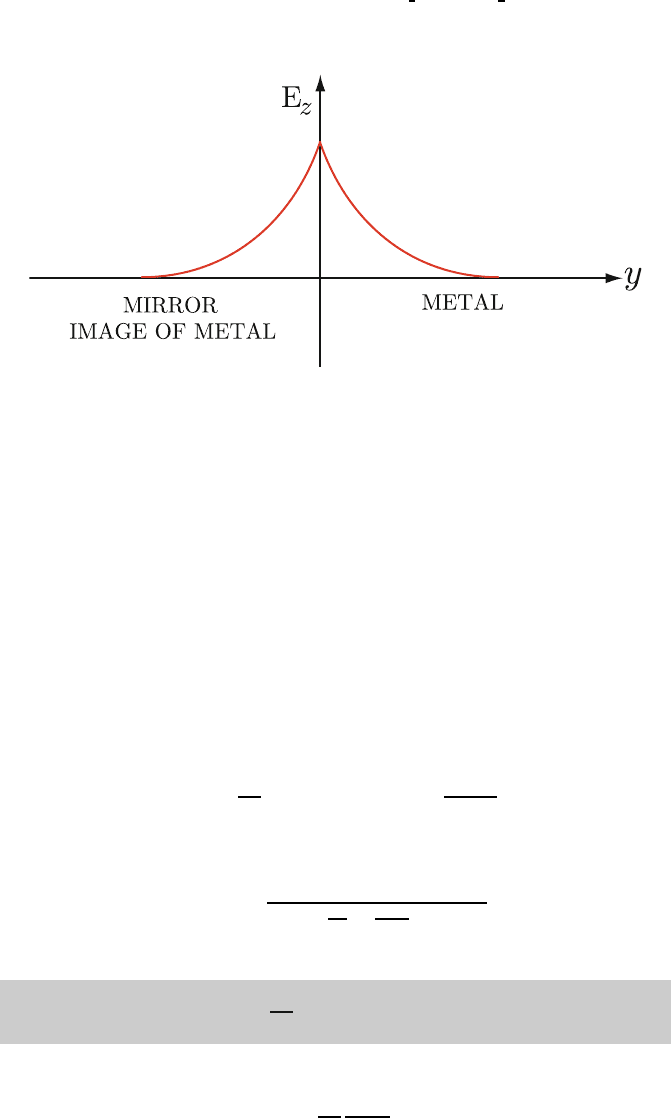
Fig. 14.2. A semi-infinite medium in terms of infinite medium picture. An electric
field E
z
(y) in the metal is shown near the surface y =0
the induced electron current given by σ
zz
(q, ω)E(q, ω). For the semi-infinite 105
medium, however, one must exercise some care to account for the boundary 106
conditions. The electric field in the metal will decay in amplitude with distance 107
from the surface y = 0. There is a discontinuity in the first derivative of 108
E(r,t)aty = 0. Actually the term −q
2
E in the wave equation came from 109
making the assumption that E(y) was of the form e
−iqy
.Onecanusethis 110
“infinite medium” picture by replacing the vacuum by the mirror image of 111
the metal as shown in Fig. 14.2. The fictitious surface current j
0
∝ δ(y)must 112
be introduced to properly take account of the boundary conditions. By putting 113
j
e
(q, ω)=σ
zz
(q, ω)E(q, ω), we can solve the wave equation for E(q, ω). The 114
fictitious surface current sheet of density j
0
is very simply related to the 115
magnetic field at the surface 116
j
0
(y)=
c
2π
H(0)δ(y)orj
0
(q)=
cH(0)
2π
. (14.31)
Solving (14.30) for E(q, ω)gives
117
E(q, ω)=
2iωH(0)/c
−q
2
+
ω
2
c
2
−
4πiω
c
2
σ
zz
(q, ω)
. (14.32)
By substituting this result into the Fourier transform
118
E(y)=
1
2π
∞
−∞
dq e
−iqy
E(q, ω), (14.33) 119
and the definition of the surface impedance Z 120
Z =
4π
c
E(0)
H(0)
, (14.34)
Uncorrected Proof
BookID 160928 ChapID 14 Proof# 1 - 29/07/09
14.3 Azbel–Kaner Cyclotron Resonance 429
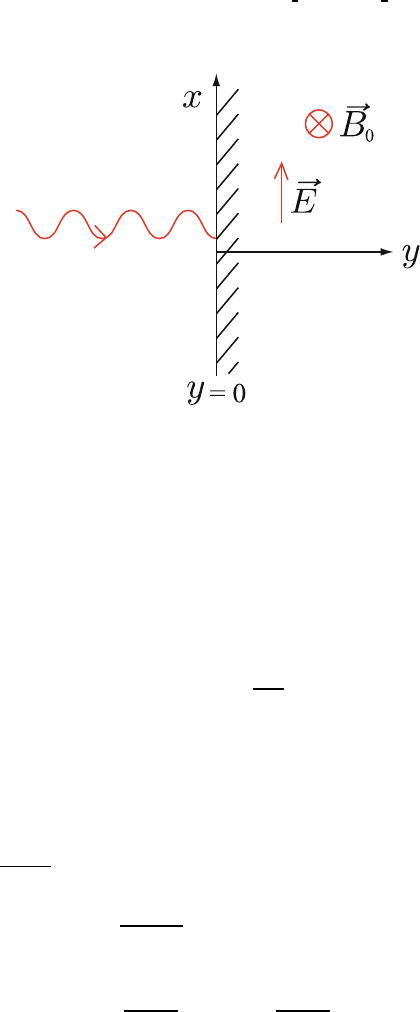
Fig. 14.3. The coordinate system for an electromagnetic wave propagating parallel
to the y-axis to the metal surface (y = 0) for the case of polarization in the x-
direction. A dc magnetic field B
0
is parallel to the z-axis
we can easily obtain the electric field as a function of position and the surface 121
impedance of the metal. In (14.34), E(0) and H(0) are the electric field and 122
the magnetic field at the surface, respectively. 123
For the case of a wave polarized in the x-direction instead of the 124
z-direction, σ
zz
is replaced by 125
σ
T
= σ
xx
+
σ
2
xy
σ
yy
. (14.35)
This is equivalent to assuming that electrons are specularly reflected at the
126
boundary y = 0. Figure 14.3 shows the coordinate system for a wave prop- 127
agating perpendicular to the boundary of the metal with polarization in the 128
x-direction normal to the dc magnetic field. One can see that although E(y) 129
is continuous, its first derivative is not. Therefore, in defining the Fourier 130
transform of
∂
2
E(y)
∂y
2
we must add terms to take account of these continuities. 131
∞
−∞
dy e
iqy
∂
2
E(y)
∂y
2
=ΔE
0
− iqΔE
0
− q
2
E(q), (14.36)
where
132
ΔE
0
=
∂E(y)
∂y
y=0
+
−
∂E(y)
∂y
y=0
−
, (14.37)
and
133
ΔE
0
= E(0
+
) − E(0
−
). (14.38)
For the case of specular reflection we take ΔE
0
=0andΔE
0
=2E
(0
+
). This 134
adds a constant term to the wave equation 135

Uncorrected Proof
BookID 160928 ChapID 14 Proof# 1 - 29/07/09
430 14 Electrodynamics of Metals
−q
2
+
ω
2
c
2
E(q, ω)=−ΔE
0
+
4πiω
c
2
j
e
(q, ω). (14.39)
This added term can equally well be thought of as a fictitious surface current
136
j
0
(y)givenby 137
j
0
(y)=−
c
2
ΔE
0
4πiω
δ(y). (14.40)
So that the infinite medium result (or infinite medium wave equation) can be
138
used if we take for j
T
(q, ω) 139
j
T
(q, ω)=j
e
(q, ω)+j
0
(q). (14.41)
Actually, the results just derived are valid in the absence of a magnetic field
140
as well as in the presence of a dc magnetic field. In the absence of a magnetic 141
field the conductivity tensor is given by 142
σ(q, ω)=
ω
2
p
4πiω
{1
+ I(q, ω)}, (14.42)
where
143
I(q, ω)=
m
N
kk
f
0
(ε
k
) − f
0
(ε
k
)
ε
k
− ε
k
− ¯hω
k
|V
q
|kk
|V
q
|k
∗
. (14.43)
14.4 Azbel–Kaner Effect 144
If we use the Cohen–Harrison–Harrison expression for σ
zz
(q, ω), (13.125), we 145
have 146
σ
zz
=3σ
0
∞
n=−∞
c
n
(w)
1 − iτ (nω
c
− ω)
, (14.44)
147
where 148
c
n
(w)=
1
2
1
−1
d(cos θ)cos
2
θJ
2
n
(w sin θ). (14.45)
Since w 1 (i.e., we assume w ≡
qv
F
ω
c
1 for the values of q of interest 149
in this problem) we can replace J
n
(w sin θ) by its asymptotic value for large 150
argument. 151
lim
z→∞
J
n
(z) ≈
8
2
πz
cos[z −
n +
1
2
π
2
]. (14.46)
Substituting (14.46) into the expression for c
n
(w) (14.45) gives 152
c
n
(w) ≈
1
4w
. (14.47)

Uncorrected Proof
BookID 160928 ChapID 14 Proof# 1 - 29/07/09
14.5 Magnetoplasma Waves 431
Therefore, we have 153
σ
zz
≈
3ω
2
p
4πi˜ω
1
4w
∞
n=−∞
1
1+nω
c
/˜ω
. (14.48)
Making use of the fact that
154
∞
n=−∞
1
1+nω
c
/ω
=
πω
ω
c
cot
πω
ω
c
(14.49)
and −icotx =cothix, one can easily see that
155
σ
zz
≈
3ω
2
p
16qv
F
coth
π(1 + iωτ)
ω
c
τ
. (14.50)
This can be rewritten
156
σ
zz
≈−
3iω
2
p
16qv
F
cot
π(ω − i/τ)
ω
c
. (14.51)
157
In the limit ωτ 1, this function has sharp peaks at ω nω
c
.Inthislast 158
expression, we have substituted ω −i/τ for ω. In the limit ωτ 1, σ
zz
shows 159
periodic oscillations as a function of ω
c
. These oscillations also show up in the 160
surface impedance. 161
In using the Cohen–Harrison–Harrison expression for σ
zz
,wehaveobvi- 162
ously omitted quantum oscillations. By using the quantum mechanical expres- 163
sion for σ, for example σ
QO
(q, ω) given by (13.154), one can easily obtain the 164
quantum oscillations of the surface impedance. 165
14.5 Magnetoplasma Waves 166
We have seen that if we omit spin magnetization, the Maxwell equations for 167
awaveoftheforme
iωt−iq·r
can be written 168
j
T
=Γ(q,ω) · E. (14.52)
The total current is usually the sum of some external current and the induced
169
electron current. If one is interested in the self-sustaining oscillations of the 170
system, one wants the external driving current to be equal to zero. Then the 171
electron current is given by j
e
= σ · E, and this is the only current. Thus, 172
j
T
=Γ· E = σ · E,sothatwehave 173
| Γ − σ |= 0 (14.53)
gives the dispersion relation for the normal modes of the system.
174
In the absence of a dc magnetic field (14.53) reduces to 175
(ω
2
ε − c
2
q
2
)
2
ε =0. (14.54)
Uncorrected Proof
BookID 160928 ChapID 14 Proof# 1 - 29/07/09
432 14 Electrodynamics of Metals
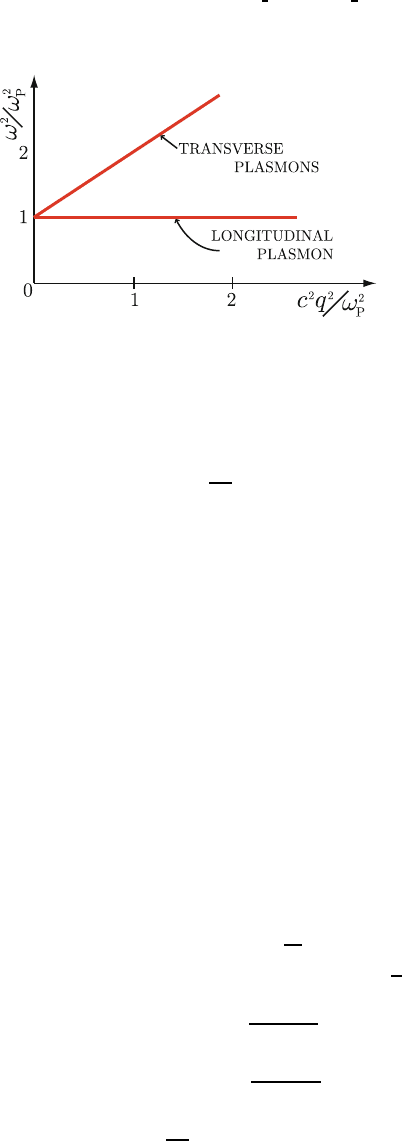
Fig. 14.4. The dispersion curves of transverse and longitudinal plasmon modes in
the absence of a dc magnetic field
In the local (collisionless) theory, the dielectric function is given by 176
ε ≈ 1 −
ω
2
p
ω
2
, (14.55)
so the normal modes are two degenerate transverse modes of frequency
177
ω
2
= ω
2
p
+ c
2
q
2
, (14.56)
and a longitudinal mode of frequency
178
ω = ω
p
. (14.57)
Figure 14.4 shows the dispersion curves of transverse and longitudinal plasmon
179
modes in the absence of a dc magnetic field. There are no propagating modes 180
for frequencies ω smaller than the plasma frequency ω
p
. 181
Now, consider the normal modes of the system in the presence of a dc 182
magnetic field. We choose the z-axis parallel to the magnetic field, and let the 183
wave vector q lie in the y − z plane. The secular equation can be written 184
ε
xx
− ξ
2
ε
xy
0
−ε
xy
ε
xx
− ξ
2
z
ξ
y
ξ
z
0 ξ
y
ξ
z
ε
zz
− ξ
2
y
=0. (14.58)
In writing down (14.58) we have introduced ξ =
cq
ω
, and now assume a local 185
theory of conductivity in which the nonvanishing elements of ε are 186
ε
xx
(ω)=ε
yy
(ω)=1−
ω
2
p
ω
2
− ω
2
c
,
ε
xy
(ω)=−ε
yx
(ω)=−i
ω
2
p
ω
c
/ω
ω
2
− ω
2
c
, (14.59)
ε
zz
(ω)=1−
ω
2
p
ω
2
.
Uncorrected Proof
BookID 160928 ChapID 14 Proof# 1 - 29/07/09
14.5 Magnetoplasma Waves 433
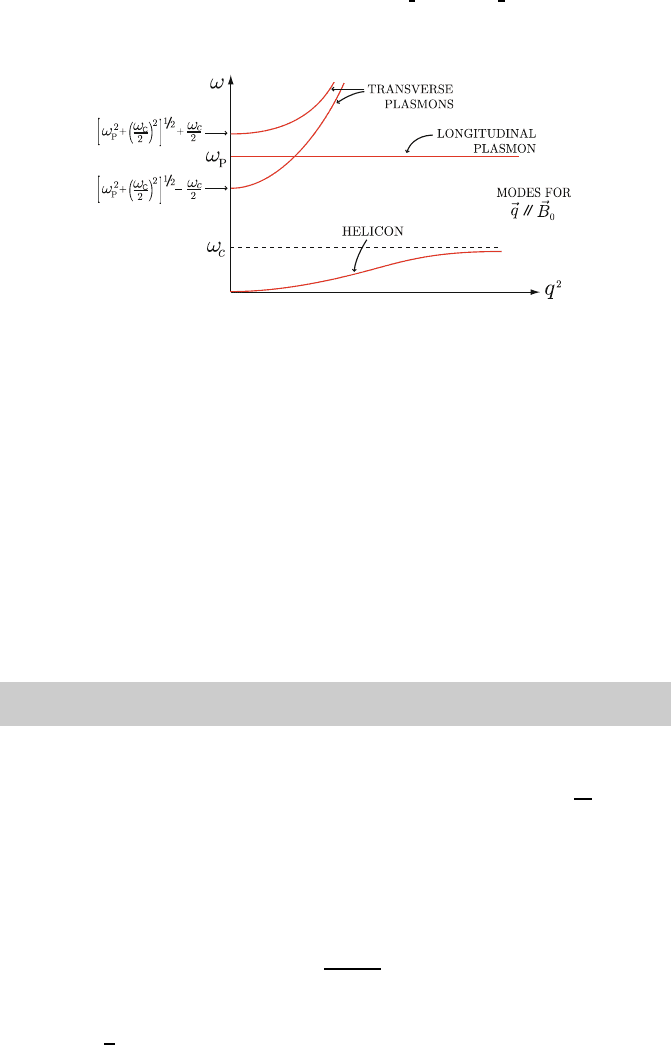
Fig. 14.5. The dispersion curves of magnetoplasma modes in a metal when the
wave propagates in the z-direction parallel to the dc magnetic field B
0
Because the dielectric constant is independent of q, the secular equation turns 187
out to be rather simple. It is a quadratic equation in q
2
188
αq
4
+ βq
2
+ γ =0, (14.60)
where
189
α = ε
xx
(ω)sin
2
θ + ε
zz
(ω)cos
2
θ,
β = −ω
2
-
ε
xx
(ω)ε
zz
(ω)(1 + cos
2
θ)+[ε
2
xy
(ω)+ε
2
xx
(ω)] sin
2
θ
.
, (14.61)
γ = ω
4
ε
2
xx
(ω)+ε
2
xy
(ω)
ε
zz
.
Here, θ is the angle between the direction of propagation and the direction
190
of the dc magnetic field. For θ = 0 (14.60) reduces to 191
ε
zz
(ω)
-
[q
2
− ω
2
ε
xx
(ω)]
2
+ ω
4
ε
2
xy
(ω)
.
=0. (14.62)
192
The roots can easily be plotted; there are four roots as are shown in Fig. 14.5. 193
The longitudinal plasmon ω = ω
p
is the solution of ε
zz
(ω)=0.Thetwo194
transverse plasmons start out at q =0asω =
ω
2
p
+(ω
c
/2)
2
1/2
±
ω
c
2
.Atvery 195
large q they are just light waves, but there is a difference in the phase velocity 196
for the two different (circular) polarizations. Their difference in phase velocity 197
is responsible for the Faraday effect–the rotation of the plane of polarization 198
in a plane polarized wave. The low frequency mode is the well-known helicon. 199
For small values of q it begins as 200
ω =
ω
c
c
2
q
2
ω
2
p
, (14.63)
and it asymptotically approaches ω = ω
c
for large q. 201
For θ =
π
2
(14.60) reduces to 202
[q
2
− ω
2
ε
zz
(ω)]
-
q
2
ε
xx
(ω) − ω
2
[ε
2
xx
(ω)+ε
2
xy
(ω)]
.
=0. (14.64)
The mode corresponding to q
2
= ω
2
ε
zz
(ω) is a transverse plasmon of fre- 203
quency ω =
ω
2
p
+ c
2
q
2
1/2
. The helicon mode appears no longer. The other
204
Uncorrected Proof
BookID 160928 ChapID 14 Proof# 1 - 29/07/09
434 14 Electrodynamics of Metals
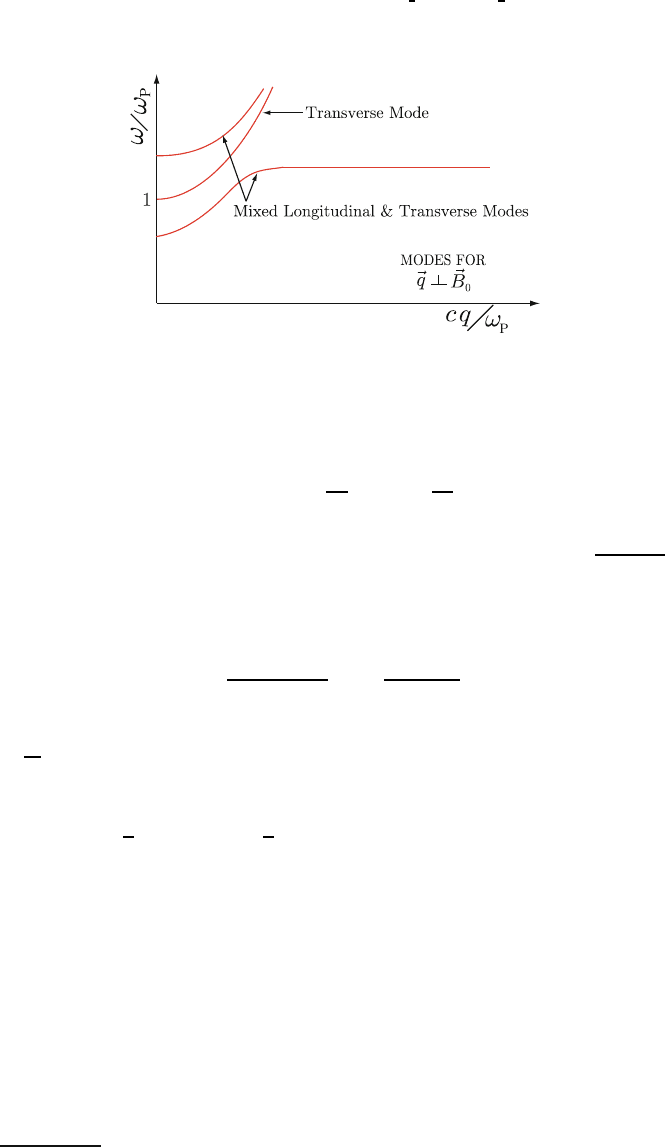
Fig. 14.6. The dispersion curves of magnetoplasma modes in a metal when the
wave propagates in the z-direction normal to the dc magnetic field B
0
two modes have mixed longitudinal and transverse character. They start at 205
ω =
ω
2
p
+
ω
c
2
2
1/2
±
ω
c
2
(14.65)
for q = 0. For very large q one mode is nearly transverse and varies as
206
ω ≈ cq while the other approaches the finite asymptotic limit ω =
2
ω
2
p
+ ω
2
c
. 207
The roots of (14.64) are sketched in Fig. 14.6. For an arbitrary angle of 208
propagation
1
the helicon mode has a frequency (we assume ω
p
ω
c
) 209
ω
ω
c
c
2
q
2
cos θ
ω
2
p
+ c
2
q
2
1+
i
ω
c
τ cos θ
. (14.66)
Here, we have included the damping due to collisions. For very large values
210
of
cq
ω
, the two finite frequency modes are sometimes referred to as the hybrid- 211
magnetoplasma modes. Their frequencies are 212
ω
2
±
=
1
2
ω
2
p
+ ω
2
c
+
1
4
ω
2
p
+ ω
2
c
2
− ω
2
p
ω
2
c
cos
2
θ
1/2
. (14.67)
213
For propagation at an arbitrary angle we can think of the four modes as 214
coupled magnetoplasma modes. The ω
±
modes described above for very large 215
values of q are obviously the coupled helicon and longitudinal plasmon. 216
14.6 Discussion of the Nonlocal Theory 217
By considering the q dependence of the conductivity one can find a number 218
of interesting effects that have been omitted from the local theory (as well as 219
the quantitative changes in the dispersion relation which are to be expected). 220
Among them are: 221
1
M.A. Lampert, J.J. Quinn, S. Tosima, Phys. Rev. 152, 661 (1966).