
Quinn J.J., Yi K.-S. Solid State Physics: Principles and Modern Applications
Подождите немного. Документ загружается.


Uncorrected Proof
BookID 160928 ChapID 14 Proof# 1 - 29/07/09
14.7 Cyclotron Waves 435
1. Landau Damping and Doppler Shifted Cyclotron Resonance 222
Suppose an electromagnetic wave of frequency ω and wave number q prop- 223
agates inside a metal. To absorb energy from the electromagnetic wave, 224
the component of the velocity of an electron along the applied dc mag- 225
netic field must satisfy nω
c
+ q
z
v
z
= ω for some integral values of n. 226
When nω
c
− q
z
v
F
<ω<nω
c
+ q
z
v
F
, there are electrons capable of direct 227
absorption of energy from the electromagnetic field and we have cyclotron 228
damping even in the absence of collisions. However, if this condition is 229
not satisfied, then, for example, when | ω − ω
c
|>q
z
v
F
, there does not 230
exist any electron with v
z
=(ω
c
− ω)/q
z
, which would resonantly absorb 231
energy from the wave. For n = 0, this effect is usually known as Landau 232
damping. Then, we have −q
z
v
F
<ω<q
z
v
F
or −v
F
<v
phase
<v
F
.It 233
corresponds to having a phase velocity v
phase
parallel to B
0
equal to the 234
velocity of some electrons in the solid, i.e., −v
F
<v
z
<v
F
. These electrons 235
will ride the wave and thus absorb power from it resulting in collision- 236
less damping of the wave. For n = 0, the effect is usually called Doppler 237
shifted cyclotron resonance, because the effective frequency seen by the 238
moving electron is ω
eff
= ω −q
z
v
z
and it is equal to n times the cyclotron 239
resonance frequency ω
c
. 240
2. Bernstein Modes or Cyclotron Modes 241
These are the modes of vibration inanelectronplasma,whichoccur242
only when σ has a q-dependence. They are important in plasma physics, 243
where they are known as Bernstein modes. In solid-state physics, they are 244
known as nonlocal waves or cyclotron waves. These modes start out at 245
ω = nω
c
for q = 0. They propagate perpendicular to the dc magnetic field, 246
and depend for their existence (even at very long wavelengths) on the q 247
dependence of σ. 248
3. Quantum Waves 249
These are waves which arise from the gigantic quantum oscillations in σ. 250
These quantum effects depend, of course, on the q dependence of σ. 251
14.7 Cyclotron Waves 252
We will give only one example of the new kind of wave that can occur when 253
the q dependence of σ is taken into account. We consider the magnetic field in 254
the z-direction and the wave vector q in the y-direction. The secular equation 255
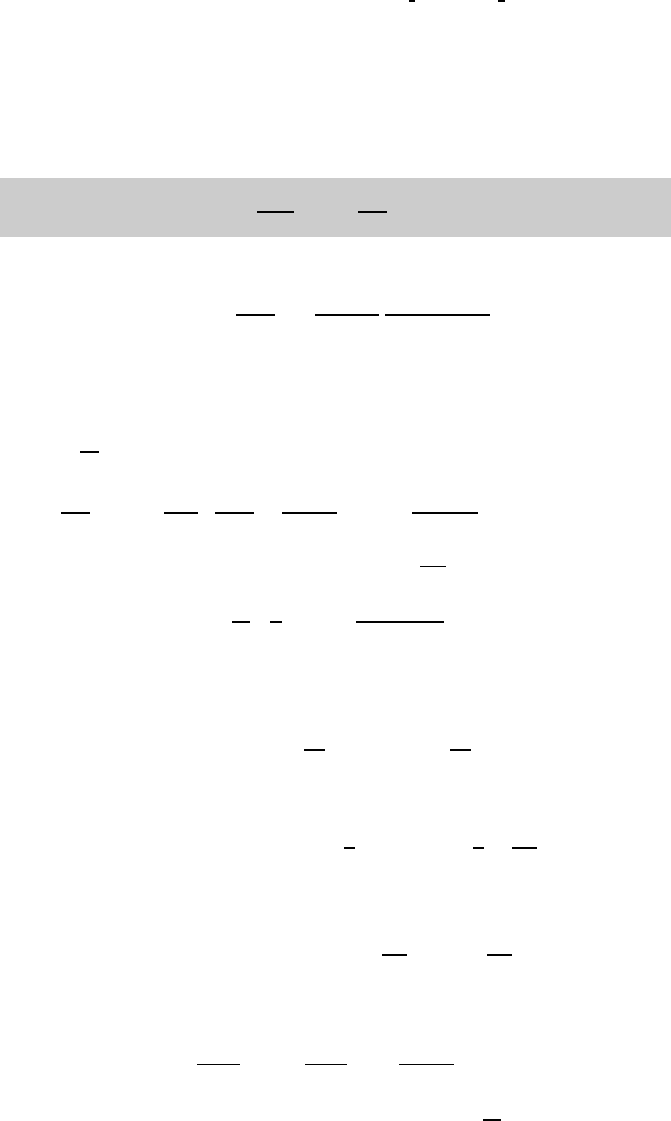
for wave propagation is the familiar 256
ε
xx
− ξ
2
ε
xy
0
−ε
xy
ε
yy
0
00ε
zz
− ξ
2
=0. (14.68)
Uncorrected Proof
BookID 160928 ChapID 14 Proof# 1 - 29/07/09
436 14 Electrodynamics of Metals
This secular equation reduces to a 2 × 2matrixanda1× 1matrix.Forthe 257
polarization with E parallel to the z-axis we are interested in the 1×1matrix. 258
The Lorentz force couples the x-y motions giving the 2×2 matrix for the other 259
polarization. For the simple case of the 1 × 1matrixwehave 260
c
2
q
2
ω
2
=1−
4πi
ω
σ
zz
, (14.69)
261
where, in the collisionless limit (i.e. τ →∞), 262
σ
zz
=
3iω
2
p
4π
∞
n=0
c
n
(w)
1+δ
n0
2ω
(nω
c
)
2
− ω
2
(14.70)
with
263
c
n
(w)=
1
0
d(cos θ)cos
2
θJ
2
n
(w sin θ). (14.71)
If we let
ω
ω
c
= a,wecanwrite 264
4πi
ω
σ
zz
= −
6ω
2
p
ω
2
c
c
0
/2
−a
2
+
c
1
1 − a
2
+ ···+
c
n
n
2
− a
2
+ ···
. (14.72)
Let us look at the long wavelength limit where
qv
F
ω
c
1. Remember that for 265
small x 266
J
n
(x)=
1
n!
x
2
n
1 −
(x/2)
2
1 · (n +1)
+ ···
. (14.73)
We keep terms to order w
2
. Because c
n
∝ J
2
n
, c
n
∝ w
2n
. Therefore, if we 267
retain only terms of order w
2
, we can drop all terms but the first two. Then, 268
we have 269
J
2
0
(x) ≈ 1 −
x
2
2
and J
2
1
(x) ≈
x
2
4
. (14.74)
Substituting (14.74) in c
0
and c
1
yields 270
c
0
(w) ≈
1
0
d(cos θ)cos
2
θ
1 −
1
2
w
2
sin
2
θ
=
1
3
−
w
2
15
, (14.75)
and for c
1
we find 271
c
1
(w) ≈
1
0
d(cos θ)cos
2
θ
w
2
4
sin
2
θ =
w
2
30
. (14.76)
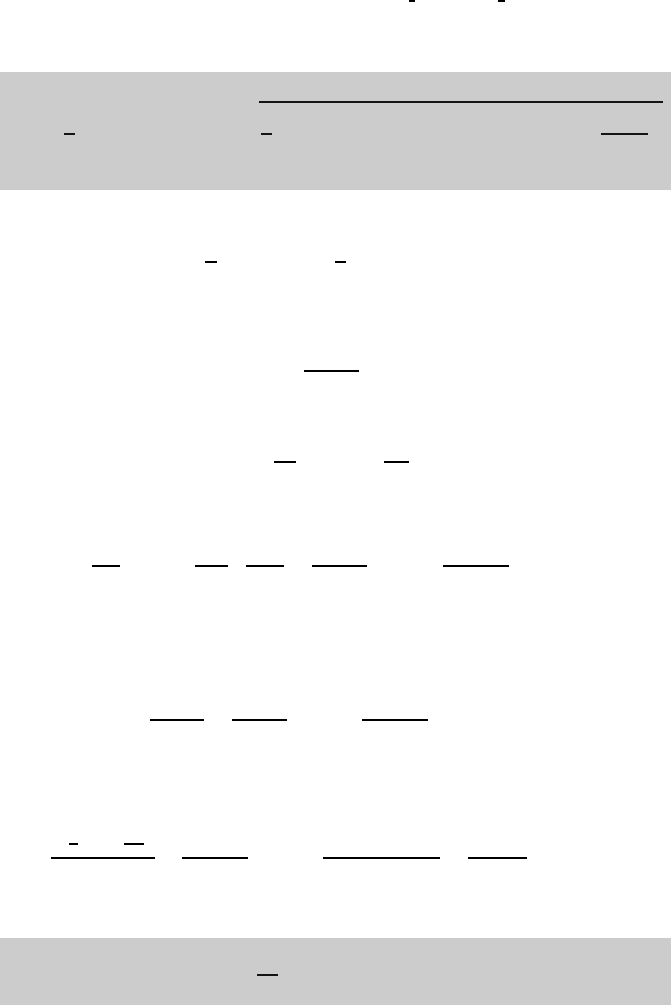
Substituting these results into the secular equation, (14.69), gives
272
c
2
q
2
ω
2
c
a
2
1 −
ω
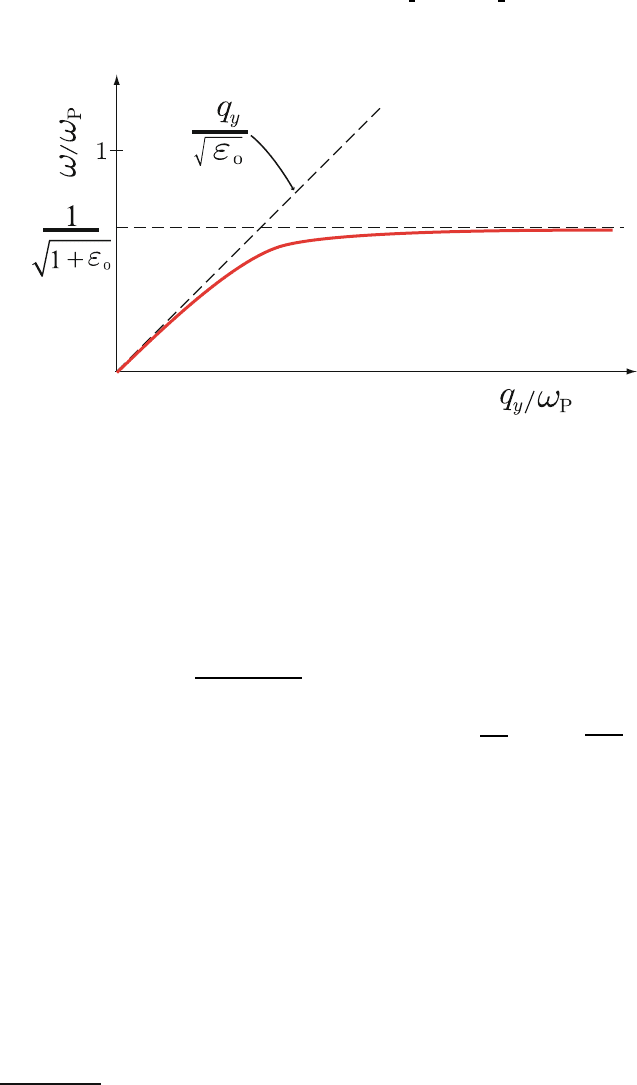
2
p
ω
2
c
a
2
1 −
w
2
/5
1 − a
2
. (14.77)
This is a simple quadratic equation in a
2
,wherea =
ω
ω
c
. The general solu- 273
tion is 274
Uncorrected Proof
BookID 160928 ChapID 14 Proof# 1 - 29/07/09
14.8 Surface Waves 437
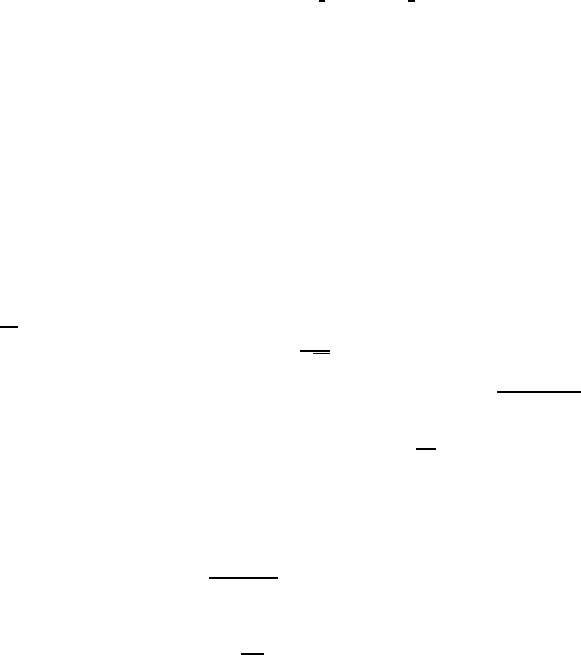
ω
2
=
1
2
ω
2
p
+ ω
2
c
+ c
2
q
2
±
1
1
4
ω
2
p
+ ω
2
c
+ c
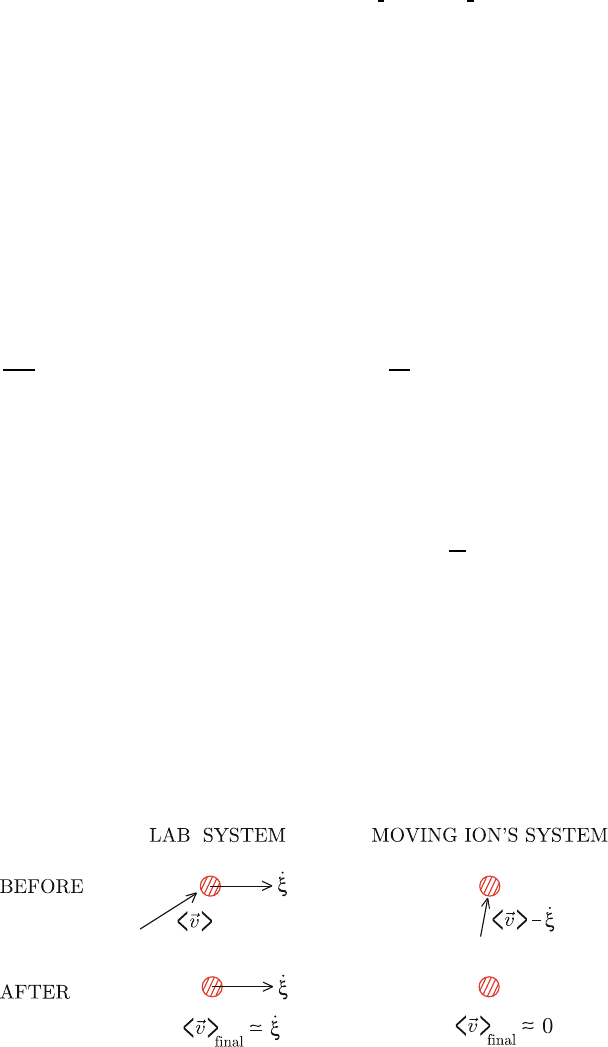
2
q
2
2
− ω
2
c
ω
2
p
+ c
2
q
2
−
ω
2
p
w
2
5
.
(14.78)
275
For q → 0, the two roots are 276
ω
2
=
1
2
ω
2
p
+ ω
2
c
±
1
2
ω
2
p
− ω
2
c
=
#
ω
2
p
,
ω
2
c
.
(14.79)
If ω
p
ω
c
, the lower root can be obtained quite well by setting 277
1 −
w
2
/5
1 − a
2
=0,
which gives
278
ω
ω
c
2
=1−
w
2
5
. (14.80)
Actually going back to (14.72)
279
4πi
ω
σ
zz
= −
6ω
2
p
ω
2
c
c
0
/2
−a
2
+
c
1
1 − a
2
+ ···+
c
n
n
2
− a
2
+ ···
,
it is not difficult to see that, for ω
p
nω
c
, there must be a solution at 280
ω
2
= n
2
ω
2
c
+O(q
2n
). We do this by setting c
n
= α
n
w
2n
for n ≥ 1. If ω
p
nω
c
, 281
then the solutions are given, approximately, by 282
−c
0
/2
a
2
+
c
1
1 − a
2
+ ···+
c
n
n
2
− a
2
+ ···
0.
Let us assume a solution of the form a
2
= n
2
+Δ,whereΔ n. Then the 283
above equation can be written 284
−
1
3
(1 −
w
2
5
)
n
2
+
α
1
w
2
1
2
− n
2
+ ···+
α
n−1
w
2(n−1)
(n − 1)
2
− n
2
+
α
n
w
2n
Δ
+ ···
0.
Solving for Δ gives Δ 3n
2
α
n
w
2n
. Thus, we have a solution of the form 285
ω
ω
c
2
= n
2
+O(q
2n
). (14.81)
286
14.8 Surface Waves 287
There are many kinds of surface waves in solids–plasmons, magnetoplasma 288
waves, magnons, acoustic phonons, optical phonons etc. In fact, we believe 289
that every bulk wave has associated with it a surface wave. To give some 290
Uncorrected Proof
BookID 160928 ChapID 14 Proof# 1 - 29/07/09
438 14 Electrodynamics of Metals
feeling for surface waves, we shall consider one simple case; surface plasmons 291
in the absence of a dc magnetic field. 292
We consider a metal of dielectric function ε
1
to fill the space z>0, and an 293
insulator of dielectric constant ε
0
the space z<0. The wave equation which 294
describes propagation in the y − z plane is given by 295
⎛
⎜
⎝
ε − ξ
2
00
0 ε − ξ
2
z
ξ
y
ξ
z
0 ξ
y
ξ
z
ε − ξ
2
y
⎞
⎟
⎠
⎛
⎜
⎝
E
x
E
y
E
z
⎞
⎟
⎠
=0. (14.82)
Here, ξ =
cq
ω
and ξ
2
= ξ
2
y
+ξ
2
z
. For the dielectric ε = ε
0
, a constant, and we find 296
only two transverse waves of frequency ω =
cq
√
ε
0
for the bulk modes. For the 297
metal (to be referred to as medium 1) there are one longitudinal plasmon of 298
frequency ω = ω
p
and two transverse plasmons of frequency ω =
2
ω
2
p
+ c
2
q
2
299
as the bulk modes. Here we are assuming that ε
1
=1−
ω
2
p
ω
2
is the dielectric 300
function of the metal. 301
To study the surface waves, we consider ω and q
y
to be given real numbers 302
and solve the wave equation for q
z
. For the transverse waves in the metal, we 303
have 304
q
2
z
=
ω
2
− ω
2
p
c
2
− q
2
y
. (14.83)
In the insulator, we have
305
q
2
z
= ε
0
ω
2
c
2
− q
2
y
. (14.84)
The q
z
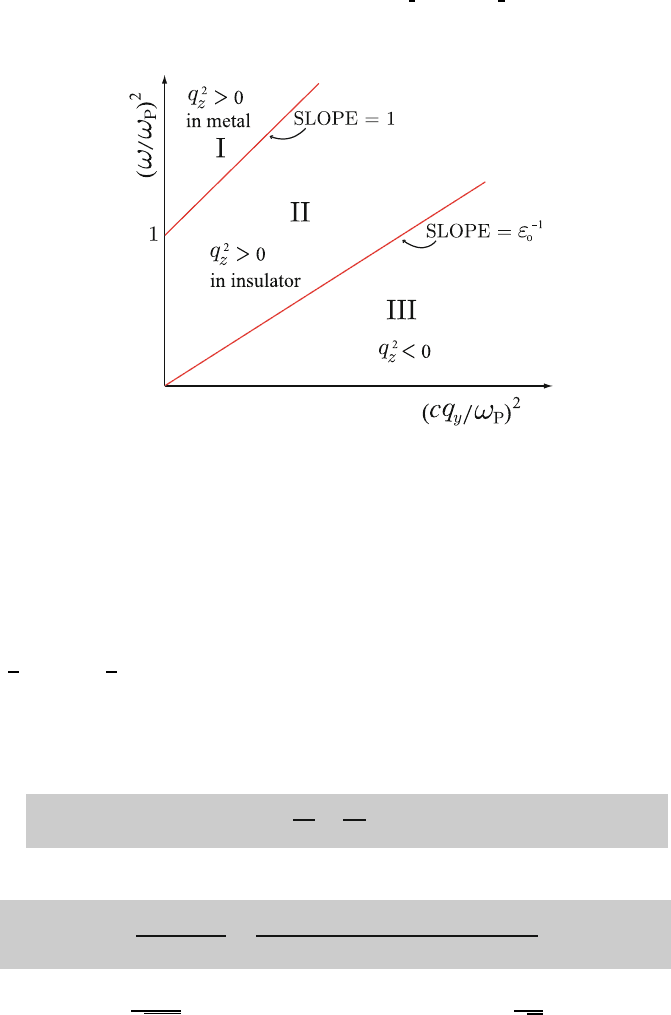
= 0 lines are indicated in Fig. 14.7 as solid lines. Notice that in region 306
III of Fig. 14.7, q
2
z
< 0 in both the metal and the insulator. This is the region 307
of interest for surface waves excitations, because negative q
2
z
implies that q
z
308
itself is imaginary. Solving for q
(1)
z
(value of q
z
in the metal) and q
(2)
z
(value of 309
q
z
in the insulator), when ω and q
y
are such that we are considering region III, 310
gives 311
q
(1)
z
= ±i(ω
2
p
+ q
2
y
− ω
2
)
1/2
= ±iα
1
,
q
(0)
z
= ±i(q
2
y
− ε
0
ω
2
)
1/2
= ±iα
0
. (14.85)
This defines α
0
and α
1
, which are real and positive. The wave in the metal 312
must be of the form e
±α
1
z
and in the insulator of the form e
±α
0
z
.Tohave 313
solutions well behaved at z → +∞ in the metal and z →−∞in the insulator 314
we must choose the wave of the proper sign. Doing so gives 315
E
(1)
(r,t)=E
(1)
e
iωt−iq
y
y−α
1
z
,
E
(0)
(r,t)=E
(0)
e
iωt−iq
y
y+α
0
z
. (14.86)
The superscripts 1 and 0 refer, respectively, to the metal and dielectric. The
316
boundary conditions at the plane z = 0 are the standard ones of continuity 317
Uncorrected Proof
BookID 160928 ChapID 14 Proof# 1 - 29/07/09
14.8 Surface Waves 439
Fig. 14.7. The ω
2
− q
2
y
plane for the waves near the interface of a metal and an
insulator at z = 0. The solid lines show the region where q
z
= 0 in the solid (line
separating regions I and II) and in the dielectric (line separating II and III). In
region III q
2
z
< 0 in both media, therefore excitations in this region are localized at
the surface
of the tangential components of E and H, and of the normal components 318
of D and B. By applying the boundary conditions (remembering that B = 319
i
c
ω
∇×E =
c
ω
(q
y
E
z
− q
z
E
y
,q
z
E
x
, −q
y
E
x
) we find that 320
1. For the independent polarization with E
y
= E
z
= 0, but E
x
=0thereare 321
no solutions in region III. 322
2. For the polarization with E
x
= 0, but E
y
=0= E
z
, there is a dispersion 323
relation 324
ε
1
α
1
+
ε
0
α
0
=0. (14.87)
325
If we substitute for α
0
and α
1
, (14.87) becomes 326
c
2
q
2
y
=
ω
2
ε
0
ε
1
(ω)
ε
0
+ ε
1
(ω)
=
ε
0
ω
2
(ω
2
p
− ω
2
)
ω
2
(ε
0
− 1) + ω
2
p
(ω
2
p
− ω
2
)
2
− ω
4
ε
2
0
. (14.88)
327
For very large q
y
the root is approximately given by the zero of the denomi- 328
nator, viz ω =
ω
p
√
1+ε
0
. For small values of q
y
it goes as ω =
c
√
ε
0
q
y
. Figure 14.8 329
shows the dispersion curve of the surface plasmon. 330
Uncorrected Proof
BookID 160928 ChapID 14 Proof# 1 - 29/07/09
440 14 Electrodynamics of Metals
c
c
Fig. 14.8. Dispersion relation of surface plasmon
14.9 Magnetoplasma Surface Waves 331
In the presence of a dc magnetic field B
0
oriented at an arbitrary angle 332
to the surface, the problem of surface plasma waves becomes much more 333
complicated.
2
We will discuss only the nonretarded limit of cq ω. 334
Let the metal or semiconductor be described by a dielectric function 335
ε
ij
(ω)=ε
L
δ
ij
−
ω
2
p
ω
2
(ω
2
− ω
2
c
)
ω
2
δ
ij
− ω
c
i
ω
c
j
− i ωω
c
k
ijk
, (14.89)
where ε
L
is the background dielectric constant, ω
c
=
eB
0
mc
, ω
c
x
=
eB
0
x
mc
,and 336
ijk
=+1(−1) if ijk is an even (odd) permutation of 123, and zero otherwise. 337
Let the insulator have dielectric constant ε
. The wave equation is given by 338
⎛
⎜
⎝
ε
xx
− q
2
/ω
2
ε
xy
ε
xz
ε
yx
ε
yy
− q
2
z
/ω
2
ε
yz
+ q
y
q
z
/ω
2
ε
zx
ε
zy
+ q
y
q
z
/ω
2
ε
zz
− q
2
y
/ω
2
⎞
⎟
⎠
⎛
⎝
E
x
E
y
E
z
⎞
⎠
=0. (14.90)
In the nonretarded limit (cq ω) the off-diagonal elements ε
xy
, ε
yx
, ε
xz
, ε
zx
339
can be neglected and (14.90) can be approximated (we put c =1)by 340
(q
2
− ω
2
ε
xx
)
ε
zz
q
2
z
+ ε
yy
q
2
y
+(ε
yz
+ ε
zy
)q
y
q
z
≈ 0. (14.91)
The surface magneto-plasmon solution arises from the second factor. Solving
341
for q
z
in the metal we find 342
2
A summary of magnetoplasma surface wave results in semiconductors is reviewed
by Quinn and Chiu in Polaritons, edited by E. Bernstein, F. DeMartini,
Pergamon, New York (1971), p. 259.

Uncorrected Proof
BookID 160928 ChapID 14 Proof# 1 - 29/07/09
14.10 Propagation of Acoustic Waves 441
q
(1)
z
q
y
= −i
1
ε
yy
ε
zz
−
ε
yz
+ ε
zy
2ε
zz
2
−
ε
yz
+ ε
zy
2ε
zz
. (14.92)
343
The superscript 1 refers to the metal. In the dielectric (superscript 0) q
(0)
z
= 344
+iq
y
. The eigenvectors are 345
E
(1)
(r,t)
9
0,E
(1)
y
, −
E
(1)
y
q
(1)
z
q
y
:
e
iωt−iq
y
y−iq
(1)
z
z
,
B
(1)
(r,t)
c
ω
q
y
E
(1)
z
− q
(1)
z
E
(1)
y
, 0, 0
e
iωt−iq
y
y−iq
(1)
z
z
≈ 0, (14.93)
E
(0)
(r,t)
9
0,E
(0)
y
, −
E
(0)
y
q
(0)
z
q
y
:
e
iωt−iq
y
y−iq
(0)
z
z
,
B
(0)
(r,t)
c
ω
q
y
E
(0)
z
− q
(0)
z
E
(0)
y
, 0, 0
e
iωt−iq
y
y−iq
(0)
z
z
≈ 0.
The dispersion relation obtained from the standard boundary conditions is
346
+iε
=
q
(1)
z
q
y
ε
zz
+ ε
zy
. (14.94)
With ε
L
= ε
, (14.94) simplifies to 347
ω
2
− ω
2
c
+(ω ± ω
c
x
)
2
−
ω
2
p
ε
L
=0, (14.95)
where the ± signs correspond to propagation in the ±y-directions, respec-
348
tively. For the case B
0
=0,thisgivesω =
ω
p
√
2ε
L
.ForB
0
⊥ x,we349
have 350
ω =
8
ω
2
c
+ ω
2
p
/ε
L
2
,
and with B
0
x we obtain 351
ω =
1
2
1
ω
2
c
+
2ω
2
p
ε
L
∓
ω
c
2
,
where the two roots correspond to propagations in the ±y-directions, respec-
352
tively. 353
14.10 Propagation of Acoustic Waves 354
Now, we will try to give a very brief summary of propagation of acoustic waves 355
in metals. Our discussion will be based on a very simple model introduced by 356
Quinn and Rodriguez.
3
The model treats the ions completely classically. The 357
metal is considered to consist of 358
3
J.J. Quinn, S. Rodriguez, Phys. Rev. 128, 2487 (1962).
Uncorrected Proof
BookID 160928 ChapID 14 Proof# 1 - 29/07/09
442 14 Electrodynamics of Metals
1. A lattice (Bravais lattice for simplicity) of positive ions of mass M and 359
charge ze. 360
2. An electron gas with n
0
electrons per unit volume. 361
3. In addition to electromagnetic forces, there are short range forces between 362
the ions which we represent by two ‘unrenormalized’ elastic constants C
363
and C
t
. 364
4. The electrons encounter impurities and defects, and have a collision time 365
τ associated with their motion. 366
First, let us investigate the classical equation of motion of the lattice. Let 367
ξ(r,t) be the displacement field of the ions. Then we have 368
M
∂
2
ξ
∂t
2
= C
∇(∇·ξ) −C
t
∇×(∇×ξ)+zeE +
ze
c
˙
ξ ×(B
0
+ B)+F. (14.96)
The forces appearing on the right hand side of (14.96) are
369
1. The short range “elastic” forces (the first two terms). 370
2. The Coulomb interaction of the charge ze with the self-consistent electric 371
field produced by the ionic motion (the third term). 372
3. The Lorentz force on the moving ion in the presence of the dc magnetic 373
field B
0
and the self-consistent ac field B.Theterm
ze
c
˙
ξ ×B is always very
374
small compared to zeE, and we shall neglect it (the fourth term). 375
4. The collision drag force F exerted by the electrons on the ions (the last 376
term). 377
The force F results from the fact that in a collision with the lattice, the elec- 378
tron motion is randomized, not in the laboratory frame of reference, but in a 379
frame of reference moving with the local ionic velocity. Picture the collisions as 380
shown in Fig. 14.9. Here, v is the average electron velocity (at point r where 381
the impurity is located) just before collision. Just after collision v
final
≈ 0 382
in the moving system, or v
final
≈
˙
ξ in the laboratory. Thus the momentum 383
Fig. 14.9. Schematic of electron–impurity collision in the laboratory frame and in
the coordinate system moving with the local ionic velocity. In the latter system a
typical electron has velocity v−
˙
ξ before collision and zero afterward. In the lab
system, the corresponding velocities are v before collision and
˙
ξ afterwards

Uncorrected Proof
BookID 160928 ChapID 14 Proof# 1 - 29/07/09
14.10 Propagation of Acoustic Waves 443
imparted to the positive ion must be Δp = m(v−
˙
ξ). This momentum is 384
imparted to the lattice per electron collision; since there are z electrons per 385
atom and
1
τ
collisions per second for each electron, it is apparent that 386
F =
z
τ
m(v−
˙
ξ). (14.97)
We can use the fact that the electronic current j
e
(r)=−n
0
ev(r) to write 387
F = −
zm
n
0
eτ
(j
e
+ n
0
e
˙
ξ). (14.98)
But the ionic current density is j
I
= n
0
e
˙
ξ so that 388
F = −
zm
n
0
eτ
(j
e
+ j
I
). (14.99)
The self-consistent electric field E appearing in the equation of motion,
389
(14.96), is determined from the Maxwell equations, which can be written 390
j
T
=Γ(q,ω) · E. (14.100)
Let us consider j
T
. It consists of the ionic current j
I
, the electronic current j
e
, 391
and any external driving current j
0
. For considering the normal modes of the 392
system (and the acoustic waves are normal modes) we set the external driving 393
current j
0
equal to zero and look for self-sustaining modes. Perhaps, if we have 394
time, we can discuss the theory of direct electromagnetic generation of acoustic 395
waves; in that case j
0
is a “fictitious surface current” introduced to satisfy the 396
boundary conditions in a finite solid (quite similar to the discussion given in 397
our treatment of the Azbel–Kaner effect.). For the present, we consider the 398
normal modes of an infinite medium. In that case, j
0
=0sothatj
T
= j
I
+ j
e
. 399
The electronic current would be simply j
e
= σ · E except for the effect of 400
“collision drag” and diffusion. These two currents arise from the fact that the 401
correct collision term in the Boltzmann equation must be 402
∂f
∂t
c
= −
f −
¯
f
0
τ
, (14.101)
where
¯
f
0
differs from the overall equilibrium distribution function f
0
in two 403
respects: 404
1.
¯
f
0
depends on the electron kinetic energy measured in the coordinates 405
system of the moving lattice. 406
2. The chemical potential ζ appearing in
¯
f
0
is not ζ
0
, the actual chemi- 407
cal potential of the solid, but a local chemical potential ζ(r,t)whichis 408
determined by the condition 409
d
3
k
f −
¯
f
0
=0, (14.102)
i.e., the local equilibrium density at point r must be the same as the
410
nonequilibrium density. 411
Uncorrected Proof
BookID 160928 ChapID 14 Proof# 1 - 29/07/09
444 14 Electrodynamics of Metals
We can expand
¯
f
0
as follows: 412
¯
f
0
(k, r,t)=f
0
(k)+
∂f
0
∂ε
−mv
k
·
˙
ξ + ζ
1
(r,t)
, (14.103)
where ζ
1
(r,t)=ζ(r,t)−ζ
0
. Because of these two changes, instead of j
e
= σ·E, 413
we have 414
j
e
(q,ω)=σ(q,ω) ·
E −
m
˙
ξ
eτ
+ eD
·∇n, (14.104)
where
415
D =
σ
e
2
g(ζ
0
)(1 + iωτ)
(14.105)
is the diffusion tensor. In (14.105), g(ζ
0
) is the density of states at the Fermi 416
surface and n(r,t)=n
0
+ n
1
(r,t) is the electron density at point (r,t). The 417
electron density is determined from the distribution function f,whichmustbe 418
solved for. However, at all but the very highest ultrasonic frequencies, n(r,t) 419
can be determined accurately from the condition of charge neutrality. 420
ρ
e
(r,t)+ρ
I
(r,t)=0, (14.106)
where ρ
e
(r,t)=−en
1
(r,t)andρ
I
can be determined from the equation of 421
continuity iωρ
I
− iq · j
I
= 0. Using these results, we find 422
j
e
(q,ω)=σ(q,ω) ·
E −
iωm
eτ
ξ +
n
0
eg(ζ
0
)(1 + iωτ)
q(q · ξ)
. (14.107)
If we define a tensor Δ
by 423
Δ =
n
0
eiω
σ
0
#
1
−
1
3
q
2
l
2
iωτ(1 + iωτ)
ˆ
q
ˆ
q
$
, (14.108)
where
ˆ
q =
q
|q|
,wecanwrite 424
j
e
(q,ω)=σ(q,ω) · E(q,ω) − σ(q,ω) · Δ(q,ω) · ξ(q,ω). (14.109)
We can substitute (14.109) into the relation j
e
+ j
I
=Γ·E,andsolveforthe 425
self-consistent field E to obtain 426
E(q,ω)=[Γ− σ]
−1
(iωne 1 − σ · Δ) · ξ. (14.110)
Knowing E,wealsoknowj
e
and hence F, (14.98) in terms of the ionic dis- 427
placement ξ. Thus, every term on the right-hand side of (14.96), the equation 428
of motion of the ions can be expressed in terms of ξ. The equation of motion 429
is thus of the form 430
T(q,ω) · ξ(q,ω)=0, (14.111)
431