
Quinn J.J., Yi K.-S. Solid State Physics: Principles and Modern Applications
Подождите немного. Документ загружается.

Uncorrected Proof
BookID 160928 ChapID 15 Proof# 1 - 29/07/09
466 15 Superconductivity
E
F
E
F
+
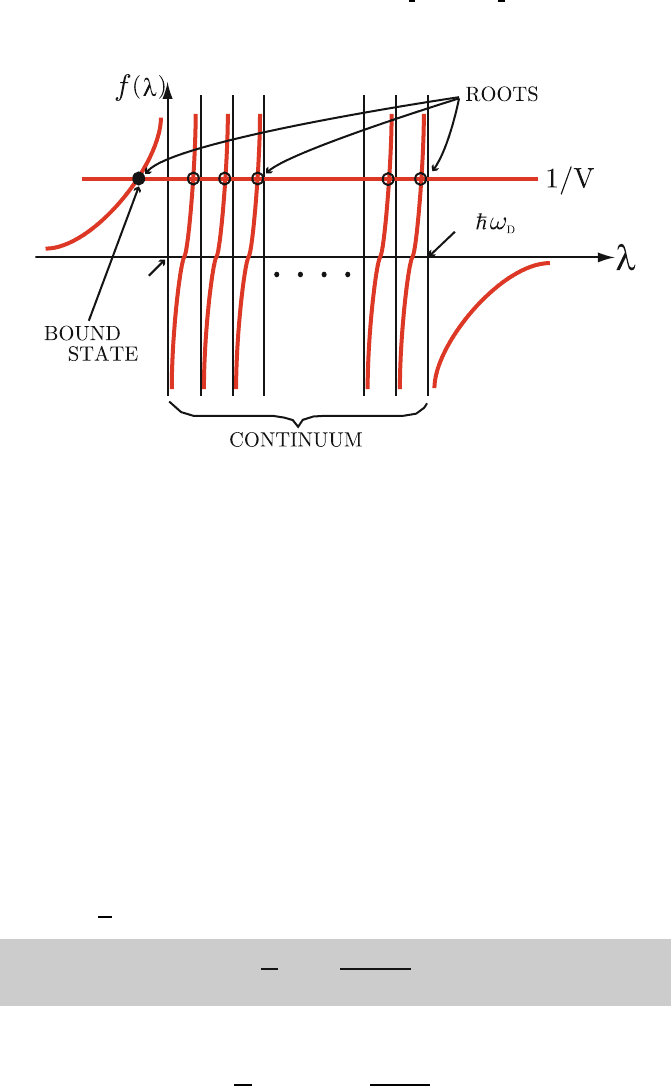
Fig. 15.10. Graphical solution of (15.30)
the function f(λ) is displayed as a function of λ, and it shows the graphical 181
solution of (15.30). Note that f(λ)goesfrom−∞ to ∞ every time λ crosses 182
a value of 2ε
k
in the quasi continuum. If we take (15.26) 183
(2ε
k
− λ) a
k
− V
a
=0, (15.31)
multiply by a
∗
k
and sum over k,weobtain 184
k
(2ε
k
− λ) a
∗
k
a
k
− V
k
a
∗
k
a
=0. (15.32)
This is exactly the same equation we obtained from writing
185
Ψ | H − E | Ψ =0, (15.33)
if we take λ = E, the energy of the variational state Ψ. Thus, our equation
186
for f (λ)=
1
V
could be rewritten 187
1
V
=
k
1
2ε
k
− E
. (15.34)
188
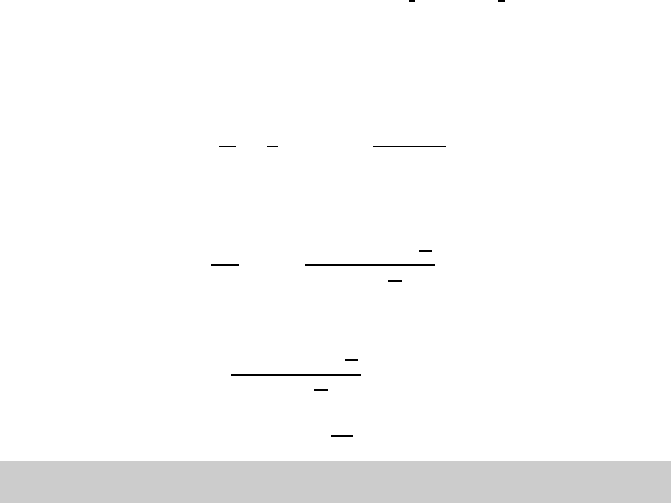
Approximate the sum in (15.34) by an integral over the energy ε and write 189
1
V
=
E
F
+¯hω
D
E
F
g(ε) dε
2ε − E
. (15.35)
Uncorrected Proof
BookID 160928 ChapID 15 Proof# 1 - 29/07/09
15.4 The BCS Ground State 467
Now, let us take g(ε) g(E
F
) ≡ g in the region of integration to obtain 190
1
V
=
g
2
E
F
+¯hω
D
E
F
dx
x − E/2
. (15.36)
Integrating (15.36) out gives
191
2
gV
=ln
9
E
F
+¯hω
D
−
E
2
E
F
−
E
2
:
, (15.37)
or
192
E
F
+¯hω
D
−
E
2
E
F
−
E
2
=e
2/gV
.
For the case of weak coupling regime
2
gV
1ande
−2/gV
1. This gives 193
E 2E
F
− 2¯hω
D
e
−2/gV
. (15.38)
194
The quantity 2¯hω
D
e
−2/gV
is the binding energy of the Cooper pair. Notice 195
that 196
1. One can get a bound state no matter how weakly attractive V is. The free 197
electron gas is unstable with respect to the paired bound state. 198
2. This variational result, which predicts the binding energy proportional to 199
e
−2/gV
, could not be obtained in perturbation theory. 200
3. The material with higher value of V would likely show higher T
c
. 201
The BCS theory uses the idea of pairing to account of the most important 202
correlations. 203
15.4 The BCS Ground State 204
Let us write the model Hamiltonian, (15.21) by 205
H = H
0
+ H
1
, (15.39)
where
206
H
0
=
k
ε
k
c
†
k↑
c
k↑
+ c
†
−k↓
c
−k↓
(15.40)
and
207
H
1
= −V
kk
c
†
k
↑
c
†
−k
↓
c
−k↓
c
k↑
. (15.41)

Uncorrected Proof
BookID 160928 ChapID 15 Proof# 1 - 29/07/09
468 15 Superconductivity
Note that we have included in the interaction only the interaction of k ↑ with 208
−k ↓. In our discussion of the totally noninteracting electron gas, we found 209
it convenient to use a description in terms of quasielectrons and quasiholes, 210
where a quasielectron was an electron with |k| >k
F
and a quasihole was the 211
absence of an electron with |k| <k
F
. We could define 212
d
†
kσ
= c
kσ
for k < k
F
,
d
kσ
= c
†
kσ
for k < k
F
.
(15.42)
Then d
†
kσ
creates a “hole” and d
kσ
annihilates a “hole”. If we measure all 213
energies ε
k
relative to the Fermi energy, then H
0
can be written as 214
H
0
=
k,σ
ε
k
c
†
kσ
c
kσ
= E
0
+
|k|>k
F
,σ
˜ε
k
n
kσ
+
|k|<k
F
| ˜ε
k
| (1 − n
kσ
),
(15.43)
where n
kσ
= c
†
kσ
c
kσ
,˜ε
k
= ε(k) − E
F
,andE
0
=
|k|<k
F
ε
k
is the energy
215
of the filled Fermi sphere. Because c
†
kσ
adds a momentum k and spin σ to 216
the system while d
†
kσ
subtract k and σ (or adds −k and ¯σ), it is useful to 217
introduce 218
α
†
kσ
= u
k
c
†
kσ
+ v
−k
c
−k¯σ
(15.44)
and its Hermitian conjugate
219
α
kσ
= u
k
c
kσ
+ v
−k
c
†
−k¯σ
. (15.45)
The operator α
†
kσ
adds momentum k and spin σ to the system. If u
k
=1, 220
v
k
=0for|k| >k
F
and u
k
=0,v
k
=1for|k| <k
F
,wehavesimply 221
the noninteracting electron gas described in terms of α
kσ
and α
†
kσ
.Wemust 222
have u
k
= u
−k
and v
k
= − v
−k
.Alsou
2
k
+ v
2
k
= 1 in order to satisfy the 223
anticommutation relations
α
k
,α
†
k
+
= δ
kk
. 224
From (15.44) and (15.45) we have that 225
c
†
kσ
c
kσ
= u
2
k
α
†
kσ
α
kσ
+ v
2
k
α
−k¯σ
α
†
−k¯σ
+ u
k
v
k
α
†
kσ
α
†
−k¯σ
+ α
−k¯σ
α
kσ
.
Hence
226
k,σ
ε
k
c
†
kσ
c
kσ
=
k
ε
k
u
2
k
α
†
k↑
α
k↑
+ v
2
k
(1 − α
†
−k↓
α
−k↓
)
=
|k|<k
F
ε
k
+
k,σ
|ε
k
|α
†
kσ
α
kσ
.
Therefore, in terms of the α
k
and α
†
k
, the noninteracting Hamiltonian is writ- 227
ten as 228
H
0
= E
0
+
k,σ
| ˜ε
k
| α
†
kσ
α
kσ
. (15.46)
229

Uncorrected Proof
BookID 160928 ChapID 15 Proof# 1 - 29/07/09
15.4 The BCS Ground State 469
The ground state of the noninteracting electron gas (filled Fermi sphere) can 230
be constructed by annihilating quasiholes in all states with | k |<k
F
and is 231
given by 232
| GS =
kσ
α
kσ
α
−k¯σ
| VAC , (15.47)
where | VAC is the true vacuum state. Using (15.44) and (15.45) gives
233
| GS =
kσ
v
2
k
c
†
−k¯σ
c
†
kσ
| VAC . (15.48)
But, for the noninteracting system v
k
=1if|k| <k
F
and zero otherwise so 234
that 235
| GS =
|k|<k
F
,σ
c
†
−k¯σ
c
†
kσ
| VAC . (15.49)
236
For the interacting system we will use a slight generalization of the notation 237
used above. 238
15.4.1 Bogoliubov–Valatin Transformation 239
For the Hamiltonian given in (15.40) and (15.41), we make the transformation 240
(called Bogoliubov–Valatin transformation) defined by 241
α
k
= u
k
c
k↑
− v
k
c
†
−k↓
β
†
k
= u
k
c
†
−k↓
+ v
k
c
k↑
, (15.50)
242
with Hermitian conjugates α
†
k
= u
k
c
†
k↑
+ v
k
c
−k
¯
↓
and β
k
= u
k
c
−k↓
+ v
k
c
†
k↑
. 243
Note that the up spin ↑ is associated with the index k and the down spin 244
↓ is associated with the index −k. The operators α
†
k
and α
k
create or destroy 245
an excited state of the system, which is a correlated electron–hole pair. We 246
take u
k
= u
−k
and v
k
= −v
−k
; in addition u
2
k
+ v
2
k
must be equal unity in 247
order to satisfy the anticommutation relations: 248
α
k
,α
†
k
+
=
β
k
,β
†
k
+
= δ
kk
;[α
k
,α
k
]
+
=[β
k
,β
k
]
+
=0.
We can solve (15.50) for c
k↑
and c
−k↓
and their Hermitian conjugates 249
c
k↑
= u
k
α
k
+ v
k
β
†
k
; c
†
k↑
= u
k
α
†
k
+ v
k
β
k
c
†
−k↓
= u
k
β
†
k
− v
k
α
k
; c
−k↓
= u
k
β
k
− v
k
α
†
k
.
(15.51)
Note that u
2
k
is the probability that a pair of states with opposite k and σ is 250
unoccupied and v
2
k
is the probability that it is occupied. Substituting (15.51) 251
in (15.40) gives 252

Uncorrected Proof
BookID 160928 ChapID 15 Proof# 1 - 29/07/09
470 15 Superconductivity
H
0
=
k
˜ε
k
u
2
k
α
†
k
α
k
+ v
2
k
β
k
β
†
k
+ u
k
v
k
(α
†
k
β
†
k
+ β
k
α
k
)
+ u
2
k
β
†
k
β
k
+ v
2
k
α
k
α
†
k
− u
k
v
k
(β
†
k
α
†
k
+ α
k
β
k
)
.
(15.52)
Let us put the operators in normal form using β
k
β
†
k
=1− β
†
k
β
k
.Thisgives 253
H
0
=
k
˜ε
k
2v
2
k
+(u
2
k
− v
2
k
)(α
†
k
α
k
+ β
†
k
β
k
)+2u
k
v
k
(α
†
k
β
†
k
+ β
k
α
k
)
.
(15.53)
If we do the same thing for the interaction part H
1
given by (15.41) 254
H
1
= −V
kk
c
†
k
↑
c
†
−k
↓
c
−k↓
c
k↑
, (15.54)
we obtain
255
H
1
= −V
kk
(u
k
α
†
k
+ v
k
β
k
)(u
k
β
†
k
− v
k
α
k
)(u
k
β
k
− v
k
α
†
k
)(u
k
α
k
+ v
k
β
†
k
)
= −V
kk
u
k
v
k
u
k
v
k
(1 − α
†
k
α
k
− β
†
k
β
k
)(1 − α
†
k
α
k
− β
†
k
β
k
)
+ u
k
v
k
(1 − α
†
k
α
k
− β
†
k
β
k
)(u
2
k
− v
2
k
)(α
†
k
β
†
k
+ β
k
α
k
)
+4
th
order off-diagonal terms
.
(15.55)
When this expression is multiplied out and then put in normal form (with all 256
annihilation operators on the right of all creation operators), the result can 257
be written 258
H = H(0) + H(2) + H(4). (15.56)
Here, H(2n) contains terms involving products of 2n Fermion operators
259
(α, α
†
,β,andβ
†
). It is simple to evaluate H(0): 260
H(0) = 2
k
ε
k
v
2
k
− V
kk
u
k
v
k
u
k
v
k
. (15.57)
The terms in H(2) can be written
261
H(2) =
k
ε
k
(u
2
k
− v
2
k
)+V (
k
2u
k
v
k
)u
k
v
k
(α
†
k
α
k
+ β
†
k
β
k
)
+
k
2u
k
v
k
˜ε
k
− (u
2
k
− v
2
k
)V
k
u
k
v
k
(α
†
k
β
†
k
+ β
k
α
k
).
(15.58)
We will neglect the terms in H(4); they contain interactions between the ele-
262
mentary excitations. H(0) + H(2) is not exactly in the form we desire because 263
of the term proportional to (α
†
k
β
†
k
+ β
k
α
k
). We are still at liberty to choose 264
u
k
and v
k
; we do this by requiring the coefficient of (α
†
k
β
†
k
+ β
k
α
k
)tovanish. 265
This gives us 266
2u
k
v
k
˜ε
k
=(u
2
k
− v
2
k
)V
k
u
k
v
k
. (15.59)
267
Uncorrected Proof
BookID 160928 ChapID 15 Proof# 1 - 29/07/09
15.4 The BCS Ground State 471
Let us define Δ by 268
Δ=V
k
u
k
v
k
(15.60)
269
and use it in (15.59) after squaring both sides. This gives 270
4u
2
k
v
2
k
˜ε
2
k
=Δ
2
(u
2
k
− v
2
k
)
2
. (15.61)
We can eliminate u
2
k
sincewealreadyknowthatu
2
k
+ v
2
k
= 1. Doing so gives 271
the quadratic equation in v
2
k
. 272
v
4
k
[˜ε
2
k
+Δ
2
] − v
2
k
[˜ε
2
k
+Δ
2
]+
Δ
2
4
=0. (15.62)
We choose the solution of the form
273
v
2
k
=
1
2
(1 − ξ
k
). (15.63)
Here, ξ
k
=
˜ε
k
√
˜ε
2
k
+Δ
2
. Furthermore since u
2
k
=1− v
2
k
, we find that 274
u
2
k
=
1
2
(1 + ξ
k
). (15.64)
But (15.60), the definition of Δ, can now be written
275
Δ=
1
2
V
k
2
1 − ξ
2
k
. (15.65)
With a little algebra, (15.65) becomes
276
Δ=
V
2
k
Δ
˜ε
2
k
+Δ
2
. (15.66)
Thus, the equation for the energy gap Δ is given by
277
1=
V
2
k
1
˜ε
2
k
+Δ
2
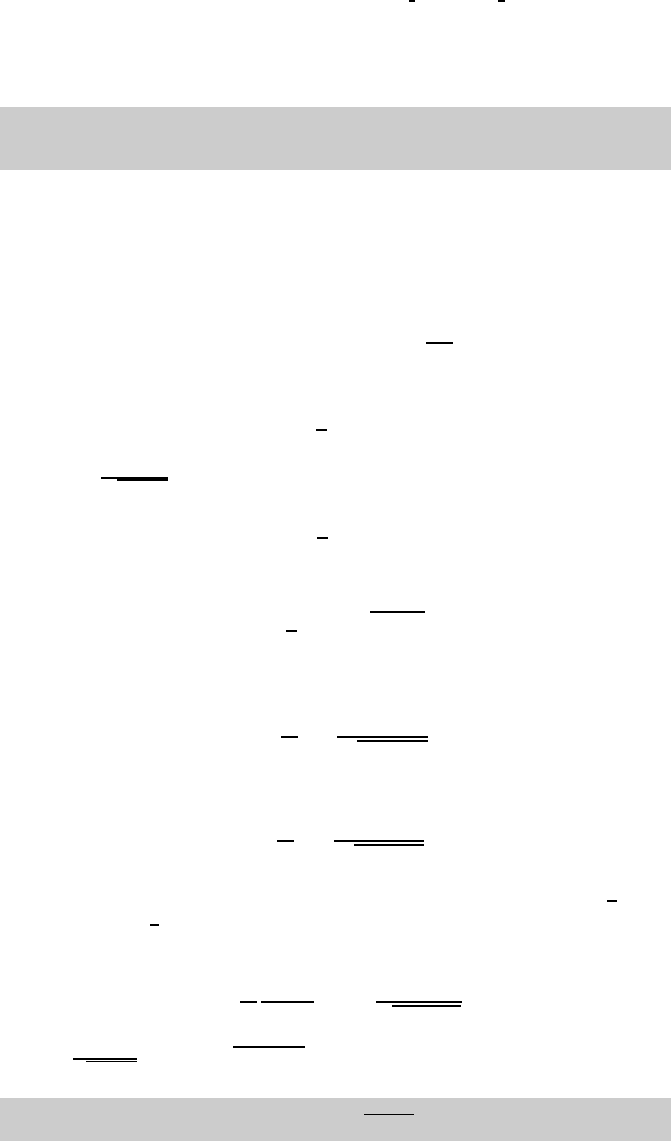
. (15.67)
Now, replace the sum by an integral taking for the density of states
1
2
g(E
F
) 278
of the pair. The
1
2
results from the fact that only k ↑ and −k ↓ are coupled 279
by the interaction. Then, (15.67) becomes 280
1=
V
2
g(E
F
)
2
¯hω
q
−¯hω
q
dε
√
ε
2
+Δ
2
. (15.68)
Using
"
dx
√
x
2
+Δ
2
=ln(x+
√
x
2
+Δ
2
)=sinh
−1
(x/Δ), the result for Δ becomes 281
282
Δ=2¯hω
q
e
−
2
g(E
F
)V
. (15.69)
283
Uncorrected Proof
BookID 160928 ChapID 15 Proof# 1 - 29/07/09
472 15 Superconductivity
If the interaction V is zero, the one-particle states of the system would be 284
occupied up to |k| = k
F
, and Δ agrees with the binding energy of a Cooper 285
pair. 286
15.4.2 Condensation Energy 287
The condensation energy ΔE(≡ E
0
S
− E
0
N
) defined by the difference between 288
the ground state energy in the normal state and the state with finite Δ is 289
approximately given by 290
ΔE −g(E
F
)
Δ
2
×
Δ
2
= −g(E
F
)
Δ
2
4
. (15.70)
291
The ground-state wave function Ψ
0
of the superconducting system is the 292
eigenfunction of the diagonalized BCS Hamiltonian, so that 293
α
k
| Ψ
0
= β
†
k
| Ψ
0
=0. (15.71)
One can obtain Ψ
0
by writing 294
| Ψ
0
=
k
α
k
β
k
| VAC . (15.72)
This gives the normalized wave function
295
| Ψ
0
=
k
(u
k
+ v
k
c
†
k
c
†
−k
) | VAC, (15.73)
which is the BCS variational wave function normalized so that Ψ
0
|Ψ
0
=1. 296
15.5 Excited States 297
From (15.58) we can see that 298
H(2) =
k
E
k
(α
†
k
α
k
+ β
†
k
β
k
), (15.74)
where
299
E
k
=˜ε
k
(u
2
k
− v
2
k
)+2Δu
k
v
k
. (15.75)
Knowing that u
k
=
1
√
2
√
1+ξ
k
and v
k
=
1
√
2
√
1 − ξ
k
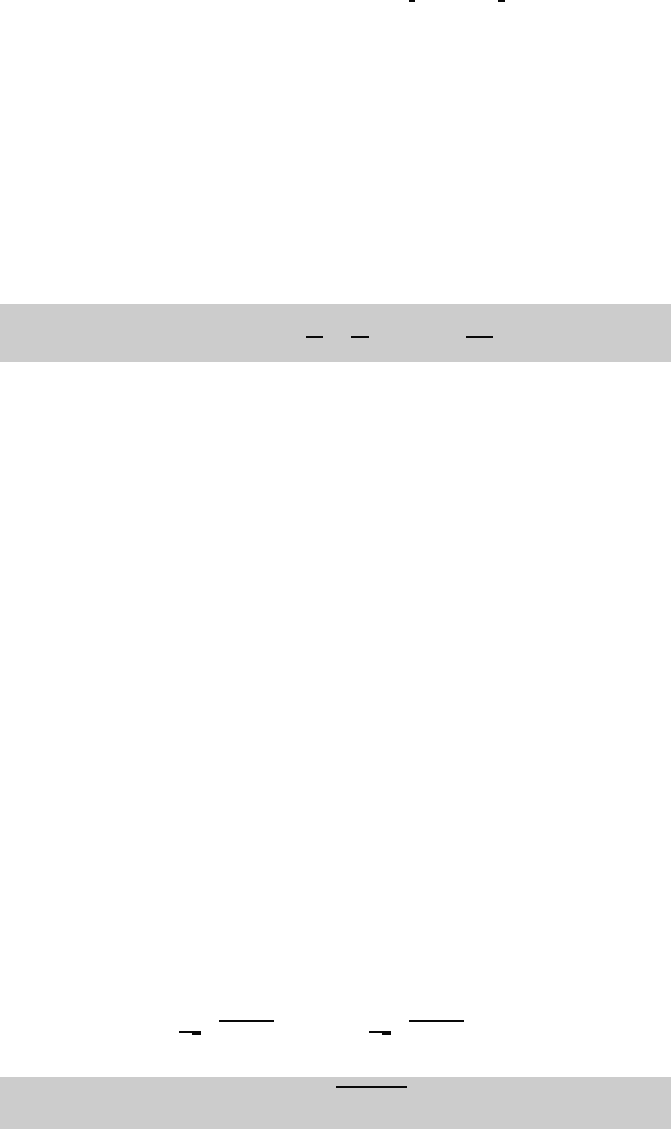
allows us to obtain the 300
energy of an individual quasiparticle 301
E
k
=
2
˜ε
2
k
+Δ
2
, (15.76)
302
Uncorrected Proof
BookID 160928 ChapID 15 Proof# 1 - 29/07/09
15.5 Excited States 473
~
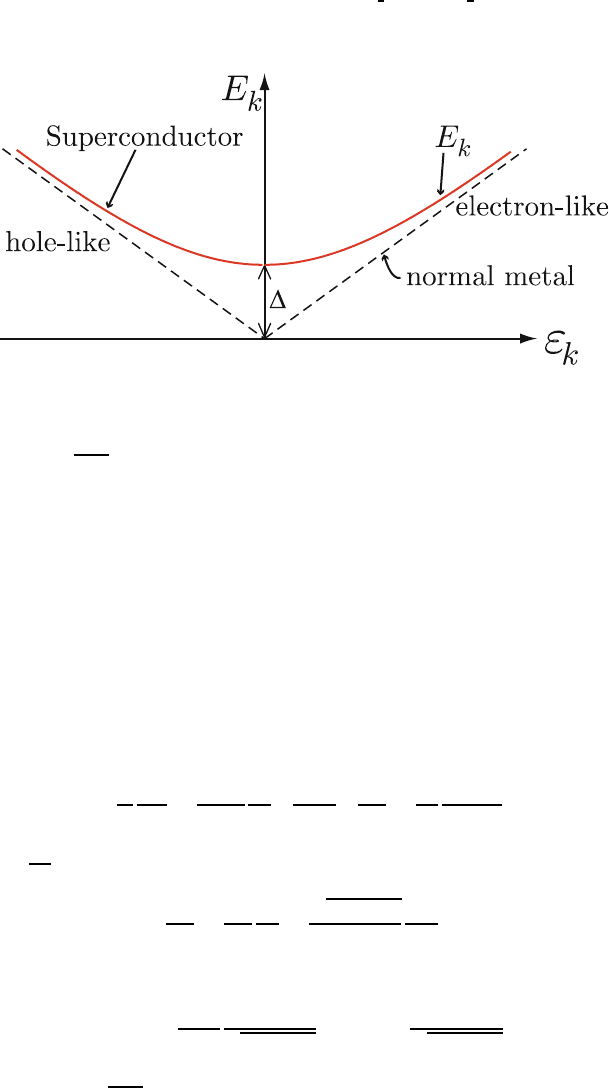
Fig. 15.11. Elementary excitations in a normal metal and in a superconductor
where ˜ε
k
=
¯h
2
k
2
2m
−E
F
, i.e., the energy is measured relative to the Fermi energy 303
E
F
. Thus, there is a gap Δ for the creation of elementary excitations α
†
k
| Ψ
0
304
or β
†
k
| Ψ
0
.Thestateα
†
k
| Ψ
0
is a quasiparticle state of wave vector k, 305
involving a superposition of an electron of wave vector k and a hole of wave 306
vector −k. In Fig. 15.11 quasiparticle energy spectra for a normal metal and 307
for a superconductor are illustrated. The excitation spectrum has a gap Δ, 308
which is known as the gap parameter. We notice that, since α
†
k
and β
†
k
are 309
linear combinations of single Fermion operators and always appear in pairs in 310
the interaction Hamiltonian. Therefore, quasiparticles can be excited in pairs 311
with the minimum excitation energy of 2Δ. The experimental gap should be 312
2Δ in experiments on absorption of electromagnetic radiation. 313
The density of quasiparticle states in the superconductor can be obtained 314
using the quasiparticle dispersion relation E
k
. 315
g
S
(E)=
1
Ω
dN
dE
=
2
(2π)
3
d
dk
4πk
3
3
dk
dE
=
k
2
π
2
1
dE/dk
, (15.77)
where
dE
dk
is written, from (15.76), by 316
dE
dk
=
dE
d˜ε
d˜ε
dk
=
√
E
2
− Δ
2
E
¯h
2
k
m
. (15.78)
Substituting (15.78) in (15.79) gives
317
g
S
(E)=
mk
F
π
2
¯h
2
E
√
E
2
− Δ
2
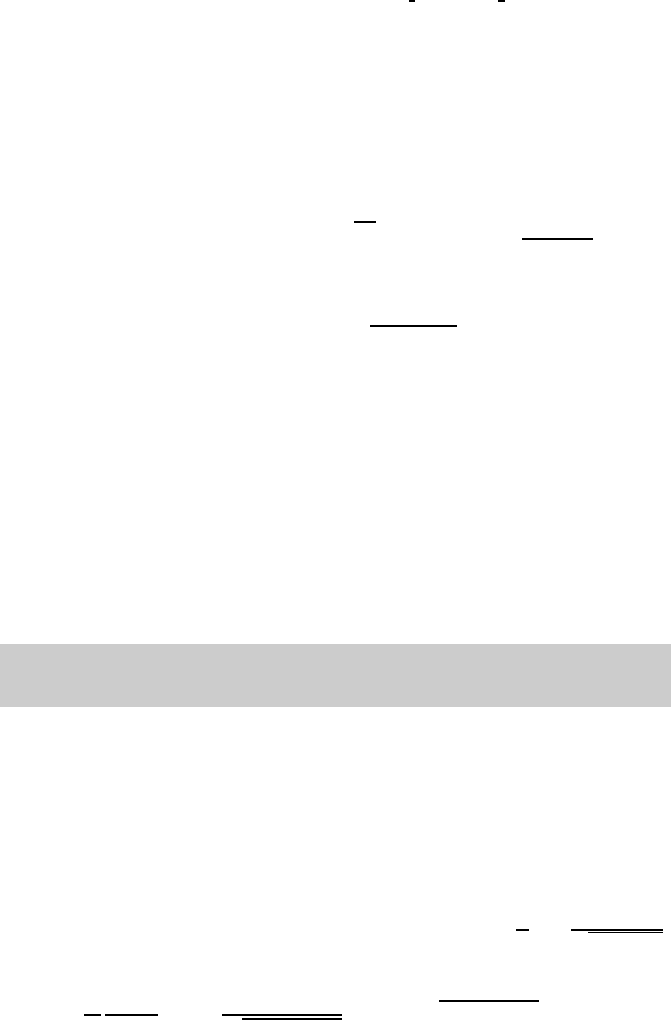
= g
N
(E
F
)
E
√
E
2
− Δ
2
, (15.79)
where g
N
(E)=
mk
π
2
¯h
2
is the density of states of the normal metal. Since we con- 318
sider the quasiparticle energies close to the Fermi surface, we replaced g
N
(E) 319
by its value at the Fermi energy E
F
. Notice that the density of quasiparticles 320
Uncorrected Proof
BookID 160928 ChapID 15 Proof# 1 - 29/07/09
474 15 Superconductivity
in the superconducting states shows a singularity at the energies E = ±Δ 321
measured with respect to the Fermi energy. 322
Essentially, all the other properties of a BCS superconductor can be 323
evaluated knowing that 324
1. The ground-state energy given by H(0), (15.57), is lower than the normal 325
state energy (E
0
N
=
|k|<k
F
˜ε
k
)by−
Δ
2
4
g(E
F
), (15.70). 326
2. The energy of elementary excitations is given by E
k
=
˜ε
2
k
+Δ
2
, (15.76). 327
3. The Fermi distribution function n
k
is given by 328
f(E
k
)=n
k
=
1
e
E
k
/Θ
+1
.
Here, of course, ˜ε
k
appearing in E
k
is measured relative to E
F
. 329
4. The BCS wave function is given by (15.73) 330
| Ψ
0
=
k
(u
k
+ v
k
c
†
k
c
†
−k
) | VAC.
One final example shows how to calculate the energy gap Δ as a function of
331
temperature. We note that states k ↑ and −k ↓ are occupied statistically at 332
finite temperatures. The Δ given in (15.69) was obtained under the assump- 333
tion that n
k
=0atT = 0. But, at finite temperatures the Fermi distribution 334
function should be understood as the occupation probability, and we expect 335
n
k
=0andΔ=Δ(T ). To evaluate Δ(T ) we need to extend (15.59) by writing 336
2u
k
v
k
˜ε
k
=(u
2
k
− v
2
k
)V
k
u
k
v
k
(1 − 2f(E
k
)) . (15.80)
337
This comes from keeping a term −(α
†
k
α
k
+ β
†
k
β
k
) averaged at T =0in 338
1 − (α
†
k
α
k
+ β
†
k
β
k
) =1− n
k
− n
k
=1− 2f (E
k
),
instead of just unity as was done in writing (15.58). Now, we define
339
Δ(T )=V
k
u
k
v
k
[1 − 2f(E
k
)] . (15.81)
Substituting (15.64) and (15.63) for u
k
and v
k
gives 1 =
V
2
k
1−2f(E
k
)
√
˜ε
2
k
+Δ
2
(T )
, 340
which reduces to 341
1=
V
2
g(E
F
)
2
¯hω
D
−¯hω
D
dε
ε
2
+Δ
2
(T )
1 − 2f(
ε
2
+Δ
2
(T ))
. (15.82)
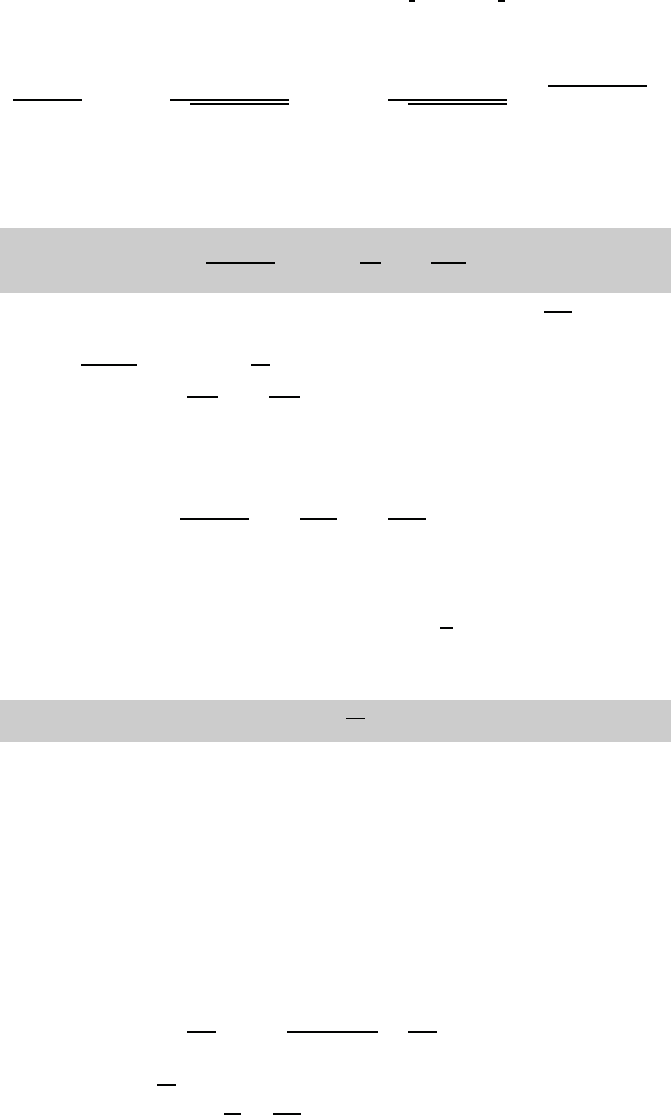
At T = 0 this is the T = 0 gap equation, (15.68). As T increases from T =0,
342
Δ(T ) would decreases from Δ
0
, the zero temperature value. Δ(T )vanishes 343
for T ≥ T
c
, where Δ = 0 is the only stable solution. The superconductivity 344
disappears above T
c
. Now, (15.82) can be written 345
Uncorrected Proof
BookID 160928 ChapID 15 Proof# 1 - 29/07/09
15.6 Type I and Type II Superconductors 475
4
g(E
F
)V
=
¯hω
D
−¯hω
D
dε
ε
2
+Δ
2
(T )
− 2
¯hω
D
−¯hω
D
dε
ε
2
+Δ
2
(T )
f(
ε
2
+Δ
2
(T )).
(15.83)
Since Δ becomes zero at T = T
c
,wecandetermineT
c
by setting Δ = 0 in 346
(15.83). This gives 347
2
g(E
F
)V
=
¯hω
D
0
dε
ε
tanh
ε
2Θ
c
, (15.84)
348
where Θ
c
= k
B
T
c
. Introducing the dimensionless variable x =
ε
2Θ
c
we have 349
2
g(E
F
)V
=
"
¯hω
D
/2Θ
c
0
dx
x
tanh x
=ln
¯hω
D
2Θ
c
tanh
¯hω
D
2Θ
c
−
"
¯hω
D
/2Θ
c
0
ln x sech
2
xdx.
(15.85)
Since η ≡ ¯hω
D
/2Θ
c
1, in general for weak coupling superconductors, we 350
may extend the upper limit of the integral to ∞ to have 351
2
g(E
F
)V
=ln
¯hω
D
2Θ
c
tanh
¯hω
D
2Θ
c
+lnC, (15.86)
where the constant ln C is given, in terms of Euler’s constant γ:
352
ln C = −
∞
0
ln x sech
2
x dx = γ +ln
4
π
≈ 0.81876.
Then, one can write
353
Θ
c
1.13¯hω
D
e
−
2
gV
≈ 0.57Δ(0), (15.87)
354
where ω is replaced by the Debye frequency ω
D
. The Debye temperature Θ
D
355
is much larger than the superconducting transition temperature Θ
c
.Figure 356
15.12 sketches the Δ(T ) obtained by numerical integration of (15.82). 357
15.6 Type I and Type II Superconductors 358
Correlations in superconductors involve electrons in a very limited range of 359
values in momentum space. The range δp about the Fermi momentum p
F
360
must be restricted to 361
p
2
F
2m
− Δ ≤
(p
F
+ δp)
2
2m
≤
p
2
F
2m
+Δ. (15.88)
This gives | δp |≤
Δ
v
F
. The spread of momentum δp leads to a coherence length 362
in coordinate space ξ
0
=
¯h
δp
∼
¯hv
F
Δ
. ξ
0
indicates the spatial range of the pair 363
wave function. We distinguish type I and type II superconductors by whether 364