
Riendeau A Roger E. Brief History of Canada
Подождите немного. Документ загружается.


A BRIEF HISTORY OF CANADA
130
and they made for a bumpy ride at best. As late as 1837, an English-
woman remarked that it took her stagecoach well over three hours to
travel a stretch of seven miles on the “highway” from Hamilton to Lon-
don. In fact, London was the only signifi cant inland center, boasting a
population of about 10,000 when it was incorporated as a city in 1855.
The poor state or absence of roads added to the arduousness and lone-
liness of life in the backcountry of Upper Canada until the dawning of
the railway age in the 1850s.
Despite the completion of the St. Lawrence canal system and the
growth of the Upper Canadian settlement frontier, Montreal’s aspira-
tion to become the continent’s dominant commercial metropolis ulti-
mately rested on a precarious foundation of public policy that was
beyond its control. In particular, a combination of free trade in the
United States and a protected market in Britain permitted British man-
ufactured goods imported by way of Montreal to fl ow into the markets
of the American Midwest, while American grain and other products
entering Canada shared in the preferences that Britain extended to
colonial products, and thus had the advantage over exports from Amer-
ican ports. Although the American government was moving in a pro-
tectionist direction after 1815, substantial tariff increases were checked
by the opposition of the southern states. An even more ominous sign of
pending trouble for the Montreal merchants was the ongoing debate in
Britain from the 1820s to the mid-1840s between the defenders of mer-
Artist Charles William Jeffreys (1869–1951) represents the slow and treacherous pace of
inland transportation in the fi rst half of the 19th century as a result of the appalling state of
roads, which were often impassable after heavy rains.
(Library and Archives Canada C-069849)

131
cantilism and the advocates of free trade. The restrictions of the old
colonial system, which had fostered the growth of British commerce,
now appeared as obstacles to industrial expansion. As the world’s lead-
ing producers, British manufacturers demanded the removal of all bar-
riers to trade. Canadian commercial interests were worried when the
preferential duty on timber was lowered in 1842, but they were relieved
in the following year when the imperial Parliament passed the Canada
Corn Act, which increased the British preference on fl our imported
from Canada. As a result, the act encouraged wheat from the American
West to be milled in Canada for shipment to Britain.
However, the hopes of the Montreal merchants were dashed in 1846
when the impact of the disastrous Irish famine caused by the spread of
potato blight brought the imperial government to the decisive step of
repealing the Corn Laws (McCalla 1993). Ending the preference on
colonial grain was justifi ed on the grounds that quantities of cheap food
were immediately needed to avert the threat of mass starvation in Ire-
land. But the subsequent reductions in the timber preference and the
end of the Navigation Laws in 1849 signaled the systematic dismantling
of the old colonial system. As the world’s unchallenged industrial
power, Britain could extend its imperial dominance, in effect, to most
of the Western world, which eagerly demanded manufactured goods
and willingly offered raw materials in return. Under these circum-
stances, Britain no longer needed to bear the expensive burden of
defending and administering distant colonies that were already clamor-
ing for self-government (Careless 1967).
The loss of imperial grain preference was a serious blow to milling
and transportation interests along the St. Lawrence route. Their plight
was compounded by the Drawback Acts of 1845–46, which allowed free
passage of Canadian exports and imports through American ports.
Thus, while the British shift to free trade reduced the incentive for
Americans to use the St. Lawrence route, the American legislation was
luring Canadian trade from Montreal to New York. In their shock at this
apparent abandonment by Britain, confi rmed politically by the granting
of responsible (self-) government to Nova Scotia and the Province of
Canada, some prominent Montreal merchants, such as William Molson
and John Redpath, signed the Annexation Manifesto of 1849. This
document advocated the severance of all ties with Britain and the annex-
ation of Canada by the United States. The Annexation Manifesto was
overwhelmingly rejected by popular opinion, and the Montreal busi-
nessmen who signed it soon regretted that they had acted so rashly. The
ambitions of the old St. Lawrence commercial empire were no longer
THE EXPANDING COLONIAL ECONOMY

A BRIEF HISTORY OF CANADA
132
feasible, but new opportunities for transcontinental economic expan-
sion were already emerging for the second half of the 19th century
(Creighton 2002).
Commercial Development in the Atlantic Provinces
Meanwhile, the Atlantic Provinces were developing in relative isolation
and in a different direction from their western colonial neighbors. With
a limited amount of fertile land to offer, the Atlantic Provinces relied on
the sea and the forest for their economic development (MacNutt 1965).
Newfoundland grew slowly, continuing to depend on its cod fi shery
supplemented by salmon fi shing and seal hunting. As Britain gradually
came to treat Newfoundland as a colony rather than as a large fi shing
station for summer fi shermen, St. John’s emerged as the main adminis-
trative center on the island. The town’s excellent harbor, sheltered
behind a line of rocky hills that protected it from the open Atlantic,
enabled the town to become a strategic base of defense as well as a lead-
ing Atlantic fi shing entrepôt with a population exceeding 8,000 by the
early 1820s. The importance of St. John’s continued to grow as it offi -
cially became the provincial capital when Newfoundland was granted
representative government in 1832. The merchants and shipowners of
St. John’s fi nanced the island’s fi shing trade and acted as suppliers of
capital and manufactured goods to the outports (Rothney 1964).
In the immediate post–American Revolution era, Nova Scotia hoped
to capitalize on the departure of the New England colonies from the
empire by replacing them as a supplier of codfi sh and lumber for the
sugar islands of the British West Indies. The British Navigation Acts,
which decreed that imperial commerce should be reserved for imperial
ships, initially protected maritime shipping from American competition
in the British West Indies. Nova Scotia shipping also benefi ted from the
bad relations between Britain and the United States leading up to the
War of 1812, which further cut down American competition in the
protected imperial markets. However, when relations between Britain
and the United States improved after 1815, Nova Scotia could not sus-
tain its strategic advantage in the West Indian trade because it was
unable to supply foodstuffs other than fi sh.
The forests of New Brunswick, however, supplied the timber for the
development of the Nova Scotia shipbuilding industry to complement its
inshore fi sheries. The “Bluenose” shipbuilders of Nova Scotia became
world renowned for their splendid clipper ships, which sailed throughout
the globe and formed the backbone of one of the world’s leading merchant

133
fl eets. As the wooden sailing vessel gave way to iron-hulled steamships,
Nova Scotia led the way. The Royal William built by Samuel Cunard, the
most famous of the Nova Scotia shipowners and a leading West Indian
trader, was the fi rst mainly steam-powered ship to cross the Atlantic
Ocean in 1833. In 1840 Cunard inaugurated the fi rst regular steamship
service across the Atlantic. By reducing the transatlantic crossing to less
than four weeks, steamship travel encouraged immigration and commer-
cial development and reinforced imperial economic integration.
Nova Scotia’s economic growth continued to focus on Halifax, which
was incorporated as a city in 1841. The provincial capital and imperial
garrison base developed into a major shipping center, particularly for
the West Indian trade, largely because of its substantial and secure ice-
free harbor, which was situated close to the major North Atlantic ship-
ping lanes. Halifax also became a regional fi nancial center when a group
of local merchants founded the Halifax Banking Company in 1825 and
the more enduring Bank of Nova Scotia in 1832. Although its popula-
tion grew from 11,000 in 1817 to 20,000 in 1851, Halifax’s lack of an
economic hinterland would restrict its rise as a commercial metropolis.
Besides contributing to Nova Scotia’s shipping and shipbuilding
industry, the forests of New Brunswick, covering nearly 90 percent of
its landscape, were the catalyst for that province’s economic develop-
ment during the fi rst half of the 19th century. Boosted by imperial
preference, New Brunswick’s rich white pine timber stands produced
vital ship masts for the Royal Navy during the Napoleonic Wars.
Closely integrated with the timber trade was a shipbuilding industry
that by mid-century was turning out over 100 wooden sailing vessels
per year. The most famous New Brunswick ship was the Marco Polo,
launched from the building yard of James Smith in 1851. It earned the
title fastest ship in the world for cutting a week off the previous record
for the round trip from England to Australia, completing the run in less
than six months (Sagar and Fischer 1986).
Saint John emerged as the principal timber port and shipbuilding
center of the Maritimes because of its strategic location at the mouth of
the Saint John River. Extending more than 400 miles into the interior
of New Brunswick, the Saint John River gave the city access to and
control over a substantial resource frontier. As a result, Saint John, with
a population of 22,000 in 1851, was edging ahead of Halifax in the race
to become the commercial metropolis of the Maritimes.
A dispute over timber rights in a 12,000 square mile area on the New
Brunswick–Maine frontier precipitated a settlement of the eastern
boundary between the United States and British North America, which
THE EXPANDING COLONIAL ECONOMY

A BRIEF HISTORY OF CANADA
134
had been only vaguely drawn north of the St. Croix River at the end of
the American Revolution. In 1839 an armed clash nearly erupted
between New Brunswick and Maine loggers over the right to cut in
disputed territory at the mouth of the Aroostook River. Although the
terms of the treaty that British envoy Lord Ashburton and American
secretary of state Daniel Webster negotiated in 1842 were unsatisfac-
tory to both sides, they succeeded in establishing an enduring bound-
ary between New Brunswick and Maine.
The reduction of the imperial preference on colonial timber during
the 1840s raised serious concerns among Maritime traders, particularly
in New Brunswick, where forest products accounted for more than 80
percent of exports by mid-century. But while the timber trade to Britain
began to decline in relative terms, new markets for sawn lumber were
already opening up in the growing cities of the United States. This loos-
ening of the imperial tie and reorientation to the North American mar-
ket was helping to set the stage for eventual Maritime participation in
a transcontinental economy.
The middle of the 19th century turned out to be the high tide of
Maritime economic development. The dismantling of the British mer-
cantile system and the impending replacement of the wooden sailing
vessel with iron and steel steamships on the world’s oceans were seri-
ous blows to Maritime economic fortunes. But the Achilles’ heel of the
Atlantic economy continued to be its limited agricultural potential.
Only in Prince Edward Island did agriculture thrive, while Nova Sco-
tia’s Annapolis valley and New Brunswick’s Saint John River valley,
although rich in farmland, could not suffi ciently fulfi ll regional agricul-
tural needs. In the fi nal analysis, excessive reliance on highly volatile
staples like fi sh and timber would leave the Atlantic Provinces vulner-
able to extreme boom and slump cycles.
As the colonies of British North America emerged out of their pioneer
stage of development by the middle of the 19th century, it was becoming
evident that their commercial life could not continue to depend upon
the production of staples for export to an imperial market. The rise of
free trade in Britain induced the colonies to pursue continental markets.
The growing prospects of a north-south fl ow of trade with the United
States was pointing the way toward reciprocity. Moreover, the British
North American provinces were beginning to realize that their contin-
ued growth would depend on the breakdown of isolation and a conver-
gence of their diverse interests. But the achievement of east-west
transcontinental economic integration would require new political
structures oriented toward nationalism rather than colonialism.

135
9
FROM OLIGARCHIC RULE TO
RESPONSIBLE GOVERNMENT
(1815–1850)
T
he economic and population growth that the British North American
colonies experienced after 1815 was accompanied by challenges
to the system of government established in reaction to the American
Revolution. To restrict the rise of democracy, the excess of which
supposedly had induced the thirteen colonies to rebel, the imperial
authority encouraged a form of representative government that allowed
political control to rest in the hands of an elite group of appointed colo-
nial offi cials. The movements for political reform that arose in opposi-
tion to oligarchic rule were strongest in the larger provinces of Upper
and Lower Canada where the outbreak of rebellion in 1837 forced a
reconsideration of imperial policy toward colonial governance. The
union of the Canadas and responsible government advocated in Lord
Durham’s Report and achieved during the 1840s would prove to be a
prelude for further colonial unity and political independence leading
eventually to nationhood.
The Emergence of Colonial Governing Elites
Colonial oligarchies in British North America were a product of both
pioneer conditions and imperial design. In a society in which relatively
few men had the education, means, and leisure needed to hold the lead-
ing positions of government, it was inevitable that a small core of
executive and judicial offi cers should form around the governor to offer
advice and to conduct the day-to-day responsibilities of public admin-
istration. While the governor was generally a capable and devoted ser-
vant of the Crown, he was almost always a short-term visitor who
seldom came to know the province well enough to be a commanding
or effective leader. Under such fl eeting circumstances, the lifetime

A BRIEF HISTORY OF CANADA
136
appointees to the Executive and Legislative Councils invariably became
the force of stability and permanence within the colony upon whom the
governor could depend.
For their part, the members of the colonial ruling elite were usually
able and public-spirited citizens who came from a small number of
well-established families, often of Loyalist origin, and who sincerely
believed in the duty of the better class of people to rule. The core of the
ruling elite, the Executive and Legislative Councillors, were able to
consolidate their power by fi lling government offi ces with and distrib-
uting political patronage to like-minded men. A large class of govern-
ment offi cials such as judges, justices of the peace, customs collectors,
and postmasters owed their appointments to their direct or indirect
connections with the provincial governing elite. The ruling elite also
cultivated close relations with business and professional leaders as well
as the higher clergy of the Church of England.
Oligarchic power was further extended by conscious imperial efforts
to limit the elected assembly’s control over lawmaking and public
fi nances. Laws passed by the Legislative Assembly could be revised by
the Executive or Legislative Councils and vetoed by the governor or the
Crown. Some of the main sources of government revenue, notably
Crown and clergy reserves as well as customs duties, were not placed
under the control of the Assembly, which meant that the appointed
offi cials could function independently of the taxation power of the
elected representatives of the people. In effect, early 19th-century colo-
nial government was democratic to the extent that it was representative
of, but certainly not responsible to, the popular will (Craig, Upper
Canada, 1963; Buckner 1985).
The most powerful and wealthiest of the colonial oligarchies was the
Chateau Clique of Lower Canada. While an elite group of merchants
and seigneurs had served on the council to advise the British governor
in the three decades after the fall of New France, the ruling oligarchy
that evolved into the Chateau Clique received its impetus from the
Constitutional Act of 1791. By granting representative institutions, the
act gave the French Catholic population, previously indifferent to
democracy, a forum within which to develop its political power and
sense of nationalism. In the fi rst session of the newly created Assembly
in 1792, the French majority demonstrated its ability and willingness
to fl ex its legislative muscle by engineering not only the election of a
French-speaking member as the offi cial speaker but also the equal rec-
ognition of French and English as the offi cial languages of the legisla-
ture. In a sharp reversal of roles, the once-democratic English-speaking

137
merchants allied themselves with their former arch rival, the governor,
by accepting appointments to the Legislative and Executive Councils.
In this way, they were able to protect the interests of the St. Lawrence
commercial empire against a predominantly agrarian French majority
elected to the Legislative Assembly. Although a few leading French-
speaking seigneurs and merchants were invited into the ruling elite,
just as some English-speaking businessmen and farmers opposed oli-
garchic rule, the basic political division in Lower Canada remained
along ethnic and religious lines (Ouellet 1980).
The ruling oligarchy of Upper Canada, the Family Compact, was
grounded in the tensions between Great Britain and the United States.
Compact members were usually second-generation Loyalists or British
immigrants who had arrived in the province prior to the end of the 18th
century. Most of them had fought in defense of the province during the
War of 1812 because of an unswerving devotion to the British Crown
and a strong anti-American sentiment. To members of the Compact
and their associates, the United States was a source of unsound ideas
and institutions in the realm of government and religion, in addition to
being a powerful economic competitor and military threat. Upper
Canada could never realize its destiny unless its predominantly Ameri-
can population was constantly kept aware of the dangers arising out of
the close proximity of the United States. Besides embracing the late-
18th-century concept of a balanced constitution, Compact members
also believed that the lack of loyalty among certain segments of the
population during the War of 1812 could be attributed to the lack of an
established church. Accordingly, Bishop John Strachan devised a plan
for a provincial system of education under the direction of the Church
of England of which the British Crown was the head. Although freedom
of worship still prevailed, the Anglican tradition was publicly sup-
ported as the pillar of a stable society, as it was in Britain. While the
Family Compact’s vision for Upper Canada may have been responsive
to late 18th- and early 19th-century realities, its undemocratic approach
to colonial rule and its inadequate response to the social and economic
changes in the wake of massive British immigration in the 1820s and
1830s would raise serious challenges to oligarchic power (Craig, Upper
Canada, 1963).
The oligarchies of the Maritime Provinces were not as strongly
entrenched as those of Upper and Lower Canada, with the result that
the political confl icts of the 1820s and 1830s were not as sustained or
intense. Oligarchic rule in the Maritimes was not complicated by
Lower Canada’s ethnic division between English and French, nor was
FROM OLIGARCHIC RULE TO RESPONSIBLE GOVERNMENT
A BRIEF HISTORY OF CANADA
138
a privileged governing class aroused to defend against dangerous
American infl uences, since the Loyalists outnumbered the original
New Englanders and the War of 1812 had only marginally affected
the Atlantic region. Furthermore, the slower rate of growth compared
to the Canadas raised fewer contentious issues relating to social and
economic change prior to the 1840s (MacNutt 1965).
In Nova Scotia, as in the other Maritime Provinces, the same group
of offi cials sat in both the Executive and Legislative Councils. The rul-
ing elite, known as the Council of Twelve, consisted mostly of Halifax
merchants and bankers who dominated the economic and political life
of the province. Opposition to the council arose over control of public
revenues, particularly relating to the endowment of non-Anglican edu-
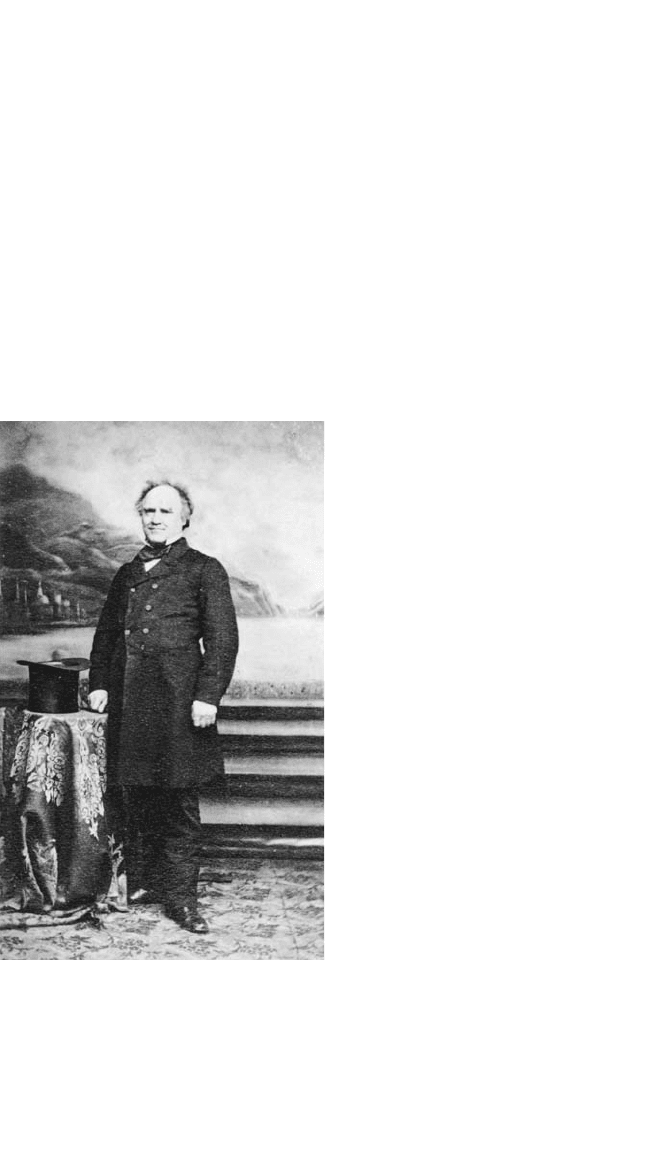
cational institutions. Beginning in the late 1820s, Joseph Howe used his
newspaper to attack the eco-
nomic and political power of the
oligarchy and to expose the
undue privileges that the Church
of England enjoyed in religion
and education. After being
elected to the Assembly in 1836,
he assumed the leadership of the
reform movement, and in the
following year, he succeeded in
securing the separation of the
Legislative and Executive Coun-
cils as well as the inclusion on
the latter body of four members
from the Assembly. For the next
decade, he would continue his
struggle to have the entire Exec-
utive Council selected from the
Assembly (Beck 1965).
The governing elite of New
Brunswick originated from the
group of Loyalist military offi -
cials and bureaucrats who had
served Sir Guy Carleton during
the evacuation of New York at
the end of the American Revolu-
tion. While the colonial oligarchy
consisted of wealthy landowners
Pictured here later in life, Joseph Howe (1803–
73) was the reform leader of Nova Scotia and
the chief architect of responsible government,
but he would ultimately have misgivings about
Confederation for the Atlantic region.
(Library
and Archives Canada C-021463)

139
who presided over vast timber stands, the Assembly was dominated by
rival timber merchants. Since members of both the appointed and
elected bodies had common economic interests and an Anglican Loy-
alist background, provincial politics remained relatively stable. The
separation of the Executive and Legislative Councils was achieved
with little controversy in 1832. However, the following year, the oli-
garchy and the Assembly clashed over control of the revenue from
timber duties imposed on the heavily forested Crown lands or from
the sale thereof. With mediation from the Colonial Offi ce, the issue
was resolved in 1837 when control of Crown lands and their revenue
was transferred to the Assembly in return for a permanent civil list—
that is, payment of colonial administration, including the salaries of
civil servants.
Land was also the major issue on Prince Edward Island, but political
discontent was directed toward the absentee landlords living in Eng-
land who withheld their large holdings from settlement. The local oli-
garchy actually supported the Assembly’s petition to the imperial
authorities to have these absentee holdings revert to Crown lands in
1838. Although this effort was unsuccessful, the separation of the
Executive and Legislative Councils was achieved in 1839.
Newfoundland remained at a rudimentary stage of political develop-
ment until 1825, when rule by naval admirals ended and Britain
appointed the fi rst civil governor, Sir Thomas Cochrane. British recog-
nition of the island as a colony rather than merely a fi shing base was
further confi rmed with the granting of representative government in
1832. Predictably, the Assembly immediately clashed with the recently
formed Legislative Council over the control of public fi nances. Con-
stant internal dissension—between English and Irish, between Protes-
tants and Catholics, between merchants and fi shermen, and between St.
John’s and the outports—forced the British government to suspend the
provincial constitution in 1842. An integrated legislature consisting of
11 elected members and 10 Crown appointees assisted the governor in
ruling the province until the two-chamber system was restored in 1848
(Rothney 1964).
The Rise of French-Canadian Nationalism
In sharp contrast to the orderly and peaceful opposition to oligarchy in
the Maritimes, the accumulation of political grievances in Lower and
Upper Canada culminated in armed insurrection, which only served to
stall the rising reform movements. In Lower Canada, political confl ict
FROM OLIGARCHIC RULE TO RESPONSIBLE GOVERNMENT