
Riendeau A Roger E. Brief History of Canada
Подождите немного. Документ загружается.


A BRIEF HISTORY OF CANADA
150
America, but he realized that this larger union would have to await the
further development of transportation and communication links
between Canada and the Maritime colonies.
Finding Durham’s recommendation for a union of the Canadas to be
compelling, the British Parliament passed the Act of Union in 1840.
The United Province of Canada, which offi cially came into being in
1841, was to be governed in accordance with the basic provisions of the
Constitutional Act of 1791: a governor-general advised by an Executive
Council would preside over an appointed Legislative Council and an
elected Legislative Assembly. Deviating from Durham’s original intent
to merge the two cultures into a single English-dominated community
to facilitate the assimilation of the French, the Act of Union stipulated
that representation in the legislature was to be distributed equally
between two distinct sections to be known as Canada West and Canada
East, corresponding with the former provinces of Upper and Lower
Canada, respectively. Assigning the same number of legislative repre-
sentatives to each section even though the population of Canada East
outnumbered that of Canada West by nearly 200,000 was a deliberate
but short-sighted effort to reinforce English political dominance over
the French. The initial French outrage over this underrepresentation,
in addition to the Act of Union’s provision for offi cial English unilin-
gualism, would ironically give way to a comparable English response
slightly more than a decade later when the continuing infl ux of British
immigration would propel the population of Canada West past that of
Canada East.
The Evolution of Responsible Government
While immediately accepting the union of the Canadas, the British
government did not respond as favorably to the other major recom-
mendations of Durham’s Report. Based chiefl y on his consultation with
Robert Baldwin, Durham concluded that the primary cause of political
discontent in Upper Canada was a defective constitution that encour-
aged the monopolization of power by “a petty, corrupt, insolent Tory
clique.” To combat the irresponsible power of the Family Compact,
Durham recommended a form of “responsible government” in which
the governor would “secure the cooperation of the assembly in his
policy, by entrusting its administration to such men as could command
a majority.” As the leading colonial advocate of this reform, Baldwin
wanted the doctrine of responsible government based on the British
cabinet system, whereby the governor merely accepted policies put

151
forward by his advisors in the Executive Council who were collectively
responsible to the majority in the Assembly. Instead, Durham proposed
that the governor initiate policy to be administered by executive coun-
cillors with majority support in the Assembly. Nevertheless, the clear
intent of this recommendation was to place effective control over colo-
nial affairs in the hands of the elected representatives (Buckner 1985).
To strengthen colonial self-government, Durham further recom-
mended the separation of local and imperial affairs. He pointed out that
regular interference in colonial affairs in the past had tended to make
the British government a party to local squabbles that could jeopardize
or detract from more important imperial interests. Accordingly, inter-
vention in colonial affairs should be confi ned to a relatively few matters
of real imperial concern such as constitutional change, international
relations, foreign trade, and the management of public lands. Durham
was supremely confi dent that local self-government based on the prin-
ciple of executive responsibility to the people would lead to greater
loyalty to, rather than secession from, the empire.
While Lord Durham’s Report effectively legitimized the doctrine of
responsible government as an integral part of a reformed British consti-
tution, rather than an instrument of American republicanism, the impe-
rial authority remained reluctant to incorporate the principle into
colonial administration. Imperialism dictated that a colonial governor
could not serve two masters—that is, follow the instructions of the
colonial secretary in Britain while acting on the advice of executive
councillors responsible to a local assembly. But imperial authorities
were confi dent that colonial government could be made more respon-
sive in practice without becoming fully responsible in principle.
When he succeeded Lord Durham in 1839, Charles Poulett Thomp-
son, who became Lord Sydenham, was confronted with the challenge
of exercising power with the majority support of the elected colonial
representatives without yielding his independent authority as governor.
In the hope of silencing demands for responsible government, Syden-
ham deliberately set out to eliminate remaining vestiges of oligarchic
rule by establishing much of the pattern of British ministerial govern-
ment in Canada. He organized a group of government departments,
each headed by member of the Executive Council, who was also
required to hold a seat in the Legislative Assembly. With the replace-
ment of the old lifetime appointees by elected members, the Executive
Council was becoming a veritable cabinet of ministers under the leader-
ship of the governor, who was virtually his own prime minister. These
ministers were not collectively responsible to the Assembly but rather
FROM OLIGARCHIC RULE TO RESPONSIBLE GOVERNMENT

A BRIEF HISTORY OF CANADA
152
individually to the governor who regarded his council only as a body of
advisors and department heads to consult. Still, by adopting the prac-
tice of choosing ministers acceptable to the Assembly, Lord Sydenham
had effectively advanced a step closer to the principle of responsible
government (Careless 1967).
To ensure a favorable majority in the Assembly, Lord Sydenham
actively campaigned against French candidates in Canada East and
Reformers in Canada West during the fi rst provincial election of the
United Province of Canada in 1841. A shrewd and unscrupulous polit-
ical tactician, Sydenham gerrymandered riding boundaries, manipu-
lated poll results, and intimidated voters in the open voting to secure
victory for English-speaking candidates, particularly Tories who were
opposed to responsible government out of fear that it would weaken
imperial ties and their infl uence in the legislature. Consequently, he
was able to form an Executive Council that excluded French Canadians
and yet enjoyed majority support of the Assembly. Furthermore,
Sydenham maintained his control over the newly elected legislature by
adeptly exploiting the division within the French ranks. The radicals,
on the one hand, wanted to repeal the union of the Canadas and saw
responsible government as a means of perpetuating it. The moderate
reformers, on the other hand, supported responsible government as a
way of changing the assimilationist features of the union.
However, Sydenham’s political manipulations were unintentionally
encouraging the Reformers of Canada West, led by Baldwin and Francis
Hincks, to join forces with the moderate French Reformers, led by
Louis Lafontaine and Augustin-Norbert Morin, to achieve their com-
mon goal of responsible government. In September 1841, Sydenham
died before he had to face the diffi cult political problem of maintaining
majority support for the governor’s policies in the wake of the growth
of formal party lines in the Assembly. His successor, Sir Charles Bagot,
realized during the legislative session of 1842 that an effective majority
in the Assembly could only be achieved by cultivating political support
on a group rather than on an individual basis. Accordingly, he departed
from the imperial policy of excluding French elected representatives
from the Executive Council by attempting to recruit Lafontaine, who
led the largest single political grouping in the Assembly. Lafontaine
agreed to join the Executive Council only if Baldwin was included in
the new ministry. By including Baldwin and Lafontaine along with
three other Reformers in the Executive Council, Bagot retained his
independent authority as governor and averted formal recognition of
responsible government. But by bestowing a measure of political power
153
upon the emerging Reform coalition, he gave impetus to the modern
Canadian party system, which in itself advanced the cause of respon-
sible government.
The next step on the road to responsible government resulted from
yet another governor’s attempt to resist acceptance of the principle. In
1844 Sir Charles Metcalfe, who had succeeded Bagot as governor in the
previous year, clashed with the Executive Council over the right of a
responsible ministry to approve all offi cial appointments. When the
governor refused to surrender what he considered to be a prerogative
of the Crown, the ministry resigned, supported by the Assembly in a
vote of confi dence. Metcalfe dissolved the Assembly, called an election,
and campaigned against the disloyalty and patronage-mongering of the
Reformers. While Metcalfe was successful in engineering the defeat of
Baldwin and the Reformers in Canada West, Lafontaine remained
fi rmly entrenched in Canada East. To form a government, Metcalfe
called upon William Henry Draper, leader of the moderate Tory major-
ity in Canada West. For the next three years, the rudiments of the
future Conservative Party struggled to maintain a precarious majority
support in the Assembly. The Executive Council functioned practically
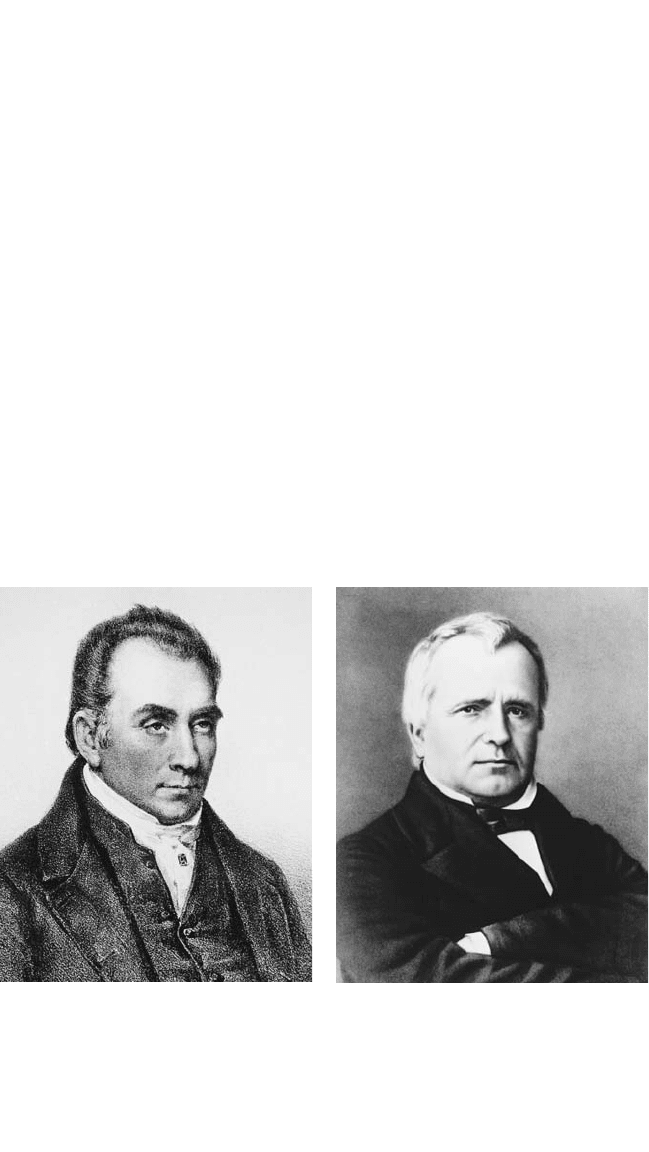
On the left, Robert Baldwin (1804–58), reform leader of Upper Canada, and on the right,
Louis Lafontaine (1807–64), reform leader of Lower Canada, photographed by Albert Ferland.
The architects of responsible government established the fi rst of many French-English political
alliances that would lead Canada toward nationhood and sustain it thereafter.
(Archives of
Ontario S 2071 and Library and Archives Canada C-005961)
FROM OLIGARCHIC RULE TO RESPONSIBLE GOVERNMENT

A BRIEF HISTORY OF CANADA
154
as a cabinet with Draper as virtual prime minister whose advice the
governor had to accept or else turn to the only viable alternative, a
Reform alliance led by Lafontaine, which would insist on the complete
submission of the governor to majority party rule.
The struggle for responsible government was fi nally determined by
the course of events in Britain rather than in the colonies. The repeal of
the Corn Laws in 1846 and the Navigation Laws in 1849 heralded the
end of the old colonial system and ushered in the era of free trade in
Britain. Now that colonial economic activity was no longer subject to
imperial control, there seemed little reason to control political life,
either.
The political consequences of free trade for the British North Ameri-
can colonies were fi rst manifested in Nova Scotia, where Joseph Howe
was leading a fi ght for responsible government that was less turbulent
but no less persistent than in the Canadas. In November 1846, Colonial
Secretary Lord Grey sent a dispatch to Governor John Harvey stating
“that it is neither possible nor desirable to carry on the government of
any of the provinces of British North America in opposition to the opin-
ion of the inhabitants.” Another dispatch in March 1847 specifi ed that
there was now no obstacle to the full and immediate adoption of the
British cabinet system in the colonies. When Howe led the Reformers
to electoral victory later that autumn and followed up with a motion of
nonconfi dence in the existing ministry in January 1848, the governor
had no recourse but to summon him and his party to form the next
government. Thus, Nova Scotia had the distinction of inaugurating the
new order of responsible government in the British colonies (Careless
1967; Buckner 1985).
Two months later, the principle was extended to the Province of
Canada, although in reality responsible government may have arrived a
little earlier. When Lord Elgin assumed the post of governor in January
1847, he placed himself at the disposal of the precarious Conservative
majority in the Assembly, which was opposed to responsible govern-
ment. In effect responsible government prevailed, since the governor
was willing to abide by the wishes of the Executive Council without
question. When the Reformers were swept back into power in the elec-
tion of January 1848, the stage was set for the formation of the fi rst
unifi ed one-party ministry under Baldwin and Lafontaine two months
later. The fi rst test of responsible government came with the passing of
the Rebellion Losses Bill to compensate various Lower Canadians who
had suffered fi nancially as a result of the Rebellion of 1837. Lord Elgin’s
routine approval of the bill in April 1849, in accordance with the prin-

155
ciples of responsible government, unleashed the fury of the Montreal
Tories who regarded the measure as a fl agrant endorsement of treason.
Interpreting recent British policy in terms of economic and political
abandonment as well as submission to French domination, several
prominent and avowedly loyal English-speaking members of the Mon-
treal business community not only participated in riots resulting in the
burning of the House of Parliament but also signed the Annexation
Manifesto of 1849 supporting union with the United States. This
expression of despair proved to be futile as responsible government was
extended to all North American colonies of the British Empire, includ-
ing Prince Edward Island in 1851, New Brunswick in 1854, and New-
foundland in 1855.
The achievement of responsible government, in effect political inde-
pendence from Britain, highlighted an essential difference between the
two nations that would ultimately share the North American continent.
Whereas the thirteen colonies had to liberate themselves from Britain
through revolution, the British North American colonies gained their
freedom through evolution. Unlike the United States, which emerged
out of a bloody struggle against imperialism, the future nation of Can-
ada was nudged, if not pushed, toward independence by the same
imperial power that had attempted to block American liberty less than
a century before. The union of the Canadas and the achievement of
responsible government represented the fi rst steps on the road to
nationhood for the British North American colonies. The fi nal and most
formidable step would be unity of political will between the Canadian
and Maritime Provinces.
FROM OLIGARCHIC RULE TO RESPONSIBLE GOVERNMENT

156
10
THE ROAD TO
CONFEDERATION
(1850–1867)
B
y the middle of the 19th century, the United Province of Canada
and the Maritime colonies remained separated by hundreds of
miles of wilderness and had little in the way of communication and
commercial relations with one another. Even more isolated and remote
were the vast domains of the rugged Canadian Shield and the frigid
Arctic to the north as well as the prairie wilderness and towering coastal
mountain region to the west, all of which were sparsely populated
by Native peoples and fur traders. Yet within a span of two decades,
the far-fl ung British North American colonies came to the realization
that their continued growth, indeed their survival in the shadow of a
powerful and ambitious neighbor, would depend on the breakdown
of isolation and a convergence of their diverse interests. The coming
of the railway age made transcontinental transportation and commu-
nication linkage feasible. The British withdrawal as an imperial force
in the upper half of the continent and the apparent willingness of the
United States to take its place rendered intercolonial unity more urgent.
The political breakdown of the union of the Canadas and the rise of a
Maritime union movement offered the occasion for the reconstitution
of the British North American colonies into a new nation to be known
as the Dominion of Canada.
Reciprocity and Railways
The advent of British free trade conspired with the onset of economic
depression throughout the Western world to reduce exports via the St.
Lawrence by about one-third in the late 1840s. This downturn in eco-
nomic fortunes, coinciding with the granting of responsible govern-

157
ment, no doubt accounted for the panic among the Montreal merchants
who signed the Annexation Manifesto of 1849. But with the revival of
the world economy in the following year, thoughts of fi nding new mar-
kets and prosperity through political union with the United States had
all but disappeared in the Province of Canada.
In fact, closer economic integration of the Canadian and Maritime
colonies with the United States was becoming possible without sacrifi c-
ing recently gained political autonomy. Much of the decline in British
demand for grain and timber by 1850 was being offset by the emer-
gence of new markets, particularly for wheat, dairy products, and sawn
lumber, in the rapidly growing cities of the American Midwest and the
Atlantic seaboard. While this continental trade was not about to
develop on the same scale as transatlantic commerce, which had
returned to normal levels by the mid-1850s, it offered Canada and the
Maritimes an alternative strategy for economic development beyond
mere dependence on the imperial market. Commercial reciprocity with
the United States, therefore, became a major priority of the Canadian
government, and the idea was endorsed by the British government as a
means of reducing colonial dependence (Masters 1963).
Although the American border regions were more favorable to reci-
procity and the midwestern states were interested in free access to the
St. Lawrence route, on the whole, strong protectionist sentiment still
had to be overcome, particularly in the northern states. Another imped-
iment was the growing sectional confl ict over slavery. As supporters of
slavery, the southern states were apprehensive in the wake of northern
assertions that reciprocity was a prelude to annexation, which in turn
would lead to a preponderance of free states in the union. Eventually,
British envoy Lord Elgin was able to assuage southern concerns by
arguing that a Canada made prosperous by free trade was less likely to
accept annexation to the United States. The interest of the United States
in reciprocity was increased in 1852 by the threat of a naval clash with
Britain over the extent of American rights to the inshore fi sheries of the
Maritime Provinces. The American desire to resolve the long-standing
fi sheries dispute combined with the Canadian demand for freer trade
culminated in the Reciprocity Treaty of 1854.
The treaty, concluded for an initial period of 10 years, provided for
the free exchange of natural (as opposed to manufactured) products
between the United States and the British North American colonies,
free navigation of the American-controlled Lake Michigan and the
Canadian-controlled St. Lawrence River, and joint access to all coastal
fi sheries north of the 36th parallel. Over the next decade, trade between
THE ROAD TO CONFEDERATION

A BRIEF HISTORY OF CANADA
158
the two partners to this agreement trebled in value, and henceforth, a
regional commerce of convenience, involving the midwestern and
northern border states with the St. Lawrence– Great Lakes region, New
England with the Maritimes, and eventually the American western
states bordering the 49th parallel with their Canadian counterparts,
characterized a growing continental economic integration. Although
more than half of Canada’s trade and almost two-thirds of Maritime
commerce was still conducted with Britain, these colonies were enhanc-
ing their future economic options by maintaining a foothold in each of
the imperial and continental markets.
Competitiveness in either the imperial or the continental market
after 1850 depended on continued transportation improvement, as
exemplifi ed by the completion of the St. Lawrence canal system.
Although more economical and effi cient to use than the Hudson-Erie
route to New York, the St. Lawrence route through Montreal was
closed by ice for nearly half the year. Moreover, during the 1840s, every
major American port on the Atlantic seaboard, including New York,
Philadelphia, Boston, and Baltimore, was connected to the interior by
railroads. By contrast to over 9,000 miles of railway in the United
States, little more than 60 miles of track had been laid in all of British
North America by mid-century; but within a decade there would be
over 2,000 miles of railways, mostly in the Province of Canada.
To gain access to an ice-free Atlantic port, a group of Montreal busi-
nessmen collaborated with railway promoters from Portland, Maine, in
1850 to build the St. Lawrence and Atlantic line. When completed in
1853, the St. Lawrence and Atlantic had the distinction of being the
world’s fi rst international railway. The following year, the Great West-
ern Railway, promoted by Allan MacNab, opened its main line from
Hamilton to Windsor with the intention of extending westward to
Detroit in order to link up with the Michigan Central system and east-
ward to Buffalo in order to connect with the New York railway net-
work. Accordingly, the Great Western could channel a share of the
American midwestern trade through Canada West by serving as a por-
tage route from Chicago to New York. By 1855 the Northern Railway
was completed from Toronto to Collingwood on Georgian Bay. By link-
ing Lakes Ontario and Huron, the Northern line serviced the agrarian
hinterland north of Toronto and opened up the prospect of a combined
water and rail route to the upper Great Lakes and beyond (Careless
1967).
Railway-building fever was also prevalent in the Maritimes, albeit to
a lesser extent. With provincial government assistance, lines were built

159
linking Halifax to Truro in Nova Scotia and Saint John to Shediac in
New Brunswick by the late 1850s. These lines refl ected the hope of
Halifax and Saint John merchants to link their ice-free ports with the
St. Lawrence transport system and thus tap into the traffi c between the
American Midwest and Europe. However, to build and operate railways
in the Maritimes was more expensive than in Canada because of the
greater distances from larger urban centers and the lack of a populated
hinterland to generate local revenue from shipment and passenger traf-
fi c. For such reasons, Joseph Howe’s proposal for an intercolonial link
with Canada fell through in 1852.
The most ambitious scheme was the Montreal-based Grand Trunk
Railway. Initiated in 1853, the Grand Trunk was a transprovincial line
extending from Sarnia at the southwestern end of Canada West to
Quebec City in Canada East. The failure to negotiate the intercolonial
extension to Halifax prompted the Grand Trunk to purchase the St.
Lawrence and Atlantic Railway, which offered access to the ice-free
Atlantic port of Portland, Maine. When completed in 1859, the Grand
Trunk was the longest railway line in the world—a continuous stretch
of 1,100 miles, which was later extended westward to reach Chicago.
Not surprisingly, this extraordinary enterprise was constantly plagued
by fi nancial diffi culties, despite a considerable infusion of private
capital from British investors and the generous support of the Cana-
dian government. As construction progressed, the Grand Trunk Rail-
way Company repeatedly appealed for more aid from the provincial
government, which, in turn, had to borrow heavily to satisfy this
urgent need.
The government felt obliged to bail out the struggling railway not
only because the line was considered vital to future economic develop-
ment but also because six of the Grand Trunk’s 12 directors were mem-
bers of the Canadian cabinet. Such confl icts of interest were commonplace
in mid-19th-century politics. Sir Francis Hincks, who fought for
responsible government alongside Robert Baldwin, was intimately
involved with the Grand Trunk while he was serving as prime minister.
Likewise, George-Étienne Cartier was a paid solicitor for the Grand
Trunk before becoming prime minister. Alexander Galt, as president of
the St. Lawrence and Atlantic, arranged the absorption of the railway
by the Grand Trunk and went on to become a minister of fi nance. Sir
Allan MacNab, a leading promoter of the Great Western Railway and a
prime minister from 1854 to 1856, summed up the spirit of the age
when he frankly admitted: “All my politics are railroads.” Indeed, gov-
ernment support for railways tended to be a contentious political issue
THE ROAD TO CONFEDERATION