
Riendeau A Roger E. Brief History of Canada
Подождите немного. Документ загружается.


A BRIEF HISTORY OF CANADA
100
differences, including the Loyalist claims and the rights of British fur
traders in the West.
The departure of the American colonies from the British Empire also
involved negotiations that established the St. Croix River as the offi cial
boundary between what would be the future state of Maine and the
future province of New Brunswick and which renewed fi shing rights in
the Gulf of St. Lawrence and the inshore waters of Nova Scotia and
Newfoundland. Even though the Americans had forfeited these rights
by seceding from the empire, imperial authorities realized the practical
diffi culties and the potential confl ict that would result from their con-
tinued exclusion. American fi shermen were also allowed the right to
continue to dry their catch along unsettled mainland coasts. Despite
being addressed by the Treaty of Versailles, the international boundary
and fi shing rights would remain sources of dispute between the United
States and the British North American colonies.
With the end of the American Revolution in 1783, Britain had lost
its most stable and populous colonies, which had formed the pillars of
the old mercantile system. Britain still retained a foothold on the North
American continent, but the remnants that were left could not compen-
sate for the loss of the thirteen colonies. The three remaining northern
colonies, consisting of scarcely more than 40,000 English Protestants
and over 110,000 French Catholics, were isolated from one another
and were at a much more primitive stage of development than the lost
colonies to the south. The resources of the remaining empire in North
America were far less varied, and the opportunities for expansion there
far less extensive. Indeed, the sugar islands of the West Indies and the
colonial prospects unfolding in India offered far more promise. More-
over, imperial authorities could easily have been discouraged by the
lack of loyalty that the remaining North American subjects manifested
in the face of invading rebels, were it not for concern over the plight of
the “Loyalist” American refugees who made their way to Quebec and
Nova Scotia.

101
7
THE EMERGENCE OF
COLONIAL COMMUNITIES
(1783–1850)
T
he American Revolution profoundly altered the destinies of two
nations in North America. Ironically, the event that gave birth to the
United States of America also gave impetus to the creation of English
Canada. The Loyalists as refugees of the American Revolution became
the founders of two provinces, Ontario and New Brunswick; and the
presence of the Loyalists as a group with a strong moral claim on Britain
prompted the restructuring of government by the Constitutional Act,
itself a reaction to the American Revolution. Without the Loyalist
presence, land-hungry New Yorkers and Pennsylvanians would have
poured into the unoccupied southern Ontario frontier beginning in the
1790s, and New Englanders would have moved into sparsely settled
New Brunswick when the Maine frontier expanded in the 1830s. The
Loyalist population of Upper Canada also proved to be a bastion of
defense against American invasion during the War of 1812, thereby
ensuring that an English Canada still existed to accommodate the sub-
sequent tide of British immigration.
The Coming of the Loyalists
A prominent Revolutionary leader, Samuel Adams, speculated that one-
third of the people of the thirteen colonies actively supported the
Revolution, one-third remained neutral, and one-third actively sup-
ported Britain. The accuracy of this estimation has been diffi cult to
ascertain, but it does point to the prevailing lack of unity in the embry-
onic stages of American nationhood. Upwards of 100,000 people suf-
fered persecution and were forced into exile for supporting the imperial
cause or for remaining neutral during the Revolution, and as many as
A BRIEF HISTORY OF CANADA
102
one-half of those refugees escaped to British North America. The more
infl uential Loyalists, including royal offi cials, wealthy merchants, land-
owners, and professionals, as well as high-ranking military offi cers,
returned to Britain during or after the Revolutionary War to take
advantage of the preferments that awaited them there. The vast major-
ity of Loyalists, however, being of lesser means, either drifted to nearby
British colonies or gathered in the imperial stronghold at New York,
from which they were evacuated to other parts of the empire (Moore
1984).
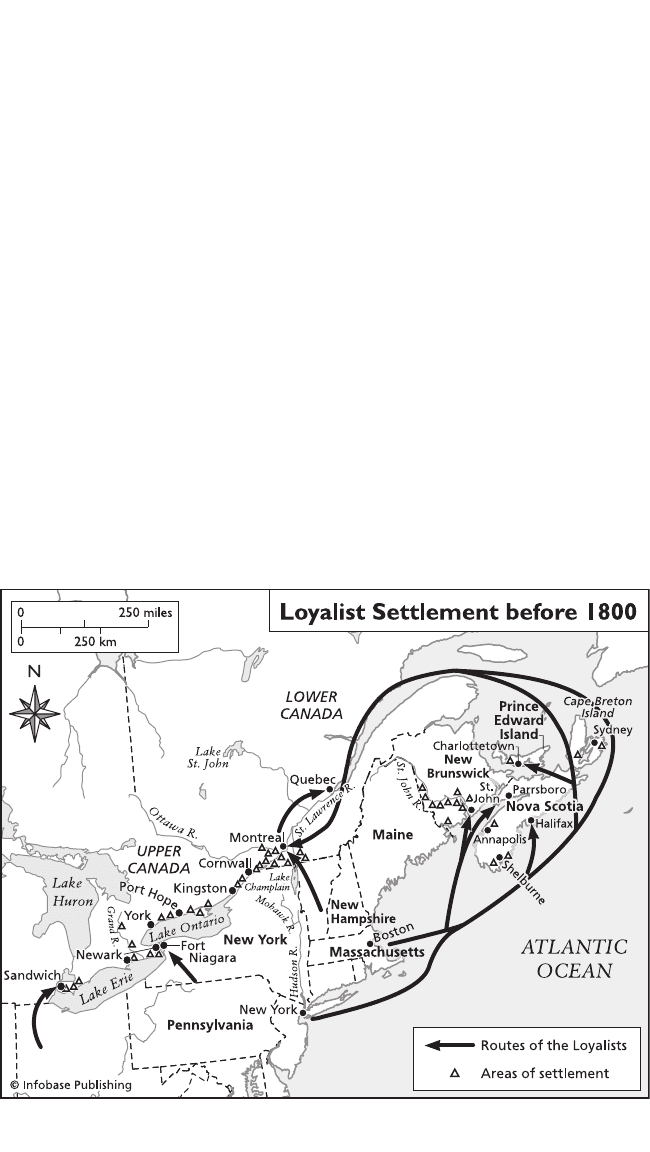
Nova Scotia, as the most accessible British colony by sea and one
with an abundance of vacant land for settlement, was considered the
most convenient destination for the 30,000 to 40,000 Loyalist refugees,
who tended to come from the coastal towns. Almost half of the Loyal-
ists were settled along the Saint John River valley, while most of the
other half went to peninsular Nova Scotia. Small groups of Loyalists
also settled in Cape Breton Island, Prince Edward Island, and New-
foundland. About half of the Loyalist immigrants came from New York
or New Jersey, while the origin of the remainder was almost equally
divided between New England and the southern states. Many of the

103
approximately 3,000 black Loyalists who came to Nova Scotia had
taken advantage of the British proclamation of 1779, which offered
freedom to any slaves who left their American masters to support the
British cause. Disappointed over the settlement prospects, nearly half of
these black Loyalists had left Nova Scotia to join a free black colony in
Sierra Leone by the early 1790s (Winks 1997).
Indeed, disappointment was a prevailing sentiment as the sudden
infl ux of a population that was almost double the size of the existing
colony created diffi culties for new and established settlers alike. For
their devotion to the imperial cause, the Loyalists were promised land
grants ranging from 100 acres for the head of a family, with an addi-
tional 50 acres for each member, to 1,000 acres for a military offi cer.
Although poor crops, shortages of supplies, and delays in securing title
to land contributed to early hardship, many of the Loyalists suffered
from the reality of being former town dwellers unaccustomed to the
challenges of pioneer life in Nova Scotia, with its marginal farmland
and erratic climate. Despairing of the grueling life and limited resources
of “Nova Scarcity,” some Loyalists gave up the struggle and drifted back
to the United States after tempers had subsided; others went to Britain
or tried their luck in the new western province of Upper Canada
(Brown and Senior 1984).
Tension was further heightened by the rivalries that soon developed
between Loyalist and existing settlers. Some Loyalists complained that
the more desirable locations were already held by the earlier arrivals,
while Loyalist leaders who had held offi cial positions in the old colony
demanded government posts in Nova Scotia. By virtue of their recent
sacrifi ces, the Loyalists felt entitled to preferential treatment and were
openly resentful of the “neutral Yankees,” whom they suspected of dis-
loyalty. To satisfy the Loyalists, the British government partitioned the
colony in 1784 to create the new province of New Brunswick, com-
posed mostly of Loyalists, which could serve as a buffer between pen-
insular Nova Scotia and the United States. The following year, the
community of 3,500 people at the mouth of the Saint John River
became the fi rst incorporated city in what is now Canada. While Saint
John was to be the economic heart of the new province, Thomas Car-
leton, the fi rst governor of New Brunswick, selected Fredericton to be
the provincial capital—not only to promote inland settlement but also
to protect the garrison from a sudden American attack.
The several hundred Loyalists who settled St. John’s Island (Prince
Edward Island) did not fare as well as their New Brunswick counter-
parts. To attract Loyalist settlers, some absentee landlords promised
THE EMERGENCE OF COLONIAL COMMUNITIES

A BRIEF HISTORY OF CANADA
104
grants of land with clear and secure title. However, after the Loyalists
had settled and begun cultivating the land, the landlords were unwill-
ing to grant them freeholder status. While many of the Loyalists left the
island out of frustration, some stayed on as tenant farmers. Squatters
and tenant farmers comprised the majority of the slightly more than
4,000 people who lived in the colony when it was renamed Prince
Edward Island in 1799. The land question would continue to be a
major source of confl ict and a primary obstacle to Prince Edward
Island’s development for the next three-quarters of a century.
Upwards of 10,000 Loyalists made their way to Quebec, mainly from
New York and New England by way of the Lake Champlain–Richelieu
River route. Governor Frederick Haldimand, who had succeeded Car-
leton in 1778, sought to avoid confl ict with the French by arranging to
settle some of the Loyalists along the sparsely populated southern shore
of the St. Lawrence River. These settlements, later known as the Eastern
Townships, laid the foundation for the English-speaking community in
the Province of Quebec.
The majority of Loyalists, however, settled in the western frontier of
the province well beyond the seigneurial lands. These western Loyalists
arrived by land, mostly from the frontier districts of New York, Penn-
sylvania, and New England. They included members of loyal American
regiments and their families; disbanded German, Swiss, and Dutch
mercenaries who had fought in the British army; a small group of
Quakers and Mennonites who had refused to bear arms due to religious
conviction; aspiring frontier farmers; and Native Americans led by
Chief Joseph Brant of the Six Nations Iroquois Confederacy. Since most
of the western Loyalists were already familiar with the rigors of pioneer
farming, they were better prepared for the backbreaking work of clear-
ing the virgin forest, building crude shelters out of logs, planting their
fi rst crops, and coping with food shortages and severe winters. Despite
the hardships of life in the wilderness, Quebec Loyalists were less
inclined than Nova Scotians to consider returning to the United States
or Britain because of the abundance of fertile land available to them
(Wilson 1981).
To accommodate the initial wave of Loyalists, Governor Haldimand
arranged for the purchase of land along the upper St. Lawrence River
and eastern Lake Ontario as well as in the Niagara Peninsula from the
Mississauga in 1783–84. Into these areas he relocated some 6,000 civil-
ian refugees and former militia, granting them land on the same scale
and terms as in Nova Scotia. Haldimand also reserved the Grand River
valley for settlement by the majority of the 2,000 Iroquois Loyalists

105
under Chief Brant. During the 1780s Loyalist settlements also spread
along the northwestern shore of Lake Erie and up the Ottawa River.
As more successful Loyalists wrote back to friends and relatives in
the United States about how they had been able to secure a grant of
land merely by swearing allegiance to King George III, many aspiring
American settlers who had taken little or no active part in the Revolu-
tion were prepared to denounce republicanism in return for a farm. For
their part, imperial authorities were quite willing to grant land to new
colonists renewing their old allegiance on the same terms as the origi-
nal Loyalists. Within a few years, it was diffi cult to distinguish between
those “United Empire” Loyalists who truly sought refuge in a British
colony and those “Late Loyalists” who were attracted by the prospects
of free land. The steady fl ow of American immigrants into the western
frontier of the Province of Quebec during the 1780s and 1790s coin-
cided with the natural expansion of settlement from the Atlantic sea-
board into the interior. In their quest, land-hungry pioneers were
inclined to be oblivious to national borders, with the result that the
fertile upper St. Lawrence Valley and Great Lakes basin were regarded
as a northward extension of the United States’s western frontier. Late
Loyalists soon outnumbered the original Loyalists as the population of
western Quebec exceeded 20,000 by 1791.
The Constitutional Act of 1791
Whether they had been actually driven from their homes because of their
expressed loyalty to British rule or whether they were merely opportunis-
tic land-seekers, the American immigrants expected to enjoy the consti-
tutional and legal rights of British subjects. But by providing for only
seigneurial tenure and appointed legislators, the Quebec Act effectively
denied them the rights to freehold land tenure and representative govern-
ment to which they had become accustomed in the American colonies.
Because they were more likely to be too occupied with the daily routines
of farming and coping with the hardships of the wilderness to think
about the problems of government, the overriding concern of American
immigrants, once they had acquired, cleared, and cultivated their land,
was to secure legal title. While the Loyalists were not about to relinquish
their right to representative government, they tended to be less support-
ive of the democratic political aspirations of the British merchants of
Quebec. For those settlers who had been victimized in their former
homeland by excessive self-government, democracy raised memories of
armed rebellion and mob violence (Craig, Upper Canada, 1963).
THE EMERGENCE OF COLONIAL COMMUNITIES

A BRIEF HISTORY OF CANADA
106
The presence of a sizable contingent of English-speaking Protestants
renewed the hope of the British merchants that the Quebec Act could
be repealed and that the French would eventually be assimilated.
Believing that they deserved political power commensurate with their
contribution to the economic growth of the province, the English-
speaking merchants of Quebec continued to demand an elected assem-
bly. While the seigneurs were concerned that an assembly might tax
land and make their tenants their political equals, the French mercan-
tile and professional classes were becoming more favorable to the idea
of an elective body over which the cultural majority could exert greater
political infl uence. The stage was therefore set for political change in
British North America.
Upon his return as governor in 1786, Carleton, now Lord Dorches-
ter, was more receptive to English demands in view of the disappoint-
ing French response to the American invasion a decade previously. He
appointed as his principal advisor and chief justice William Smith, a
Loyalist from New York, to review the constitutional affairs of the col-
ony. Smith’s proposed union of all of British North America under a
federal system of government in 1790 was prophetic, but the scheme
was dismissed as impracticable by the imperial authorities, which con-
sidered the colonies to be too separated by distance and too divided in
interests. In contrast to Smith’s desire for a wider unity, the imperial
authorities were convinced by their American experience to proceed in
the opposite direction. Imperial authorities concluded that the Ameri-
can colonies had been allowed to grow too large and too strong; and
most important, they had been allowed too much self-government. To
prevent a similar occurrence in British North America, an imperial
policy of “divide and rule” was adopted whereby colonies were to be
kept small and dependent, thereby thwarting the rise of nationalism.
The division of New Brunswick and Cape Breton Island from Nova
Scotia in 1784 (Cape Breton Island was reunited with Nova Scotia in
1820) was further manifestation of this thinking. This imperial reorga-
nization focused on averting what British offi cials perceived to be the
principal constitutional weakness of the American colonies—the dem-
ocratic elements of government had been allowed to prevail over the
monarchical and aristocratic elements. A truly British constitution
would maintain a balance between the interests of monarchy, aristoc-
racy, and democracy.
Accordingly, the British Parliament passed the Constitutional Act in
1791, which provided for the division of Quebec into two distinct prov-
inces. Beyond the farthest western seigneury, in the vicinity of where
107
the Ottawa River meets the St. Lawrence River, the new province of
Upper Canada was designed to accommodate the Loyalist immigrants.
The remainder of the Province of Quebec was renamed Lower Canada
and would continue to be governed under the terms of the Quebec Act
with a few important modifi cations. The provinces were given the
option of maintaining French civil law or introducing English civil law,
and naturally the fi rst legislature of Upper Canada opted for the latter.
Although the existing seigneurial system of Lower Canada was left
untouched, the Constitutional Act did permit freehold tenure where
desired. The rights of the Catholic Church under the Quebec Act were
specifi cally reaffi rmed. But the desire to strengthen Protestantism was
refl ected in provisions that assigned to the provincial government the
right to collect tithes from Protestants and the obligation to set aside
one-seventh of future land grants for the “support and maintenance of
a Protestant clergy.”
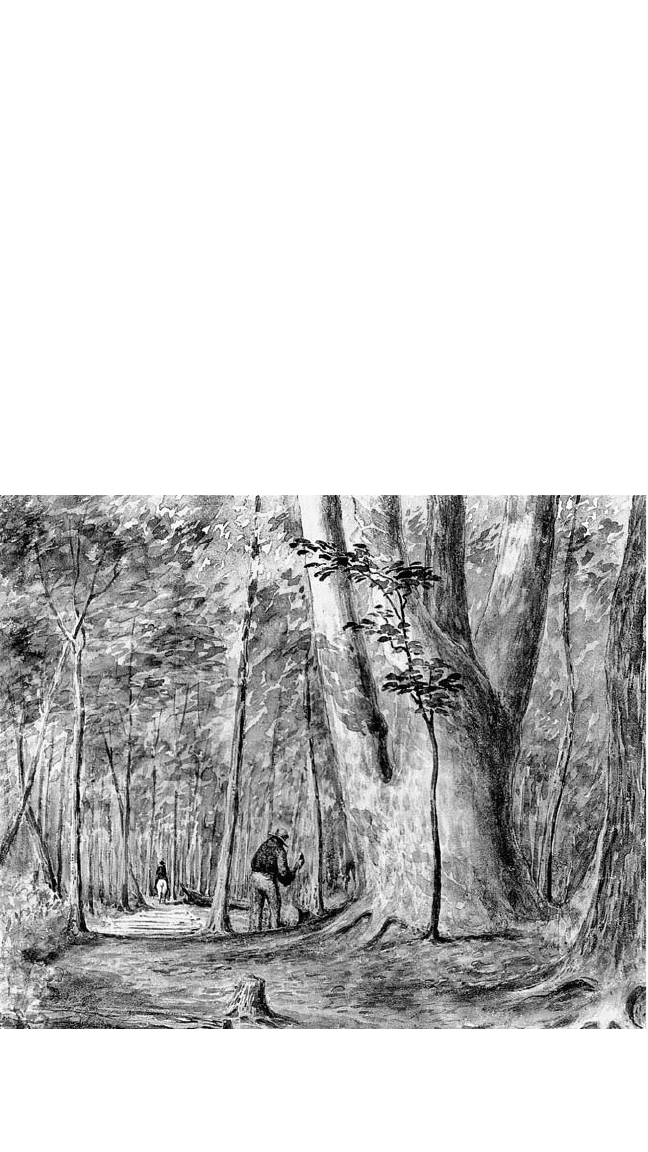
A watercolor by Phillip John Bainbridge depicting a buttonwood tree, 18 feet in circumference,
in the bush near Chatham, Upper Canada, ca. 1840. The pioneer settlers faced the daunting
task of clearing the primeval forest with only a primitive ax.
(Library Archives Canada C-01883)
THE EMERGENCE OF COLONIAL COMMUNITIES

A BRIEF HISTORY OF CANADA
108
The Constitutional Act modifi ed the Quebec Act most signifi cantly
in terms of the structure of government. Upper and Lower Canada were
each to be governed by a lieutenant governor who was responsible to
the governor-general of all of British North America and who repre-
sented monarchical or executive authority. Because his tenure in offi ce
was short-term and because he knew relatively little about the province
when he arrived, the lieutenant governor relied on the advice of leading
citizens whom he appointed to the Executive Council, which func-
tioned like the British cabinet. The lieutenant governor also appointed
members to the Legislative Council, which served as the upper house
or the aristocratic branch of government. An early draft of the consti-
tutional bill intended to grant members of the Legislative Council
hereditary titles was modelled after the British House of Lords. How-
ever, the thought of a pioneer nobility in the colonial backwoods was
greeted with laughter when introduced to the British Parliament, with
the result that the idea was discreetly dropped. Like the British upper
house, the Legislative Council approved, amended, or rejected legisla-
tion passed by the democratic branch, the Legislative Assembly, the
equivalent of the House of Commons in Britain. Even if the Legislative
Council approved a measure passed by the popularly elected Legislative
Assembly, it could still be subject to the veto of the governor and the
British Crown. Such severe restrictions to self-government were
designed to reduce the colonial assembly to little more than a debating
society.
Nevertheless, in their effort to limit democracy, imperial authorities
were no longer as willing to suppress representative government as
they had been when conceiving and implementing the Quebec Act of
1774. Elected assemblies were deemed essential in order that the colo-
nies might levy taxes to meet their own expenses. In an unsuccessful
attempt to conciliate the rebellious American colonies, the British gov-
ernment had relinquished its power to raise revenue within any of its
colonies in 1778. By 1791 the American revolutionary demand of “no
taxation without representation” had become a common colonial
expectation, and British taxpayers were more reluctant to bear the
expensive burden of maintaining overseas colonies. But while conced-
ing the practical necessities of democracy, imperial authorities further
undermined the infl uence of the elected branch of government by set-
ting aside one-seventh of all lands as Crown reserves. The revenues
from the sale or lease of these lands were to be used to support the
colonial administration, thereby making it less dependent on the taxa-
tion power of the Legislative Assembly.

109
The Constitutional
Act of 1791
Anno Tricesimo Primo
GeorgII III. Regis.
Cap. XXXI.
An Act to repeal certain Parts of an Act, passed in the Fourteenth
Year of His Majesty’s Reign, intituled, An Act for making more effectual
Provision for the Government of the Province of Quebec, in North
America; and to make further Provision for the Government of the
said Province. . . .
II. And whereas His Majesty has been pleased to signify, by His
Message to both Houses of Parliament, His Royal Intention to divide
His Province of Quebec into Two separate Provinces, to be called
The Province of Upper Canada, and The Province of Lower Canada;
be it enacted by the Authority aforesaid, That there shall be within
each of the said Provinces respectively a Legislative Council, and an
Assembly, to be severally composed and constituted in the Manner
herein-after described; and that in each of the said Provinces respec-
tively His Majesty, His Heirs or Successors, shall have Power, during
the Continuance of this Act, by and with the Advice and Consent of
the Legislative Council and Assembly of such Provinces respectively,
to make Laws for the Peace, Welfare, and good Government thereof,
such Laws not being repugnant to this Act; and that all such Laws, being
passed by the Legislative Council and Assembly of either of the said
Provinces respectively, and assented to by His Majesty, His Heirs or
Successors, or assented to in his Majesty’s Name, by such Person as His
Majesty, His Heirs or Successors, shall from Time to Time appoint to be
the Governor, or Lieutenant Governor, of such Province . . . shall be
. . . valid and binding to all Intents and Purposes whatever, within the
Province in which the same shall have been so passed. . . .
XLIII. And be it further enacted by the Authority aforesaid, That
all Lands which shall be hereafter granted within the said Province of
Upper Canada shall be granted in Free and Common Soccage, in like
Manner as Lands are now holden in Free and Common Soccage, in that
Part of Great Britain called England; and that in every Case where Lands
shall be hereafter granted within the said Province of Lower Canada,
and where the Grantee thereof shall desire the same to be granted in
Free and Common Soccage, the same shall be so granted. . . .
Source: Shortt and Doughty 1918, 2: 1031–48.
THE EMERGENCE OF COLONIAL COMMUNITIES