
Samarskii A.A., Vabishchevich P.N. Numerical Methods for Solving Inverse Problems of Mathematical Physics
Подождите немного. Документ загружается.


316 Chapter 7 Evolutionary inverse problems
Scheme (7.240) can be written in the canonical form for three-layer difference
schemes
B
y
n+1
− y
n−1
2τ
+ R(y
n+1
− 2y
n
+ y
n−1
) + Ay
n
= 0 (7.241)
with operators
B = 0, R =
1
τ
2
E, A =−, (7.242)
i. e., with A = A
∗
< 0.
Theorem 7.24 The explicit scheme (7.240) is ρ-stable with
ρ = exp (M
1/2
τ). (7.243)
Proof. For scheme (7.240), we check that the following conditions for ρ-stability (see
Theorem 4.11) are fulfilled:
ρ
2
+ 1
2
B + τ(ρ
2
− 1)R ≥ 0, (7.244)
ρ
2
− 1
2τ
B + (ρ − 1)
2
R + ρ A > 0, (7.245)
ρ
2
− 1
2τ
B + (ρ + 1)
2
R − ρ A > 0. (7.246)
Apparently, in the case of B ≥ 0, A ≤ 0, R ≥ 0 and ρ>1 (see (7.242)) inequalities
(7.244) and (7.246) are fulfilled for all τ>0.
With (7.242), inequality (7.245) yields:
(ρ − 1)
2
E − τ
2
ρ ≥ ((ρ − 1)
2
M
−1
− τ
2
ρ) > 0.
Derivation of the estimates is based on the following useful result.
Lemma 7.25 Inequality
(ρ − 1)
2
χ −τ
2
ρ>0 (7.247)
is fulfilled for positive χ , τ and for ρ>1 in the case of
ρ ≥ exp
χ
−1/2
τ
.
Proof. Inequality (7.247) is fulfilled in the case of ρ>ρ
2
, where
ρ
2
= 1 +
1
2
τ
2
χ
−1
+ τχ
−1/2
1 +
1
4
τ
2
χ
−1
1/2
.
Taking into account the inequality
1 +
1
4
τ
2
χ
−1
1/2
< 1 +
1
8
τ
2
χ
−1
,

Section 7.4 Second-order evolution equation 317
we obtain
ρ
2
< 1 + τχ
−1/2
+
1
2
τ
2
χ
−1
+
1
8
τ
3
χ
−3/2
< 1 + τχ
−1/2
+
1
2
τ
2
χ
−1
+
1
6
τ
3
χ
−3/2
< exp (χ
−1/2
τ).
Thus, the lemma is proved.
In the case of interest, we have χ = M
−1
and, hence, for ρ we obtain the desired
estimate (4.32) for the explicit scheme (7.240).
With regard to the boundedness of (in Cauchy problems for elliptic equations),
we conclude that the grid step over space limits the solution growth, i.e., serves the
regularization parameter.
Let us construct now, at the expense of introducing penalty terms into the difference
operators of difference schemes, unconditionally stable difference schemes for the ap-
proximate solution of problem (7.237)–(7.239). Starting from the explicit scheme
(7.240), we write the regularized scheme in the canonical form (7.241) with
B = 0, R =
1
τ
2
(E + αG), A =−. (7.248)
Theorem 7.26 The regularized scheme (7.241), (7.248) is ρ-stable with the regulizer
G = with
ρ = exp
τ
√
α
, (7.249)
and with the regulizer G =
2
, with
ρ = exp
τ
2
√
α
. (7.250)
Proof. Starting from (7.245) for (7.248), we arrive at the inequality
(ρ − 1)
2
(E + αG) − τ
2
ρ ≥ 0. (7.251)
In the case of G = , analogously to the proof of Theorem 7.24 (χ = α + M
−1
)
we obtain the following expression for ρ:
ρ = exp
(α +
−1
)
−1/2
τ
.
Making ρ cruder yields the estimate (7.249).
In the case of G =
2
, from inequality (7.245) we obtain:
E +α
2
−
τ
2
ρ
(ρ − 1)
2
=
√
α −
τ
2
ρ
2
√
α(ρ − 1)
2
E
2
+
1 −
τ
4
ρ
2
4α(ρ − 1)
4
E.

318 Chapter 7 Evolutionary inverse problems
This inequality is fulfilled for some given ρ if
α ≥
τ
4
ρ
2
4(ρ − 1)
4
. (7.252)
Let us evaluate now the quantity ρ for given α from inequality (7.252) rewritten in the
form
(ρ − 1)
2
2
√
α − τ
2
ρ.
By the above lemma with χ = 2
√
α, the latter inequality is fulfilled for the values of ρ
defined by (7.250).
The regularized scheme (7.241), (7.248) with the regularizer G = can be written
as the weighted scheme
y
n+1
− 2y
n
+ y
n−1
τ
2
− (σ y
n+1
+ (1 − 2σ)y
n
+ σ y
n−1
) = 0 (7.253)
with σ =−α/τ
2
. Thereby, the regularizing parameter here is the negative weight in
(7.253). The latter scheme can also be related to a version of the generalized inverse
method (7.225) for the approximate solution of the ill-posed problem (7.187)–(7.189).
The construction of the regularized difference scheme is based on a perturbation
of the operators in the generic difference scheme (7.241), (7.242) chosen so that to
fulfill the operator inequality (7.245). In Theorem 7.26, the latter can be achieved
at the expense of some additive perturbation (increase) of R. There are many other
possibilities. In particular, note the possibility of additive perturbation of B:
B = αG, R =
1
τ
2
E, A =−. (7.254)
Theorem 7.27 The regularized scheme (7.241), (7.254) with G = is ρ-stable with
ρ = exp
τ
α
. (7.255)
Proof. Inequality (7.245) can be rearranged as
ρ
2
− 1
2τ
B + (ρ − 1)
2
R + ρ A >
ρ
2
− 1
2τ
α −ρ ≥ 0.
This inequality is fulfilled with ρ ≥ ρ
2
, where
ρ
2
=
τ
α
+
1 +
τ
2
α
2
1/2
< 1 +
τ
α
+
1
2
τ
2
α
2
< exp
τ
α
.
From here, expression (7.255) for ρ in the difference scheme (7.241), (7.254) follows.
The regularized scheme (7.241), (7.254) can be directly related to the use of the gen-
eralized inverse method in its version (7.234). In a similar way, regularized schemes
can be constructed which can be related to the basic variant (7.225) of the generalized
inverse method.

Section 7.4 Second-order evolution equation 319
7.4.6 Program
Here, we do not has as our object to check the efficiency of all mentioned methods for
the approximate solution of the model Cauchy problem for elliptic equation (7.180)–
(7.182), (7.184). As judged from the standpoint of computational realization, the sim-
plest approach here is related with using regularized schemes of type (7.241), (7.248)
(or (7.241), (7.254)) with the regulizer G = .
In the case of (7.241), (7.248), the approximate solution is to be found from the
difference equation
(E + α)
y
n+1
− 2y
n
+ y
n−1
τ
2
− y
n
= 0,
and in the case of (7.241), (7.254), from
α
y
n+1
− y
n−1
2τ
+
y
n+1
− 2y
n
+ y
n−1
τ
2
− y
n
= 0.
For such schemes, the computational realization is not much more difficult than for
direct problems.
Here, to be controlled (bounded) is the growth of the solution norm, this very often
being not sufficient for obtaining a satisfactory approximate solution. The latter cir-
cumstance is related with the fact that, here, we do not use any preliminary treatment
of the approximate solution burdened with input-data inaccuracy. That is why we have
to use regularized difference schemes with stronger regulizers.
The program PROBLEM13 realizes the regularized difference scheme (7.241),
(7.248) with G =
2
:
(E + α
2
)
y
n+1
− 2y
n
+ y
n−1
τ
2
− y
n
= 0. (7.256)
For the model problem (7.180)–(7.182), (7.184), the realization of (7.256) is based on
using the five-point sweep algorithm.
Note some possibilities available in choosing the regularization parameter. In the
most natural approach, the regularization parameter is to be chosen considering the
discrepancy; here, we compare, at t = 0, the solutions of the direct problem of type
(7.180)–(7.183), in which the boundary condition (7.183) is formulated from the solu-
tion of the inverse problem. Here, two circumstances are to be mentioned, which make
this approach very natural as used with regularized difference schemes of type (7.256).
First, the used algorithm becomes a global regularization algorithm (we have to solve
the problem for all times t at ones). Second, here the computational realization of
the direct problem, i.e., the boundary value problem for the elliptic equation, is much
more difficult than for the inverse problem, a problem for the second-order evolution
equation.

320 Chapter 7 Evolutionary inverse problems
With the aforesaid, for choosing the value of the regularization parameter we have
to apply such algorithms that retain the local regularization property (making a con-
secutive determination of the approximate solution at the next time layer possible). A
simplest such algorithm is realized in the program PROBLEM13.
Previously (see (7.140)–(7.143)), the relation between the regularized schemes and
the difference-smoothing algorithms was elucidated. We rewrite scheme (7.256) as
˜w
n
− y
n
= 0,
(E + α
2
)w
n
=˜w
n+1
,
where
w
n
=
y
n+1
− 2y
n
+ y
n−1
τ
2
.
In this way, the second difference derivative is first to be calculated by an explicit
formula and, then, to be smoothed:
J
α
(w
n
) = min
v∈H
J
α
(v),
J
α
(v) =v −˜w
n
2
+ αv
2
.
In the case under consideration, the regularization is related with smoothing of mesh
functions.
First of all, the smoothing procedure has to be applied to the inaccurate input data.
Here, these data are the mesh function y
0
. In accordance with the discrepancy princi-
ple, the regularization (smoothing) parameter can be found from the condition
y
0
− u
δ
0
=δ,
with
J
α
(y
0
) = min
v∈H
J
α
(v),
J
α
(v) =v − u
δ
0
2
+ αv
2
.
Program PROBLEM13
C
C PROBLEM13 - CAUCHY PROBLEM FOR THE LAPLACE EQUATION
C TWO-DIMENSIONAL PROBLEM
C REGULARIZED SCHEME
IMPLICIT REAL
*
8 ( A-H, O-Z )
PARAMETER ( DELTA = 0.005D0,N=65,M=65)
DIMENSION U0(N), U0D(N), UT(N), U(N), U1(N), Y(N), Y1(N)
+ ,X(N), A(N), B(N), C(N), D(N), E(N), F(N)
C
C PARAMETERS:
C

Section 7.4 Second-order evolution equation 321
C XL, XR - LEFT AND RIGHT ENDS OF THE SEGMENT;
C N - NUMBER OF NODES IN THE SPATIAL GRID;
C TMAX - MAXIMAL TIME;
C M - NUMBER OF NODES OVER TIME;
C DELTA - INPUT-DATA INACCURACY LEVEL;
C Q - FACTOR IN THE FORMULA FOR THE REGULARIZATION PARAMETER;
C U0(N) - INITIAL CONDITION;
C U0D(N) - DISTURBED INITIAL CONDITION;
C UT(N) - EXACT END-TIME SOLUTION;
C U(N) - APPROXIMATE SOLUTION OF THE INVERSE PROBLEM;
C
XL = 0.D0
XR = 1.D0
TMAX = 0.25D0
C
OPEN (01, FILE = ’RESULT.DAT’)! FILE TO STORE THE CALCULATED DATA
C
C GRID
C
H=(XR-XL)/(N-1)
TAU = TMAX / (M-1)
DOI=1,N
X(I) = XL + (I-1)
*
H
END DO
C
C EXACT SOLUTION OF THE PROBLEM
C
DOI=1,N
U0(I) = AU(X(I), 0.D0)
UT(I) = AU(X(I), TMAX)
END DO
C
C DISTURBING OF MEASURED QUANTITIES
C
DOI=2,N-1
U0D(I) = U0(I) + 2.
*
DELTA
*
(RAND(0)-0.5)
END DO
U0D(1) = U0(1)
U0D(N) = U0(N)
C
C INVERSE PROBLEM
C
C SMOOTHING OF INITIAL CONDITIONS
C
IT=0
ITMAX = 100
ALPHA = 0.00001D0
Q = 0.75D0
100IT=IT+1
C
C DIFFERENCE-SCHEME COEFFICIENTS IN THE INVERSE PROBLEM
C
DOI=2,N-1
A(I) = ALPHA / (H
**
4)
B(I) = 4.D0
*
ALPHA / (H
**
4)
C(I) = 6.D0
*
ALPHA / (H
**
4) + 1.D0
D(I) = 4.D0
*
ALPHA / (H
**
4)
E(I) = ALPHA / (H
**
4)
END DO
C(1) = 1.D0

322 Chapter 7 Evolutionary inverse problems
D(1) = 0.D0
E(1) = 0.D0
F(1) = 0.D0
B(2) = 0.D0
C(2) = 5.D0
*
ALPHA / (H
**
4) + 1.D0
C(N-1) = 5.D0
*
ALPHA / (H
**
4) + 1.D0
D(N-1) = 0.D0
A(N) = 0.D0
B(N) = 0.D0
C(N) = 1.D0
F(N) = 0.D0
DOI=2,N-1
F(I) = U0D(I)
END DO
C
C SOLUTION OF THE DIFFERENCE PROBLEM
C
ITASK = 1
CALL PROG5 ( N, A, B, C, D, E, F, U1, ITASK )
C
C CRITERION FOR THE EXIT FROM THE ITERATIVE PROCESS
C
WRITE (01,
*
) IT, ALPHA
SUM = 0.D0
DOI=2,N-1
SUM = SUM + (U1(I) - U0D(I))
**
2
*
H
END DO
SL2 = DSQRT(SUM)
C
IF (IT.GT.ITMAX) STOP
IF ( IT.EQ.1 ) THEN
IND=0
IF ( SL2.LT.DELTA ) THEN
IND=1
Q = 1.D0/Q
END IF
ALPHA = ALPHA
*
Q
GO TO 100
ELSE
ALPHA = ALPHA
*
Q
IF ( IND.EQ.0 .AND. SL2.GT.DELTA ) GO TO 100
IF ( IND.EQ.1 .AND. SL2.LT.DELTA ) GO TO 100
END IF
C
C INVERSE-PROBLEM SOLUTION WITH CHOSEN REGULARIZATION PARAMETER
C REGULARIZED SCHEME
C
C INITIAL CONDITION
C
DOI=1,N
Y1(I) = U1(I)
END DO
DOI=2,N-1
Y(I) = Y1(I)
+ + 0.5D0
*
TAU
**
2/H
**
2
*
(Y1(I+1)-2.D0
*
Y1(I) + Y1(I-1))
END DO
Y(1) = 0.D0
Y(N) = 0.D0
DOK=3,M
C

Section 7.4 Second-order evolution equation 323
C DIFFERENCE-SCHEME COEFFICIENTS IN THE INVERSE PROBLEM
C
DOI=2,N-1
A(I) = ALPHA / (H
**
4)
B(I) = 4.D0
*
ALPHA / (H
**
4)
C(I) = 6.D0
*
ALPHA / (H
**
4) + 1.D0
D(I) = 4.D0
*
ALPHA / (H
**
4)
E(I) = ALPHA / (H
**
4)
END DO
C(1) = 1.D0
D(1) = 0.D0
E(1) = 0.D0
F(1) = 0.D0
B(2) = 0.D0
C(2) = 5.D0
*
ALPHA / (H
**
4) + 1.D0
C(N-1) = 5.D0
*
ALPHA / (H
**
4) + 1.D0
D(N-1) = 0.D0
A(N) = 0.D0
B(N) = 0.D0
C(N) = 1.D0
F(N) = 0.D0
DOI=3,N-2
F(I) = A(I)
*
(2.D0
*
Y(I-2) - Y1(I-2))
+ - B(I)
*
(2.D0
*
Y(I-1) - Y1(I-1))
+ + C(I)
*
(2.D0
*
Y(I) - Y1(I))
+ - D(I)
*
(2.D0
*
Y(I+1) - Y1(I+1))
+ + E(I)
*
(2.D0
*
Y(I+2) - Y1(I+2))
+ - TAU
**
2/(H
*
H)
*
(Y(I+1)-2.D0
*
Y(I) + Y(I-1))
END DO
F(2) = - B(2)
*
(2.D0
*
Y(1) - Y1(1))
+ + C(2)
*
(2.D0
*
Y(2) - Y1(2))
+ - D(2)
*
(2.D0
*
Y(3) - Y1(3))
+ + E(2)
*
(2.D0
*
Y(4) - Y1(4))
+ - TAU
**
2/(H
*
H)
*
(Y(3)-2.D0
*
Y(2) + Y(1))
F(N-1) = A(N-1)
*
(2.D0
*
Y(N-3) - Y1(N-3))
+ - B(N-1)
*
(2.D0
*
Y(N-2) - Y1(N-2))
+ + C(N-1)
*
(2.D0
*
Y(N-1) - Y1(N-1))
+ - D(N-1)
*
(2.D0
*
Y(N) - Y1(N))
+ - TAU
**
2/(H
*
H)
*
(Y(N)-2.D0
*
Y(N-1) + Y(N-2))
C
C SOLUTION OF THE DIFFERENCE PROBLEM
C
DOI=1,N
Y1(I) = Y(I)
END DO
ITASK = 1
CALL PROG5 ( N, A, B, C, D, E, F, Y, ITASK )
END DO
DOI=1,N
U(I) = Y(I)
END DO
C
C SOLUTION
C
WRITE ( 01,
*
) (U0(I),I=1,N)
WRITE ( 01,
*
) (UT(I),I=1,N)
WRITE ( 01,
*
) (U0D(I),I=1,N)
WRITE ( 01,
*
) (X(I),I=1,N)
WRITE ( 01,
*
) (U(I),I=1,N)
324 Chapter 7 Evolutionary inverse problems
CLOSE (01)
STOP
END
DOUBLE PRECISION FUNCTION AU ( X, T )
IMPLICIT REAL
*
8 ( A-H, O-Z )
C
C EXACT SOLUTION
C
PI = 3.1415926D0
C1 = 0.1D0
C2 = 0.5D0
*
C1
AU=C1
*
(DEXP(PI
*
T) + DEXP(-PI
*
T))
*
DSIN(PI
*
X)
++C2
*
(DEXP(2
*
PI
*
T) + DEXP(-2
*
PI
*
T))
*
DSIN(2
*
PI
*
X)
C
RETURN
END
7.4.7 Computational experiments
The data presented below were obtained on a uniform grid with h = 1/64 and l = 1.
The inverse problem was solved till the time T = 0.25, the time step size of the grid
being τ = T/64. The exact solution of the inverse problem is
u(x, t) = ch (πt) sin (πx) +
1
2
ch (2π t) sin (2π x).
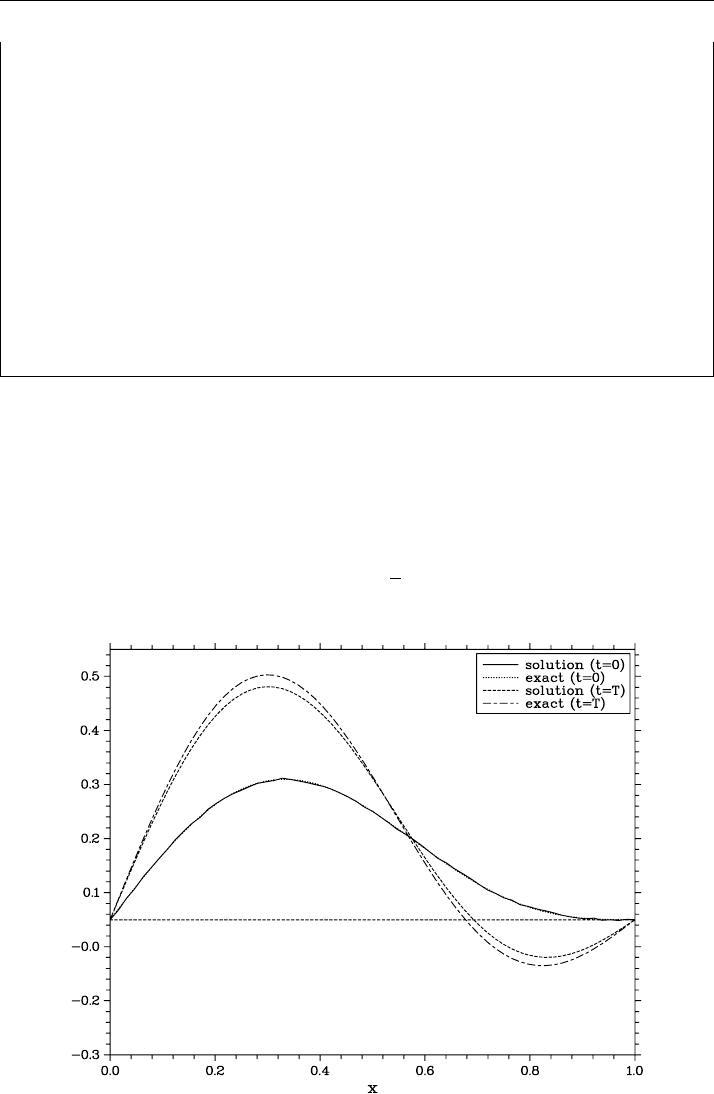
Figure 7.14 Solution of the problem obtained with δ = 0.002
Section 7.4 Second-order evolution equation 325
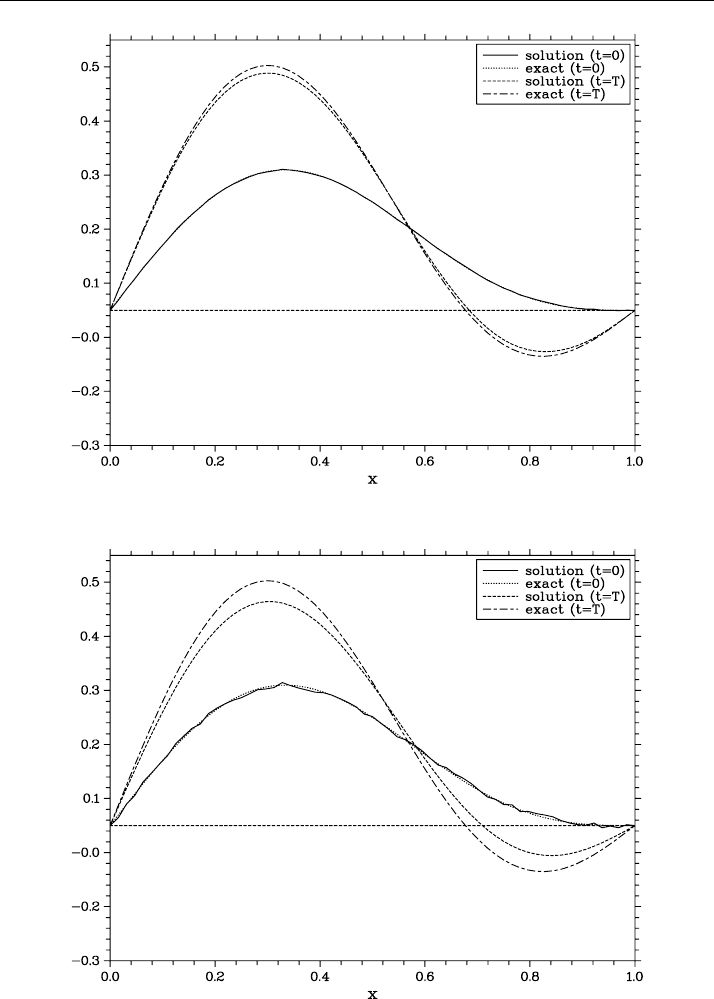
Figure 7.15 Solution of the problem obtained with δ = 0.001
Figure 7.16 Inverse-problem solution obtained with δ = 0.005
Figure 7.14 shows the solution of the inverse problem obtained for the inaccuracy
level defined by the quantity δ = 0.002. Here, the exact and perturbed initial condi-