
Samarskii A.A., Vabishchevich P.N. Numerical Methods for Solving Inverse Problems of Mathematical Physics
Подождите немного. Документ загружается.


336 Chapter 7 Evolutionary inverse problems
C
C SOLUTION AT THE OBSERVATION POINTS
C
CALL PU (IM, JM, A(10
*
N+1), N1, N2, FF, L)
DO IP = 1,L
FIK(IP,K) = FF(IP)
END DO
END DO
C
C CONJUGATE STATE
C
T = TMAX + TAU
C
C INITIAL CONDITION
C
DOI=1,N
A(10
*
N+I) = 0.D0
END DO
DOK=2,M+1
C
C DIFFERENCE-SCHEME COEFFICIENTS
C
CALL FDS (A(1), A(N+1), A(2
*
N+1), A(9
*
N+1), A(10
*
N+1),
+ H1, H2, N1, N2, TAU)
CALL RHS (A(9
*
N+1), N1, N2, H1, H2, FID, FIK, IM, JM, L, M, K)
C
C SOLUTION OF THE DIFFERENCE PROBLEM
C
IDEFAULT(1) = 0
IREPT = 0
CALL SBAND5 (N, N1, A(1), A(10
*
N+1), A(9
*
N+1), EPSR, EPSA)
END DO
C
C SIMPLE ITERATION METHOD
C NEXT APPROXIMATION
C
CALL BS (A(10
*
N+1), A(1), A(N+1), A(2
*
N+1), A(12
*
N+1), N1, N2 )
DOI=1,N
A(11
*
N+I) = A(11
*
N+I) - SS
*
A(12
*
N+I)
END DO
C
C EXIT FROM THE ITERATIVE PROCESS BY THE DISCREPANCY CRITERION
C
SUM = 0.D0
DOK=1,M
DOIP=1,L
SUM = SUM + (FID(IP,K) - FIK(IP,K))
**
2
*
TAU
END DO
END DO
SUM = SUM/(L
*
TMAX)
SL2 = DSQRT(SUM)
WRITE (
*
,
*
) IT, SL2
IF ( SL2.GT.DELTA ) GO TO 100
C
C SOLUTION
C
WRITE ( 01,
*
) (A(11
*
N+I), I=1,N)
WRITE ( 01,
*
) ((FI(IP,K), IP=1,L), K=1,M)
CLOSE (01)
STOP

Section 7.5 Continuation of non-stationary fields from point observation data 337
END
C
SUBROUTINE INIT (U, X1, X2, N1, N2)
C
C INITIAL CONDITION
C
IMPLICIT REAL
*
8 ( A-H, O-Z )
DIMENSION U(N1,N2), X1(N1), X2(N2)
DOI=1,N1
DOJ=1,N2
U(I,J) = 0.D0
IF ((X1(I)-0.6D0)
**
2 + (X2(J)-0.6D0)
**
2.LE.0.04D0)
+ U(I,J) = 1.D0
END DO
END DO
C
RETURN
END
C
SUBROUTINE FDS (A0, A1, A2, F, U, H1, H2, N1, N2, TAU)
C
C GENERATION OF DIFFERENCE-SCHEME COEFFICIENTS
C FOR PARABOLIC EQUATION WITH CONSTANT COEFFICIENTS
C IN THE CASE OF PURELY IMPLICIT SCHEME
C
IMPLICIT REAL
*
8 ( A-H, O-Z )
DIMENSION A0(N1,N2), A1(N1,N2), A2(N1,N2), F(N1,N2), U(N1,N2)
C
DOJ=2,N2-1
DOI=2,N1-1
A1(I-1,J) = 1.D0/(H1
*
H1)
A1(I,J) = 1.D0/(H1
*
H1)
A2(I,J-1) = 1.D0/(H2
*
H2)
A2(I,J) = 1.D0/(H2
*
H2)
A0(I,J) = A1(I,J) + A1(I-1,J) + A2(I,J) + A2(I,J-1)
+ + 1.D0/TAU
F(I,J) = U(I,J)/TAU
END DO
END DO
C
C FIRST-KIND HOMOGENEOUS BOUNDARY CONDITION
C
DOJ=2,N2-1
A0(1,J) = 1.D0
A1(1,J) = 0.D0
A2(1,J) = 0.D0
F(1,J) = 0.D0
END DO
C
DOJ=2,N2-1
A0(N1,J) = 1.D0
A1(N1-1,J) = 0.D0
A1(N1,J) = 0.D0
A2(N1,J) = 0.D0
F(N1,J) = 0.D0
END DO
C
DOI=2,N1-1
A0(I,1) = 1.D0
A1(I,1) = 0.D0

338 Chapter 7 Evolutionary inverse problems
A2(I,1) = 0.D0
F(I,1) = 0.D0
END DO
C
DOI=2,N1-1
A0(I,N2) = 1.D0
A1(I,N2) = 0.D0
A2(I,N2) = 0.D0
A2(I,N2-1) = 0.D0
F(I,N2) = 0.D0
END DO
C
A0(1,1) = 1.D0
A1(1,1) = 0.D0
A2(1,1) = 0.D0
F(1,1) = 0.D0
C
A0(N1,1) = 1.D0
A2(N1,1) = 0.D0
F(N1,1) = 0.D0
C
A0(1,N2) = 1.D0
A1(1,N2) = 0.D0
F(1,N2) = 0.D0
C
A0(N1,N2) = 1.D0
F(N1,N2) = 0.D0
C
RETURN
END
C
SUBROUTINE RHS (F, N1, N2, H1, H2, FI, FIK, IM, JM, L, M, K)
C
C RIGHT-HAND SIDE IN THE EQUATION FOR THE CONJUGATE STATE
C
IMPLICIT REAL
*
8 ( A-H, O-Z )
DIMENSION F(N1,N2), FI(L,M), FIK(L,M), IM(L), JM(L)
C
DOJ=2,N2-1
DOI=2,N1-1
DOIP=1,L
IF (I.EQ.IM(IP).AND.J.EQ.JM(IP)) THEN
F(I,J) = F(I,J) + (FIK(IP,M+2-K)-FI(IP,M+2-K))/(H1
*
H2)
END IF
END DO
END DO
END DO
C
RETURN
END
C
SUBROUTINE MEGP (XP, YP, IM, JM, L, H1, H2)
C
C OBSERVATION POINTS
C
IMPLICIT REAL
*
8 ( A-H, O-Z )
DIMENSION IM(L), JM(L), XP(L), YP(L)
C
XP(1) = 0.17D0

Section 7.5 Continuation of non-stationary fields from point observation data 339
YP(1) = 0.53D0
XP(2) = 0.36D0
YP(2) = 0.87D0
XP(3) = 0.42D0
YP(3) = 0.39D0
XP(4) = 0.58D0
YP(4) = 0.48D0
XP(5) = 0.83D0
YP(5) = 0.25D0
XP(6) = 0.11D0
YP(6) = 0.15D0
XP(7) = 0.76D0
YP(7) = 0.71D0
XP(8) = 0.28D0
YP(8) = 0.33D0
XP(9) = 0.35D0
YP(9) = 0.65D0
XP(10) = 0.49D0
YP(10) = 0.24D0
DO IP = 1,L
IM(IP) = XP(IP)/H1 + 1
IF ((XP(IP) - IM(IP)
*
H1).GT. 0.5D0
*
H1) IM(IP) = IM(IP)+1
JM(IP) = YP(IP)/H2 + 1
IF ((YP(IP) - JM(IP)
*
H2).GT. 0.5D0
*
H2) JM(IP) = JM(IP)+1
END DO
C
RETURN
END
C
SUBROUTINE PU (IM, JM, U, N1, N2, F, L)
C
C SOLUTION AT THE MEASUREMENT POINTS
C
IMPLICIT REAL
*
8 ( A-H, O-Z )
DIMENSION IM(L), JM(L), F(L), U(N1,N2)
C
DO IP = 1,L
I = IM(IP)
J = JM(IP)
F(IP) = U(I,J)
END DO
C
RETURN
END
C
SUBROUTINE BS ( U, A0, A1, A2, B, N1, N2 )
C
C FUNCTIONAL GRADIENT
C
IMPLICIT REAL
*
8 ( A-H, O-Z )
DIMENSION U(N1,N2), A0(N1,N2), A1(N1,N2), A2(N1,N2), B(N1,N2)
C
DOJ=2,N2-1
DOI=2,N1-1
B(I,J) = A0(I,J)
*
U(I,J)
*
- A1(I-1,J)
*
U(I-1,J)
*
- A1(I,J)
*
U(I+1,J)
*
- A2(I,J-1)
*
U(I,J-1)
*
- A2(I,J)
*
U(I,J+1)
END DO
340 Chapter 7 Evolutionary inverse problems
END DO
C
RETURN
END
We have restricted ourselves to the case in which in equation (7.257) we have k(x) = 1
and, in addition, purely implicit schemes are used (the difference-scheme coefficients
for the ground state are generated in the subroutine FDS, and for the conjugate state,
in the subroutines FDS and RHS.
7.5.6 Computational experiments
The basic grid was the uniform grid with h
1
= 0.02 and h
2
= 0.02 for the problem in
unit square. In the realization of the quasi-real experiment, as input data, the solution
of the direct problem at some points of the calculation domain was taken. The problem
is solved till the time T = 0.025, the time step size of the grid being τ = 0.00025. In
the direct problem, the initial condition is given in the form
u
0
(x, 0) =
1,(x
1
− 0.6)
2
+ (x
2
− 0.6)
2
≤ 0.04,
0,(x
1
− 0.6)
2
+ (x
2
− 0.6)
2
> 0.04.
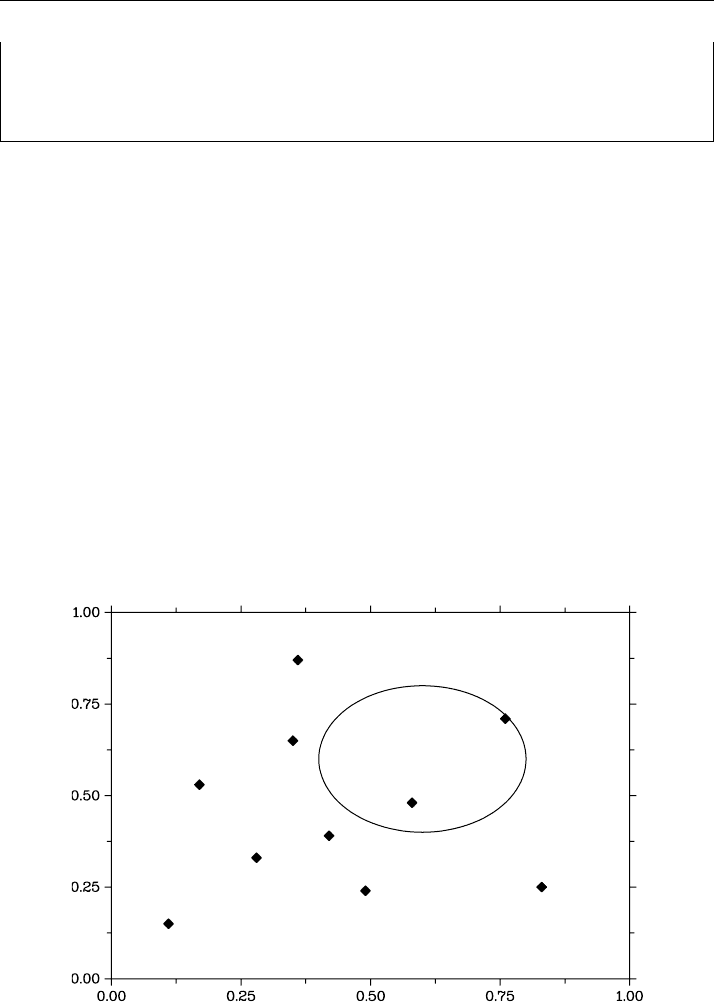
Figure 7.18 Observation points and initial conditions in the direct problem
Figure 7.18 shows the location of the observation points and indicates the portion
of the calculation domain in which the initial condition was localized. As input data,
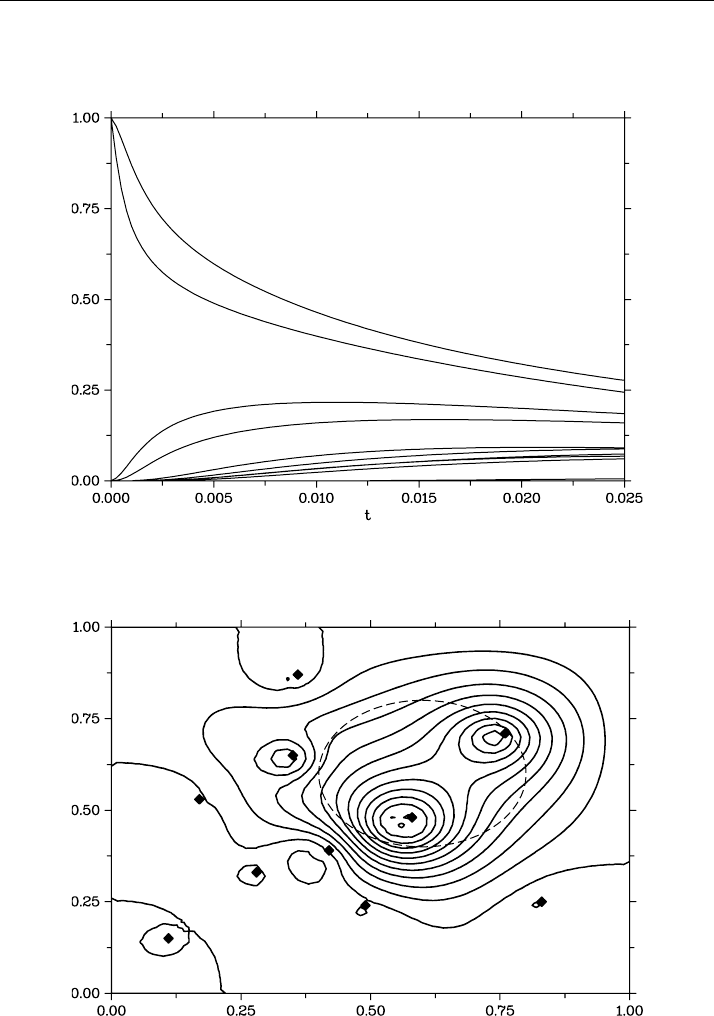
the solution at the observation points is used (see Figure 7.19).
Section 7.5 Continuation of non-stationary fields from point observation data 341
Figure 7.19 Solution at the observation points
Figure 7.20 Inverse-problem solution obtained with δ = 0.02
342 Chapter 7 Evolutionary inverse problems
Consider calculated data that illustrate possibilities in reconstructing the initial con-
dition from point observation data. Figure 7.20 shows the solution of the inverse prob-
lem obtained with the inaccuracy level δ = 0.02 (plotted are contour lines following
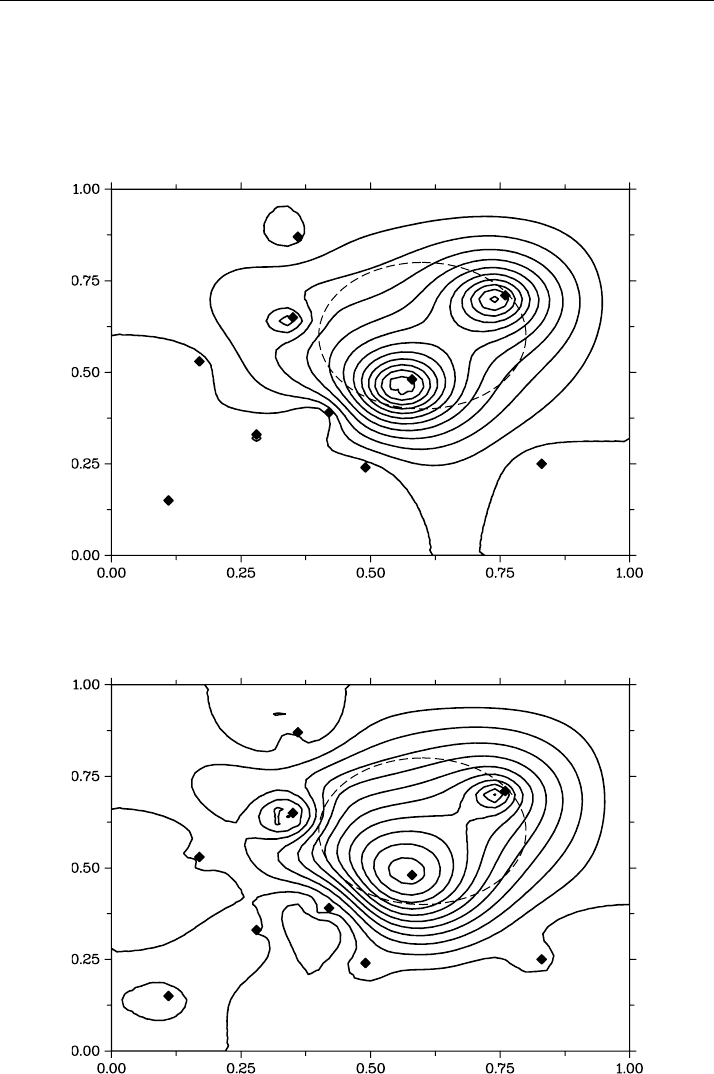
with the grid size u = 0.1). The effect due to the inaccuracy level is illustrated in
Figures 7.21 and 7.22.
Figure 7.21 Inverse-problem solution obtained with δ = 0.04
Figure 7.22 Inverse-problem solution obtained with δ = 0.01

Section 7.6 Exercises 343
7.6 Exercises
Exercise 7.1 Examine convergence of the approximate solution found by formulas
(7.14), (7.36) to the exact solution of problem (7.6), (7.7) H
D
, D = S
2
.
Exercise 7.2 Formulate the non-local problem that arises in the optimal control prob-
lem (7.38)–(7.41) with a non-self-adjoint operator A.
Exercise 7.3 Using the program PROBLEM10, examine the time dependence of the
approximate-solution inaccuracy. Compare the experimental data with the theoretical
results (see estimate (7.35)).
Exercise 7.4 Examine the generalized inverse method (7.109), (7.138) to approxi-
mately solve the ill-posed problem (7.101), (7.102).
Exercise 7.5 Consider the additive scheme of component-by-component splitting (to-
tal approximation scheme)
y
n+1/2
− y
n
τ
−
1
y
n
+ α
2
1
(σ y
n+1/2
+ (1 − σ)y
n
) = 0,
y
n+1
− y
n+1/2
τ
−
2
y
n+1/2
+ α
2
2
(σ y
n+1
+ (1 − σ)y
n+1/2
) = 0
for the Cauchy problem posed for equation (7.158).
Exercise 7.6 Based on the data calculated by the program PROBLEM11, examine the
effect of exact-solution smoothness on the initial-condition reconstruction inaccuracy.
Exercise 7.7 Consider the possibility of using iteration methods constructed around
the minimization of the discrepancy functional in solving the inverted-time problem
(7.159)–(7.161).
Exercise 7.8 Construct an iteration method for refining the initial condition in scheme
(7.166), (7.167) as applied to the approximate solution of the retrospective inverse
problem with a non-self-adjoint, positively defined operator .
Exercise 7.9 Using the program PROBLEM12, experimentally examine how the
choice of B in (7.179) affects the possibility of identifying a solution with desired
smoothness.
Exercise 7.10 Construct a difference scheme for the non-local boundary value prob-
lem
−
d
dx
k(x)
du
dx
+ q(x)u = f (x), 0 < x < l,
u(0) + αu(l) = μ
1
,
−k(0)
du
dx
(0) = μ
2
.
Modify the sweep algorithm so that to make it appropriate for the solution of the related
non-local difference problem.

344 Chapter 7 Evolutionary inverse problems
Exercise 7.11 Construct the difference scheme for the generalized inverse method
(7.220)–(7.222) as applied to the approximate solution of the ill-posed problem
(7.187)–(7.189) and perform a stability study for this scheme.
Exercise 7.12 Perform computational experiments (program PROBLEM13) to inves-
tigate into the solution inaccuracy in the Cauchy problem for the Laplace equation as
dependent on the smoothness of exact initial conditions.
Exercise 7.13 Formulate optimality conditions for the minimization problem for
(7.274), (7.275) under constraints (7.270), (7.271).
Exercise 7.14 Derive optimality conditions for the difference problem (7.271)–
(7.274), (7.275) in the case of a non-self-adjoint operator >0.
Exercise 7.15 Modify the program PROBLEM14 so that the initial condition be re-
fined by the method of minimal discrepancies instead of the simple iteration method.
8 Other problems
Above, two classes of inverse problems for mathematical physics equations have been
considered in which it was required to identify the right-hand side of an equation or the
initial condition for the equation. Among other problems important for applications,
boundary value inverse problems deserve mention in which to be reconstructed are the
boundary conditions. For approximate solution of the latter problems, methods using
some perturbation of the equation or methods using non-locally perturbed boundary
conditions can be applied. In the case in which the generalized inverse method is used
to solve some boundary value inverse problem, namely, in treating the spatial coordi-
nate as the evolutionary coordinate, special emphasis is to be placed on the hyperbolic
regularization method, used to pass from the hyperbolic to a parabolic equation. In the
present chapter, possibilities offered by the generalized inverse method as applied to
problems with perturbed boundary conditions are discussed with the example of the
boundary value inverse problem for the one-dimensional parabolic equation of sec-
ond order. For a more general two-dimensional problem, an algorithm with iteratively
refined boundary condition is used. The problems most difficult for examination are
coefficient inverse problems for mathematical physics equations. Here, we have re-
stricted ourselves to the matter of numerical solution of two coefficient problems. In
the first problem it is required to determine the higher coefficient as a function of the
solution for a one-dimensional parabolic equation. We describe a computational al-
gorithm that solves the coefficient inverse problem for the two-dimensional elliptic
equation in the case in which the unknown coefficient does not depend on one of the
two coordinates.
8.1 Continuation over the spatial variable in the boundary
value inverse problem
In this section, we consider the boundary value inverse problem for the one-
dimensional parabolic equation of second order (heat conduction equation). In this
problem, it is required to reconstruct the boundary condition from measurements per-
formed inside the calculation domain. This problem belongs to the class of condition-
ally well-posed problems and, to be solved stably, it requires the use of regularization
methods. Here, the generalized inverse method is to be applied under conditions in
which the problem is considered as an evolutionary one with respect to the spatial
variable. The use of the generalized inverse method leads, in particular, to the well-
known hyperbolic regularization of boundary value inverse problems.