
Scheffler Immo E. Mitochondria
Подождите немного. Документ загружается.

TRANSCRIPTION OF MITOCHONDRIAL DNA–RNA METABOLISM 111
4.4.2 Transcription of mtDNA in the Yeast Saccharomyces cerevisiae
A comparison of the structure of the yeast mt genome with that of animals
immediately suggests that many more transcriptional start sites must exist,
since the genome is about fi ve times larger, the genes are dispersed, and AT -
rich, noncoding sequences are inserted between them. At least 13 transcription
initiation sites have been mapped, and there are an additional four sites for
the synthesis of primers to be used in DNA replication (184, 185) . The simple
promoters all have a 9 - bp consensus sequence: 5 ′ - ATATAAGTA(+1) - 3 ′ . The
last A also corresponds to the 5 ′ end of the transcript. Like in animal cells,
polycistronic RNAs (but smaller) are still produced which must be cleaved
and processed to yield mRNAs encoding peptides, tRNAs and rRNAs. A total
of eight peptides are encoded by the mRNAs: cytochrome oxidase subunits I,
II, III (COXI, COXII, COXIII), apo - cytochrome b (COB), subunits 6, 8, and
9 of the F
0
complex of the mitochondrial ATP synthase, and a ribosomal
protein VAR1. There are some nonessential peptides encoded by introns of
COXI, COB, and the 21S rRNA gene which are required when the introns are
present (maturases), or can be active in the transposition of the introns, but
in intronless strains they are absent and not missed. Three open reading frames
have so far been identifi ed only from sequencing, not from isolation of tran-
scripts or from the discovery of mutations within these sequences. It has been
speculated that such as yet unknown functions may be required for DNA
replication or general recombination (186) .
Transcription itself is accomplished by a core RNA polymerase (145 kDa,
encoded by the nuclear RPO41 gene), and a specifi city factor (43 kDa, encoded
by the nuclear MTF1 gene). Both genes have been cloned and the proteins
have been characterized (187) . Like the mammalian enzymes, the polymerase
bears a relationship to polymerases of the bacteriophages T3 and T7, while
the specifi city factor resembles the bacterial sigma ( σ ) factors, but it has also
been compared to the mtTFA protein in mammalian mitochondria. The Mtf1
protein is released from the transcriptional complex after the fi rst few nucleo-
tides have been polymerized and is then recycled. Its function is primarily to
assure specifi city, stimulating polymerase activity only a few - fold. When the
MTF1 gene is deleted, the maintenance of the yeast mt genome is no longer
assured.
4.4.3 Transcription of mtDNA in Plant Mitochondria
An up - to - date and expert review of the present state of knowledge has recently
been written by Binder, Marchfelder, and Brennicke (188) , and references to
much of the primary literature can be found in this review. The area is in an
explosive state of growth, and many examples in the literature on the one hand
permit increasingly reliable generalizations on certain aspects, while on the
other hand plant - specifi c differences are also apparent. For example, monocot
112 BIOGENESIS OF MITOCHONDRIA
and dicot plants share many broad features but may differ in detail. A distinc-
tion for all plants is the simultaneous presence of chloroplasts. Mitochondria
and chloroplasts are often discussed together, not only because of obvious
similarities — for example, the observation of RNA editing in both plastids —
but because it is likely that factors may be shared between these two
organelles.
The variable size of plant mtDNAs has already been emphasized. At the
same time, a large fraction of this DNA does not have any obvious coding or
regulatory function, and generally the same limited number of proteins, rRNAs
and tRNAs, is encoded by plant mtDNA as in the mtDNA of animals and
fungi. Only a limited number of multicistronic transcription units have been
described so far, and these may be more common in plant mitochondria having
relatively small genomes with a denser spacing of genes. As described earlier,
the intergenic regions of plant mtDNA can be expanded or contracted by
frequent recombination events, which can also rearrange the position of genes
relative to each other.
Many examples of monocistronic transcripts encoding proteins (atp6, atp9,
cytb, cox1, cox2, and cox3) have been described. Such transcripts include
extended untranslated regions at the 5 ′ and 3 ′ end, frequently hundreds of
nucleotides in length. In contrast to other species, plant mitochondrial tran-
scripts are not polyadenylated. Since the primary 5 ′ ends of such transcripts
are not capped, they can be capped by an in vitro reaction, which subsequently
permits a distinction between a 5 ′ end of a primary transcript and the 5 ′ end
of a mature mRNA generated from RNA processing. By this method, at least
15 primary transcripts (and promoters) have been identifi ed in Oenothera
(188) , with the promoters distributed over the entire genome. The analysis of
primary transcripts can be complicated by the existence of multiple promoters,
spaced over several hundred nucleotides upstream of the coding sequence.
Multiple transcripts of different size may therefore be found. It has not yet
been resolved whether such arrangements have a regulatory signifi cance in
differentiation and development. Another potential complication is the possi-
bility of multiple copies of a gene in the genome which may yield transcripts
with differing 5 ′ and/or 3 ′ UTRs.
A detailed analysis of several promoters has been greatly facilitated by the
development of in vitro transcription systems, permitting the examination
of promoters and derived variants with deletions, substitutions, and linker -
insertions. From such an approach a promoter region of about 17 nucleotides
has been identifi ed in monocot plant mitochondria (wheat, maize) and includes
(a) a conserved tetranucleotide CRTA at the transcription initiation site and
(b) a conserved purine - rich stretch about 15 nt upstream of the transcription
initiation site. In dicots (e.g., pea), the CRTA motif is also conserved, and an
A - rich region is found upstream which is important as demonstrated by in
vitro mutagenesis experiments. In vitro studies also permit the testing of a
promoter from one species with extracts from another species, and by such
means functioning promoter sequences can be confi rmed, but differences in
TRANSCRIPTION OF MITOCHONDRIAL DNA–RNA METABOLISM 113
effi ciencies are indicative of differences in the interaction of promoters
with species - specifi c factors. Such differences cannot be deduced from simple
inspection of primary sequences.
Not all promoters are identical on a specifi c mtDNA. Ribosomal RNAs are
apparently transcribed from promoters with a distinct sequence in both mono-
cots and dicots, based on sequence inspections or on in vitro experiments with
homologous or heterologous mitochondrial lysates. Such observations have
given rise to speculations about different transcriptional activators, and even
about the possibility of more than one RNA polymerase in plant mitochon-
dria, a situation encountered in chloroplasts of higher plants (189) . Differences
in RNA polymerases, factors, and promoter sequence suggest that activity at
different promoters may variable and regulated. Such a conclusion is sup-
ported by run - on experiments in isolated organelles or lysates — that is, elonga-
tion of pre - initiated transcripts with added nucleotides. Ribosomal RNAs and
ribosomal protein genes were found to be most actively transcribed, and dis-
tinctions were found in one case between the other transcripts. Comparison
of such data with the observed steady - state levels of transcripts in vivo is
clearly indicative of the existence of extensive post - transcriptional regulatory
mechanisms, most likely at the level of mRNA stability.
4.4.4 Transcriptional Termination
Transcription of an entire circular template in animal cells raises the question
of whether true transcriptional termination occurs. This has been a diffi cult
question to answer, but a region at the 3 ′ terminus of the rRNA gene and
immediately adjacent to the tRNA
Leu(UUR)
gene has attracted attention based
on (a) in vitro experiments showing transcription termination at this site (190)
and (b) a very provocative fi nding of an ∼ 34 - kDa protein that can footprint
this sequence. The same sequence is mutated in a patient with MELAS (myop-
athy, encephalopathy, lactic acidosis, and stroke - like symptoms; see Chapter 7 )
(191) , and the mutated form has a lowered affi nity for this presumed termina-
tion protein (192) . A factor named mTERF (mitochondrial transcription ter-
mination factor) has recently been purifi ed by DNA affi nity chromatography
using the boundary sequence between the 16S rRNA and the tRNA
Leu(UUR)
genes (193) . The important role of this protein is most likely related to the
need for making more ribosomes than mRNAs (see above). It is not clear
whether it can directly infl uence the rates at which the two closely spaced ini-
tiation sites are used, but by terminating the majority of the transcripts at
the boundary site the overproduction of rRNAs compared to mRNAs is
assured.
4.4.5 RNA Processing in Mitochondria
An equally challenging problem has been the elucidation of the precise mech-
anism by which the primary transcripts are processed to form individual
114 BIOGENESIS OF MITOCHONDRIA
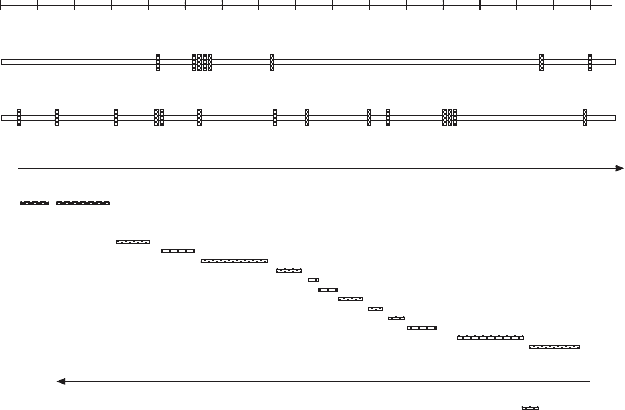
mRNAs, rRNAs, and tRNAs. It is clear that the process must recognize the
interspersed tRNAs (Figure 4.8 ), because they are joined directly to rRNA or
coding sequences. In the original publication describing the localization of the
tRNA genes, Attardi and his colleagues made reference to the “ tRNA punc-
tuation model ” for mt RNA processing (175) , an apt description of how the
compact genome is organized and interpreted. In attempts to reproduce this
processing in vitro , the primary transcript has been produced with prokaryotic
RNA polymerases, but efforts to achieve processing with mitochondrial
extracts have been quite unsuccessful. Thus it is possible that most of the pro-
cessing occurs already with nascent transcripts.
Splicing out a tRNA requires two endonucleolytic cleavages: at the 5 ′ end
and at the 3 ′ end. Cleavage at the 5 ′ end could occur as soon as the entire
tRNA sequence has been transcribed and has assumed the appropriate sec-
ondary structure; in mitochondria this cleavage would produce the 3 ′ end of
an mRNA, for example. From the study of tRNA precursors and their process-
ing in bacteria and other organisms, a nuclease, RNase P, has been character-
ized which performs the 5 ′ cleavage, prompting a search for a corresponding
activity in mitochondria of yeast and mammals which only recently has met
with success (194) . Most signifi cantly, it was found that the yeast enzyme was
a ribonucleoprotein that consisted of a peptide encoded in the nucleus and an
RNA encoded by the mt genome in yeast, but presumably by the nuclear
Figure 4.8 Schematic representation of the major transcripts from the H - strand, and
the subsequent processing to form mature rRNAs, tRNAs (not shown), and mRNAs.
Only a single mRNA (ND6) and several tRNAs are derived from the transcript of the
L - strand.
ND5
12S 16S
rRNAs
COX3
ND4
ND2
COX1
COX2
ATPase8
ATPase6
ND3
ND4L
ND1
5’
Primary Transcript from H-Strand
Primary Transcript from L-Strand
123456 78910111213141516kb
H-strand
3’
L-strand
Gln Ala Asn Cys Tyr Ser Glu Pro
Phe Val Leu IIe f-Met Trp Asp Lys Gly Arg His Ser Leu Thr
ND6
CYTB
TRANSCRIPTION OF MITOCHONDRIAL DNA–RNA METABOLISM 115
genome in other organisms. The RNA has two regions highly conserved in
RNAs found in other RNase Ps. They are believed to participate in basepairing
interactions leading to pseudoknot formation and the formation of the cata-
lytic core of the enzyme.
The other steps in RNA processing are even less well understood. In general,
the activities of interest are present at low abundance, making purifi cation
diffi cult, even when a specifi c substrate for the assay was available from in
vitro transcription of an engineered template. A genetic approach in yeast
is a possibility, but the specifi c mutant would presumably have to be
distinguished from a large number of other respiration - defi cient mutants
(petites).
The following types of activities remain to be purifi ed and characterized in
detail:
1. The nucleases complete the processing of the polycistronic transcripts —
for example, the cleavage at the 3 ′ end of the tRNAs.
2. Mature mRNAs and even rRNAs are polyadenylated. Symptomatic for
the extreme economy in the genome is the fi nding that some mRNAs do
not have complete stop codons until the third adenine nucleotide is
added as part of the polyadenylation reaction.
3. Fungi and plant mtDNAs encode ORFs interrupted by introns. These
introns can be of type I or type II. Some of these introns include ORFs
encoding maturases or reverse transcriptase activities that play a role in
intron splicing and mobility. Some of the diversity and variability of these
introns in different species and even within a species have been discussed
in the section on gene organization. In Saccharomyces cerevisiae introns
have been found in the mt COXI gene and the mt COB gene. They have
been characterized as self - splicing group II introns (195 – 197) .
Processing of transcripts in plant mitochondria is certainly necessary when
the transcript is polycistronic — for example, the 18S – 5S – nad5 transcript in
Oenothera mitochondria. Little is known at this time about the details of the
enzymatic reactions and about the processing signals recognized by the trans-
acting factors. 5 ′ and 3 ′ processing is required, depending on the transcript. For
example, the 18S rRNA is transcribed from an upstream promoter and requires
the removal of 25 – 120 nt, depending on the plant. Various mRNA have been
found to have a double stem loop at the 3 ′ end, and it has been hypothesized
that the transcript initially extends beyond the stem loop, but is trimmed back
by a 3 ′ exonuclease until the stabilizing secondary structure prevents further
hydrolysis (188) .
For the processing of tRNAs, processing systems have been established
in vitro from mitochondrial extracts, and such extracts have been shown
to contain an RNase - P - like enzyme with an RNA moiety necessary for
activity. As discussed above, this enzyme is distinct from the necessary 3 ′
endonuclease.
116 BIOGENESIS OF MITOCHONDRIA
In higher plant mitochondria a number of transcripts have been found to
contain group II introns that are similar to this class of introns found in yeast
mitochondria. A relatively unique feature is that some introns are physically
disrupted by a large intervening portion of the genome. In virtually all fl ower-
ing plants, such disrupted introns have been discovered in the nad1, nad2, and
nad5 genes. mRNA maturation requires trans - splicing to transcripts with
exons that are independently transcribed. One specifi c example will illustrate
the surprises and unpredictability of transcription and splicing implants. The
penultimate intron of the nad1 gene appears to contain an ORF potentially
encoding the only maturase identifi ed so far in plant mitochondria (198) .
Trans - splicing of this intron occurs in petunia and wheat, but in the fi rst
example the maturase ORF is in the upstream half of the intron, while in
wheat it is found in the downstream portion of the intron. In the broad bean
this intron is not trans - spliced at all, and the maturase ORF is located between
the two exons (188) . Small wonder that a review on the subject is entitled “ The
Mitochondrial Genome: So Simple Yet So Complex ” (199) .
4.4.6 RNA Editing in Kinetoplastid Protozoa
One of the most bizarre and unexpected observations was the discovery of
RNA editing in mitochondria of kinetoplastid protozoa. After its discovery
in these organisms, editing was subsequently found in a few other organellar
or nuclear transcripts in a wide range of organisms, but the extent to which
it is being used in kinetoplastids is astonishing. The authors of one review
point out that it appears to be completely redundant, because there is no
obvious reason why the same polypeptides could not be encoded directly by
the genes and the resulting transcripts (200) . What is editing? In the most
general sense it means that an RNA, after it has been transcribed from the
corresponding gene, is altered by the insertion or deletion of nucleotides that
are not encoded by the gene. The unedited transcript could not be translated
because there is no sensible ORF. An ORF is created only after a series of
nucleotides have been inserted or deleted (or altered). As pointed out by one
of the pioneers in the fi eld (201) , the term RNA “ editing ” has been used
rather indiscriminately to describe many types of RNA modifi cations occur-
ring post - transcriptionally; and in many of these, site - specifi city is achieved
with the help of small complementary RNAs. RNA interference and siRNA -
mediated degradation of mRNAs may be included under this broader defi ni-
tion. The present discussion will be concerned with phenomena defi ned by
the more limited defi nition above. A discussion of RNA editing from a per-
spective of an evolutionary biologist can be found in the review by Covello
and Gray (200) .
The major effort has been devoted to the study of the trypanosomatid
genera Trypanosoma and Leishmania , since they are the pathogens responsi-
ble for several widespread diseases of humans and animals in tropical Africa
and South America. Their interesting life cycle includes stages in both a
TRANSCRIPTION OF MITOCHONDRIAL DNA–RNA METABOLISM 117
mammalian host and insect host which serves as the vector in transmitting the
pathogen.
The structure of the kDNA in the kinetoplast within the single mitochon-
drion has been described in an earlier chapter. It remains to defi ne and explain
how mature, translatable mRNAs are produced from transcripts of the “ cryp-
togenes ” on the maxicircle. RNA editing in these organisms requires the inser-
tion, and less frequently the deletion, of uridylate residues, not as a rare event
but in a process involving more than half of the maxicircle transcripts. Not only
are the majority of the transcripts affected, but the addition of Us is extensive,
such that in some cases the transcript is doubled in size, and essential, because
the addition of Us creates start and/or stop codons and the desired open
reading frame. Unedited transcripts are believed not to be recognized by the
translational initiation mechanism. This amazing violation of orthodoxy has
been and continues to be met with questions about What? How? Why? and
When? (200, 202, 203) . The fi rst two can now be answered with some confi dence
and in detail (201, 204, 205) . The last is a question about the evolution of this
phenomenon, and answers are coming in as more and more examples become
available to construct reliable phylogenetic trees (200, 202) . Why? is the ques-
tion most diffi cult to answer, and a speculative answer will be deferred until it
has been made clear what is happening to the transcripts.
RNA editing is not confi ned to trypanosomes (206, 207) . However, in
mammals less than a handful of nuclear gene transcripts and some viral tran-
scripts have been found to be edited, usually at a single position, where a C is
converted to a U, or the change is U - to - C. In marsupial mitochondria a C - to - U
conversion in the anticodon loop converts a tRNA
Gly
to tRNA
Asp
(208) . The
COX1 mRNA in mitochondria of the slime mold Physarum polycephalum is
edited by a C - to - U conversion. In plants, more extensive editing occurs in
mitochondria and in chloroplasts (C to U). In distinction to the editing observed
in trypanosomes, editing in the other examples involves a base change — for
example, a C - to - U conversion in apolipoprotein B, or an A - to - I conversion in
the AMPA receptor — by hydrolytic deamination, while for editing in trypano-
somes the change entails insertions and deletions of uridines. One should also
distinguish clearly between editing occurring within an RNA sequence and
the “ editing ” that is exemplifi ed by the polyadenylation of mRNA, or the
addition of the sequence CCA at the 3 ′ end of tRNAs. The addition of a 3 ′
oligo(U) tail to the kinetoplastid mRNAs and gRNAs (see below) also belongs
to a distinct category, requiring the activity of a mitochondrial terminal uridy-
lyl transferase.
The editing proceeds in a systematic manner from the 3 ′ end to the 5 ′ end,
and it requires the participation of so - called guide RNAs (gRNAs). As one
portion of the mRNA becomes edited, it can form a basepair with another
gRNA, and the editing step can be repeated further upstream in the mRNA.
The gRNAs are encoded in both maxicircles and minicircles, with their abun-
dance being assured by the abundance of minicircles (45) . The complexity of
the minicircles and the total number of gRNAs varies from species to species;
118 BIOGENESIS OF MITOCHONDRIA
T. brucei has over 300 different minicircle classes, each encoding three gRNAs.
The gRNA contain sequences that are antisense to portions of the mRNA to
be edited, and short “ anchor ” duplexes are formed between the two RNAs
just 3 ′ of the sequence to be edited. The subsequent steps can so far be
modeled by several schemes involving either transesterifi cations or cleavage –
ligation ( “ cut, insert, and paste, ” also described as the enzyme cascade model),
with recent in vitro studies favoring a cleavage – ligation model. Each scheme
still includes alternatives for the terminal reactions (207, 209, 210) .
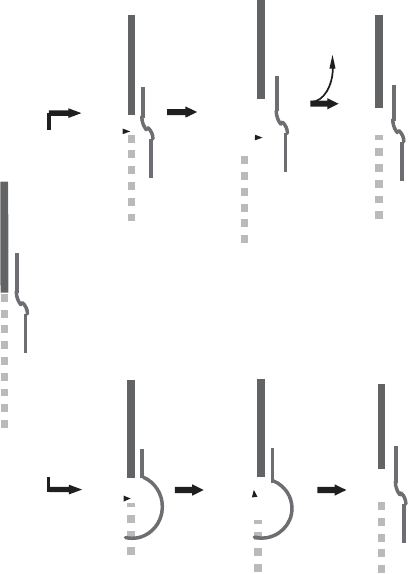
A model based on successive transesterifi cation reactions is shown in Figure
4.9A . The initial reaction is a nucleophilic attack at a site specifi ed by the guide
RNA, upstream from the anchor sequence. The resulting 3 ′ hydroxyl group on
the upstream portion of the pre - edited mRNA can then make another nucleo-
philic attack leading to the insertion of only one uridine, if the initial nucleo-
phile is UTP (scheme on the right), and may lead to the insertion of one or
more uridines if the nucleophile is the 3 ′ end of the oligo (U) tail of the guide
RNA. Thus, in this model the gRNA has two functions: It serves to specify the
site of insertion by the specifi city of the anchor sequence, and it may provide
the uridines inserted into the mRNA. While this model was initially appealing
in its resemblance to RNA - catalyzed splicing reactions, and hence indicative
of a potential, common evolutionary origin, recent evidence leads to a rejec-
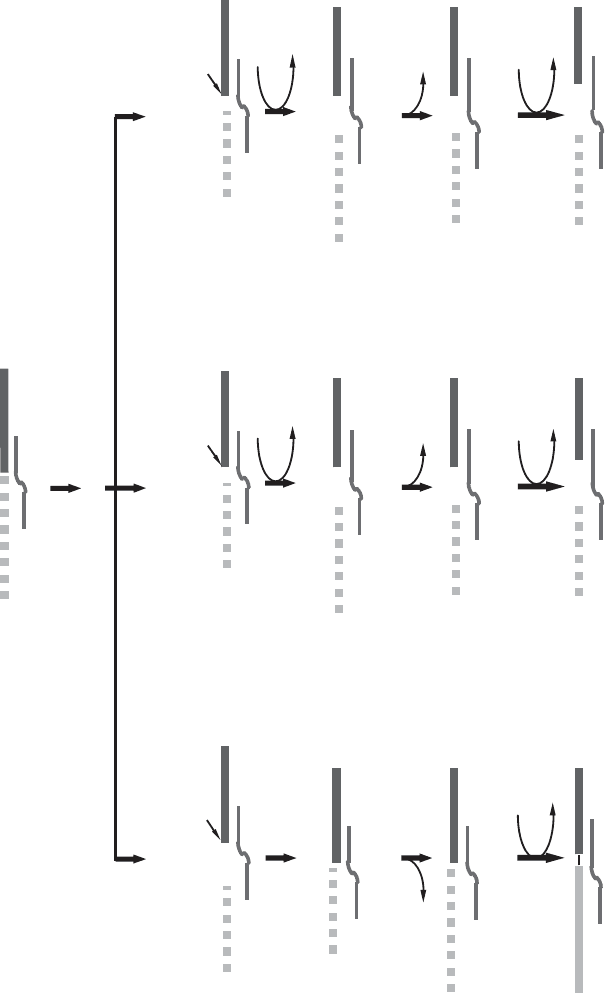
tion of this model in favor of the cascade model shown in Figure 4.9B . The
anchor sequence of the guide RNA again serves to specify a point of cleavage
by an endonuclease, and cleavage occurs precisely at the fi rst mismatched
nucleotide upstream of the duplex formed between the gRNA and the pre -
edited mRNA. Uridylate residues can be added to the 3 ′ end by a terminal
transferase (addition, middle, and right scheme). 3 ′ – 5 ′ exonuclease trimming
may be necessary, and may be responsible for the guided deletion of U ’ s (left
scheme) (211) , and fi nally an RNA ligase restores the continuity in the mRNA.
At this point the gRNA must be released (presumably with the help of a
helicase), and the steps can be repeated at a new position.
Evidence favoring the second model is derived from signifi cant advances
in reproducing some of the required steps in vitro (see Simpson (201) for an
up - to - date review and a listing of many references). In addition to a model
system demonstrating the gRNA - dependent insertion of Us directly from
UTP (and a requirement for exogenous UTP), it could also be shown that the
required ATP is hydrolyzed between the α – β bond, as expected for an RNA
ligation reaction in which AMP becomes covalently linked to an intermediate.
Chemical blockage of the 3 ′ end of the gRNA by periodation did not prevent
U - insertion, eliminating this end as a potential nucleophile. As discussed in
more detail by Alfonzo et al. (209) , a major modifi cation of the original
enzyme - cascade model includes the addition of multiple U ’ s to the 5 ′ cleavage
fragment, followed by trimming by a 3 ′ exonuclease. This model could thus
accommodate additions, deletions, and even misediting in a single mechanism.
In subsequent years an additional insight was that separate but interconnected
enzymatic pathways exist for U - insertion and U - deletion sites (212) .
TRANSCRIPTION OF MITOCHONDRIAL DNA–RNA METABOLISM 119
Figure 4.9 RNA editing in Trypanosomes (see reference 201 for details). (A) Double transesterifi cation models, showing only the U -
insertions. (B) The modifi ed enzyme cascade model showing U - deletion, or U - addition or misedited U - addition as alternatives. In the
simplest version the U - tail of the guide RNA is shown as a free overhang, but it is also possible that it may pair with a purine - rich sequence
of the pre - edited RNA . The number of Us added to the 5 ′ fragment in the U - addition pathway (middle) is show as 13, but this number
is actually variable. If the trimming is precise, correct guided products are obtained. If trimming is incomplete or excessive, a misedited
product may result. (The fi gures were provided by Dr. L. Simpson. With permission from Oxford University Press.) See color plates.
PP
i
first
transesterification
second
transesterification
Nucleophile:
UTP
Nucleophile:
oligo [U] tail
...3’
|||||||
-P-P-P...5’
5’...
anchor
guide RNA
pre-edited mRNA
UUU-
U
U
U
HO-UU
UTP-OH
|
|||||||
-P-P-P...5’
...3’5’...
-P-
UUU-
U
U
U
HO-UU
...3’
5’...
-OH
||||||
-P-P-P...5’
P-P-P-U-
|
UUU-
U
U
U
HO-UU
||||||
-P-P-P...5’
...3’
-U-
|
5’...
UUU-
U
U
U
HO-UU
||||||
-P-P-P...5’
...3’
-U-
|
5’...
UUU-
U
U
U
HO-U
5’...
-O
|||||||
-P-P-P...5’
...3’
|
|
|
U
U
U-
U
U
U
U
U
H
-P-
5’...
|||||||
-P-P-P...5’
...3’
|
U
U
U
U
U
U
U
OH
|
|
U
A
120 BIOGENESIS OF MITOCHONDRIA
ligation
3í-5’ exonuclease
trimming
U-deletion
guided
U-addition
guided
UUU-
U
U
U
HO-U…UUU
UUU-
U
U
U
HO-U…UUU
PP
i
UTP
ATP
PP
i
+ AMP
||||||||
...3’
-P-P-P...5’
|
|
|
...3’
||||||
5’...
-UUU-
|
-P-P-P...5’
|
-U
U
U
UUUUUUU-OH
|
U
U
U
...3’
-P-P-P...5’
||||||||
5’...
UMP
-U
UU
-OH
|
|
|
UUU-
U
U
U
HO-U…UUU
5’...
...3’
|||||||
5’...
-
O
H
-P-P-P...5’
UUU-
U
U
U
HO-U…U
UMP
-
U
U
U
-
O
H
|||||||
...3’
5’...
|
-P-P-P...5’
|||||||
...3’
5’...
-
O
H
|
-P-P-P...5’
ATP
PP
i
+ AMP
UUU-
U
U
U
HO-U…UUU
UUU-
U
U
U
HO-U…UUU
...3’
|||||||
5’...
-
O
H
-P-P-P...5’
UUU-
U
U
U
HO-U…U
-UUU
|||||||
...3’
|
-P-P-P...5’
UUU-
U
U
U
HO-U…UUU
5’...
U-additions
UUU-
U
U
U
HO-U…UUU
UUU-
U
U
U
HO-U…UUU
PP
i
UTP
ATP
PP
i
+ AMP
||||||||
...3’
-P-P-P...5’
|
|
|
5’...
-UU
-U
U
U
UUUUUUU-OH
U
U
U
...3’
-P-P-P...5’
||||||||
5’...
UMP
-U
UU
UU-OH
|
|
|
UUU-
U
U
U
HO-U…UUU
5’...
...3’
|||||||
5’...
-
O
H
-P-P-P...5’
UUU-
U
U
U
HO-U…U
U-addition
misedited
cleavage
|||||||
-P-P-P...5’
...3’5’...
anchor
guide RNA
pre-edited mRNA
UUU-
U
U
U
HO-U…UUU
3’-5’ exonuclease
trimming
ligation
U
...3’
-P-P-P...5’
||||||
U
U
|
|
|
|
-
B
Figure 4.9 (Continued)