
Schultz D. Encyclopedia of the United States Constitution
Подождите немного. Документ загружается.

of appeals judge from 1982 to 1988. He became
a fellow at the American Enterprise Institution
for Public Policy Research in 1988. His many
publications include Slouching Towards Gomor-
rah (1997), The Tempting of America (1997), and
Coercing Virtue (2003).
He is fi rst known for his dark role in the Water-
gate scandal and his willingness to carry out Pres-
ident Richard Nixon’s order to fi re Watergate
special prosecutor Archibald Cox following Cox’s
request of tapes of Oval Offi ce conversations, the
existence of which had been revealed by Nixon
presidential assistant Alexander Butterfi eld. Nix-
on’s attorney general, Elliot Richardson, and
deputy attorney general, William Ruckleshaus,
resigned rather than carry out that order. Bork,
as next in line promptly fired Cox. Public reac-
tion to the chain of events became popularized as
the “Saturday Night Massacre.” The subsequent
appointment of Leon Jaworski as another special
prosecutor ultimately led to public knowledge of
Nixon’s role in the Watergate cover-up when the
Supreme Court ordered the tapes to be reviewed.
Rather than confront impeachment proceedings
stemming from his role in the Watergate cover-up,
Nixon resigned the presidency thus averting a pos-
sible constitutional crisis.
Bork’s second foray into the public spotlight
involved his 1987 nomination to the Supreme
Court by President Ronald Reagan. Through-
out his career, Bork has remained critical of
the judicial activism practiced by the Supreme
Court in landmark cases involving abortion,
civil rights, and affirmative action. A
self-proclaimed strict constructionist in inter-
preting the Constitution, Bork remains critical
of judges applying broad interpretations of con-
stitutional intent and has vowed to exercise judi-
cial restraint and not be complicitous in Supreme
Court decisions that thwart the will of popu-
larly elected lawmakers. Bork believes judges
should not substitute their values for the original
intent of the framers of the Constitution.
Bork’s contrary public position in cases such as
G
RISWOLD V. CONNECTICUT, 318 U.S. 479 (1965),
which provided the constitutional foundation for
the right to privacy, and ROE V. WADE, 410 U.S.
113 (1973), which established a woman’s right
to an abortion, was characterized by Bork as “a
serious and wholly unjustifi ed usurpation of state
legislative authority.” Bork also criticized the
public accommodation provision in the Civil
Rights Act of 1964 for being a violation of the
proprietor’s freedom of association, and its prin-
ciple, one of “unsurpassed ugliness.” Comments
like these ignited a fi restorm of controversy at
his confi rmation hearings and placed him at the
center of a jurisprudence maelstrom when he
appeared before the 14-member judiciary com-
mittee. Throughout his five days of testimony,
the longest confi rmation hearing since hearings
began in 1939, Bork surprised everyone by pro-
viding testimony that revealed a moderation of
his controversial views.
However, despite Bork’s attempt at conciliatory
and nonideological testimony, his confirmation
hearings became so vituperative and vitriolic that
his ultimate defeat in the judiciary committee (9-
5) and a fl oor vote in the Senate (58-42) has pos-
sibly forever scarred, politicized, and tainted the
advice-and-consent role of the Senate. The Bork
confi rmation experience established a new verb,
bork, to describe the rough treatment of presiden-
tial nominees at congressional hearings.
Bork has had two major infl uences on the Con-
stitution. In his articles and especially in his book
The Tempting of America, he has developed many
of the ideas of Herbert Wechsler and has argued
that the Court must use neutral principles as
a guide to interpreting the Constitution. Bork’s
arguments have taken him to arguing for a limited
Court role in resolving constitutional disputes if
it cannot apply neutral principles of law that were
given to it by Congress. Second, Bork’s writings
on antitrust law, such as The Antitrust Paradox
(1978), have been tremendously infl uential. In that
book, he advocated that the Supreme Court adopt
a more economic approach to understanding and
interpreting antitrust law. To a large extent, the
Court has done that in part because of the argu-
ments made by Bork.
For more information: Vieira, Norman, and
Leonard Gross. Supreme Court Appointments
72 Bork, Robert H.
xviii+446_EofUSConsti-v1.indd 72 3/12/09 3:03:58 PM
and the Politicization of Senate Confi rmations.
Carbondale: Southern Illinois University Press,
1998.
—William W. Riggs
Boumediene v. Bush, ___ U.S. ___ 128 S.Ct.
2229
(2008)
In Boumediene v. Bush, the Supreme Court issued
a 5-4 decision declaring that aliens detained as
enemy combatants at the U.S. Naval Station at
Guantánamo Bay, Cuba, could use habeas cor-
pus to challenge the legality of their detention.
Boumediene is an important decision because it
represents the fi fth case the Bush administration
lost before the Supreme Court regarding presi-
dential authority to prosecute individuals involved
with terrorism and the events of 9/11.
As a result of terrorist attacks against the United
States on September 11, 2001, Congress autho-
rized the president to use all “necessary and appro-
priate force” against any persons, organizations,
and nations that aided or supported those acts of
terrorism. To fi ght the “War on Terror” President
George W. Bush used this authorization to send
troops to Afghanistan against al-Qaeda and the
Taliban regime that had supported them. He also
used this authority and the power granted to him
under Article II of the U.S. Constitution
to create a detainment facility at the Naval Station
at Guantánamo Bay to incarcerate individuals who
were suspected of involvement in the events of 9/11
or other acts of terrorism. These individuals were
declared by the president as “enemy combatants,”
not entitled to protections under international law,
such as the Geneva Convention Relative to the
Treatment of Prisoners of War, and were ordered
held in confi nement without habeas corpus pro-
tection. Habeas corpus refers to a right of individu-
als found in Article I, Section 9 of the Constitution
that allows persons to challenge in court their
detention, unless the right has been suspended by
Congress for reasons of rebellion, invasion, or pub-
lic safety. This section of the Constitution is often
referred to as the suspension clause.
Prior to Boumediene, several cases had tested
the scope of Bush’s presidential power to fi ght ter-
rorism. In R
ASUL V. BUSH, 545 U.S. 466 (2004), the
U.S. Supreme Court ruled that aliens being held
in confi nement at the U.S. military base at Guan-
tánamo Bay were entitled to have a federal court
hear challenges to their detention under the federal
habeas corpus statute. In Hamdan v. Rumsfeld, 548
U.S. ___, 126 S.Ct. 2749 (2006), the Supreme Court
ruled that a Yemeni national held at Guantánamo
Bay was entitled to habeas review of his detention
and trial before a special military commission.
As a result of Rasul and Hamdan, Congress
sought to limit the rights of detainees at Guantá-
namo Bay. First it adopted the Detainee Treat-
ment Act (DTA) of 2005, which sought to deny
habeas review to any alien detained at this facility.
In Hamdan, the Court declared this act inappli-
cable to cases pending when it was passed. Con-
gress then adopted the Military Commissions Act
(MCA) of 2006, which sought to preclude courts
from having habeas jurisdiction over detained
aliens determined to be enemy combatants.
Lakhdar Boumediene, an alien designated as an
enemy combatant detained at Guantánamo Bay,
challenged the law and his confi nement by seek-
ing habeas review of his incarceration. The lower
courts ruled against Boumediene, holding that
they lacked jurisdiction as a result of the MCA.
The Supreme Court reversed the rulings.
In a 5-4 opinion written by Justice Anthony
M. Kennedy, the majority noted that neither
aliens nor individuals designated as enemy com-
batants were precluded by the suspension clause
from raising a habeas claim. Second, the Court
ruled that the clause was applicable to the facility
at Guantánamo Bay. Third, the provisions for trials
set up in the MCA were inadequate substitutes for
habeas review. Finally, the narrow exceptions that
past precedents had established for when habeas
review may be limited did not exist in this case.
The dissenters criticized the majority opin-
ion on several counts. First, they criticized them
for second guessing Congress and the president
regarding the adequacy of protections that ought
to be offered to enemy combatants. Second, it was
unclear if the provisions of MCA were insuffi cient,
because no one had tried to avail himself fully of
them. Finally, the majority failed to describe what
Boumediene v. Bush 73
xviii+446_EofUSConsti-v1.indd 73 3/12/09 3:03:58 PM
procedures had to be in place to comply with the
suspension clause requirements.
Boumediene v. Bush was considered a major
victory for individual rights and a blow to presi-
dential and congressional power. Many saw it as a
rejection of the way President Bush had conducted
the war on terrorism. The case is an important
statement about the scope of habeas rights for any
individuals detained by the government in facili-
ties located in areas under United States’ control.
For more information: Adler, David Gray, and
Robert George, eds. The Constitution and the
Conduct of American Foreign Policy. Lawrence:
University Press of Kansas, 1996; Fisher, Louis.
Presidential War Power. Lawrence: Univer-
sity Press of Kansas, 2004; Henkin, Louis. For-
eign Affairs and the United States Constitution.
Oxford: Clarendon Press, 1996; ———. Constitu-
tionalism, Democracy, and Foreign Affairs. New
York: Columbia University Press, 1990; Schultz,
David. “Democracy on Trial: Terrorism, Crime,
and National Security Policy in a Post 9-11 World,”
Golden Gate Law Review 38 (2008): 195–248.
—David Schultz
Bowers v. Hardwick 478 U.S. 186 (1986)
In Bowers v. Hardwick, the U.S. Supreme Court
ruled 5-4 that a Georgia statute that criminalized
consensual sodomy was constitutional. Michael
Hardwick, a homosexual man accused of consen-
sual sodomy, challenged the Georgia statute in
federal district court claiming that it violated his
fundamental rights because “his homosexual
activity is a private and intimate association that
is beyond the reach of state regulation.” The dis-
trict court granted the Georgia attorney general’s
motion to dismiss for failure to state a claim, and a
short time later, the U.S. Court of Appeals for the
Eleventh Circuit reversed and remanded, stating
that the statute violated certain rights guaranteed
under the Ninth Amendment and the due pro-
cess clause of the Fourteenth Amendment.
The issue the Supreme Court addressed was
framed by Justice Byron White, in his majority
opinion, as whether “the Federal Constitution
confers a fundamental right upon homosexuals
to engage in sodomy,” along with addressing the
Court’s reach or role in altering historically long-
standing state laws that criminalize such behav-
ior. Justice White answered this question in the
negative. First, the Court noted that prior cases
conferring rights within family relationships,
child rearing, procreation, and abortion had no
resemblance to the rights claimed by Hardwick, as
sodomy between two homosexual males was not
part of the traditional familial relationship. Sec-
ond, in granting certain substantive rights height-
ened judicial protection, the Court must show
that the right to engage in homosexual sodomy is
“deeply rooted in this Nation’s history and tradi-
tion” and that this right is “implicit in the concept
of ordered liberty,” which the Court found that it
did not (P
ALKO V. STATE OF CONNECTICUT [1937]).
This decision is no longer good law, however.
The Supreme Court in Lawrence et al. v. Texas
(2003), overturned the ruling in Bowers and
declared that making it a crime for two persons of
the same sex to engage in certain intimate sexual
conduct violated the due process clause of the
Fourteenth Amendment.
For more information: Pinello, Daniel R. Gay
Rights and American Law. New York: Cambridge
University Press, 2003; Richards, David A. J. The
Case for Gay Rights: From Bowers to Lawrence
and Beyond. Lawrence: University Press of Kan-
sas, 2005.
—Peter A. Collins
Bowsher v. Synar 478 U.S. 714 (1986)
The Supreme Court, in Bowsher v. Synar, ruled
that the provision in the Balanced Budget and
Emergency Defi cit Control Act of 1985 (commonly
known as Gramm-Rudman-Hollings Act) that
gave authority to the U.S. Offi ce of the Comptrol-
ler General to order the president to cut funds from
the federal budget violated the separation of pow-
ers doctrine and was, therefore, unconstitutional.
The purpose of Gramm-Rudman-Hollings was
to eliminate the annual budget defi cits that had
been increasing sharply since 1980 and to fore-
74 Bowers v. Hardwick
xviii+446_EofUSConsti-v1.indd 74 3/12/09 3:03:59 PM
stall the projected, steep increases of the next
10 years. The budget crisis came about with the
election of Ronald Reagan, who campaigned in
1980 promising to cut income-tax rates, increase
defense spending, and signifi cantly reduce dis-
cretionary domestic spending. Reagan delivered
on two of his pledges, cutting taxes and increas-
ing defense spending; however, his reluctance to
call for drastic cuts in domestic spending, coupled
with a Congress more willing to spend than save,
caused the national debt (the accumulated annual
defi cits) to more than double in four years.
Faced with two branches that appeared inca-
pable of willfully making the decisions necessary
to resolve the problem, Republican senators Phil
Gramm of Texas and Warren Rudman of New
Hampshire, with assistance from Democratic
senator Ernest (Fritz) Hollings of South Carolina,
proposed the act, which essentially took budget
decisions away from both branches and gave them
to the Comptroller General’s offi ce (CG).
The law established shrinking defi cit targets for
each year from 1986 to 1991, at which point the
defi cit would reach zero. If Congress and the presi-
dent were unable voluntarily to attain the targeted
figures, then automatic, across-the-board cuts
were to be imposed, with half made in the military
budget and the other half made equally across the
remaining budget categories. Exempted from any
reductions were Social Security, veterans, health,
and several antipoverty programs. There were also
provisions that protected the budget in case of
national emergency, economic recession, or war.
The automatic budget cuts were to occur each
year after the directors of the Offi ce of Management
and Budget (OMB), an executive agency, and the
Congressional Budget Offi ce (CBO) independently
estimated the size of the budget defi cit. If the defi cit
exceeded the target fi gure, the directors indepen-
dently were to calculate, on a program-by-program
basis, the reductions needed to ensure the target
was met (Section 251). The directors’ reports were
then submitted to the CG for review. The comptrol-
ler general next sent his own recommendations to
the president (Section 251[b]). The president was
then to issue a sequestration order (in other words,
a mandatory spending reduction order) using the
CG’s figures (Section 252 [a][3]). Congress was
given some additional time to make spending cuts
of its choice to meet the target, but failing that, the
sequestration order was to take effect.
The law was immediately challenged by Ohio
representative Michael Synar, a Democrat, and
the case was fi rst heard by a three-judge district
court appointed for the purpose. That court, in
Synar v. U.S. (626 F.Supp. 1374), ruled that the
defi cit reduction process violated the separation
of powers because Congress had effectively legis-
lated itself a role in the implementation of the act
by placing authority to cut budgeted funds in the
hands of the comptroller general, an offi cer of the
Congress. The appeal was made in an expedited
process to the Supreme Court.
In writing for the majority, Chief Justice War-
ren Earl Burger drew heavily on the reason-
ing of the lower court. By assigning the authority
to the comptroller general to issue essentially
sequestration orders and thus carry out the provi-
sion of the act, Congress had violated the separa-
tion of powers doctrine. Central to the majority’s
decision was the relationship of the comptroller
general to the Congress.
As head of the Government Accountabil-
ity Office (then called the General Accounting
Offi ce), an agency Congress created to assist it in
overseeing the executive branch, the comptrol-
ler general is nominated by the president from a
list of three people recommended by the Speaker
of the House of Representatives and presi-
dent pro tempore of the Senate, is confirmed
by the Senate, but may be removed only at the
discretion of Congress by a joint resolution or by
impeachment. While a president could veto a
joint resolution, such a veto may be overridden
by Congress; therefore, the comptroller general is
not removable by the president alone. Congress,
declared the majority, may not “retain the power
of removal over an offi cer performing executive
functions” and cited the cases of M
YERS V. UNITED
S
TATES, 272 U.S. 52 (1926) and HUMPHREY’S EXECU-
TOR V. UNITED STATES, 295 U.S. 602 (1935):
By placing the responsibility for execution of
the Balanced Budget and Emergency Deficit
Bowsher v. Synar 75
xviii+446_EofUSConsti-v1.indd 75 3/12/09 3:03:59 PM
Control Act in the hands of an officer who is
subject to removal only by itself, Congress in
effect has retained control over the execution
of the Act and has intruded into the executive
function. The Constitution does not permit such
intrusion.
Justices John Paul Stevens and Thurgood Mar-
shall concurred with the majority, but instead
of basing their reasoning on which branch can
remove the comptroller general, they focused
on his “longstanding statutory responsibilities”
as an agent of Congress. The act empowered the
comptroller general, an agent of the legislature,
to make policy (decide budget cuts) without going
through the full legislative process. Such delega-
tion of power to the comptroller general violated
the separation of powers doctrine.
Dissenting in the case were Justices Byron
White and Harry Blackmun. White found the
removal of the comptroller general argument
“insignificant,” while Blackmun would have
restricted the Court’s ruling to the invalidation
only of those provisions of the act that concerned
the sequestration order.
Bowsher, Immigration and Naturalization Ser-
vice v. Chadha, 462 U.S. 919 (1983), and Clinton
v. New York, 524 U.S. 417 (1998), remain impor-
tant as cases that sustain the Supreme Court’s
interpretation of the separation of powers doc-
trine. Moreover, should questions be brought to
the Court about the constitutionality of presi-
dential signing statements, the justices are
likely to seek direction from these decisions.
For more information: Clayton, Cornell W.
“Separate Branches, Separate Politics: Judicial
Enforcement of Congressional Intent.” Political
Science Quarterly 109, no. 5 (1994): 843–872;
Shepsle, Kenneth A. “Representation and Gover-
nance: The Great Legislative Trade-Off.” Politi-
cal Science Quarterly 103, no. 3 (1988): 461–484;
West, William F., and Joseph Cooper. “Legislative
Infl uence v. Presidential Dominance: Competing
Models of Bureaucratic Control.” Political Science
Quarterly 104, no. 4 (1989): 581–606.
—Thomas J. Baldino
Boy Scouts of America v. Dale 530 U.S.
640
(2000)
In its 5-4 decision in Boy Scouts v. Dale, the
Supreme Court reversed the lower New Jersey
court decision and held that the Boy Scouts of
America (BSA) was a private, not-for-profi t orga-
nization, as well as an expressive organization,
protected under the First Amendment from
having to comply with state regulations concern-
ing antidiscrimination on the basis of sexual orien-
tation in public accommodations.
Earlier, in the New Jersey state court, the BSA
had been found to be a public accommodation
and hence within the purview of the regulations.
As such, it could not discriminate against James
Dale—an adult volunteer assistant scoutmaster
who had been in the BSA since 1978, had been
admitted to the Order of the Arrow and also
awarded the rank of eagle scout, and had earned
25 merit badges along the way—because he was
gay, as he had expressed on his college campus. At
the time his membership was revoked, however,
BSA had no publicly expressed standard specifi -
cally regarding gay members.
The resolution of this case in the favor of the
BSA mirrors other rulings involving the BSA and
discrimination on the basis of sexual orientation or
atheism. These cases present a confl ict between a
large, national organization that relies on public
support or government gratuities and makes use
of public accommodations, which are governed
by various nondiscrimination statutes, and the
organization’s claim nonetheless to be private and
values based in such a way that to require it to
adhere to these local statutes would compromise
its identity and infringe on its mission and ability
to interpret it.
The Court found that the BSA’s stated policy
and mission constituted it as an expressive asso-
ciation within the ambit of the First Amendment.
Here, both its freedom of speech and freedom of
religion rights were implicated, given the nature
of its mission, which included the BSA oath to be
“morally straight” and the BSA policy injunction
to be “clean,” interpreted here to exclude all gay
persons from any fi eld position with the BSA as
“unfi t role models.” An internal policy memo clari-
76 Boy Scouts of America v. Dale
xviii+446_EofUSConsti-v1.indd 76 3/12/09 3:03:59 PM
fying the meaning of morally straight to exclude
gay persons had been only recently distributed to
a few within the BSA’s national leadership hier-
archy and not disseminated to any lower or fi eld
levels prior to this case. Nonetheless, the Court
gave deference to the BSA’s assertions regard-
ing its expression of values and found that to be
required to retain Dale would burden the BSA’s
right to oppose or disfavor homosexual conduct as
a legitimate form of behavior. The forced inclusion
of Dale would probably significantly affect the
BSA’s ability to advocate public or private view-
points, and so the New Jersey antidiscrimination
statute had to give way to the right of expression as
protected under the First Amendment.
The dissent in Boy Scouts argued that the
BSA’s contentions regarding its goals and the
values it teaches warranted examination. In his
dissenting opinion Justice David H. Souter
expressed skepticism at BSA claims and expressed
concern that the right of expressive association not
become a convenient trump of antidiscrimination
law, itself a valuable state interest. Justice John
Paul Stevens’s dissent focused attention on the
BSA’s lack of any specifi c language regarding the
terms morally straight and clean in reference to
sexual orientation, as well as the BSA injunction
against any discussion of sexual matters with a
boy scout, referring any inquiring boy scout to the
religious leader of his choice, who might well not
interpret those terms as in any way prejudicial to
gay persons.
The general issues raised by cases involving
the BSA have included whether the United Way
should donate money to it if it is a private organi-
zation, whether a city should make public school
facilities available to it as it can discriminate on
the basis of sexual orientation, whether it may
recruit members on public property given both
its status as private and its stated views and poli-
cies regarding homosexuality and atheism, and
whether public agencies governed by state and
federal antidiscrimination statutes should abro-
gate charters with the BSA.
For more information: Babst, Gordon A. Lib-
eral Constitutionalism, Marriage, and Sexual
Orientation. New York: Peter Lang Publishing,
2002; Pinello, Daniel R. Gay Rights and Ameri-
can Law. New York: Cambridge University Press,
2003; Richards, David A. J. The Case for Gay
Rights: From Bowers to Lawrence and Beyond.
Lawrence: University Press of Kansas, 2005.
—Gordon A. Babst
Bradwell v. State of Illinois 83 U.S. 130
(1872)
The Supreme Court held, in Bradwell v. Illinois,
that the state of Illinois could deny Myra Bradwell
a license to practice law because she was a mar-
ried woman without violating the privileges
and immunities clause of the Fourteenth
Amendment. The reasoning of this decision
was couched in historical notions regarding the
female sex, notions ultimately grounded in a reli-
gious perspective, the assumption of which would
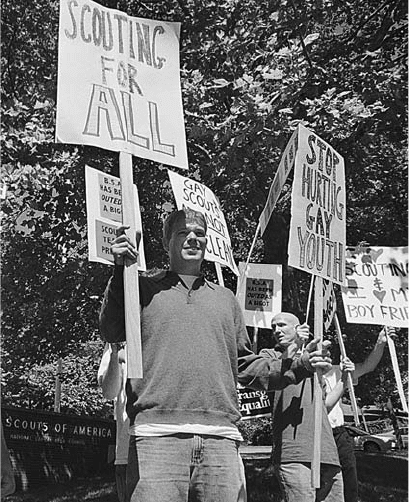
Demonstrators protest outside the National Capi-
tal Area Council for the Boy Scouts of America,
August 21, 2000, in Bethesda, Maryland.
(Michael
Smith/Getty)
Bradwell v. State of Illinois 77
xviii+446_EofUSConsti-v1.indd 77 3/12/09 3:04:00 PM
trouble today’s jurists. Hence, what Bradwell is
most known for is its now iconic statement regard-
ing women and women’s role in society.
Bradwell, whose application to practice law in
the state of Illinois, where she had been resid-
ing for several years, was denied by that state’s
supreme court, appealed the decision to the
U.S. Supreme Court. Both courts relied on tra-
ditional views about women and legal practices
that refl ected them. For example, it was submit-
ted that, as in the earlier era in which the law was
rooted, no one contemplated women’s employ-
ment outside the domestic sphere, so there was no
reason to suspect that, although never explicitly
stated, the law ever contemplated the inclusion of
women. In addition, it was believed that married
women who practiced law were limited in that
they would have diffi culty enforcing contracts for
their clients, as they were themselves limited in
their own ability to enter into binding contracts
separate from their husbands.
On behalf of Bradwell, it was argued that she
was fully qualifi ed to practice law, a point that was
never in doubt regarding her professional train-
ing, extensive legal experience in her native state
of Vermont, and success as a legal scholar. It was
further argued that the Fourteenth Amendment
applies to each state and so protected a member
of a class of citizens when she emigrates from one
state to another within the Union and so, too, the
privileges and immunities she enjoyed in her for-
mer state of residence. The issue before the Court
became whether admission to the bar in one state
constituted a class of privileges that a state may
not abridge or whether it belongs to a class of
political rights in which the state may discrimi-
nate between citizens.
The Court answered the question of whether
Bradwell had an enforceable right to employ-
ment by practicing at the bar of a judicial court in
the negative, stating that this right is in no sense
dependent on national citizenship and is not an
avocation open to all citizens as a matter of right.
The Court held that the privileges and immuni-
ties enjoyed by citizens in their state of residence
applied only there and may not pertain to other
states. The Court, then, gave this clause a nar-
row reading, one that was being explicated in
the Slaughterhouse Cases, and rejected the anal-
ogy urged on it between discrimination against
a class of people because of race and because of
sex. Women, presumably regardless of their race,
stood in a different relation to the law than did
men, against whom it would be unlawful to dis-
criminate on the basis of race.
The opinion of Justice Joseph P. Bradley was
especially pointed as regards women’s place in
society “from time immemorial” and the ultimate
source of that wisdom, before which the civil law
must bend. He stated that the “paramount des-
tiny and mission of woman are to fulfi ll the noble
and benign offi ces of wife and mother” and that
this is “the law of the Creator” to which “humane
movements of modern society” as regards women’s
advancement must be adapted. Furthermore, he
opined that it is the police power of the state to
comprehend the law of nature in order to ordain
which honorable professions and offi ces women
may be permitted entry as a matter of right and
which are reserved for men.
For more information: Friedman, Jane M.
America’s First Woman Lawyer: The Biography
of Myra Bradwell. Buffalo, N.Y.: Prometheus
Books, 1993; Mezey, Susan Gluck. Elusive Equal-
ity: Women’s Rights, Public Policy, and the Law.
Boulder, Colo.: Lynne Rienner Publishers, 2003.
—Gordon A. Babst
Brandeis brief
When first presented in 1908, the Brandeis
brief was a revolutionary approach to elaborat-
ing legally before the U.S. Supreme Court. It is
named for Louis D. Brandeis (1856–1941), who
argued before the Court against the removal of
labor restrictions related to the number of hours a
woman could work in the state of Oregon.
The seminal report for Muller v. Oregon, 208
U.S. 412 (1908), incorporated economic, statis-
tical, and psychosocial data, within the disci-
plines of sociology and psychology. The reliance
on factual data allowed Brandeis to successfully
make his point that the restriction of hours upon
78 Brandeis brief
xviii+446_EofUSConsti-v1.indd 78 3/12/09 3:04:00 PM
female workers was both reasonable and within
the underpinnings of the protections covered
by the Constitution. His brief pursuant to this
arguing before the Court resulted in a new man-
ner of argument based upon data, not just legal
thought.
Brandeis had a history of defending the pub-
lic welfare and was hired in 1907 to represent the
state of Oregon in a case before the U.S. Supreme
Court that involved the constitutionality of limit-
ing hours for female laundry workers. This effort
by Brandeis to argue before the high court a
cause championed by the Progressive movement
resulted in a legal brief that retained the typi-
cal identity of a brief on the fi rst two pages and
then moved into more than 100 pages of data. At
the time, the political climate had begun to turn
against industrialists, and the regulation of indus-
tries began to be battled out in the courts. When
the state of Oregon established a 10-hour workday,
businesses challenged the law.
The Progressive movement was meanwhile
picking battles across the United States to push
its agenda, and Oregon was ripe for change. The
Progressives claimed that businesses had long
been operating in manners that furthered the
exploitation of women, children, and the envi-
ronment. Brandeis believed that private property
rights of employers were subject to regulation by
the government, and, thus, he acted as counsel
and argued cases where he believed the courts
did have a place in affi rming the power of Con-
gress to regulate industry through the acknowl-
edgment of the need to manage the health and
welfare of the populace. His lasting legacies were
both the style of brief he created in Muller and
its melding of facts with jurisprudence precedent
to answer a previously unanswered challenge
by the Supreme Court in the 1905 L
OCHNER V.
N
EW YORK case. In a fi rst, Justice David Josiah
Brewer acknowledged the brief, which was the
highest of compliments, but also admitted that
he agreed with the approach that women were
in fact different from men and consequently
needed labor protections. As the Fourteenth
Amendment was not absolute, Brewer stated,
the government retained a compelling right to
limit the citizen’s power of contract for his or
her and others’ benefi t.
For more information: Strum, Philippa. Louis
D. Brandeis: Justice for the People. Cambridge,
Mass.: Harvard University Press, 1984.
—Ernest Gomez
Brandenburg v. Ohio 395 U.S. 444 (1969)
In Brandenburg v. Ohio, the U.S. Supreme Court
defined the modern standard for when speech
that may incite illegal action is protected by the
First Amendment and when such speech goes
too far and may be punished. The Court ruled
that speech advocating illegal action may be pun-
ished only if it is “directed to inciting or producing
imminent lawless action and is likely to incite or
produce such action.”
The decision was a monumental one in free
speech law. It moved the Court away from the
decades-old clear and present danger test
fi r s t d e v e l o p e d i n S
CHENK V. UNITED STATES, 249
U.S. 47 (1919). That test, developed by Justice
Oliver Wendell Holmes, Jr., had launched
a 50-year struggle in the Court to try to define
when words create a “clear and present danger” of
unlawful action that Congress thus has a right to
prohibit. Critics said this standard restricted far
too much speech that posed no real threat and
punished dissent because it was effective.
In Brandenburg, the Court moved to a standard
that was much more protective of free speech. The
test requires both an intent by the speaker to pro-
voke illegal action immediately and circumstances
in which such action is likely to occur.
The case involved a Ku Klux Klan rally in
Ohio. Clarence Brandenburg was a Klan leader
who was convicted under Ohio law for advocating
violence for political change; he was sentenced to
one to 10 years in prison and $1,000 fi ne. Accord-
ing to evidence at his trial, Brandenburg called a
local television reporter who arrived with a cam-
eraman and recorded the rally. In a speech at the
rally, Brandenburg warned that if the federal gov-
ernment did not stop acting against white Ameri-
cans, “there might have to be some revengeance
Brandenburg v. Ohio 79
xviii+446_EofUSConsti-v1.indd 79 3/12/09 3:04:01 PM
[sic] taken.” He challenged his conviction as vio-
lating the First Amendment as applied to the
states through the Fourteenth Amendment,
but the Ohio courts rejected the constitutional
arguments.
The Supreme Court reversed the ruling of the
Ohio courts and also overruled an earlier decision,
W
HITNEY V. CALIFORNIA, 274 U.S. 357 (1927), which
had upheld a California law similar to Ohio’s. The
Court said the Ohio law punished simple advocacy
and did not require any evidence of imminent law-
less action. As a result, the Court said the Ohio
statute was unconstitutional.
The Court ruled in an unsigned opinion labeled
per curiam, meaning “for the court.” Researchers
have determined that the opinion was started by
Justice Abe Fortas, but when he resigned from the
Court in a scandal in May 1969, Justice William
J. Brennan, Jr., completed the decision.
Justice William O. Douglas wrote a concur-
ring opinion, as did Justice Hugo Black. Since
the Supreme Court did not expressly overrule the
clear and present danger test but rather simply did
not mention it, the two justices wrote to make sure
the Court was no longer relying on the old test,
which they believed did not properly refl ect the
values of the First Amendment. Douglas wrote: “I
see no place in the regime of the First Amend-
ment for any ‘clear and present danger’ test.”
For more information: Linde, Hans A. “Clear
and Present Danger Reexamined: Dissonance
in the Brandenburg Concerto.” Stanford Law
Review 22 (1970): 1,163; Smolla, Rodney A.
Smolla & Nimmer on Freedom of Speech. New
York: Clark Boardman Callaghan, 1996; Wirenius,
John F. “The Road to Brandenburg: A Look at the
Evolving Understanding of the First Amendment.”
Drake Law Review 43 (1994): 1.
—Stephen Wermiel
Branzburg v. Hayes 408 U.S. 665 (1972)
In Branzburg v. Hayes, the U.S. Supreme Court
ruled that the First Amendment guarantees of
freedom of speech and freedom of the press
do not shield journalists from the legal obligation
to testify before grand juries about their confi den-
tial sources or other information.
In a 5-4 decision, written by Justice Byron R.
White, the Court said that when a law is generally
applicable (that is, it applies in the same manner to
everyone), the First Amendment does not require
that an exception be made to protect journalists.
In this case, the generally applicable legal prin-
ciple is that everyone has the same legal obliga-
tion to comply with subpoenas to appear before a
grand jury or to testify at a trial.
The ruling was intended to settle an important
legal question, yet the issue has remained the focus
of controversy and debate for numerous reasons.
First, lawyers representing news organizations
have successfully taken advantage of ambiguity in
the Branzburg ruling. Second, state legislatures
have created various forms of privilege for jour-
nalists and their sources. Third, there have been
periodic high-profi le cases in which reporters have
gone to jail rather than reveal their sources, call-
ing dramatic attention to the question of whether
lawyers can protect their confi dential providers of
information.
The Branzburg ruling was actually four con-
solidated cases. Paul Branzburg, a Louisville
Courier-Journal reporter, was called to testify
before a grand jury after he wrote a story in 1969
about two local hashish makers whose identity he
had promised not to reveal. He also was called
to testify before a second grand jury based on
a 1971 story about drug use in Frankfort, Ken-
tucky, in which he did not identify the names of
users. The Kentucky courts ordered him to tes-
tify and rejected his claims of a First Amendment
privilege.
A third case involved Paul Pappas, a reporter-
photographer for a New Bedford, Massachusetts,
television station who in 1970 spent several hours
inside a Black Panther headquarters that was bar-
ricaded to protect against a rumored police raid
that never materialized. Pappas refused to tell
a grand jury about what he had observed and
recorded, and the Massachusetts courts ruled
against his claims of privilege.
The fourth case centered on New York Times
reporter Earl Caldwell who was subpoenaed to tell
80 Branzburg v. Hayes
xviii+446_EofUSConsti-v1.indd 80 3/12/09 3:04:01 PM
a grand jury what he had learned from interviews
with leaders of the Black Panther Party. A federal
judge found that Caldwell had a First Amendment
privilege to protect confidential informants but
had to testify about anything he was told for pur-
poses of publication. When the grand jury expired,
the process was repeated with a new grand jury
and judge. When Caldwell did not appear, he was
held in contempt. But the U.S. Court of Appeals
for the Ninth Circuit reversed and said Caldwell
had a right not to appear before the grand jury
because testifying would interfere with the fl ow of
news to the public.
The U.S. Supreme Court ruled against all of the
journalists. “It is clear that the First Amendment
does not invalidate every incidental burdening of
the press that may result from the enforcement of
civil or criminal statutes of general applicability,”
Justice White wrote. Although White was clear in
his decision, Justice Lewis Franklin Powell,
Jr., wrote a concurrence that seemed to create
some ambiguity. “The asserted claim to privilege,”
Powell wrote, “should be judged on its facts by the
striking of a proper balance between freedom of
the press and the obligation of all citizens to give
relevant testimony with respect to criminal con-
duct.” When compared to the dissent of Justice
Potter Stewart, supported by Justices William J.
Brennan, Jr., and Thurgood Marshall, and that
of William O. Douglas, Powell’s words left
the impression that five justices favored a First
Amendment privilege under some circumstances.
Urged on by news media lawyers, numerous fed-
eral appeals courts agreed in the decades that
followed.
Also in the years that followed, many states
passed shield laws, recognizing some degree of
privilege for reporters to protect confidential
sources. In others, state supreme courts found the
privilege to exist in state law or state constitutions.
Some offer an absolute privilege; others attach
qualifi cations. Only the U.S. Congress and Wyo-
ming have refrained from recognizing a reporter’s
privilege.
High-profile jailings of journalists have also
kept the issue in focus. In 2005, New York Times
reporter Judith Miller refused to identify a source
in the case involving the disclosure of covert CIA
agent Valerie Plame’s identity. Miller spent almost
three months in jail before saying her confi dential
source had given her permission to reveal his iden-
tity. A freelance blogger and journalist spent seven
months in prison in 2006 and 2007 for refusing to
turn over to police video outtakes of a San Fran-
cisco protest in 2005 during an economic summit.
In 1978, New York Times reporter Myron Farber
spent more than a month in jail for refusing to
turn over notes and interviews in a high-profi le
New Jersey murder case.
For more information: Dienes, C. Thomas, Lee
Levine, and Robert C. Lind. “Newsgathering and
the Law Section 14-1–Section 14-6, 720–765.”
Charlottesville, Va.: Lexis Law Publishing, 1999;
Smolla, Rodney A. Smolla & Nimmer on Freedom
of Speech. New York: Clark Boardman Callaghan,
1996.
—Stephen Wermiel
Bray v. Alexandria Women’s Health Clinic
506 U.S. 263 (1993)
In Bray v. Alexandria Women’s Health Clinic, the
Supreme Court held that anti-abortion rights
protesters could not be sued as a private conspir-
acy to deny women their constitutional rights.
As a result of controversy stemming from the
decision in R
OE V. WADE, 410 U.S. 113 (1973),
which had legalized abortion across the country,
individuals and organizations who opposed abor-
tion rights protested outside abortion clinics. The
protesters occasionally trespassed on the clinics’
property, obstructed access to the clinics, and, in
some instances, even took violent action against
the clinics, doctors, and women seeking abor-
tions. Several abortion clinics brought suit against
the protesters, arguing that the protesters were
engaged in a private conspiracy to deprive women
seeking abortions of their constitutional right to
interstate travel.
The Supreme Court held, in an opinion by
Justice Antonin Gregory Scalia, that the
abortion clinics could not bring suit against the
protesters because the federal statute under
Bray v. Alexandria Women’s Health Clinic 81
xviii+446_EofUSConsti-v1.indd 81 3/12/09 3:04:01 PM