
Schultz D. Encyclopedia of the United States Constitution
Подождите немного. Документ загружается.

which the clinics had brought suit did not provide
a private cause of action against people obstruct-
ing access to abortion clinics. The federal statute
required that the protesters discriminate against
the women seeking an abortion because of their
sex. The Court determined that the protesters did
not have a generalized animus toward women but
instead intended to protect fetuses by prevent-
ing women from seeking abortions. Furthermore,
the Court explained that the protesters’ activities
were not aimed specifi cally at the women’s right
to travel across state lines to receive an abortion
but were rather aimed at all women who sought
an abortion.
In a dissent, Justice John Paul Stevens
argued that the federal statute under which the
abortion clinics brought suit provided a private
cause of action to the abortion clinics. In his view,
the anti-abortion rights protesters were engaged
in exactly the kind of “massive, organized, law-
lessness” that the statute was originally enacted
to punish. Rather than accepting what he saw as
Justice Scalia’s too “abstract question of logical
deduction,” Justice Stevens argued that the major-
ity’s decision ignored Congress’s intent to protect
“this Nation’s citizens from what amounts to the
theft of their constitutional rights by organized
and violent mobs across the country.” Because the
abortion clinics were merely asserting the private
cause of action that Congress sought to provide
private litigants, the clinics should have been per-
mitted to proceed with their suit.
For more information: Eisenstein, Laurence J.,
and Semeraro, Steven. “Abortion Clinic Protest
and the First Amendment.” Saint Louis Univer-
sity Public Law Review 13 (1993): 221; McCam-
mond, Lisa. “Bray v. Alexandria’s Women’s Clinic:
Narrowing the Scope of 42 U.S.C. 1985(3).” Gon-
zaga Law Review 29 (1994): 645.
—Winston E. Calvert
Brennan, William J., Jr. (1906–1997)
Supreme Court justice
William Joseph Brennan, Jr., was an associate jus-
tice of the U.S. Supreme Court from 1956 until
1990. He was one of the most infl uential liberal
forces on the high court of the 20th century.
Brennan was born in Newark, New Jersey, on
April 25, 1906, the second of William and Agnes
McDermott Brennan’s eight children. His parents
were both Irish immigrants who met and married
in the United States. William Brennan, Sr., was
initially a laborer but rose to the position of New-
ark’s director of public safety. He was an active
labor leader at a time when many signs still hung
on shop doors indicating that “no Irish need apply.”
Brennan, Sr., would play an enormously infl uen-
tial role in Brennan, Jr.’s life. It was his father’s
idea, in fact, that young William become a lawyer.
This pro-labor, pro–common man infl uence of his
father would help Brennan to become a leader of
constitutional revolution on the Supreme Court.
Brennan graduated from Barringer High
School in Newark in 1924, capturing most of the
academic awards that were available. He then
went on to the University of Pennsylvania’s under-
graduate Wharton School of Finance and Com-
merce. Although he graduated with honors in
economics in 1928, his academic career was solid
but somewhat unremarkable. He eloped with
Marjorie Leonard right before his college gradu-
ation but made sure to have a Catholic wedding
in Baltimore Cathedral. They remained married
and deeply devoted to one another for 54 years,
until her death. They had three children (William
Brennan III, Hugh, and Nancy).
Marjorie stayed and worked in Newark to help
pay tuition while Brennan attended Harvard Law
School. His father died of pneumonia in 1930 dur-
ing Brennan’s second year. He nearly was forced
to drop out but was granted a scholarship and
supplemented by waiting tables and working odd
jobs. Brennan was a member of Harvard’s Legal
Aid Society and represented the poor in various
civil cases. He hoped to represent unions after
his graduation in 1931, but with his wife, mother,
and six siblings to support, he opted instead for a
position with Pitney, Hardin & Skinner, Newark’s
premier law fi rm. He had clerked there during
law school and became their fi rst Catholic law-
yer. He would later go on to become a partner in
1937. During his time with the fi rm, he repre-
82 Brennan, William J., Jr.
xviii+446_EofUSConsti-v1.indd 82 3/12/09 3:04:02 PM
sented management in labor affairs—180 degrees
from his inclinations. He became an expert labor
negotiator, and as an associate justice of the U.S.
Supreme Court, he would become one of the
most famous legal negotiators of all time. He
would also end up becoming a great proponent of
the individual worker through his Supreme Court
opinions.
In 1942, Brennan accepted a post in the U.S.
Army to help with labor issues during World War
II. He eventually became chief of the Ordinance
Department’s Civilian Personnel Division and
retired from the army in 1946 as a full colonel.
He then headed back to his old law fi rm. In 1949,
he acquiesced and agreed to become a trial judge
and was appointed by the Republican governor of
New Jersey. Brennan took a substantial pay cut
with this position but still managed to support his
extended family. After two other judicial promo-
tions, he was quickly appointed to the New Jersey
Supreme Court in 1952 by the same governor.
The year 1956 held a number of fortuitous
events for Brennan. Associate Justice Sherman
Minton resigned, which opened a seat on the high
court. Several important supporters of Brennan
suggested to President Dwight D. Eisenhower
that he appoint him to the Supreme Court. It
was an election year, and having an Irish Catholic
Democrat appointed seemed to be a shrewd polit-
ical move for Eisenhower. Later, President Eisen-
hower would say that appointing Justice Brennan
was one of the worst mistakes he had made as
president. At the time of Brennan’s appointment,
there were certainly inklings of his later clear lib-
eral leanings, but his real infl uence would be on
the Supreme Court.
Justice Brennan was characterized by a love of
humanity. He was deeply religious and extremely
close to his family. Notably, he was just as inter-
ested in the life of the Supreme Court’s janitor as
he was in the lives of the other justices. Even his
critics noted his great warmth, charm, and abil-
ity to come up with a compromise if at all pos-
sible. He was driven by a desire to protect human
dignity through democracy, the Bill of Rights,
and the Fifth, Thirteenth, and Fourteenth
Amendments. The increasingly liberal Warren
Court, which was headed by Chief Justice Earl
Warren from 1953 to 1969, was the perfect soil in
which Justice Brennan’s ideals could be planted.
He masterfully drafted compromise opinions and
authored the second most opinions of any Supreme
Court justice: 1,360 in all.
Justice Brennan’s long career on the Court
includes many landmark and controversial cases. It
is impossible to recite a full listing here, but some
of his opinions particularly stand out. In B
AKER V.
CARR, 369 U.S. 186 (1962), Brennan’s opinion of
the Court stated that apportionment (voting dis-
tributions) was an appropriate question for federal
courts. This set the stage for later cases ensuring
“one person, one vote.”
In Jencks v. United States, 353 U.S. 657 (1957),
he wrote the majority opinion, which required
prosecutors to release statements that would be
used by witnesses at trial. He continued to fi ght
for the constitutional rights of criminal defendants
throughout his career.
Justice Brennan also was very involved in pro-
tecting the rights of free speech and the First
Amendment. Brennan took his seat on the
Supreme Court around the time of the McCar-
thy era and fought to keep Americans free to voice
their political opinion. He also penned the opinion
of the Court in N
EW YORK TIMES V. SULLIVAN, 376
Brennan, William J., Jr. 83
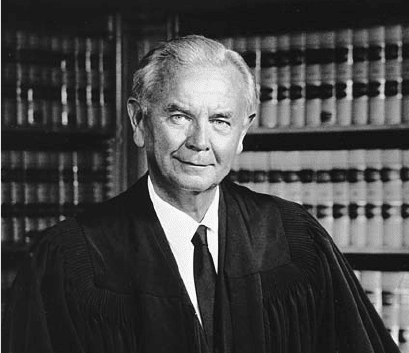
Associate Justice William Joseph Brennan, Jr. (U.S.
Supreme Court)
xviii+446_EofUSConsti-v1.indd 83 3/12/09 3:04:02 PM
U.S. 254 (1964), which pushed back politicians’
ability to stifl e free press through libel laws.
Brennan is most remembered as a bulwark of
civil rights (and one of the most activist judges
of all times). In G
REEN V. COUNTY SCHOOL BOARD OF
N
EW KENT COUNTY, VIRGINIA, 391 U.S. 430 (1968)
and Keyes v. School District No. 1, 413 U.S.
189 (1973), Justice Brennan furthered the cause
of school desegregation. In PLYLER V. DOE,
457 U.S. 202 (1982), his well-negotiated major-
ity opinion ensured access to public schools for
undocumented alien children. He also staunchly
supported the rights of women. He remained ada-
mantly pro-choice and voted with the majority in
R
OE V. WADE, 410 U.S. 113 (1973).
After the death of his wife, Marjorie, in 1982,
he married his secretary of 25 years. Brennan was
77 at the time. The marriage came as a surprise to
others at the Supreme Court, who found out about
it after the fact. Justice Brennan sent out a memo
that simply said, “Mary Fowler and I were married
yesterday and we have gone to Bermuda.” They
remained married until Justice Brennan’s death.
The more conservative Rehnquist Court
decisions were challenging for a liberal, but Bren-
nan remained a bridge builder between liberals
and conservatives. He continued to write impor-
tant opinions until the end of his career as a Jus-
tice in 1990, when he retired due to failing health.
For example, in T
EXAS V. JOHNSON, 491 U.S. 397
(1989), and United States v. Eichman, 496 U.S.
310 (1990), Justice Brennan wrote powerful major-
ity opinions protecting free speech rights. After
his retirement, his seat on the Supreme Court was
fi lled by Associate Justice David H. Souter.
After his retirement from the Court, he taught
seminars on constitutional law and theory and
often visited his friends in the Court. He died in
an Arlington, Virginia, nursing home, where he
was recuperating from a broken hip.
The core, if not all, of his constitutional philoso-
phy is likely to be a lasting legacy in constitutional
law as society and civil rights continue to evolve.
For more information: Eisler, Kim Isaac. The
Last Liberal: Justice William J. Brennan, Jr. and
the Decisions That Transformed America. Fred-
erick, Md.: Beard Books, 2003; Sepinuck, Stephen
L., ed. The Conscience of the Court: Selected
Opinions of Justice William J. Brennan, Jr. on
Freedom and Equality. Carbondale: Southern
Illinois University Press, 1999.
—Maria Collins Warren
Breyer, Stephen G. (1938– ) Supreme Court
justice
Stephen G. Breyer has been an associate justice
of the U.S. Supreme Court since August 3, 1994,
after a distinguished career that included lengthy
tenure as a professor at Harvard Law School and
a judge on the U.S. Court of Appeals for the First
Circuit.
He was born on August 15, 1938, in San Fran-
cisco, earned his undergraduate degree from Stan-
ford University, and obtained his law degree from
Harvard Law School. He served as a law clerk to
Supreme Court justice Arthur Goldberg and then
as an assistant in the Antitrust Division of the U.S.
Department of Justice before joining the Harvard
Law School faculty in 1967, where he became an
expert in regulation and administrative law. In
the 1970s, he did stints as an assistant prosecu-
tor on the staff of the Watergate Special Prosecu-
tor and as special counsel and then chief counsel
to the Senate Judiciary Committee. In 1980, he
was sworn in as a federal appeals court judge on
the First Circuit and served as chief judge from
1990 to 1994. While on the appeals court, he also
served as a founding member of the U.S. Sentenc-
ing Commission, which rewrote the federal crimi-
nal sentencing guidelines. He was nominated
to the Supreme Court by President Bill Clinton to
replace Justice Harry A. Blackmun.
On the bench, Breyer generally slipped into
the liberal or moderate wing of the Court that
regularly included Justices John Paul Stevens,
David H. Souter, and Ruth Bader Ginsburg.
He wrote the Court’s 5-4 decision in Stenberg
v. Carhart, 530 U.S. 914 (2000), striking down a
Nebraska law banning a form of late-term abor-
tion. Although his decision was eclipsed by G
ON-
ZALES, ATTORNEY GENERAL V. CARHART, ___ U.S. ___
(2007), which upheld a similar federal law, Breyer
84 Breyer, Stephen G.
xviii+446_EofUSConsti-v1.indd 84 3/12/09 3:04:02 PM
made his position on abortion clear that govern-
ments should not impose obstacles in the path of
women seeking abortions.
His decisions are often described as pragmatic
and not as predictable as some other liberal jus-
tices. When the Supreme Court upheld one display
of the Ten Commandments and struck down
another, it was Breyer alone who saw all-impor-
tant factual distinctions between the unlawful
Kentucky display, M
CCREARY COUNTY, KENTUCKY
V. AMERICAN CIVIL LIBERTIES UNION, 545 U.S. 844
(2005), and the lawful Texas one, V
AN ORDEN V.
PERRY, 545 U.S. 677 (2005).
He was a solid member of the liberal wing that
dissented from the Court’s several rulings curtail-
ing the powers of Congress in relation to the states.
He wrote a dissent in U
NITED STATES V. LOPEZ, 514
U.S. 549 (1995), when the Court invalidated a
federal restriction on guns near schools. Breyer
offered a list of reasons why it was appropriate for
Congress to feel that guns near schools had a sub-
stantial effect on interstate commerce.
Breyer has had unusual visibility for at least two
reasons. First, in 2005, he wrote Active Liberty:
Interpreting Our Democratic Constitution, a book
in which he analyzed his own judicial decision-
making patterns and concluded that the Constitu-
tion must be understood as promoting active citizen
participation in democracy. He also engaged in a
series of debates with Justice Antonin Gregory
Scalia, first in 2005 over the relevance of for-
eign law to decisions of the U.S. Supreme Court
and then in 2006 over the differences in their
approaches to constitutional interpreta-
tion. Breyer argued in the fi rst instance that for-
eign courts could infl uence the evolution of U.S.
court decisions, while Scalia was adamant that for-
eign law has no relevance to interpreting the U.S.
Constitution. In the second engagement, Breyer
took the position that the Constitution must be
understood not just as a set of words but also as a
set of goals and ideals; Scalia argued that it was the
words of the Constitution that mattered when it
was drafted in 1787 and that still matter today.
For more information: Breyer, Stephen G.
Active Liberty: Interpreting Our Democratic
Constitution. New York: Alfred A. Knopf, 2005;
Gewirtz, Paul. “The Pragmatic Passion of Stephen
G. Breyer.” Yale Law Journal 115 (2006): 1,675;
Urofsky, Melvin I., ed. Biographical Encyclope-
dia of the Supreme Court. Washington, D.C.: CQ
Press, 2006.
—Stephen Wermiel
Broadrick v. Oklahoma 413 U.S. 601 (1973)
In Broadrick v. Oklahoma, the Supreme Court
issued an important First Amendment ruling
that clarifi ed what is known as the “overbreadth”
doctrine.
Broadrick v. Oklahoma involved three appel-
lants who were employees of the state of Okla-
homa. Charges were filed against these state
employees for having violated Section 818 of the
Oklahoma Merit System of Personnel Administra-
tion Act. According to paragraph six of this act,
no classifi ed state employee “shall directly or indi-
rectly, solicit, receive, or in any manner be con-
cerned in soliciting or receiving any assessment
. . . or contribution for any political organization,
candidacy or other political purpose.” Paragraph
seven of this act states that no employee shall be a
member of “any national, state or local committee
of a political party.” In other words, an Oklahoma
state employee may not be involved in politics
“except to exercise his right as a citizen privately to
express his opinion and . . . vote.”
In 1970, employees of the Oklahoma Corpo-
ration Commission had been actively involved
in the reelection campaign of a state corpora-
tion commissioner who was their superior. They
allegedly asked other employees to take part in
the campaign. One individual was charged with
distributing campaign posters, and two of the
appellants were charged with soliciting cam-
paign contributions from commission employees.
The appellants claimed in the federal district
court that the act was overly broad when applied;
therefore, the act may deprive people of pro-
tected forms of free speech, such as using cam-
paign button or bumper stickers. The district
court upheld the law, and the case made its way
to the U.S. Supreme Court.
Broadrick v. Oklahoma 85
xviii+446_EofUSConsti-v1.indd 85 3/12/09 3:04:03 PM
In a 5-4 decision, written by Justice Byron
White, the Court upheld the law under the First
Amendment of the Constitution. The Court noted
the following:
Although such laws, if too broadly worded, may
deter protected speech to some unknown extent
there comes a point where that effect—at best
a prediction—cannot, with confi dence, justify
invalidating a statute on its face and so prohib-
iting a State from enforcing the statute against
conduct that is admittedly within its power to
proscribe. . . . To put the matter another way, par-
ticularly where conduct and not merely speech
is involved, we believe that the overbreadth
[emphasis added] of a statute must not only be
real, but substantial as well, judged in relation
to the statute’s plainly legitimate sweep. . . . It is
our view that 818 is not substantially overbroad
and that whatever overbreadth may exist should
be cured through case-by-case . . . analysis of the
fact situations to which its sanctions, assertedly,
may not be applied.
The Court noted two key points to this doctrine
of overbreadth. A law that focuses on conduct and
not just mere speech must (1) be real and (2) be
substantial. In this case, the Court determined
the law focused on conduct and not merely speech
and that the law was not substantial enough to
be overbroad. However, the Court appears to
have left the issue open with the comment, “that
whatever overbreadth may exist should be cured
through case-by-case . . . analysis.”
For more information: Farber, Daniel A., Wil-
liam N. Eskridge, Jr., and Philip P. Frickey. Cases
and Materials on Constitutional Law: Themes for
the Constitution’s Third Century. St. Paul, Minn.:
West Publishing, 1993.
—Dan Krejci
Brown v. Board of Education of Topeka
347 U.S. 483 (1954)
In Brown v. Board of Education of Topeka, the
Supreme Court struck down the “separate but
equal” doctrine as it applied to primary and sec-
ondary education. The 1954 decision was the
culmination of decades of work by civil rights
activists including the National Association for
the Advancement of Colored People (NAACP),
which had been working in the federal courts
for decades to desegregate the nation’s schools.
Arguably, the Brown decision is one of the most
important cases and opinions ever issued by the
Supreme Court.
In the 1930s and 1940s, some progress was
made toward desegregation in higher edu-
cation. Then, in 1950, the Supreme Court held
in Sweatt v. Painter, 339 U.S. 629, that the
equal protection clause of the Fourteenth
Amendment required a black man, Herman
Marion Sweatt, be admitted to the University of
Texas Law School because the available schooling
for blacks was grossly unequal to that for whites.
Also in 1950, in McLaurin v. Oklahoma, 339 U.S.
637, the Court held that allowing blacks into the
school for whites (the University of Oklahoma)
and providing them with separate spaces within
that school created an unequal situation.
About the time those decisions were being
handed down, in the early 1950s, Linda Brown,
a third grader in Topeka, Kansas, was walking six
blocks to her school bus stop to ride to Monroe
Elementary, her segregated black school one mile
away, while Sumner Elementary, a white school,
was only seven blocks from her house. Her father
contacted a local attorney, who, in turn, referred
him to the local chapter of the NAACP. It asked
parents of black students to attempt enrolling
their children in the closest neighborhood school
in the fall of 1951. Each was refused enrollment
and directed to segregated schools.
A class-action suit was fi led against the Board
of Education of the City of Topeka, Kansas, in
the U.S. District Court for the District of Kan-
sas on behalf of these parents and their chil-
dren. Eventually, the case made its way to the
Supreme Court, which combined fi ve cases under
the heading of Brown v. Board of Education
because each sought the same legal remedy. The
combined cases originated in Delaware, Kansas,
South Carolina, Virginia, and Washington, D.C.
86 Brown v. Board of Education of Topeka
xviii+446_EofUSConsti-v1.indd 86 3/12/09 3:04:03 PM
Four of the cases were to be argued on the basis
of the equal protection clause of the Fourteenth
Amendment. The District of Columbia case,
B
OLLING V. SHARPE, was covered by the equal pro-
tection clause of the Fifth Amendment, not of the
Fourteenth.
The cases were initially argued in December
1952, but a decision was never handed down
because, under Chief Justice Frederick Moore
Vinson’s leadership, the Court attempted to
decide the case both on the merits and remedy.
The Court was divided not on the merits but on
relief. In summer 1953, Vinson died and President
Dwight D. Eisenhower appointed Earl Warren to
succeed him. The case was reargued on Decem-
ber 8, 1953, and the Court handed down a unani-
mous decision on May 17, 1954.
Warren had convinced the members of the Court
to decide the case on just the merits and defer the
question of relief to a second opinion following re-
argument. It was the decision on the merits that
was handed down in May 1954. The decision was
just 11 pages: Warren wanted an opinion that the
layperson could read and understand and one that
the newspapers could print in its entirety. The deci-
sion did not expressly overturn P
LESSY V. FERGUSON
as it applied only to primary and secondary educa-
tion. It stated that segregation of children in pub-
lic schools solely on the basis of race deprives the
children of the minority group of equal educational
opportunities and that the separate but equal doc-
trine had no place in the fi eld of public education.
When the state undertook to provide education, it
had to do so on equal terms to all.
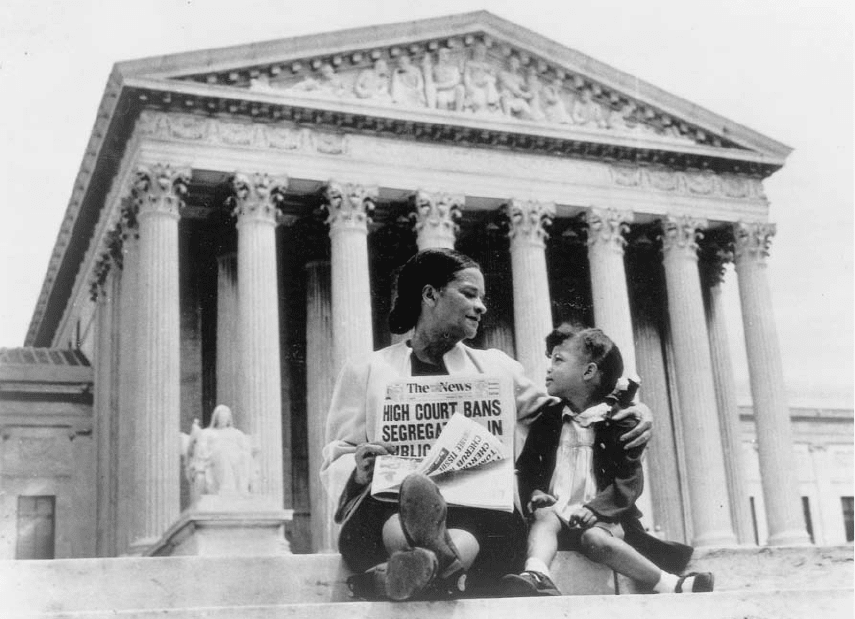
A newspaper headline announcing that the U.S. Supreme Court has abolished segregation in public
schools
(Schomburg Center for Research in Black Culture)
Brown v. Board of Education of Topeka 87
xviii+446_EofUSConsti-v1.indd 87 3/12/09 3:04:03 PM
A controversial portion of the opinion was
footnote 11 in which Warren applied sociological
views to the case instead of interpreting the law.
Northern newspapers, for the most part, hailed
the decision as “momentous,” while the black com-
munity took a mixed wait-and-see reaction.
One year after Brown, the Court handed down
its decision dealing with relief. The decision states
that school districts should desegregate “with all
deliberate speed.” This ambiguous decision mud-
died the waters more than it cleared them, and
it took many years for consistent progress to be
made in the implementation of Brown. With no
federal leadership, implementation of Brown
was deliberately slow and uneven. By the mid-
1960s, the Departments of Justice and Health,
Education, and Welfare had assumed leadership
in implementing Brown. But whatever the weak-
nesses were in the Brown decision, it was still a
signifi cant step toward attempting to bring about
equality among the races.
For more information: Klarman, Michael J.
From Jim Crow to Civil Rights. New York: Oxford
University Press, 2004; Kluger, Richard. Simple
Justice: The History of Brown v. Board of Educa-
tion and Black America’s Struggle for Equality.
New York: Vintage Books, 2004; Urofsky, Melvin,
and Paul Finkelman. A Constitutional History of
the United States. Vol. 2: A March of Liberty. New
York: Oxford University Press, 2002.
—Mark Alcorn
Buchanan v. Warley 245 U.S. 60 (1917)
In Buchanan v. Warley, the Supreme Court ruled
that residential segregation laws violated the prop-
erty rights of individuals. Such laws were enacted
in a number of communities in the upper South
during the second decade of the 20th century.
These measures were justifi ed as an exercise of
police power to prevent racial confl ict by man-
dating separate residential areas for blacks and
whites.
In 1914, Louisville, Kentucky, passed an ordi-
nance prohibiting whites and blacks from living
in houses on blocks where a majority of homes
were occupied by individuals of the other race. To
arrange a test case challenging the ordinance, a
white seller and a black purchaser entered a con-
tract for the sale of property on a majority white
block. The purchaser then refused to complete the
transaction on grounds that he could not occupy
the premises under the ordinance. The Kentucky
Court of Appeals sustained the ordinance as a
valid police power regulation to promote racial
harmony and safeguard racial purity. It therefore
ruled that the ordinance constituted a defense to
an action for specifi c performance of the contract
by the seller.
The Supreme Court, in a unanimous opinion
by Justice William R. Day, held that the ordinance
amounted to a deprivation of property without due
process of law in violation of the Fourteenth
Amendment. Justice Day declared: “Property is
more than the mere thing which a person owns. It
is elementary that it includes the right to acquire,
use and dispose of it.” He was skeptical about the
racial purity rationale, pointedly observing that
“the employment of colored servants in white fam-
ilies [was] permitted.” Day was also unconvinced
that racial segregation would preserve property
values. He noted that nearby property might
be acquired “by undesirable white neighbors.”
Cutting to the heart of the matter, Justice Day
asserted: “The right which the ordinance annulled
was the civil right of a white man to dispose of his
property if he saw fi t to do so to a person of color
and of a colored person to make such disposition
to a white person.” It followed that this restriction
on the right to alienate land constituted an uncon-
stitutional deprivation of an essential attribute of
property. Day concluded that the goal of racial
harmony could not be accomplished by destroy-
ing the right to dispose of property.
Decided in an era when segregationist atti-
tudes were widely shared, Buchanan linked judi-
cial solicitude for the rights of property owners
with concern for racial minorities. This landmark
decision halted the movement to enact residential
segregation laws in American cities and was the
most signifi cant victory for civil rights in the
early decades of the 20th century. Justice Day’s
opinion rested squarely on the premise that the
88 Buchanan v. Warley
xviii+446_EofUSConsti-v1.indd 88 3/12/09 3:04:04 PM
due process clause of the Fourteenth Amendment
imposed substantive limits on state governments.
Buchanan was a powerful reminder that a prin-
cipled defense of individual property rights may
safeguard the interests of vulnerable segments of
society.
For more information: Ely, James W., Jr.
“Reflections on Buchanan v. Warley, Property
Rights, and Race.” Vanderbilt Law Review 51
(1998): 953; Klarman, Michael J. From Jim Crow
to Civil Rights: The Supreme Court and the
Struggle for Racial Equality. New York: Oxford
University Press, 2004.
—James W. Ely, Jr.
Buck v. Bell 274 U.S. 200 (1927)
In Buck v. Bell, the U.S. Supreme Court upheld
a Virginia statute providing for compulsory ster-
ilization of the mentally retarded for the protec-
tion and general welfare of the state. The effect of
the case was to legitimize eugenic sterilization in
the United States. While many states already had
sterilization statutes in effect at the time of the
ruling, the Court’s decision led many other states
to create new sterilization statutes or update their
current ones to resemble more closely the Virginia
statute upheld by the Court.
The case began when, on September 10, 1924,
the superintendent of the Virginia State Colony
for Epileptics and Feebleminded petitioned to the
board of directors of the Virginia State Colony to
have Carrie Buck, an 18-year-old patient at the
institution, sterilized. The statute required that
a hearing be conducted prior to the sterilization
procedure to determine whether it was necessary.
The board of directors granted the petition and
the guardian of Buck appealed the case to the Cir-
cuit Court of Amherst County, which upheld the
decision of the board. The case then moved to the
Supreme Court of Appeals of Virginia, where the
board’s decision was again upheld. Following the
decision of the lower courts to uphold the steril-
ization statute as compliant with both state and
federal constitutions, the case moved to the U.S.
Supreme Court. The question presented by the
case was whether the Virginia statute that called
for compulsory sterilization denied Buck the due
process of law as guaranteed under the Four-
teenth Amendment.
The Supreme Court held, in an 8-1 ruling, that
the statute did not violate the due process clause
of the Fourteenth Amendment. The Court deter-
mined that given the fact that before the steril-
ization procedure could take place a hearing, at
which the patient and a parent or guardian could
be present, must be conducted and the fact that
the appeals process allowed the case to reach the
circuit court of the county as well as the supreme
court of appeals of the state, Buck’s Fourteenth
Amendment rights had not been violated. Writ-
ing for the majority, Justice Oliver Wendell
Holmes, Jr., stated that the interests of the state
in preventing the birth of mentally underdevel-
oped children was suffi cient to justify the statute
and added, in words that have become infamous,
“Three generations of imbeciles are enough.”
For more information: Kevles, Daniel J. In
the Name of Eugenics: Genetics and the Uses of
Human Heredity. New York: Knopf, 1985; Lom-
bardo, Paul A. “Three Generations, No Imbeciles:
New Light on Buck v. Bell.” New York University
Law Review 60, no. 1 (1985): 50–62.
—Marc Ruffi nengo
Buckley v. American Constitutional Law
Foundation
525 U.S. 182 (1999)
In Buckley v. American Constitutional Law Foun-
dation (ACLF), the Supreme Court held that por-
tions of Colorado’s restrictions on initiative petition
circulators violated the First Amendment. The
case demonstrates the Supreme Court’s delicate
balance between First Amendment protections
and proper regulations to ensure fair elections.
Colorado’s initiative process allows its resi-
dents to add proposed laws to the ballot by
submitting petitions with a required number of
valid signatures. In Meyer v. Grant, 486 U.S.
414 (1988), the Supreme Court had struck down
Colorado’s ban on paid initiative petition circula-
tors, fi nding that initiative petitioning was “core
Buckley v. American Constitutional Law Foundation 89
xviii+446_EofUSConsti-v1.indd 89 3/12/09 3:04:04 PM
political speech.” The state’s subsequent limita-
tions on petition circulators were challenged in
federal court by the ACLF and several individu-
als. The district court upheld requirements that
circulators submit affidavits with their names
and addresses, a six-month time limit for peti-
tions, and requirements that circulators be 18
years or older and be registered to vote. How-
ever, the court held the requirement that circula-
tors wear name badges, as well as portions of the
requirements for reporting the names of payors
and payments made to circulators, to be in viola-
tion of the First Amendment in ACLF v. Meyer,
870 F. Supp. 995 (Colo. 1994). The Tenth Cir-
cuit agreed but added that the voter registration
requirement unduly limited political expression
(ACLF v. Meyer, 120 F.3d 1092 [1997]).
The Supreme Court’s majority decision, writ-
ten by Justice Ruth Bader Ginsburg and joined
by Justices John Paul Stevens, Antonin
Gregory Scalia, Anthony M. Kennedy, and
David H. Souter, affi rmed the Tenth Circuit’s
balance between valid ballot-access regulations
and undue limitations on First Amendment rights,
noting that there can be “no litmus paper test.”
The Court found that the state’s interest in polic-
ing circulators who might break election laws was
fulfi lled by the affi davit requirement and, there-
fore, did not justify the voter registration or name
badge requirements. The Court found that voter
registration requirements substantially decreased
the number of eligible circulators and noted that
the refusal to register to vote might be an act of
political expression. The Court argued that the
name badge requirement overly burdened the
circulator’s interest in anonymous speech at the
moment of contact, which might limit the number
of people willing to circulate petitions on volatile
issues. The Court also found that the state’s inter-
est in disclosure of special interest infl uence was
served by reporting the names and amounts of
payors of petition circulators, but requiring disclo-
sure of payments to individual circulators failed to
survive the “exacting scrutiny” required by B
UCK-
LEY V. VALEO, 424 U.S. 1 (1976).
Justice Clarence Thomas concurred but
argued that the Court should have used strict
scrutiny analysis to find that the require-
ments were not narrowly tailored to serve the
state’s interests. Chief Justice William Hubbs
Rehnquist, dissenting, argued that voter reg-
istration and residency requirements were not
unduly burdensome and that states should be
able to limit those circulating petitions to those
who can ultimately vote on them. Sandra Day
O’Connor and Stephen G. Breyer, concur-
ring in part and dissenting in part, agreed with
Rehnquist’s analysis of voter registration require-
ments but argued that the disclosure require-
ments reasonably advanced state interests in
public disclosure and deterring fraud, similar to
campaign contributor requirements previously
upheld under Buckley v. Valeo.
The effect of Buckley v. American Constitu-
tional Law Foundation was to affi rm that direct
democracy petition campaigns are “core political
speech” that cannot be unduly burdened and to
distinguish these undue burdens from necessary
election regulations, as in Storer v. Brown, 415
U.S. 724 (1974); Anderson v. Celebrezze, 460 U.S.
780 (1983); and T
IMMONS V. TWIN CITIES AREA NEW
PARTY, 520 U.S. 351 (1997).
For more information: Braunstein, Richard.
Initiative and Referendum Voting: Governing
Through Direct Democracy in the United States.
New York: LFB Scholarly Publishing, 2004; Ryden,
David. The U.S. Supreme Court and the Electoral
Process. 2d ed. Washington, D.C.: Georgetown
University Press, 2002; Urofsky, Melvin I. Money
and Free Speech: Campaign Finance Reform and
the Courts. Lawrence: University Press of Kansas,
2005; Zimmerman, Joseph F. The Initiative: Citi-
zen Law-Making. Oxford: Praeger, 1999.
—Julie Lantrip
Buckley v. Valeo 424 U.S. 1 (1976)
Buckley v. Valeo is the key campaign finance
ruling of the U.S. Supreme Court. At its broad-
est level, Buckley v. Valeo held that limits on
spending by candidates are unconstitutional but
that campaign contributions could be limited to
prevent corruption or the appearance of corrup-
90 Buckley v. Valeo
xviii+446_EofUSConsti-v1.indd 90 3/12/09 3:04:04 PM
tion. The issues raised in Buckley continue to be
litigated in federal courts and before the Supreme
Court, and campaign fi nance remains an emerg-
ing and changing area of constitutional law.
In 1974, in the wake of the Watergate scandal,
the U.S. Congress passed the Federal Election
Campaign Act (FECA). The primary provisions of
the FECA imposed expenditure limits for candi-
dates, established contribution limits set at $1,000
per election, created public disclosure require-
ments, established the Federal Election Commis-
sion (FEC), and created the presidential campaign
public fi nancing system.
The Court addressed the constitutionality of
the contribution limits and upheld them. The
Court found that contribution limits implicate
both the freedom of association and freedom of
expression provisions of the First Amendment.
Despite the infringement on protected rights, the
Court held that the prevention of corruption or
the appearance of corruption was a suffi cient and
constitutional justifi cation for limiting campaign
contributions from an individual to a candidate
for federal offi ce to $1,000. On balance, the Court
concluded, the $1,000 contribution limit was
allowed to stand; however, the Court created an
exemption from the contribution limit for contri-
butions from the candidate’s own personal funds.
The Court reasoned that a candidate’s own money
could not corrupt the candidate.
Litigation has continued to challenge the con-
stitutionality of contribution limits, and such lim-
its were upheld in cases such as N
IXON V. SHRINK
M
ISSOURI GOVERNMENT PAC, 528 U.S. 377 (2000),
which dealt with candidates for state offi ce in Mis-
souri, but were ruled unconstitutional in Randall
v. Sorrell, 126 S. Ct. 1184, 163L. Ed. 2d 1126
(2006), which dealt with candidates for state offi ce
in Vermont.
In contrast to the contribution limits, the Court
found that expenditure limits imposed “direct and
substantial restraints on the quantity of political
speech.” These limits, the Court held, did not
address the “corruption or appearance of corrup-
tion” that justified contribution limits because
there is no legitimate government interest in
reducing the quantity of political speech.
The Court did uphold, however, expenditure
limits contained within the voluntary public
financing system established by the FECA for
candidates for president. The Court reasoned that
the exchange of government money for restrictions
on spending did not violate the First Amendment.
The Court upheld the public disclosure provisions
of the FECA, which required that both contri-
butions and expenditures by candidates, politi-
cal parties, and political committees be publicly
disclosed.
The Court, nonetheless, appeared to narrow
the scope of the FECA so that “expenditures”
for public communications were covered by the
FECA only if they contained words of “express
advocacy” such as elect, support, defeat, or vote
for. This led to the rise of so-called issue ads that
were run by political parties and other interest
groups that would say “Call candidate Smith and
tell him to support lower taxes” and, as a result,
were outside of the regulation of the FECA.
This apparent narrowing of the FECA has been
at issue since that time. The FEC litigated numer-
ous cases against speech it felt was covered by the
FECA, but the courts, with one exception, have uni-
formly rejected the FEC’s view of the scope of the
FECA. However, in 2002, the U.S. Congress passed
the Bi-Partisan Campaign Reform Act (BCRA),
which sought to limit so-called issue advocacy by
requiring disclosure and limiting the source of funds
that could be used to air broadcast advertisements
mentioning or referring to federal candidates within
a certain period of time before an election. The
Supreme Court ultimately upheld this limitation and
cast doubt on the validity of the apparent narrow-
ing construction of Buckley when the Court decided
M
CCONNELL V. FEC, 540 U.S. 93 (2003).
Buckley v. Valeo continues to be the most
important of the Supreme Court’s campaign
fi nance opinions. When legislatures consider cre-
ating or modifying campaign finance schemes,
the Supreme Court’s ruling in Buckley must be
reviewed and incorporated into the legislation
or the scheme risks invalidation under the First
Amendment. Litigation over the meaning of
Buckley continues to this day and is expected to
continue for years to come.
Buckley v. Valeo 91
xviii+446_EofUSConsti-v1.indd 91 3/12/09 3:04:05 PM