
Schultz D. Encyclopedia of the United States Constitution
Подождите немного. Документ загружается.

humankind as being driven by a higher will, sug-
gesting a morality guided by providence.
The second school of historical interpretation
referenced by Beard and that followed Bancroft
was termed Teutonic. This school was derived
from the political talents and genius of the Teu-
tonic tribes who invaded England and destroyed
the older Roman and British cultures. Their
example of free government became a model for
the world, and Teutonic knowledge has served as
a foundation for the creation of the federal con-
stitution. The third school was not characterized
by a unique phrase or title and lacked a central
hypothesis. This school was narrowly empirical
and turned away from historical interpretation to
critical analysis of documents and facts.
Beard’s critique of these classical interpreta-
tions of history proved infl uential in the develop-
ment of his own interpretations and his decision
to ally himself instead to some degree with the
Turner school (named for Frederick Jackson
Turner), given its affinity for economic inter-
pretation. Beard’s Economic Interpretation of
the Constitution of the United States examined
numerous historical documents, including unpub-
lished records from the U.S. Department of the
Treasury and records from the debates at the
Constitutional Convention. An investiga-
tion of these sources and the documented obser-
vations of Alexander Hamilton led Beard to
conclude that the convention was composed of
fi ve distinct upper-class groups. In his own words,
Beard argued that “the overwhelming majority of
members, at least fi ve-sixths, were immediately,
directly, and personally interested in the outcome
of their labors at Philadelphia, and were to a
greater or less extent economic benefi ciaries from
the adoption of the Constitution” (149). Each
group represented a different economic interest
in society.
The fi rst group was composed of public secu-
rity interests such as creditors, fi nanciers, bank-
ers, and moneylenders. Beard was able to identify
at least 40 of the 55 delegates at the convention
as falling in this category. A second category of
economic interests was represented by merchants
and manufacturers and those in shipping lines.
This grouping consisted of 11 of the 55 delegates
at the convention, who were ultimately infl uen-
tial in designing Article I, Section 9, of the U.S.
Constitution dealing with the interstate com-
merce clause. This clause centralized control
of commerce at the national level and prevented
state tariffs on imports. The third category identi-
fi ed by Beard consisted of bankers, debtors, and
investors. Of the delegates there were 24 who fell
in this group and represented economic interests
in areas of business law and contracts. This inter-
est infl uenced the design of Congress’s powers to
formulate bankruptcy laws, coin money, and regu-
late some of the more fi nancially driven elements
of the new nation.
A fourth category of convention delegates was
composed of western land speculators and pro-
moters, men like George Washington, Benjamin
Franklin, Robert Morris, James Wilson, William
Blount, and others of wealth who had purchased
large parcels of land. This group included 14 of the
55 delegates and was infl uential in bolstering the
constitutional powers of the chief executive and
U.S. militia to fi ght American Indian tribes who
populated western territories. The fi nal category
was composed of slaveowners. Beard’s research
identifi ed 15 of the 55 delegates in this category,
which mainly consisted of southern slave owners
who were infl uential in propagating slavery until
ratifi cation of the Thirteenth Amendment. In
all, Beard argued that the gathering of interest-
driven delegates who convened to draft the U.S.
Constitution was composed of practical men who
“were able to build the new government upon the
only foundations which could be stable: funda-
mental economic interests” (151).
Beard’s categorical typology has served as a
reference for historians, political scientists, and
economists. While he places many of the 55 del-
egates into one or more of the fi ve categories, the
typology still provides an idea for what motivated
the delegates and how the U.S. Constitution may
have consequently been designed to consider such
economic interests. Beard was a champion of the
progressive school of history, writing during an era
of tremendous economic growth and industrial
development. His unorthodox economic interpre-
52 Beard, Charles Austin
xviii+446_EofUSConsti-v1.indd 52 3/12/09 3:03:51 PM
tations of key historical eras and political events
questioned traditional modes of writing and have
in turn been challenged by numerous academi-
cians over time, such as Edward S. Corwin, Rob-
ert Brown, and Richard Hofstadter. Beard himself
acknowledged that his research was fragmentary
in nature but contended that it was “designed to
suggest new lines of historical research rather than
to treat the subject in an exhaustive fashion” (v).
Even so, his historical interpretation that the Con-
stitution was an economic document has survived
criticism and has earned a place in the literature
as an interesting, if not unorthodox, perspective
on the Founding Fathers.
For more information: Beale, Howard K., ed.
Charles Beard: An Appraisal. New York: Octagon
Books, 1976; Beard, Charles. An Economic Inter-
pretation of the Constitution of the United States.
New York: Macmillan, 1925; Benson, Lee. Turner
and Beard: American Historical Writing Recon-
sidered. New York: Free Press, 1960; Brown,
Robert E. Charles Beard and the Constitution:
A Critical Analysis of “An Economic Interpreta-
tion of the Constitution.” Princeton, N.J.: Princ-
eton University Press, 1965; Hofstadter, Richard.
The Progressive Historians: Turner, Beard, Par-
rington. New York: Alfred A. Knopf, 1968.
—Daniel Baracskay
Beauharnais v. Illinois 343 U.S. 250 (1952)
In Beauharnais v. Illinois, the U.S. Supreme
Court upheld an Illinois group libel statute by a
5-4 vote, ruling that it did not violate the First
Amendment. While Beauharnais has never been
explicitly overruled, many legal scholars question
whether it is still good law.
Joseph Beauharnais, president of the White
Circle League, distributed a leafl et, set forth as
a petition of grievances, that called on Chicago’s
mayor and city council “to halt . . . the further
encroachment . . . [of] white people . . . by the
Negro.” The leaflet added that if “persuasion”
would not unite the white race, “the aggressions
. . . rapes, robberies, knives, gins and marijuana
of the negro . . . surely will.”
Beauharnais was convicted under an Illinois
statute banning public distribution of materials
portraying “depravity, criminality, unchastity or
lack of virtue of a class of citizens” on the basis of
“race, color, creed, or religion” when it exposes the
group in question to “contempt, derision or oblo-
quy” or causes a “breach of the peace or riots.”
Although Beauharnais offered to present evidence
that statements in the pamphlet were true, the trial
judge restricted the jury to the issue of whether
Beauharnais published the pamphlet. The Illinois
Supreme Court affi rmed the conviction.
U.S. Supreme Court justice Felix Frankfurter,
affi rming the Illinois Supreme Court, relied on
C
HAPLINSKY V. NEW HAMPSHIRE, 315 U.S. 568 (1942),
which held that certain types of speech—includ-
ing libel—fell outside the First Amendment. He
buttressed this point by noting that in 1952 most
states punished criminal libel by common law or
statute. He then discussed the history of race rela-
tions in Illinois, a history that could have led the
state to conclude that conveying falsehood about
“racial and religious groups” tends to “obstruct the
manifold adjustments required for free, ordered
life in a polyglot community.” Therefore, the Illi-
nois legislature was not “without reason” in try-
ing to curb “false and malicious defamation of
racial and religious groups,” especially given the
“powerful emotional impact” on those exposed to
it. While Justice Frankfurter admitted the Illinois
statute could be used in a discriminatory manner,
he would not strike it down based on the mere
possibility of abuse.
There were four dissents. Justice Hugo Black,
laying great emphasis on the right to petition
the government, accused the Court of wanting
to “degrade First Amendment freedoms to a ratio-
nal basis level.” He also worried that the statute
could be used against proponents of racial inte-
gration, a concern shared by Justice William O.
Douglas in his dissent. The remaining dissents
were narrower. Justice Stanley Reed, conceding
that Illinois could ban group libel, argued that
terms such as virtue made the Illinois law uncon-
stitutionally vague. Finally, Justice Robert Jackson
argued that the states had great leeway in punish-
ing speech but faulted the Illinois statute because
Beauharnais v. Illinois 53
xviii+446_EofUSConsti-v1.indd 53 3/12/09 3:03:52 PM
it did not let the accused present the defense of
truth to the jury.
Beauharnais has not aged well. In 1961, Illi-
nois removed the group libel statute. Three years
later, in N
EW YORK TIMES V. SULLIVAN, 376 U.S. 254
(1964), the Court outlawed criminal libel, weak-
ening one of the mainstays of Justice Frankfurter’s
argument. Later, in Collin v. Smith, 578 F.2d 1197
(7th Cir. 1978), the case growing out of the Skokie
affair, the Seventh Circuit questioned whether
Beauharnais remains good law. Interestingly,
Beauharnais has fared better outside the United
States, where foreign courts use it as an example
of a constitutionally valid hate speech law.
For more information: Kalven, Harry, Jr. The
Negro and the First Amendment. Chicago: Univer-
sity of Chicago Press, 1965; Walker, Samuel. Hate
Speech: The History of an American Controversy.
Lincoln: University of Nebraska Press, 1994.
—Robert A. Kahn
Betts v. Brady 316 U.S. 455 (1942)
In Betts v. Brady, the Supreme Court ruled that
an individual facing criminal charges in state
court was not entitled to a attorney provided by
the government if he or she could not afford one
of his own.
Betts, an unemployed farmhand on welfare
and with little formal education, was charged
with robbery in Maryland. As he could not afford
to hire a defense lawyer, he asked the court to
appoint one. When his request was denied, Betts
pleaded not guilty and attempted to conduct his
own defense in a bench trial. He questioned the
state’s witnesses and called his own witnesses in
an effort to establish an alibi. The judge found him
guilty and sentenced Betts to eight years in prison.
Betts sought a writ of habeas corpus claiming
he had been denied his right to counsel under
the Fourteenth Amendment due process
guarantee.
Justice Owen Roberts delivered the opinion of
the Court, which found that Betts was not denied
due process of law. They held that the Sixth
Amendment of the Constitution, providing
for assistance of counsel, applied only in federal
courts and was not applicable to the states. Rather
they found that due process is measured by a
totality of the circumstances in a given case. They
distinguished Betts’s situation from their holding
in Powell v. Alabama, 287 U.S. 45 (1932), where
the Court held that depriving the Scottsboro boys
of adequate counsel was a due process violation.
To the Betts majority, it was signifi cant that the
Powell defendants faced capital charges and addi-
tionally that they were considered incapable of
making their own defense because of “ignorance,
feeblemindedness, illiteracy, or the like.” Betts did
not face the death penalty, and, they claimed, he
was not helpless but a 43-year-old man of average
intelligence. Therefore, requiring states to provide
counsel in situations like his would force them to
afford attorneys in “every criminal case, whatever
the circumstances.”
The majority opinion also drew on the origi-
nal intent of the writers of the Constitution. They
noted that when the Bill of Rights was adopted,
the founders intended the Sixth Amendment to
allow defendants only the privilege of hiring pri-
vate counsel. If individual states wished to provide
attorneys for indigent defendants, that was their
choice rather than a constitutional requirement.
Justice Hugo Black wrote the dissent, joined
by Justices William O. Douglas and William
Francis Murphy. They argued that the right to
counsel was fundamental to a fair trial and that
the Sixth Amendment was applicable to the states
through the Fourteenth Amendment’s due process
guarantee. They further claimed that the circum-
stances in Betts’s case constituted a denial of proce-
dural protection. To deny a request for an attorney
and to subject someone to a greater likelihood of
conviction merely because of the defendant’s pov-
erty was not consistent with “common and funda-
mental ideas of fairness and right.” It contradicted
a democratic society’s promise of equal justice
under law. Betts v. Brady was overturned in 1963
in G
IDEON V. WAINWRIGHT, 372 U.S. 335.
For more information: Lewis, Anthony. Gide-
on’s Trumpet. New York: Random House/Vintage,
1966; Uelmen, Gerald F. “A Train Ride: A Guided
54 Betts v. Brady
xviii+446_EofUSConsti-v1.indd 54 3/12/09 3:03:52 PM
Tour of the Sixth Amendment Right to Counsel.”
Law and Contemporary Problems 58 (2001):
13–29.
—Mary Welek Atwell
bicameral legislature
Bicameralism is the principle that describes the
division of power in the U.S. legislative branch
between the House of Representatives and
the Senate. Bicameralism is provided for in
Article I of the U.S. Constitution and is
one of the many checks placed upon legislative
power.
Bicameralism describes any legislature com-
posed of two distinct chambers. The chambers,
or houses, are often differentiated on the basis
of their constituencies or method(s) of election
or selection. A so-called lower house is normally
directly elected by the general voting-age popu-
lation, while the upper house may be appointed,
directly elected, or indirectly elected. Bicameral-
ism, in the U.S. Constitution, provides for checks
and balances of legislative authority by dividing
its powers between the two houses, requiring con-
currence in the passage of legislation while assign-
ing unique authority to one chamber or the other,
for example, ratifi cation of treaties, confi rmation of
appointments, and origination of revenue bills.
The governments of many countries utilize bicam-
eral parliaments, though some democratic nations
operate under a unicameral (single chamber) par-
liament, an example being the Knesset in Israel.
The lengths of members’ terms differ by chamber,
with lower-house delegates serving shorter terms
(normally two years) and upper-house delegates
serving longer ones (normally four to six years).
When applied to governments in the United
States, the U.S. Congress and 49 of the 50
states operate with bicameral legislatures. Only
Nebraska maintains a unicameral legislature, a
feature it implemented in 1937, championed by
U.S. senator George W. Norris. The vast majority
of local governments in the United States—cities,
towns, boroughs, school districts, etc.,—employ
unicameral bodies, such as city councils, boards,
or commissions.
Dividing a parliament into two chambers estab-
lishes an internal check on legislative powers. To
pass a law, both chambers must agree on exactly
the same language, which requires compromise
between the houses, thereby greatly reducing
extremist legislation. Critics of bicameral legis-
latures argue that they are ineffi cient and easily
stalemated by partisan politics.
The bicameral tradition in the United States
may be traced to the British Parliament, which
itself is a bicameral institution. As each of the thir-
teen colonies in America established its govern-
ment, many adopted the English model, although
several, such as Pennsylvania, opted for a uni-
cameral body. The first U.S. constitution—the
Articles of Confederation—created a unicameral
legislature in which each state, regardless of the
size of its population or delegation to the congress,
received one vote.
The Convention of 1787 drafted a new consti-
tution, one that included, out of political neces-
sity, a bicameral legislature. One of the most
contentious issues faced by the Constitutional
Convention’s delegates was the matter of repre-
sentation, in particular, whether states or citizens
or both should be refl ected in a new legislature.
Those states with small populations favored a
unicameral body similar to that under the Arti-
cles of Confederation, while heavily populated
states argued for parliamentary representation
based on population. The convention assigned
the problem to a committee, and from that group
emerged the Great Compromise, which struck a
balance between the demands of the large and
small states, fi nally settling the matter. The U.S.
Congress consists of the House of Representa-
tives, in which representation is based on a state’s
population, and the Senate, in which each state is
treated equally, receiving two votes.
Who should be counted in the population
of a state divided the convention’s delegates as
well. The framers reached another compromise
in the matter, the odious Three-fi fths Compro-
mise, which counted each slave as three-fi fths of
a person.
Recently, the question of how to count the pop-
ulation was brought before the Supreme Court. At
bicameral legislature 55
xviii+446_EofUSConsti-v1.indd 55 3/12/09 3:03:52 PM
issue was the use of statistical sampling to predict
more accurately the census of the United States as
opposed to the traditional, actual head count. In
Department of Commerce v. U.S. House of Rep-
resentatives, 525 U.S. 316 (1999), the majority,
in a 5-4 vote, ruled that the U.S. Census Bureau
must use an actual enumeration for the purpose
of determining the total population to be used for
apportioning representatives in the House. How-
ever, in Utah v. Evans, 535 U.S. 452 (2002), with
another 5-4 vote, the Court approved the U.S.
Census Bureau’s use of “hot-deck imputation,”
a statistical technique that Congress had earlier
approved, which estimates how many people the
actual count is missing.
For more information: Pitkin, Hanna Fenichel.
The Concept of Representation. Berkeley: Univer-
sity of California Press, 1967; Tsebelis, George,
and Jeannette Money. Bicameralism. Cambridge:
Cambridge University Press, 1997.
—Thomas J. Baldino
Bickel, Alexander Mordecai (1924–1974)
scholar
Alexander Mordecai Bickel was a renowned com-
mentator and scholar who studied and wrote about
the role of the U.S. Supreme Court in American
life.
Bickel was born in Bucharest, Romania, but
immigrated to the United States with his parents
in 1939. He received his undergraduate degree
from City College of the City University of New
York in 1947 and graduated in 1949 from Harvard
Law School with highest honors after serving as
editor of the school law review. Bickel then went
on to serve as a law clerk to Supreme Court justice
Felix Frankfurter from 1952 to 1953. While work-
ing for Frankfurter, Bickel was involved in assist-
ing the justice as the Court debated the historic
school desegregation decision, B
ROWN V. BOARD
OF EDUCATION OF TOPEKA, 347 U.S. 483 (1954).
In 1956, Bickel accepted a position as a pro-
fessor at Yale Law School, where he taught until
his death. It was during this time that Bickel had
his most enduring impact on the scholarly com-
munity. One of Bickel’s contributions was his coin-
ing of the phrase countermajoritarian diffi culty,
a phrase still widely in use today (see counter-
majoritarianism). This phrase represented the
concept that there is an inherent tension between
the exercise of judicial review and the demo-
cratic principles on which the United States is
founded. Judicial review is the idea that the fed-
eral courts can strike down legislation passed by
Congress if it violates the Constitution.
Bickel also presented a solution to lessen the
tension between these two ideas that was at the
core of his main scholarly contribution. Unlike
many at the time, Bickel did not believe the
Supreme Court should be an unimportant part
of the government. At the same time, however,
Bickel believed that in many regards the Supreme
Court had extended itself too far in major national
controversies such as school desegregation and
affirmative action. The Court’s main role,
for Bickel, was one where its wisdom and isolation
from elections allowed it to defend historic moral
virtues from the short-term desires of the public
and elected offi cials.
Another contribution made by Bickel was his
theory of the passive virtues of judicial decision
making. Under this logic, the Supreme Court
should decide cases on the narrowest grounds pos-
sible. Justice Byron R. White, who served on the
Court from 1962 to 1993, is an example of a judge
whose legal beliefs were generally supportive of
Bickel’s viewpoint. Justice White would frequently
admonish his colleagues who used broad constitu-
tional reasoning in an opinion when a much nar-
rower approach would suffi ce.
Bickel was also involved in several Supreme
Court cases while he was a law professor. The
most important was a Supreme Court case involv-
ing free speech and national security. Bickel rep-
resented the New York Times at oral argument in
New York Times v. United States, 403 U.S. 713
(1971), which addressed whether the government
could prohibit newspaper publication of allegedly
sensitive war materials during the Vietnam War
(Bickel’s side prevailed). Just three years later, in
1974, Bickel died of cancer at the age of 50 in New
Haven, Connecticut.
56 Bickel, Alexander Mordecai
xviii+446_EofUSConsti-v1.indd 56 3/12/09 3:03:53 PM
For more information: Ward, Kenneth D., and
Cecilia R. Castillo, eds. The Judiciary and Ameri-
can Democracy: Alexander Bickel, the Coun-
termajoritarian Difficulty, and Contemporary
Constitutional Theory. Albany: State University
of New York Press, 2005.
—Ryan C. Black
bill of attainder
A bill of attainder is a specifi c law naming an indi-
vidual guilty of a crime. Bills of attainder are pro-
hibited by the U.S. Constitution.
Article I, Section 9, Clause 3 of the Constitution
states: “No Bill of Attainder or ex post facto Law
shall be passed.” Section 10, Clause 1 addition-
ally states: “No State shall enter into any Treaty,
Alliance, or Confederation; grant letters of
Marque and Reprisal; coin Money; emit Bills
of Credit; make any Thing but gold and silver Coin
a Tender in Payment of Debts; pass any Bill of
Attainder, ex post facto Law, or Law impairing the
Obligation of Contracts, or grant any Title of Nobil-
ity.” Therefore, neither the federal government nor
any state government shall be able to pass a law
that equates to a bill of attainder.
A bill of attainder is defi ned in United States
v. Brown, 381 U.S. 437, 448–49 (1965), as “legis-
lative acts, no matter what their form, that apply
either to named individuals or to easily ascertain-
able members of a group in such a way as to infl ict
punishment on them without a judicial trial.” An
act is a bill of attainder when the punishment is
death, and it is a bill of pains and penalties when
the punishment is less severe. Both kinds of pun-
ishment fall within the scope of the constitutional
prohibition.
The prohibitions covered in both Sections 9 and
10 are best illustrated by United States v. Lovett,
328 U.S. 303 (1946). In Lovett, Congress passed
a law that prohibited the payment of salaries to
three named federal government employees. Con-
gress did this because the employees were engaged
in subversive activities. Lovett and two other
named defendants were government employees
working in government agencies that had lawfully
employed them. Their employers were fully sat-
isfi ed with the quality of their work and wished
to keep them employed in their jobs. Congress
provided in Section 304 of the Defi ciency Appro-
priation Act of 1943 that no salary should be paid
to these three named individuals. Congressman
Martin Dies spoke on the fl oor of the House and
attacked, among others, Lovett, naming him as an
“irresponsible, unrepresentative, crackpot, radical
bureaucrat” and an affi liate of “Communist front
organizations.” The U.S. Supreme Court said that
Section 304 was designed to apply to particular
individuals, and it thus operated “as a legislative
decree of perpetual exclusion” from a chosen voca-
tion. The Court went on to declare the act invalid
as a bill of attainder since it applied to named indi-
viduals and punishes them through nonpayment
for services rendered without a judicial trial in
front of a neutral and detached magistrate.
For more information: Cohen, William, and
David J. Danelski. Constitutional Law: Civil Lib-
erty and Individual Rights. 5th ed. New York:
Foundation Press, 2002.
—Kelli Styron
Bill of Rights (1791)
The Bill of Rights refers to the first 10 amend-
ments to the U.S. Constitution introduced in the
House of Representatives by James Madi-
son in 1789 and ratifi ed in 1791 after three-quar-
ters of the then 14 states adopted them. The Bill
of Rights are perhaps the most important amend-
ments to the Constitution, including some of the
most fundamental rights and liberties regard-
ing free expression, religion, rights of the accused,
and property rights. Throughout U.S. history these
rights have been the subject of countless Supreme
Court constitutional law decisions.
The idea of a bill of rights dates back to the
Magna Carta of 1215. This document, signed
by King John, forced him to recognize certain
fundamental rights such as habeas corpus and
a right to trial by jury of one’s peers. In
1689, Parliament adopted the English Bill of
Rights, which protected many religious liberties
and granted individuals the right to petition the
Bill of Rights 57
xviii+446_EofUSConsti-v1.indd 57 3/12/09 3:03:53 PM
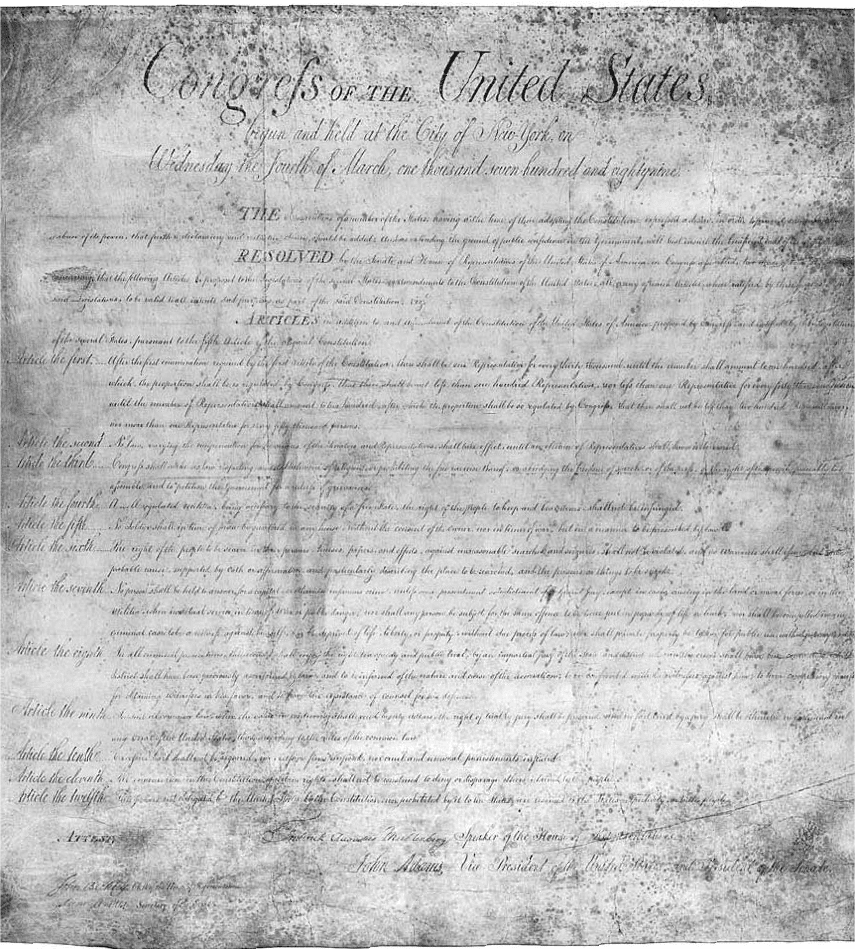
monarch to address grievances. Together, the
Magna Carta and the Bill of Rights placed lim-
its on governmental power in an effort to protect
individual rights.
The need for a bill of rights in the new American
nation surfaced during the ratifi cation debates in
the states following the drafting of the Constitution
in Philadelphia in 1787. Critics of the proposed con-
The Bill of Rights (National Archives)
58 Bill of Rights
xviii+446_EofUSConsti-v1.indd 58 3/12/09 3:03:53 PM
stitution were known as the Anti-Federalists, and
they were fearful of the new national government
that it created because in part they saw it as too
powerful. Anti-Federalists such as Patrick Henry
asserted the need for a bill of rights. One of the
Anti-Federalist publications known as the Letters
from a Federal Farmer noted the importance of a
bill of rights in England: “The country from which
we have derived our origin, is an eminent example
of this. Their magna charta and bill of rights have
long been the boast, as well as the security, of that
nation.” For Anti-Federalists, a bill of rights listing
the basic liberties of individuals was necessary to
restrain the new national government.
In response, Federalists such as Alexander
Hamilton, Madison, and James Wilson, who
were defenders of the new constitution, gener-
ally rejected calls for a bill of rights. Hamilton, in
Federalist 84 (of The Federalist Papers), sought
to respond to Anti-Federalist demands for a bill
of rights by dismissing the need for one. First he
pointed out that the Constitution already con-
tained numerous provisions protecting individual
rights. Second, he asserted: “I go further, and
affi rm that bills of rights, in the sense and to the
extent in which they are contended for, are not
only unnecessary in the proposed Constitution,
but would even be dangerous. They would contain
various exceptions to powers not granted; and, on
this very account, would afford a colorable pretext
to claim more than were granted.” For Hamilton,
no bill of rights was needed since the Constitution
did not grant the national government the power
to limit individual rights.
Eventually, the Federalists held the day, and
the Constitution was adopted; however, to secure
its confirmation, Madison conceded the argu-
ments of the Anti-Federalists and promised intro-
duction of a bill of rights in Congress if the new
constitution was adopted. In 1789, he introduced
17 amendments. Of these 17, 12 were adopted by
Congress, and of these, 10 of them were ratifi ed
by 1791 and became what is now known as the
Bill of Rights. Originally, Madison’s plan was to
have them directly incorporated into the text of
the Constitution, but he later changed his mind
and opted to add them as a separate document.
The Bill of Rights contains numerous provi-
sions. The First Amendment contains clauses
guaranteeing rights to free speech, press, exercise
of religion, and right to assembly and petition for
grievances. It also prevents the establishment of
religion.
The Second Amendment refers to a right to
bear arms. In D
ISTRICT OF COLUMBIA V. HELLER,
the Supreme Court resolved a long-running debate
and held that this amendment protects an individ-
ual’s right to bear arms. The Third Amendment
protects against quartering of troops in one’s home.
The Fourth Amendment is protection against
unreasonable seizures, and the Fifth Amend-
ment protects a right to an indictment by a grand
jury, protection against double jeopardy, and a
right against self-incrimination. The Fifth
Amendment also contains the takings clause,
which regulates the use of eminent domain, as
well as a due process clause.
The Sixth Amendment provides for a right
to a speedy trial, to defend oneself with witnesses
and to confront witnesses and question them,
and to be represented by a lawyer. The Seventh
Amendment provides for a jury trial in some
civil matters. The Eighth Amendment proscribes
cruel and unusual punishment and exces-
sive bail. Finally, the Ninth Amendment and
Tenth Amendment serve as catch-all protections
of rights, with the former stating that the enumer-
ation of specifi c rights shall not deny people of all
their other rights and the latter reserving to the
states powers not delegated to the national gov-
ernment nor prohibited to them.
The Bill of Rights was originally written to limit
the power of the national government, not the state
governments. The significance of the point was
emphasized by Chief Justice John Marshall in
B
ARRON V. MAYOR AND CITY COUNCIL OF BALTIMORE,
32 U.S. 243 (1833). In this case, he rejected claims
that a state violated the Fifth Amendment rights of
an individual who had had property taken without
compensation. He held that the “Fifth Amend-
ment must be understood as restraining the power
of the general government, not as applicable to the
States.” Thus, the Bill of Rights did not apply to the
states or limit their authority.
Bill of Rights 59
xviii+446_EofUSConsti-v1.indd 59 3/12/09 3:03:54 PM
This view of the Bill of Rights as inapplicable to
the states changed with the adoption of the Four-
teenth Amendment in 1868. Section 1, contain-
ing the due process clause, has been used to apply
many of the provisions of the Bill of Rights to the
states. Starting fi rst in Chicago, B. & Q. R. Co. v.
City of Chicago, 166 U.S. 226 (1897), which reversed
Barron and stipulated that the Fifth Amendment’s
just compensation applied to the states, and then
in G
ITLOW V. PEOPLE OF THE STATE OF NEW YORK, 268
U.S. 652 (1925), where the Court stated that the
First Amendment free speech clause limited states,
the Supreme Court has ruled that most of the major
provisions of the Bill of Rights are applicable and
enforceable against states by way of the due process
clause of the Fourteenth Amendment.
The process of applying the Bill of Rights to the
states by way of the due process clause is known
as incorporation. The Court, with the nota-
ble exception of Justice Hugo Black, has never
adopted the argument that the entire Bill of Rights
was incorporated through the Fourteenth Amend-
ment to limit states. Instead, it has opted for selec-
tive incorporation of parts of the Bill of Rights. Most
of the Bill of Rights was incorporated after World
War II and under the Warren Court. Except for
the Second and Third Amendments, the Grand
Jury provision of the Fifth Amendment, the right
to jury trial provision in the Seventh Amendment,
and the excessive bail provision of the Eighth, the
rest of the Bill of Rights has been incorporated.
The adoption of the Bill of Rights represented
a major change in the way rights were to be pro-
tected in the United States. Instead of relying on
federalism, separation of powers, and checks
and balances to protect individuals, the Bill of
Rights takes certain issues out of the political pro-
cess, leaving it up to the courts to protect them.
Beginning with United States v. Carolene Prod-
ucts Co., 304 U.S. 144 (1938), the Supreme Court
subjected legislation implicating Bill of Rights
protections to strict scrutiny, demanding
that the government demonstrate a compelling
interest that is narrowly tailored before permit-
ting their restriction or limitation. Generally, the
Court has not been supportive of limits on Bill of
Rights protections since Carolene Products.
While Bill of Rights provisions are generally
supported, it is often diffi cult to ascertain what
the amendments mean today, and many are con-
troversial. For example, in 1791, the World Wide
Web and the Internet did not exist, and many other
technologies of today were absent. Determining
how to apply the First and Fourth Amendments
to these new technologies is diffi cult. In addition,
since the terrorist attacks of September 11, 2001,
some have argued for the need to relax some of
the search and seizure and other criminal law
protections of the Bill of Rights in order to facili-
tate the “war on terrorism.” In response, defend-
ers of individual liberties such as the American
Civil Liberties Union oppose this, arguing
that the Bill of Rights is supposed to apply at all
times, including during periods of war.
Overall, the Bill of Rights is one of the major
constitutional law documents in the United States.
Its adoption has had a signifi cant impact on the
protection of rights and the operation of the dif-
ferent levels of government.
For more information: Kelly, Alfred, Winfred
A. Harbinson, and Herman Belz. The American
Constitution: Its Origins and Development. New
York: W. W. Norton & Co., 1991; Levy, Leonard
W. Original Intent and the Framers’ Constitu-
tion. New York: Macmillan Publishing, 1989;
Perry, Michael J. We the People: The Fourteenth
Amendment and the Supreme Court. New York:
Oxford University Press, 1999; Schwartz, Ber-
nard. A History of the Supreme Court. New York:
Oxford University Press, 1993; Stone, Geoffrey
R., and Richard A. Epstein. The Bill of Rights in
the Modern States. Chicago: University of Chi-
cago Press, 1992; Storing, Herbert J. What the
Anti-Federalists Were For. Chicago: University of
Chicago Press, 1981.
—David Schultz
Bivens v. Six Unknown Named Agents of
Federal Bureau of Narcotics
403 U.S.
388
(1971)
In Bivens v. Six Unknown Named Agents of Fed-
eral Bureau of Narcotics, the U.S. Supreme Court
60 Bivens v. Six Unknown Named Agents of Federal Bureau of Narcotics
xviii+446_EofUSConsti-v1.indd 60 3/12/09 3:03:54 PM
established a civil remedy for individuals who had
been allegedly wronged by illegal action by the
federal government.
Traditionally, individuals who had been sub-
ject to illegal activity by police offi cers, such as
the use of excessive force, could sue them and
the federal government under the Federal Tort
Claims Act. However, in Bivens, the Court ruled
that the Constitution provided for civil remedies
to compensate for wrongs committed against
them by federal law-enforcement agents who vio-
late their rights.
Webster Bivens was arrested without warrant
and had his house searched without warrant. No
charges were brought against him, whereupon Biv-
ens brought suit that his Fourth Amendment
right to protection from unreasonable searches
and seizure was violated. The Supreme Court,
with the opinion delivered by Justice William
J. Brennan, Jr., ruled that the Fourth Amend-
ment provided for fi nancial damages or remedy
to citizens for every wrong committed by the gov-
ernment where a remedy did not exist or where
one could have been recovered if the violation had
been committed by a private citizen and suit was
then brought against that person.
For more information: Langran, Robert W. The
Supreme Court: A Concise History. New York:
Peter Lang, 2004.
—Ernest Gomez
Black, Hugo (1886–1971) Supreme Court justice
Hugo Black was nominated to serve as a U.S.
Supreme Court associate justice by President
Franklin Roosevelt in 1937. After confirmation
in 1937, Black served on the Supreme Court until
1971. Associate Justice Black left a lasting legacy
on the judiciary. Serving more than 34 years on
the Supreme Court, Black is one of the longest-
serving Supreme Court justices, along with Asso-
ciate Justices William O. Douglas and Stephen
Johnson Field and Chief Justice John Marshall.
Justice Black is best known as one of the liber-
als on the Roosevelt Supreme Court and for his
insistence that the Fourteenth Amendment
served to incorporate all of the Bill of Rights
provisions to apply to the states.
Hugo Black came from humble beginnings to
national prominence. He was born on February
27, 1886, in a poor farming community in Alabama
and was the youngest of eight children of Hugo
and Martha Black. After attending medical school
for a year, Black decided to pursue law instead. In
1906, Hugo Black graduated from the University
of Alabama law school. In February 1921, Black
married Josephine Foster, and the couple had
three children. Josephine died in 1951, and Black
married Elizabeth DeMeritte in 1957.
In 1927, Black was sworn in as a senator repre-
senting the state of Alabama. An eloquent speaker
and a loyal Democrat, Black quickly won the
admiration of leaders of his party and gained the
attention of President Roosevelt. This admiration
earned Black a nomination for the U.S. Supreme
Court. Since Black was serving as a senator when
he was nominated, it seemed his confirmation
would be quick and easy; however, this was the
fi rst appointment that President Roosevelt made
after his court-packing plan. For the first time
since 1888, instead of receiving a quick confi rma-
tion with little debate, Senator Black’s nomination
was sent to the Senate Judiciary Committee.
Black was placed under much scrutiny, and his
confirmation seemed in doubt when his former
membership in the Ku Klux Klan (KKK) came
into question. A radio speech on October 1, 1937,
in which Black denied any present affi liation with
the KKK helped sway public support. Ultimately,
the Senate confi rmed Black’s nomination with a
vote of 63-13. On his first day of service to the
Supreme Court, on October 4, 1937, demonstra-
tors protesting Black’s appointment to the Court
crowded the Supreme Court building.
As a justice, the rulings of Black would be
labeled “activist” because of his willingness to
review laws and strike them down as unconsti-
tutional. On the Court, Black’s rulings distanced
his image as a Klan member. In one of his early
rulings as justice, the unanimous opinion of the
Supreme Court in Chambers v. Florida, 309 U.S.
227 (1940), written by Black, favored three Afri-
can-American defendants in a question of unjust
Black, Hugo 61
xviii+446_EofUSConsti-v1.indd 61 3/12/09 3:03:54 PM