
Schultz D. Encyclopedia of the United States Constitution
Подождите немного. Документ загружается.

War could not again be elected to Congress unless
a two-thirds vote of both houses permitted this.
Section 4 of the Fourteenth Amendment
appears to sanction the ability of Congress to pro-
vide for pensions for individuals who were veterans
of the Civil War. Finally, Section 5 was a general
provision that granted Congress the power to
enforce the provisions of the entire amendment.
The most signifi cant litigation and impact sur-
rounding the Fourteenth Amendment is found in
Section 1. There, three clauses—the privileges or
immunities, due process, and equal protection—
have had important and wide ranging histories
with major constitutional importance.
Privileges and immunities are referred to
in two sections of the Constitution. Article IV, Sec-
tion 2 of the Constitution stipulates that the citizens
of each state “shall be entitled to all the Privileges
and Immunities of the Citizens in the several
States.” Section 1 of the Fourteenth Amendment
declares that no state can “abridge the privileges
or immunities of citizens of the United States.”
Notwithstanding the slight change in phrasing
in the two different clauses, what exactly are the
privileges or immunities that are referenced in the
Fourteenth Amendment? In C
ORFIELD V. CORYELL,
6 F. Cas. 546 (1823), Supreme Court Justice Bush-
rod Washington, while riding circuit court, stated
that the privileges and immunities of Article IV
included:
Protection by the government; the enjoyment of
life and liberty, with the right to acquire and pos-
sess property of every kind, and to pursue and
obtain happiness and safety; subject nevertheless
to such restraints as the government may justly
prescribe for the general good of the whole. The
right of a citizen of one state to pass through, or
to reside in any other state, for purposes of trade,
agriculture, professional pursuits, or otherwise;
to claim the benefi t of the writ of habeas cor-
pus; to institute and maintain actions of any kind
in the courts of the state; to take, hold and dis-
pose of property, either real or personal; and an
exemption from higher taxes or impositions than
are paid by the other citizens of the state; may be
mentioned as some of the particular privileges
and immunities of citizens, which are clearly
embraced by the general description of privi-
leges deemed to be fundamental: to which may
be added, the elective franchise, as regulated
and established by the laws or constitution of the
state in which it is to be exercised.
It is these rights, referred to in Corfi eld, and
which were again mentioned in statute in the
Civil Rights Act of 1866, that seem to be the privi-
leges or immunities protected by the Fourteenth
Amendment. However, in the Slaughterhouse
Cases, 83 U.S. 36 (1873), the Supreme Court nar-
rowed the scope of the privileges or immunities
clause so much that most scholars had declared
it dead. This was true until S
AENZ V. ROE, 536
U.S. 489 (1999), when the Court struck down as
unconstitutional a state law limiting welfare ben-
efi ts in cases involving recent immigrants to the
state. The Court used the privileges or immunities
clause in ruling that the right to interstate travel
was one of the rights protected by it.
The due process clause of Section 1 has also
been an important source of litigation and con-
stitutional law. First, due process has taken on
two different types of meanings—substantive
and procedural. Substantive due process
was an important legal concept developed by the
Supreme Court beginning in the 1870s and lasting
until the New Deal. In cases such as L
OCHNER V.
N
EW YORK, 198 U.S. 45 (1905), and ADKINS V. CHIL-
DREN’S HOSPITAL, 261 U.S. 525 (1923), the Court
used substantive due process as a legal doctrine
to place limits on state regulation of the economy.
Substantive due process, also known as liberty
of contract or economic due process, was also
employed to protect property rights. In both cases,
substantive due process employed strict scru-
tiny when the Court examined legislation affect-
ing the economy or property rights. It was not
until 1938 in United States v. Carolene Products,
304 U.S. 144 (1938), that the Court seemed to offi -
cially bring a close to substantive due process.
Procedural due process generally refers to
the rights of individuals to have hearings or be
informed about government procedures when they
are facing a challenge or threat to their personal or
292 Fourteenth Amendment
xviii+446_EofUSConsti-v1.indd 292 3/12/09 3:05:09 PM
property rights. In cases such as Goldberg v. Kelly,
397 U.S. 254 (1970), and Mathews v. Elbridge, 424
U.S. 19 (1976), the Court has used procedural due
process to determine if and what types of hearings
are due to individuals facing the potential loss of
government employment or benefi ts.
The due process clause has also been impor-
tant in incorporating or applying numerous provi-
sions of the Bill of Rights to the states. In B
ARRON
V. MAYOR AND CITY COUNCIL OF BALTIMORE, 32 U.S.
243 (1833), the Supreme Court had ruled that
the various provisions of the Bill of Rights did not
place limits on states. However, starting with Chi-
cago, Burlington & Quincy Railroad Company v.
Chicago, 166 U.S. 226 (1897), the Court declared
that the takings clause of the Fifth Amend-
ment applied to the states through the due pro-
cess clause of the Fourteenth Amendment. After
that, in G
ITLOW V. NEW YORK, 268 U.S. 652 (1925),
the Court applied the First Amendment free
expression clauses to the states via the due pro-
cess. Gradually, through what has become known
as selective incorporation, almost all of the Bill
of Rights, with the notable exception of the Sec-
ond and Third Amendments, has been applied
to the states through the due process clause.
Finally, the equal protection clause of the
Fourteenth Amendment has been the subject of
signifi cant and varied interpretation. Originally,
the clause was meant to ensure that states treat all
persons as legally the same. However, in M
INOR V.
H
APPERSETT, 88 U.S. 162 (1875), the Court rejected
claims that the equal protection clause granted
women the right to vote. In addition, in S
ANTA
C
LARA COUNTY V. SOUTHERN PACIFIC RAILROAD,
118 U.S. 394 (1886), the Court declared business
corporations to be persons under the Fourteenth
Amendment, but in P
LESSY V. FERGUSON, 163 U.S.
537 (1896), the Court rejected claims that the
equal protection clause barred laws that racially
segregated African Americans from whites. Dur-
ing the first half of the 20th century, the equal
protection clause was an ineffective tool in chal-
lenging discrimination until B
ROWN V. BOARD OF
EDUCATION, 347 U.S. 43 (1954), declared school
segregation unconstitutional under that clause. In
BOLLING V. SHARPE, 347 U.S. 497 (1954), a com-
panion case to Brown, the Court performed a
reverse incorporation, applying the equal protec-
tion clause to the federal government.
Since Brown, the equal protection clause has
been used to challenge numerous discrimination
laws as they affect race, gender, age, and national
origin. When the government classifi es individuals
by one of these categories, such as race, the Court
will generally subject the law to either strict or
some other form of heightened scrutiny, demand-
ing of the government some compelling gov-
ernmental interest before it will allow such
a classifi cation. When a suspect or semi-suspect
classifi cation is not employed, the equal protec-
tion clause will require that the government have
a rational basis for its distinction. In this case, it is
generally easy for the government to prevail.
The equal protection clause has been invoked
to justify or attack numerous government activi-
ties since the 1970s. The clause has been impor-
tant in challenging laws that discriminate against
women, such as Frontiero v. Richardson, 411 U.S.
677 (1973). The clause has been at the center of
disputes involving affirmative action and
reapportionment in cases such as G
RUTTER V. BOL-
LINGER, 539 U.S. 306 (2003), and SHAW V. RENO,
509 U.S. 630 (1993), where the Court struggled
with the permissibility of using race in college
admissions or in the drawing of legislative and
congressional district lines. In BUSH V. GORE, 531
U.S. 98 (2000), and REYNOLDS V. SIMS, 377 U.S. 533
(1964), the equal protection clause was invoked in
matters affecting the right to vote. Finally, some
are increasingly arguing that the equal protection
clause should be used to invalidate laws that dis-
criminate against gays and lesbians.
Overall, some scholars such as Bruce Ackerman
have argued that the adoption of the Fourteenth
Amendment should be seen as effecting a major
constitutional restructuring in the United States.
It did that by rearranging state and federal power,
giving the national government more power over
the former than it had before the Civil War to pro-
tect individual rights.
For more information: Kelly, Alfred, Winfred
Harbinson, and Herman Belz. The American
Fourteenth Amendment 293
xviii+446_EofUSConsti-v1.indd 293 3/12/09 3:05:09 PM
Constitution: Its Origins and Development. New
York: W.W. Norton & Company, 1991; Schwartz,
Bernard. A History of the Supreme Court. New
York: Oxford University Press, 1993.
—David Schultz
Fourth Amendment
The Fourth Amendment protects individuals
against unreasonable searches and seizures and
generally requires the government to obtain a
warrant, issued by a judge, upon showing of rea-
sonableness, before one’s person, home, or prop-
erty can be searched. The Fourth Amendment
is one of the original ten, the Bill of Rights that
amended the Constitution in 1791, which was
proposed by James Madison. While originally
this amendment did not apply to the states, it has
been incorporated via the due process clause of
the Fourteenth Amendment to apply to the
states.
The Fourth Amendment, along with the Fifth,
Sixth, Seventh, and Eighth, were adopted to pro-
vide for the protection of those accused of crimes.
In the case of the Fourth Amendment, its adop-
tion can be traced to the experiences of the Amer-
ican colonies under British rule. The authorization
of the use of general warrants by the British gov-
ernment to search persons and properties in the
colonies was one of the abuses alluded to when the
1776 Declaration of Independence provided
a bill of particulars regarding why the United
States sought its independence from Britain.
In interpreting the Fourth Amendment, several
issues arise. These include when does the Fourth
Amendment apply, what constitutes a search and
seizure, the requirements necessary to obtain a
warrant, when a warrant is required, and what to
do with evidence that has been illegally obtained.
In O
LMSTEAD V. UNITED STATES, 277 U.S. 438
(1928), the Supreme Court originally rejected the
application of the Fourth Amendment to elec-
tronic eavesdropping or surveillance. The Court
ruled that only physical things could be searched
and seized. However, in Katz v. United States,
389 U.S. 37 (1967), the Court rejected this argu-
ment, instead contending that the Fourth Amend-
ment applied to protect expectations of privacy.
Specifically, the Court stated that the Fourth
Amendment would apply when an individual had
an expectation of privacy that was respected or
endorsed by society. In Katz, the Court stated that
individuals had expectations of privacy in making
telephone calls from public phone booths. How-
ever, the Court has ruled that there is no expecta-
tion of privacy in placing one’s trash out on public
property for pickup. There is also no expectation
of privacy in most public places or in one’s auto-
mobile. However, there is generally a very high
expectation of privacy in one’s home or apartment,
and as the Court stated in K
YLLO V. UNITED STATES,
533 U.S. 27 (2001), the presumption is that a war-
rant is almost always needed when searches here
occur.
The Fourth Amendment bans unreasonable
searches and seizures. This phrase has been inter-
preted by the Supreme Court in Boyd v. United
States, 116 U.S. 616 (1886), to require that the
search be reasonable. Reasonable has been inter-
preted to require that there is particular or spe-
cifi c suspicion that an individual is suspected of a
crime or that some location contains illegal goods.
The reasonableness requirement demands that
the police produce individualized and not gen-
eral suspicion. Merely believing one is a member
of a large group of individuals whom the police
may think are involved in criminal activity is not
enough to justify the search as reasonable.
Thus, in order to obtain a search warrant the
government must do three things. First, they
must have reasonable suspicion or probable cause
that one has done something illegal. Second, they
must then state with particularity whom they
wish to arrest or search, or what items they wish
to inspect. Third, the police or other law enforce-
ment offi cials must obtain a search warrant validly
issued by a neutral magistrate or judge.
The Fourth Amendment applies only when
a search and seizure has occurred. The Court
has developed a complex body of law to deter-
mine when one or a thing has been searched and
seized. In United States v. Mendenhall, 446 U.S.
544 (1980), the Supreme Court decided that one
was seized when a person was not free to leave. In
294 Fourth Amendment
xviii+446_EofUSConsti-v1.indd 294 3/12/09 3:05:10 PM
Florida v. Bostick, 501 U.S. 429 (1991), the Court
ruled that searches of passengers on buses and
other public places were not necessarily unrea-
sonable or involved a seizure because one might
be free to leave. In terms of a search, drug sniffs
by dogs in public places do not constitute a search,
nor does a fl ight by an airplane over a property.
However, a search would include the use of a ther-
mal heat detector directed at a house to detect the
use of lamps to grow marijuana.
The Court has created a general presumption
that search warrants are required to search homes
or individuals. Yet it has also carved out numerous
exceptions to this presumption. A search warrant
is not required if one consents to a search (Sch-
neckloth v. Bustamonte, 412 U.S. 218 [1972]; if the
search is incident to an arrest (C
HIMEL V. CALIFOR-
NIA, 395 U.S. 752 [1969]; if the search is limited
to looking for weapons (T
ERRY V. OHIO, 392 U.S. 1,
19 [1968] [stop and frisk]); if necessary due to
exigent circumstances (United States v. Watson,
423 U.S. 411 [1976]) or due to a public safety (New
York v. Quarles, 467 U.S. 649 [1984]); if there is
a risk of evidence’s being destroyed (U.S. v. Mac-
Donald, 335 U.S. 451 [1948]); or if the police are
in hot pursuit of a suspect (Warden v. Hayden,
387 U.S. 294 [1967]).
In addition, no warrant is required if items are
in plain view of the police (Arizona v. Hicks, 480
U.S. 321 [1987]) or if the items will inevitably be
discovered (Nix v. Williams, 467 U.S. 431 [1984]).
Finally, warrants are not required for searches of
automobiles (Carroll v. United States, 267 U.S.
132 [1925]), border searches (Almeida-Sanchez v.
United States, 413 U.S. 266 [1973]), or for admin-
istrative inventory searches (Camera v. Municipal
Court, 387 U.S. 523 [1967]).
In some situations, the government or law
enforcement officials may secure evidence or
materials in violation of the Fourth Amendment.
In W
EEKS V. UNITED STATES, 232 U.S. 383 (1914),
the Court held that the Fourth Amendment
barred the prosecution from introducing evidence
seized by federal offi cials during illegal searches.
This rule is commonly called the exclusionary
rule. Based on the Weeks decision, the exclusion-
ary rule applied only to federal cases. The Court
later extended the exclusionary rule to state cases
in Mapp v. Ohio, 367 U.S. 643 (1961). However, in
New York v. Harris, 495 U.S. 14 (1990) the Court
ruled that the exclusionary rule does not bar the
introduction of illegally obtained evidence for the
purposes of impeaching a witness. Such evidence
may also be introduced at grand jury proceedings.
Generally, third parties cannot object to exclu-
sionary rule violations; only those who have been
subject to the illegal search and seizure can.
The exclusionary rule and warrant require-
ments of the Fourth Amendment are often viewed
by some as an impediment to police apprehend-
ing criminals. There is little evidence that the
two hamstring law enforcement activity. More-
over, since 9/11, the PATRIOT Act has eased the
requirements for obtaining the search warrants
in national security matters. President George
Bush was criticized for authorizing electronic
surveillance of telephone and internet messages
in apparent violation of the Foreign Intel-
ligence Surveillance Act of 1978, which
outlined procedures to obtain warrants from a
special court in cases like this. While the ACLU
and other groups sought to challenge these war-
rantless searches, the courts have not been recep-
tive to hearing these cases.
Overall, the Fourth Amendment represents an
important constitutional protection of individual
rights that places several requirements upon the
government when it seeks to search individuals,
property, or places.
For more information: LaFave, Wayne R., Jer-
old H. Israel, and Nancy J. King. Criminal Proce-
dure. St. Paul, Minn.: Thomson West, 2004.
—David Schultz
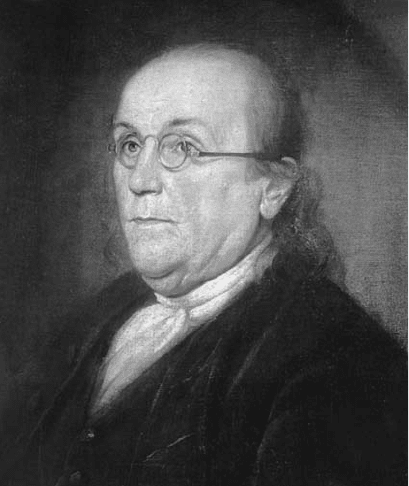
Franklin, Benjamin (1706–1790) publisher,
scientist, inventor, diplomat, statesman
Benjamin Franklin was an inventor, publisher, and
diplomat and one of the most prominent fi gures of
the American Revolution. He was born on Janu-
ary 17, 1706, in Boston, Massachusetts. He is best
known as a major Revolutionary War fi gure and as
one of the Constitution’s Founding Fathers.
Franklin, Benjamin 295
xviii+446_EofUSConsti-v1.indd 295 3/12/09 3:05:10 PM
During his youth, Franklin learned how to print
and to publish from his older brother who worked
in Boston. Once he learned what he believed was
necessary to be successful in printing, Franklin
left Boston alone and on his own will, establishing
himself in the bustling city of Philadelphia.
In Philadelphia, Franklin became one of the
most prominent American statesmen. He set up
a printing business, selling almanacs and news-
papers. He gained notoriety as the publisher of
Poor Richard’s Almanack and The Pennsylvania
Gazette. He expanded into the merchant sec-
tor, accruing significant wealth, which he used
to finance numerous projects in Philadelphia
and throughout the colonies and later the young
nation. In Philadelphia, particularly, he estab-
lished the fi rst public library and the fi rst volun-
teer fi re department in America, as well as setting
up the predecessor of the University of Pennsylva-
nia. His personal interests varied as well; he made
significant advances in science and technology,
specifi cally in electricity and eyesight.
Franklin was a prominent member of the Penn-
sylvania Assembly, but lost his seat in the Paxton
Boys Affairs. This setback, however, allowed him
to return to England as a diplomat from Pennsyl-
vania to petition the King on colonial self-rule in
1764. Soon after, he became more of a voice for
many colonies, while arguing against the Stamp
Act and the Townshend Acts, leading to his rise as
one of the most famous and popular pro-Ameri-
can radicals.
He traveled around Britain, Ireland, and France
and met with King Louis XV. Everywhere, Frank-
lin’s exploits in electrical research, publishing, and
diplomacy preceded him. In 1775, as tensions wors-
ened, Franklin’s pro-American activities forced
him to leave England. When he reached America,
open war had already begun, and he was selected
as a delegate to the Second Continental Congress
from Pennsylvania. In 1776, he was a member of
the drafting team for the Declaration of Inde-
pendence, which he signed soon after.
During the war, Franklin was America’s dip-
lomat to France, where he was well received. He
successfully negotiated a critical military alliance
and ultimately the Treaty of Paris in 1783, grant-
ing independence to the United States. He fi nally
returned home in 1785, as turmoil from the failing
Articles of Confederation was increasing. He soon
after freed his two slaves, becoming an ardent
abolitionist.
Although aged and in retirement, Franklin
agreed to join the Constitutional Conven-
tion in Philadelphia as a delegate in 1787. As the
Convention seemed to be degenerating, Franklin
acted as a calming force and power. On the last day
of the Convention, Franklin, who was 81, wrote a
speech that he was too weak and gout-ridden to
deliver, which is generally judged to be one of the
masterpieces of the Convention. On September 17,
1787, fellow Pennsylvanian delegate James Wilson
read it aloud. In it, he appealed for unity behind
the new government even though he and others
had certain minor qualms with the fi nal proposal.
He argued that although it had faults, in his opin-
ion, it could get no better. Soon after, he signed
the new Constitution, becoming the only man to
sign all three of America’s most crucial and forma-
Benjamin Franklin. Portrait by Charles Willson
Peale
(Library of Congress)
296 Franklin, Benjamin
xviii+446_EofUSConsti-v1.indd 296 3/12/09 3:05:10 PM
tive documents: the Declaration of Independence,
the Treaty of Paris, and the Constitution.
For more information: “Ben Franklin on the
Federal Constitution.” Available online. URL:
http://lexrex.com/enlightened/writings/franklin_
on_const.htm. Accessed May 12, 2008; Brands,
H. W. The First American: The Life and Times
of Benjamin Franklin. New York: Anchor Publish-
ing, 2002; Collier, Christopher. Decision in Phila-
delphia: The Constitutional Convention of 1787.
New York: Ballantine Books, 1987.
—Arthur Holst
freedom of religion
Freedom of religion is a distinguishing attribute of
the American ethos. It is also a feature of the U.S.
Constitution as amended in the congressionally
formulated Bill of Rights. The First Amend-
ment begins famously, “Congress shall make no
law respecting an establishment of religion, or pro-
hibiting the free exercise thereof.” The 13 states
that ratifi ed the constitution had varying ways of
defi ning religion and defending religious liberties.
Recognizing the differences, the fi rst Congress
chose broad terms. According to constitutional
scholar John Witte, the terminology summarizes
a range of principles such as liberty of conscience,
religious equality, religious pluralism, and separa-
tion of church and state. The federal government
was thus restrained by declaration from a legal
power to privilege any religious sect or interfere
with any state’s decisions regarding the religious
liberties of sects or individuals.
During the American colonial era, religious
liberty tended to be communitarian, moralistic,
and exclusive. Most immigrants who migrated to
America in search of religious freedom did not
seek an environment of religious pluralism but a
context liberated from the control of European
ecclesiastical institutions. While the religious plu-
ralism of Roger William’s Providence Plantation
was a harbinger of religious toleration that would
spread, most Pilgrims, Puritans, and religion-
ists saw no philosophical contradiction in setting
up community-based religious establishments in
America. From this point of view, palatable reli-
gious liberty developed more from competitive
circumstances, experimental learning, and the
advent of federalism than from purposeful
design.
The nature of religious liberty began to change
when the 13 original American states turned away
from the Articles of Confederation and formulated
a federal constitution. Under the Articles, the
union was merely a league of friendship—power
at the center being diminutive. In this context,
there was no need of a shared understanding of
private or public religion, although a good deal
of commonality existed. Each state’s constitution
created its own unique place for religion. Some
states had moved to religious pluralism, some had
partial establishments, and a few still held to full
establishments. The challenge for the 1787 Con-
stitutional Convention was to satisfy those
who felt the convention best served states’ inter-
ests by remaining silent on religious liberty as well
as others who wanted a positive declaration that
all powers pertaining to religion remained with
the states. The convention chose to leave it up to
the new U.S. Congress regarding how best to deal
with the issue.
In 1789 the first session of Congress began
their work on a bill of rights. Many members of
this Congress, including James Madison, had
been delegates to the Constitutional Convention,
so there was little loss of continuity. The Congress
and its committees worked their way through 20
proposals and drafts on religious freedom before
agreeing upon wording that proved to be brilliant
for the times. The fi nal construction of the religion
clauses in the Bill of Rights effectively prevented
the federal government from meddling in the reli-
gious affairs of the states prior to the nation’s cul-
tural readiness for such incursions. Such readiness
was a long way off as evidenced over a half cen-
tury later in Permoli v. First Municipality of New
Orleans, 44 U.S. (3 How.) 589 (1844) when the
Court ruled unanimously that citizens’ religious
liberties were not protected by the Constitution
but only by the laws of the respective states.
In formulating the religion clauses, the Congress
dropped the popular House-sponsored phrase “nor
freedom of religion 297
xviii+446_EofUSConsti-v1.indd 297 3/12/09 3:05:11 PM
shall the rights of conscience be infringed”—reli-
gious conscience potentially broadening the nature
of actions defendable as religious expression. A
question illustrating the connection of conscience
to action appeared in the landmark case Reynolds
v. United States, 98 U.S. 145 (1879). In Reynolds,
a unanimous Court ruled against religiously justi-
fi ed polygamy, the Court stating that human action
could be regulated even if beliefs could not. The
same jurisprudential latitude remained evident a
century later when the Rehnquist Court held
that freedom of religion did not give individuals,
including Native Americans, the right to smoke
the sacramental hallucinogenic peyote when use
of the drug was prohibited by neutral and rational
state law (E
MPLOYMENT DIVISION V. SMITH, 494 U.S.
872 [1990]). The fl exibility of this jurisprudence is
rooted in the decision of the Founders not to fed-
erally defi ne religion in the Constitution.
In present times, not all of what is constitu-
tionally guaranteed in the First Amendment’s
religion clauses is clear, leading to a “tangled
jurisprudence” according to Kenneth Wald and
many political scientists. Some legal theorists
follow a “thick reading” of the religious clauses
while others advocate a “thin reading.” The thick
reading mines inferences and clues from the fi rst
Congress’s work, concluding that the democratic
majority had specific intent that is knowable
today. By contrast, the thin reading suggests an
intentional vagueness so that later generations
could make the constitutional guarantees secure a
framework of religious freedoms pertinent to the
times. Not surprisingly, jurisprudence has drifted
toward the politicization of the clauses as the only
means of surmounting interpretative impasses.
Still, this situation has not stopped the search for
universal principles.
The Court’s search for principles to replace
federalism in the religion clauses gained traction
with the due process and equal protection
clauses of the Fourteenth Amendment. In
P
IERCE V. SOCIETY OF SISTERS, 268 U.S. 510 (1925),
the Supreme Court ruled against an Oregon law
aimed at undermining Catholic schools as alter-
native venues of education. The Court claimed
a “fundamental theory of liberty,” clarifying this
idea a few years later in Cantwell v. Connecti-
cut, 310 U.S. 296 (1940). In Cantwell, the Court
decided that the Fourteenth Amendment had
“rendered the legislatures of the states as incom-
petent as Congress” to enact laws that work to
deprive people “of their liberty without due pro-
cess of law.” In this instance, Jehovah’s Witnesses
were affi rmed in their liberty to proselytize in a
Connecticut city without a solicitation license,
while the city’s apparent effort to protect the
community’s religious tendencies failed the high
court’s emerging standard. Cantwell thus incor-
porated the Fourteenth Amendment against the
First Amendment’s free exercise clause. But it
would take another seven years before the Court
would duplicate the new jurisprudence in regard
to the no establishment clause.
When the Court decided E
VERSON V. BOARD OF
E
DUCATION, 330 U.S. 1 (1947), it formalized on a
national level a judicial philosophy of disestab-
lishment that many of the states had signifi cantly
moved toward in their constitutions—mostly on
a piecemeal basis. Full-scale sectarian establish-
ment at the state level failed much earlier because
religious liberties achieved through religious plu-
ralism within states had stronger appeal than did
religious freedom accomplished through federal-
ism between states. Nevertheless, fragmentary
establishment continued in some states—state
majorities wishing to discourage unpopular sects
from populating, proselytizing, or creating disrup-
tive infl uences in their communities. In these mat-
ters, it would take a long series of U.S. Supreme
Court decisions to build a metaphorical wall of
separation between church and state.
As the passage of time demonstrated, the high
court found that a wall of separation did not
always facilitate fundamental religious freedoms,
these liberties better protected in some instances
by policies of accommodation. Consequently,
the Court followed an accommodating line of
church and state jurisprudence in about half of
its important religious cases from 1943 to 2003.
The diffi culty is that the nationalization of reli-
gious liberties has put the establishment clause
in frequent disjunction with the free exercise
clause.
298 freedom of religion
xviii+446_EofUSConsti-v1.indd 298 3/12/09 3:05:11 PM
The U.S. Supreme Court faces a large chal-
lenge in fi nding neutral ground when one person’s
free exercise of religion conflicts with another
person’s religious belief against that exercise, or
some group’s free exercise seems like a public
establishment of religion to an opposing group.
Prior to the incorporation of the Fourteenth
Amendment against the First, the choice of which
freedom to protect was merely an expression of
federalism, each state having its own formula.
But in the modern era, federalism in religion has
become mostly unconstitutional, opening the way
for religiously interested groups to litigate for pub-
lic policy wins in a national context. Many of these
contests have involved religious speech and dis-
plays, religious schooling, Bible reading and prayer
in public schools, and the teaching of evolution.
Major precedent-setting cases involving public
education include E
NGEL V. VITALE, 370 U.S. 421
(1962), Epperson v. Arkansas, 393 U.S. 97 (1968),
and L
EMON V. KURTZMAN, 403 U.S. 602 (1971). In
cases involving issues of licensing, labor laws, gov-
ernment grants and benefi ts, tax exemptions, civil
powers, equal access, and medical care, McGowan
v. Maryland, 366 U.S. 420 (1961), and Sherbert
v. Verner, 374 U.S. 398 (1963) stand as landmark
decisions, both addressing Sabbath Day issues.
Some leading scholars who observe problems
in the evolving jurisprudence are at the same time
sanguine about the outcomes, the Court showing
fi nesse in balancing its decisions between accom-
modation and separatism. Many astute observers
conclude that the Court’s nuanced approach is
stimulative of the continuing vitality of religion in
America. With the expansion of religious diversity
and the development of the commercial state, the
breakdown of religious federalism was inevitable,
requiring a national level intervention by the high
Court. In spite of some uncertainties as to where
the Court’s jurisprudence will lead, polls show
that most Americans believe the U.S. Constitu-
tion continues to be the world’s gold standard for
protecting freedom of religion.
For more information: Wald, Kenneth D. Reli-
gion, and Politics in the United States. 4th ed.
Lanham, Md.: Rowman & Littlefi eld Publishers,
2003; Witte, John, Jr. Religion and the Ameri-
can Constitutional Experiment. 2nd ed. Boulder,
Colo.: Westview Press, 2005.
—Timothy J. Barnett
freedom of the press
Freedom of the press refers to one of the expres-
sive freedoms found in the First Amendment.
Thomas Jefferson once said that “our liberty
depends on the freedom of the press, and that
cannot be limited without being lost.” The framers
of the U.S. Constitution ensured that Jefferson’s
sentiment would live on by including a clause in
the First Amendment of the Bill of Rights that
protects freedom of the press: “Congress shall
make no law . . . abridging the freedom of speech,
or of the press.” Although the press in the United
States does not operate free of all restrictions, the
U.S. Supreme Court has given reporters, editors,
and publishers a great deal of latitude in terms of
what they can say in their pages, on the airwaves,
and now in cyberspace.
But long before Jefferson wrote those words
or the colonists fought the Revolutionary War or
the founding fathers drafted the Constitution,
the trial of a New York printer demonstrated the
importance Americans placed on maintaining a
free press. John Peter Zenger was the printer and
editor of the New York Weekly Journal, which
published articles critical of New York’s colonial
governor. In November 1734, the governor had
Zenger arrested and jailed for 10 months on the
charge of seditious libel. Philadelphia Attorney
Andrew Hamilton, who defended Zenger, admit-
ted to the jury that Zenger published the offend-
ing stories but argued that if the information in
the articles were true, then he should not be found
guilty for his criticism of the government. Zenger
was acquitted despite the judge’s instructions that
he be convicted.
If the Zenger trial marked the beginning of
American jurisprudence regarding freedom of the
press in the United States, then the next 200-plus
years have been spent determining the boundar-
ies of that freedom. Generally, it is accepted that
the press is entitled to no more freedom than the
freedom of the press 299
xviii+446_EofUSConsti-v1.indd 299 3/12/09 3:05:11 PM
public. However, the U.S. Supreme Court has
issued numerous rulings that have dealt directly
with the press’s ability to gather information and
publish that information.
One of the central tenets of press freedom in
the United States is the near total prohibition on
prior restraint. This means that if the government
wants to stop a newspaper or other media outlet
from presenting material to the public, it better
have a very compelling reason for doing so. N
EAR
V. MINNESOTA, 283 U.S. 697 (1931), crystallized
that notion when it struck down a Minnesota law
that allowed government offi cials to prevent the
publication of “malicious, scandalous and defama-
tory” periodicals.
Furthermore, if a publisher had been stopped
from publishing such a periodical, the publisher
had to receive government approval before resum-
ing operations. Although the Near Court found the
law unconstitutional, it was not ready to say that
the government had no recourse at all in prevent-
ing the publication of certain information. Chief
Justice Charles Evans Hughes wrote that the pub-
lication of troop movements could be prevented
prior to publication. He added that “the primary
requirements of decency may be enforced against
obscene publications. The security of the com-
munity life may be protected against incitements
to acts of violence and the overthrow by force
of orderly government.” Despite these apparent
loopholes that allowed the government to engage
in prior restraint, the Supreme Court continued to
set the bar quite high when it came to the notion
of prior restraint.
In the famous Pentagon Papers case the Court
ruled against the Nixon Administration, which
claimed that national security required the Court
to enjoin the New York Times and the Washington
Post from publishing classifi ed documents about
the country’s conduct of the Vietnam War. In an
extremely brief decision, the Court wrote that the
government failed to meet its “heavy burden” to
stop the publication of the Pentagon Papers.
Furthermore, the government cannot use the
back door to stifl e the press when it can not get in
the front. Grosjean v. American Press, 297 U.S.
233(1936), dealt with a state tax on ads in publica-
tions that had a circulation of more than 20,000
copies a week. The Court found the law violated
the First Amendment. The Court said that the
press could be treated as the government would
treat any other business, but it could not create
laws that would single out the media and lead to
prior restraint or limit circulation. Justice George
Sutherland, writing for the Court, said that when
the framers wrote the First Amendment, it “was
meant to preclude the national government, and,
by the Fourteenth Amendment, to preclude
the states, from adopting any form of previous
restraint upon printed publications, or their circu-
lation, including that which had theretofore been
effected by . . . well known and odious methods,”
such as the English tradition of taxing the press.
Sutherland added, “The form in which the tax
is imposed is, in itself, suspicious. It is not mea-
sured or limited by the volume of advertisements.
It is measured alone by the extent of the circula-
tion of the publication in which the advertisements
are carried, with the plain purpose of penalizing
the publishers and curtailing the circulation of a
selected group of newspapers.” Just as the govern-
ment cannot curtail publishing under the First
Amendment’s free speech clause, it cannot com-
pel it either. In M
IAMI HERALD PUBLISHING CO. V.
TORNILLO, 418 U.S. 241 (1974), the U.S. Supreme
Court struck down a Florida statute that required
newspapers to give access to candidates when they
ran political editorials critical of the candidates.
But the cases interpreting freedom of the press
have addressed more than just prior restraint. For
example, the Supreme Court has issued a ruling
establishing how much the press can say about
someone, even if what the media outlet says hurts
that person’s reputation. The ultimate defense to
a libel claim is, of course, the truth. Until 1964,
however, state common law governed these cases.
In that year, the U.S. Supreme Court applied the
First Amendment to the question of libel and
gave the press a defense beyond simply the truth.
The case that gave rise to this enhanced defense
resulted from an advertisement related to the Civil
Rights movement that ran in the New York Times.
The ad criticized the Montgomery, Alabama,
police department and contained some facts that
300 freedom of the press
xviii+446_EofUSConsti-v1.indd 300 3/12/09 3:05:12 PM
were incorrect. Although he was not mentioned by
name, L. B. Sullivan, Montgomery’s police com-
missioner, sued the Times for libel and won. The
newspaper appealed. The Supreme Court ruled in
N
EW YORK TIMES V. SULLIVAN, 376 U.S. 254 (1964),
that the government cannot, under the First and
Fourteenth Amendments, award damages to a
public official for a defamatory falsehood relat-
ing to his or her offi cial conduct unless the offi cial
proves “actual malice.” Also, the Court deter-
mined that a public offi cial could be libeled only if
the press published the statement with knowledge
of its falsity or with reckless disregard of whether
it was true or false. The Court made its determi-
nation in order to promote the nation’s “commit-
ment to the principle that debate on public issues
should be uninhibited, robust and wide-open, and
that it may well include vehement, caustic and
sometimes unpleasantly sharp attacks on govern-
ment and public offi cials.” Although Sullivan dealt
with statements about public offi cials, over time,
other cases have applied the principles developed
in Sullivan to public fi gures as well.
Beyond protecting the press’s ability to pub-
lish news and giving reporters and editors some
leeway to make mistakes, the First Amendment
also protects the news-gathering function of the
media. Justice Byron White said in B
RANZBURG V.
HAYES, 408 U.S. 665 (1972), that although report-
ers do not have a First Amendment privilege to
refuse to answer grand jury questions directly
related to criminal conduct the journalists wit-
nessed, his opinion did not “suggest that news
gathering does not qualify for First Amendment
protection.” He added that “without some pro-
tection for seeking out the news, freedom of the
press could be eviscerated.”
The reporters in the case had argued that with-
out being able to keep information and sources
confidential they would have a difficult time
convincing people to talk to them and give them
the information necessary to keep the public
informed. Despite the Court’s rejection of their
argument, White’s opinion also noted that grand
juries were prevented from using their powers
to drive a wedge between journalists and their
sources. “Offi cial harassment of the press under-
taken not for the purposes of law enforcement but
to disrupt a reporter’s relationship with his news
sources would have no justifi cation.” Although the
First Amendment may not provide all the protec-
tion that journalists would like, many states have
adopted so-called “shield laws” that permit report-
ers to protect their sources when subpoenaed to
testify in court.
Meanwhile, the Supreme Court has often sided
with journalists when it comes to gaining access to
court proceedings. For the most part, the question
of the ability of the press to attend criminal trials
has been settled since the Supreme Court ruled in
Richmond Newspapers, Inc. v. Virginia, 448 U.S.
555 (1980). Chief Justice Warren Earl Burger
wrote that the right to attend trials is implied in
the First Amendment. He opined that “people
in an open society do not demand infallibility
from their institutions but it is diffi cult for them
to accept what they are prohibited from observ-
ing.” The press stands in for those people unable
to attend important trials. Again, as with so many
rights guaranteed by the First Amendment, the
right to attend trials is not absolute. Globe News-
paper Co. v. Superior Court, 457 U.S. 596 (1982),
clarifi ed the Richmond opinion by explaining that
“where the State attempts to deny the right of
access in order to inhibit the disclosure of sensi-
tive information [in a trial], it must be shown that
the denial is necessitated by a compelling gov-
ernmental interest and is narrowly tailored
to serve that interest.” In other words, under some
circumstances, trials may be closed.
Today, as the press migrates from traditional
media, like newspapers and television, to new
forms of news-gathering and dissemination on the
Internet, questions about the application of the
First Amendment’s guarantees of press freedom to
these new technologies continue to arise. Already
the Supreme Court has ruled that the strictest
level of scrutiny must be applied when evaluat-
ing a government regulation that implicates First
Amendment freedoms as it relates to the Inter-
net (for example, in Reno v. ACLU, 521 U.S. 844
[1997]). And a court in New York ruled in 2001
that an online news organization had the same
rights as a traditional media outlet when it came to
freedom of the press 301
xviii+446_EofUSConsti-v1.indd 301 3/12/09 3:05:12 PM