
Schultz D. Encyclopedia of the United States Constitution
Подождите немного. Документ загружается.

questions of libel. The opinion of the court, citing
the New York Times v. Sullivan case, said that the
Web site in question is entitled to heightened pro-
tection under the First Amendment.
For more information: Harrison, Maureen, and
Steve Gilbert. Freedom of Press Decisions of the
United States Supreme Court. San Diego, Calif.:
Excellent Books, 1996; Reves, Richard. What the
People Know: Freedom and the Press. Cambridge,
Mass.: Harvard University Press, 1998.
—Jim Jacobson
Fuller Court
Chief Justice Melville W. Fuller presided over
the Supreme Court during a pivotal era of Ameri-
can history, from 1888 to 1910. The Fuller Court
confronted a variety of issues emanating from the
sweeping economic and social changes that trans-
formed American society at the end of the 19th
century.
The Court under Fuller’s leadership fashioned
a constitutional jurisprudence grounded on prin-
ciples of limited national government, state auton-
omy, and high regard for the rights of property
owners. Adhering to the views of the framers of
the Constitution, members of the Fuller Court
believed that liberty and property were indissolu-
bly linked. Liberty, defi ned largely in economic
terms, was the guiding spirit of the Fuller Court.
Protection of private property and contractual
freedom was deemed necessary to restrain the
reach of government and thus safeguard individ-
ual liberty.
Although the Court under Fuller gave height-
ened protection to the rights of property owners,
it is important to keep the work of the Court in
historical perspective. Rather than making a
sharp break with the past, the Fuller Court built
upon time-honored constitutional themes. More-
over, the Court functioned broadly within the
contours of public opinion. Fuller and his col-
leagues spoke for the conservative political coali-
tion that dominated American public life at the
end of the 19th century. Lastly, for all its dedica-
tion to property rights, the Fuller Court upheld
most economic regulations and allowed room for
moderate reform.
In its efforts to vindicate property rights, the
Fuller Court rendered a number of important
decisions and embraced a broad reading of consti-
tutional guarantees. For example, the Fuller Court
construed the due process clause of the Four-
teenth Amendment as a check on state legisla-
tive authority. The Court struck down regulations
found to constitute an unreasonable or arbitrary
interference with property rights as a violation
of due process. In a line of decisions, Fuller and
his colleagues limited the power of the states to
impose rates on railroads and turnpikes, asserting
a judicial role to inquire into the reasonableness
of charges set by states. This trend culminated
in Smyth v. Ames, 169 U.S. 466 (1898), in which
the Fuller Court insisted that railroads were con-
stitutionally entitled to a “fair return” upon the
“fair value” of their property. Designed to protect
investors and regulated industries against unrea-
sonably low or confi scatory rates, the Smyth rule
made federal courts the fi nal arbiter of the reason-
ableness of imposed rates.
In addition, the Fuller Court interpreted the
liberty component of the due process clause to
encompass freedom of contract. The Court in All-
geyer v. Louisiana, 165 U.S. 578 (1997), defi ned
liberty as more than just freedom from physical
restraint and as embracing the right to pursue any
lawful calling and to enter contracts for that pur-
pose. To be sure, the Fuller Court never took the
position that contractual freedom was absolute.
Still, the justices treated contractual freedom as
a constitutional baseline and expected states to
demonstrate a good reason, such as safeguarding
public health, safety, or morals, for laws that lim-
ited this right. In Holden v. Hardy, 169 U.S. 366
(1898), for instance, the Fuller Court sustained
a state law that restricted the hours of work in
underground mines as a health measure. On the
other hand, in the famous case of L
OCHNER V. NEW
YORK, 198 U.S. 45 (1905), the Court, by a 5-4 vote,
struck down a New York law limiting hours of
work in bakeries as an abridgment of the liberty
of contract. The majority was not persuaded
that the baking trade was unhealthy and could
302 Fuller Court
xviii+446_EofUSConsti-v1.indd 302 3/12/09 3:05:12 PM
fi nd no direct relationship between hours of work
and the health of bakers. In the same vein, the
Fuller Court in Adair v. United States, 208 U.S.
161 (1908), struck down a congressional statute
that outlawed so-called yellow dog contracts in
the rail industry. It reasoned that the measure was
an arbitrary interference with the right of employ-
ers and employees to bargain over the terms of
employment.
The Fuller Court, however, was prepared to
sustain workplace regulations to safeguard persons
seen as vulnerable in the workplace. In Muller v.
Oregon, 208 U.S. 412 (1908), the justices upheld
a state law restricting working hours for women in
factories and laundries to 10 hours a day. Empha-
sizing the health needs and maternal function of
women, they found that the statute was a reason-
able exercise of police power, which trumped
the freedom of contract. In Muller, the Fuller
Court mirrored prevailing societal attitudes about
the appropriate function of women.
Besides a broad reading of the due process norm,
Fuller and his colleagues did much to strengthen
the takings clause of the Fifth Amendment as
a shield for individual property rights. In Monon-
gahela Navigation Co. v. United States, 148 U.S.
312 (1893), the Fuller Court insisted that the
determination of just compensation when pri-
vate property was appropriated by government
was a judicial function. The Court defined just
compensation in terms of market value. Moreover,
in Chicago, Burlington, and Quincy Railroad Co.
v. Chicago, 166 U.S. 226 (1897), the Court ruled
that payment of just compensation when private
property was taken for public use was an essential
element of due process guaranteed by the Four-
teenth Amendment against state abridgment.
This decision marked the fi rst acceptance by the
Supreme Court of the view that the due process
clause made certain fundamental provisions of the
Bill of Rights applicable to the states. Fuller and
his colleagues even grappled with the question of
whether a regulation could so reduce the value of
land as to be tantamount to a taking.
Despite these steps to fashion a muscular tak-
ings jurisprudence, the Fuller Court allowed the
states latitude in exercising the power of eminent
domain and imposing land use regulations. The
Court repeatedly insisted that private property
could be taken by eminent domain only for a pub-
lic use and not for the private benefi t of another.
Yet the Fuller Court frequently deferred to state
legislative declarations of what amounted to pub-
lic use, recognizing that there was a wide variety
of local conditions across the nation. In addition,
the Court allowed localities to impose some land
use regulations. For example, in Welch v. Swasey,
214 U.S. 91 (1909), the Court upheld a restriction
on the height of buildings in sections of Boston
as a valid exercise of the police power to protect
public safety against fi re.
The Fuller Court’s respect for private property
and the role of the states in the federal union also
found forceful expression in P
OLLOCK V. FARMERS’
LOAN AND TRUST COMPANY, 157 U.S. 429, 158 U.S.
601 (1895). At issue was the constitutionality of
the 1894 income tax, the fi rst peacetime levy on
incomes. In two opinions, the Court invalidated
the levy as a “direct tax” which, according to the
Constitution, had to be apportioned among the
states according to population. The Court pictured
the direct tax clauses as provisions crafted to pro-
tect both state autonomy and owners of property
by curtailing congressional taxing power. It bears
emphasis that the Fuller Court made no system-
atic attempt to prevent the taxation of wealth. The
Court upheld both federal and state inheritance
taxes, as well as the authority of states to tax busi-
ness corporations.
Fuller and his colleagues steadfastly champi-
oned free trade among the states. They vigorously
wielded the dormant commerce power to elimi-
nate state-imposed barriers to the fl ow of goods
in the national market. Thus, the Fuller Court
repeatedly held that states could not bar interstate
shipments of liquor despite local prohibition laws,
nor impede the import of food products from
other jurisdictions.
Still, the Fuller Court sought to preserve a role
for the states in governing the economy. This was
made clear by United States v. E.C. Knight Com-
pany, 156 U.S. 1 (1895), in which the Court limited
the reach of the Sherman Anti-Trust Act and dis-
tinguished between commerce and manufacturing.
Fuller Court 303
xviii+446_EofUSConsti-v1.indd 303 3/12/09 3:05:12 PM
Congress was confi ned to regulating trade among
the states. Fuller and his colleagues were con-
cerned that permitting congressional power over
interstate commerce to encompass all eco-
nomic activity would be inconsistent with the basic
idea of a national government of enumerated pow-
ers. On the other hand, the Fuller Court enforced
the anti-trust laws where the authority of Congress
was clear, such as interstate railroading.
By and large, the line between production and
commerce articulated in E.C. Knight governed
commerce clause jurisprudence until the New
Deal era. The Fuller Court, however, was surpris-
ingly receptive to the use of the commerce clause
by Congress to indirectly control public health
and morals, matters traditionally reserved for the
states. In Champion v. Ames, 188 U.S. 321 (1903),
the Court determined that Congress could ban
the transportation of lottery tickets from state to
state. The practical effect of this decision was to
sanction a federal police power based on the claim
of regulating interstate commerce.
The Fuller Court was not supportive of the
fl edging movement to organize labor unions.
The Court affi rmed the growing use of injunc-
tions against strikes in the case of I
N RE DEBS,
158 U.S. 564 (1895). Upholding the contempt con-
viction of union leader Eugene V. Debs for violat-
ing an injunction to cease interfering with trains
in interstate commerce, Fuller and his colleagues
broadly invoked federal authority to remove any
obstructions to interstate commerce and the
movement of mail. Similarly, in Loewe v. Lawlor,
208 U.S. 274 (1908), the Fuller Court applied the
Sherman Anti-Trust Act to labor union activities.
This decision raised the specter that secondary
boycotts or other union actions could be seen as
combinations in restraint of trade and thus render
unions liable for damages. Unions would not gain
greater legal protection until enactment of New
Deal labor legislations in the 1930s.
In contrast to its activist record championing
the rights of property owners, the Fuller Court
demonstrated little interest in the claims of racial
minorities, criminal defendants, and persons who
breached accepted codes of moral behavior. The
Court consistently maintained that the guar-
antees of the Bill of Rights, aside from the just
compensation requirement, did not apply to the
states. Hence, Fuller and his colleagues gener-
ally deferred to state governance of race relations,
criminal justice, and public morals.
The Fuller Court put its seal of approval on
the emerging system of racial segregation in the
southern states. In P
LESSY V. FERGUSON, 163 U.S.
537 (1896), the justices brushed aside challenges
to a Louisiana law requiring railroads to assign
white and black passengers to separate cars. Even
more striking was Berea College v. Kentucky,
211 U.S. 45 (1908), in which the Court ruled that
Kentucky could make it illegal for a private school
to teach white and black students together. Nor
did the Fuller Court resist the movement to dis-
enfranchise blacks and exclude blacks from jury
service in the South. Although the Fuller Court’s
record on civil rights was bleak by modern
standards, in fairness it should be noted that the
Court refl ected the racial attitudes of the age.
Likewise, the Fuller Court allowed the states
wide autonomy over the administration of crimi-
nal justice. In T
WINING V. NEW JERSEY, 211 U.S. 78
(1908), for example, the Court held that the Fifth
Amendment’s privilege against self-incrimination
was not an essential element of liberty embedded
in the notion of due process and effective against
the states. Yet the decision also suggested that
some rights guaranteed by the Bill of Rights might
be safeguarded against state action because denial
of them would violate due process. The implica-
tions of this suggestion would not be realized until
long after the end of Fuller’s tenure. Unlike its
hands-off approach to state criminal proceedings,
the Fuller Courts generously construed the Bill of
Rights in federal prosecutions. In Hale v. Henkel,
201 U.S. 43 (1906), the Court ruled that business
corporations were protected under the Fourth
Amendment against unreasonable searches and
seizures, but that such entities were not entitled to
Fifth Amendment guarantees.
The acquisition of overseas territories by the
United States following the Spanish-American
War of 1898 raised contentious political and legal
issues. In a cluster of decisions known as the Insu-
lar Cases (1901–04), the Fuller Court grappled
304 Fuller Court
xviii+446_EofUSConsti-v1.indd 304 3/12/09 3:05:13 PM
with the constitutional status of these territories.
Thus, in the leading case of Downes v. Bidwell,
182 U.S. 244 (1901), the Court concluded that the
Constitution did not automatically extend to the
overseas possessions and that the inhabitants were
subject to control by Congress. The upshot of the
Insular Cases was judicial support for the policy
of overseas expansion.
The triumph of the New Deal and liberal stat-
ism in the 1930s eclipsed much of the work of the
Fuller Court for decades. Only in recent years
has the Supreme Court again been receptive to
curtailing congressional power over economic life
and to defending the rights of individual property
owners. This development has triggered renewed
interest in the jurisprudence of the Fuller Court.
For more information: Ely, James W., Jr. The
Chief Justiceship of Melville W. Fuller, 1888–
1910. Columbia, S.C.: University of South Caro-
lina Press, 1995; Ely, James W., Jr. “The Fuller
Court and Takings Jurisprudence.” Journal of
Supreme Court History 2, no. 120 (1996); Fiss,
Owen M. Troubled Beginnings of the Modern
State, 1888–1910. New York: Macmillan Publish-
ing, 1993; Gillman, Howard. “More on the Origins
of the Fuller Court’s Jurisprudence: Reexamining
the Scope of Federal Power over Commerce and
Manufacturing in Nineteenth-century Constitu-
tional Law.” Political Science Quarterly 49, no. 2
(1996): 415 –437.
—James W. Ely, Jr.
Fullilove v. Klutznick 448 U.S. 448 (1980)
In Fullilove v. Klutznick, the Supreme Court
extended its confused jurisprudence on the ques-
tion of what constitutional standard should apply
to remedial race-based governmental action. Fif-
teen years before A
DARAND CONSTRUCTORS, INC. V.
P
EÑA established that all governmentally imposed
racial classifi cations should be analyzed under a
strict scrutiny standard, the Court in Fulli-
love held that a minority business enterprise set-
aside was constitutional, but the plurality decision
failed to conclusively establish the proper level of
constitutional analysis.
Petitioners in Fullilove included associations
of construction contractors and subcontractors
who sought to enjoin enforcement of the minor-
ity business enterprise (MBE) provision of the
Public Works Employment Act of 1977. The
provision required that, absent an administra-
tive waiver, at least 10 percent of federal funds
granted for local public works projects had to be
used by the state or local grantees to procure ser-
vices or supplies from businesses owned by U.S.
citizens who were “Negroes, Spanish-speaking,
Orientals, Indians, Eskimos, [or] Aleuts.” Thus,
contracts were awarded to MBEs even when they
were not the lowest bidders. Both the district
court and the Second Circuit upheld the validity
of the program.
Chief Justice Warren Burger, writing an
opinion in which Justices Lewis Franklin
Powell, Jr., and Byron White joined, held that
the objectives of the MBE provision were to
ensure, without hard and fast quotas, that grant-
ees would not employ procurement practices that
Congress had concluded might result in perpetu-
ation of the effects of prior discrimination which
had limited or foreclosed access by minority
businesses to public contracting opportunities.
The objectives of the MBE program were well
within Congress’s spending power, and in fact,
could have been justifi ed under the commerce
clause or the Fourteenth Amendment as
well. Furthermore, the MBE program was not
constitutionally defective merely because of the
disappointed expectations of nonminority fi rms
who had not themselves engaged in discrimina-
tion; when effectuating a limited and properly
tailored remedy to cure the effects of prior dis-
crimination, a “sharing of the burden” by inno-
cent parties was not impermissible. The program
was not under inclusive (in that the benefi t was
limited to specific minority groups) because
there was no evidence that Congress had inad-
vertently excluded an identifi able disadvantaged
group, nor was the program over inclusive (in
that some minority businesses might unjustly
benefi t). The administrative program specifi cally
provided a waiver and exemption procedure to
identify and eliminate from participation MBEs
Fullilove v. Klutznick 305
xviii+446_EofUSConsti-v1.indd 305 3/12/09 3:05:13 PM
who were not bona fi de or attempted to exploit
the remedial aspects of the program by charging
unreasonable prices not attributable to the pres-
ent effects of past discrimination. In addition,
the pilot program nature of the MBE provision
meant that its limited extent and duration, as
well as Congressional reassessment prior to any
extension, provided additional safeguards.
Justices Thurgood Marshall, William J.
Brennan, Jr., and Harry Blackmun concurred in
the judgment but asserted more defi nitively that
the proper inquiry for determining the constitu-
tionality of racial classifi cations that provide ben-
efi ts to minorities for the purposes of remedying
the present effects of past racial discrimination
should be whether the classifi cations serve impor-
tant governmental objectives and are substantially
related to the achievement of those objectives.
Hence, where the race-based governmental action
was remedial in nature, the level of constitutional
inquiry should be more than the rational basis
test but less than a strict scrutiny analysis used
for non-remedial racial classifi cations.
Justices Potter Stewart and William Hubbs
Rehnquist dissented, asserting that all govern-
mental racial distinctions were equally invidious
and that “the rule cannot be any different when
the persons injured by a racially biased law are not
members of a racial minority.” Justice John Paul
Stevens also dissented, going so far as to suggest
that the regulation was “slapdash” and imprecise
and that if the government was going to make “a
serious effort to defi ne racial classes by criteria
that can be administered objectively,” it should
consult the laws from the Nazi regime.
The emotionally charged rhetoric and consti-
tutional confusion over affirmative action
which had begun with R
EGENTS OF THE UNIVER-
SITY OF CALIFORNIA V. BAKKE would continue over
the next decade and a half. However, the Court
in 1995 fi nally eschewed any intermediate level
of scrutiny for remedial race-based governmen-
tal classifi cations and affi rmed that all such racial
distinctions would be evaluated under strict scru-
tiny. Thus, Fullilove was relegated to the position
of a jurisprudential stepping-stone on the path to
racial fungibility.
For more information: Spann, Girardeau. The
Law of Affi rmative Action: Twenty-Five Years of
Supreme Court Decisions on Race and Remedies.
New York: New York University Press, 2000.
—Virginia Mellema
fundamental rights
Fundamental rights are those rights that are
explicitly or implicitly protected by the United
States Constitution and Bill of Rights and given
their importance, are accorded special status by
the judiciary. These rights include the right to
privacy, to vote, to procreate, free speech, and
freedom of religion.
Historically, fundamental rights coincide
with the natural rights assigned to every human
being and with those rights listed in the U.S. Bill
of Rights. They prescribe the limits of interven-
tion and interference of the central government
in citizens’ lives and can only be partially and
transitorily restricted under a state of exception;
for instance, in case of national emergencies like
a war, a spate of terrorist attacks, or civil unrest,
when security concerns prevail over certain civil
liberties and personal entitlements. However,
even a partial suspension or infringement of these
rights must be strictly scrutinized by the Supreme
Court.
The origin of the concept of fundamental rights
grows out of a series of eugenics laws that were fi rst
adopted in the early part of the 20th century. By
1914, marriage restriction laws targeting “feeble-
minded” citizens had been enacted in more than
half the states, and by 1917, 15 states had passed
sterilization laws. But “only” a few thousand ster-
ilizations had been actually performed, mainly
because nearly half of such laws had been struck
down on the ground that they violated due pro-
cess, freedom from cruel and unusual pun-
ishment, and the equal protection clause. A
second wave of eugenics laws coincided with the
Immigration Restriction Act (1924) and Virginia’s
Act to Preserve Racial Integrity (1924). In 1924,
Virginia also passed a law authorizing the invol-
untary sterilization of alleged mental defectives.
This law was upheld 8–1 by the Supreme Court
306 fundamental rights
xviii+446_EofUSConsti-v1.indd 306 3/12/09 3:05:13 PM
in BUCK V. BELL, 274 U.S. 200 (1927). Justice Oli-
ver Wendell Holmes, Jr., who was joined
by Louis D. Brandeis and William Howard Taft,
infl uenced by a crude scientifi c naturalism, a pes-
simistic anthropology, and a corrosive skepticism,
wrote in the now infamous opinion for the Court
that “the principle that sustains compulsory vac-
cination is broad enough to cover cutting the Fal-
lopian tubes. . . . Three generations of imbeciles
are enough.”
As a result of this decision, nearly half the U.S.
states passed eugenics laws authorizing compul-
sory and nonvoluntary sterilization. Sterilization
rates dramatically increased, especially during
the Depression, when few families were prepared
to put up with the social protection of what was
perceived to be a disproportionate number of
dependent people and did not protest against the
systematic infringement of their fundamental
rights. Buck v. Bell was effectively overturned by
the Supreme Court in S
KINNER V. OKLAHOMA, 316
U.S. 535 (1942), which defi ned procreation “one
of the basic civil rights of man” and steriliza-
tion an invasion of fundamental interests which,
according to Justice William O. Douglas,
“in evil or reckless hands” could have genocidal
consequences.
In P
ALKO V. CONNECTICUT, 302 U.S. 319 (1937),
Justice Benjamin Cardozo described fundamental
rights as those “implicit in the concept of ordered
liberty” and which represent “fundamental prin-
ciples of liberty and justice which lie at the base of
all our civil and political institutions.” While Car-
dozo articulated the concept of fundamental rights
to determine which Bill of Rights protections are
incorporated through the Fourteenth Amend-
ment to apply to the states, his concept of funda-
mental rights was applied in Skinner v. Oklahoma
when it came to the right to procreate, and it has
also come to be applied to most if not all Bill of
Rights protections. It also applies to the right to
vote, to marry, and to privacy. Through the early
1970s, the Supreme Court seemed willing to fi nd
new fundamental rights in the Constitution. Except
for the right to die in C
RUZAN V. MISSOURI, 497
U.S. 261 (1990), the Court of late seems unwilling
to add or create more fundamental rights.
In order for the government to restrict a funda-
mental right it must demonstrate and pass a com-
pelling governmental interest test. Such a
test poses a high burden and it is thus not easy to
restrict a fundamental right.
For more information: Morone, James A. Hell-
fi re Nation: The Politics of Sin in American His-
tory. New Haven, Conn.: Yale University Press,
2003; Nieman, Donald G., ed. The Constitution,
Law, and American Life: Critical Aspects of the
Nineteenth-Century Experience. Athens: The
University of Georgia Press, 1992; Reilly, Philip R.
The Surgical Solution. A History of Involuntary
Sterilization in the United States. Baltimore, Md.:
Johns Hopkins University Press, 1991.
—Stefano Fait and David Schultz
Furman v. Georgia 408 U.S. 238 (1972)
In Furman v. Georgia, the United States Supreme
Court determined that the then current proce-
dures in place for implementation of the death
penalty violated the cruel and unusual clauses of
the Eighth and Fourteenth Amendments of
the Constitution. The Court issued its decision in
Furman v. Georgia per curiam, meaning that the
decision itself was issued in the name of the Court
rather than in the name of one justice. The deci-
sion was 5–4 that “the imposition and carrying
out of the death penalty in these cases constitute
cruel and unusual punishment in violation
of the Eighth and Fourteenth Amendments.”
The cases were remanded to the lower courts for
further proceedings. Although the decision was
issued per curiam, all of the justices in the major-
ity chose to fi le separate concurring opinions. The
fact that all fi ve of the justices chose to fi le sepa-
rate opinions is an indication of the signifi cance
of the case.
Although the decision was named for the Fur-
man case, the Court addressed three different
cases in its decision. In each of these cases, the
death penalty was imposed: in one case for mur-
der and in two cases for rape. Only two of the jus-
tices (William J. Brennan, Jr., and Thurgood
Marshall) believed that the death penalty was
Furman v. Georgia 307
xviii+446_EofUSConsti-v1.indd 307 3/12/09 3:05:14 PM
unconstitutional in all situations. The remain-
ing three justices in the majority focused on the
constitutionality of the death penalty with regard
to its implementation. The concurring opinions
expressed concern with regard to the arbitrary
nature of the implementation of the death pen-
alty, the frequency of its imposition, and its impo-
sition with regard to a select group of minorities as
opposed to the population as a whole.
In his concurring opinion, Justice William O.
Douglas stated that it was unconstitutional to
implement a penalty that society would not apply to
the general population but only to a specifi c group.
Justices Potter Stewart and Byron White wrote that
the sentences were cruel in the sense that they went
beyond what the state legislatures had determined
to be the appropriate punishment for the crime
and were unusual in that the death penalty is not
usually imposed for murder and rarely imposed for
rape. In all of the concurring opinions, the justices
refer to how often the death penalty is imposed.
It was apparent that one of the considerations the
Court was concerned with was the standard by
which society judges a punishment.
The decision in Furman v. Georgia did not
conclude that the death penalty itself was uncon-
stitutional. Rather, the Court determined that the
current procedures in place for implementation of
the death penalty violated the cruel and unusual
clauses of the Eighth and Fourteenth Amend-
ments of the Constitution. This decision made it
possible for the states to rewrite their laws in order
to reinstate the death penalty. A case (G
REGG V.
GEORGIA) would come before the Court in 1976
that successfully rewrote the procedures allowing
the reinstatement of the death penalty in those
states that had previously had it. Furman is sig-
nifi cant because it was the fi rst time the Supreme
Court held that the death penalty was unconstitu-
tional. This holding applied only to how the pen-
alty was carried out, however, and did not mean
there were not circumstances in which the death
penalty was appropriate.
For more information: Furman v. Georgia, 408
U.S. 238 (1972); Jolly, Robert W., Jr., and Edward
Sagarin. “The First Eight After Furman: Who Was
Executed With The Return of The Death Pen-
alty?” Crime and Delinquency 30, no. 4 (1984):
610–629; Keil, Thomas J., and Vito, Gennaro F.
“The Effects of the Furman and Gregg Decisions
on Black-White Execution Ratios in the South.”
Journal of Criminal Justice 20, no. 3 (1992): 217–
245; Wells, Diane. “Federal Habeas Corpus and
the Death Penalty: A Need for a Return to the
Principles of Furman.” Journal of Criminal Law
and Criminology 80, no. 2 (1989): 427–484.
—Valerie Bell
308 Furman v. Georgia
xviii+446_EofUSConsti-v1.indd 308 3/12/09 3:05:14 PM
309
ﱶﱷﱸ
Garcia v. San Antonio Metropolitan Transit
Authority
469 U.S. 528, 105 S.Ct. 1005
(1985)
In Garcia v. San Antonio Metropolitan Transit
Authority, the Supreme Court held that the Tenth
Amendment to the Constitution that recognizes
powers reserved to the states places no limitations
on Congress’s interstate commerce pow-
ers and, consequently, Congress does have the
authority to apply the Fair Labor Standards Act
(first enacted in 1938 and amended in 1974) to
states and municipalities.
The Court’s decision in Garcia overturned its
holding of less than a decade earlier in N
ATIONAL
LEAGUE OF CITIES V. USERY, 426 U.S. 833 (1976), in
which it had argued that essential state functions
are beyond the authority of Congress to regulate.
The Court reasoned in Garcia that there was no
clear line to be drawn between “essential” and
“nonessential” state functions and, thus, its pre-
vious decision in National League of Cities had
established an unworkable standard that should be
abandoned. Further, the Court argued that courts
should not be the ones to determine what func-
tions should be or should not be performed by the
states; that is, what is or is not an essential func-
tion. That question, the Court argues here, should
be left to the people through their representa-
tives. In the Garcia doctrine, the Court reasons
that the appropriate arena for deciding what func-
tions the states should perform is the democratic
process and not the courts because, absent a clear
constitutional standard to measure what is and is
not an essential state function, court line-drawing
would amount to an unprincipled supplanting of
the policy judgment of elected bodies for that of
unelected courts. The Court argues that because
the people in the states and, thus, the states them-
selves also influence congressional action, the
democratic process can limit over-reaching by
Congress in its exercise of its interstate commerce
powers. Or put differently, the appropriate check
on Congress’s power is the people exercising the
electoral franchise, not the courts exercising pol-
icy preferences.
Garcia overturned the 1976 decision in National
League of Cities with the same narrow 5-4 major-
ity. Justice Harry Blackmun was in the majority in
both cases, reversing course and providing the nec-
essary fi fth vote, making a new majority in Garcia
and returning interstate commerce clause doc-
trine to that which had been established in 1937
that recognized a broad authority of Congress to
use its own judgment in the regulation of interstate
commerce. National League of Cities had broken
with past doctrine to limit Congress’s authority
under the interstate commerce clause in favor of
strengthening the states’ authority under the Tenth
Amendment. These two cases bracket alternative
views of the principle of federalism that under-
girds the American constitutional order. Federal-
ism is the principle that both the national and state
governments derive their authority directly from
the people and each retains powers not given to
the other and as well exercises overlapping and
shared powers.
The National League of Cities Court under-
stands federalism as state sovereignty with
reserved powers that operate as limits on the
national government. In this view, the national
power is understood as that remaining after
carving out authority for the states. Conversely,
the Garcia Court understands federalism as the
national government’s having supreme power in
G
xviii+446_EofUSConsti-v1.indd 309 3/12/09 3:05:14 PM
all areas where the Constitution gives it author-
ity. Under Garcia, the states’ power is residual
to national power, not the reverse. Although the
Supreme Court continues to vacillate between
these opposing views, the judgment handed down
in Garcia favoring the national power over that of
the states remains current doctrine.
For more information: Kahn, Ronald, and Ken-
neth Ira Kersch. The Supreme Court and Ameri-
can Political Development. Lawrence: University
Press of Kansas, 2006; Tushnet, Mark V. A Court
Divided: The Rehnquist Court and the Future of
Constitutional Law. New York: W.W. Norton Co.,
2005.
—Julian M. Davis and Phyllis Farley Rippey
gay and lesbian rights
The Supreme Court’s serious attention to, and
support for, gay and lesbian rights has been a rela-
tively recent development. Before the 1990s, the
Court’s approach was one of either complete lack
of concern or outright hostility. Even when giving
these rights its fullest consideration, the Court has
declined to apply the same level of protection for
sexuality as for race and gender.
One of the Court’s earliest gay and lesbian
rights cases, ONE v. Olesen, 355 U.S. 772 (1958),
helped to create the modern gay rights movement
in the United States by applying First Amend-
ment-protective obscenity standards, as stated
in R
OTH V. U.S., 354 U.S. 476 (1957), to gay and
lesbian periodicals. This lessened censorship and
allowed the mail system to be a mechanism for
social and political organizing. At the same time,
however, the Court let stand the federal govern-
ment’s classifi cation of sexual minorities as possess-
ing “psychopathic” personalities for immigration
purposes (Boutilier v. INS, 387 U.S. 118 [1967]).
Most of the justices did nothing to challenge the
anti-gay climate of the 1950s and 1960s and likely
exacerbated the situation by utilizing morally con-
demnatory language typical of the times. Not all
legal elites viewed gay and lesbian rights in the
same manner, however. In 1955, The American
Law Institute recommended, as a part of its Model
Penal Code, the decriminalization of consensual
sex acts between persons of the same gender.
The decades of the 1970s and 1980s saw little
movement in a positive direction for gay and les-
bian rights from the Supreme Court. Indeed, U.S.
courts were generally unsympathetic to gay rights
claims even after the start of the gay rights political
movement after the Stonewall Riots in 1969. Legal
calls for same-sex marriage in the early 1970s
were quickly rejected by state courts (Singer v.
Hara, 522 P. 2d 1187 [Wash. 1974]). The Supreme
Court rebuffed a sodomy law challenge in Doe v.
Commonwealth’s Attorney, 425 U.S. 901 (1976).
The high point for Supreme Court resistance
to gay and lesbian rights claims was the case of
B
OWERS V. HARDWICK, 578 U.S. 186 (1986). In that
case, a narrow 5–4 majority upheld Georgia’s anti-
sodomy law. The Court refused to apply evolving
privacy standards, because, the majority rea-
soned, homosexuality had long been disfavored by
society and the law. In a concurring opinion, Chief
Justice Warren Burger described homosexual-
ity by quoting William Blackstone in describ-
ing sodomy as a “malignity worse than rape.”
In a vigorous dissent, Justice Harry Blackmun
saw this issue as one of privacy rights and would
have invalidated the Georgia law. The case was
almost decided the other way, with Justice Lewis
Franklin Powell, Jr., changing his vote, origi-
nally asserting in conference discussions that the
anti-sodomy law violated the Eighth Amendment’s
ban on “cruel and unusual” punishment, particu-
larly for its status as a felony. The decision was a
blow to the gay and lesbian rights movement and
shifted the litigation focus of the movement away
from federal courts to state courts. Many state
courts invalidated sodomy laws under state con-
stitutional jurisprudence and some readdressed
and validated arguments for same-sex marriage
and relationship equality. However, the continued
constitutionality of sodomy laws continued to be
an obstacle for the movement, because, while sel-
dom enforced, they were often cited to deny rights,
such as employment, child custody and visitation,
and military service for gays and lesbians.
The Court significantly shifted its approach
to gay and lesbian rights in R
OMER V. EVANS, 517
310 gay and lesbian rights
xviii+446_EofUSConsti-v1.indd 310 3/12/09 3:05:15 PM
U.S. 620 (1996). Here the Court struck down
Colorado’s Amendment 2, which invalidated all
local laws outlawing sexual orientation discrimi-
nation. Justice Anthony M. Kennedy did not
break new constitutional ground with his decision,
in that he did not claim that sexuality was similar
to race or gender under the equal protection
clause, but he applied a vigorous rational basis
test to conclude that the Colorado amendment
was without any legitimate purpose other than
animus toward gays and lesbians. Justice Anto-
nin Gregory Scalia vigorously dissented, argu-
ing that the Colorado enactment was a legitimate
exercise of the moral sentiments of the citizens
of the state and that the majority had “mistaken a
Kulturkampf for a fi t of spite.”
Despite this seeming turn for the Court, gays
and lesbians did not fare well when groups wished
to exclude them from participation in activities
and organizations. Generally, freedom of speech
and association were seen to trump equality con-
cerns. In H
URLEY V. IRISH-AMERICAN GAY, LESBIAN,
AND BISEXUAL GROUP OF BOSTON, the Court unani-
mously decided that organizers of South Boston’s
St. Patrick’s Day parade could exclude gays,
despite the presence of a sexual orientation-inclu-
sive anti-discrimination law in Massachusetts. The
parade was “expressive association.” A divided
Court allowed the exclusion of gays from the Boy
Scouts in B
OY SCOUTS OF AMERICA V. DALE, 530 U.S.
640 (2000) on similar grounds.
Perhaps the biggest advance for gay and lesbian
rights came in L
AWRENCE V. TEXAS, 539 U.S. 558
(2003). In this 6-3 decision, the Court overruled
Bowers and held that sodomy laws violated the right
to privacy, thereby applying privacy jurisprudence
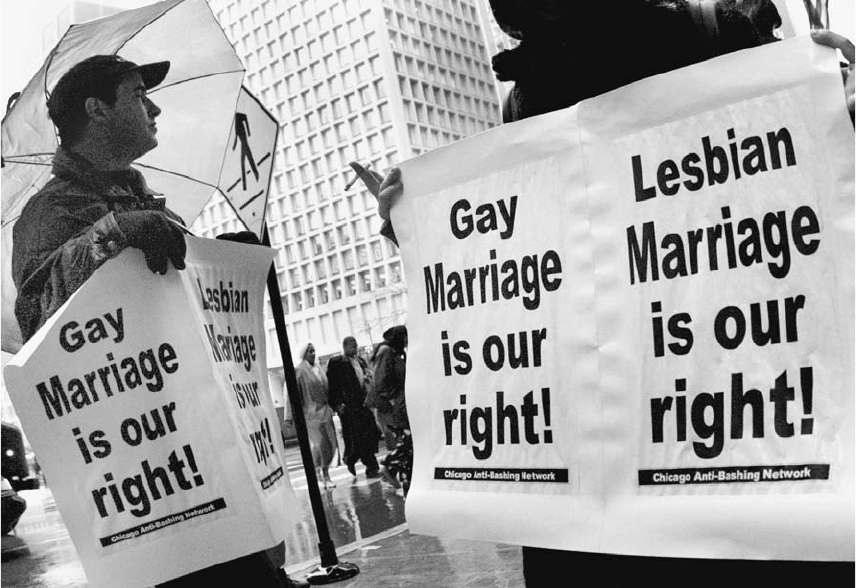
Gay protesters demonstrate outside Chicago’s City Hall to call attention to the issue of gay marriage. (Tim Boyle/
Getty Images)
gay and lesbian rights 311
xviii+446_EofUSConsti-v1.indd 311 3/12/09 3:05:15 PM