
Schultz D. Encyclopedia of the United States Constitution
Подождите немного. Документ загружается.

Many decades would pass before black citizens
fully regained this right. In 1915, the Supreme
Court struck down grandfather clauses (Guinn
v. United States, 238 U.S. 347). It struck down
“white primary” laws in 1944 (S
MITH V. ALLWRIGHT,
321 U.S. 649). Such laws allowed political parties
to exclude blacks from membership, which then
prevented them from voting in primary elections.
And in 1960, the Court ruled that states could not
gerrymander their legislative districts to minimize
black voting power (G
OMILLION ET AL. V. LIGHTFOOT,
M
AYOR OF TUSKEGEE, ET AL. 364 U.S. 339).
Congress took several small steps to enforce the
Fifteenth Amendment in the late 1950s and early
1960s, but massive civil rights demonstrations,
combined with the 1964 murder of white activ-
ists attempting to register black voters in Missis-
sippi, convinced it to pass a comprehensive law
guaranteeing black citizens the right to vote. The
1965 Voting Rights Act outlawed literacy tests and
other Jim Crow laws designed to prevent blacks
from voting and gave federal examiners the power
to monitor voting laws and register black citizens
to vote. Its effects were immediate: 250,000 south-
ern black voters registered to vote within a year.
For more information: Finkelman, Paul. Afri-
can Americans and the Right to Vote. New York:
Garland, 1992; Vallely, Richard M. The Two Recon-
structions: The Struggle for Black Enfranchise-
ment. Chicago: University of Chicago Press, 2004.
—Ellen Ann Andersen
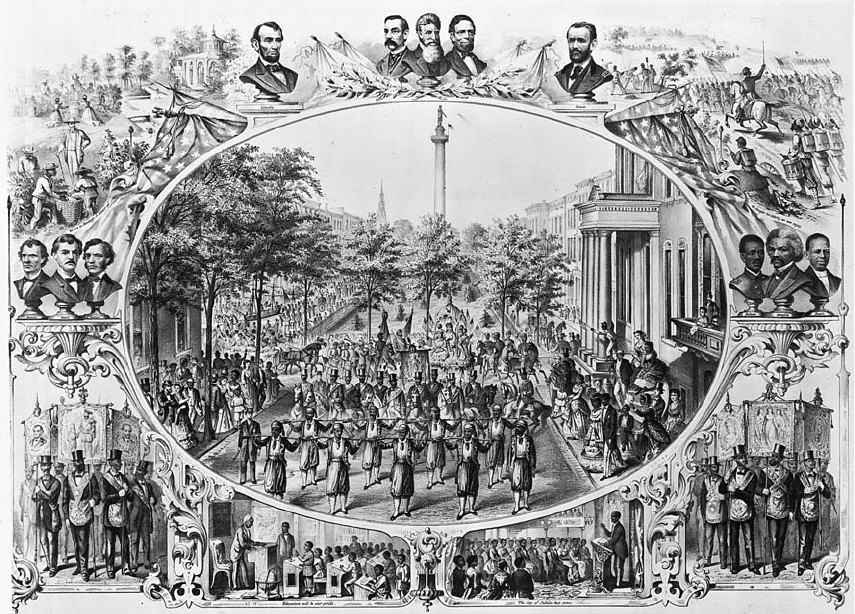
One of several commemorative prints marking the enactment on March 30, 1870, of the Fifteenth Amend-
ment and showing the parade celebrating it, which was held in Baltimore, Maryland, on May 19 of the same
year
(Library of Congress)
272 Fifteenth Amendment
xviii+446_EofUSConsti-v1.indd 272 3/12/09 3:05:03 PM
First Amendment (1791)
The First Amendment to the U.S. Constitution
prohibits Congress from interfering with the
expressive freedoms of individuals and persons
such as corporations, labor unions, and politi-
cal parties. It prohibits the government from
abridging or limiting freedom of speech, press,
assembly, religion, or the right to petition
the government. In addition, it also prohibits
the government from establishing religion. The
First Amendment is one of the original 10 Bill
of Rights that amended the Constitution in 1791
and was proposed by James Madison. While
originally this amendment did not apply to the
states, it has been incorporated via the due pro-
cess clause of the Fourteenth Amendment.
Now all of its clauses also restrict state and local
governments.
Many legal philosophers consider the First
Amendment to be the most important of all the
provisions of the Bill of Rights, yet there was sig-
nifi cant debate over whether it or any of the Bill of
Rights was necessary. Anti-Federalists criticized
the proposed new constitution of 1787 as giv-
ing too much power to the national government
and as defective because it lacked a bill of rights.
Alexander Hamilton, writing in Federalist 85,
said that no bill of rights was necessary because,
among other things, nothing in the proposed Con-
stitution gave the national government the power
to limit freedom of the press. Thus, a bill
of rights was unnecessary since it would seek to
limit a power Congress did not possess. Few were
impressed by this argument, and eventually Mad-
ison agreed to introduce a bill of rights in Con-
gress in 1787. When he did that, the rights that
eventually worked their way into the present First
Amendment were at the top of the list of items to
be addressed.
The First Amendment contains six restrictions:
The government cannot 1) establish a religion, 2)
prohibit the free exercise of religion, 3) abridge
freedom of speech, 4) abridge freedom of the
press, 5) abridge the right to peaceful assembly,
or 6) deny the right to petition the government.
Many of the prohibitions here directly relate
back to grievances the founders had against King
George III and which they described in the Dec-
laration of Independence.
Efforts to interpret the six prohibitions in the
First Amendment have resulted in literally thou-
sands of U.S. Supreme, lower federal, and state
court cases. At the core of these cases are ques-
tions about what exactly the First Amendment is
prohibiting. For example, What does it mean to
establish a religion? What is speech? What con-
stitutes a peaceful assembly? While some would
contend that a literal or formal reading of the
Constitution produces clear answers to these
questions, most are not persuaded. Instead, efforts
either to interpret what the framers intended or
to ascertain what the basic goals of the different
clauses or prohibitions are, or even efforts to apply
a 200-year-old document to new technologies such
as the World Wide Web and YouTube (which the
framers could not have foreseen), have resulted in
many questions about what the First Amendment
means.
The first two prohibitions of this amend-
ment address religion. When one reads the First
Amendment one notices that there are two dis-
tinct injunctions regarding religion, stating
that “Congress shall make no law respecting an
establishment of religion, or prohibiting the free
exercise thereof.” These two clauses, referring
to establishment of religion (establishment
clause) and free exercise (free exercise clause)
raise important questions in addition to the ones
noted above. Particularly, what is a religion? Do
religious beliefs include simply ideas or beliefs
about a god, or do they include particular prac-
tices, such as a religious service, animal sacrifi ce,
or baptisms? Does the idea of religion only refer
to a belief in a god, or could not other fi rmly held
beliefs be considered a form of religion? Is devil
worship a religion?
The free exercise and establishment clauses
independently serve different purposes but can
also be in confl ict. Generally, one can look at the
free exercise and establishment clauses separately,
but on occasion they can confl ict. For example,
in dissent in A
BINGTON TOWNSHIP V. SCHEMPP, 374
U.S. 203 (1963), Justice Potter Stewart indicated
a paradox:
First Amendment 273
xviii+446_EofUSConsti-v1.indd 273 3/12/09 3:05:03 PM
[T]he fact is that while in many contexts the
Establishment Clause and the Free Exercise
Clause fully complement each other, there
are areas in which a doctrinaire reading of the
Establishment Clause leads to irreconcilable
conflict with the Free Exercise Clause. A sin-
gle obvious example should suffi ce to make the
point. Spending federal funds to employ chap-
lains for the armed forces might be said to violate
the Establishment Clause. Yet a lonely soldier
stationed at some far-away outpost could surely
complain that a government which did not pro-
vide him the opportunity for pastoral guidance
was affi rmatively prohibiting the free exercise of
his religion. And such examples could readily be
multiplied.
As Justice Stewart noted, both the free exercise
and establishment clauses stipulate distinct con-
stitutional requirements, yet the diffi cult part is
defi ning what both of the clauses require and how
to sort out conflicts between them. Performing
both of these tasks is not the product of scientifi c
deduction but involves diffi cult political and social
choices that do not easily yield a correct answer.
In the 1940 case Cantwell v. Connecticut, 310
U.S. 296, the Supreme Court declared that the
free exercise of religion was a fundamental right
that could only be limited with a compelling state
interest. But what is religion, and what are reli-
gious beliefs? Do they include all beliefs and prac-
tices or only some? In United States v. Seeger, 380
U.S. 163 (1965), the Supreme Court attempted to
answer this question when it sought to determine
what type of beliefs constitute a religion, in this
case, granting one an exemption from military ser-
vice as a conscientious objector:
Does the term “Supreme Being” as used in s 6(j)
mean the orthodox God or the broader concept
of a power or being, or a faith, “to which all else
is subordinate or upon which all else is ultimately
dependent”? . . . Some believe in a purely per-
sonal God, some in a supernatural deity; others
think of religion as a way of life envisioning as
its ultimate goal the day when all men can live
together in perfect understanding and peace.
There are those who think of God as the depth
of our being; others, such as the Buddhists, strive
for a state of lasting rest through self-denial
and inner purification; in Hindu philosophy,
the Supreme Being is the transcendental real-
ity which is truth, knowledge and bliss . . . The
essence of religion is belief in a relation to God
involving duties superior to those arising from
any human relation.
In Seeger, the Court argued that religious belief
is some type of sincere commitment to a set of
principles. But could a set of philosophical beliefs
constitute a religious belief? In W
ISCONSIN V. YODER,
406 U.S. 205 (1972), a case involving the refusal of
the Amish to send their children to school beyond
eighth grade, the Court claimed no:
A way of life, however virtuous and admirable,
may not be interposed as a barrier to reason-
able state regulation of education if it is based
on purely secular considerations; to have the
protection of the Religion Clauses, the claims
must be rooted in religious belief. Although a
determination of what is a “religious” belief or
practice entitled to constitutional protection may
present a most delicate question, the very con-
cept of ordered liberty precludes allowing every
person to make his own standards on matters of
conduct in which society as a whole has impor-
tant interests.
Here, the Court seeks to distinguish secular or
philosophical beliefs from religious ones. But that
is not an easy task. What if one’s religious beliefs
are quite unorthodox, involving the belief that the
supreme being is some ultimate cosmic force that
created the universe in a big bang billions of years
ago. Is this a secular or spiritual belief? The com-
ments in Yoder seem to imply that society, and not
the individual, must at some point make a deter-
mination as to what is a religious belief.
Another question growing out of efforts to
defi ne religion involves identifying what features
or facets are important to religion. Besides iden-
tifying beliefs, most religions also have important
practices and traditions that are crucial to their
274 First Amendment
xviii+446_EofUSConsti-v1.indd 274 3/12/09 3:05:04 PM
faith. Many religions have communions, religious
services, prayers, or other practices that are per-
formed as part of a religious ceremony. May the
state or government regulate these practices, or
does the free exercise of religion give one a right to
do whatever one wants as long as it is part of a reli-
gious ceremony? Could one engage in polygamy?
Use of illegal drugs? Animal sacrifice? Human
sacrifi ce?
In United States v. Seeger, the Supreme Court
sought to determine how far free exercise pro-
tects religiously motivated behavior. The Court
stated that “[t]here are clear limits here, and reli-
gion must conform to secularized rules regarding
behavior. Thus, ‘belief’ can not be regulated, but
practices can.” Despite the fact that certain prac-
tices are very much linked to and defi ne a religion,
the courts have distinguished religious belief from
practice, claiming the former cannot be regulated
while the latter may.
In E
MPLOYMENT DIVISION V. SMITH, 494 U.S. 872
(1990), the Court again sought to defi ne the limits
of free exercise and government regulation. Here,
the majority of the Supreme Court held that it
was permissible to deny unemployment benefi ts
to individuals who had been fi red from their job
because they tested positive for the use of peyote
(a drug). The peyote was used during a Native
American religious ceremony that took place
outside work. Here again, the Court invoked the
belief versus practice distinction and also argued
that because the use of peyote was illegal it could
be banned in the interest of regulating the use of
drugs in society. Despite the fact that the Court
has argued in Cantwell and Barnette that free
exercise of religion is a fundamental right that
may not be subject to the “vicissitudes of political
controversy,” Justice Antonin Gregory Scalia
and a majority of the Court seem willing to permit
elections and majoritarian politics to determine
the scope of protection that free exercise of reli-
gion is entitled to.
In contrast to free exercise, the establishment
clause imposes a different duty on the govern-
ment: not to proscribe religion or religious beliefs.
The question arises, What does it mean to estab-
lish a religion? Is it adopting an offi cial national
religion? Does it mean no reference to religion or
God at all, including Christmas, Easter, or Hanuk-
kah displays? Does it ban prayer in public school,
including silent prayer? These are all good ques-
tions, and it is not easy to decide what the estab-
lishment clause means.
To understand this clause, legal scholars and
judges often adopt either a “high wall” or “accom-
modationist” stance. The high-wall position can
trace its roots to a January 1, 1802, speech by
Thomas Jefferson in which he argued that the
establishment clause meant the building of a “wall
of separation between Church and State.” The
reason for the wall is both to prevent churches
from using the government to oppress others and
to prevent the state from regulating or interfering
with any religion. Conversely, the accommoda-
tionist position reminds us that we are a religious
nation with a long history of church and state
interaction. This interaction occurs in the form
of public proclamations, Thanksgiving, and in
respecting the free exercise of individuals to prac-
tice their religions. For the accommodationist,
maintaining a high wall of separation might move
the state beyond simply being neutral toward reli-
gion and instead actually oppressing religious lib-
erty. Determining which of these understandings
of the establishment clause is correct is diffi cult,
and the Supreme Court itself has often changed
its mind and adopted conflicting views of what
this clause prohibits.
The Supreme Court has sought to create a rule
to determine when the establishment clause has
been violated. The Supreme Court formulated this
rule in L
EMON V. KURTZMAN, 403 U.S. 602 (1971). In
this case, Rhode Island and Pennsylvania sought
to expend state funds either to reimburse private
schools for the cost of teachers’ salaries, textbooks,
and instructional materials in secular materials or
to supplement directly these teacher’s salaries.
The Court answered no in both cases. This case
sets down a three-part test to clarify the establish-
ment question:
Every analysis in this area must begin with con-
sideration of the cumulative criteria developed
by the Court over many years. Three such tests
First Amendment 275
xviii+446_EofUSConsti-v1.indd 275 3/12/09 3:05:04 PM
may be gleaned from our cases. First, the statute
must have a secular legislative purpose; second,
its principal or primary effect must be one that
neither advances nor inhibits religion, fi nally, the
statute must not foster “an excessive government
entanglement with religion.”
The Lemon test, as this three-part test has
come to be known, requires a statute to satisfy all
three prongs of the test before it will be upheld
and deemed not a violation of the establishment
clause. Thus, a statute must have a secular pur-
pose, neither advance nor inhibit religion, nor
foster excessive entanglements with religion.
While the Lemon test may sound simple, since
its formulation in 1971, the debate to determine
the meaning of the establishment clause has
continued.
While the Lemon test has recently been used to
help clarify establishment clause violations, many
cases in the 1950s and 1960s were important in
formulating the current law on the establishment
clause. In these cases, the Supreme Court struck
down either Bible readings, posting of the Ten
Commandments, or recitation of a teacher-led
prayer to start the public school day. For example,
in E
NGEL V. VITALE, 370 U.S. 421 (1962), the issue
was whether the New Hyde Board of Education
could, upon the recommendation of the New
York State Board of Regents, begin each public
school day by having a “nonsectarian” prayer read
in class? Additionally, in Abington v. Schempp,
the question was whether the state of Pennsylva-
nia may require 10 verses of the Bible to be read
at the start of every school day and allow any
child who objected to be exempt from the reading
upon written parental request? In both cases, the
Court reached the same conclusion, that these
activities were clearly violations of the establish-
ment clause.
The particular concern of permitting prayer
in school involves the question of coercion. Spe-
cifi cally, even though many of the programs for
prayer allowed students not to participate, some
on the Court felt that it would be very hard for
children to go against their teacher or peers and
not pray. In effect, they would feel forced to pray
or take part in religious activities that they might
not support.
When decided, Engel v. Vitale and these other
cases were quite controversial, and they remain so
today. Many people view these decisions as “tak-
ing God out of the schools,” as hostility to religion,
or as the cause of the undermining of school dis-
cipline or the loss of morality in society. Hence,
there remains signifi cant demand in some school
districts to reinstate prayer or some type of reli-
gious education into public schools. Two contro-
versial decisions worth noting are W
ALLACE V.
JAFFREE, 472 U.S. 38 (1985), and LEE V. WEISMAN,
505 U.S. 577 (1992). In both cases, not only was
the Court asked to revisit its earlier decisions on
school prayer, but it was also asked to rethink
the Lemon test.
At issue in the fi rst case was an Alabama law
that started each day with a one-minute moment
of silence. This moment could be used for prayer,
silent meditation, or whatever the students pre-
ferred. For some, this moment of silence lacked the
coerciveness of a read prayer that required active
participation. During this meditation minute, no
one would know if one was praying or doing some-
thing else. Despite this claim, a divided Supreme
Court struck down the prayer. Important to the
reasoning of the majority was reference to the
records of the Alabama legislature indicating that
the sponsor of this law authorizing the moment of
silence saw this bill as a fi rst step toward returning
prayer to public schools.
In citing this legislative intent and history, the
Court argued that the law failed the Lemon test.
First, the law clearly was not secular in its intent
but had a religious purpose. Second, the law was
not neutral and instead its aim was to support
religion.
Conversely, Justice William Hubbs
Rehnquist in dissent saw this silent moment
as lacking the coerciveness of the prayers struck
down in Engel v. Vitale. Rehnquist also used the
occasion to argue that past establishment clause
rulings were erratic, that the application of the
Lemon test was inconsistent, and that many of
these rulings supported some type of state-church
interaction in the schools.
276 First Amendment
xviii+446_EofUSConsti-v1.indd 276 3/12/09 3:05:04 PM
In Lee v. Weisman, the issue was the deliv-
ery of a state-written nondenominational prayer
at public junior and high school graduation cer-
emonies. More specifically, a rabbi opened up
the ceremony with an invocation that referred to
God. There was also a benediction delivered by
the rabbi that referred to God. This case tested
the applicability of school prayer cases to school
activities that take place outside of the normal
school day. Moreover, given what appeared to be
a more conservative Court that seemed sympa-
thetic to religion, there was hope that a majority
of the justices would seek to change or abandon
the Lemon test.
However, the Court struck down the prayer,
although the justices were badly divided. Justice
Anthony M. Kennedy, who had previously crit-
icized the Lemon test, wrote for the majority and
argued that students really were not free to excuse
themselves from their graduation ceremony and
that they were in fact being forced to listen to
the prayer. Additionally, the fact that the school
had helped compose the prayer was also upset-
ting to him and the majority. He noted that this
type of state composition of a religious message is
what the establishment clause was meant to ban.
Finally, Justice Kennedy rejected a rethinking of
the Lemon test, stating that there was no need to
review it at this time.
In dissent, four justices argued that the bene-
diction and invocation were part of a long-stand-
ing practice in American history and that they had
in many ways lost their religious nature. Instead,
they were part of the rites of passage for gradua-
tion. Moreover, Justices Scalia, Rehnquist, Byron
White, and Clarence Thomas argued that the
Lemon test had problems and that it needed to be
rethought or rejected.
Both Wallace and Lee appear to indicate that
almost all types of prayer are banned from school.
However, with a divided Court, a change in a few
justices might change some things. Moreover,
these opinions do not indicate whether at bacca-
laureate ceremonies prayers are unconstitutional.
Would student-composed and -recited prayers at
graduation be permitted? Would prayers by play-
ers before a football game be unconstitutional?
Perhaps yes, but where is the element of coer-
cion here? Are students really required to play
football, attend sporting events, or assist in writ-
ing a prayer? Additionally, the Court in Marsh v.
Chambers, 463 U.S. 783 (1983), itself has upheld
prayer before the start of Congress each day and
has ruled that this was not coercive and unconsti-
tutional. What is the difference between allowing
that prayer and what might be a moment of silence
during graduation or before a sports event?
Another area of concern for the establishment
clause is with public display of holiday or reli-
gious symbols. In L
YNCH V. DONNELLY, 465 U.S.
668 (1984), the question was whether the city of
Pawtucket, Rhode Island, in cooperation with
its downtown merchants, could erect a Christ-
mas display in a privately owned park adjacent
to City Hall when that display included, among
other things, a Santa Claus and a crèche or Nativ-
ity scene that was owned by the city. Writing for
a majority of the Court, Chief Justice Warren
E. Burger held that this display was permissible
and that it was not a violation of the establish-
ment clause. Burger rejected the high wall theory
of the establishment clause and argued instead
that there was a long history of governmental
accommodation with religion in America. After
indicating that neither U.S. history nor the intent
of the Founding Fathers seemed hostile to some
church-state interaction, Burger proceeded to use
the Lemon test to indicate that the establishment
clause would not preclude the type of display
found in Pawtucket.
In applying the three-part Lemon test, Chief
Justice Burger failed to fi nd an excessive entangle-
ment. He observed that the cost of the crèche and
its maintenance were small and that the crèche
was displayed next to other items, such as rein-
deer, which were not religious but more symbolic
of the secular holiday mood of goodwill and cheer.
Because of this context of several different sym-
bols, Burger concluded for the Court: “We are
satisfi ed that the City has a secular purpose for
including the crèche, that the City has not imper-
missibly advanced religion, and that including the
crèche does not create excessive entanglement
between religion and government.”
First Amendment 277
xviii+446_EofUSConsti-v1.indd 277 3/12/09 3:05:04 PM
In dissent, Justice William J. Brennan, Jr.,
and the minority argued that in fact an exces-
sive entanglement had occurred and that both
the fi rst and third prongs of the Lemon test had
been violated. Brennan’s argument was that while
perhaps up to this point there was no excessive
entanglement between Pawtucket or other cit-
ies and churches, this decision would potentially
lead to confl icts in the future. This is exactly what
happened in Pittsburgh, Pennsylvania, a few years
later in Allegheny v. ACLU, 492 U.S. 573 (1989).
The city of Pittsburgh sought to erect a Christ-
mas crèche on the grand staircase of the Allegh-
eny County courthouse and place a menorah
outside the city-county building, next to a Christ-
mas tree and a sign saluting Lady Liberty. Four
justices, Kennedy, White, Rehnquist, and John
Paul Stevens would have upheld both displays
as constitutional; three justices, Thurgood Mar-
shall, Stevens, and Brennan, would have struck
down both; Justices Sandra Day O’Connor and
Harry A. Blackmun struck down the fi rst display
but permitted the menorah. The result was that
the display of the crèche, even though it was next
to other displays including a Santa Claus, was
found to violate the establishment clause because
it was a state endorsement of religion. However,
the display of the menorah was found to be con-
stitutional because, for the Court, the “menorah’s
message is not exclusively religious. The menorah
is the primary visual symbol for a holiday that, like
Christmas, has both religious and secular dimen-
sions.” Hence, while the crèche in Pawtucket was
not religious, in Pittsburgh it was, despite the fact
that the display of the menorah was not. In reach-
ing all three of these holdings, the Court sought
to use the same Lemon test to interpret the same
establishment clause. Despite what would appear
to be an easy task, nine justices could not agree on
the correct result dictated by past rulings and the
Constitution, and it is not easy to determine who,
if any, of the justices was correct.
A fi nal establishment clause issue occurs where
particular religious views might endorse a specifi c
set of laws or public policies. For example, reli-
gious views on the sabbath were once infl uential
in the passage of “blue laws.” Blue laws prevented
certain types of businesses from being open on
Sunday. In two cases, Gallagher v. Crown Kosher
Super Market, 366 U.S. 616 (1961), and Braunfeld
v. Brown, 366 U.S. 599 (1961), Orthodox Jewish
merchants objected to these laws. The basis of
their objection was that since they were already
closed on Saturday, the Jewish sabbath, the Sun-
day closing law forced them to close an additional
day, and it hurt their businesses. The Supreme
Court rejected their claims, indicating that there
was an independent secular rule for the Sunday
closings despite the religious origin of these laws
and the impact they had on Orthodox Jews.
The prohibition on the abridgment of free
speech raises the most questions. For example,
does it prevent the government from passing any
laws regulating or prohibiting speech? A literal or
absolutist reading of the text of the First Amend-
ment would seem to suggest that. However, there
are numerous exceptions the courts have made to
this. On one level, criminal laws making extortion
or blackmail illegal regulate speech but nonethe-
less have been upheld because they are not the
kind of speech the First Amendment was meant
to protect.
There are competing philosophies regarding
what the free speech clause is supposed to protect.
One school of thought, as articulated by Alexander
Meiklejohn, argues that the First Amendment’s
core purpose is to protect the political speech
of individuals. Steve Shiffrin believes that it is to
protect the right to criticize, while Thomas Emer-
son sees its purpose as to promote self-expression.
Lee Bollinger argues that the First Amendment
seeks to help promote toleration. These competing
perspectives on the free speech clause are more
than academic; they affect what types of speech or
communications will receive protection. In effect,
they will decide what counts as speech for the
purposes of the First Amendment.
Over time, the Supreme Court has examined
numerous types of communication and found
them to be speech. These include flag burning
(T
EXAS V. JOHNSON, 491 U.S. 397 [1987]), cross
burning (R.A.V. V. ST. PAUL, 505 U.S. 377 [1992]),
the use of offensive language in a court (C
OHEN
V. CALIFORNIA, 283 U.S. 359 [1971]), and sexually
278 First Amendment
xviii+446_EofUSConsti-v1.indd 278 3/12/09 3:05:05 PM
explicit materials (MILLER V. CALIFORNIA, 413 U.S.
15 [1973]). Conversely, the Court has stated that
libel is not speech (N
EW YORK TIMES V. SULLIVAN,
376 U.S. 254 [1964]) and that obscene materials
(Miller v. California) are also exempt from First
Amendment protection. There is then a category
of communications that may be speech but none-
theless either entitled to some or very little First
Amendment protection. For example, nude but
nonobscene dancing is expressive, but it does not
receive much constitutional protection (Barnes v.
Glen Theatre, 501 U.S. 560 [1991]), and money is
not speech, but it may receive some First Amend-
ment protections in the context of political contri-
butions and expenditures (B
UCKLEY V. VALEO, 424
U.S. 1 [1976]).
The test for when something is or is not pro-
tected by the First Amendment has evolved over
time. Initially, William Blackstone in his book
Commentaries on the Laws of England, which
was infl uential in early American law, argued that
seditious libel (criticism of the government)
was the goal of free speech. The 1735 New York
acquittal of publisher Peter Zenger in colonial
America on charges of seditious libel against the
British government reaffi rmed this notion of what
free speech protected.
Modern notions regarding the scope of the
protections of the First Amendment free speech
clause begin in S
CHENCK V. UNITED STATES, 249
U.S. 47 (1919). Here, in upholding the conviction
of two individuals accused of violating the 1917
Espionage Act during World War I by seeking
to disrupt military recruitment, Justice Oliver
Wendell Holmes, Jr., stated that speech was
no longer protected under the First Amendment
when it posed a “clear and present danger” that it
would bring about the evils Congress intended to
prevent.
In Masses Publishing Co. v. Patten, 244 Fed.
535 (D.NY) (1917), Judge Learned Hand adopted
the “incitement” test to decide on the scope of
free speech, arguing that if the speech stops just
short of inciting or urging others to break the law,
it is protected under the First Amendment. The
incitement and clear and present danger
tests became encapsulated into the “imminent
lawless” test in B
RANDENBURG V. OHIO, 395 U.S 444
(1969), when the Court stated that speech is pro-
tected until such time as it advocates imminent
lawlessness or violence that is actually imminent.
In effect, mere advocacy of ideas or beliefs is pro-
tected by the First Amendment, regardless, it
appears, of what those ideas advocate.
Another issue affecting interpretations of the
free speech clause is whom and what it protects.
Historically, the First Amendment only protected
individual speech. However, the Supreme Court
has also extended free speech protections to, for
example, corporations, labor unions, and political
parties, in some cases ruling that commercial
speech or advertising is entitled to some First
Amendment protection. Finally, in interpreting
the First Amendment, the Supreme Court has
had to address issues of how to regulate speech
on public property, when it involves government
employees, when speech and nonspeech activity
are intertwined, and in the context of new tech-
nologies such as the World Wide Web and the
Internet. In all these areas, complex rules have
been fashioned to interpret what the First Amend-
ment prohibits.
Freedom of the press is a fourth protection
found in the First Amendment. The trial of Peter
Zenger seemed to establish a broad right to use the
press to criticize the government. In fact, during
the Revolutionary War, pamphlets and the presses
were routinely used to criticize the British, and
the battle over ratifi cation of the 1787 Constitu-
tion was fought in part in the newspapers. Three
cases defi ne the current framework for freedom of
press under the First Amendment. In N
EAR V. MIN-
NESOTA, 283 U.S. 697 (1931), the Supreme Court
struck down as unconstitutional a Minnesota law
that made it illegal to publish “obscene, lewd, and
lascivious” or “malicious” materials. The law gave a
judge the power to shut down a paper that violated
or attempted to violate this law. The Court ruled
that this law constituted prior restraint, which was
prohibited under the First Amendment.
In New York Times v. Sullivan, the Court
voided an Alabama law and verdict that found
a newspaper had committed libel in publish-
ing material that contained some inaccuracies in
First Amendment 279
xviii+446_EofUSConsti-v1.indd 279 3/12/09 3:05:05 PM
its criticism of a public offi cial. The Court ruled
that unless one demonstrated actual malice, the
criticism of a public offi cial would not be found
to be libelous. New York Times was heralded as
a monumental defense of freedom of press, vin-
dicating constitutionally what the trial of Zenger
had begun. Finally, in New York Times v. United
States, 403 U.S. 713 (1971), the Supreme Court
upheld the decision of a paper to publish the Pen-
tagon Papers, classified information critical of
the United States’s involvement in Vietnam. As in
Near, the Court ruled against censorship.
Freedom of the press addresses other issues,
too. For example, are reporters required to
divulge sources in their stories when subpoenaed?
In Branzburg v. Hayes, 408 U.S. 665 (1972), the
Supreme Court rejected claims that the First
Amendment contained a shield law protecting
reporters. However, many states do have shield
laws, and the federal government has debated
enacting one. In addition, the First Amendment
seems to treat print, radio, television, and the
Internet differently. Because the public owns the
television and radio airwaves, the Court has been
more willing to allow some regulation of speech,
especially to prevent minors from viewing sexually
explicit materials, in particular during prime and
day time and on the major networks. Different
rules have been allowed for cable. However, the
Court has given more protection for print materi-
als, and increasingly it seems to be rejecting con-
tent regulation on the Internet.
The right to a peaceful assembly is a fi fth pro-
tection found in the First Amendment. In NAACP
v. Alabama, 357 U.S. 449 (1959), a unanimous
Supreme Court ruled that Alabama’s request of a
civil rights group to make its membership list
public infringed on its right of freedom of asso-
ciation. In Roberts v. United States Jaycees, 468
U.S. 609 (1984), the Court rejected freedom of
association claims on the part of the Jaycees to
refuse to admit women to their organization as
members. However, in B
OY SCOUTS V. DALE, 530
U.S. 640 (2000), and in H
URLEY V. IRISH-AMERICAN
GAY, LESBIAN & BISEXUAL GROUP OF BOSTON, 515
U.S. 557 (1995), the Court upheld exclusion of
homosexuals from membership in the Boy Scouts
or from marching in a St. Patrick’s Day parade.
In both cases, the Court ruled that freedom of
association also entailed the right not to associate
with others. In other contexts, the right of free-
dom of association has been invoked by political
parties to restrict who can participate in their
primaries.
Finally, the right to petition the government
is often ignored in litigation and has often been
examined under the right of assembly and asso-
ciation decisions as in B
UCKLEY V. AMERICAN CON-
STITUTIONAL LAW FOUNDATION, 525 U.S. 182 (1999),
where the Court struck down some requirements
a state had imposed on individuals hired to gather
signatures for ballot propositions. The right to
petition the government also includes the right of
individuals and groups to hire lobbyists to advo-
cate on their behalf.
Overall, the First Amendment contains numer-
ous protections for expressive freedoms that are
critical both to self-identity and to the functioning
of a democracy. The amendment touches issues
ranging from music and art censorship to prayer
in school and political demonstrations. Given this
breadth, it is not surprising that there are perhaps
more controversy and litigation surrounding it
than any other amendment.
For more information: Bollinger, Lee C. The
Tolerant Society: Freedom of Speech and Extrem-
ist Speech in America. New York: Oxford Univer-
sity Press, 1986; Emerson, Thomas I. Toward a
General Theory of the First Amendment. New
York: Random House, 1966; Harry Kalven, Jr. A
Worthy Tradition: Freedom of Speech in Amer-
ica. New York: Harper & Row, 1988; Meiklejohn,
Alexander. Free Speech and its Relation to Self-
Government. New York: Harper & Row, 1948;
Shiffrin, Steven. The First Amendment, Democ-
racy, and Romance. Cambridge, Mass.: Harvard
University Press, 1990.
—David Schultz
fl ag burning amendment
The fl ag burning amendment refers to efforts to
overturn a Supreme Court decision that made
280 fl ag burning amendment
xviii+446_EofUSConsti-v1.indd 280 3/12/09 3:05:05 PM
the act of burning the American fl ag a protected
First Amendment expression.
In June 1989, the U.S. Supreme Court issued
a controversial decision in the case T
EXAS V. JOHN-
SON, 491 U.S. 397. In that decision, it held a man
convicted under a Texas law for burning an Amer-
ican fl ag at the 1984 Republican Convention was
engaged in protected speech and reversed his con-
viction. The decision set off a fi restorm of protest
from many quarters and led several groups and
politicians to call for an amendment to the Consti-
tution to protect the fl ag from desecration.
Immediately after the decision was handed
down by the Supreme Court, individuals began
to call for a constitutional amendment to protect
the fl ag. Senator George Mitchell said: “I do not
believe that Americans have to see the fl ag, that
symbolizes their freedom to speak, devalued and
cheapened in the cause of preserving that free-
dom.” On June 20, 1989, President George H. W.
Bush also called for a constitutional amendment
to protect the fl ag, stating, “But before we accept
dishonor to our fl ag, we must ask ourselves how
many have died, following the order to ‘Save the
Colors!’ ”
The House of Representatives held hear-
ings on the fl ag amendment in July. During the
hearings, the committee heard from veterans
on both sides of the question. Pro-amendment
speakers emphasized the patriotic appeal of the
fl ag as a symbol of national pride and honor. Anti-
amendment speakers emphasized the flag as a
symbol of freedom and argued that the amend-
ment would undermine constitutional guarantees
of freedom of speech.
In September 1989, the Senate subcommit-
tee voted to recommend a statute protecting the
flag but rejected a constitutional amendment.
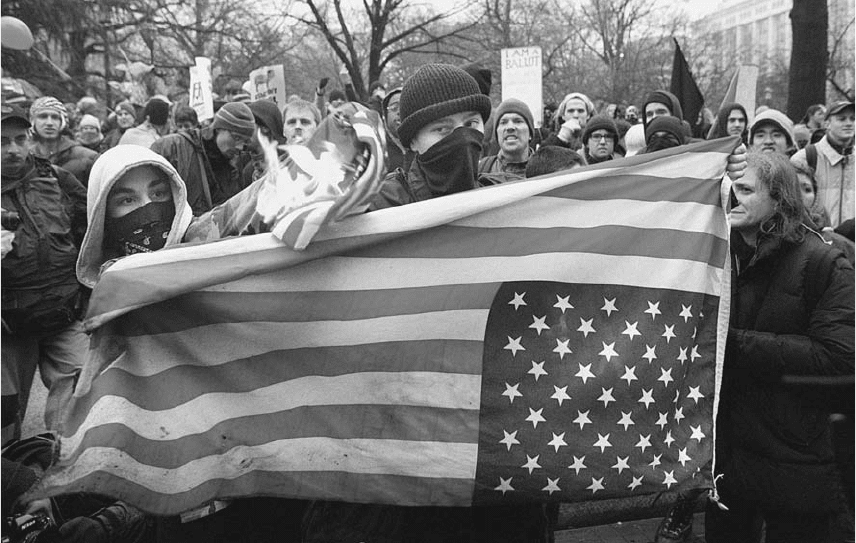
Protesters burn an American fl ag in Washington, D.C., at the inauguration of President George W. Bush.
(Levine/Getty Images)
fl ag burning amendment 281
xviii+446_EofUSConsti-v1.indd 281 3/12/09 3:05:05 PM