
Schultz D. Encyclopedia of the United States Constitution
Подождите немного. Документ загружается.

the admissions policy was not narrowly tailored
but was a veiled attempt to achieve racial bal-
ancing. He concluded that, since the numbers
of admissions of various minorities differed from
one another and were close to the proportion of
minorities in the applicant pool, they must have
been based on race and ethnicity rather than upon
some notion of critical mass.
In a companion case, G
RATZ V. BOLLINGER,
involving the undergraduate College of Literature,
Science, and the Arts, a 6-3 Court invalidated an
admissions procedure that automatically gave a
20-point bonus out of a 100-point total to each
African-American, Hispanic, and Native-Ameri-
can applicant. Chief Justice Rehnquist, who wrote
for the majority, called the policy a functional
equivalent of a quota and said it offended Bakke,
since it was not narrowly tailored to achieve a
compelling interest.
For more information: Devins, Neal. “Explain-
ing Grutter v. Bollinger.” University of Pennsyl-
vania Law Review 152, no. 1 (2003): 347–383;
Guinier, Lani. “Admissions Rituals as Political
Acts: Guardians at the Gates of Our Democratic
Ideals.” Harvard Law Review 117, no. 1 (2003):
113–225.
—JeDon Emenhiser
guarantee clause (U.S. Constitution Article
IV, Section 4)
The Constitution’s guarantee clause directs the
federal government to “guarantee to every State in
this Union a Republican Form of Government”—
not a government run by a particular political
party, but a government run by representatives of
the people.
The clause represents an important allocation
of power within the federal structure, but the
text neither defi nes a “republican” form of gov-
ernment nor clarifi es what federal offi cials should
do to effect the guarantee. It was designed in part
to reassure states that the new national govern-
ment would commit to protect each state against
attempts to topple its government. Various com-
mentators have since suggested that, absent this
sort of insurrection, the clause should be inter-
preted to protect or forbid different ways in which
representatives are elected, representative power
is apportioned, or the legislative process is car-
ried out.
There is, however, no defi nitive interpretation
of the scope of the guarantee clause, because the
judicial branch—the usual final arbiter of legal
meaning—has largely tied its own hands. In the
last 150 years, the Supreme Court has generally
said that Congress and the president, not the
courts, should decide whether a particular prac-
tice violates the guarantee. In other words, the
Supreme Court has usually said that the rights
granted by the clause are “nonjusticiable.”
This approach began with L
UTHER V. BORDEN,
48 U.S. (7 How.) 1 (1849). By 1841, Rhode Island
was the only state where real estate ownership was
still required to vote. With support from some of
the state’s propertied voters, disenfranchised and
disaffected citizens established their own constitu-
tion and government; the dispute then turned vio-
lent, in what became known as Dorr’s Rebellion.
A state offi cial named Borden arrested one of the
rebelling citizens, named Luther, and allegedly
damaged his property. When Luther sued, the
dispute turned in part on which government was
legitimate. The Supreme Court refused to decide
the question, saying that under the guarantee
clause, Congress alone—and not the courts—had
the right to choose between two ostensibly legiti-
mate governments.
Over the next century, this line of reasoning
expanded: the political branches alone had the
right to decide whether the guarantee of a repub-
lican government prohibited a state from legislat-
ing by popular initiative (Pacifi c States Telephone
& Telegraph Co. v. Oregon, 223 U.S. 118 [1912]);
prohibited a legislature from delegating decisions
to a probate judge (Ohio ex rel. Bryant v. Akron
Metropolitan Park Dist., 281 U.S. 74 [1930]); or
prohibited the federal government from demand-
ing that states seek federal approval for certain
legislation (City of Rome v. United States, 446
U.S. 156 [1980]).
The Supreme Court’s refusal to decide cases
under the guarantee clause was not absolute. On
332 guarantee clause
xviii+446_EofUSConsti-v1.indd 332 3/12/09 3:05:22 PM
occasion, it has decided that certain practices
do not unduly detract from a state’s republican
governmental structure. A state still maintains
its republican form of government, for example,
when a state court and not the legislature changes
municipal boundaries (Forsyth v. Hammond, 166
U.S. 506 [1897]); when a state commission and not
the legislature regulates milk prices, (Highland
Farms Dairy v. Agnew, 300 U.S. 608 [1937]); and
when a federal statute provides monetary incen-
tives for states to act in certain ways (New York v.
United States, 505 U.S. 144 [1992]).
Thus, when rights under the guarantee clause
are asserted, courts sometimes decide not to
decide, and sometimes they decide that the prac-
tice in question does not deprive the state of a
republican form of government. Very few courts to
date have decided that a particular policy offends
the guarantee clause and must be overturned.
Congress has also exercised that power only
in the rarest of cases. After the Civil War, for
example, Congress agreed to admit or readmit
states into the Union only as they agreed to extend
the franchise to African Americans. In several of
these instances, Congress declared explicitly that
its power to exact these conditions arose under
the guarantee clause. As Senator Charles Sumner
recognized, this exceedingly rare but exceedingly
powerful exercise of authority rendered the clause
a “sleeping giant.”
Since the 1860s, with few exceptions, neither
Congress nor the courts have done much to artic-
ulate the contours of the rights guaranteed by
the guarantee clause. Yet this does not mean that
the clause is entirely a dead letter. In 1992, the
Supreme Court signaled that a case might one day
again present claims under the guarantee clause
that federal courts are competent to resolve.
Until then, the clause will likely remain patiently
“sleeping.”
For more information: Ely, John Hart. Democ-
racy and Distrust: A Theory of Judicial Review.
Cambridge, Mass.: Harvard University Press,
1980; Merritt, Deborah Jones. “The Guarantee
Clause and State Autonomy: Federalism for a
Third Century.” Columbia Law Review 88 (1988):
1–78; Wiecek, William. The Guarantee Clause of
the U.S. Constitution. Ithaca, N.Y.: Cornell Uni-
versity Press, 1972.
—Justin Levitt
gun control
See right to bear arms; PRINTZ V. UNITED STATES;
UNITED STATES V. LOPEZ
gun control 333
xviii+446_EofUSConsti-v1.indd 333 3/12/09 3:05:23 PM
334
ﱶﱷﱸ
habeas corpus
Habeas corpus is a legal proceeding in which a
prisoner asks a court to evaluate the legality of his
or her detention. After the prisoner fi les a petition
with the court, the court orders the governmen-
tal offi cial with custody of the prisoner to appear
in court, with the prisoner, and explain the legal
justifi cation for the detention. If the court deter-
mines that the detention is unlawful, the court
has the authority to order the prisoner immedi-
ately released. For this reason, the writ of habeas
corpus, often referred to as the “Great Writ,” has
always been considered an important means for
protecting personal freedom from unlawful and
arbitrary government action. The overriding pur-
pose of habeas corpus is to keep the executive
departments of government accountable to the
judiciary.
The term habeas corpus comes from the
Latin phrase habeas corpus ad subjiciendum,
which means have the body to submit to the
authority of the court. The writ of habeas cor-
pus originated in the common law and traces its
roots to the Habeas Corpus Act of 1679 enacted
by the British Parliament. It was later included
in the Constitution of the United States. Article
1, Section 9 states: “The Privilege of the Writ of
Habeas Corpus shall not be suspended, unless
when in Cases of Rebellion or Invasion the public
Safety may require it.”
Originally, habeas corpus was a procedure
for the federal judiciary to evaluate the legality
of the federal government’s authority as a purely
jurisdictional matter. In other words, it was a pro-
ceeding in which the courts sought to answer the
question of whether the prisoner’s detention was
a legitimate exercise of the federal government’s
authority. In those cases, the government offi-
cial could justify the legality of the detention of
a prisoner by showing the court documents, such
as a warrant or a judgment of conviction, which
ordered the official to imprison the individual.
Over the years, however, both the availability of
the Great Writ and the nature of claims that could
be considered have been expanded signifi cantly.
First, in 1867, the U.S. Congress enacted a habeas
corpus statute that extended the writ to include
consideration of whether a state prisoner’s deten-
tion violated of any of the rights protected by the
U.S. Constitution. Then, following the ratifi cation
of the Fourteenth Amendment as the Bill
of Rights was applied to the states, the types of
claims that could be asserted against state offi cials
as constitutional violations grew substantially.
By the 1970s, habeas corpus was viewed as a
means for asserting any provision of the national
constitution as a challenge to the legality of any
detention imposed by any government. This
included challenges to incarceration following a
criminal conviction, detention immediately fol-
lowing arrest, and commitment to a mental insti-
tution. It also included challenges to the nature of
the detention.
However, it was most often used by state
inmates as a means of post-conviction review of
their criminal convictions in state court under the
U.S. Constitution in federal court. The expansion
of the procedure to include allegations of constitu-
tional violations that occurred at trial led to com-
prehensive review of state court criminal trials
in the federal courts. Most notably, state inmates
were afforded a forum to allege that they were
denied the right to counsel under the Sixth
Amendment. Such claims constitute the bulk of
H
xviii+446_EofUSConsti-v1.indd 334 3/12/09 3:05:23 PM
the claims reviewed by federal courts in habeas
corpus proceedings.
Eventually, the broad review exercised by the
federal courts became the subject of great con-
troversy. The federal courts increasingly disliked
the remarkable increase in their caseloads caused
by habeas corpus petitions fi led by state inmates.
Meanwhile, the general public began to criticize
the federal courts because of the delays caused by
habeas corpus litigation and what seemed to be
unending abuse of the justice system by inmates.
The courts responded by placing limits on the fi l-
ing of habeas corpus petitions and the claims that
could be raised, including: the requirement that
claims first be raised at every level of the state
courts; the preclusion of claims seeking retroac-
tive application of new rules of constitutional law;
the application of a lower standard of the harm-
less error doctrine; and an absolute preclu-
sion of claims under the Fourth Amendment’s
search and seizure clause.
The public backlash against habeas corpus
review in federal courts led to the enactment of
the Anti-Terrorism and Effective Death Penalty
Act of 1996 (AEDPA). This statute created new
prerequisites for habeas corpus review, codifi ed
some of the judicially created limitations, and
created special procedures for death penalty
cases. Notably, the AEDPA imposed a one-year
time period for seeking habeas corpus review,
required all state court procedures to be pursued
before seeking habeas corpus review, and prohib-
ited the fi ling of multiple petitions. More impor-
tantly, the AEDPA imposed a requirement that
federal courts defer to the judgment of the state
courts unless that judgment was unreasonable
and placed a substantial limitation on a prisoner’s
right to an evidentiary hearing in federal court.
The unreasonableness standard and the prohibi-
tion of hearings substantially limited the avail-
ability of habeas corpus relief for state prisoners.
Nevertheless, habeas corpus remains a very
important remedy for state prisoners. It is gener-
ally referred to as the third tier of review because
it follows the two tiers of review available in most
state court systems: trial and direct appeal, and
post-conviction review. In that context, the writ of
habeas corpus remains an important safeguard of
individual liberty. It provides a forum in federal
court through which violations of rights protected
by the U.S. Constitution may be corrected in cases
in which the state courts fail to do so.
The controversy surrounding the availability of
the writ and the nature of claims that can be raised
continues. The question is whether a state prisoner
may pursue a claim of innocence as part of a federal
habeas corpus proceeding. In the past, claims of
innocence have been precluded from habeas cor-
pus review because the determination of guilt has
been considered a factual question reserved for the
jury to resolve, rather than a legal question to be
resolved in federal court. State and federal courts
have long recognized that, under the U.S. Consti-
tution, an accused person is entitled to a fair trial,
not a perfect trial. Thus, there has been an implicit
recognition that even the procedural protections
afforded to an accused in the criminal justice sys-
tem may not preclude the accused from being con-
victed of a crime he or she did not commit.
However, if the accused received a fundamen-
tally fair trial, the Constitution will not have been
violated. Moreover, the procedural rules applied
to habeas corpus petitions have precluded claims
of innocence except as a means of setting aside the
procedural limitations to federal review. But as
DNA evidence becomes more sophisticated, ques-
tions are being raised concerning the availability
of habeas corpus review for claims of innocence
that cannot be raised in state courts. The resolu-
tion of that question could alter the nature and
scope of federal habeas corpus review and open
habeas corpus up to jury trials on the prisoner’s
claim of innocence.
The right of habeas corpus, including to whom
it applies and where, was raised in the context of
the war on terrorism following the terrorist attacks
against the United States on September 11, 2001.
After these attacks, President George W. Bush
created a facility at the U.S. Naval Station at Guan-
tánamo Bay, Cuba, to incarcerate individuals who
were suspected of being involved in the events of
9/11 or other acts of terrorism. These individuals
were declared by the president to be “enemy com-
batants,” not entitled to protections under interna-
habeas corpus 335
xviii+446_EofUSConsti-v1.indd 335 3/12/09 3:05:23 PM
tional law, such as the Geneva Convention Relative
to the Treatment of Prisoners of War, and were
ordered held without habeas corpus protection.
The president contended that since these individu-
als were either enemy combatants, noncitizens, or
were located at a faculty outside of United States’
sovereign control, habeas did not apply.
In a series of decisions, the Supreme Court
rejected these arguments. In H
AMDI V. RUMSFELD,
542 U.S. 507 (2004), the Court ruled that a U.S.
citizen could not be held indefi nitely on U.S. soil
without a right to habeas corpus review. In R
ASUL
V. BUSH, 545 U.S. 466 (2004), it ruled that aliens
being held in confinement at the U.S. military
base in Guantánamo Bay, Cuba, were entitled
to have a federal court hear challenges to their
detention under the federal habeas corpus statute.
In Hamdan v. Rumsfeld, 548 U.S. , 126 S.Ct. 2749
(2006), the Supreme Court ruled that a Yemeni
national held at Guantánamo Bay was entitled to
habeas review of his detention and trial before
a special military commission. The Court ruled
that the Detainee Treatment Act (DTA) of 2005,
which sought to deny habeas review to any alien
detained at this facility did not apply to persons
whose cases were in the courts at the time the act
was adopted. Congress then adopted the Military
Commissions Act (MCA) of 2006, which sought
to preclude courts from having habeas jurisdic-
tion over detained aliens determined to be enemy
combatants. Finally, in B
OUMEDIENE V. BUSH, ___
U.S. ___, 128 S.Ct. 2229 (2008), the Court ruled
that the MCA provided inadequate substitution
for habeas and that individuals detained at Guan-
tánamo Bay were entitled to have civil courts
review their detentions.
Overall, these recent decisions reaffirm the
broad scope of the right of habeas corpus to indi-
viduals detained by the United States government
in areas under its control.
For more information: Freedman, Eric M.
Habeas Corpus: Rethinking the Great Writ of
Liberty. New York: New York University, 2003;
Neeley, Mark E., Jr. The Fate of Liberty: Abraham
Lincoln and Civil Liberties. Oxford: Oxford Uni-
versity Press, 1992; ; Schultz, David. “Democracy
on Trial: Terrorism, Crime, and National Security
Policy in a Post 9-11 World,” Golden Gate Law
Review 38 (2008): 195–248.
—Mark A. Fulks
Hague v. Committee for Industrial
Organizations
307 U.S. 496 (1939)
In Hague v. CIO, the Supreme Court voided a
municipal ordinance that required a permit for
public assembly in streets, parks, and other public
spaces. The decision overturned Davis v. Mas-
sachusetts, 167 U.S. 43 (1897), which had upheld
the right of the states to use their police pow-
ers to broadly regulate assembly in public spaces.
The effect of overturning Davis v. Massachusetts
was to shift the emphasis from state regulation
of speech itself to state regulation of the public
space. Mitchell (2003, 70) states, “By arguing that
the streets, parks, and public spaces constituted a
kind of public forum, the Court found a means
of regulating not speech itself but the space in
which the speech occurred.” This is refl ected in
the subsequent cases of Thornhill v. Alabama, 310
U.S. 88 (1940), and Carlson v. California, 310 U.S.
106 (1940), in which the Supreme Court upheld
picketing as a form of public assembly.
Members of the Committee for Industrial
Organization (CIO) were denied a permit to
assemble in a public space on the grounds that
their assembly would violate a Jersey City antilit-
tering ordinance. The intention of the CIO mem-
bers was to hand out fl yers purporting the benefi ts
of the National Labor Relations Act of 1935. The
true intention of city offi cials was to prevent the
CIO from politically organizing in Jersey City.
Mayor Frank Hague believed the CIO’s presence
would undermine his efforts to attract industrial
investment. Some of the CIO members distrib-
uted leafl ets and pamphlets in public spaces and
were subsequently searched, arrested, and trans-
ported to New York City. The CIO filed suit,
arguing that the ordinance was unconstitutional
on the grounds that it violated the privileges or
immunities clause of the Fourteenth Amend-
ment. The CIO argued that its members should
be afforded protection of their right to peaceful
336 Hague v. Committee for Industrial Organizations
xviii+446_EofUSConsti-v1.indd 336 3/12/09 3:05:24 PM
assembly, against arbitrary infringement by the
state, as citizens of the United States. The Dis-
trict Court and Circuit Court of Appeals ruled in
favor of the CIO. The City of Jersey City appealed
to the Supreme Court, citing Davis v. Massachu-
setts, in which the Supreme Court had ruled in
1897 that the broad use of police powers by the
state for purposes of promoting “the public con-
venience” was constitutional.
Justice John G. Roberts, Jr. wrote the plural-
ity opinion with Justice Hugo Black and Chief
Justice Charles Evans Hughes concurring. Jus-
tice Roberts negates the decision made in Davis
v. Massachusetts that the “City’s ownership of
streets and parks is as absolute as one’s ownership
of his home . . . though the city holds the streets in
trust for public use, the absolute denial of their use
to the respondents is a valid exercise of the police
power.” Roberts differentiates Davis v. Massachu-
setts from Hague v. CIO by noting a difference
between measures to promote the public conve-
nience and “the exercise of the right of assembly
for the purpose of communicating views enter-
tained by speakers.” Justice Roberts then provides
a historical antecedent for the protection of the
right of assembly in public spaces by arguing that
the use of the streets for assembly, from ancient
times, has been part of the privileges, immunities,
rights, and liberties of citizens.
Hague v. CIO is an important case because it
legitimized the use of public space for purposes of
peaceful political assembly. The Supreme Court
was careful, however, not to refute the power of
states to discern their own use of police powers
in order to promote order and convenience. The
general rule that developed from Hague v. CIO
was that the use of public space can be regulated
through content-neutral, time, manner, and place
regulations, but that expression itself can not. Public
offi cials may not act under cover of law to regulate
public assembly and expression when the intent is
to discriminate against organizations with views or
opinions that may be counter to the interests of the
government’s leadership. The expression of politi-
cal ideas, promoted via public assembly, is a right
protected under the Fourteenth Amendment’s
privileges or immunities clause. In later cases, for
which Hague v. CIO set a precedent, there would
be a shift from the use of the Fourteenth Amend-
ment’s privileges or immunities clause to the Four-
teenth Amendment’s due process clause.
For more information: Mitchell, Don. The Right
to the City: Social Justice and the Fight for Public
Space. New York: Guilford Press, 2003.
—J. David Granger
Haig v. Agee 453 U.S. 280 (1981)
In a 7-2 decision, the Supreme Court held in Haig
v. Agee that the secretary of state had acted within
his constitutional and statutory authority in revok-
ing the passport of Philip Agee, a former CIA
operative who was engaged in a campaign to reveal
the identities of American covert intelligence
operatives worldwide. The decision established
that citizens do not have an absolute right to hold a
passport and that one could be denied or revoked
on the basis of national security concerns.
Philip Agee was a covert operative for the Cen-
tral Intelligence Agency from 1957 until 1968.
Agee left the agency disenchanted with American
foreign policy and abuses by the CIA. In 1974,
Agee announced a “campaign to fi ght the United
States CIA wherever it is operating” (283). This
campaign primarily involved revealing the iden-
tities of CIA operatives and sources, particularly
those operating under diplomatic cover. His 1975
book, Inside the Company, included a 23-page
appendix listing individuals and organizations that
had assisted the CIA. In 1978, Agee founded the
Covert Action Information Bulletin, best known
for its “Naming Names” column, which was dedi-
cated to blowing the cover of intelligence agents.
Agee’s actions helped inspire the passage of the
1982 Intelligence Identities Protection Act (50
U.S.C. Section 422).
In 1979, the secretary of state revoked Agee’s
passport on the grounds that Agee’s activities were
causing significant harm to American national
security. Agee fi led suit, claiming the revocation
amounted to an infringement on his right to travel
under the Fifth Amendment, as well as his First
Amendment right to criticize the government.
Haig v. Agee 337
xviii+446_EofUSConsti-v1.indd 337 3/12/09 3:05:24 PM
The district court supported Agee’s position, as
did the Court of Appeals for the District of
Columbia. The Supreme Court agreed to hear
the case, holding oral arguments on January 14,
1981, and delivering its decision on June 29, 1981.
In addition to his claim that the revocation
of his passport violated his constitutional rights,
Agee argued that the secretary of state had
overstepped his statutory authority, as the 1926
Passport Act (22 U.S.C. Section 211a) made no
provision for the revocation of passports. The
government’s position was that the secretary of
state had sufficient authority to revoke Agee’s
passport and that its revocation was not an
infringement on Agee’s constitutional rights. The
Court agreed and in a 7-2 decision overturned
this circuit court’s ruling, allowing the revoca-
tion of Agee’s passport to stand.
Chief Justice Warren Burger wrote for the
majority and was joined by Justices Potter Stewart,
Byron White, Harry Blackmun, Lewis Frank-
lin Powell, Jr., William Hubbs Rehnquist,
and John Paul Stevens. Justice Blackmun also
fi led a concurring opinion, and Justice William
J. Brennan, Jr., fi led a dissent, which was joined
by Justice Thurgood Marshall.
The Court held that despite the absence of
explicit language providing for the revocation of
passports under the 1926 Passport Act, the secre-
tary still possessed suffi cient authority to revoke
Agee’s passport. The Court also rejected Agee’s
First and Fifth Amendment claims, holding that
the revocation decision was predicated not on
Agee’s words per se, but upon actions that caused
harm to American national security.
For more information: Agee, Philip. Inside the
Company: CIA Diary. New York: Stonehill Pub-
lishing Co., 1975; Leigh, Monroe. “Judicial Deci-
sions: Haig v. Agee. 101 S.Ct. 2766.” The American
Journal of International Law 75 (1981): 962–963.
—Thomas C. Ellington
Hamdi v. Rumsfeld 542 U.S. 507 (2004)
In Hamdi v. Rumsfeld, the Supreme Court ruled
that an American citizen could not be held indefi -
nitely on American soil without a right to habeas
corpus review. The significance of the Hamdi
decision was that it limited the ability of the presi-
dent to detain American citizens in the war on ter-
rorism after September 11, 2001, and it reaffi rmed
the basic right of Americans to have a judge deter-
mine whether they have been illegally detained.
On September 11, 2001, Al Qaeda terrorists
hijacked four commercial airplanes and used
them in several attacks against the United States.
Subsequently, Congress authorized the presi-
dent to use all “necessary and appropriate force”
against any persons, organizations, and nations
that aided or supported these acts of terrorism.
The president then used this authorization to
send troops to Afghanistan against al-Qaeda and
the Taliban regime that had supported them.
Yaser Hamdi, an American citizen, was cap-
tured in Afghanistan, and he was classifi ed as an
“enemy combatant” because he had supposedly
taken up arms against the United States. Hamdi
was placed in indefi nite detention in a naval brig
in South Carolina and denied access to legal
counsel. Hamdi’s father sought habeas corpus
review for his son in federal court, claiming that
the incarceration violated the Fifth and Four-
teenth Amendments. The district court ruled
in favor of Hamdi, ordering him released, and the
Fourth Circuit Court of Appeals reversed. The
Supreme Court reversed, holding that Hamdi
was entitled to a hearing to determine the factual
basis for why he was being held.
Justice Sandra Day O’Connor wrote for a
four-person plurality that also included Chief Jus-
tice William Hubbs Rehnquist and Justices
Anthony M. Kennedy and Stephen G. Breyer.
In this opinion, O’Connor argues that while Con-
gress had authorized the detention of enemy com-
batants, Congress could not do so indefinitely.
Moreover, even recognizing the power of Congress
to fight the war on terrorism and authorize the
detention of those considered to be enemy com-
batants, the basic principles of the federal habeas
corpus law grant American citizens—even though
captured on foreign soil during combat—being
detained on American soil some right to contest the
factual basis for why they are being incarcerated.
338 Hamdi v. Rumsfeld
xviii+446_EofUSConsti-v1.indd 338 3/12/09 3:05:24 PM
Justice O’Connor also addressed a second
claim that the courts should not second-guess
the president when it comes to decisions made
regarding military matters. While acknowledging
the important separation of powers argument here
and the respect that the courts ought to afford the
president when it comes to sensitive foreign policy
and military matters, O’Connor argued that the
interest Hamdi had in the protection of his rights
outweighed the interest the government had
in detaining him without granting access to the
courts. In short, O’Connor and the four-person
plurality opinion did not see judicial review of
Hamdi’s detention as posing a major threat or hav-
ing a “dire impact” upon the government’s war-
making functions.
In a separate concurrence, Justices David
H. Souter and Ruth Bader Ginsburg generally
agreed with the O’Connor opinion, but they also
questioned whether the congressional resolution
authorized Hamdi’s detention. Specifi cally, they
cited the Non-Detention Act (18 U.S.C. Section
4001[a]), which places limits upon the ability of
Congress to authorize the detention of Ameri-
can citizens. This act, passed in response to the
internment of Japanese Americans during World
War II, required very clear and manifest author-
ity by Congress before the president could detain
American citizens. In this case, Souter and Gins-
burg did not see that clear authority.
Overall, Hamdi was an important statement by
the court regarding the protection of individual
liberties and on the power of the president in
emergencies. In many ways, it stands in refuta-
tion to an earlier precedent, K
OREMATSU V. UNITED
STATES, 323 U.S. 214 (1944), which had upheld
the forced relocation of over 120,000 Japanese
Americans during World War II, without offer-
ing any evidence that these individuals were
security threats to the country. The Hamdi opin-
ion was issued the same day that R
ASUL V. BUSH
was decided. In Rasul, the U.S. Supreme Court
ruled that aliens being held in confinement at
the American military base in Guantánamo Bay,
Cuba, were entitled to have a federal court hear
challenges to their detention under the federal
habeas corpus statute. Taken together, the Hamdi
and Rasul opinions will now require the president
to justify before a court the detaining of individu-
als on American soil who are suspected of being
terrorists.
For more information: Adler, David Gray, and
Robert George, eds. The Constitution and the
Conduct of American Foreign Policy. Lawrence:
University Press of Kansas, 1996; Henkin, Louis.
Constitutionalism, Democracy, and Foreign
Affairs. New York: Columbia University Press,
1990; Henkin, Louis. Foreign Affairs and the
United States Constitution. Oxford: Clarendon
Press, 1996.
—David Schultz
Hamilton, Alexander (ca. 1755–1804) U.S.
Constitution framer, federalist leader, fi rst
secretary of the treasury
Alexander Hamilton, lawyer, statesman, signer
of the Constitution, coauthor of T
HE FEDERALIST
P
APERS, founder of the Federalist Party, the fi rst
Secretary of the Treasury, and arguably the most
infl uential Founder never to become President,
was born on January 11, 1755 or 1757, in the Brit-
ish West Indies, and died on July 12, 1804, after
being wounded in a duel with Aaron Burr. He
came to the American colonies in 1773 and stud-
ied at King’s College. During the Revolutionary
War, he fought in a volunteer company, served
as George Washington’s aide-de-camp, and rep-
resented New York in the Continental Congress.
After the war, Hamilton practiced law in New York
and defended many British loyalists from vindic-
tive patriots. He was instrumental in establishing
the Bank of New York in 1784.
In 1786, spurred by increasingly frequent com-
mercial disputes among the states, delegates from
the states—Hamilton among them—gathered at
Annapolis, Maryland. The result of the Annapolis
Convention was a resolution, drafted by Hamilton,
calling for another convention in 1787 to consider
amendments to the Articles of Confederation.
Hamilton had long found fault with the Articles.
A persistent critic of the fractious state govern-
ments and a zealous supporter of a strong, cen-
Hamilton, Alexander 339
xviii+446_EofUSConsti-v1.indd 339 3/12/09 3:05:25 PM
tralized federal government, he was frustrated by
the impotence of the federal authority established
under the Articles. In the years immediately fol-
lowing independence, that government had been
unable to deal with the former colonies’ fi nancial
woes, regulate commerce, or respond to alarming
episodes of domestic turmoil. Hamilton hoped
that the delegates to the convention would do
more than merely amend the Articles of Confed-
eration. He envisioned a new constitution and a
new government.
Hamilton was appointed by New York to the
Constitutional Convention. However,
because the two other delegates from New York
opposed his ideas, his state and its one vote always
sided against him. Consequently, Hamilton’s infl u-
ence at the Convention was limited. He said very
little of importance in debate; in his most notable
remarks, he apparently argued for the abolition of
the state governments and for an elected “mon-
arch” who, once elected, would serve a life term.
In addition, at the Convention he was a fi rm advo-
cate of a powerful president or executive, espe-
cially in the areas of foreign policy and defense.
The record of the Convention also suggests that
Hamilton had serious misgivings about the new
constitution, as it took shape. He put aside his
doubts once the Convention’s work was complete,
however. He served on the Committee of Style and
Arrangement, which, in a mere four days, crafted
the Constitution in its fi nal form. He was the only
New York delegate to sign the document.
Hamilton made his greatest contribution to
the Constitution, and to constitutional law, after
the Convention. From 1787 to 1788, as the states
debated ratifi cation, Hamilton, James Madison,
and John Jay defended the new Constitution in a
series of 85 essays titled The Federalist. Of those
85, Hamilton wrote 51. He authored all the essays
on the executive and judicial branches (numbers
67–77 and 78–83, respectively); he also wrote on
the Senate, military affairs, and taxation. Law-
yers, judges, and constitutional scholars regard the
collected Federalist essays as the most authoritative
contemporary commentary on the Constitution.
In 1789, Hamilton was appointed by President
Washington as the fi rst secretary of the treasury.
At Hamilton’s urging, the federal government
assumed the states’ war debts, funded the national
debt, imposed a tax on spirits, and, in 1791, cre-
ated a national bank. The establishment of the
national bank raised important constitutional
questions. Opponents argued that the federal
government lacked the power to create a bank,
because that power was not specifi cally granted
by the Constitution. Hamilton, whose more fl ex-
ible interpretation of the Constitution favored
active federal involvement in economic matters,
countered with his theory of implied powers. He
contended that the Constitution granted Congress
additional unenumerated powers related to those
that were specifi ed, through the necessary and
proper clause. That clause, he argued, should
be interpreted fl exibly, “to give a liberal latitude to
the exercise of specifi ed powers.” In the landmark
Supreme Court case McCulloch v. Maryland, 17
U.S. (4 Wheat.) 316 (1918), Justice J. Marshall
adopted Hamilton’s reasoning.
340 Hamilton, Alexander
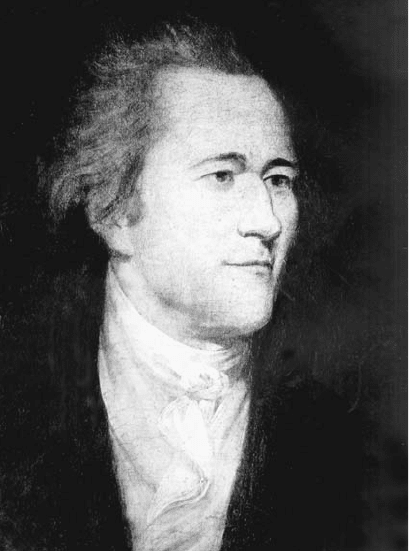
Alexander Hamilton. Engraving (Library of Congress)
xviii+446_EofUSConsti-v1.indd 340 3/12/09 3:05:25 PM
Hamilton resigned his position as Treasury Sec-
retary in 1795, after his political foes uncovered
the fact that he had been involved in an affair.
He did not retire from public life, however. He
resumed his legal practice in New York and was
a strong force in the Federalist Party, which he
had founded in the early 1790s, until the party’s
collapse in 1800.
For more information: Chernow, Ron. Alexan-
der Hamilton. New York: Penguin Press, 2004.
—Nathan M. Ingebretson
Hammer v. Dagenhart 247 U.S. 251 (1918)
In Hammer v. Dagenhart, the Supreme Court
ruled that Congress does not have the power
under the commerce clause to regulate child
labor within the individual states. The decision
represented a narrow interpretation of congres-
sional power to regulate commerce, and it dealt a
temporary blow to national efforts to address the
problem of child labor.
During the Industrial Revolution, many busi-
ness owners and stockholders favored the use of
child workers because it resulted in greater prof-
its. By the 1910s, spurred by Progressive reform-
ers, a national consensus had developed in favor of
limiting children’s work, and many states passed
legislation regulating the practice. Despite this
consensus, exemptions in southern states and
lack of effective enforcement of state laws led to
efforts to pass national legislation to curb child
labor. The Constitution, however, does not give
Congress the enumerated power to regulate
hours and working conditions for labor within the
states. In an attempt to regulate child labor indi-
rectly, Congress passed the Keating-Owen Act of
1916 under its authority to regulate commerce
between the states. The law prohibited producers
and manufacturers from shipping in interstate
commerce any product made by children under
14 or merchandise that had been made in facto-
ries where children between 14 and 16 had been
permitted to work more than eight hours a day,
six days a week, or at night. Roland Dagenhart,
who worked in a cotton mill in Charlotte, North
Carolina, with his two sons, ages 13 and 15, chal-
lenged the law with the support of the Executive
Committee of Southern Cotton Manufacturers.
Justice William R. Day, writing for the major-
ity, was joined by Chief Justice Edward White
and Justices Mahlon Pitney, Willis Van Devanter,
and James McReynolds. Justice Day wrote that
Congress does not have the authority to regulate
commerce of goods manufactured by children and
therefore the Keating-Owen Act was unconstitu-
tional. Day distinguished previous cases where
the Court upheld federal attempts to control lot-
teries, prostitution, and liquor, by arguing that
the manufacture of cotton was not a moral evil.
According to Day, the regulation of child labor
within states is purely a state authority. He used
the Tenth Amendment to support his argument,
although he misquoted the provision with regard
to powers delegated to Congress. Day claimed that
there is no power vested in Congress to require
the states to exercise their police power so as
to prevent unfair competition. He warned that to
allow Congress such authority would end freedom
of commerce and the power of the states over
local matters and thus “our system of government
would be practically destroyed.”
In dissent, Justice Oliver Wendell Holmes,
Jr., joined by Justices Joseph McKenna, Louis D.
Brandeis, and John H. Clarke, argued that the law
did not preempt state authority to regulate child
labor within a state. States have discretion to regu-
late their internal affairs, but when “they seek to
send their products across state lines they are no
longer within their rights.” Congress can regulate
commerce that crosses state lines even though it
may have an indirect effect upon the activities of
the states. Holmes concluded that the public pol-
icy of the United States is shaped to benefi t the
nation as a whole, and Congress may enforce its
policy by all means at its command.
The Hammer decision was eventually over-
turned in U
NITED STATES V. DARBY LUMBER, 312 U.S.
100 (1941). In Darby, the Court upheld the Fair
Labor Standards Act using many of the arguments
in Holmes’s dissent in Hammer. Congress now
has broad authority to regulate labor, wages, and
working conditions under the commerce clause.
Hammer v. Dagenhart 341
xviii+446_EofUSConsti-v1.indd 341 3/12/09 3:05:25 PM