
Schultz D. Encyclopedia of the United States Constitution
Подождите немного. Документ загружается.

and incident to this is the power to fi x the term
of offi ce and condition of removal. Moreover, the
legislative language, legislative reports, and gen-
eral purpose of the legislation demonstrate con-
gressional intent to create a body of experts free
from political control.
Finally, the Court ruled that presidential
removal violates the separation of powers, because
the ability to remove makes the commissioner
dependent on the executive. Since the FTC per-
forms legislative and judicial functions, this would
mean that the president would exercise legisla-
tive and judicial power which the Constitution
forbids.
This decision has had a signifi cant impact on
the administrative structure of government. The
independence granted regulatory agencies insures
impartial administration of the law and provides
stability, because a change in presidents will not
change the policies of the agency. However, many
believe this leads to ineffective and inefficient
policy, because independent agencies can pursue
policies that compete with and are contradictory
to policies pursued by other agencies and depart-
ments. This is especially troubling since the agen-
cies are not directly accountable to anyone.
For more information: James, Scott. Presidents,
Parties, and the State: A Party System Perspective
on Democratic Regulatory Choice, 1884–1936.
Cambridge: Cambridge University Press, 2001;
Stone, Alan. Economic Regulation and the Public
Interest: The Federal Trade Commission in The-
ory and Practice. Ithaca, N.Y.: Cornell University
Press, 1977.
—Sean Evans
Hunt v. Cromartie 532 U.S. 234 (2001)
In Hunt v. Cromartie, the U.S. Supreme Court
held that the district court made a mistake when it
found that the state of North Carolina violated the
equal protection clause in its 1997 redrawing
of its 12th Congressional District’s 1992 boundar-
ies and that it was based on “erroneous fi ndings.”
In S
HAW V. RENO, 509 U.S. 630 (1993), the U.S.
Supreme Court, for the fi rst time, acknowledged a
basis for which action could be brought by anyone
of any race to dispute redistricting plans. If the
plans were drawn unconstitutionally on the “uses
of race,” then anyone could challenge them. Under
the Fourteenth Amendment, race is considered
a “suspect category.” Therefore, legislative deci-
sions that are based on race are subject to strict
scrutiny.
The Shaw case involved a “bizarre”-shaped
Congressional district. It was drawn to satisfy
Department of Justice demands that the state cre-
ate another largely African-American district. It
was more than 160 miles long and very narrow in
width, a “snakelike shape.” It connected various,
unrelated sections of African-American voting
populations (47 percent). The Court found that if
a redistricting map is “so bizarre on its face that it
is ‘unexplainable on the grounds other than race,’ ”
it should be held to “strict scrutiny.”
In Shaw v. Hunt, 517 U.S. 899 (1996), the
Petitioners claimed that the state of North Caro-
lina violated the Fourteenth Amendment’s
equal protection clause. The Court ruled that the
redrawing of a North Carolina congressional dis-
trict to include a majority of African Americans
could not be justifi ed because it did violate the
equal protection clause of the Fourteenth Amend-
ment to the U.S. Constitution.
Following the Supreme Court’s decision, that
the district had been unconstitutionally drawn,
the state made a new redistricting plan in 1997.
After the boundaries had been redrawn, Martin
Cromartie again disputed the boundaries of the
12th District, stating that it resulted in racial
gerrymandering.
Before there could be any review of the evi-
dence or what action should be taken, the district
court granted Cromartie a “summary judgment,”
stating the Court found that the new boundaries
had also been drawn with respect to race. Hunt
appealed to the U.S. Supreme Court, which in
turn agreed to hear the case, Hunt v. Cromartie,
526 U.S. 541 (1999).
The Court found that even though there was
strong evidence of racial gerrymandering, the
North Carolina General Assembly’s real inten-
tions were in question and there should be more
362 Hunt v. Cromartie
xviii+446_EofUSConsti-v1.indd 362 3/12/09 3:05:33 PM
of an investigation. Since racial gerrymandering
is of constitutional signifi cance there should be
a strict evaluation. So the fact that the accusa-
tions were so lightly dismissed without a full trial
was “erroneous.” The Court reviewed the district
court’s fi ndings only to see if there was error and
if the decision was based on accurate evidence.
Another reason for the review is that there was
no intermediate court review. The U.S. Supreme
Court reversed the district court’s decision, stat-
ing that the evidence was inadequate and “erro-
neous” to show an unconstitutional race-based
objective.
When the case was sent back, the district
court again found, after a three-day trial, that
the legislature’s decisive factor was “race driven”
in drawing the 1997 boundaries. The conclusion
was based on three factors; the district’s shape,
the splitting of towns and counties, and its heav-
ily African-American voting population, all of
which the Court deemed inappropriate with rela-
tion to the “summary judgment.” In the appeal,
the Court reviewed the district court’s fi ndings,
and in a 5-4 opinion the Court reversed the dis-
trict court’s conclusion that the state violated
the equal protection clause when redrawing the
1997 boundaries. Also, the decision was based on
“erroneous fi ndings.”
Justice Stephen G. Breyer delivered the
opinion of the Court, joined by Justice John P.
Stevens, Justice Sandra Day O’Connor, Jus-
tice David H. Souter, and Justice Ruth Bader
Ginsburg. He wrote for the Court that “the pri-
mary evidence upon which the District Court
relied for its ‘race, not politics,’ conclusion is evi-
dence of voting registration, not voting behavior.”
In opposition to the ruling were Justice Clar-
ence Thomas, Chief Justice William Hubbs
Rehnquist, Justice Antonin Gregory Scalia,
and Justice Anthony M. Kennedy. The oppos-
ing justices cited that they did not believe that the
district court committed “clear error.” The Vot-
ing Rights Act requires authorities to consider
issues of race when drawing district lines. The
Shaw case states that one should not make deci-
sions based on race. A governmental entity must
consider two different legal requirements when
drawing redistricting lines; the Voting Rights Act
and the requirements of Shaw.
For more information: Ryden, David K. The
U.S. Supreme Court and the Electoral Process.
Washington, D.C.: Georgetown University Press,
2002.
—Thomas Caiazzo
Hurley v. Irish-American Gay, Lesbian &
Bisexual Group of Boston
515 U.S. 557
(1995)
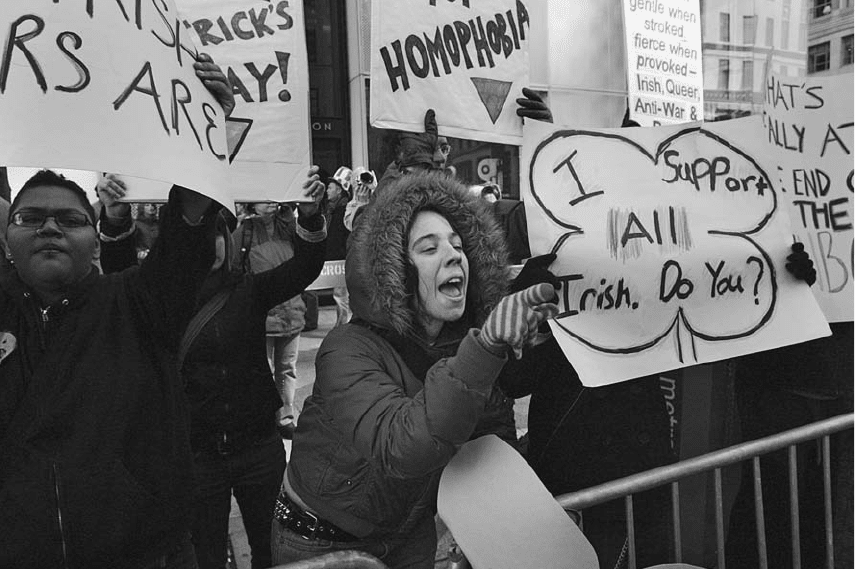
In Hurley v. Irish-American Gay, Lesbian &
Bisexual Group of Boston, the Supreme Court
ruled that the sponsor of the annual St. Patrick’s
Day-Evacuation Day Parade did not have to
include members from an Irish gay, lesbian, and
bisexual group because to force it to do so would
violate its First Amendment rights.
The unanimous ruling by the Court, written
by Justice David H. Souter, held application
of the public accommodations law to require the
inclusion of a party the sponsor did not wish to
include violated the sponsor’s free speech rights.
The issues raised in this case include the extent
of a public accommodations law, the primacy of
the First Amendment’s free speech guarantee,
and the nature of a parade in the public forum
as a form of expression. The interesting twist in
this case is that the group at issue, the group that
wished to participate in the parade, was an organi-
zation of gay, lesbian, and bisexual descendants of
Irish immigrants known as GLIB. The Massachu-
setts State Court had ordered the parade sponsors
to include the GLIB contingent, citing the public
accommodations law.
The Court found that the parade was an open
recreational event because its sponsors, the South
Boston Allied War Veterans Council, had been
granted authority to organize and conduct the
parade since 1947 through a permit process that
has involved no other applicant. The Court agreed
with the sponsors that their parade is nonethe-
less a private event, despite as many as 20,000
marchers and up to 1 million viewers, because of
the private sponsorship, irrespective of the size
Hurley v. Irish-American Gay, Lesbian & Bisexual Group of Boston 363
xviii+446_EofUSConsti-v1.indd 363 3/12/09 3:05:33 PM
or location of the audience. As regards parade
participants, the Court found that although they
were not directed to communicate a specifi c mes-
sage, the entire parade was organized to impart
a collective message with respect to each other
and any bystanders along the way, and so was a
form of expression. The Court agreed with the
sponsors, who maintained that GLIB intended
to express its own viewpoint in celebration of
its members’ sexual identity as gay, lesbian, and
bisexual descendants of Irish immigrants and
that this particular expression confl icts with the
parade organizers.
The issue of whether in fact the two expres-
sions collided was resolved in favor of the spon-
sor, a private speaker whose First Amendment
rights included making this determination, one
that is beyond the state’s power to control. Each
parade participant’s expression of whatever view-
point it wishes is perceived by spectators as part
of the overall parade message, so not to allow
the parade’s sponsors to determine whether this
or that message conforms to the overall message
would infringe on their free speech rights, which
include the right to decide on the content of its
own message as well as what it does not wish to
have said in its parade.
Massachusetts’s public accommodations law
was determined not to target speech or discrimi-
nate on the basis of content beyond mandating that
the state prohibit discrimination against individu-
als or groups on the basis of proscribed grounds,
such as sexual orientation. The parade’s sponsors
indicated that they would welcome the participa-
tion of members of GLIB, just not as a unit march-
ing under its own banner. Hence, regardless of the
364 Hurley v. Irish-American Gay, Lesbian & Bisexual Group of Boston
Demonstrators protest the policy of New York’s St. Patrick’s Day Parade organizers not to allow gay groups to
march openly in the procession, as it makes its way up Fifth Avenue on March 17, 2006.
(Michael Nagle/Getty)
xviii+446_EofUSConsti-v1.indd 364 3/12/09 3:05:33 PM
wisdom of the parade’s sponsors in exercising their
freedom of association by not including GLIB and
not desiring to have a statement made regarding
sexual orientation during the parade, they were
well within their rights.
For more information: Murdoch, Joyce, and
Deb Price. Courting Justice: Gay Men and Les-
bians v. the Supreme Court. New York: Basic
Books, 2001.
—Gordon A. Babst
Hylton v. United States 3 U.S. 171 (1796)
Hylton v. United States is an important case that
set the groundwork for judicial review in the
United States. This 1796 opinion of the Supreme
Court explicitly considered the constitutionality
of a federal law, thus indirectly addressing the
extent to which the Court had the power of judi-
cial review. In the end, the Court did not exercise
such review, but the simple fact of considering it
is important historically, as it presaged M
ARBURY V.
M
ADISON (1803).
In 1794, the Congress passed a law assessing
a tax of 16 dollars on “carriages for the convey-
ance of persons.” Daniel Hylton refused to pay
the tax on his carriages. He contended that this
tax amounted to a “direct tax,” prohibited by the
U.S. Constitution. The United States brought suit
against Hylton, alleging that he had violated the
law and that the law had been properly passed.
As Justice Samuel Chase put it, the question in
this case is simple: “whether the law of Congress
. . . entitled ‘An act to lay levies upon carriages,
for the conveyance of persons,’ is unconstitu-
tional and void?” Thus, he defi nes this case as
explicitly addressing the constitutionality of a
federal law.
The decision was rendered by seriatim opin-
ions. Justices Chase, William Paterson, and James
Iredell delivered opinions, all agreeing that the law
was to be upheld. Justice James Wilson recused
himself, since he had expressed a prior opinion on
the case in the Circuit Court of Virginia. Justice
William Cushing did not take part, since he had
been prevented from attending the oral argument.
Newly appointed Chief Justice Oliver Ellsworth
had been sworn in after argument and declined to
take part in the decision.
Chase’s opinion explored the extent to which
the tax was “direct,” and he decided that it was
not. He concludes, with a consideration of the
power of the Court to declare laws unconstitu-
tional, in these words: “It is unnecessary, at this
time, for me to determine, whether this court,
constitutionally possesses the power to declare an
act of Congress void, on the ground of it being
contrary to, and in violation of, the Constitution;
but if the court have such power, I am free to
declare, that I will never declare it, but in a very
clear case.”
Paterson likewise concludes that the tax is not
direct, as does Justice Iredell. Justice Wilson, as
noted, recused himself, but he did allude to the
issue of judicial review when he concluded that “I
shall now, however, only add, that my sentiments,
in favor of the constitutionality of the tax in ques-
tion, have not been changed.” By implication, if he
could be in favor of constitutionality, he could also
be against it under different circumstances.
This is, then, one of the precursors of Marbury
v. Madison. Walter Murphy, James Fleming, and
Sotirios Barber note the importance of Hylton v.
U.S., as well as Hayburn’s Case (1792) and Yale
Todd’s Case (1794) (presented in U.S. v. Ferreira,
54 U.S. 40 [1851]) in raising issues of judicial
review, with the last named case actually invali-
dating provisions of federal law.
For more information: Langran, Robert W. The
Supreme Court: A Concise History. New York:
Peter Lang Publishing, 2004.
—Steven A. Peterson
Hylton v. United States 365
xviii+446_EofUSConsti-v1.indd 365 3/12/09 3:05:34 PM
366
ﱶﱷﱸ
Illinois v. Caballes 543 U.S. 405 (2005)
In Illinois v. Caballes, the U.S. Supreme Court
ruled that police may use drug dogs during rou-
tine traffi c stops, even if they lack probable cause
or reasonable suspicion that the vehicle contains
illegal drugs. This decision gives the police tre-
mendous discretion to search for drugs without
any evidence that the person or vehicle being
searched actually possesses drugs. The use of
canines as a legitimate drug detection tool was
established in United States v. Place, 462 U.S. 696
(1983). In Place, the Court ruled that a canine
sniff was reasonable because a sniff reveals only
illegal drugs, which are contraband and illegal to
possess.
Caballes was stopped for speeding by an Illi-
nois state trooper. After stopping Caballes, the
trooper conducted a routine registration and
criminal record check. While a warning ticket was
being written, the record check came back indi-
cating that Caballes had a prior arrest for mari-
juana distribution. The trooper sought consent
from Caballes to search his vehicle, but Caballes
refused. At this point, approximately 10 minutes
into the traffi c stop, a second trooper arrived with
a drug dog, and he ran the dog around Caballes’s
vehicle. The canine alerted, and a subsequent
search of the vehicle revealed a large quantity of
marijuana. Caballes was arrested.
Prior to trial, Caballes fi lled a motion to sup-
press the evidence, arguing that the use of the
drug dog without probable cause or reasonable
suspicion of drug possession violated the Fourth
Amendment. Caballes acknowledged that the
amount of time it took to conduct a criminal
record check and to write the warning ticket
was reasonable. The state acknowledged that
no reasonable suspicion that there were drugs
in Caballes’s vehicle existed prior to the canine
alert. The suppression motion was denied, and
Caballes was convicted. The state trial court held
that the length of the traffi c stop was not unduly
increased by the canine sniff and that the canine
was sufficiently reliable to create the probable
cause needed by the offi cers to conduct a search
of Caballes’s vehicle. The Illinois Supreme Court
reversed this decision, holding that the troopers
lacked “reasonable suspicion” that Caballes was
involved in criminal activity, and that reasonable
suspicion was required before a canine could be
used during a routine traffi c stop.
The U.S. Supreme Court reversed the Illinois
Supreme Court and upheld the use of drug dogs
during routine traffi c stops. First, the Court noted
that when a traffi c stop is both legitimate and con-
ducted in a reasonable manner, then a canine sniff
during the stop is not a search because a sniff of
the exterior of a vehicle does not violate a person’s
legitimate expectation of privacy. Second, the
Court determined that since a person does not
have a legitimate privacy interest in the possession
of illegal drugs, a canine sniff, which only exposes
illegal drugs, does not infringe upon a person’s
legitimate privacy interest. Thus, a canine sniff is
not a search for purposes of the Fourth Amend-
ment, and neither “probable cause” nor “reason-
able suspicion” are needed to conduct a canine
sniff of the exterior of a vehicle.
For more information: Hemmens, Craig, Jen-
nifer Ashley, and Simon Billenge. “Who Let the
Dogs Out?: Drug Dogs in Court.” Criminal Jus-
tice Studies 20, no. 3 (2007): 177–196; Hemmens,
Craig, John Worrall, and Alan Thompson. Crimi-
I
xviii+446_EofUSConsti-v1.indd 366 3/12/09 3:05:34 PM
nal Justice Case Briefs: Signifi cant Cases in Crim-
inal Procedure. Los Angeles: Roxbury Publishing,
2004.
—Jennifer J. Ashley
Illinois v. Gates 462 U.S. 213 (1983)
In Illinois v. Gates, the Supreme Court estab-
lished rules for when an anonymous tip could be
used as the basis of a search warrant under the
Fourth Amendment.
Warrants are generally required under the
Fourth Amendment. To secure a warrant, law
enforcement offi cials need to establish probable
cause before a judge that they will fi nd some ille-
gal contraband such as drugs. However, what do
police offi cers need to produce to establish proba-
ble cause? In many cases, informants provide that.
But what if the tip they receive is anonymous?
In Aguilar v. Fenton, 473 U.S. 402 (1985), the
Supreme Court stated that it was permissible to
use hearsay evidence to establish probable cause
but one must show that the informant is credible
and reliable.
In Spinelli v. United States, 393 U.S. 410 (1969),
the Court fi rst tried to clarify the standards that
must be met to use an anonymous tip to estab-
lish probable cause. At issue was whether there
was probable cause to search an individual based
upon a tip that a person was involved in gambling,
that he was traveling into and out of a particular
apartment, that the apartment contained two
telephones, and that this individual engaged in
luxury, and when that information was verifi ed by
FBI observation of that person. The Court said
that, here, there was not enough information of
the underlying circumstances in the tip to deter-
mine how the conclusion could be reached. For a
tip to be used it must meet Aguilar standards, and
it must meet reliability and credibility as indepen-
dent standards. The Court also stated that there
be independent corroboration of the tip.
Gates revisits and revises the Spinelli stan-
dards. Here, at issue was whether there was prob-
able cause to issue a search warrant of a residence
and car based upon an anonymous letter detail-
ing a drug purchase when the major facts of the
letter were independently corroborated by a sub-
sequent police investigation. The Supreme Court
said yes. In supporting its decision, the Court said
that there were two factors associated with using
an anonymous tip for the purposes of establish-
ing probable cause: the basis of knowledge and its
veracity. Probable cause is established in a totality
of circumstances test that a search will uncover
wrongdoing instead of following a two-step pro-
cess as suggested by Spinelli.
Gates thus appeared to make it easier to obtain
a search warrant based on an anonymous tip. Even
with the relaxed standards, though, independent
corroboration of such a tip is generally required
under the Fourth Amendment.
For more information: LaFave, Wayne R., Jer-
old H. Israel, and Nancy J. King. Criminal Proce-
dure. St. Paul, Minn.: Thomson/West, 2004.
—Ernest Gomez and David Schultz
impeachment
The power to impeach federal offi cers is one of
the greatest powers held by the U.S. Congress,
but this power is rarely utilized. This power allows
Congress to keep a check on both the executive
and judicial branches. The House of Repre-
sentatives can bring up impeachment charges
on a federal offi cial, and afterwards the offi cial
is brought to trial by the Senate. They can then
choose to convict the official with a two-thirds
vote of the Senate and remove him or her from
office. Congress has the ability to impeach the
president, vice president, cabinet members,
federal judges, and the chief justice and associate
justices of the U.S. Supreme Court. Impeachment
does not hold any criminal or civil penalties, sim-
ply removal from public offi ce and possibly ineligi-
bility for future attempts to run for offi ce.
Impeachment was a major consideration during
the Constitutional Convention. The U.S.
Constitution provides for the power of impeach-
ment, but rather vaguely. It is unclear as to who
qualifi es as a civil offi cer and thus holds a federally
impeachable offi ce. We can see this in Article II,
Section 4 of the U.S. Constitution, which states
impeachment 367
xviii+446_EofUSConsti-v1.indd 367 3/12/09 3:05:34 PM
that “the President, Vice President and all civil
Officers of the United States, shall be removed
from Offi ce on Impeachment for, and Conviction
of, Treason, Bribery, or other high crimes and
misdemeanors.” The most frequent target of
impeachment is federal judges who hold lifetime
appointments.
The impeachment process has its origins
in 14th-century England. During this period,
the struggling English Parliament utilized the
impeachment process to force the offi cers of the
king to be held accountable. The king himself was
not impeachable, but the ministers and judges
were punishable for criminal activity and abuse
of power by use of impeachment. In the early
American colonies, the governments made use of
this English process of impeachment. They had a
system by which the lower legislative house would
bring charges and the upper legislative body would
issue judgment.
During the Constitutional Convention, the
framers wished to keep provisions for impeach-
ment. They did not want severe sanctions as in
England such as fines, imprisonment, or even
death. In the English system, the House of Com-
mons had the ability to impeach practically anyone
for crimes and misdemeanors. However, the fram-
ers wished to focus impeachment procedures on
specifi c federal offi ces rather than on individuals.
The idea was to protect the interest of the public
rather than punish specifi c individuals.
The Constitution is clear about the process of
impeachment. Article I lays out which chamber
is in charge of the different processes involved
in the impeachment process. Section 2 sets out
that the House of Representatives “shall have the
sole power of impeachment” and Section 3 states
that the U.S. Senate has “the sole power to try
all impeachments.” It is also specifi ed in Article
II, Section 2 that the president does not have the
ability to grant reprieves and pardons in cases of
impeachment.
The impeachment process has not been utilized
on many occasions. Because of this, there has not
been a standard procedure for initiating impeach-
ments. A few ways in which impeachments have
been brought about are by a letter from the presi-
dent, a resolution fi led by a member of the House
of Representatives to conduct an investigation,
and sometimes the House Judiciary Committee
issues a resolution.
When an impeachment resolution is passed
in the House of Representatives, the House then
selects who will serve as prosecutors during the
trial in the Senate. The House of Representa-
tives then provides the Senate with the articles
of impeachment and notifi es them that there is a
need to hold a trial. The trial that takes place in
front of the Senate is similar to that of a criminal
trial where each side has the opportunity to pres-
ent evidence and call witnesses, and the offi cial
that is being tried has the right to have an attor-
ney. Generally, the president pro tempore of the
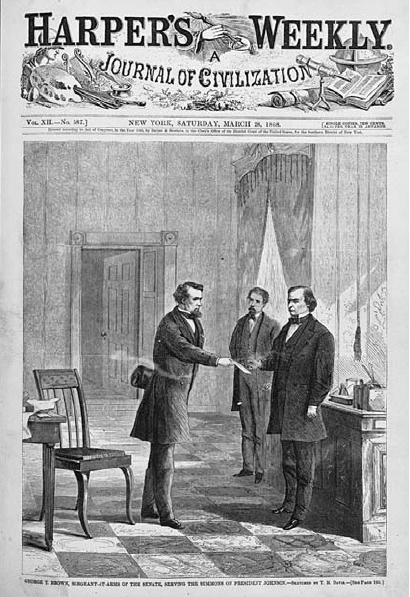
Illustration by T. R. Davis of George T. Brown, ser-
geant-at-arms, serving a summons on President John-
son, in Harper’s Weekly, March 28, 1868
(Library of
Congress)
368 impeachment
xviii+446_EofUSConsti-v1.indd 368 3/12/09 3:05:35 PM
Senate or the vice president presides over the trial,
and the chief justice is usually on hand to rule on
evidence and answer questions. During a closed
session at the end of the trial, the Senate deliber-
ates the guilt or innocence of the accused person.
The Senate votes on each article of impeachment,
and if any article receives a two-thirds vote, then
they rule to convict the offi cial. Finally, the Sen-
ate votes whether or not to remove a guilty offi cial
from offi ce and whether or not he or she is eligible
to hold a federal offi ce in the future.
Throughout American history, few individuals
have been subject to impeachment. In 1804, Fed-
eralist Party Supreme Court Justice Samuel Chase
was impeached by the Democratic-Republican
House over disputes regarding his handling of tri-
als. The Senate, with Vice-President Aaron Burr
presiding, acquitted him in 1805. Among presi-
dents, the Republican House impeached Andrew
Johnson in 1868 in disputes over the handling of
Reconstruction. The Senate acquitted him by one
vote. In 1974, the House Judiciary Committee
voted on several articles of impeachment against
President Richard Nixon that included obstruc-
tion of justice arising out of Watergate and for
engaging in secret bombings of Cambodia. Nixon
resigned before the full House voted to impeach.
Finally, in 1998, the House voted to impeach
President William Clinton on four charges arising
out of the special prosecutor’s investigation into
his affairs with Monica Lewinsky and Paula Jones.
The Senate acquitted him on all charges.
For more information: Bacon, Donald C.,
Roger H. Davidson, and Morton Keller, eds. The
Encyclopedia of the United States Congress. New
York: Simon and Schuster, 1995; Nelson, Michael,
ed. Guide to the Presidency. 2nd ed. Washington,
D.C.: Congressional Quarterly, 1996.
—Jacqueline M. Loubet
imports, taxes on
Tariffs, or taxes on imports, played an integral
role in the American push for independence
from Great Britain. Accordingly, tariffs assumed
a place of central importance in the Constitu-
tion. The authority to impose a tariff is allocated
to Congress by Article 1, Section 8 of the U.S.
Constitution as part of congressional power to lay
and collect taxes. Import taxes must be uniform,
imposed throughout the United States.
Throughout U.S. history, taxes on imports have
been used to raise revenue, to protect American
manufacturers from foreign competition, or to
retaliate against other nations. The demand for
revenue, however, has been the driving force
behind tariff policy. The leaders of the new nation
recognized that the government needed to cre-
ate a revenue system to provide for operating
expenses while paying down the debt left over
from the American Revolution. However, any new
level of taxation would compete with numerous
state and local revenue streams. Congress real-
ized that federal revenue needed to come from
tariffs, since Americans imported a large number
of manufactured goods along with raw materi-
als, such as molasses. In 1789, the fi rst tariff act
passed under the Constitution after considerable
debate. Many of the northern states, interested in
developing their own manufacturing industries,
demanded high protective tariffs, while the agri-
culture-based southern states saw low tariffs as
being in their best interests. Throughout the 19th
century, protection of the iron, cotton manufac-
turing, wool, hemp, and other domestic industries
remained a recurrent theme in tariff bills.
The challenge to free trade posed by the tariff
has long been controversial. Robert Walker, secre-
tary of the treasury in the administration of Presi-
dent James K. Polk and a proponent of free trade,
engaged in an inclusive reading of Article 1, Sec-
tion 8. He interpreted the Constitution as requir-
ing Congress to both impose and collect taxes. In
reality, Walker’s concern proved unwarranted as
Congress never laid duties that it could not col-
lect. Merchants, on selecting goods to import, had
to pay the congressionally predetermined duty for
the given product.
The Supreme Court has occasionally ruled on
tariffs. In P
OLLOCK V. FARMERS LOAN AND TRUST
COMPANY, 157 U.S. 429 (1895), the Court struck
down an income tax provision included in the Wil-
son-Gorman Tariff Act of 1894 on the grounds
imports, taxes on 369
xviii+446_EofUSConsti-v1.indd 369 3/12/09 3:05:35 PM
that it was a direct tax under the U.S. Constitution.
Passage of the Sixteenth Amendment in 1913
made the Court decision moot. As other forms of
government fi nancing gained popularity, the tariff
dimmed in importance. Protectionist sentiment in
Congress took precedence to the revenue needs
of the government. The Hawley-Smoot Tariff Act
of 1930 constituted the peak of U.S. duties. Fol-
lowing the Great Depression, the international
community generally acknowledged that tariffs
damaged world trade and contributed to slowed
economic growth.
For more information: Elliott, Orrin. The
Tariff Controversy in the U.S., 1789-1833. Palo
Alto, Calif.: Stanford University, 1892; Sorenson,
Leonard R. Madison on the “General Welfare” of
America: His Consistent Constitutional Vision.
Lanham, Md.: Rowman & Littlefi eld, 1995.
—Caryn E. Neumann
impoundment
Impoundment refers to the practice of a chief
executive to not spend money appropriated by
the legislature. Presidents have exercised the
impoundment power since the early republic.
The impoundment of funds has often been used
to respond to changing events, such as entering
a war, and to prevent waste by making federal
projects more efficient. The Constitution does
not expressly allow for the exercise of the power
of impoundment, and its authority is derived from
legislation. The president does have the power of
the veto, which if used successfully, reduces the
need for impoundment.
The question of impoundment raises the larger
issue of who has the “power of the purse” to
determine budgetary priorities and direct federal
funds. Presidents began expanding their control
over economic and budgetary matters with the
administration of Franklin D. Roosevelt. Until
the time that President Richard Nixon came
into offi ce, impoundments were infrequent and
temporary, usually involving small amounts of
money, and Congress often supported their use.
However, Nixon sought to impound funds at an
unprecedented level, claiming that it was an
inherent presidential power to refuse to spend
appropriated monies for projects he did not sup-
port and to control defi cit spending by the Demo-
cratic-dominated Congress. The City of New York
fi led a lawsuit challenging Nixon’s impoundment
of funds, and the Supreme Court ruled that presi-
dents had no constitutional authority to withhold
funds allotted by law (Train v. City of New York,
420 U.S. 35 [1975]).
Congress also challenged Nixon, claiming he
used impoundment as selective law enforcement.
To recapture its control of federal funds and stop
the perceived presidential encroachment onto its
budgetary turf, Congress passed the Congressio-
nal Budget and Impoundment Control Act of 1974.
A primary purpose of this act was to constrain the
use of impoundments by codifying the chief exec-
utive’s impoundment authority. Two new proce-
dures were established. Under the act, a president
may propose to rescind, or cancel, appropria-
tions, although Congress must agree by a major-
ity vote within forty-fi ve days for the rescission to
take effect. A president may also recommend to
defer spending appropriated funds within a one-
year time frame. The act created a Congressional
Budget Offi ce and permanent committees in both
chambers to provide support to members of Con-
gress in the form of cost estimates and a budget
timetable for tracking spending. These reforms
added a measure of coherence to the budgetary
process, since before this there was no real coordi-
nation between the congressional committees that
raised revenues and those that spent the monies.
There is general agreement that the passage of
the 1974 act has led to a reassertion of the role
of Congress in the budgetary process, although
room for improvement remains as deadlines for
enacting budget resolutions are routinely missed
and partisanship on budget matters has increased.
Nevertheless, Congress still tends to respond to
priorities set by chief executives.
For more information: Cronin, Thomas E., and
Michael A. Genovese. The Paradoxes of the Amer-
ican Presidency. 2nd ed. New York: Oxford Uni-
versity Press, 2004; Fisher, Louis. Constitutional
370 impoundment
xviii+446_EofUSConsti-v1.indd 370 3/12/09 3:05:35 PM
Confl icts between Congress and the President. 4th
ed. Lawrence: University Press of Kansas, 1997.
—Rebecca Wiggins
incorporation
Incorporation refers to the process where the
Supreme Court has utilized the Constitution’s
Fourteenth Amendment to require state gov-
ernments to apply to their citizens the civil lib-
erties specifi ed in the Bill of Rights. Even
though most of the Bill of Rights has now been
incorporated to apply to states, not all of the provi-
sions are binding on them. The process of incorpo-
ration has been a gradual one, taking place during
most of the 20th century, with the bulk of that
occurring after World War II.
Because the national government conceived by
the Constitutional Convention would pos-
sess only the delegated and enumerated powers,
the delegates, especially those who were mem-
bers of the Federalist Party, such as Alexander
Hamilton, deemed a bill of rights unnecessary.
During the battle over ratification of the
Constitution, the omission of a bill of rights
attracted criticism from the Anti-Federalists. In
September 1789, James Madison, in the first
Congress, proposed 12 amendments, 10 of which,
once ratifi ed in December 1791, became the Bill of
Rights. Insofar as the Constitution’s purpose was
to establish the national government, it followed
that the amendments were designed to restrict
national government actions that would deprive
citizens of civil liberties. Accordingly, the first
words of the First Amendment are “Congress
shall make no law.” In proposing the amendments,
Congress did not intend to place restrictions on
state governments’ actions, and, in ratifying them,
the state legislatures did not anticipate that such
restrictions would be imposed on them. The U.S.
Supreme Court affi rmed the inapplicability of the
Bill of Rights at the state level in its 1833 opinion
in the case of B
ARRON V. MAYOR AND CITY COUN-
CIL OF BALTIMORE, 32 U.S. (7 Pet.) 243 (1833). This
circumstance left citizens unprotected, at least as
far as the Constitution and the national govern-
ment were concerned, when state governments
mistreated them by refusing to recognize their
entitlement to civil liberties.
In the aftermath of the Civil War, Congress and
the state legislatures placed three amendments
into the Constitution to protect African Ameri-
cans. The Thirteenth Amendment reaffi rmed
the prohibition against slavery, the Fourteenth
Amendment established the right of blacks to enjoy
the status of national and state citizenship, and
the Fifteenth Amendment prohibited denial
of the right to vote based on race. Section 1
of the Fourteenth Amendment states, “All persons
born or naturalized in the United States, and sub-
ject to the jurisdiction thereof, are citizens of the
United States and of the state wherein they reside.
No state shall make or enforce any law which shall
abridge the privileges or immunities of citizens of
the United States; nor shall any state deprive any
person of life, liberty, or property, without due
process of law; nor deny to any person within its
jurisdiction the equal protection of the laws.”
This section would take on signifi cance beyond
the intention to ensure that African Americans
would be recognized as citizens.
Ratification of the Fourteenth Amendment
prompted attorneys for criminal defendants and
other litigants to appeal adverse decisions of state
supreme courts to the U.S. Supreme Court based
on the claim that the amendment had estab-
lished state-level protections of civil liberties. At
first, such attorneys invoked the amendment’s
privileges and immunities clause. The U.S.
Supreme Court rebuffed such claims, rejecting
the suggestion that “privileges and immunities”
ought to be interpreted as a reference to specifi c
liberties (Slaughterhouse Cases, 83 U.S. [16 Wall.]
36, 74–80 [1873]). Attorneys then directed the
Court’s attention to the provision of the amend-
ment that prohibited any state government from
“depriv[ing] any person of life, liberty, or prop-
erty, without due process of law.” Again, the Court
was initially skeptical. For example, in its opinion
in the case of Hurtado v. California, 110 U.S.
516, 534–535 (1884), the Court offered an argu-
ment based on “nonsuperfl uousness.” In Hurtado,
when the Court was urged to interpret “due pro-
cess” as encompassing the right to indictment by
incorporation 371
xviii+446_EofUSConsti-v1.indd 371 3/12/09 3:05:36 PM