
Schultz D. Encyclopedia of the United States Constitution
Подождите немного. Документ загружается.

use, or sell an invention for a specifi c period of
time, generally 20 years—essentially a monopoly
over the invention for a limited time.
In the United States, Congress is given the
power by the United States Constitution, Article
I, Section 8, Clause 8, to grant rights to inven-
tors to “promote the progress of science and use-
ful arts, by securing for limited times to authors
and inventors the exclusive right to their respec-
tive writings and discoveries.” The United States
Patent and Trademark Offi ce is the agency of the
United States Department of Commerce charged
with the duty of examining patent applications.
There, patent examiners ensure that each patent
application meets with all of the requirements of
the United States Patent Act.
There are three types of patents available in
the United States: utility, design, and plant pat-
ents. The Patent Act, codifi ed in 35 United States
Code §101 et al., defi nes patentable subject matter
for a utility patent and requires that the invention
be useful, novel, and nonobvious.
In order for a patent application to progress
to a patent, the invention must be useful or have
utility. Such utility needs only to be sufficient
to convince one skilled in the art or technology
that the invention has the inventor’s asserted util-
ity (In re Brana, 51 F.3d 1560 [Fed. Cir. 1995]).
An invention claimed in a patent must be new or
novel at the time of invention, meaning, among
other requirements, that the invention was not
known or used by others in the United States or
described in a printed publication anywhere in
the world (35 U.S.C §102). An invention that is not
novel is described as anticipated by the art. Even
if the invention is not anticipated at the time of
invention, the subject matter of the application as
a whole must not be such that it would have been
obvious to a person having ordinary skill in the art
or technology (35 U.S.C §103).
The United States patent system defi nes rights
on a first-to-invent basis, as opposed to almost
entirely the rest of the world, which uses a fi rst-
to-fi le basis. Courts have interpreted the concept
of invention to include conception, diligence, and
reduction to practice (Marhurkar v. C.R. Bard,
Inc., 79 F.3d 1572, 1577 [Fed. Cir. 1996]). If an
inventor works with reasonable diligence to actu-
ally demonstrate that the invention is suitable for
its intended purpose (reduction to practice), then
the inventor may establish rights back to the date
that he or she had such a fully formed thought
(conception) that such thought only need be con-
structed (Brown et al. v. Barbacid et al., 436 F.3d
1376 [Fed. Cir. 2006]).
The Patent Act allows inventors to seek protec-
tion for “any new, original, and ornamental design
for an article of manufacture” (35 U.S.C. §171).
Also, one who “invents or discovers and asexually
reproduces any distinct and new variety of plant”
may be entitled to protection of such as a plant
patent (35 U.S.C. 161).
Philosophical bases for the grant of a patent
include that an inventor is entitled to the fruits of
his or her intellectual labor and that the grant of
such a monopoly fosters technological innovation.
For more information: Durham, Alan L. Pat-
ent Law Essentials: A Concise Guide. Westport,
Conn.: Praeger Press, 2005.
—Nathan H. Cristler
PATRIOT Act (USA PATRIOT Act)
The PATRIOT Act refers to a law and its subse-
quent reauthorization in 2006 that was enacted
to detect terrorist activity after the events of 9/11.
While many believe the act is an important tool
to enhance American security, others argue that
portions of it violate the Constitution.
On September 11, 2001, al-Qaeda terrorists
hijacked four commercial airplanes, using them
to attack the United States, ending in a huge loss
of life and numerous injuries. In the weeks fol-
lowing the terrorist attacks, the U.S. government
took several steps—proactive and preventive mea-
sures—to avoid a repeat of the terrible events that
occurred on September 11.
In addition to providing the president with
unprecedented authorization in the fi ght against
terrorism, Congress took steps to provide law
enforcement and intelligence agencies with
expanded powers for countering terrorist activi-
ties against the United States, both within the
542 PATRIOT Act
vi+904_EofUSConsti-v2.indd 542 3/20/09 2:18:03 PM
country and abroad. One of the most visible and
perhaps controversial steps taken by Congress was
the passage of the PATRIOT Act, signed into law
by the president on October 26, 2001, only 45 days
after the terrorist attacks in New York and Wash-
ington, D.C.
The Uniting Strengthening America by Provid-
ing Appropriate Tools Required to Intercept and
Obstruct Terrorism Act of 2001 (Public Law 107-
56), more commonly known as the PATRIOT Act,
originated in the House of Representatives as
Bill H.R. 2975 (the PATRIOT Act) and in the Sen-
ate as S. 1510 (the USA Act). These bills passed
through both houses in the early half of Octo-
ber 2001. Due to some unresolved discrepancies
between the original text and previous legislation
on money laundering and intelligence gathering,
the House subsequently passed a clean bill H.R.
3162 on October 24, 2001, incorporating changes
that expanded and amended the previously passed
Foreign Intelligence Surveillance Act
(FISA) of 1978, and also passed on October 26,
2001, the Financial Anti-Terrorism Act. The Sen-
ate agreed to the changes with only one dissenting
voice (Senator Russ Feingold, D-Wisconsin) and
one nonvoting member (Senator Mary Landrieu,
D-Louisiana). The bill was then sent to the presi-
dent and signed into law on October 26, 2001.
In particular, the PATRIOT Act provided
federal offi cials with sweeping powers for track-
ing and intercepting communications for law
enforcement and intelligence-gathering purposes.
It seeks to close off American borders to foreign
terrorists, to detain and remove those terrorists
already within our borders, and to shut down their
fi nancial resources with expanded money launder-
ing powers. The PATRIOT Act has created new
procedures, penalties, and defi nitions of crimes
to combat domestic and international terrorism.
Despite garnering majority support and quick pas-
sage through Congress, the act was surrounded by
controversy, with those supporting it claiming that
the provisions have not gone far enough to ensure
the United States is protected from future terror-
ist acts. Opponents have argued against the act
on the grounds that it treads heavily on citizens’
civil liberties in the fi ght against terrorism.
For example, the PATRIOT Act has eased gov-
ernment access to confi dential information and
authorizes so-called sneak-and-peak search war-
rants to be issued for “reasonable cause” rather
than “probable cause.” However, there were also
a number of safeguards included within the text
of the act, specifying notification periods and
requirement of authorization for particular provi-
sions on surveillance, wiretaps, and the issuance
of warrants. These safeguards also included pro-
viding additional review, clarifi cation, and public
reporting, as checks built into the reforms to avoid
actual or perceived abuse of power.
Due to the impact the act would have on indi-
vidual liberties and the sweeping reforms it imple-
ments, a sunset clause was added, requiring that
Congress take active steps to reassess the act after
its implementation and testing over time. Several
of the surveillance sections of the original act
would have expired on December 31, 2005, but
these were extended until March 10, 2006. Con-
gress reauthorized the PATRIOT Act without
much reform, with President Bush signing it into
law on March 9, 2006, a day before the exten-
sion was due to expire. The reauthorized act has
included a four-year sunset clause on three specifi c
provisions covering attainment of records (such as
library records), use of wiretaps to monitor com-
munications, and secret surveillance of non-U.S.
citizens within the country—all without probable
cause or suspicion—an important reform with
regard to protection of civil liberties and First
Amendment rights.
Although the PATRIOT Act has had a large
impact on First Amendment rights and civil liber-
ties since its passage in 2001, the debate surround-
ing it has also expanded over the past four years
about the balance between security and preemp-
tive measures for combating terrorism versus pro-
tection of individual rights. This is perhaps most
evident in the fact that while only one senator
voted against the original PATRIOT Act in 2001,
during Senate debate in mid-December 2005, a
bipartisan group of 52 senators filibustered the
reauthorization. In the end, 10 senators opposed
the reauthorization of the PATRIOT Act without
substantial reform in early 2006. Moreover, the
PATRIOT Act 543
vi+904_EofUSConsti-v2.indd 543 3/20/09 2:18:03 PM
American Civil Liberties Union has tried
to challenge the act in court, claiming it violates
either the First Amendment freedom of speech
clause or the Fourth Amendment’s protec-
tion against unreasonable searches and seizures.
While some district courts have ruled in favor of
the ACLU, appellate courts have either thrown
the suits out or refused to rule on the issues. For
the most part, core challenges to the PATRIOT
Act have faced mixed success.
For more information: Abdolian, Lisa Finnegan,
and Harold Takooshian. “The USA PATRIOT Act:
Civil Liberties, the Media, and Public Opinion.”
Fordham Urban Law Journal 30 (May 2003):
1,429–1,453; Cole, David. “The Priority of Moral-
ity: The Emergency Constitution’s Blind Spot.”
Yale Law Journal 113 (June 2004): 1,753–1,800;
Etzioni, Amitai. How Patriotic Is the Patriot Act?:
Freedom versus Security in the Age of Terrorism.
New York: Routledge, 2004; Gudridge, Patrick O.,
and Laurence H. Tribe. “The Anti-Emergency
Constitution.” Yale Law Journal 113 (June 2004):
1,801–1,870; Heymann, Philip B. “Civil Liberties
and Human Rights in the Aftermath of September
11.” Harvard Journal of Law & Public Policy 25
(Spring 2002): 441–456.
—Dale Mineshima-Lowe
Payne v. Tennessee 501 U.S. 111 (1991)
In Payne v. Tennessee, the United States Supreme
Court was asked to decide whether the cruel
and unusual punishment clause of the Eighth
Amendment to the United States Constitution
barred the introduction of victim impact testi-
mony during the sentencing phase of a death pen-
alty trial.
The Eighth Amendment states: “Excessive bail
shall not be required, nor excessive fi nes imposed,
nor cruel and unusual punishments inflicted.”
Prior to the decision in Payne, in Booth v. Mary-
land, 482 U.S. 496 (1987), and Carolina v. Gath-
ers, 490 U.S. 805 (1989), the Supreme Court had
ruled that victim impact evidence—evidence
concerning a victim’s personal characteristics and
the emotional impact of the crime on the victim’s
family—could not be relied upon by the prosecu-
tion when seeking the death penalty, because it
would create an unacceptable risk that the jury
would impose an arbitrary and capricious death
sentence. In Payne, the Court revisited the issue,
overruled Booth and Gathers, and held that the
Eighth Amendment does not bar the introduction
of victim impact testimony.
The issue arose during the death penalty mur-
der trial of Purvis Payne. Payne brutally killed
a mother and her two-year-old daughter and
attempted to kill her three-year-old son, but the
son survived his wounds. After being found guilty,
Payne sought to mitigate his sentence with evi-
dence of his good personal characteristics. He
called his parents, his girlfriend, and a clinical psy-
chologist to testify that he was a docile, law-abid-
ing man of limited mental abilities who attended
church, did not use drugs and alcohol, and was
good with children. In rebuttal, the prosecution
called the surviving son’s grandmother to testify
about the emotional impact that the murders had
on the victim and his family. Then, during closing
arguments, the prosecutor relied upon that testi-
mony in asking the jury to impose a sentence of
death.
Payne challenged the admission of the vic-
tim impact testimony as a violation of the Eighth
Amendment’s prohibition against cruel and
unusual punishments, relying upon the Supreme
Court’s decisions in Booth and Gathers. However,
the Tennessee Supreme Court rejected Payne’s
claim, concluding that the impact of the crimes on
the surviving victim was relevant to determining
Payne’s blameworthiness and that any violation of
Payne’s constitutional rights was harmless beyond
a reasonable doubt. Thereafter, Payne sought
review in the United States Supreme Court.
The Supreme Court accepted the case in
order to reevaluate its prior decisions. Ultimately,
the court rejected the rule that had prohibited
the introduction of victim impact evidence. The
Court concluded that consideration of the nature
and extent of the harm caused by a particular
crime had always been included in the determi-
nation of the appropriate punishment for a par-
ticular crime. Moreover, the court rejected the
544 Payne v. Tennessee
vi+904_EofUSConsti-v2.indd 544 3/20/09 2:18:03 PM
premise of Booth and Gathers and concluded
that “a State may properly conclude that for the
jury to assess meaningfully the defendant’s moral
culpability and blameworthiness, it should have
before it at the sentencing phase evidence of
the specifi c harm caused by the defendant.” In
reaching this decision, the Court recognized that
the prosecution has a legitimate interest in coun-
teracting the defendant’s mitigating evidence
with evidence about the individual character of
the victim and the impact of the crime on the
victim’s family. Accordingly, victim impact evi-
dence is an integral part of the jury’s sentencing
decision, and its admission does not violate the
Eighth Amendment’s cruel and unusual punish-
ment clause.
For more information: Coyne, Randall, and
Lyn Entzeroth. Capital Punishment and the Judi-
cial Process. Durham, N.C.: Carolina Academic
Press, 2006.
—Mark A. Fulks
Penn, William (1644–1718) Quaker leader,
founder of Pennsylvania
William Penn, founder of the colony of Penn-
sylvania, symbol of religious tolerance, and an
inspirational fi gure in the formation of the U.S.
Constitution, was born on October 14, 1644,
to a wealthy Anglican family living in London.
Although raised as an Anglican, Penn became
a Quaker when he was 22 years old, joining the
Religious Society of Friends. Penn’s conversion
alarmed his father, Admiral Sir William Penn,
whose military prowess had earned his family
fame and extensive property in Ireland, not least
because his son’s new religious affi liation did not
allow him to go to war.
Although Penn never went to war, he did get
into trouble with the law rather frequently as a
result of his religious convictions, nor was he able
to pursue his studies at Oxford. In London, the
Quakers drew the ire of the Lord Mayor for leading
Quaker meetings, resulting in numerous arrests,
but Penn was never convicted. During one of his
self-defended trials, Penn won a landmark case,
which established the precedent of jury nullifi ca-
tion, freeing juries from the views of the judge.
Penn’s continued troubles and the persecution
of Quakers made him look across the Atlantic.
Some Quakers had already established themselves
in America but also faced hard treatment from
Puritans in the Massachusetts colony and in the
Caribbean. Penn, however, was able to negotiate a
land deal with King Charles II, because the king
needed to repay a loan made by Penn’s father. On
March 4, 1681, the king offi cially granted Penn
land west and south of New Jersey, along the Del-
aware River.
Quickly, Penn worked to assure that his colony
became a successful venture. He composed the
colony’s “Frame of Government” which estab-
lished a democratic governmental structure based
on representation, religious tolerance, and a fair
legal system. He publicized his colony throughout
Europe, attracting numbers of Dutch Quakers,
French Huguenots, and German Lutherans to his
promise of religious freedom.
Penn, William 545
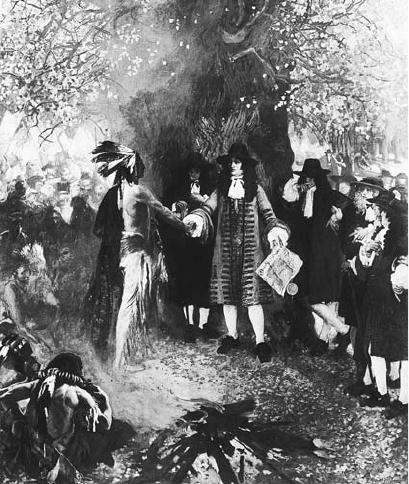
This painting shows William Penn negotiating a
treaty with Native Americans.
(Library of Congress)
vi+904_EofUSConsti-v2.indd 545 3/20/09 2:18:03 PM
Beginning in 1682, Penn came to America and
established the plans for his capital city of Phila-
delphia. Soon after, he traveled inland, making
treaties with local Native American tribes and
even learning native languages. Penn’s treatment
of the Natives was unlike that of any other English
colony, leading to fair payment for the land, fair
trials in disputes between Natives and colonists,
and a lengthy period of peace. Additionally, Penn
received praise from European intellectuals like
Voltaire for his fair treatment of the Natives and
his religious-tolerance principle.
The colony developed rapidly, but Penn did
not earn enough money from his colony to pay
his debts in England (caused by mismanagement
by a fi nancial adviser), forcing him to return to
England in 1684. He returned to America briefl y
in 1699, but passed most of the remainder of his
life facing his economic diffi culties in England.
After suffering a stroke in 1712, Penn passed
away six years later in Ruscombe, England, as
a poor man. His accomplishments however,
inspired the Founding Fathers to build upon his
principles of religious tolerance and separation
of powers, ultimately espousing them in the U.S.
Constitution.
For more information: Kroll, Steven, and Ron-
ald Himler. William Penn: Founder of Pennsylva-
nia. New York: Holiday House, 2000; Soderlund,
Jean R. William Penn and the Founding of Penn-
sylvania: 1680–1684. Philadelphia: University of
Pennsylvania Press, 1983.
—Arthur Holst
Pennsylvania v. Nelson 350 U.S. 497 (1956)
In Pennsylvania v. Nelson, the Supreme Court
held by a 6-3 vote that federal antisedition leg-
islation preempted the prosecution of a commu-
nist under a state sedition law. The case aroused
great interest because, when Nelson was decided,
42 states had such laws. In addition, critics of the
Court’s school desegregation case, BROWN V.
BOARD OF EDUCATION, 347 U.S. 483 (1954), saw
Nelson as another instance of the Court’s intrud-
ing on states’ rights.
Steve Nelson, a Communist Party organizer,
was convicted of violating the Pennsylvania Sedi-
tion Act, which made it illegal to threaten the
overthrow of the federal government or of Penn-
sylvania’s government. The Pennsylvania Supreme
Court reversed on preemption grounds, point-
ing out that Nelson had not uttered a “single word
. . . against the Government of Pennsylvania.”
The United States Supreme Court affirmed.
Writing for the majority, Chief Justice Earl War-
ren noted the many federal laws targeting sedi-
tion, including the Smith Act (1940), the Internal
Security Act of 1950, and the Communist Control
Act (1954). Although none of these acts directly
excluded state prosecutions, taken together, they
demonstrated a congressional intent to “occupy
the field” of sedition law. Chief Justice Warren
added that state sedition laws posed “a serious
danger of confl ict” with federal antisedition laws.
Here he drew on testimony from FBI director J.
Edgar Hoover, who—writing in 1940—stressed
the importance of “meeting the spy or saboteur”
with the “experienced men” of the FBI.
Chief Justice Warren pointed to another dan-
ger. Unlike the Smith Act, which left the power
to prosecute in the hands of government offi cials,
the Pennsylvania law let private individuals fi le
charges. Other laws criminalized mere mem-
bership in subversive organizations—unlike the
Smith Act, which explicitly rejected this basis of
liability. The concern with the scope of sedition
laws foreshadowed Yates v. United States, 354
U.S. 298 (1957), which interpreted the Smith Act
narrowly to exclude statements that abstractly
advocated the overthrow of the government.
Justice Reed, joined by Justices Burton and
Minton, dissented. Justice Reed argued that none
of the laws passed by Congress explicitly rejected
state regulation of sedition. Nor should the court
preempt based on “[m]ere fear . . . of possible dif-
fi culties.” Finally, Justice Reed rejected the notion
that state offi cials were “less alert to ferret out . . .
subversion.”
The reaction to Nelson was quite negative.
States felt a threat both to their ability to fi ght sub-
version and to their dignity. There was widespread
agreement among scholars, the media, and federal
546 Pennsylvania v. Nelson
vi+904_EofUSConsti-v2.indd 546 3/20/09 2:18:04 PM
legislators themselves that Congress had never
intended to overrule state sedition laws. Repre-
sentative Howard Smith, author of the Smith Act,
proposed legislation limiting preemption of state
legislation to those situations where Congress
explicitly stated its intent to occupy the fi eld. The
legislation was reported out of the House and
Senate but never brought to a vote.
The occupation of the field test survived to
remain a pillar of federal preemption doctrine.
Meanwhile, Nelson remains noteworthy as the
moment during the Cold War when the Court
began to return to the libertarian approach that
dominated the 1930s and 1940s.
For more information: Belknap, Michael R.
Cold War Political Justice: The Smith Act, the
Communist Party, and American Civil Liber-
ties. Westport, Conn.: Greenwood Press, 1977;
Caute, David. The Great Fear: The Anti-Com-
munist Purge under Truman and Eisenhower.
New York: Simon & Schuster, 1978; Hunt, Alan
Reeve. “State Control of Sedition: The Smith Act
as the Supreme Law of the Land.” Minnesota Law
Review 41 (1958): 287–332.
—Robert A. Kahn
Penry v. Lynaugh 492 U.S. 302 (1989)
In Penry v. Lynaugh, the Supreme Court ruled
that a jury should be instructed to consider men-
tal retardation as a mitigating circumstance dur-
ing the sentencing phase of a trial. The Court also
held that the execution of the mentally retarded
did not violate the Eighth Amendment’s prohibi-
tion against cruel and unusual punishment.
On October 22, 1979, Pamela Carpenter was
raped, beaten, and stabbed with a pair of scissors
in her home in Livingston, Texas. Although she
later passed while receiving medical treatment
at the hospital, Pamela was able to describe her
assailant to the local sheriff. Penry, who had just
been released on parole after being convicted on
another rape charge, matched the description.
Two local sheriffs apprehended the suspect and,
while in custody, Penry confessed to the crime
and was charged with capital murder.
At trial, Penry was found competent to stand
trial, even though a psychologist had testifi ed that
Penry was mentally retarded and had the men-
tal age of a 6½-year-old. Penry raised an insan-
ity defense, arguing that he suffered from brain
damage and moderate retardation, but the jury
rejected his claim and found him guilty of capital
murder. During the penalty phase, the jury was
not instructed that it could consider the mitigating
circumstances of Penry’s mental retardation, and
he was sentenced to death. Penry appealed to the
Texas Court of Criminal Appeals, which rejected
his claim and affi rmed his conviction. The federal
district court then denied his habeas corpus
petition, and the court of appeals affi rmed. The
Supreme Court partially affi rmed and partially
reversed the lower court’s decision, holding that,
although the jury should have been instructed to
consider Penry’s mental defi ciencies during the
sentencing phase, the Eighth Amendment did not
categorically prohibit the execution of the men-
tally ill.
Justice Sandra Day O’Connor wrote the
opinion of the Court, in which Justices Wil-
liam J. Brennan, Jr., Marshall, Blackman and
John Paul Stevens joined, with respect to the
first issue raised by Penry. In her opinion, she
argued that the Texas death penalty statute was
applied unconstitutionally, because the jury was
not allowed to consider Penry’s mitigating circum-
stances during the sentencing phase of his trial.
O’Connor went on to argue that, although the jury
should have considered his mental retardation and
history of abuse, this decision would not create a
new rule requiring juries to always consider men-
tal retardation and child abuse before imposing
the death penalty.
Justice O’Connor also wrote the opinion of the
Court with respect to Penry’s second claim, in
which Chief Justice William Hubbs Rehnquist
and Justices White, Antonin Gregory Scalia,
and Anthony M. Kennedy joined. O’Connor
argued that the execution of the mentally retarded
does not violate the Eighth Amendment, because
opinion surveys and state statutes did not estab-
lish the required societal consensus banning such
practice. Although a “national consensus against
Penry v. Lynaugh 547
vi+904_EofUSConsti-v2.indd 547 3/20/09 2:18:04 PM
execution of the mentally ill may someday emerge
refl ecting the ‘evolving standards of decency that
mark a maturing society,’ ” at the time Perry was
brought before the Court, Justice O’Connor could
not fi nd suffi cient consensus to rule such practice
unconstitutional.
In two separate concurring opinions, Justice
Brennan (joined by Marshall) and Justice Stevens
(joined by Blackmun) agreed with O’Connor that
the jury should have been instructed to consider
those mitigating circumstances but argued that
the Eighth Amendment did prohibit the execution
of the mentally retarded.
Justice Scalia authored the last concurring
opinion, which Chief Justice Rehnquist and Jus-
tices White and Kennedy joined. Although Scalia
agreed with O’Connor concerning the constitu-
tionality of the death penalty, he argued that the
jury should not be required to consider these
mitigating factors when considering whether to
impose the death penalty.
Overall, Penry made it clear that the Court
was not willing to create a new rule prohibit-
ing the execution of the mentally retarded until
a larger national consensus against such practice
could be shown. It would take another 13 years
for the Court to rule that the “evolving standards
of decency” were suffi cient, and in 2002 the Court
ruled in A
TKINS V. VIRGINIA that the Eighth Amend-
ment to the Constitution prohibited the execution
of the mentally retarded.
For more information: Latzer, Barry. Death
Penalty Cases: Leading U.S. Supreme Court
Cases on Capital Punishment. Woburn, Mass.:
Butterworth-Heinemann, 1998.
—Katherine M. Miller
people with disabilities
The Americans with Disabilities Act (ADA),
enacted on July 26, 1990, is the nation’s most far-
reaching attempt to combat discrimination on the
basis of disabilities. The law emerged out of the
disability rights movement of the 1970s and 1980s
and was intended to establish a “national mandate”
to end discrimination against people with disabili-
ties and to guarantee that the federal government
would play a major role in enforcing the law.
In enacting the ADA, Congress guaranteed
civil rights protection to persons with dis-
abilities in employment, in the delivery of state
and local government services, including public
transportation, in public accommodations, and
in telecommunications. At the time of its pas-
sage, Congress estimated that there were at least
43 million people with disabilities in the United
States and that this number would increase as
the population aged. The law allowed individu-
als complaining of discrimination to sue private
businesses as well as state and local governments.
Although Congress had enacted laws to protect
the rights of disabled persons in the past—the
Architectural Barriers Act of 1968; the Urban
Mass Transportation Act of 1970; the Rehabili-
tation Act of 1973; the Education of All Handi-
capped Children Act of 1975, later amended and
renamed the Individuals with Disabilities Educa-
tion Act; the Air Carrier Access Act of 1986; and
the Fair Housing Act Amendments of 1988—it
was not until the ADA was passed that the nation
adopted a comprehensive approach to combating
discrimination on the basis of disabilities, produc-
ing a law that drew on well-established principles
of civil rights guarantees.
In the late 1960s, people with disabilities began
to be recognized as a civil rights group, follow-
ing in the path of women and racial minorities.
For the most part, however, their claims were not
based on constitutional rights, but on federal laws
enacted by Congress.
The fi rst major piece of disability rights legis-
lation was the 1973 Rehabilitation Act. Its most
important provision was Section 504, which pro-
hibits discrimination in federally assisted pro-
grams on the basis of disability. Shortly after
the passage of the Rehabilitation Act, Congress
enacted the Education of All Handicapped
Children Act (EAHCA) in 1975; in 1990, it was
renamed the Individuals with Disabilities Educa-
tion Act (IDEA). The heart of the bill was a grants-
in-aid program that required states to allocate
signifi cant resources for the education of children
with disabilities if they wished to receive federal
548 people with disabilities
vi+904_EofUSConsti-v2.indd 548 3/20/09 2:18:05 PM
funding; they could avoid the requirements of
the act by refusing the federal funds. Subsequent
amendments to the EAHCA expanded the state’s
responsibility to children from birth to 21, guar-
anteed a wide range of educational and support
services, and specifi ed that all children were cov-
ered, whether they lived at home or in a foster
care or institutional setting.
During the 1980s and 1990s, Congress contin-
ued to enact laws affecting the rights of people
with disabilities. Perhaps the most comprehensive
legislation predating the ADA was the Fair Hous-
ing Act Amendments (FHAA) of 1988, amending
the 1968 Fair Housing Act (FHA). The 1968 FHA
prohibited discrimination in the sale and rental of
public and private housing on the basis of race,
religion, and national origin. The 1988 FHAA
extended the law to include discrimination based
on disability in selling, renting, fi nancing, zoning,
new construction design, and advertising.
During the 1970s, there had been a good deal
of support for ending discrimination against peo-
ple with disabilities, in part fueled by the disabil-
ity community’s association with the ideology and
rhetoric of the Civil Rights movement. Through-
out the 1980s, disability rights groups became
adept at political mobilization, demanding equal-
ity for people with disabilities, reminiscent of the
earlier struggles for civil rights. By the end of the
decade, as disability advocates became convinced
that Section 504 was inadequate to achieve their
goal of removing barriers to their full participa-
tion in society, they began to press members of
Congress to enact a successor to Section 504.
It became increasingly clear that more com-
prehensive legislation was needed when, in 1985,
the United States Supreme Court decided City
of Cleburne v. Cleburne Living Center, 473 U.S.
432 (1985), a case establishing the boundaries of
the equal protection guarantee of the Four-
teenth Amendment for people with disabilities.
In this case, the Court held that the Constitution
permitted states latitude in enacting laws based
on disability, merely requiring them to act ratio-
nally. Although the plaintiffs succeeded in chal-
lenging the zoning regulation, the Court ruled
that laws based on disability were consistent with
the Fourteenth Amendment as long as they were
reasonable.
As a result of wide-ranging lobbying efforts by
disability rights advocates, Congress enacted the
ADA, a wide-ranging law, banning discrimination
on the basis of disabilities in employment (Title
I), in the delivery of state and local government
services, including public transportation (Title
II), in public accommodations (Title III), and in
telecommunications (Title IV). Title V consists
of miscellaneous provisions, including attorneys’
fees, alternative dispute resolution, retaliation,
consistency with state laws, and insurance under-
writing. The law defi nes a disability with a broad
stroke, classifying “an individual with a disability”
as a person with “a physical or mental impairment
that substantially limits one or more of the major
life activities” of an individual. The second part
of the defi nition, “has a record of such an impair-
ment,” refers to an individual “who has a history
of, or has been misclassifi ed as having, a mental or
physical impairment that substantially limits one
or more major life activities.” The third, “regarded
as,” prong applies to individuals who have no sub-
stantially limiting impairments but are treated as
if they do, or their substantially limiting impair-
ments result from the attitudes of others.
For more information: Fleischer, Doris Zames,
and Frieda Zames. The Disability Rights Move-
ment: From Charity to Confrontation. Philadel-
phia: Temple University Press, 2001; Mezey, Susan
Gluck. Disabling Interpretations: Judicial Imple-
mentation of the Americans with Disabilities Act.
Pittsburgh: University of Pittsburgh Press, 2005;
O’Brien, Ruth. Crippled Justice: The History of
Modern Disability Policy in the Workplace. Chi-
cago: University of Chicago Press, 2001; Percy,
Stephen L. Disability, Civil Rights, and Public
Policy. Tuscaloosa: University of Alabama, 1989.
—Susan Gluck Mezey
peremptory challenges
Peremptory challenges refer to the right that par-
ties are given during jury selection to remove
potential jurors without being required to offer a
peremptory challenges 549
vi+904_EofUSConsti-v2.indd 549 3/20/09 2:18:05 PM
reason. These challenges have come under consti-
tutional scrutiny in the last few years because of
allegations they are used in a racially biased fash-
ion or on account of gender.
The process of jury selection is known as voir
dire, which means “to speak the truth” in French.
In the process of selecting a jury, each side in a trial
wishes to remove jurors who are biased against
their client, and they also seek to fi nd jurors who
will be sympathetic towards their client. Potential
jurors, also known as veniremen, who are removed
based on the sole discretion of the attorney (usually
with the consent of his or her client) are excused
through a process called peremptory challenges
or peremptory strikes during jury selection. Other
jurors who are removed for a particular reason by
the judge are excused based on a cause challenge.
Usually, this is because of an obvious reason, such
as that the potential juror is related to a party or
the potential juror states that he or she cannot be
fair and impartial in this case. There is no maxi-
mum number of cause challenges.
One concern with the use of peremptory chal-
lenges is using them due to bias. In the South,
prior to the civil rights era of the 1950s and
1960s, it was not uncommon for all-white juries
to convict African Americans of crimes. This was
the case in the famous Scottsboro case of the
1930s. In B
ATSON V. KENTUCKY, 476 U.S. 79 (1986),
the Supreme Court ruled that race was an imper-
missible basis for using a peremptory challenge
by the state against an African-American juror.
Other United States Supreme Court cases have
further solidified this decision. Among others,
Edmonson v. Leesville Concrete Co., 500 U.S.
614 (1991), applied Batson to juries in civil trial,
and Georgia v. McCollum, 505 U.S. 42 (1992),
extended Batson to disallow the discriminatory
use of a criminal defendant’s own peremptory
strikes based on race. Later, in J.E.B. V. ALABAMA,
511 U.S. 127 (1994), the high court applied Bat-
son to gender.
Many critics of peremptory challenges see
their potential abuse as so great that they advo-
cate eliminating them or turning the process of
jury selection over to the presiding judge. Former
Associate Justice of the United States Supreme
Court Thurgood Marshall made this argument
in his concurring opinion in the Batson case, in
fact. Many attorneys feel, however, that peremp-
tory strikes are absolutely necessary to ensure a
fair trial.
For more information: Klarman, Michael J.
From Jim Crow to Civil Rights: The Supreme
Court and the Struggle for Racial Equality. New
York: Oxford University Press, 2004; Mauet,
Thomas A. Trial Techniques. 4th ed. Frederick,
Md.: Aspen Publishing, Inc., 1996.
—Maria Collins Warren
Philadelphia v. New Jersey 437 U.S. 617
(1978)
The Supreme Court ruled on the case of the City
of Philadelphia v. New Jersey that New Jersey’s
waste importation restriction laws were unconsti-
tutional, because they violated the Constitution’s
commerce clause by discriminating against
another state’s goods.
In 1973, the government of the state of New
Jersey passed a law forbidding the importation
of waste “solid or liquid which was originated or
was collected outside of the territorial limits of
the State.” For New Jersey, this law carried great
importance, as the state was seen regionally and
nationally as a receiving center for garbage and
waste originating from nearby states, especially
New York and Pennsylvania. The law was passed
in order to counteract what was seen as an unac-
ceptable amount of waste being disposed of within
the state boundaries of New Jersey.
Almost immediately, this new law caused seri-
ous logistical waste disposal issues for cities near
New Jersey, such as New York and Philadelphia,
that had traditionally shipped their waste to land-
fi ll operators located there. As a result, cities and
landfi ll operators began to sue the state of New
Jersey in order to challenge the constitutionality
of the law. The major case was spearheaded by the
city of Philadelphia.
A positive verdict for the city was received from
the original trial, because the judge was convinced
that the law violated the commerce clause of the
550 Philadelphia v. New Jersey
vi+904_EofUSConsti-v2.indd 550 3/20/09 2:18:05 PM
Constitution by restricting interstate trade. The
ruling was soon challenged by the state of New
Jersey, leading to a case in the Supreme Court of
New Jersey. The state supreme court reversed the
original verdict, claiming that the law had other
benefi ts, which outweighed the minor interstate
commercial issues related to the law. In their
decision, the court stated that the public health
of the citizens of New Jersey and the protection
of the state’s environment was more important
than absolute protection of the commerce clause.
In response, the city of Philadelphia’s legal team
decided to appeal the decision of the state supreme
court to the U.S. Supreme Court.
The U.S. Supreme Court accepted the appeal,
and arguments began on March 27, 1978. The
Court delivered its decision roughly three months
later on June 23, 1978, overturning the Supreme
Court of New Jersey’s reversal of the original deci-
sion. Justice Potter Stewart wrote the 7 to 2 major-
ity opinion, rejecting New Jersey’s claims that waste
was not a matter of interstate commerce, since
it believed it to be “worthless.” Stewart stated that
this argument was false and was not an exception
to the commerce clause, since waste has an eco-
nomic value, whether it is positive or negative. Ulti-
mately, New Jersey’s 1973 waste restriction law was
overturned as unconstitutional for discriminating
against products from another state and violating
interstate commerce clauses and precedents.
Justice William Hubbs Rehnquist wrote
the dissenting opinion, arguing that products that
may cause public health issues should fall subject
to quarantine laws, which prohibit exportation
and importation of harmful products. Neverthe-
less, New Jersey has since tried to fi nd other ways
to cope with its waste importation issues and high
population density, promoting waste reduction
efforts in Philadelphia and creating waste inciner-
ators in numerous counties throughout the state.
For more information: Corwin, Edward S. The
Commerce Power Versus States’ Rights. Princeton,
N.J.: Princeton University Press, 1936; Schwartz,
Bernard. A History of the Supreme Court. New
York: Oxford University Press, 1993.
—Arthur Holst
Pierce v. Society of the Sisters of the Holy
Names of Jesus and Mary
268 U.S. 519
(1925)
Pierce v. Society of the Sisters of the Holy Names
of Jesus and Mary is a U.S. Supreme Court
decision upholding economic and personal lib-
erty against government regulation. As such,
two major strands of the constitutional doctrine
known as substantive due process intersect
in the judgment. Pierce also is doubly ironic, fi rst,
because of its origins and, second, because of its
author.
Pierce originated in a challenge to a 1922 ini-
tiative measure adopted by Oregon voters. The
Oregon compulsory public school law required
all children under 16 to be educated in pub-
lic schools. What spawned this mandate was an
incongruous—not untypical American—mix of
aspirations and anxieties: populist support for
universal education, civic literacy, and curricular
reform commingled with bias, bigotry, and fear
of the Red Menace. Groups supporting the initia-
tive included Scottish Rite Masons, the American
Legion, the Federation of Patriotic Societies, and
the Ku Klux Klan, which had close to 15,000 Ore-
gon members in the 1920s and controlled the state
legislature during that decade.
A primary target of the compulsory public
school movement was Catholic parochial educa-
tion. Appellant Walter M. Pierce, 16th governor
of Oregon, personified the blend of intolerance
and ideals underlying the Oregon law. The Roman
Catholic Church, Pierce believed, was “an author-
itarian institution bent upon subverting demo-
cratic thought and human progress.” He also
believed that public school education could teach
even Catholic children to be good Americans.
From these thorny circumstances came a decision
affi rming fundamental rights.
Justice James C. McReynolds wrote the unani-
mous opinion. More bigoted than Governor Pierce,
McReynolds was an unlikely champion of liberty.
Nevertheless, in his Pierce, opinion, McReynolds
defi ned “liberty” expansively. In Pierce, McReyn-
olds relied on a decision he had authored two
years previously, Meyer v. Nebraska, 262 U.S. 390,
where he had written that liberty was
Pierce v. Society of the Sisters of the Holy Names of Jesus and Mary 551
vi+904_EofUSConsti-v2.indd 551 3/20/09 2:18:05 PM