
Schultz D. Encyclopedia of the United States Constitution
Подождите немного. Документ загружается.

standard” element as an exercise in futility. The
Court also reaffi rmed some basic underlying ideas
espoused in their earlier cases, emphasizing the
importance of a free and robust exchange of ideas.
Citing Roth, they reiterated that the First Amend-
ment was to protect the exchange of ideas for the
purpose of bringing political and social changes
desired by the people, and that public portrayal of
hard-core sexual conduct for commercial gain falls
outside the protection of the Constitution.
The dissenters in Miller, Justices William O.
Douglas, Brennan, Stewart, and Marshall, felt
that the law was still too vague and overbroad. Jus-
tice Douglas wrote that “what shocks me may be
sustenance for my neighbor” and that “obscenity—
which even we cannot defi ne with precision—is
a hodge-podge. To send men to jail for violating
standards they cannot understand, construe, and
apply is a monstrous thing to do in a Nation dedi-
cated to fair trials and due process.”
Despite the concerns of the dissenting justices,
the Miller test remains alive and well. It was last
utilized by the Court in deciding A
SHCROFT V.
ACLU, 535 U.S. 564 (2002). Some legal scholars
see the application of Miller as an affirmation
of its continued viability and an indication that
the Court has no intention of reformulating an
obscenity test any time soon.
Obscenity laws apply to all forms of publica-
tions, printed or recorded, on paper, tape, or in
cyberspace. The widespread availability and use
of the Internet in the late ’90s prompted Congress
to pass several forms of legislation intended to
keep obscene materials from being easily viewed
by children. All of the laws enacted were chal-
lenged and have been struck down in whole or in
part. The Court found that the 1996 Communi-
cations Decency Act and portions of the 1998
Child Online Protection Act and the Child Por-
nography Prevention Act were unconstitutionally
overbroad in several cases, including Ashcroft v.
ACLU.
The Court acknowledged the government’s
compelling interest in protecting minors from
commercial pornographers, but found that all
three laws were overbroad and that there were
less restrictive alternatives available that would
not unduly interfere with an adult’s constitutional
right to view this type of materials.
The Supreme Court has been diligent and
steadfast in upholding the First Amendment. It
should also be noted that state law, federal law,
and the Supreme Court have never set their sights
on punishing or limiting private, individual, in-
home possession of obscene materials. In all the
cases, the focus of attention was on the distribu-
tion and sale of materials by dealers for commer-
cial gain. However, the mere possession of child
pornography is in violation of the law. The Court
has noted that child pornography can con-
stitutionally be totally proscribed because of the
state’s interest in protecting the children exploited
in the production process.
For more information: Kalven, Harvey. A Wor-
thy Tradition: Freedom of Speech in America.
New York: Harper & Row, 1988.
—Loretta M. Young
O’Connor, Sandra Day (1930– ) Supreme
Court justice
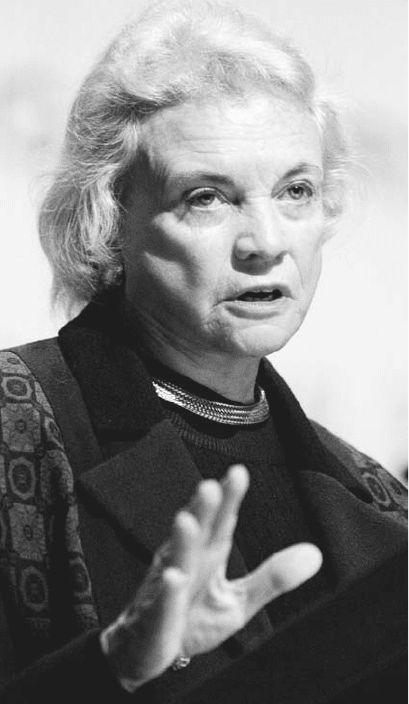
Sandra Day O’Connor was sworn in as the first
female Supreme Court justice on September 25,
1981, after being nominated by President Ron-
ald Reagan and confi rmed 99–0 by the Senate.
On July 1st, 2005, O’Connor announced that her
retirement from the Supreme Court would occur
upon the confi rmation of her successor. However,
with the death of Chief Justice William Hubbs
Rehnquist, John G. Roberts, Jr., who was
nominated to assume O’Connor’s position, instead
took the place of Rehnquist. The retirement of
Sandra Day O’Connor from the Supreme Court
became offi cial on January 31, 2006, when Sam-
uel Alito was sworn in as associate justice.
On March 26, 1930, Sandra was born to Henry
and Ada Day in El Paso, Texas. She spent most of
her childhood on a cattle ranch in southeastern
Arizona, where she worked on the ranch and read
in her spare time.
The intelligent Sandra Day headed to Stanford
University in California for college. In 1950, she
graduated with a bachelor’s degree in economics
522 O’Connor, Sandra Day
vi+904_EofUSConsti-v2.indd 522 3/20/09 2:17:57 PM
and headed off to Stanford Law School. Her per-
formance in law school was stellar. She completed
the course work in two years instead of three,
served on the Stanford Law Review, was inducted
into the legal honor society Order of the Coif, and
graduated third in a class of 102. The person who
graduated fi rst in that class was future Chief Jus-
tice William Hubbs Rehnquist. Rehnquist and
Sandra Day formed a close friendship during
law school that including a brief period of dating.
They would become lifelong friends. While in law
school, Sandra did meet the man that she would
eventually marry, John Jay O’Connor III. The
couple married on December 20, 1952, about six
months after Sandra graduated law school.
Since the beginning of her legal career, being
female played a major role. Despite stellar per-
formance in law school, the only job Sandra Day
O’Connor was offered was a secretarial position
in Los Angeles. At that time, there were very few
women in the legal industry, and law fi rms were
not willing to hire a woman to be an attorney.
Women in law fi rms generally worked only in sec-
retarial and administrative positions. Given her
training and intellectual capabilities, O’Connor
continued searching for a position as an attorney.
She turned to a district attorney in San Mateo
County, California, who had previously hired a
female attorney, and she sought any position as an
attorney. The district attorney gave her an attor-
ney position, even though it was unpaid initially.
In this position, O’Connor found that she loved
being a lawyer and the fulfi llment of a career in
public service.
The following year, in 1953, O’Connor’s hus-
band John graduated from law school and took a
position with the army’s Judge Advocate General
Corps stationed in Frankfurt, Germany. Sandra
Day O’Connor went with her husband, but once
again found diffi culties gaining employment. In
Germany, she worked as a civilian lawyer with
the Quartermaster Corps. After a few years in
Germany, John O’Connor found a good job with
a large law firm in Phoenix, Arizona, in 1957.
Despite having higher grades and class ranking
than her husband, Sandra once again had dif-
fi culties fi nding a position and eventually ended
up forming her own law fi rm with another person.
Within the fi rst six years of living in Phoenix, the
O’Connors had three sons, and Sandra decided
to become a full-time mother and part-time vol-
unteer in 1962, when her second son was born.
In 1965, she decided to return to full-time legal
work and found a position in the Arizona attor-
ney general’s offi ce. After excelling in the attorney
general’s offi ce, she was appointed to the Arizona
state senate in 1969. Starting in 1974, she served
as a judge on the Maricopa County Superior
Court. Five years later, Governor Bruce Babbitt
appointed her to the Arizona Court of Appeals.
Associate Justice Sandra Day O’Connor (United
States Supreme Court)
O’Connor, Sandra Day 523
vi+904_EofUSConsti-v2.indd 523 3/20/09 2:17:57 PM
At a time when women faced many barriers in the
legal industry, she excelled and eventually earned
an appointment to the United States Supreme
Court.
When O’Connor became the fi rst female justice,
the Court adopted the term “Justice” instead of
addressing each other as “Mr. Justice.” Observers
assumed that she would become one of the most
conservative members of the Court. As a justice
on the Supreme Court, she often voted with other
conservatives such as Chief Justice Rehnquist.
Generally, she opposed extending new rights to
those accused of committing crimes, and she was
also a reliable vote in supporting states rights and
federalism, such as in U
NITED STATES V. LOPEZ,
514 U.S. 549 (1995), seeking to place some lim-
its upon the ability of the federal government to
regulate states or tell them what to do. Over time,
O’Connor seemed to change or moderate her con-
servative views. For example, while in WEBSTER
V. REPRODUCTIVE HEALTH SERVICES, 492 U.S. 490
(1990), she voted to uphold some restrictions on
the use of state funds to provide for abortion
services, in PLANNED PARENTHOOD OF SOUTHEAST-
ERN PENNSYLVANIA V. CASEY, 505 U.S. 833 (1992),
she wrote the majority opinion reaffi rming ROE V.
WADE, 410 U.S. 113 (1973), affi rming the right of
women to terminate pregnancies. Additionally, in
cases such as SHAW V. RENO, 509 U.S. 690 (1993),
she was very critical of the use of race in the draw-
ing of district lines, but in GRUTTER V. BOLLINGER,
539 U.S. 306 (2003), she wrote the majority opin-
ion affi rming the use of race in a law school admis-
sions process in order to promote diversity. Finally,
while in BOY SCOUTS OF AMERICA V. DALE, 530 U.S.
640 (2000), she upheld the right of the Boy Scouts
to exclude a gay leader from their organization, in
LAWRENCE V. TEXAS, 539 U.S. 558 (2003), she wrote
a separate concurrence striking down, on equal
protection grounds, a state law that criminal-
ized consensual homosexual sodomy.
In her last couple of years on the Supreme
Court, Justice O’Connor became a critical swing
vote. With the Court often deadlocked 4-4
between liberals and conservatives, her fi fth vote
was highly sought and generally decided the out-
come in the case.
After leaving the Court in 2006, she toured
the country speaking, and also served as a senior
judge in some lower federal court cases.
For more information: Maveety, Nancy. Jus-
tice Sandra Day O’Connor. New York: Rowman
& Littlefi eld Publishers, 1996; McFeatters, Ann
Carey. Sandra Day O’Connor: Justice in the Bal-
ance. Albuquerque: University of New Mexico,
2005.
—Carol Walker
Ogden v. Saunders 25 U.S. 213 (1827)
In Ogden v. Saunders, the Supreme Court upheld
a state bankruptcy law against claims that it vio-
lated the contract clause of the Constitution.
Article I, Section 10, Clause 1 of the Constitu-
tion states, “No State shall enter into any Treaty,
Alliance, or Confederation; grant Letters of
Marque and Reprisal; coin Money; emit Bills
of Credit; make any Thing but gold and silver Coin
a Tender in Payment of Debts; pass any bill of
attainder, ex post facto Law, or Law impairing
the Obligation of Contract, or grant any Title of
Nobility.” Article I, Section 8, Clause 4 notes that
Congress has the power “to establish an uniform
Rule of Naturalization, and uniform laws on the
subject of Bankruptcies throughout the United
States.” Ogden v. Saunders focuses on portions
of these two sections—the issue of making laws
“impairing the Obligation of Contracts” and laws
on the subject of bankruptcies. This case involved
a citizen of Kentucky named Saunders who was
suing a Louisiana citizen named Ogden over a
contract dispute. Ogden had been a resident of
Louisiana when the two agreed to the contract.
Ogden subsequently moved to New York. Saun-
ders claimed in the suit that Ogden had not made
payment on the obligation. Ogden, as a resident of
New York, claimed bankruptcy as his defense on
an 1801 New York bankruptcy law.
In a 4-3 decision, Justice Washington, in his
discussion of the case, posed an intriguing ques-
tion. The first and most important point to be
decided in this cause turns essentially upon the
question whether the obligation of a contract is
524 Ogden v. Saunders
vi+904_EofUSConsti-v2.indd 524 3/20/09 2:17:58 PM
impaired by a state bankruptcy law or insolvent
law, which discharges the person from his liability
under a contract entered into in that state after
the passage of the act.
The key question here was whether Congress
had the sole power to pass bankruptcy laws, which
hinged on what was meant by the phrase regard-
ing the enactment of laws “impairing the Obli-
gation of Contracts.” The Court found that the
New York law was not in violation of the contract
clause contained in the U.S. Constitution. In other
words, for any contract that is made after the
enactment of a bankruptcy law, any obligations set
forth in the contract are subject to the provisions
of that law. In other words, once a bankruptcy law
is enacted, that law becomes part of any contract
that is entered into after the date of enactment.
However, even though the Court upheld the legal-
ity of the 1801 New York law, it restricted its appli-
cability to the state in which the law was enacted.
For more information: Hall, Kermit L., and
Kevin T. McGuire, eds. The Judicial Branch. New
York: Oxford University Press, 2005.
—Dan Krejci
Olmstead v. United States 277 U.S. 438
(1928)
In Olmstead v. United States, the Court ruled that
using evidence from wiretaps without a warrant
is not an illegal search and seizure violating the
Fourth Amendment. This decision promotes
the physical trespass theory, which says that the
Fourth Amendment prevents the government only
from physically seizing tangible items, not intan-
gible items like conversations. Forty years later,
the Court overruled Olmstead in Katz v. United
States, 389 U.S. 347 (1967).
Roy Olmstead was a successful bootlegger who
was indicted and convicted for importing and sell-
ing liquor during Prohibition. At his trial, pros-
ecutors introduced incriminating evidence from
wiretaps placed on Olmstead’s and his partner’s
telephone lines without a warrant. Olmstead
unsuccessfully sought to exclude this evidence
on the grounds that it was an illegal search and
seizure under the Fourth Amendment and that
it violated his Fifth Amendment right against
self-incrimination. The appellate court
affi rmed the conviction, and the Supreme Court
upheld wiretapping in a 5-4 decision.
Writing for the majority, Chief Justice Taft
promoted the physical trespass theory, which says
that the Fourth Amendment protects only tan-
gible things such as houses, persons, papers, etc.,
from physical intrusion and literal seizure. Since
the police did not enter the house or offi ce of the
accused and they cannot seize the spoken word,
there was no search and no seizure. The police
simply tapped lines outside the house and wrote
down the conversations they heard, making the
wiretap the equivalent of overhearing a conversa-
tion in public. Moreover, since there was no illegal
search, there was no Fifth Amendment violation
against self-incrimination.
In dissent, Justice Brandeis objected to the lit-
eral interpretation of the Constitution, claiming
that constitutional doctrine must change as tech-
nology changes. He believed that physical intru-
sion and seizure is immaterial, because the Fourth
Amendment protects against “every unjustifi able
intrusion by the government upon the privacy of
the individual.” Wiretapping violated Olmstead’s
privacy, and the evidence should be thrown out.
In a separate dissent, Justice Butler used a lit-
eral approach infused with property rights prin-
ciples to protect the conversations. He claimed
that the parties on the phone own their conversa-
tion, because the wires belong solely to the par-
ties communicating at that time. Thus, any seizure
violates the Fourth Amendment.
In response to this decision, Congress prohib-
ited the warrantless wiretapping of telephones and
telegraphs by passing the Federal Communica-
tions Act in 1934. However, the physical trespass
theory still allowed the police to intercept conver-
sations by listening through walls as long as they
did not physically invade the individual’s home or
offi ce. Eventually, the Supreme Court replaced
the physical intrusion standard with the “reason-
able expectation of privacy” standard in Katz,
providing greater protection to persons, conversa-
tions, homes, businesses, papers, etc.
Olmstead v. United States 525
vi+904_EofUSConsti-v2.indd 525 3/20/09 2:17:58 PM
For more information: Diffi e, Whitfi eld, and
Susan Landau. Privacy on the Line: The Politics of
Wiretapping and Encryption. Cambridge, Mass.:
MIT Press, 1998; Kerr, Orin S. “The Fourth
Amendment and New Technologies: Constitu-
tional Myths and the Case for Caution.” Michigan
Law Review 102 (March 2004): 801–888.
—Sean Evans
one person, one vote
“One person, one vote” is a voting principle that
emphasizes political equality which was fi rst pro-
nounced as a constitutional rule by the Supreme
Court in REYNOLDS V. SIMS, 377 U.S. 533 (1964).
It gives assurance to citizens that their political
preference is equal in weight to those of all oth-
ers. Such equality is politically fair, because it
preserves the core ideal of universal suffrage by
incorporating the respect due, and the responsi-
bilities owed, to each citizen in a democracy.
In the United States, the concept of one per-
son, one vote originates from two sources: the
Constitution and the Supreme Court’s articula-
tion of relevant constitutional provisions. First,
from the Constitution, the concept of one person,
one vote is drawn from Article I, Section 2 and
the Fourteenth Amendment equal protec-
tion clause. While the Constitution states that
congressional apportionment of “representatives
and direct taxes shall be apportioned among the
several states . . . according to their respective
numbers,” the equal protection clause has been
the source of making the one person, one vote
principle applicable to states, since the Constitu-
tion vests primary responsibility to allocate leg-
islative districts to states. Second, in American
constitutional law and the politics of representa-
tion, the Supreme Court has been instrumental in
making the one person, one vote principle a cur-
rency in political conversations. It has done so in
a series of landmark decisions rendered between
1960 and 1969 that challenged serious population
inequities on how congressional and state district-
ing were drawn.
Prior to 1960, the Supreme Court did not show
much interest in reviewing state districting and
apportionment practices despite serious com-
plaints of population inequality in congressional
and state legislative districts. Before then, the
Supreme Court had ruled only in one case that
issues of state legislative apportionments were
political questions not appropriate for judicial
resolution. Its position on this matter is refl ected
in the plurality opinion in C
OLEGROVE V. GREEN
(1946), a case in which members of the Illinois
electorate challenged provisions of Illinois law
governing the apportionment of congressional
districts. Illinois voters claimed that, due to sub-
sequent changes in population, the congressional
districts for the election of representatives lacked
approximate equality of population. Three mem-
bers of that Court agreed that equal protection
required the election of congressmen from dis-
tricts that were generally equal in population. Jus-
tice Frankfurter wrote for the 4-3 undermanned
Court majority decision, where he warned against
the judiciary entering a “political thicket” of con-
gressional districting. He viewed the case as one
that did not present justiciable questions. Accord-
ingly, “the basis for the suit is not a private wrong,
but a wrong suffered by Illinois as a polity,”
Frankfurter wrote, and “the remedy for unfair-
ness in districting is to secure State legislatures
that will apportion properly, or invoke the ample
powers of Congress.”
Sixteen years later, the Supreme Court surpris-
ingly entered the very political thicket it previ-
ously deemed not to present justiciable questions
in 1946. Reversing Colegrove in a 6-2 decision in
BAKER V. CARR, 369 U.S. 186 (1962), the Court held
that apportionment issues were indeed reviewable
under the Fourteenth Amendment. More specifi -
cally, that “the mere fact the suit seeks protection
of political right does not mean that it presents a
political question.” This decision refl ected a sig-
nifi cant change in the Court’s jurisprudence and
a new development that facilitated the application
of the equality principle of one person, one vote in
subsequent cases. As exemplifi ed in Gray v. Sand-
ers (1963), Wesberry v. Sanders (1964), Reynolds
v. Sims (1964), and Kirkpatrick v. Preisler (1969)
discussed below, the principle of one person, one
vote would emerge as a fundamental political
526 one person, one vote
vi+904_EofUSConsti-v2.indd 526 3/20/09 2:17:58 PM
right, empowering citizens to partake in the pro-
cess of self-government.
Pioneering this principle in an 8-1 decision
in Gray v. Sanders, 372 U.S. 368 (1963), the
Supreme Court assuredly equated the concept of
political equality to one person, one vote. The case
involved Georgia’s notorious county unit system
of nominating candidates to statewide offi ces in
which each county was assigned a unit vote that
had little relation to its population. Invalidating
Georgia’s congressional districts on the grounds
of population inequality, the Court declared that
“[t]he conception of political equality from the
Declaration of Independence, to Lincoln’s
Gettysburg Address, to the Fifteenth, Seven-
teenth, and Nineteenth Amendments can
mean only one thing—one person, one vote.” Said
the Court, “Once the geographical unit for which
a representative is to be chosen is designated, all
who participate in the election are to have an equal
vote—whatever their race, whatever their sex,
whatever their occupation, whatever their income,
and wherever their home may be in the geographi-
cal unit. This is required by the Equal Protection
Clause of the Fourteenth Amendment.” While
the case dealt with the weight of a person’s vote
within a previously designated geographical unit,
the principle of “one person, one vote” announced
would later be extended to subsequent cases exam-
ining constitutional challenges of congressional
redistricting (Wesberry, 1964) and congressional
and state legislative redistricting (Reynolds, 1964).
In these two cases, the Court established defi ni-
tively that the United States Constitution imposed
a fundamental requirement on those charged with
congressional and state legislative redistricting to
approximate their population as “practicable” or
make them as “substantially” equal relative to the
population as possible.
Wesberry v. Sanders, 376 U.S. 1 (1964), was
the next case in the Court’s development of the
one person, one vote criterion. It involved a con-
gressional redistricting in the state of Georgia.
Citing the principle articulated a year before in
Gray as authority in a 6-3 decision, the Court
ordered that districts in Georgia be redrawn more
evenly. Holding that gross disparities in Georgia’s
congressional districts were a violation of the U.S.
Constitution, the Court concluded that “Article I,
Section 2 of the Constitution requires that rep-
resentatives shall be chosen by the people of the
several states” and be “apportioned among the
several States . . . according to their respective
Numbers.” Although in this case the Court recog-
nized the impossibility of drawing congressional
districts with mathematical precision, its dictum
revealed the expectation that “as nearly as is prac-
ticable one man’s vote in a congressional election
is to be worth as much as another’s.” Emphasiz-
ing the importance for a universally fair system of
election that incorporates the respect due and the
responsibilities owed to each citizen, the Court
observed further that “no right is more precious
in a free country than that of having a voice in the
election of those who make the laws under which,
as good citizens, we must live.” Other rights, even
the most basic, the Court added, “are illusory if
the right to vote is undermined.”
In Reynolds v. Sims (1964), a related case
decided four months after Wesberry but this time
focusing on state legislative districts alone, the
Supreme Court held that both houses of a state
legislature must be apportioned on the basis of
population equality and that “population” will
hence be the controlling factor in the construc-
tion of legislative districts. Upholding a lower
court decision invalidating Alabama’s legislative
apportionment, the Court observed that the equal
protection clause of the Fourteenth Amendment
requires that a state make an honest and good-
faith effort to construct districts, in both houses
of its legislature, as nearly equal in population as is
practicable. Put differently, the apportionment of
seats and boundary for legislative districts for both
houses of state legislatures had to be arranged so
that the number of inhabitants per legislator in
any one district is substantially equal or roughly
equal to the number of inhabitants per legislator
in any other district in the same state. Indeed, in
Baker v. Carr (1960), a case that in hindsight set
the stage for the development of the concept of
one person, one vote, the Supreme Court also held
that issues relative to state legislative apportion-
ment were appropriate for judicial review.
one person, one vote 527
vi+904_EofUSConsti-v2.indd 527 3/20/09 2:17:59 PM
Until Kirkpatrick v. Preisler, 394 U.S. 526
(1969), a case that challenged a Missouri con-
gressional redistricting plan, there were no clear
standards to achieve the one person, one vote
objectives clearly stated in previous cases. Surely,
Gray, Wesberry, and Reynolds strove to end the
pattern of gross rural overrepresentation and
urban underrepresentation. However, the conclu-
sion that emerged from these cases was that the
principle of proportionality should be practiced
in the strictest way possible to achieve political
equality. But how? The answer was at best unclear,
and perhaps was made deliberately so.
In announcing the one person, one vote rule in
June 1964, the Court left a considerable amount
of flexibility to the lower courts in working out
standards so long as population equality was the
general pattern. Refi ning that rule for Missouri’s
congressional redistricting plan in Kirkpatrick,
the Supreme Court held that states are required
to “come as nearly as practicable to population
equality,” provided that doing so (a) does not
offend the principle of one person, one vote; and
(b) so long as the ratio of representatives to vot-
ers remain equal. Article I, Section 2, the Court
reasoned, requires states to create congressional
districts that provide equal representation for
equal numbers of people with possible minimum
population variances that are unavoidable, despite
good-faith effort and for which a compelling justi-
fi cation can be presented.
In the Court’s view, setting an acceptable mini-
mum range is arbitrary and inconsistent with the
“as nearly as practicable” standard—a rule more
likely to encourage legislators to strive for the min-
imum rather than promote equality. The Court
concluded that even where population variances
among the districts were shown to be unavoidable
despite a state’s good-faith effort to achieve popu-
lation equality, the state must justify each varia-
tion, no matter its size. Lastly, for each contested
redistricting plan to prevail, states must prove that
the population deviation at issue is necessary to
achieve a legitimate state objective.
In Karcher v. Daggett, 462 U.S. 725 (1983), the
Supreme Court went further than before to pro-
vide needed clarity. It placed the burden on states
relative to any contested redistricting scheme that
undermines the one person, one vote principle
or political equality. Specifi cally, the Court con-
cluded that:
States must show with some specifi city that a par-
ticular objective requires the specifi c deviations
in its plan, rather than simply relying on general
assertions. The showing required to justify popu-
lation deviation is fl exible, depending on the size
of the deviations, the importance of the State’s
interests, the consistency with which the plan as
a whole refl ects those interests, and the availabil-
ity of alternatives that might substantively vindi-
cate those interests yet approximate population
equality more closely.
States must show with clear specifi city, rather than
make generalized assertions, the objective they
intend to accomplish for each deviation in their
apportionment and redistricting plans.
The overall effect of the Supreme Court’s reap-
portionment decisions from the 1960s is that they
altered forever the substantive nature of political
representation in the United States. They created
more equity in congressional and state legislative
districting and apportionments by requiring that
states alter their priorities to make the political
process fair and more inclusive. To be sure, the
principle of one person, one vote as developed so
far remains fundamentally one that assures all vot-
ers the right to cast a theoretically equal ballot.
However, to the extent that it matters, it allows
the vote of each citizen to exert an equal infl uence
on the forming of representation regardless of the
constituency in which the citizen votes.
Thus, where the right to vote has been
restricted, the principle is used to advocate uni-
versal suffrage, thereby broadening the electoral
base to include everyone, particularly minorities
and all others who are disenfranchised. Support
for a wide and more equal participation in the
political systems also meant steadfast opposition
to voting schemes that undermined the integrity
of electoral systems. For example, the theoretical
right to vote cannot be realized under electoral
schemes that allow “winner-take-all districts,”
528 one person, one vote
vi+904_EofUSConsti-v2.indd 528 3/20/09 2:17:59 PM
since widespread use of such districts undermines
the validity of votes cast by citizens.
Lastly, within representative political sys-
tems such as the United States, the concept of
one person, one vote is often linked to calls for
more direct democracy, where representatives
are selected through electoral schemes hinged on
making equal representation for equal numbers of
people. Although historically contested, this view
is now settled in American constitutional law and
the Supreme Court’s interpretation of relevant
constitutional provisions. Today, any understand-
ing at odds with Article I, Section 2 and the
equal protection clause that connotes anything
other than one person, one vote is unconvincing.
The Court has said this much, clearly, in its deci-
sions from the early 1960s.
For more information: Bybee, Keith J. Mistaken
Identity: The Supreme Court and the Politics of
Minority Representation. Princeton, N.J.: Princ-
eton University Press, 1998; Dixon, Robert. “The
Court, the People Voting and One Man One Vote.”
In Reapportionment in the 1970s Rights. Berkeley
and Los Angeles, Calif.: University of California
Press, 1971; Grofman, Bernard, and Chandler
Davidson, eds. Controversy in Minority Voting:
The Voting Rights Act in Perspective. Washington,
D.C.: Brookings Institute, 1992; Guinier, C. Lani.
“[E]racing Democracy: The Voting Rights Cases.”
Harvard Law Review 108 (1994): 109–137; Levin-
son, Sanford. “Gerrymandering and the Brooding
Omnipresence of Proportional Representation:
Why Won’t It Go Away?” UCLA Law Review 33
(1985): 257–281.
—Marc G. Pufong
original jurisdiction
Original jurisdiction refers to cases that Article
III of the U.S. Constitution gives to the
Supreme Court to hear directly and not on appeal.
These cases include disputes involving ambassa-
dors and where states are parties, among other
types of cases. Cases on original jurisdiction are
far less than 1 percent of all the cases the Court
hears.
The United States Constitution provides
original and appellate jurisdictional rules under
Article III, and Congress has several important
jurisdictional powers. The Constitution provides
the federal courts with original jurisdiction in
Article III. Section 2 provides that the Supreme
Court has original jurisdiction “in cases affecting
ambassadors, other public ministers and consuls,
and those in which a state shall be a party.” The
Supreme Court usually hears cases upon appel-
late review from a lower federal court or a state
supreme court. The cases or controversies listed
in Article III, Section 2 allow for petitioners to
bypass lower courts and have the Supreme Court
hear the dispute from the fi rst instance. The Judi-
ciary Act of 1789 outlined original jurisdiction
and allowed the Court to have original and exclu-
sive jurisdiction in disputes between states. For all
other Section 2 disputes, the Court has original
but concurrent jurisdiction.
When the Supreme Court hears an original
jurisdiction case, it acts similarly to a trial court.
The chief justice appoints a special master to hear
evidence and compose factual fi ndings. The Court
will issue an opinion after reviewing the report of
the special master and hearing oral arguments.
The Court treats the report of the special master
in a similar fashion as it does an appealed lower
court ruling, and procedurally issues a fi nal opin-
ion in the case as accepting, modifying, or reject-
ing the recommendations of the special master as
reported. Unlike other disputes, original jurisdic-
tion cases offer no opportunity for appeal, because
the United States Supreme Court is the highest
judicial authority.
Chief Justice John Marshall gave the fi rst
interpretation of original jurisdiction for the Court
in MARBURY V. MADISON, 5 U.S. 137 (1803), and in
the majority opinion he outlined that original juris-
diction could not be enlarged or restricted by Con-
gress. Original jurisdiction has limited fungibility
with regard to jurisdictional questions. As legal
scholar Herbert Johnson has noted, “Unfortunately
for Marbury, the Constitution does not give this
original jurisdiction to the Supreme Court, and the
question then becomes whether Congress can do
so in the absence of a constitutional grant.”
original jurisdiction 529
vi+904_EofUSConsti-v2.indd 529 3/20/09 2:17:59 PM
In the case of Utah v. United States, 394 U.S.
89 (1969), the Court restricted its own origi-
nal jurisdiction powers in a per curiam opinion
by stating, “Our original jurisdiction should be
invoked sparingly.” The Court has also explained
that original jurisdiction is not a mandate on the
Supreme Court to hear every case involving a dis-
pute between two states. In Texas v. New Mexico,
462 U.S. 554 (1983), Justice William J. Bren-
nan, Jr. explained the unanimous opinion of
the Court and offered this statement: “We have
consistently interpreted 28 U.S.C. 1251(a) as pro-
viding us with substantial discretion to make case-
by-case judgments as to the practical necessity
of an original forum in this Court for particular
disputes within our constitutional original juris-
diction.” The standard for accepting original juris-
diction cases was determined in Illinois v. City
of Milwaukee, 406 U.S. 91, 93 (1972), where the
Court decided the appropriateness of the claim by
examining (1) the “seriousness and dignity of the
claim” and (2) the “availability of another forum
where there is jurisdiction over the named par-
ties, where the issues tendered may be litigated,
and where appropriate relief may be had.” If relief
can be provided in another forum, then the Court
has routinely refused to hear original jurisdiction
cases to “avoid impairing its ability to administer
its appellate docket.”
For more information: Johnson, Herbert. Amer-
ican Legal and Constitutional History. London:
Austin & Winfield, 1994; Marbach, Joseph R.,
Ellis Katz, and Troy E. Smith, eds. Federalism in
America. Westport, Conn.: Greenwood Publish-
ing, 2005; Wood, Gordon. The Creation of the
American Republic 1776–1787. New York: W.W.
Norton & Co., 1969.
—Michael W. Hail and Brian Weber
original package doctrine
The original package doctrine was one rule
fashioned by the Supreme Court to determine
if states could regulate the shipment of goods
without violating the commerce clause. The
doctrine, although it is no longer used, was fi rst
pronounced in Brown v. Maryland, 12 Wheat
419 (1827).
The Constitution of the United States granted
Congress the power to regulate commerce with
foreign nations, the Indian tribes, and between
the states (Article I, Section 8, Paragraph 3). It
also gave to Congress the power to supervise the
importing and exporting of goods (Article I, Sec-
tion 10) and forbade states from taxing imported
goods without congressional approval.
In Brown v. Maryland, the Maryland state
legislature had enacted a law that required all
importers to spend $50 for a license before they
could handle or sell foreign articles or commodi-
ties. In contrast, no such license fee was required
of merchants handling only domestic goods. Alex-
ander Brown and other importers refused to pay
the license fee. He and the other importers took
the $100 fi ne to the Court of Appeals of Maryland
and then to the United States Supreme Court.
Chief Justice John Marshall delivered the
Court’s opinion. He reasoned that Maryland had
every right to tax goods that had become commin-
gled with domestic goods. However, as long as the
goods were in their original package in the ware-
house of the importer and still the property of the
importer, they could not be taxed, because the tax
would be a duty on imports, specifi cally forbidden
by the Constitution.
In Leisy v. Hardin, 135 U.S. 100 (1890), the
Court ruled that goods in interstate shipments
could not be regulated by a state until the original
package had been delivered to the consignee and
the original package had been broken open.
The Court used the original package doctrine
to prevent the states from imposing an ad valorem
tax on imported goods and on goods imported
from one state into another in domestic inter-
state commerce. When “dry” states tried to
prevent the importation of alcohol into their bor-
ders, they were blocked by the original package
doctrine, which viewed liquor as still in interstate
commerce even though being consumed locally
out of its original container.
Beginning in the 1940s, the Supreme Court
began to limit the scope of the doctrine. By
the 1950s, it allowed states to tax raw materials
530 original package doctrine
vi+904_EofUSConsti-v2.indd 530 3/20/09 2:17:59 PM
imported for manufacturing, arguing that they
immediately became an essential part of the
manufacturing process. In Michelin Tire Corp.
v. Wages, 423 U.S. 276 (1976), the Court allowed
Gwinnett County, Georgia, to tax goods imported
from France and Nova Scotia, even though still
in their original packages. In Limbach v. Hooven
& Allison Co., 466 U.S. 352 (1984), the Court
expressly announced the death of the original
package doctrine. It allowed Ohio to impose a tax
on imported fi bers used for tire cordage even when
stored in their original package, before the pack-
age was opened for spinning into tire cordage.
For more information: Corwin, Edward S. The
Commerce Power Versus States’ Rights. Princeton,
N.J.: Princeton University Press and London: H.
Milford, Oxford University Press, 1936; Ribble, F.
D. G. State and National Power over Commerce.
New York: Columbia University Press, 1937.
—Andrew J. Waskey
overbreadth doctrine
The overbreadth doctrine is a legal concept used
to evaluate laws that may restrict First Amend-
ment free speech rights.
The Supreme Court has used the overbreadth
doctrine in cases to overturn laws that hinder free
expression of ideas. The overbreadth doctrine, on
the surface, appears simplistic in nature, yet is
rather ingenious in its application. This doctrine
stipulates that if a law is written in an overbroad
fashion, then the law faces the possibility of being
overturned, even if the law, according to Black’s
Law Dictionary, “prohibits acts that may legiti-
mately be forbidden.” Two cases provide exam-
ples of how the Court applies the overbreadth
doctrine.
The fi rst case is BROADRICK V. OKLAHOMA, 413
U.S. 601 (1973). This case involved three appel-
lants who were employees of the state of Okla-
homa. The state of Oklahoma fi led charges against
these state employees for violating Section 818 of
the Oklahoma Merit System of Personnel Admin-
istration Act. According to Paragraph 6 of this act,
no classifi ed state employee “shall directly or indi-
rectly, solicit, receive, or in any manner be con-
cerned in soliciting or receiving any assessment
. . . or contribution for any political organization,
candidacy or other political purpose.” Paragraph 7
of this act states that no employee shall be a mem-
ber of “any national, state or local committee of a
political party.” In other words, an Oklahoma state
employee may not be involved in politics “except
to exercise his right as a citizen privately to express
his opinion and . . . vote.”
In a 5-4 decision, written by Justice White, the
Court upheld the law under the First Amendment
of the Constitution. The Court noted:
Although such laws, if too broadly worded, may
deter protected speech to some unknown extent,
there comes a point where that effect—at best
a prediction—cannot, with confi dence, justify
invalidating a statute on its face and so prohib-
iting a State from enforcing the statute against
conduct that is admittedly within its power to
proscribe. To put the matter another way, par-
ticularly where conduct and not merely speech
is involved, we believe that the overbreadth
[emphasis added] of a statute must not only be
real, but substantial as well, judged in relation
to the statute’s plainly legitimate sweep. It is our
view that 818 is not substantially overboard and
that whatever overbreadth may exist should be
cured through case-by-case analysis of the fact
situations to which its sanctions, assertedly, may
not be applied.
The Court stressed two key points to this doctrine
of overbreadth. A law that focuses on conduct and
not mere speech must (1) be real and (2) be sub-
stantial. In this case, the Court determined that
the law focused on conduct and not merely speech
and that the law was not substantial enough to
be overbroad. However, the Court appears to
have left the issue open with the comment “that
whatever overbreadth may exist should be cured
through case-by-case analysis.”
The second case, Board of Airport Com-
missioners v. Jews for Jesus, Inc., 482 U.S. 569
(1987), revolved around a resolution that had been
adopted by the Board of Airport Commissioners
overbreadth doctrine 531
vi+904_EofUSConsti-v2.indd 531 3/20/09 2:18:00 PM