
Schultz D. Encyclopedia of the United States Constitution
Подождите немного. Документ загружается.

not merely freedom from bodily restraint but
also the right of the individual to contract, to
engage in any of the common occupations of life,
to acquire useful knowledge, to marry, establish
a home and bring up children, to worship God
according to the dictates of his own conscience,
and generally to enjoy those privileges long rec-
ognized at common law as essential to the orderly
pursuit of happiness by free men.
McReynolds drew upon this blend of economic
and personal liberty to nullify the Oregon initia-
tive. He held that the law “unreasonably inter-
feres with the liberty of parents and guardians to
direct the upbringing and education of children
under their control,” as well as being an “arbitrary,
unreasonable, and unlawful interference with [the
Society of Sisters’] patrons and the consequent
destruction of their business and property.”
With its reliance on economic and personal
liberty, Pierce exemplifies substantive due pro-
cess. This doctrine holds that certain fundamen-
tal rights constrain government—regardless of
what regulatory procedures government employs.
Although the economic strand of substantive due
process went into judicial eclipse in the late 1930s,
the personal liberty strand remains influential,
albeit controversial, in areas such as child welfare,
contraception, abortion, and sexual preference.
For more information: Ross, William G. Forg-
ing New Freedoms: Nativism, Education, and
the Constitution, 1917–1927. Lincoln: University
of Nebraska Press, 1994; Woodhouse, Barbara
Bennett. “Child Abuse, the Constitution, and
the Legacy of Pierce v. Society of Sisters,” Mercy
Law Review 78 (Spring 2001): 479; ———. “ ‘Who
Owns the Child?’: Meyer and Pierce and the Child
as Property,” William and Mary Law Review 33
(Summer 1992): 995–1,122.
—James C. Foster
plain view doctrine
The plain view doctrine states that an item: (1)
within the sight of a police offi cer (2) who is legally
in a position to see the item may be seized without
a search warrant, (3) so long as the item is immedi-
ately recognizable evidence subject to seizure. Plain
view is a recognized exception to the search war-
rant requirement of the Fourth Amendment.
For the plain view doctrine to apply, the police
must be “lawfully present.” This means the police
must have a legal right to be where they are when
they observe an item in plain view. This is some-
times referred to as a “valid prior intrusion” (Car-
men, 2006). Some examples of situations in which a
law enforcement offi cer is lawfully present include
a traffi c stop or the pursuit of a fl eeing suspect.
Under the plain view doctrine, police may
seize an item only if it is “immediately apparent”
that the item is subject to seizure (Hemmens et
al., 2004). This means that the police must have
probable cause that an item is subject to seizure
without conducting any further examination of
the object. While the plain view doctrine does not
allow a police offi cer to conduct a further search
of an object to determine its incriminating nature,
an offi cer may use mechanical aids (such as fl ash-
lights) to assist in observing items of evidence, and
alter his or her position to gain a better view.
It was once thought that the discovery of evi-
dence in plain view must be “inadvertent” to sat-
isfy the “immediately apparent” requirement. In
Horton v. California, 496 U.S. 128 (1990), the
Supreme Court held that an item seen in plain
view need not have been discovered inadver-
tently or by accident.
Some courts have expanded the plain view doc-
trine to the senses of smell and touch. These
courts frequently cite United States v. Johns, 469
U.S. 478 (1985), in which the Supreme Court said
in dicta that it was “debatable” whether there is a
privacy interest in a package “reeking of mari-
juana.” It is unclear whether the Supreme Court
currently endorses this expansion of the plain
view doctrine. In MINNESOTA V. DICKERSON, 508
U.S. 366 (1993), the Supreme Court stated that
the plain view doctrine “has an obvious applica-
tion by analogy” to instances involving the discov-
ery of contraband through the sense of touch, but
disallowed a seizure of crack cocaine found during
552 plain view doctrine
vi+904_EofUSConsti-v2.indd 552 3/20/09 2:18:06 PM
a frisk because the offi cer manipulated the jacket
containing crack cocaine before determining it
was seizable. It is unclear whether it could ever
be “immediately apparent” that an unseen item is
seizable without some manipulation.
The plain view doctrine is an important, and
logical, exception to the search warrant require-
ment. It allows police offi cers to seize evidence
without a warrant so long as they are lawfully
present and the item seized is clearly subject to
seizure. Since the police are lawfully present,
requiring them to obtain a warrant before seizing
an item that they have seen and know is subject
to seizure would unnecessarily complicate the
search process without protecting any reasonable
expectation of privacy.
For more information: Carmen, Rolando del.
Criminal Procedure: Law and Practice. 7th ed.
Belmont, Calif.: Wadsworth/Thomson, 2006; Hem-
mens, Craig, John Worrall, and Alan Thompson.
Criminal Justice Case Briefs: Signifi cant Cases in
Criminal Procedure. Los Angeles: Roxbury, 2004;
Horton v. California, 496 U.S. 128 (1990); Min-
nesota v. Dickerson, 508 U.S. 366 (1993); United
States v. Johns, 469 U.S. 478 (1985).
—Craig Hemmens
Planned Parenthood v. Casey 505 U.S. 833
(1992)
In Planned Parenthood v. Casey, the Supreme
Court rebuffed efforts to overturn ROE V. WADE,
410 U.S. 113 (1973) by upholding restrictions on
abortion as long as they did not unduly burden
women seeking abortions. The signifi cance of this
case is that it upheld the basic fi nding of Roe that
women have a constitutional right to have an abor-
tion while jettisoning the trimester framework for
the undue burden standard.
After the Supreme Court upheld several
restrictions on abortion in WEBSTER V. REPRODUC-
TIVE HEALTH SERVICES, 492 U.S. 490 (1989), Penn-
sylvania passed even a more restrictive abortion
law that required doctors to discuss the risks and
alternatives to abortion, provided for informed
consent, required minors to receive parental or
judicial consent before receiving an abortion,
imposed reporting and public disclosure require-
ments on doctors, and required spousal consent
for abortions. Planned Parenthood immediately
challenged the law, and the Third Circuit upheld
all provisions of the law except for spousal con-
sent. The Supreme Court affi rmed in a 5-4 deci-
sion, even though the justices split into three
camps.
Writing for the plurality, Justices Sandra Day
O’Connor, Anthony M. Kennedy, and David
H. Souter claimed that stare decisis and public
opinion demand that they uphold the essence of
Roe, which is that women have a constitutional
right to an abortion. They claimed that to do oth-
erwise would negatively impact the Court’s legiti-
macy and the nation’s commitment to the rule of
law. However, the Court replaced the trimester
approach with the undue burden test, because
medical technology has changed the point of via-
bility and rendered the trimester approach inef-
fectual. The Court said that an undue burden
exists when a law’s purpose or effect “is to place a
substantial obstacle in the path of a woman seek-
ing an abortion before the fetus attains viability.”
Laws that do not do this must have a rational basis.
The Court concluded by saying that the informed
consent, 24-hour waiting period, and parental
notifi cation have a rational basis but that spousal
notification places an undue burden on women
and is unconstitutional.
Concurring with the result, Justice Blackmun
would maintain the original ruling of Roe and use
strict scrutiny to strike down all provisions.
Surprisingly, he ended his concurrence by noting
his mortality and calling on political forces to fi ght
in the coming elections to ensure that his succes-
sor would be a supporter of abortion rights.
Dissenting, Chief Justice William Hubbs
Rehnquist claimed that stare decisis should
not be controlling, because the plurality rejected
Roe’s holdings that abortion is a fundamental
right, strict scrutiny should apply, and states must
follow the trimester approach. This meant there
was nothing to uphold. Moreover, public opinion
should not be used to justify upholding bad law,
because it would require the Court to uphold
Planned Parenthood v. Casey 553
vi+904_EofUSConsti-v2.indd 553 3/20/09 2:18:06 PM
discredited principles, such as separate but equal.
In a separate dissent, Justice Antonin Gregory
Scalia rejected the right to an abortion because
the Constitution does not mention the right, and
history shows that states have proscribed it in the
past.
Contrary to many people’s expectations, the
Court refused to overturn Roe and upheld the
right to an abortion while allowing restrictions.
This decision seems to be a good example of the
Court’s “following the election returns.” Polls con-
sistently show that the public supports the general
right to an abortion, but their discomfort with it
leads to support for commonsense restrictions.
For more information: Baer, Judith. A Histori-
cal and Multicultural Encyclopedia of Women’s
Reproductive Rights in the United States. West-
port, Conn.: Greenwood Publishing, 2001; Hull,
N. E. H., and Charles Hoffer. Roe v. Wade: The
Abortion Rights Controversy in American His-
tory. Lawrence: University of Kansas Press, 2001.
—Sean Evans
Plessy v. Ferguson 163 U.S. 537 (1896)
Plessy v. Ferguson was one of the most landmark
civil rights cases in American history. In this
case, the Supreme Court upheld a state law seg-
regating blacks from whites on railroad cars. As a
result of the U.S. Supreme Court’s decision, seg-
regation became the federal government’s de facto
policy toward civil rights and race relations in the
United States for many diffi cult decades.
In 1865, the United States found itself wounded
by years of war, destruction, and harsh and inhu-
mane treatment of a significant portion of its
population who had formerly lived under slavery.
In order to address these problems, the federal
government began a string of programs known
today as Reconstruction, which involved sending
the U.S. military into defeated Southern states
to rebuild farms and infrastructure, to guarantee
that peace was respected, and to ensure a very
basic protection of freed slaves’ civil rights.
Reconstruction ended in 1877, and the military
was withdrawn as a result, leaving some Southern
states with the ability to pass more repressive leg-
islation than was possible before. The laws that
came about became known as Jim Crow laws,
which prohibited African Americans from using
the same facilities as whites, among other dis-
criminatory practices. As the civil rights struggle
continued, in 1883 the Supreme Court overruled
most of the Civil Rights Act of 1875 by stating that
the Fourteenth Amendment applied only to
the actions of state governments, not to individual
citizens or their businesses.
In Louisiana, a state law was passed that
required separate passenger cars for blacks and
whites on all state railways. In response, a multira-
cial group of concerned citizens organized a small
movement to fi ght the law in New Orleans, a focal
point of the civil rights struggle at the time. The
group persuaded a local, Homer Plessy, who was
only one-eighth black, to purchase a ticket and
place himself in a car reserved for whites. Once he
boarded the train and took his seat, he informed
the conductor of his racial background and was
soon after asked to move to a car reserved for
blacks. Plessy denied this request and the police
were called to place him under arrest.
Plessy and the group of concerned citizens
argued their case all the way to the U.S. Supreme
Court. Plessy and his lawyer, Albion W. Tourgee,
based their case on the argument that Louisiana’s
law denied U.S. citizens all of their privileges and
rights guaranteed by the Constitution, as well as
denying due process and equal protection
of law for all citizens regardless of race. Addition-
ally, they argued that the law implied that blacks
were racially inferior.
The U.S. Supreme Court ruled 7-1, voting to
uphold Louisiana’s segregation law. The over-
whelming majority of the justices rejected Plessy
and Tourgee’s arguments; they claimed that the
law did not violate the Constitution, nor imply the
inferiority of blacks. Interestingly, the only dis-
senting justice, John Harlan, himself a former
slave-owner, wrote that the law violated the Con-
stitution since it was not color-blind and equal,
like the Constitution itself.
In the aftermath of the ruling, segregation was
legitimized and became more widespread. Finally,
554 Plessy v. Ferguson
vi+904_EofUSConsti-v2.indd 554 3/20/09 2:18:06 PM
in January 1897, Plessy paid the $25 fi ne assessed
to him by the police for refusing to leave his seat
many years earlier.
In 1954, Plessy was overturned by BROWN V.
BOARD OF EDUCATION.
For more information: Fireside, Harvey. Plessy
v. Ferguson: Separate but Equal. Berkeley Heights,
N.J.: Enslow Publishers, 1997; Thomas, Brook.
Plessy v. Ferguson: A Short History with Docu-
ments. New York: Bedford, St. Martins, 1996.
—Arthur Holst
Plyler v. Doe 457 U.S. 202 (1982)
In Plyler v. Doe, the Supreme Court held that state
and local policies that denied children without
legal immigration status (undocumented children)
free public education violated the equal protec-
tion clause of the Fourteenth Amendment.
In 1975, Texas amended its Education Code
so that local school districts were allowed to deny
enrollment of undocumented children or to condi-
tion enrollment upon the payment of full tuition.
Constitutional challenges against the Texas code
as well as local school district policies imple-
menting the code were brought across the state
by parents and guardians of children who were
thus denied public education. These challenges
were eventually consolidated into this case. The
Court had ample precedents, dating back to 19th-
century cases regarding discrimination against
Chinese immigrants, to hold that the Fourteenth
Amendment extended its protection to all persons
who were within the territory of the United States,
regardless of citizenship.
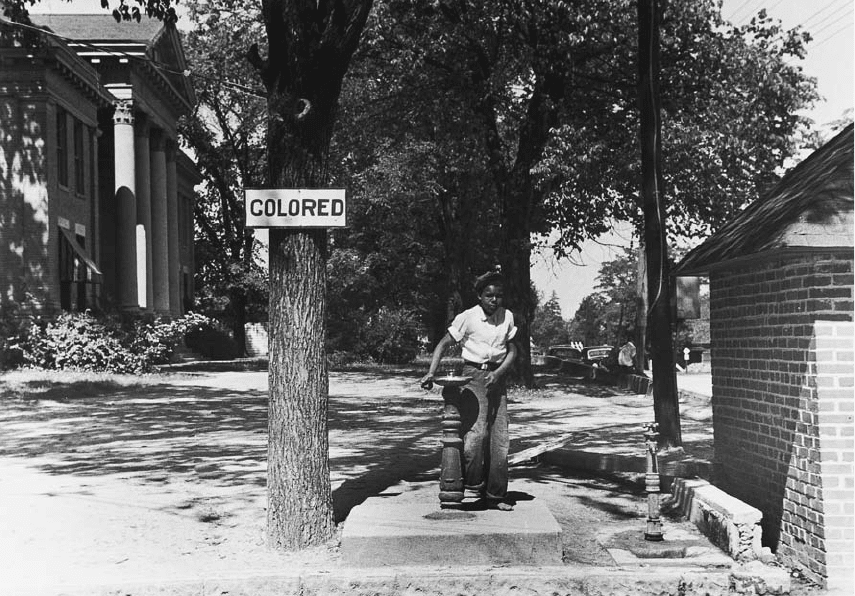
A drinking fountain on the county courthouse lawn, Halifax, North Carolina, 1938 (Library of Congress)
Plyler v. Doe 555
vi+904_EofUSConsti-v2.indd 555 3/20/09 2:18:07 PM
But extensive discussion ensued over the appli-
cation of the equal protection clause to the Texas
statute in question. Under the equal protection
clause analysis, the government is given wide lati-
tude in making distinctions and classifi cations in
the course of conducting policy, unless it involves
a suspect classifi cation (such as race) or it touches
upon a fundamental right of a person. In Ply-
ler, the Court had trouble deciding what level of
scrutiny should apply. While the Court rejected
the claim that illegal aliens were a suspect class,
it nonetheless held that the children in this case
were special members of this underclass. They
were brought to the United States as young mem-
bers of their family, and they had no control over
their parents’ decisions to do so. It was unfair to
punish these children for their parents’ acts, just
like it was unfair to discriminate against children
born out of wedlock. And while the Court did not
fi nd that education was a fundamental right, it dis-
tinguished education from other forms of social
welfare legislation where the government had
wide discretion. Citing B
ROWN V. BOARD OF EDUCA-
TION, 347 U.S. 483 (1954), the Court emphasized
that the inestimable toll on the social, economic,
intellectual, and psychological well-being of the
individual in being deprived of education was dif-
fi cult to reconcile with the framework of equality
embodied in the equal protection clause.
For these reasons—special consideration for
children, and special consideration for deprivation
of education—the Court adopted a quasi-suspect
class and quasi-fundamental rights analysis (in the
words of the dissenting opinion), and held that the
denial must be justifi ed by showing that it furthers
some substantial state interest. The Court found
that none of the justifications offered by Texas
withstood this scrutiny. Accordingly, the law was
in violation of the equal protection clause.
The dissenting opinion argued that undocu-
mented status itself was suffi cient justifi cation for
denial of public benefi ts. However, the majority
held that states could act with respect to illegal
aliens when it mirrored federal objectives, and
that in this case it perceived no national policy
that supported depriving undocumented children
of elementary education.
There are important contextual factors behind
the case. The trial courts had found as a matter of
fact that most undocumented children were likely
to stay in the United States permanently through
various forms of legalization. Given this context,
the Court found that deprivation of education
for these children would create a permanent
underclass within the United States and that the
Fourteenth Amendment was meant to prevent
such second-class citizens from emerging. On the
other hand, the Court had been struggling with
school fi nance litigations across the nation, and
had held in San Antonio School District v. Rodri-
guez, 411 U.S. 1 (1973), that education was not
a fundamental right. This is why the Court had
to emphasize that Plyler involved a deprivation of
education, not the relative quality of education, as
in school fi nance cases, in invoking a heightened
scrutiny.
Although Plyler could be narrowly construed
to apply only to the special circumstances of the
case, it has resonated throughout debates over the
rights of immigrants, the role of federal and state
governments, and the manner of judicial inter-
vention. State initiatives (such as Proposition 187,
which sought to deny government services to ille-
gal aliens in California) containing provisions con-
tradicting Plyler have been repeatedly proposed.
Plyler continues to be a guiding case for judicial
scrutiny of such actions.
For more information: Hutchinson, Dennis
J. “More Substantive Equal Protection?: A Note
on Plyler v. Doe.” The Supreme Court Review
1982 (1982): 167–194; Petronicolos, Loucas, and
William S. New. “Anti-Immigrant Legislation,
Social Justice, and the Right to Equal Educational
Opportunity.” American Educational Research
Journal 36, no. 3 (Autumn 1999): 373–408.
—Takeshi Akiba
Poe v. Ullman 367 U.S. 497 (1961)
In Poe v. Ullman, the Supreme Court again dis-
missed a constitutional challenge to Connecticut’s
long-standing yet unenforced 1879 law criminaliz-
ing the use and distribution of contraceptives
556 Poe v. Ullman
vi+904_EofUSConsti-v2.indd 556 3/20/09 2:18:07 PM
as well as medical advice about their use. The
Court had earlier denied standing to a doctor’s
challenge to the law in Tileston v. Ullman, 318
U.S. 44 (1943). In Poe, two anonymous married
couples who faced possible health complications
from future pregnancies and their physician chal-
lenged the law. None had been arrested or pros-
ecuted, but all argued the law’s existence denied
them liberty without due process of law in viola-
tion of the Fourteenth Amendment.
The Supreme Court again considered the case
nonjusticiable. Justice Felix Frankfurter, writing
for a plurality, called the parties’ fears of crimi-
nal liability “chimerical.” No one had ever been
prosecuted under this law; thus there is a “tacit
agreement” not to enforce it, and “this Court can-
not be umpire to debates concerning harmless,
empty shadows” (508). William J. Brennan, Jr.,
concurred in the judgment, noting that the “true
controversy” would concern the opening of birth
control clinics in the state (509).
This case is significant for the dissenting
opinions by Justices William O. Douglas
and John Marshall Harlan. Douglas found
standing, asking “What are these people—doc-
tor and patients—to do? Flout the law and go to
prison? Violate the law surreptitiously and hope
they will not get caught?” (513). He found that
the law violated the free speech rights of the doc-
tor and a right to privacy of the married couple
that “emanates from the totality of the constitu-
tional scheme under which we live,” including the
Third Amendment (521).
Harlan also found standing, claiming the mar-
ried couples are saved only by “the whim of the
prosecutor” (536). On the merits, Harlan argued
that constitutional liberty protected by the Four-
teenth Amendment is not reducible to the spe-
cifi c protections stated in the Bill of Rights;
rather, it is “a rational continuum which, broadly
speaking, includes a freedom from all substantial
arbitrary impositions and purposeless restraints”
(543). He admits that the right of marital privacy
“most manifestly is not an absolute.” Nevertheless,
the novel nature of Connecticut’s broad law con-
stitutes an “imminent threat to the privacy of the
households of the State” (552, 553).
Justice Hugo Black dissented without opin-
ion. Justice Potter Stewart also briefl y dissented
from the dismissal, stating “I in no way imply that
the ultimate result I would reach on the merits of
these controversies would differ from the conclu-
sions of my dissenting Brothers” (555).
Four years later, in G
RISWOLD V. CONNECTICUT,
381 U.S. 479 (1965), the Court would hear a chal-
lenge from a physician who was convicted for dis-
tributing contraceptives. By a 7-2 vote, the Court
struck the law. Douglas wrote the majority opin-
ion, articulating a constitutional right to marital
privacy based on penumbra formed by emanations
from the several of the fi rst 10 amendments. Har-
lan wrote a concurring opinion that reiterated his
argument in Poe. Black—joined, surprisingly, by
Stewart—dissented.
For more information: Garrow, David J. Liberty
& Sexuality: The Right to Privacy and the Mak-
ing of Roe v. Wade. New York: Macmillan, 1994;
Johnson, John W. Griswold v. Connecticut: Birth
Control and the Constitutional Right of Privacy.
Lawrence: University of Kansas Press, 2005.
—Frank J. Colucci
police civil liability
Police civil liability is granted to citizens under
the Constitution both directly and indirectly from
actions by the government that are determined
to be illegal or wrongful in nature. Generally, the
more common claims for relief come from the
protections derived under the First, Fourth,
Sixth, and Fourteenth Amendments, indi-
vidually or in sum. Intrusion by the government
or its agents can be challenged by both criminal
and civil action, if it is deemed that the conduct
of the offi cer was committed “under color of law.”
In more common terms, the officer must have
been acting in an official government capacity
and retained the authority of the state in his/her
actions.
Unreasonable intrusions into the privacy of
persons, even with a compelling government rea-
son, is generally deemed an unacceptable prac-
tice. In Katz v. United States, one of the most
police civil liability 557
vi+904_EofUSConsti-v2.indd 557 3/20/09 2:18:08 PM
notable Fourth Amendment cases in criminal law,
the Court questioned whether there were protec-
tions included against unreasonable searches and
seizures that required the police or agents of the
government to obtain a search warrant in order
to wiretap a public pay phone and record the per-
sonal and private conversations of the accused. The
decision offered that Katz was entitled to Fourth
Amendment protection for his conversations. This
concept of accepted protections and police liabil-
ity grew further, as the courts reviewed aspects
of the amendments that included violations of
42 U.S.C. 1983 (Section 42 of the United States
Code, a law banning the violation of the consti-
tutional rights of individuals) and other rights of
the accused.
In Paul v. Davis, 424 U.S. 693 (1976), Davis
sought civil restitution under the Fourteenth
Amendment’s protections for the actions of Paul,
the Louisville police chief, for the distribution of a
fl yer identifying Davis as a “shoplifter.” The court
ruled against relief and stated privacy and liberty
under the due process clause was not violated,
which further narrowed the interpretation of
when relief could be instituted.
In Barnes v. Gorman, 536 U.S. 181 (2002),
Gorman sued police offi cials in Kansas for puni-
tive damages due to alleged discrimination against
him on the basis of his disability, which was pro-
hibited within the Americans with Disabilities Act
of 1990 (ADA) and the Rehabilitation Act of 1973
(RA). In a conservative opinion and to further the
stare decisis, Justice Antonin Gregory Scalia
wrote that, because punitive damages could not
be awarded in private suits brought under Title VI
of the Civil Rights Act of 1964, it is within
precedent that similar restrictions be followed for
suits brought under the ADA and the RA. There-
fore, through the above examples, it should be
understood that there are specifi cities of the cases
that must be considered in totality of the circum-
stances, and that relief is not deemed an automatic
response to a suit.
Additional police liability falls under violations
of 42 U.S. §1983, further making available other
civil rights remedies, if clearly there is a vio-
lation of a statute that has conferred substantive
rights to the citizen and is not just a congressio-
nal declaration of policy. In addition, the statute
must not expressly foreclose the use of a civil
rights remedy. In order to recover, the officer
must have been acting under the color of law, and
it must be proven that the offi cer’s conduct was
not only the cause in fact of injuries or damages
and the proximate cause (it was reasonable and
foreseeable that the offi cer’s actions could have
caused the damage) of constitutional or statutory
loss. The fi nal aspect of considering whether or
not the police acted in proper manner, and thus
are eligible for a defense, lies in the understand-
ing related to a police offi cer’s reasonable belief as
measured objectively that his actions were allow-
able under the law and that he had utilized all
available information.
Relief is granted for violations of the statutes
for recovery of out-of-pocket expenses sustained
as a result of the defendant’s conduct, such as in
the case of medical expenses, lost wages or lost
earnings, losses of potential or future income,
and for damages suffered from pain and suffer-
ing, emotional distress, humiliation, and injury to
reputation. If the conduct by the offi cer was reck-
less or egregious, then punitive damages may be
awarded as well as attorney’s fees.
For more information: Kappeler, Victor. Criti-
cal Issues in Police Civil Liability. Long Grove,
Ill.: Waveland Press, 2006.
—Ernest Gomez
police interrogations
See MIRANDA V. ARIZONA.
police power
Police power is the power of states to make laws
to protect the health, safety, welfare, and mor-
als of their inhabitants. While the 50 different
states have inherent police power, neither the
federal nor local governments have this author-
ity. The federal government must rely upon its
commerce clause power to perform police
power–type functions, while local governments
558 police interrogations
vi+904_EofUSConsti-v2.indd 558 3/20/09 2:18:08 PM
may receive this authority from their respective
states.
Police power is the general power of state gov-
ernments to act on behalf of their citizens. Police
power, eminent domain, and taxation are the
basic three powers of state governments. In the
case of police power, it is the authority used by
states to build schools; to enact health codes, con-
struction codes, and criminal laws; and to regulate
a host of other activities. As stated by Chief Justice
John Marshall in G
IBBONS V. OGDEN, 22 U.S. 1
(1824), of police powers:
They form a portion of that immense mass of leg-
islation which embraces everything within the
territory of a State not surrendered to the Gen-
eral Government; all which can be most advan-
tageously exercised by the States themselves.
Inspection laws, quarantine laws, health laws
of every description, as well as laws for regulat-
ing the internal commerce of a State, and those
which respect turnpike roads, ferries, &c., are
component parts of this mass.
States do not need to have police power granted
to them in their own constitutions. Instead, it is
assumed that every state has inherent policing
authority.
However, the federal government does not
have inherent police power authority. Instead, its
power to act in this area is located in the com-
merce clause, according to the Court in New
York v. Miln, 36 U.S. 102 (1837). There is a ten-
sion between the authority of Congress to regu-
late commerce and the police power authority of
states. While Congress has the general authority
to regulate commerce, necessitating that states
refrain from discriminating against it, there are
some situations where state police power func-
tions may permit the state to interfere with it. For
example, while states cannot enact taxes or other
laws to discriminate against goods imported from
other states in order to protect their own prod-
ucts, they may enact laws out of health or safety
concerns, even if those laws in effect make it more
diffi cult to import out-of-state goods. This is the
justifi cation that Michigan and New York gave in
G
RANHOLM V. HEALD, 544 U.S. 460 (2005), in their
effort to prevent the shipment of out-of-state wine
into their state. The Supreme Court ruled that
this type of legislation exceeded the police power
authority of the states and instead discriminated
against interstate commerce.
Conversely, in cases such as P
RINTZ V. UNITED
STATES, 521 U.S. 898 (1997), and Lopez v. United
States, 514 U.S. 549 (1995), the Supreme Court
invalidated laws regulating handgun possession,
ruling that Congress had exceeded its commerce
clause authority to act in areas traditionally rel-
egated to states under their police power.
Finally, while states’ police power has tradition-
ally extended to protect the health, safety, welfare,
and morals of their people, some have argued that
this authority to regulate morality is archaic, or
that the rights of personal privacy limit states’
ability to regulate, in the areas of sexual behavior,
for example.
For more information: Barros, D. Benjamin.
“The Police Power and the Takings Clause.” Uni-
versity of Miami Law Review 58, no. 2 (2004):
471–524; Novak, William J. The People’s Wel-
fare: Law and Regulation in Nineteenth-Century
America. Chapel Hill: University of North Caro-
lina Press, 1996; Reynolds, Glenn H., and David
B. Kopel. “The Evolving Police Power: Some
Observations for a New Century.” Hastings Con-
stitutional Law Quarterly 27 (2000): 511–536.
—Kim Mac Innis and David Schultz
Pollock v. Farmers’ Loan and Trust
Company
157 U.S. 429, 158 U.S. 601 (1895)
In Pollock v. Farmers’ Loan and Trust Company,
the Supreme Court invalidated the 1894 income
tax as an unconstitutional direct tax. Two provi-
sions of the Constitution require that direct taxes
must be apportioned among the states accord-
ing to population. The framers anticipated that
most federal revenue would be raised by indi-
rect levies, such as tariff duties and excise taxes.
The apportionment rule limited the power of
Congress to impose direct taxes. Designed to
prevent abuses of taxing authority and to make
Pollock v. Farmers’ Loan and Trust Company 559
vi+904_EofUSConsti-v2.indd 559 3/20/09 2:18:08 PM
direct taxes geographically fair, the impact of the
apportionment rule turned upon the defi nition
of “direct tax.”
Congress enacted the fi rst income tax in 1862
to help pay for the Civil War. The levy became
increasingly unpopular after the war, and Con-
gress allowed it to expire in 1872. Thereafter, the
Supreme Court in Springer v. United States, 102
U.S. 586 (1881), upheld the levy as applied to pro-
fessional earnings against the contention that it
was a direct tax that had to be apportioned among
the states.
In the 1890s, the Populists spearheaded a drive
to revive the income tax. They argued that an
alternative source of revenue would bring about
tariff reductions and shift more of the national tax
burden to the wealthy. Congress enacted the fi rst
peacetime income tax as part of the Wilson-Gor-
man Tariff Act. The measure imposed a fl at tax
rate on individual incomes above $4,000 a year as
well as a levy on corporate profi ts. It was estimated
that the tax would fall upon less than 1 percent of
the nation’s population, with most taxpayers living
in the Northeast. The 1894 income tax triggered a
bitter public debate. Critics charged that the levy
amounted to class legislation, because it burdened
only one segment of society and constituted a
direct tax that had to be apportioned among the
states according to population.
Charles Pollock, a stockholder of Farmers’ Loan
and Trust Company, sued to prevent the company
from paying the income tax on grounds that the
levy was unconstitutional. This complex case was
argued twice before the Supreme Court, and lead-
ing attorneys appeared for both sides. In April of
1895, Chief Justice Melville W. Fuller, speaking
for the majority, ruled that a tax on income from
land was a direct tax requiring apportionment. He
insisted that the apportionment requirement was
intended to confi ne the use of direct taxation to
extraordinary emergencies. Fuller explained that
this “rule of protection” was “one of the great
landmarks” defi ning the boundary between the
national government and the states, and a safe-
guard of private property (Pollock I, 583). He
also held that the federal income tax on state and
municipal bonds was unconstitutional as a viola-
tion of the doctrine of intergovernmental
tax immunity. In a forceful concurring opinion,
Justice Stephen J. Field pictured the income tax as
a step toward class warfare.
The Court was unable to resolve the validity
of other aspects of the income tax. The case was
reargued in May, when a previously absent justice
was present. Two weeks later, Fuller delivered the
second Pollock opinion, striking down the entire
income tax. He determined that a tax on income
from personal property, such as stocks and bonds,
was also a direct tax that must be apportioned
according to population. This left only an income
tax on earnings. Fuller maintained that the
scheme must be considered as a whole, and that
Congress did not intend a tax on just occupational
earnings. He noted that the Constitution could be
amended to authorize a federal income tax and
that states could tax incomes. Four justices vigor-
ously dissented, arguing that the majority ignored
precedent and inappropriately protected invested
wealth from taxation.
The underlying issue in Pollock was the legiti-
macy of using federal tax power to redistribute
wealth. The Sixteenth Amendment, adopted
in 1913, empowered Congress to levy a federal
income tax, and in effect overturned the Pollock
decisions.
For more information: Ely, James W., Jr. The
Chief Justiceship of Melville W. Fuller, 1888–
1910. Columbia: University of South Carolina
Press, 1995; Fiss, Owen M. Troubled Beginnings
of the Modern State, 1888–1910. New York: Mac-
millan Publishing, 1993; Jensen, Erik M. “Inter-
preting the Sixteenth Amendment (By Way of the
Direct-Tax Clauses),” Constitutional Commentary
21 (2004): 355–404.
—James Ely, Jr.
Posadas de Puerto Rico v. Tourism
Company of Puerto Rico
478 U.S. 328
(1986)
In Posadas de Puerto Rico v. Tourism Company of
Puerto Rico, the Supreme Court upheld a ban on
the advertising of gambling to residents of Puerto
560 Posadas de Puerto Rico v. Tourism Company of Puerto Rico
vi+904_EofUSConsti-v2.indd 560 3/20/09 2:18:08 PM
Rico. This decision was important regarding what
it had to say about commercial speech.
Posadas de Puerto Rico Associates, consisting
of Condado Holiday Inn Hotel and Sands Casino,
fi led a suit against the Tourism Company of Puerto
Rico, a state regulatory agency. The Posadas, an
American company, obtained a gambling license
to operate in the Condado Holiday Inn Hotel and
Sands Casino. Since 1978, the Posadas de Puerto
Rico had been fined $1500 and again $500 on
two separate occasions by the Tourism Company
of Puerto Rico for transgressing advertisement
restrictions as enshrined in the Gambling Act of
1948, as interpreted by the Tourism Company of
Puerto Rico.
An amendment of the Gambling Act of 1948
(15 R. & R. P. R. § 76a-1[7] [1972]) restricts adver-
tisements by gambling parlors to the public. Any
advertisement promoting a Puerto Rico game of
chance has to be first approved by the Tourism
Development Company. As a result of a one-page
advertisement in the New York Times Magazine
that highlighted the casino as one of its features,
Posadas was found guilty by the state agency. In
another case, workers at the casinos went on strike
and carried pickets suggesting the casino was
closed. The Posadas management then placed a
sign outside the establishment that read: “Casino is
opened.” Additionally, in a correspondence to the
Tourism Company of Puerto Rico, the letterhead
contained the word “casino.” For all of these deeds,
the Posadas de Puerto Rico was issued a series of
fi nes by the Tourism Company of Puerto Rico.
Having paid the fi nes, albeit reluctantly, the
Posadas started a court proceeding at the supe-
rior court to challenge the interpretation of the
Gambling Act of 1948 by the Tourism Company
of Puerto Rico. The Posadas argued that these
advertisement restrictions violated its commercial
speech as protected by the U.S. First Amend-
ment. The superior court ruled that the act was
constitutional. However, the court judged that
the interpretation of the regulations was exces-
sively strict and passed that advertisements are
permissible as long as they are aimed at tourists
and that they could appear even in the mass mar-
ket of Puerto Rico, so long as words like “casino”
were not emphasized. Failing to get a favorable
ruling from the Supreme Court of Puerto Rico,
the Posadas fi led for a review with the Supreme
Court of the United States. The arguments were
heard in April 1986, and the judgment, in July
1986 in favor of the Tourism Company of Puerto
Rico, upheld the decision of the Puerto Rico
Supreme Court.
Justice William J. Brennan, Jr., and Justice
John Paul Stevens, representing two other
judges, dissented on the basis that commercial
speech should be accorded protection by the First
Amendment, as it serves societal interest to have
access to full information on a transaction that is
not illegal. One of the key arguments of the dis-
senting bench was based on the fact that commer-
cial interests are allowed to advertise horse racing,
cockfi ghting, and the Puerto Rico lottery, with the
exception of casino gambling. Therefore, the dis-
senting voices of the Court suggested that, since
other forms of gambling advertisements, par-
ticularly the Puerto Rico lottery, are allowed, the
state cannot claim to have a substantial interest
and override the casino’s right to advertise in the
public domain, unless it could be proven that such
advertisements would result in harmful effects on
the society. Justice Stevens in particular opposed
discrimination on the basis that tourists and com-
muters may be entitled to the advertisements but
not the residents themselves.
William Hubbs Rehnquist of the Supreme
Court, presenting the Court’s verdict, opined that
the Puerto Rican government’s interest was sub-
stantial in protecting its residents and that the
freedom of commercial speech was limited from
misleading or fraudulent acts. Advertisements
in any form or manner that are visible or have a
reach to the Puerto Rico populace were deemed
as violating the Gambling Act.
For more information: Biskupic, Joan, and
Elder Witt, eds. Guide to the Supreme Court of
the United States. Washington, D.C.: Congressio-
nal Quarterly Inc., 1997; Kurland, Philip B. “Posa-
das de Puerto Rico v. Tourism Company: ’Twas
Strange, ’Twas Passing Strange, ’Twas Pitiful,
’Twas Wondrous Pitiful,” Supreme Court Review
Posadas de Puerto Rico v. Tourism Company of Puerto Rico 561
vi+904_EofUSConsti-v2.indd 561 3/20/09 2:18:09 PM