
Schultz D. Encyclopedia of the United States Constitution
Подождите немного. Документ загружается.

Tour’s insistence that it could deem walking the
course to be an integral part of the competition.
For more information: Snyder, Brad. A Well-
Paid Slave: Curt Flood’s Fight for Free Agency in
Professional Sports. New York: Viking Adult Press,
2006; White, G. Edward. Creating the National
Pastime: Baseball Transforms Itself. Princeton,
N.J.: Princeton University Press, 1996.
—Steven B. Lichtman
prosecutorial discretion
Prosecutors possess great amounts of discretional
authority—arguably more discretional authority
than any other courtroom actor. The use of this
discretion often raises constitutional issues, espe-
cially in terms of how it affects those accused of
a crime.
Prosecutors possess discretion in many different
ways. First, they possess discretion at the charg-
ing stage. They determine when to fi le a criminal
charge, the degree of seriousness of those charges,
and when to dismiss charges. Second, they have
the discretional authority to enter into plea agree-
ments—also known as “plea bargaining”—and to
decide what consideration to give during these
agreements. Third, prosecutors have the power to
request capital sentencing within statutory consid-
erations. Prosecutors have virtually unfettered dis-
cretion and ultimate power regarding the type(s)
and frequency of charges and plea bargaining.
Throughout the last 30 years, the Supreme
Court has slowly removed discretional authority
from judges—the most recent instances being
Supreme Court decisions in Apprendi v. New Jer-
sey, 530 U.S. 466 (2000), Blakely v. Washington,
542 U.S. 296 (2004), and UNITED STATES V. BOOKER,
543 U.S. 220 (2005). Legislatures have had an
interest in restricting judicial discretion in imple-
menting sentencing guidelines and statutory
ranges to equalize sentences. However, as judges
have experienced a restriction on their discretional
authority, prosecutors have gained discretional
authority. Since prosecutors possess the power
to determine the type of charges to give to par-
ticular defendants, they can undercharge likable
defendants and overcharge unlikable defendants,
ensuring that the unlikable defendants receive a
harsher punishment. The real question, then, is:
“Who is likable and who is unlikable in the eyes of
the prosecutor?”
A major component of the prosecutorial dis-
cretionary power is placed in prosecutors’ power
to negotiate guilty pleas from defendants. When
decision making is restricted, one’s discretionary
power is often displaced to someone else. In this
situation, discretional authority of the judge is dis-
placed to the prosecutor. Studies have indicated
that, due to the restrictions created in sentencing
guidelines, prosecutors have enforced their dis-
cretional authority by engaging in “hidden plea
bargaining” to undermine the rigidity—and, ulti-
mately, the uniformity—of the sentencing guide-
lines by enticing the defendant to engage in a plea
agreement. Ninety-one percent of defendants
plead guilty and, arguably, a majority of these
pleas are a result of some type of plea negotiation.
Researchers have determined that the imple-
mentation of sentencing guidelines has limited
judicial discretion, and some would argue that
the same could be concluded about prosecutorial
discretion.
The restrictive nature of sentencing guidelines
has actually increased prosecutorial discretion at
the time of initial charging practices and charge
bargaining. Because of the discretional authority
of the prosecutor over the decision to decide the
frequency and severity of charges—major deter-
minants of sentencing—the key to sentencing may
very well lie with the prosecutor, not the judge.
Research indicates that there is less structure
associated with prosecutorial discretion than with
judicial discretion. Miehte and Moore (1988) also
indicated that prosecutors possess the ability to
manipulate not only the type of sentence but also
the length of sentence through their discretionary
charging and/or charge-bargaining decisions in
sentencing-guideline states. Many scholars agree
that the goal of obtaining equal justice is cur-
rently threatened by prosecutors, not judges, and
the threat has increased as prosecutorial discre-
tion has increased. Legal scholars such as Stuntz
have indicated that, under a sentencing-guideline
582 prosecutorial discretion
vi+904_EofUSConsti-v2.indd 582 3/20/09 2:18:15 PM
system, the prosecutor “is no longer the price
taker but the price setter.” Although sentencing
guidelines were developed to limit discretion and
unwarranted disparity, it seems that they actu-
ally empower prosecutorial discretion that can
still lead to unwarranted disparity—a phenom-
enon that ought to be avoided with sentencing
guidelines.
Under the new Supreme Court decisions (i.e.,
Apprendi, Blakely, and Booker), this power is
increased to an even greater extent by limiting
judicial discretion even further, requiring a jury
to fi nd facts beyond a reasonable doubt that might
raise the sentence above the sentencing guide-
line range maximum. This discretion, therefore,
is arguably displaced to the prosecutor, an agent
with virtually unfettered discretionary power prior
to the ruling in Blakely. Although discretion can
be a very useful tool, discretion in the hands of
agents who have free reign on their decision-mak-
ing process can institute dangerous roadblocks to
carrying out justice. Namely, unwarranted dispar-
ity—through individual discrimination or contex-
tual discrimination—is a great possibility.
For more information: Albonetti, C. A. “Pros-
ecutorial Discretion: The Effects of Uncertainty.”
Law & Society Review 21 (1987): 291–313;
Albonetti, C. A., and J. R. Hepburn. “Prosecu-
torial Discretion to Defer Criminalization: The
Effects of Defendant’s Ascribed and Achieved
Status Characteristics.” Journal of Quantitative
Criminology 12 (1996): 63–81; Spohn, C. Thirty
Years of Sentencing Reform: The Quest for a
Racially Neutral Sentencing Process. Washington,
D.C.: National Institute of Justice, 2000; Tonry,
M. Sentencing Matters. New York: Oxford Uni-
versity Press, 1996.
—Amanda Freeman and Jeremy D. Ball
Pruneyard Shopping Center v. Robins 447
U.S. 74
(1980)
In this decision, the United States Supreme Court
ruled that the state of California could interpret
its constitution to protect political protesters
from being evicted from a shopping mall without
running afoul of the property rights of the mall
owner, including those rights protected under the
takings clause of the Fifth Amendment to the
United States Constitution.
Pruneyard permitted the states to carry forward
a body of law that had been taken up, then aban-
doned, by the U.S. Supreme Court. In Amalgam-
ated Food Employees Union Local 590 v. Logan
Valley Plaza, Inc., 391 U.S. 308 (1968), the U.S.
Supreme Court ruled that shopping malls were the
“functional equivalent” of a historical town square.
Accordingly, vital First Amendment interests in
preserving a vibrant political and public sphere, in
the face of increasing replacement of public gath-
ering spaces with private spaces, required that
speakers be permitted to protest in those contexts.
However, in Lloyd Corp. v. Tanner, 407 U.S. 551
(1972), the court de facto overruled Logan, leav-
ing protesters in shopping malls and similar places
with no guarantee of federal constitutional protec-
tion for their political speech.
In Pruneyard, the California court went beyond
the federal rule and held that, under the Califor-
nia constitution, a shopping mall owner could not
exclude citizens who engaged in political activ-
ity. Thereafter, several states, including Colorado
(Bock v. Westminster Mall Co., 819 P.2d 55 [1991])
and New Jersey (New Jersey Coalition v. J.M.B.,
138 N.J. 326, 650 A.2d 757 [1994]), adopted the
California rule.
Other states, such as Massachusetts (Batch-
elder v. Allied Stores Intl., 388 Mass. 83, 445
N.E.2d 590 [1983]), Oregon (Lloyd Corporation
v. Whiffen, 315 Or. 500, 849 P.2d 446 [1993]),
and Washington (Southcenter Joint Venture v.
Natnl. Dem. Policy Committee, 113 Wash.2d 413,
780 P.2d 1282 [1989]), protect citizens gather-
ing signatures for petitions (e.g., for referendum
or recall campaigns) in shopping malls, but not
speakers engaging in ordinary political speech.
Massachusetts’s reasoning is typical: The Mas-
sachusetts Supreme Judicial Court held that the
free speech protection of the Massachusetts con-
stitution is coextensive with that of the federal
constitution. However, Massachusetts contains a
separate provision guaranteeing the right to par-
ticipate in direct democracy such as referenda,
Pruneyard Shopping Center v. Robins 583
vi+904_EofUSConsti-v2.indd 583 3/20/09 2:18:15 PM
and that provision is broad enough to guarantee
a right to solicit signatures in shopping malls. At
least one state (Western Penn. Socialist Workers
1982 Campaign v. Connecticut General Life Ins.
Co., 515 A.2d 1331, 512 P.A. 23 [1984]) applies
something like a “Fairness Doctrine” to pri-
vate landowners: If the landowner invites people
to speak on one side of a political issue, opposing
speakers are protected.
The Pruneyard doctrine is one of a handful of
legal protections for speech interests against pri-
vate economic interests. Other such protections
include the Noerr-Pennington doctrine, which
insulates political activists from certain busi-
ness torts; the fair use doctrine, which privileges
certain communicative uses of copyrighted and
trademarked material; and the actual malice rule,
which privileges speech about public fi gures from
most defamation claims. Pruneyard, however,
is particularly distinctive as a constitutional doc-
trine that requires private parties to surrender a
portion of their traditionally sacrosanct private
property rights.
Pruneyard represents a distinct analytic per-
spective on the relationship of political constitu-
tional rights to private property rights. Its closest
relative along that dimension is S
HELLEY V. KRAE-
MER, 334 U.S. 1 (1948), which forbade the states
from enforcing racially restrictive covenants in
land, notwithstanding the private property rights
of the landowners, because the state could not be
a participant in racial discrimination. Pruneyard
similarly subjects private property rights to con-
stitutional checks, this time in the interest of pre-
serving a vibrant political public sphere. Thus, it is
likely to become increasingly important as more
and more public sphere communication is carried
out in spaces controlled by private economic inter-
ests, whether physically (as in shopping malls) or
virtually (as on privately owned Internet servers,
or using privately owned cultural artifacts such as
trademarks).
Pruneyard’s relatives are also becoming more
important. For example, the Noerr-Pennington
doctrine was originally developed in the context
of antitrust law to protect businesses lobbying for
advantageous government action. Now, solitary
citizens and grassroots groups frequently use it
to defend “SLAPP Suits” (“Strategic Lawsuits
Against Public Participation”), which are brought
by land developers and others in order to deter
grassroots political opposition to their commercial
projects.
For more information: Berger, Curtis. “Prune-
yard Revisited: Political Activity on Private
Lands.” New York University Law Review 66, no.
633 (1991).
—Paul Gowder
public forum
The U.S. Supreme Court has declared that the
free speech clause of the First Amendment to
the U.S. Constitution includes a “public forum
doctrine” that allows people to use public prop-
erty for free speech activities.
The public forum doctrine has its origin in the
historical fact that, before the existence of mod-
ern mass media, citizens would meet and engage
in public discussion on the streets, sidewalks, and
parklike areas of town squares. People would read
the latest news posted on a wall or in a newspaper,
share other news by word of mouth, and debate
the issues involved in the news. According to the
public forum doctrine, all government-owned
(public owned) property can be divided into three
types. First, a “traditional public forum” is govern-
ment property that has historically been used for
public gatherings and discussions. The Supreme
Court regularly lists parks, streets, and sidewalks
as public forums. Although the Court has never
declared that those are the only types of govern-
ment property that are traditional public forums,
the Court has never declared that any other gov-
ernment property meets the defi nition of a tradi-
tional public forum. In other words, whether other
types of property can be considered a traditional
public forum is an open question.
The second type of government property is a
“designated public forum.” This occurs when gov-
ernment intentionally sets aside some type of gov-
ernment property for use as a public forum. For
example, a bulletin board, a room, or an atrium
584 public forum
vi+904_EofUSConsti-v2.indd 584 3/20/09 2:18:16 PM
might be designated for use by the public as a
forum.
The third and fi nal type of government prop-
erty is all other government property; that is,
property that is neither a traditional public forum
nor a designated public forum is simply not a pub-
lic forum. For example, office space in govern-
ment buildings is not a public forum while in use
by government workers; neither are courtrooms
or legislative assemblies while in session, as well
as public school classrooms during classtime. As
another example, in the Court’s most recent pub-
lic forum case titled I
NTERNATIONAL SOCIETY FOR
KRISHNA CONSCIOUSNESS (ISKCON) V. LEE, 505
U.S. 672 (1992), the Court declared that publicly
owned airport terminals are not public forums.
Under the public forum doctrine, the type of
speech regulations the First Amendment allows to
regulate government property depend on whether
the property is a traditional or designated public
forum, or is not a public forum. If a speech regu-
lation involves a traditional public forum, the gov-
ernment must show a “compelling” justifi cation for
any limits placed on free speech activities within
that forum. Also, the government may not dis-
criminate on the basis of the subject matter of the
speech or the viewpoint of the speaker. As a prac-
tical matter, this means that few restrictions may
be placed on speech in a traditional public forum,
other than regulations to maintain public safety
and order, known as “time, place, and manner”
restrictions. For example, a person driving a car
at 3:00 a.m. in a residential neighborhood using
an electronic megaphone to ask people to support
a particular presidential candidate is using a pub-
lic street, but the government may nevertheless
prohibit even political speech done in this manner
and at this time and place.
If the government designates property to be
used as a public forum, the government again
must show a “compelling” reason for limiting free
speech, and may enact time, place, and manner
restrictions. In addition, the government may
enact regulations to preserve the nature of the
forum, even including limiting the subject mat-
ter of the speech if necessary, but government
still may not discriminate against any single view-
point among the topics it allows for discussion. For
example, if government creates a bulletin board
for use as a public forum, a regulation can restrict
the size and number of fl yers any one person or
group may post, but may not prohibit only Demo-
crats or only pro-environment groups from post-
ing fl yers. Or, if a public school district generally
opens a classroom for meetings by after-school
student groups, the school district may restrict the
number of people that may be in the room accord-
ing to the fi re code, but the government may not
prohibit only a religious group or only a gay and
lesbian rights group from using the room.
However, if government sponsors a public
debate on the death penalty, the government may
prohibit a person from speaking who wants to dis-
cuss abortion and taxes, because that is not the
designated purpose of the forum.
Finally, in government property that is not
a public forum, the government can enact any
restrictions on speech as long as those restrictions
are “reasonable.” Generally, this means that gov-
ernment acting as a property manager may restrict
any speech activities that are incompatible with
the government property functioning as its pri-
mary use. In other words, government has broad
leeway to regulate property that is not a public
forum for its intended use as something other
than a forum for public discussion.
The Court’s most recent description of the pub-
lic forum doctrine in ISKCON has led many com-
mentators as well as the dissenting justices in the
ISKCON case to criticize the Court’s narrowing of
the defi nition of traditional public forums to seem-
ingly include nothing other than parks, streets,
and sidewalks. Critics argue that in a modern era
where town squares are disappearing or do not
serve as a primary meeting place for public discus-
sion, other types of government property (such as
airport terminals or government-leased shopping
malls) must be recognized as “traditional” public
forums to be used by people to directly confront a
mass audience in person.
Otherwise, only those individuals or groups
who can afford the use of the mass media will be
able to communicate their ideas directly to a large
audience, a concept that runs contrary to the basic
public forum 585
vi+904_EofUSConsti-v2.indd 585 3/20/09 2:18:16 PM
purpose of the free speech clause: promoting
robust public discourse. For this reason, several
state supreme courts have interpreted the free
speech provisions of their respective state consti-
tutions as creating state public forum doctrines
more protective of free speech than the federal
public forum doctrine. For example, a few state
supreme courts have decided that even some pri-
vately owned property within their states, such as
large indoor shopping malls, are public forums to
a limited degree.
For more information: Volokh, Eugene. The
First Amendment: Problems, Cases and Policy
Arguments. New York: Foundation Press, 2001.
—Rick A. Swanson
586 public forum
vi+904_EofUSConsti-v2.indd 586 3/20/09 2:18:16 PM
587
ﱶﱷﱸ
racial profi ling
Racial profi ling refers to the practice of stopping
individuals or suspected criminals based upon
their race or skin color.
Racial profi ling involves the claim that police
are detaining individuals in traffi c enforcement
simply because of their race or skin color. Often-
times, the pretext for the stopping is the claim that
the individual fi ts some profi le of a person wanted
for a crime, or individuals are stopped in their car
on the basis that they have committed a minor
traffi c infraction.
The origins of profiling are rooted in four
events. First, the practice of profi ling goes back to
the middle of the 20th century, when it was used
to create sketches or psychological descriptions of
individuals in a crime that had already been com-
mitted. In these cases, specialists did the profi l-
ing. Second, in the 1960s and 1970s, profi les were
created to detect potential airplane hijackers (sky-
jackers) and then drug couriers. Third, the land-
mark case, T
ERRY V. OHIO, 392 U.S. 1 (1968), which
gave police the authority to stop and frisk indi-
viduals, expanded the discretionary authority of
law enforcement offi cials to approach individuals
suspected of engaging in illegal activity. Finally,
in cases such as WHREN V. UNITED STATES, 517 U.S.
806 (1996), the Supreme Court has given the
police broad powers to stop, detain, and search
individuals during routine traffi c stops if they are
suspected of engaging in illegal activity. According
to the Court, so long as the police observe some
illegal activity, such as speeding or a failure to sig-
nal a turn, they are permitted to stop and perhaps
search individuals and their vehicles.
Evidence that racial profiling exists began to
appear in the media in the middle to late 1990s
when newspapers revealed that the New Jersey
State Police were using racial profi les to stop and
detain motorists. Since then, statistics gathered in
other areas, such as New York City, Denver, Min-
neapolis and St. Paul, Minnesota, south Florida,
and Maryland, as well as in other cities and states,
demonstrate that people of color are disproportion-
ately more likely to be stopped than are whites.
Those who point to profi ling say that the issue
raises important legal questions regarding racial
discrimination. These issues may arise out of either
the equal protection or due process clauses
of the Fourteenth Amendment. In fact, racial
profi ling is sometimes referred to as “driving while
black.” The singling out of individuals based solely
upon their race or skin color is unconstitutional.
The statistics on who is stopped by the police are
pointed to as evidence of either de jure or de facto
discrimination or racial profi ling.
Others deny that the statistics reveal discrimi-
nation, that these stops are not motivated by
race but are simply a sign of aggressive policing
and efforts to apprehend criminals. Police are
thus stopping individuals on the basis of reason-
able suspicion that a crime has been committed,
or that the person stopped is a criminal. In fact,
in Brown v. City of Oneonta, 195 F.3d 111 (2d
Cir. 1999), a federal court ruled that in some cases
race could be used as a reason to justify an inves-
tigatory stop.
While racial profi ling has focused mostly on
police stops, other statistics reveal that whites
and people of color are treated very differently
in the entire criminal justice system. For exam-
ple, not only are people of color more likely to be
stopped, they are also more likely to be detained
longer, and searched. Statistics indicate that
R
vi+904_EofUSConsti-v2.indd 587 3/20/09 2:18:16 PM
more than 70 percent of the searches produce no
illegal substances. Overall, this means that the
initial stopping of people of color makes it more
likely that they will face additional interaction
with the criminal justice process. All of these
instances could be considered examples of racial
profi ling.
For example, whites are more likely to be
offered bail than people of color. Whites are
much less likely to receive prison than people of
color, and whites are much less likely to be prose-
cuted—and more aggressively—for drug offenses
than are people of color.
Prior to the terrorist attacks of 2001, racial pro-
fi ling appeared to be under attack in the United
States. However, since the events of 9/11, public
opinion is mixed. There are indications that indi-
viduals who are Muslim or who look like they are
from Arab countries are detained or discrimi-
nated against, especially when it comes to fl ying
on airplanes.
Overall, racial profi ling or racial disparities
exist on several levels in the criminal justice sys-
tem, raising questions regarding explanations and
possible remedies for this different treatment.
For more information: Derbyshire, John. “In
Defense of Racial Profi ling: Where Is Our Common
Sense?” National Review 53 (February 19, 2001);
Heumann, Milton, and Lance Cassak. Good Cop,
Bad Cop: Racial Profi ling and Competing Views
of Justice. New York: Peter Lang Publishing, 2003;
N.A. “Civil Rights Commission Cites Improper Use
of Racial Profi ling by New York City Police.” Jet 98,
no. 4 (July 3, 2000): 4–5; Walker, Samuel, et al. The
Color of Justice: Race, Ethnicity, and Crime in
America. Belmont, Calif.: Wadsworth, 2000.
—David Schultz
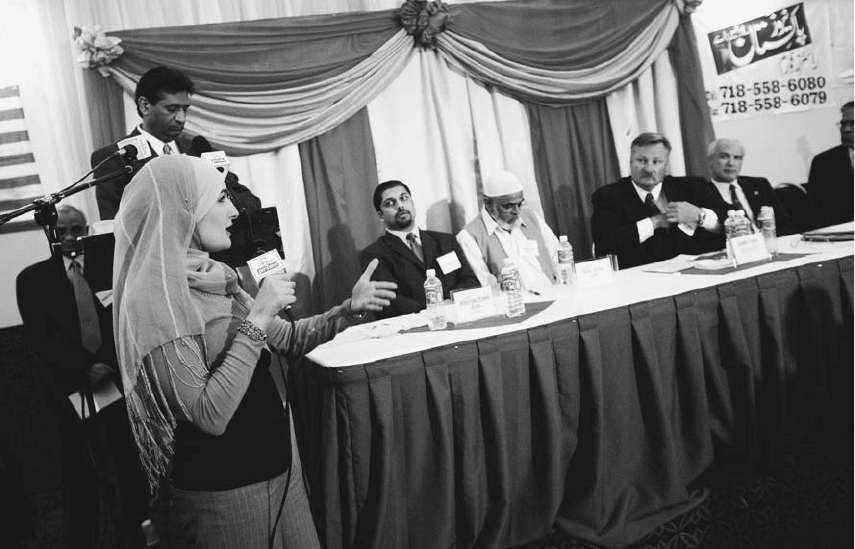
Linda Sarsour, a social activist for the Arab American Association of New York, speaks to representatives from
the FBI’s Counter Terrorism Division’s Joint Task Force and Immigration and Customs Enforcement in a discus-
sion about post-9/11 relations on June 2, 2005, in New York City.
(Robert Nickelsberg/Getty)
588 racial profi ling
vi+904_EofUSConsti-v2.indd 588 3/20/09 2:18:16 PM
racial quotas
Racial quotas are fi xed numbers or percentages of
a particular race or a select grouping of races that
need to be present within either a student body or
place of employment. In R
EGENTS OF THE UNIVERSITY
OF CALIFORNIA V. BAKKE, 438 U.S. 265 (1978), the
Supreme Court ruled that racial quotas used for
the purposes of hiring or admissions decisions to
schools violated the Fourteenth Amendment.
Racial quotas were fashioned in an effort to
implement affirmative action programs in the
1960s and 1970s. The fi rst mention of affi rmative
action was in Executive Order 10925 signed by
President John F. Kennedy in 1961. At this time,
it was not a program, but only a description of the
type of outreach or recruiting action that needed
to be taken to prevent employment discrimi-
nation based on race. What was created at that
time was the Committee on Equal Employment
Opportunity. This committee, which was created
for the purpose of eliminating discrimination in
hiring practices, was only the start of legislation
supporting affi rmative action. From 1961 to 2003,
there have been a total of 19 acts, orders, or laws
created supporting affi rmative action.
The Office of Federal Contract Compliance
began to gather data on the racial makeup of ven-
dors in 1972 in order to ensure that federal con-
tractors were complying with antidiscrimination
laws. Out of these efforts to police compliance
emerged quotas. One way to show nondiscrimi-
nation was to have hiring policies that recruited
solely on the basis of race. Thus, hiring quotas
were initiated. Eventually, schools began to con-
sider race in admissions, with some setting up spe-
cial admissions policies for people of color.
The case that has been a benchmark in how
racial quotas should be addressed is the Bakke
case. This case is Regents of the University of
California v. Bakke, 438 U.S. 265 (1978). Allan
Bakke had been rejected twice because he failed
to meet the requirements set by the University of
California medical school at the Davis campus.
The admissions program used by the University
of California was found to be operating as a racial
quota. This program was considered to be in vio-
lation of the law, in that it took race into account
in making admissions decisions. While this would
seem to settle the issue of the use of racial quo-
tas, it did not. For while the racial quotas that this
university was using were considered in violation
of the law, it did not consider all racial quotas to
be illegal; the judgment of the Supreme Court
stated that only “those racial classifi cations that
would violate the Equal Protection Clause
if employed by a State or its agencies” are pro-
hibited. Those uses, according to Justice Lewis
Powell, would be when race alone is used as an
admissions criterion. Race could be used as one of
several criteria if the goal were to promote educa-
tional diversity. This decision was upheld further
by the University of Michigan cases in 2003. There
were two cases: G
RATZ V. BOLLINGER, 539 U.S. 244
(2003), and GRUTTER V. BOLLINGER, 539 U.S. 306
(2003). The Gratz case dealt with the undergradu-
ate program, the Grutter case with the graduate
program. The law school (graduate) program was
constitutional because it was a highly individual-
ized, holistic review of each applicant’s fi le, rather
than a rigid formula. The undergraduate points
scheme, by contrast, was a non-individualized,
mechanical system and therefore not constitution-
ally acceptable because it looked more like a fi xed
racial quota system.
Finally, in Parents Involved in Community
Schools v. Seattle Sch. Dist. No. 1, ___U.S.___
(2007), the use of race in school assignment and
attendance plans was struck down as unconstitu-
tional, in part because of the quota-like aspect to
race when determining school compositions and
attendance.
Overall, the Supreme Court has made it clear
that the use of hard or fi xed racial quotas is a viola-
tion of the equal protection clause, and it appears
to be moving toward arguing that the Constitution
does not permit any use of race, even for remedial
purposes.
For more information: Schwartz, Bernard. A
History of the Supreme Court. New York: Oxford
University Press, 1993; Skrentny, John David. The
Ironies of Affi rmative Action: Politics, Culture,
and Justice in America. Chicago: University of
Chicago Press, 1996; Weiss, Robert J. “We Want
racial quotas 589
vi+904_EofUSConsti-v2.indd 589 3/20/09 2:18:17 PM
Jobs”: A History of Affi rmative Action. New York:
Garland Publishing, 1997.
—Anne D. Reynolds
Rasul v. Bush 542 U.S. 466 (2004)
In Rasul v. Bush, the United States Supreme
Court ruled that aliens being held in confi nement
at the American military base at Guantánamo
Bay, Cuba, were entitled to have a federal court
hear challenges to their detention under the fed-
eral habeas corpus statute. This decision rep-
resented an important limit upon the authority of
the United States government to detain individu-
als captured as a result of the “war on terrorism”
initiated by the president of the United States
after the attacks on the United States on Septem-
ber 11, 2001.
On September 11, 2001, al-Qaeda terrorists
hijacked four commercial airplanes and used them
in several attacks against the United States. Sub-
sequently, Congress authorized the president to
use all “necessary and appropriate force” against
any persons, organizations, and nations that aided
or supported these acts of terrorism. The presi-
dent then used this authorization to send troops
to Afghanistan against al-Qaeda and the ruling
Taliban regime that had supported them.
This military action led to the capture of
approximately 640 non-Americans who were then
relocated to the United States military base at
Guantánamo Bay, Cuba, where they were being
held indefi nitely and without access to legal coun-
sel or access to the federal courts. Among those
detained, claiming innocence and wishing to be
freed, were Shafi q Rasul and Fawzi Khalid Abdul-
lah Fahad Al Odah, neither of whom were U.S.
citizens.
Relatives of these two individuals fi led actions in
U.S. District Court for the District of Colum-
bia, challenging the detentions. First the federal
district court and then the court of appeals for the
District of Columbia dismissed the cases, claim-
ing that the courts lacked jurisdiction to hear the
challenges. In both of these cases, relatives of the
detainees sought habeas corpus review. Habeas
corpus is the constitutional right of individuals to
have a judge review the reasons why a person has
been detained.
Habeas corpus is the legal means that indi-
viduals may use to challenge what they believe
to be an illegal imprisonment by requesting that
the person holding them explain to a judge the
reasons for their confi nement. Both Article I,
Section 9, Clause 2 of the Constitution, as well as
28 United States Code section 2241, provide for
habeas review. While the law is well established
that American citizens being held in the United
States are entitled to habeas corpus review, there
seemed to be some uncertainty regarding whether
noncitizens held at Guantánamo Bay enjoyed
habeas review.
One issue is the status of Guantánamo Bay itself
and whether it is sovereign territory of the United
States. In 1934 Cuba granted the United States
a lease to Guantánamo Bay so long as the base
was being used. In turn, the United States recog-
nized Cuba’s sovereignty over Guantánamo Bay.
Second, in Johnson v. Eisentrager, 339 U.S. 763
(1950), the Supreme Court had ruled that aliens
detained outside the United States are not entitled
to habeas review. Thus, President George W. Bush
and his administration argued that they had legal
authority to detain aliens at Guantánamo Bay,
Cuba, indefi nitely without granting them access
to the courts to contest their confi nement.
The United States Supreme Court granted cer-
tiorari to the relatives after they lost in the court
of appeals. The Court, with Justice Paul Ste-
vens writing the majority opinion, ruled 6-3 that
the courts did have jurisdiction to hear the case
and that the detainees did have a right to federal
habeas review.
The Court fi rst reviewed the history of federal
habeas corpus law, noting how this right had sig-
nifi cantly expanded since its original enactment
in 1789. Justice Stevens noted that the Court
had permitted habeas review in a wide variety of
situations involving presidential detention of indi-
viduals, including those who were deemed enemy
combatants. Second, Stevens examined the status
and extent of the control the United States had over
Guantánamo Bay. The Court found the control to
be so pervasive that, while Guantánamo Bay was
590 Rasul v. Bush
vi+904_EofUSConsti-v2.indd 590 3/20/09 2:18:17 PM
not sovereign territory of the United States, it was
under its jurisdiction, and therefore the ruling in
Eisentrager did not apply. This meant that habeas
review was available to those at Guantánamo Bay,
and all those detained there were entitled to chal-
lenge their detention.
Rasul v. Bush was an important decision. It was
issued the same day as H
AMDI V. RUMSFELD, 542
U.S. 507 (2004), which ruled that an American
citizen could not be held indefi nitely on American
soil without a right to habeas review. Together,
these cases placed signifi cant limits upon the abil-
ity of the president and the government to detain
individuals suspected of being terrorists. The cases
represent a major affi rmation of the right of citi-
zens and noncitizens to challenge their confi ne-
ment, even if they are suspected of being terrorists.
Almost immediately after Rasul was decided, the
United States government was forced to under-
take procedures to permit the Guantánamo Bay
detainees to bring habeas challenges to their
confi nement.
For more information: Adler, David Gray, and
Robert George, eds. The Constitution and the
Conduct of American Foreign Policy. Lawrence:
University Press of Kansas, 1996; Henkin, Louis.
Foreign Affairs and the United States Constitu-
tion. Oxford: Clarendon Press, 1996; Henkin,
Louis. Constitutionalism, Democracy, and For-
eign Affairs. New York: Columbia University
Press, 1990.
—David Schultz
ratifi cation of the Constitution
Ratifi cation of the Constitution refers to the pro-
cess whereby the original thirteen states approved
the document written in 1787 in Philadelphia.
The Constitutional Convention that met
in Philadelphia in 1787 was called by the U.S.
Congress to propose amendments to the Articles
of Confederation. The convention reviewed pro-
posals such as the New Jersey Plan, which
would have essentially followed that congressio-
nal mandate. However, after long and considered
deliberation, the delegates completed their work
with a strong consensus for a new constitution that
would serve as a new compact between the states
and replace the Articles of Confederation. The
Philadelphia Constitutional Convention submit-
ted the new constitution to Congress in 1787, and
Congress voted to forward it to the states for their
consideration and ratification. The ratification
debates that followed in each of the states were
between the Federalists and the Anti-Federalists.
The Federalists supported the new consti-
tution and wrote the Federalist Papers, under
pseudonyms such as Publius, to articulate the
need for and meaning of the new constitution.
The newspapers in each of the states featured
writers who debated the strengths and weak-
nesses of the Articles of Confederation and the
1787 constitution.
Among the controversies that were addressed in
the ratifi cation debates was the fact that the Articles
of Confederation required unanimity to amend,
whereas the Philadelphia Convention required
only nine states to ratify. The Anti-Federalists vig-
orously objected in state after state as ratifi cation
was debated and voted upon. Though victorious in
achieving a rejection vote in Rhode Island on more
than one occasion, the Anti-Federalists witnessed
ratifi cation even in such hard-fought states as Vir-
ginia and New York. The Anti-Federalists provided
crucial interpretive points throughout the debate,
but the Federalists would ultimately prevail, and
the present Constitution serves as an enduring
legacy to their statesmanship.
The ratifi cations in several states were achieved
with “conditions.” For example, “conditional”
approvals were included in Virginia (20) and in
New York (31), and these conditions represented
signifi cant contributions of the Anti-Federalists
to the ultimate design and interpretation of the
Constitution. The deliberations and political com-
promises in the state ratifi cation processes were
signifi cant as contributions that were part of the
immediate amendments, proposed and passed by
the first Congress under the new Constitution,
that became known as the Bill of Rights.
On December 7, 1787, Delaware became the
fi rst state to ratify the new Constitution, with a
unanimous vote in favor. Pennsylvania was second
ratifi cation of the Constitution 591
vi+904_EofUSConsti-v2.indd 591 3/20/09 2:18:17 PM