
Schultz D. Encyclopedia of the United States Constitution
Подождите немного. Документ загружается.

at the reason for the delay (so as not to disadvan-
tage the defense when the prosecution asks for a
delay of the trial for its own advantage; however,
a delay can be made to secure absent witnesses
or for other practical considerations). The final
factors the Court considered important in decid-
ing whether a defendant’s right to a speedy trial
had been violated were: the time and manner in
which a defendant has asserted his/her right and
the degree of prejudice any delay has caused to
the defendant.
In cases where the reviewing court fi nds that
a defendant’s right to a speedy trial was violated
(under any part of the four-point test), the Supreme
Court has adopted an ad hoc approach to balance
the rights of the accused with justice for the pub-
lic. In its outline of the four-point test, the Court
recognizes that these four points are merely some
of the factors that courts should take into account
in their determination as to whether a defen-
dant has been deprived of his right to a speedy
trial under the Sixth Amendment. The Court has
also pointed out that a failure of the defendant
to demand the right to a speedy trial cannot be
construed as a waiver of this right, but any acqui-
escence to a delay on the defendant’s part, when
it works to his/her advantage, should and can be
used against any later assertion that she has been
denied this right. Overall, in determining whether
a violation has occurred, the Court recommends
that courts should also look to the possible preju-
dices and disadvantages suffered by a defendant
during any delay.
In such cases where a violation has been
deemed to have occurred, the Supreme Court
has held that in these instances the only appro-
priate remedy would be for the indictment to be
dismissed and/or the conviction to be overturned.
After the reversal or dismissal of a criminal case
on the grounds that there has been a violation of
a defendant’s right to a speedy trial, no further
prosecution for the alleged offense can take place
again.
For more information: Ellard, Patrick. “Learn-
ing from Katrina: Emphasizing the Right to a
Speedy Trial to Protect Constitutional Guarantees
in Disasters.” American Criminal Law Review
44, no. 3 (2004): 1,207–1,238; Freedman, Warren.
The Constitutional Right to a Speedy and Fair
Criminal Trial. Westport, Conn.: Quorum Books/
Greenwood Publishing Group, 1989; Herman,
Susan N. The Right to a Speedy and Public Trial:
A Reference Guide to the United States Constitu-
tion. 3d ed. Westport, Conn.: Praeger, 2006; Mis-
ner, Robert L. Speedy Trial: Federal and State
Practice. Contemporary litigation series. Charlot-
tesville, Va.: Michie, 1983.
—Dale Mineshima-Lowe
right to bear arms (Second Amendment)
(1791)
The Second Amendment of the Constitution, part
of the Bill of Rights, establishes the right to
keep and bear arms. Scholars disagree over whom
the right applies to and exactly what it means.
The amendment reads: “A well regulated mili-
tia, being necessary to the security of a free state,
the right of the people to keep and bear arms, shall
not be infringed.” Because its meaning is strongly
contested, the Second Amendment continues
to be one of the most controversial parts of the
Constitution. Controversy stems from attempts to
interpret the meaning of each of the clauses, to
understand the original intent of the fram-
ers, and to interpret the contemporary relevance
of the amendment in the context of changes in the
nature of the militia, the increasing deadliness of
fi rearms, and fi erce debates over fi rearms in U.S.
society. While two broad approaches—the collec-
tive rights perspective and the individual rights
perspective—have dominated interpretations of
the Second Amendment, newer approaches have
recently emerged.
According to the collective rights interpreta-
tion, the Second Amendment confers a collective
right to bear arms in a governmentally organized,
“well regulated militia,” not an individual right to
personal ownership. Emphasizing the first two
clauses of the amendment, advocates of this posi-
tion argue that the founders were not arguing
over the individual right to own and carry arms
but were concerned with giving states the right
612 right to bear arms
vi+904_EofUSConsti-v2.indd 612 3/20/09 2:18:24 PM
to have organized militias as a counterbalance to
federal power. Supporters of the collective rights
interpretation stress that the Second Amendment,
however interpreted, does not preclude gun reg-
ulation. Up until the 1970s, the majority of law
review articles tended to support this approach,
as have the courts.
The individual rights interpretation, emphasiz-
ing the last clause of the amendment, argues that
the Second Amendment establishes a constitu-
tionally protected right for individuals to own and
bear arms. Advocates of this approach sometimes
refer to it as the “standard model,” emulating the
standard model in physics and apparently trying
to put their interpretation beyond disputation.
This is now the dominant interpretation of the
Second Amendment in terms of the number of
law review articles. Many supporters of this per-
spective acknowledge that reasonable restrictions
may be imposed on gun ownership. This approach
received powerful support in 2001 when then
Attorney General John Ashcroft endorsed it in a
letter to the National Rifl e Association. The Jus-
tice Department subsequently reversed its long-
standing collective rights interpretation of the
meaning of the Second Amendment in two briefs
to the U.S. Supreme Court.
Four Supreme Court decisions, as well as
numerous lower court decisions, touching most
directly on the Second Amendment have all sup-
ported the collective rights interpretation. Three
of the Supreme Court cases dealing with Sec-
ond Amendment issues date to the 19th century:
United States v. Cruikshank, 92 U.S. 542 (1876);
Presser v. Illinois, 16 U.S. 252 (1886); and Miller
v. Texas, 153 U.S. 535 (1894). Advocates of col-
lective and individual rights interpretations have
both claimed support for their position in the only
20th-century decision, United States v. Miller
(1939). In that case, the Court ruled that a sawed-
off shotgun has no utility as a fi rearm in a mili-
tia, thus supporting the view that the amendment
referred to militias rather than individuals. Some
legal scholars expect the Court to take up a Sec-
ond Amendment case in the near future.
More recent interpretations have attempted
to reconcile differences between collective and
individual interpretations. Constitutional scholar
Akhil Reed Amar has offered a “republican” read-
ing of the Second Amendment. He argues that
collective, or states rights, interpreters fail to give
enough weight to the Founders’ equation of the
militia with much of the adult, white male citi-
zenry, while he faults individual rights advocates
for ignoring that this was a right of all the “peo-
ple,” rather than persons, and of failing to note
that the phrase bear Arms has a military meaning
and does not refer to individual gun ownership for
activities such as hunting or protection. Amar sug-
gests that the Fourteenth Amendment (1868)
freed the Second Amendment from its connection
to the militia and established it as an individual
right. Disagreeing with Amar, Uviller and Merkel
argue that while the Second Amendment origi-
nally referred to an individual right to bear arms
in an organized, governmentally sponsored mili-
tia, they suggest that the amendment “fell silent”
with the decay of the old militia and its eventual
displacement by the National Guard. Thus, they
argue that the conditions under which the Second
Amendment made sense no longer exist and that
the amendment is now irrelevant, although they
acknowledge that it could become relevant again
under changing circumstances.
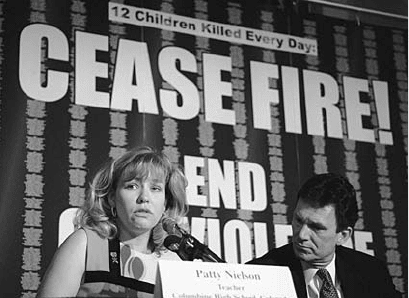
Columbine High School teacher Patty Nielson
speaks at a Senate policy committee hearing on
gun safety legislation, as Senator Tom Daschle
looks on, May 15, 2000, in Washington, D.C.
(Smith/Newsmakers)
right to bear arms 613
vi+904_EofUSConsti-v2.indd 613 3/20/09 2:18:24 PM
The Supreme Court fi nally resolved this debate
between individualist or a collective reading of
the Second Amendment in District of Columbia
v. Heller, ___ U.S. ___ (2008). In that case, Jus-
tice Antonin Gregory Scalia wrote for a 5-4
majority holding that the right to bear arms con-
ferred an individual right. How that decision will
affect gun laws is critical.
Moreover, the Second Amendment has never
been incorporated through the Fourteenth
Amendment to be binding on individual states.
This means that states are free to regulate, if not
ban, guns if they so wish.
For more information: Amar, Akhil Reed. For
the People: What the Constitution Really Says
about Your Rights. New York: Free Press, 1998;
Malcolm, Joyce Lee. To Keep and Bear Arms: The
Origins of an Anglo-American Right. Cambridge,
Mass.: Harvard University Press, 1994; Uviller, H.
Richard, and William G. Merkel. The Militia and
the Right to Arms, or, How the Second Amend-
ment Fell Silent. Durham, N.C.: Duke University
Press, 2002.
—Walter F. Carroll
right to counsel
The Sixth Amendment to the U.S. Constitution
guarantees anyone accused of a crime the right
to “the Assistance of Counsel for his defense.”
The Judiciary Act of 1789 confirmed this
guarantee in statute law, giving all parties in fed-
eral court the right to “manage and plead” their
cases with the assistance of counsel. Another fed-
eral statute, enacted in 1790, authorized federal
judges to appoint counsel for indigent defendants
in capital cases, and there is evidence that fed-
eral judges also did so in some noncapital cases.
Not until Johnson v. Zerbst, 304 U.S. 458 (1938),
did the Supreme Court require counsel to be pro-
vided to all indigent federal defendants, stating:
“The Sixth Amendment withholds from federal
courts, in all criminal proceedings, the power
and authority to deprive an accused of his life or
liberty unless he has or waives the assistance of
counsel.”
While many state constitutions contained lan-
guage similar to the Sixth Amendment, state inter-
pretations varied. Some states adopted statutes
requiring courts to provide counsel in at least some
criminal cases, while others did not. The Four-
teenth Amendment, ratifi ed in 1868, required
states to provide due process of law in criminal
prosecutions but did not specify what that meant.
The Supreme Court did not consider the right to
counsel in state courts until Powell v. Alabama,
287 U.S. 45 (1932), a capital case also known as
the “Scottsboro Boys” case. Justice Sutherland,
writing for the majority, concluded that “the right
to the aid of counsel” was a fundamental aspect
of due process: “The right to be heard would be,
in many cases, of little avail if it did not compre-
hend the right to be heard by counsel.” In BETTS
V. BRADY, 316 U.S. 455 (1942), a closely divided
Supreme Court declined to extend this principle
to all state criminal cases, ruling that the state
was required to provide counsel in noncapital
cases only when “special circumstances” made the
appointment of counsel necessary for a fair trial.
The landmark decision of GIDEON V. WAIN-
WRIGHT, 372 U.S. 335 (1963), rejected this
approach. The Supreme Court unanimously held
that states must provide counsel to all indigents
facing serious charges: “The right of one charged
with crime to counsel may not be deemed funda-
mental and essential to fair trials in some coun-
tries, but it is in ours.” Later cases applied this
principle to misdemeanor cases (Argersinger v.
Hamlin, 407 U.S. 25 [1972]), but only where the
actual punishment included incarceration, either
directly (Scott v. Illinois, 440 U.S. 367 [1979])
or as part of a suspended sentence (ALABAMA
V. SHELTON, 535 U.S. 654 [2002]). In 1967 the
right to counsel was also extended to most juve-
nile court proceedings (IN RE GAULT, 387 U.S. 1).
On the same day that Gideon was decided, the
Supreme Court extended the right to counsel to
the initial appeal, basing its decision on the Four-
teenth Amendment’s equal protection clause
as well as the due process clause. The Supreme
Court has declined to extend this right to other
appeals, although some states provide additional
legal assistance to indigent appellants.
614 right to counsel
vi+904_EofUSConsti-v2.indd 614 3/20/09 2:18:24 PM
In 1970 the Supreme Court began to address
the issue of effective counsel, noting in McMann
v. Richardson, 397 U.S. 759, that “it has long
been recognized that the right to counsel is the
right to effective assistance of counsel.” But the
standard announced in Strickland v. Washington,
466 U.S. 668 (1984), changed little. To be consid-
ered ineffective, a lawyer’s performance must be
so unreasonably defi cient that it “undermines the
proper functioning of the adversarial process.” As
late as 2000, a federal appellate court found that
even though a defendant’s lawyer slept through
“substantial portions” of his capital murder trial,
proof that this prejudiced the trial’s outcome was
also required for an ineffective assistance of coun-
sel claim (Burdine v. Johnson, 231 F.3d 950 [5th
Cir. 2000]). In recent years the Supreme Court
has looked more closely at ineffective counsel
claims, particularly in capital cases. In Wiggins
v. Smith, 539 U.S. 510 (2003), counsel’s failure to
investigate and present mitigating evidence in the
sentencing phase was held to be ineffective assis-
tance of counsel. In Rompilla v. Beard, 545 U.S.
374 (2005), a divided Supreme Court ruled that
counsel’s failure to obtain and review prosecuto-
rial materials also constituted ineffective assis-
tance of counsel.
Justice Sutherland noted in Powell v. Alabama
(1932) that the pretrial period includes the most
critical stages of the prosecution, and that defen-
dants are “as much entitled to such aid [of counsel]
during that period as at the trial itself.” As early
as 1959 (in Spano v. New York, 360 U.S. 315),
four of the nine Supreme Court justices agreed
that interrogating a defendant in the absence of
his lawyer was a denial of his right to counsel. The
Supreme Court adopted this view in M
IRANDA V.
ARIZONA, 384 U.S. 436 (1966), but based its deci-
sion primarily on the Fifth Amendment right
against self-incrimination rather than the
Sixth Amendment right to counsel.
The Supreme Court soon expanded the right
to counsel to other nontrial settings, including
the preliminary hearing, the arraignment, lineups
occurring after charges had been brought, plea
bargaining, and sentencing. During such “critical
stages,” where “substantial rights” of an accused
might be affected, due process required that the
“guiding hand of counsel” be available. In United
States v. Wade, 388 U.S. 218 (1967), a case deal-
ing with the right to counsel during lineups, Justice
William J. Brennan, Jr., wrote: “It is central to
that principle [right to counsel] that in addition to
counsel’s presence at trial, the accused is guaran-
teed that he need not stand alone against the State
at any stage of the prosecution, formal or informal,
in court or out, where counsel’s absence might der-
ogate from the accused’s right to a fair trial.”
Even so, the right to have counsel provided
by the state does not extend to all stages where a
person with resources may choose to have counsel
present. In cases decided primarily in the 1970s,
the Supreme Court has ruled that noncustodial
investigative questioning, lineups that precede
a formal charge, initial bail hearings, and most
parole hearings are not “critical stages.”
For more information: Baker, Liva. Miranda:
Crime, Law and Politics. New York: Antheneum,
1983; Bright, Stephen W. “Turning Celebrated
Principles into Reality.” The Champion (Janu-
ary/February 2003): 6–18. Available online. URL:
http://www.schr.org/indigentdefense/champion02.
htm. Accessed May 14, 2008; Carter, Dan T.
Scottsboro: A Tragedy of the American South.
Rev. ed. Baton Rouge: Louisiana State University
Press, 1979; Lewis, Anthony. Gideon’s Trumpet.
New York: Random House/Vintage, 1966.
—Barbara J. Hayler
right to die
The debate over the right to die is part of the
Supreme Court’s struggle to defi ne liberty and the
right to privacy. While the Court has not held
that a right to die exists, it recognizes a liberty
interest in control over our bodily integrity and
the administration of medicine. The problem is
complicated by those who are incapable of acting
on their own behalf and those who wish to accel-
erate death.
The contemporary debate over a constitutional
right to die is part of a long-standing discussion
over euthanasia. Euthanasia is the purposeful and
right to die 615
vi+904_EofUSConsti-v2.indd 615 3/20/09 2:18:25 PM
often dignified act of ending a human life. It is
differentiated from suicide by the role of a medi-
cal practitioner in relieving a person from suffer-
ing brought on by debilitating disease or late-stage
terminal illness. In modern times euthanasia
is accomplished through minimally disruptive
means such as the ingestion of powerful barbi-
turates. Although the Supreme Court has ruled
that the Constitution includes a right to refuse or
withhold medical treatment, it does not extend to
euthanasia.
Euthanasia is morally and politically controver-
sial. The policy debate involves many nuances as
revealed in emerging terminology. Active eutha-
nasia is where the physician administers the lethal
drug. Passive euthanasia typically involves medi-
cal cooperation with a hospitalized patient’s wish
to have life-sustaining treatment withdrawn at
some point—a matter increasingly addressed by
living wills. Physician-assisted suicide is where
a patient self-administers a lethal potion while
being medically attended. The term mercy killing
increasingly connotes incomplete consent, possibly
because of mental disability, to allow for assisted
suicide. Euthanasia can take two forms. Passive
euthanasia involves the withholding of medicine,
including nutrition. Active euthanasia involves
administering drugs to hasten death. The situa-
tions arise when life is unbearable or unrecogniz-
able to the patient. This may be due to complete
incompetence—including loss of brain function—
or a terminal illness.
In many of these instances, advocates have
worked to change state laws to allow for doctors’
assistance in ending life. Dr. Jack Kevorkian chal-
lenged the legal prohibitions to assisted suicide
and helped people end their lives. Opponents of
euthanasia raise several concerns. Some are reli-
gious—only God can take a life. Others make a
similar argument but focus on the biology; if the
heart beats and the patient can breathe—even
though through a machine—the patient lives.
These groups debate life defi ned by its quality ver-
sus life defi ned by its existence or defi ned by forces
transcending the individual. In political terms,
the pro-euthanasia followers favor the autonomy
of the individual to control her bodily integrity,
while the latter group looks to society (and the
government) to create conditions that favor and
foster continuing life, sometimes referred to as a
“culture of life.”
Constitutional controversies follow from two
aspects of this debate. The first involves the
removal of various life support systems. This issue
is settled if the person is able to state a preference
or has stated one in an ironclad way. The Supreme
Court recognizes, as an aspect of liberty found in
the due process clause, a long-standing com-
mon law right to refuse medical treatment. Forced
feeding and ventilation are considered medi-
cal treatment. If the person cannot exercise that
choice, how then should that decision be made?
An incompetent patient is assigned a guardian—
usually a close family member such as a spouse or
parent—who acts on his behalf. He may also have
left instructions while competent. Other acquain-
tances may be able to speak to those wishes. States
have required that evidence of these previous
beliefs be clear and compelling. That is a demand-
ing legal standard. Those states choose to make
biological life the default position even if it means
opposing the apparent wishes of the patient.
The Court fi rst confronted these issues in C
RU-
ZAN V. DIRECTOR, MISSOURI DEPARTMENT OF HEALTH,
497 U.S. 261 (1990). Nancy Cruzan, a healthy 25-
year-old woman, suffered severe brain damage as
a result of a car accident. She slipped into a per-
sistent vegetative state; after it was clear that she
would not regain her mental faculties, her parents,
acting as her guardian, asked the hospital to with-
draw her feeding tube. The hospital staff refused.
The state of Missouri allowed for the removal
of medical support only under conditions where
there was clear and convincing evidence that the
patient had expressed a desire for this. The state
courts ruled that Nancy had not made such a dec-
laration clearly and convincingly.
In this case, the U.S. Supreme Court reiter-
ated the due process liberty right to refuse medi-
cal treatment but refused to bring it under the
umbrella of privacy rights. This leaves the right to
die as implied (but not stated) and strongest in the
case of a competent person who chooses to refuse
medication. But this case involved a mentally
616 right to die
vi+904_EofUSConsti-v2.indd 616 3/20/09 2:18:25 PM
incompetent person, and the Court ruled that the
state law requiring clear and convincing evidence
of her previous views was reasonable. Conse-
quently, the Court left it to the states to deter-
mine the mechanism of how the liberty interest
is exercised in the case of an incapacitated/incom-
petent patient. This set the stage for Terri Schiavo.
In this gruesome case, Ms. Schiavo collapsed in
1990 and fell into a persistent vegetative state.
Her parents challenged her husband’s right to be
her legal guardian. Several times a court ordered
Ms. Schiavo’s feeding tube to be removed, and the
order was either stayed or reversed at the behest of
her parents. The case revolved around a fi ght over
who best represented her interests—who should
be her guardian—and also a profound disagree-
ment over the meaning of being alive. The ques-
tions became reduced to “whose life is it?” Who
can make a claim on it? Eventually, in 2005, the
husband prevailed.
The second aspect of the right to die contro-
versy involves the request by a patient to accel-
erate death or to escape a debilitating condition,
such as profound dementia. This is the Dr. Kev-
orkian story. Most states view the ingestion or
injection of drugs intended to bring about death
as different from the withdrawal of nutrition that
may also lead to death. Consequently, most states
outlaw this use of drugs. These laws are based on
a long tradition of opposition to suicide.
In 1997, the Supreme Court ruled on suits
against laws prohibiting assisted suicide in New
York (Vacco v. Quill, 521 U.S. 793 [1997]) and
Washington (Washington v. Glucksberg, 521 U.S.
702 [1997]). In both cases, the Supreme Court
upheld the laws. The Court reasoned that a long-
standing tradition rejecting suicide and assisted
suicide supported these laws. Many critics of the
right to die look to laws rejecting assisted suicide
as examples of how the state should exert an inter-
est in life and try to persuade the patient of the
possibility for a meaningful life. So far, only one
state has challenged this trend.
In 1994, Oregon passed the Death with Dig-
nity Act, which allows for doctors to assist their
patients to end their lives when death is immi-
nent. When the Oregon law reached the Supreme
Court, the Court did not address the constitu-
tional issues. Instead the Court focused on the
national Controlled Substances Act, which dealt
with traffi cking illegal drugs. Oregon’s law did
not fall under this, and thus the Court upheld
the law. The right to die remained neither consti-
tutionally rejected nor accepted, but and a state
matter.
A liberty right in refusing medicine allows for
control over one’s body. Claiming a right to die
suggests a more active and interventionist right.
Critics fear that this right may turn into a duty:
Do not burden the system with those hopelessly
ill. Supporters of the right to die see it as ensuring
control over our lives and selves. Religious con-
cerns, individual autonomy, control over one’s life,
and a commitment to a “culture of life” are among
the large, competing themes that ensure that this
will remain a contentious issue. The Court has
implied a right to die through ratifying a right to
refuse medication, but it refuses to extend consti-
tutional protection to a robust right to die. The
Supreme Court has left the right to die debate to
the states.
For more information: Caplan, Arthur L.,
James J. McCartney, and Dominic Sisti, eds.
The Case of Terri Schiavo: Ethics at the End of
Life. Amherst, N.Y.: Prometheus Books, 2006;
Cohen-Almagor, Raphael. The Right to Die with
Dignity: An Argument in Ethics, Medicine, and
Law. Piscataway, N.J.: Rutgers University Press,
2001; Colby, William. Unplugged: Reclaiming
Our Right to Die in America. Chicago: American
Management Association, 2006; Dowbiggin, Ian.
A Merciful End: The Euthanasia Movement in
Modern America. New York: Oxford University
Press, 2003; Eisenberg, Jon B. Using Terri: The
Religious Right’s Conspiracy to Take Away Our
Rights. New York: Harper, 2005; Lavi, Shai. The
Modern Art of Dying: A History of Euthanasia
in the United States. Princeton, N.J.: Princeton
University Press, 2005; Rosenfeld, Barry. Assisted
Suicide and the Right to Die. Chicago: American
Psychological Association, 2004.
—Timothy J. Barnett and Martin Gruberg and
Douglas C. Telling
right to die 617
vi+904_EofUSConsti-v2.indd 617 3/20/09 2:18:25 PM
right to petition the government
The “right of the people . . . to petition the Gov-
ernment for a redress of grievances” concludes
the First Amendment and overlaps with rights
to speech and assembly. While petitioning origi-
nally involved direct appeals to and responses
from the legislature, it now generally includes
any legal method of communicating political
opinions regarding government actions, whether
legislative, executive, or judicial: writing letters
to, e-mailing, or lobbying offi cials; organizing or
supporting popular referenda or ballot initiatives;
engaging in peaceful marches or protests; as well
as testifying before tribunals, fi ling lawsuits, and
suing government.
The Supreme Court repeatedly describes peti-
tioning as “among the most precious liberties
safeguarded by the Bill of Rights,” implicit
in “the very idea of a government, republican
in form” (United States v. Cruikshank, 92 U.S.
542, 552 [1876], United Mine Workers of Amer-
ica v. Illinois State Bar Association, 389 U.S.
217 [1967], BE&K Construction Co. v. National
Labor Relations Board, 536 U.S. 516 [2002]).
In constitutional theory, petitioning constitutes
a nexus between expressive and political rights.
Petitioning is sometimes described as a source of
rights to speech, press, and assembly. Likewise,
petitioning is linked to the development of popu-
lar sovereignty and rights to democratic partici-
pation and control of government, with roots in
English common law, Magna Carta, and the
English Bill of Rights of 1689.
The right to petition creates incentives and pro-
tections for individuals and groups to communi-
cate, act politically, and seek political change—by
conveying citizens’ opinions directly to governing
officials, placing issues on the political agenda,
and pressuring government to respond to politi-
cal problems. The petition clause helps channel
political information, goals, and grievances into
the political process and promotes government
accountability and responsiveness.
Drawing on their English heritage, some
American colonial charters included rights to
petition that were usually enjoyed more broadly
than voting rights. Colonial assemblies heard and
responded to petitions from women, Native Amer-
icans, felons, the indigent, and slaves, as well as
white male property owners. Much colonial legis-
lation consisted of responses to petitions on issues
as varied as religious establishment; debt; prop-
erty, and tax disputes; criminal appeals; emancipa-
tion; and public corruption. The Declaration
of Independence illustrates the revolutionar-
ies’ attachment to petitioning, asserting that the
patriots’ “repeated Petitions have been answered
only by repeated injury.” During the founding,
petitioning remained a prevalent concern, earn-
ing inclusion in the First Amendment.
Following the practice of many colonial legis-
latures, Congress initially attempted to respond
to all petitions, but this was not sustainable. The
right to petition and other expressive rights were
curtailed by the Sedition Acts of 1798 and 1918,
which prohibited writing, printing, uttering, or
publishing criticisms of the U.S. government. Peti-
tioning rights rose most prominently when aboli-
tionists fl ooded Congress with antislavery petitions
in the 1830s, leading to congressional “gag rules”
that shelved these petitions. The Supreme Court
never heard any cases involving congressional
restrictions on petitioning.
The right to petition nearly always entails other
expressive rights, and the Court has not developed
a specifi c approach to petition, but instead treats
petitioning in conjunction with speech and assem-
bly. In Cruikshank (1876), for example, the Court
confl ated petition and assembly, holding that citi-
zens may “assemble for the purpose of petition-
ing Congress for a redress of grievances.” Even in
cases that directly implicate the right to petition,
including lobbying, suing, libel actions involving
government offi cials, and lawsuits against citizens
who speak critically on political issues before gov-
erning bodies (Strategic Lawsuits Against Public
Participation or “SLAPP” suits), the Court dis-
cusses petitioning only tangentially or in connec-
tion with other expressive rights.
Although the Court repeatedly asserts the cen-
trality of the right to petition, it also permits con-
siderable limitations on petitioning. In NAACP v.
Button, 371 U.S. 415 (1963), the Court affi rmed
that the right to petition supports litigating, noting
618 right to petition the government
vi+904_EofUSConsti-v2.indd 618 3/20/09 2:18:25 PM
that lawsuits can be a form of political expression
and may provide minority groups with the abil-
ity to “petition for a redress of grievances.” In the
area of antitrust, the Court’s “Noerr-Pennington
doctrine” protects those who lobby or litigate from
prosecution under antitrust law (Eastern Railroad
Presidents Conference v. Noerr Motor Freight
Inc., 365 U.S. 127 [1961], United Mine Workers
v. Pennington, 381 U.S. 657 [1965], California
Motor Transport v. Trucking Unlimited, 404 U.S.
508 [1972]). In other cases, however, the Court has
limited the right to petition. It rejects arguments
that petitions require any form of government
response: the right to petition does not require
“government policymakers to listen or respond
to individuals’ communications on public issues”
(Minnesota Board for Community Colleges v.
Knight, 465 U.S. 271 [1984]). And, in McDonald
v. Smith, 472 U.S. 479 (1985), the Court held that
the right to petition is subject to limits, arguing
that defamatory statements in a petition to gov-
ernment are not immune from libel.
For more information: Higginson, Stephen A.
“A Short History of the Right to Petition Govern-
ment for the Redress of Grievances.” Yale Law
Journal 96, no. 1 (November 1986): 142–166; Law-
son, Gary, and Guy Seidman. “Downsizing the
Right to Petition.” Northwestern University Law
Review 93 (Spring 1999): 739–766; Mark, Gregory
A. “The Vestigial Constitution: The History and
Signifi cance of the Right to Petition.” Fordham
Law Review 66 (May 1988): 2,153–2,231.
—Elizabeth Beaumont
right to remain silent
The right to remain silent when being questioned
by the police is now a constitutional protection,
and this right and others are recognized as a set
of civil liberties for those that are accused of a
crime, are being considered as a potential suspect
by the police, or are being detained as a possible
suspect in a crime.
The rights contained within the warning, which
is mandatory for all police agencies to be read to
persons under criminal arrest, are derived from
several cases that were decided by the Supreme
Court. M
IRANDA V. ARIZONA, 384 U.S. 436 (1966),
and ESCOBEDO V. ILLINOIS, 378 U.S. 478 (1964), are
two of the more famous cases that allowed these
protections to be drawn from.
The Fourth, Fifth, and Fourteenth Amend-
ments to the Constitution support these rights
both implicitly and through judicial interpreta-
tions. The rights as defi ned in Miranda are “You
have the right to remain silent. Anything you say
can and will be used against you in a court of law.
You have the right to speak to an attorney, and to
have an attorney present during any questioning.
If you cannot afford a lawyer, one will be provided
for you at government expense.” That warning is
now known among the law enforcement commu-
nity and populace as the “Miranda warning,” and
once the person has been “read their rights,” they
have been “Mirandized.” The restrictions of when
a law enforcement offi cer must give the warning
and in what circumstances are now well defi ned as
when a person is placed in custodial interrogation.
There are some situations where the reading
of the warning is not necessary unless the sce-
nario calls for it and the officer intends for the
answers to his questioning to be utilized within
a criminal prosecution. These rights are com-
piled to avoid the situation where a person may
unintentionally incriminate himself, by allowing
them some aspect of personal freedom in that
they may refuse to answer questions, thus the
right to remain silent. The right to remain silent
begins at the very moment of the suspension of
freedom of movement, or at the time of arrest,
through to the end of any criminal proceedings
against the accused. In 1963, Ernesto Miranda, a
grade-school drop out, was arrested by the police
in Arizona for allegedly kidnapping and raping an
18-year-old woman of special needs who report-
edly had challenged intelligence levels. Miranda
was not informed that he had any rights to coun-
sel, to remain silent, or to refuse questioning; thus
Miranda signed a written confession, thereby
incriminating himself. Miranda was convicted and
his appeals went to the Supreme Court. At that
stage the case was enjoined by three others, one
being the Danny E
SCOBEDO V. ILLINOIS case. The
right to remain silent 619
vi+904_EofUSConsti-v2.indd 619 3/20/09 2:18:26 PM
Escobedo case involved a murder suspect who was
denied his right to counsel and not advised
that he could remain silent during the interro-
gations. Escobedo did not remain silent and he
confessed to his complicity in the crime and was
convicted. The decisions by the Supreme Court in
both cases threw out the confessions for basically
denying the defendant the rights aforementioned
and established that the police could not use state-
ments made by defendants while in police custody
unless the police had advised these defendants of
their rights.
In U
NITED STATES V. DICKERSON, 530 U.S. 428
(2000), the Supreme Court recognized that the
Miranda rules were constitutional and not advi-
sory in nature. Moreover, they worked for both
those under police scrutiny and those arrested. In
addition, the decision further cemented the prac-
tice within the eyes of the Court by defi ning that
the Congress cannot alter or rule over the applica-
tions made by the Court, and thus the likelihood
that the Miranda rule will ever be overturned
is even smaller. Yet the trade-off is that a guilty
person can go free if there is a procedural error
within the arrest process. If seen through the
eyes of the Miranda case, if the prosecution can
corroborate information outside of the excluded
confession or other evidence about the crime in
question, then the person will more than likely be
convicted. Miranda never quite got his freedom,
in that a girlfriend of his testified that he had
admitted to her that he had committed the rape
and kidnapping. Miranda went to jail and never
quite got his life on track, as he was arrested sev-
eral times. Upon his release from jail, Miranda
was killed in a bar fi ght by a man who was out of
jail allegedly because he was not read his rights
and suffered some self-incrimination. The man
that killed Miranda never self-incriminated him-
self in the Miranda murder and remained silent
on the issue, and thus was never convicted for the
crime of murder.
For more information: LaFave, Wayne R., Jer-
old H. Israel, and Nancy J. King. Criminal Proce-
dure. St. Paul, Minn.: Thomson/West, 2004.
—Ernest Gomez
right to trial by jury
In the United States every person accused of a
crime has a constitutional right to a trial by jury
under the Sixth Amendment. The right to a
trial by jury was later extended to defendants in
state courts under the due process clause of the
Fourteenth Amendment.
A trial by jury in the United States is applicable
in both criminal and civil cases, where the use of a
jury in a trial has often been viewed as an impor-
tant check against state power and is believed
to provide a fairer hearing for parties. The right
to a jury trial has always been dependent on the
nature of the offense with which the defendant
is charged; for example, petty offenses are not
covered by the jury requirement under the Sixth
Amendment. An exception to the petty offenses
and jury requirement was passed by the Supreme
Court with Blanton v. North Las Vegas, 489 U.S.
538 (1989), in which it ruled that “offenses for
which the maximum period of incarceration is
six months, or less, are presumptively petty . . . a
defendant can overcome this, and become entitled
to a jury trial, . . by showing that additional penal-
ties [such as monetary fi nes] . . . are . . . so severe
[as to indicate] that the legislature clearly deter-
mined that the offense is a serious one.” The lack
of jury requirement also pertains to multiple petty
offenses that exceed six month imprisonment, as
well as proceedings in state juvenile courts.
Jurors are normally selected through the use of
voter registration and drivers’ licenses, and then
prescreened as prospective jurors for specific
cases, through answering questions regarding citi-
zenship, disabilities, understanding of the English
language, and whether there are any considerations
that would excuse them from serving on a jury.
These jurists are generally not legal professionals
but are ordinary citizens who collectively form a
panel that then forms a verdict regarding the case
from the evidence presented by both the prosecu-
tion and defense. Normally, a jury has comprised
12 individuals, and verdicts had to be unanimous,
according to traditions adopted by the Constitu-
tion from England. However, with the establish-
ment of the Fourteenth Amendment, extending
the right to trial by jury to defendants in state
620 right to trial by jury
vi+904_EofUSConsti-v2.indd 620 3/20/09 2:18:26 PM
courts under the due process clause, the Supreme
Court reevaluated these requirements for una-
nimity and number of jurors. The Supreme Court
ruled that despite historical basis and precedent
mandating unanimity in federal jury trials under
the Sixth Amendment, the due process clause of
the Fourteenth Amendment did not incorporate
this and therefore did not require unanimity of
decisions in state jury trials, and there juries could
comprise six rather than 12 jurors.
Originally, the Constitution required that
defendants be tried by juries from the state in
which the crime was allegedly committed. The
Supreme Court upheld this requirement in Bea-
vers v. Henkel, 194 U.S. 73 (1904). Decisions
regarding the location of a trial were based upon
where the alleged offense occurred; if the offense
occurred across multiple districts, the trial may
then be held in any of those locations. Also in
cases where offenses were alleged to be commit-
ted outside of any state (for example, at sea), Con-
gress would determine the place of trial and jury.
Another important aspect of the right to jury
trial is the impartiality of the jury. To establish
impartiality, both the prosecution and defense are
allowed to question potential jurors to determine
any biases, challenging the inclusion of a particular
juror, with the court having fi nal determination on
the validity of these challenges. An additional fac-
tor considered is the composition of a jury panel to
ensure that it represents a fair cross-section of the
community. In this regard, a defendant may estab-
lish that the requirement of impartiality has been
violated, if it can be shown that the jury panel
excludes a “distinctive” group from within the
community, which exclusion then has an impact
on the outcome of the case. The Supreme Court
established impartiality as a deciding factor in
Taylor v. Louisiana, 419 U.S. 522 (1975), where it
invalidated a state law that exempted women from
jury service, while it had not done the same for
men. A further example regarding impartiality of
juries arose in the Rodney King case (California,
1992). The infamous case raised questions about
prejudice and the racial biases of jurors, when
the jury (consisting mostly of whites without any
black jurors) acquitted the white police offi cers
of violently beating a black man (Rodney King),
despite an incriminating videotape of the action.
The decision in this case, while leading to fur-
ther questioning about the nature of juries in trial
cases, also led to violent riots and racial clashes.
Lastly, in a vast number of criminal cases,
defendants choose to resolve the case by nego-
tiation resulting in a plea bargain. Alternatively,
defendants may choose to waive their right to a
jury trial, in which case a bench trial (with the
judge deciding) is held. However, in U.S. federal
courts, there is no absolute right to waive a jury
trial, although in most states, the defendant does
have an absolute right to waive a jury trial without
the need for the prosecution or court’s consent.
For more information: Banaszak, Ronald, Sr.,
ed. Fair Trial Rights of the Accused: A Documen-
tary History. Westport, Conn.: Greenwood Press,
2002; Butler, Jeff E. “Petty Offenses, Serious Con-
sequences: Multiple Petty Offenses and the Sixth
Amendment Right to Jury Trial.” Michigan Law
Review 94 (1995): 872–897; Cortner, Richard C.
The Supreme Court and Civil Liberties Policy.
Palo Alto, Calif.: Mayfi eld Publishing, 1975; Hoff-
man, Morris B. “The Case for Jury Sentencing.”
Duke Law Journal 52 (2003): 951–1,010; Dripps,
Donald A. About Guilt and Innocence: The Ori-
gins, Development, and Future of Constitutional
Criminal Procedure. Westport, Conn.: Praeger,
2003.
—Dale Mineshima-Lowe
right to vote
The right to vote refers to the constitutional right
to choose elected offi cials among a range of candi-
dates with competing views. While the Constitu-
tion does not explicitly grant individuals the right
to vote, the United States Supreme Court has
ruled that it is a fundamental right protected by
this document.
Nowhere in the United States Constitution is
there an explicit declaration of the right to vote.
More specifi cally, Article II, Section 1 grants to
the states the authority to determine how they will
allow for the selection of electors to choose the
right to vote 621
vi+904_EofUSConsti-v2.indd 621 3/20/09 2:18:26 PM