
Schultz D. Encyclopedia of the United States Constitution
Подождите немного. Документ загружается.

president. Originally, the Constitution permitted
state legislatures to select U.S. senators, and mem-
bers of the Supreme Court were to be appointed
by the president, subject to confi rmation by the
Senate. The only public offi cials whom the peo-
ple could select were the members of the House
of Representatives, rendering rather thin any
notion that the citizens had broad franchise rights
in the selection of the national government.
Initially the Constitution appears to have left
that right up to the states, which generally limited
the franchise to white male property owners, who
were citizens of a certain age and occasionally of
a specifi c religious faith. For example, in MINOR
V. HAPPERSETT, 88 U.S. 162 (1875), the United
States Supreme Court rejected a claim by a Mis-
souri woman that, as a citizen, the Constitution
gave her a right to vote. The Court dismissed her
claim, indicating that citizenship did not necessar-
ily include the right to vote; states could decide
who had that right.
Commencing after the Civil War, a series of
constitutional amendments were adopted that
addressed the right to vote. The Fifteenth
Amendment prohibited states from denying the
right to vote on account of “race, color, or previ-
ous condition of servitude.” The Seventeenth
Amendment permitted the direct election
of United States senators. The Nineteenth
Amendment enfranchised women. The Twenty-
fourth banned poll taxes. The Twenty-sixth
directed states to allow qualifi ed citizens who were
age 18 or older to vote. Yet none of these amend-
ments affi rmatively granted the right to vote.
It was not until the 1940s that the Supreme
Court affi rmatively addressed the constitutional
right to vote. In U
NITED STATES V. CLASSIC, 313 U.S.
299 (1941), in a case arising out of vote fraud in a
Louisiana federal election primary, the Court was
faced with the issue of whether one has a right
to vote as a primary question, and then whether
depriving a person of that right came within the
meaning of a federal criminal law that made it ille-
gal to “injure a citizen in the exercise ‘of any right
or privilege secured to him by the Constitution or
laws of the United States.’ ” The Court stated:
We come then to the question whether that right
is one secured by the Constitution. Section 2
of Article I commands that Congressmen shall
be chosen by the people of the several states by
electors, the qualifi cations of which it prescribes.
The right of the people to choose, whatever its
appropriate constitutional limitations, where in
other respects it is defi ned, and the mode of its
exercise is prescribed by state action in confor-
mity to the Constitution, is a right established
and guaranteed by the Constitution and hence
is one secured by it to those citizens and inhabit-
ants of the state entitled to exercise the right.
In addition, in REYNOLDS V. SIMS, 377 U.S. 533
(1964), the Court embraced the principle of equal
representation for equal numbers of people—one
person, one vote for the purposes of reap-
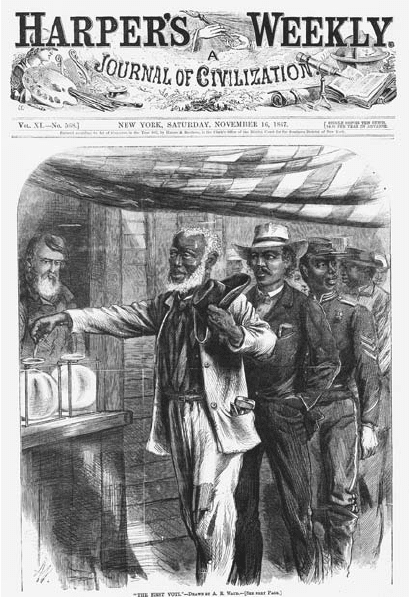
A cover of Harper’s Weekly depicting blacks voting
for the fi rst time, 1867
(Library of Congress)
622 right to vote
vi+904_EofUSConsti-v2.indd 622 3/20/09 2:18:27 PM
portionment. More importantly, in Reynolds the
Supreme Court again reaffi rmed that the Consti-
tution protects the right to vote in federal elections.
Furthermore, in Reynolds the Court drew a par-
allel between the right to vote and right to procre-
ate in S
KINNER V. OKLAHOMA, 316 U.S. 535 (1942),
declaring the right to vote as fundamental.
Locating a constitutional text to support the
right to vote in state elections is more problem-
atic. In Harper v. Virginia State Board of Elec-
tions, 383 U.S. 663 (1966), in striking down the
imposition of a poll tax in state elections, the
Supreme Court ruled that the right to vote in
state elections was located in the First Amend-
ment by way of the Fourteenth Amend-
ment’s due process and equal protection
clauses. Although the tax met traditional constitu-
tional standards, it was neither racially discrimi-
natory nor indefensible as rational policy, but the
Court found that it unconstitutionally singled out
the poor. More importantly, the Court yet again
affi rmed the importance of voting, stating that
voting is a “fundamental political right, because
preservative of all rights.” The legacy of Classic,
Reynolds, and Harper is that these three cases
stand for the proposition that voting is a fun-
damental right that must be subject to strict
scrutiny. Collectively, these cases would seem
to suggest that interference with, or regulation
of, the fundamental right to vote must be subject
to strict scrutiny, and that only if compelling
governmental interests are asserted, may it
be limited.
Enfranchisement of African Americans
The battle by African Americans to obtain the
right to vote was long and arduous. Originally,
the Constitution was silent on the right of Afri-
can Americans to vote; instead, Article I, sec-
tion 2 referred to them only as “other persons” and
counted them as only three-fi fths of a free person.
After the Civil War and during Reconstruction,
African Americans were permitted to vote, and
they elected several members of Congress in the
South. In 1870 the Fifteenth Amendment made
it unconstitutional to deny the right to vote on
account of race.
When Reconstruction ended, so did effective
franchise rights for African Americans. Many
Southern states enacted a variety of restrictions
on African-American voting rights. Some states
instituted poll taxes that required African Ameri-
cans to pay a fee to vote. Others imposed literacy
tests upon African Americans that asked them to
answer often arcane and trivial questions in order
to vote. Still other states enacted laws that declared
that individuals could vote only if their grandfa-
ther had that right, or used white primaries as a
means to exclude African Americans from partici-
pating in elections. Through these laws, as well as
by outright intimidation by the Ku Klux Klan and
other groups, African Americans effectively were
without franchise rights until the 1960s.
The Supreme Court initially upheld literacy
tests and poll taxes as constitutionally permis-
sible means by which to maintain a responsible
and informed electorate, but in the 1920s Demo-
cratic Party primaries in which participation was
restricted to whites began to crumble under judi-
cial attack in cases such as Smith v. Allwright, 321
U.S. 649 (1944).
It was not until the 1960s that the Supreme
Court and the federal government began to take
serious steps to protect the right to vote for African
Americans. The Twenty-fourth Amendment
in 1964 made the poll tax illegal; reapportionment
cases declared malapportionment on account of
race to be unconstitutional, and these cases also
established a constitutional right to vote at the
state and federal levels.
However, it was the 1965 Voting Rights Act
that had the biggest impact on African-Ameri-
can franchise rights. The Voting Rights Act was
enacted in 1965 and amended or reauthorized in
1970, 1975, 1982, and 2006. Section four of the
act outlawed some practices such as literacy tests,
section two precluded states from diluting voting
on account of race, and other parts of the act pro-
vided for new legal remedies and powers of the
federal government to intervene to protect the
African-American franchise in the states.
In addition to African Americans, other groups
have had their voting rights addressed by the
courts, Congress, or the Constitution. In 1924,
right to vote 623
vi+904_EofUSConsti-v2.indd 623 3/20/09 2:18:27 PM
Congress gave Indians the right to vote. In 1920
the Nineteenth Amendment enfranchised women,
and in 1971 the Twenty-sixth Amendment directed
states to allow qualifi ed citizens who were age 18
or older to vote.
However, two groups still do not have con-
stitutionally secure voting rights. Aliens may be
denied the right to vote, and in Richardson v.
Ramirez, 418 U.S. 24 (1974), the Supreme Court
upheld a state law denying ex-felons franchise. As
the Richardson case pointed out, many states deny
ex-felons the right to vote, often for life, thereby
affecting their rights to participate in elections
and the political process. Estimates are that up to
six million ex-felons, many of them people of color,
are denied their right to vote.
Finally, while franchise is nearly universal in
the United States, many individuals choose not to
vote, often with a turnout of less than half the eli-
gible voters for an election.
For more information: Grofman, Bernard, Lisa
Handley, and Richard Niemi. Minority Represen-
tation and the Quest for Voting Equality. New
York: Cambridge University Press, 1992; Keys-
sar, Alexander. The Right to Vote: The Contested
History of Democracy in the United States. New
York: Basic Books, 2001.
—David Schultz
Ring v. Arizona 536 U.S. 584 (2002)
In Ring v. Arizona, the U.S. Supreme Court
ruled that the imposition of capital punish-
ment by a judge, rather than a jury, violates the
Sixth and Fourteenth Amendments of the
Constitution. This case immediately impacted the
sentences of at least 168 death row inmates in fi ve
states—Arizona, Colorado, Idaho, Montana, and
Nebraska.
Timothy Stuart Ring and two other former
law enforcement offi cers planned and executed
the robbery of a Wells Fargo armored truck at a
shopping mall in Glendale, Arizona, on Novem-
ber 28, 1994. During the robbery, Ring killed
the security guard, John Magoch, with a single
shot to the head at close range using a silencer.
The three accomplices stole an estimated
$833,798. Approximately one month later, police
received a tip from one of the accomplice’s ex-
girlfriends, suggesting that Ring and the others
were involved in the heist. The FBI and Glen-
dale police secured a warrant to tap the men’s
phones, which in turn yielded incriminating
evidence. Police also observed that the three
men went on wild spending sprees following the
robbery, purchasing high-ticket items with cash.
With a warrant, police searched Ring’s home and
found the murder weapon, a silencer, stolen cash,
and incriminating notes. Ring was subsequently
charged with fi rst-degree murder, conspiracy to
commit murder, armed criminal action, and bur-
glary. The jury found Ring guilty on all counts,
but under Arizona law the judge—not the jury—
imposed the sentence. The judge ordered Ring to
be executed by lethal injection.
In a 7-2 decision, the U.S. Supreme Court
reversed and declared the Arizona law uncon-
stitutional. Writing for the majority, Ruth Bader
Ginsburg drew upon the Court’s decision in
Apprendi v. New Jersey (2000). In Apprendi, the
Supreme Court struck down a state sentencing
law that allowed trial judges to lengthen a penalty
by two years if it was determined the crime was
motivated by hate. According to Ginsburg, “The
right to trial by jury guaranteed by the
Sixth Amendment would be senselessly dimin-
ished if it encompassed the factfi nding necessary
to increase a defendant’s sentences by two years,
but not the factfi nding necessary to put him to
death.” Joining Ginsburg were David H. Souter,
John Paul Stevens, Anthony M. Kennedy,
Antonin Gregory Scalia, and Clarence
Thomas. Justice Stephen G. Breyer delivered
a concurring opinion. The two dissenters were
Arizonans Sandra Day O’Connor and Chief
Justice William Hubbs Rehnquist. Justice
O’Connor believed that the decision would have
a destabilizing effect on the criminal justice sys-
tem by opening the doors to scores of challenges
in other states.
The full impact of Ring has yet to be deter-
mined. Some death row inmates in the affected
states could be retried, resentenced, or have their
624 Ring v. Arizona
vi+904_EofUSConsti-v2.indd 624 3/20/09 2:18:27 PM
death penalties commuted to life in prison. The
Ring decision appears to be one in a line of recent
cases where the Supreme Court has restricted the
death penalty. See A
TKINS V. VIRGINIA (2002)—the
Court struck down the death penalty for the men-
tally retarded—and Roper v. Simmons (2005),
where the Court invalidated the death sentence
of a 17-year-old. The Atkins and Roper decisions
were based on the cruel and unusual proscription
in the Eighth Amendment.
For more information: Banner, Stuart. The
Death Penalty: An American History. Boston:
Harvard University Press, 2002; N.A. “The Death
Penalty and International Law,” William and
Mary Bill of Rights Journal 13 (2005): 305 (intro-
duction to symposium issue).
—Richard J. Hardy
ripeness
The doctrine of ripeness has been derived from a
particular understanding of the limited constitu-
tional authority of the judiciary.
Under Article III, Section 2 of the United
States Constitution the judicial power extends to
certain “cases” and “controversies.” The Supreme
Court has construed this “case” and “controversy”
language in Article III of the U.S. Constitu-
tion as limiting the judicial power to adjudication
of those lawsuits that raise live disputes in which
the parties have a present interest.
The doctrine of ripeness precludes adjudica-
tion by the federal courts of abstract controversies
in the absence of present and concrete hardship.
If the harm that a plaintiff claims he or she will
suffer remains contingent on future events that
are far from certain to occur, or the government
has not yet rendered a fi nal decision on the matter
at issue, the case is not yet ripe for judicial consid-
eration. In Abbott Laboratories v. Gardner, 387
U.S. 136 (1967), the Supreme Court explained
that the basic rationale of the ripeness doctrine is
to prevent the courts, through avoidance of pre-
mature adjudication, from entangling themselves
in abstract disagreements over administrative pol-
icies, and also to protect the agencies from judicial
interference until an administrative decision has
been formalized and its effects felt in a concrete
way by the challenging parties.
The Supreme Court has set out a two-part test
for determining ripeness, requiring evaluation
of both (1) “the fitness of the issues for judicial
decision” at this time and (2) “the hardship to the
parties of withholding court consideration” (Ohio
Forestry Ass’n, 523 U.S. at 733; Abbott Laborato-
ries, 387 U.S. at 149).
First, in terms of the fitness of the issue for
adjudication, the courts look to whether the issue
is fully developed in the context of a concrete and
present dispute. The Court is reluctant to hear a
facial challenge to a regulation or rule that has not
yet been applied, because “judicial appraisal . . . is
likely to stand on a much surer footing in the con-
text of a specifi c application of [the] regulation”
(Toilet Goods Ass’n v. Gardner, 387 U.S. 158, 164
[1967]). However, preenforcement relief is not
always barred, if the party challenging the gov-
ernment rule can make a compelling showing on
the second prong of the test, for example, that the
party will endure high costs in complying with the
rule or risks substantial civil or criminal penalties
if the rule is violated (see, e.g., Abbott Laborato-
ries, supra).
Second, with respect to the showing of hard-
ship by delaying adjudication, the courts consider
“the degree and nature of the [government rule’s]
present effect on those seeking relief.” Thus, “[a]
case may lack ripeness . . . even when it involves a
fi nal agency action presenting a purely legal ques-
tion,” where the action has no “suffi ciently direct
and immediate” impact on the parties (Alascom,
Inc. v. Federal Communications Comm’n, 727
F.2d 1212, 1217 (D.C. Cir. [1984]).
For more information: Aman, Alfred C., Jr., and
William T. Mayton. Administrative Law. 2d ed.
St. Paul, Minn.: West Group, 2001; Nichol, Gene
R., Jr. “Ripeness and the Constitution,” University
of Chicago Law Review 54, no. 153 (1987): 156–
160; Pierce, Richard J., Jr., Sidney A. Shapiro, and
Paul R. Verkuil. Administrative Law and Process.
4th ed. St. Paul, Minn.: West Group, 2004.
—Gregory C. Sisk
ripeness 625
vi+904_EofUSConsti-v2.indd 625 3/20/09 2:18:28 PM
Roberts, John G., Jr. (1955– ) Supreme
Court justice
John G. Roberts, Jr., is the 17th chief justice of
the Supreme Court of the United States. After
nomination by President George W. Bush and
confi rmation by the U.S. Senate, he was sworn
in on September 29, 2005, at the age of 50, as the
youngest chief justice in the last 200 years.
Roberts was born in Buffalo, New York, and
grew up a Roman Catholic in Indiana. He lives in
Bethesda, Maryland, and is married to Jane Marie
Sullivan. They have two children. He received a
bachelor’s degree summa cum laude in 1976 after
only three years at Harvard, entered Harvard
Law School, and became managing editor of the
Harvard Law Review. He graduated magna cum
laude from law school in 1979.
During the 1980 term, he served as a law clerk
for the then-associate Supreme Court justice (later
chief justice and Roberts’s predecessor) Wil-
liam Hubbs Rehnquist. From 1981 to 1982 he
was special assistant to the U.S. attorney general,
William French Smith. From 1982 until 1986 he
served as associate counsel to President Ronald
Reagan in the White House. From 1989 to 1993 he
was principal deputy solicitor general of the U.S.
Department of Justice. He argued 39 cases before
United States Supreme Court and won 25, placing
him among the most experienced litigators.
From 1986 to 1989 and from 1993 to 2003,
Roberts entered private practice as an associate at
the law fi rm of Hogan & Hartson in Washington,
D.C., where he developed a civil litigation practice
and ran the appellate division. As an attorney and
member of the D.C. Bar, he was widely involved
in bar activities. Roberts’s arguments within the
Supreme Court’s jurisdiction extend over a wide
range of issues, including antitrust, arbitration,
admiralty, administration, free speech, Indian
affairs, taxation, labor, civil rights, and criminal
law. He represented at different times a number of
states, defending diverse state, health, and welfare
policies before the United State Supreme Court.
He also represented 18 states pursuing antitrust
claims in the United States v. Microsoft case.
In 2003, when the U.S. Senate confirmed
his nomination by unanimous consent, he was
appointed to the United States Court of Appeals
for the District of Columbia Circuit, widely
considered as the country’s most important inter-
mediate appellate court. At that time Roberts
wrote 49 opinions; only two were not unanimous.
He dissented only three times.
During Senate Judiciary Committee hearings
on his nomination, Roberts testified about his
views on jurisprudence. Roberts was thought to
be conservative by temperament but not essen-
tially by ideology. He supports limited govern-
ment and believes in a narrow interpretation of
the U.S. Constitution. In October 2005, when the
Court began its 2005–06 session, he presided over
his fi rst oral arguments, and in January 2006, the
Roberts Court decided the first case argued
before it.
For more information: McElroy, Lisa Tucker.
John G. Roberts, Jr.: Chief Justice. Minneapolis,
Minn.: Lerner Publications, 2007.
—Jurij Toplak
Roberts Court (2005– )
The Roberts Court began on September 29, 2005,
when John Glover Roberts, Jr., became chief
justice of the United States Supreme Court. Origi-
nally, President George W. Bush had nominated
him to the position held by retiring associate jus-
tice Sandra Day O’Connor (July 19, 2005);
however, following the death of Chief Justice Wil-
liam Hubbs Rehnquist (September 3, 2005),
President Bush withdrew the nomination and
resubmitted it for the chief justice seat (September
6, 2005), asking Congress to confi rm the nomina-
tion in time for the beginning of the fall term in
October. Despite opposition from liberal Demo-
crats, the Senate Judicial Committee approved his
nomination. The full Senate approved the nomi-
nation on September 29, 2005. He was sworn in
a short time later by Associate Justice John Paul
Stevens in the East Room of the White House.
The members of the Roberts Court at the begin-
ning, in order of their accession to the Court, were
John Paul Stevens (appointed by President Gerald
Ford, 1975), Sandra Day O’Connor (appointed by
626 Roberts, John G., Jr.
vi+904_EofUSConsti-v2.indd 626 3/20/09 2:18:28 PM
President Ronald Reagan, 1981), Antonin Greg-
ory Scalia (appointed by President Reagan,
1986), Anthony McLeod Kennedy (appointed
by President Reagan, 1988), David Hackett
Souter (appointed by President George H. W.
Bush, 1990), Clarence Thomas (appointed
by President G. H. W. Bush, 1991), Ruth Bader
Ginsburg (appointed by President William Jef-
ferson Clinton, 1993), and Stephen G. Breyer
(appointed by President Clinton, 1994). On Febru-
ary 1, 2006, Samuel Alito, Jr., joined the court
to replace the retiring O’Connor.
The retirement of O’Connor and the accession
of Alito in the Court’s mid-term meant that sev-
eral decisions were subsequently decided without
the full participation of either. The cases of Gar-
cetti v. Ceballos (547 U.S. 410 [2006]), Hudson
v. Michigan (547 U.S. 586 [2006]), and Kansas v.
Marsh (547 U.S. 1,037 [2006]) were decided by
4-4 votes, allowing the ruling in the lower court
to stand.
Chief Justice Roberts presided over the fi rst case
before the Roberts Court on October 3, 2005, as
the Court began the fall term of its 2005–06 ses-
sion. On November 8, 2005, the opinion of the fi rst
case decided by the Roberts Court was delivered
by Associate Justice Stevens. IBP, Inc. v. Alvarez,
unanimously decided, was viewed by observers as
upholding a tradition that the fi rst case in a new
chief justice’s court is decided unanimously. This
“honeymoon” period of the Roberts Court ended
with the decision in G
ONZALES V. OREGON, 546 U.S.
243 (2006). The chief justice joined the dissent of
Antonin Scalia and Clarence Thomas in opposing
physician-assisted suicide allowed by the state of
Oregon for the terminally ill.
The new chief justice’s fi rst opinion came on
March 6, 2006, when Roberts wrote the unani-
mous decision in Rumsfeld v. Forum for Academic
and Institutional Rights, 547 U.S. 47 (2006). The
opinion required colleges and universities taking
federal funds to allow military recruiters on their
campuses. The decision agreed with a number of
earlier precedents.
The first written dissenting opinion of Chief
Justice Roberts came in the case of Georgia v.
Randolph (March 22, 2006). The majority opin-
ion said that the police may not search a home if
one spouse says that it is permissible and the other
spouse objects. The thrust of Roberts’s disagree-
ment was his view that the decision was not con-
sistent with prior case law.
Observers claim the Roberts Court is more
conservative; however, Roberts joined the liberals
in Jones v. Flowers, a case that seemed to protect
property rights by ensuring adequate due pro-
cess in tax-forfeiture cases. The Roberts Court
moved to allow legislative action that restricts
abortion when the Partial-Birth Abortion Ban
Act was upheld in GONZALES V. CARHART, ATTORNEY
GENERAL (127 S. Ct. 1610 [2007]). It also upheld
school authority over student claims to freedom of
speech (“bong hits for Jesus”) in MORSE V. FREDER-
ICK, 551 U.S. ___ (2007).
Observers of the Court believe there has been
a change in tone in the way oral arguments are
conducted. This may refl ect the Roberts experi-
ence after arguing 39 cases before the Court.
For more information: Hutchinson, Dennis J.,
et al., eds. Supreme Court Review 2006. Chicago:
University of Chicago Press Journals, 2007; Moller,
Mark K., Timothy Lynch, and Robert A. Levy, eds.
Cato Supreme Court Review 2006–2007. Wash-
ington, D.C.: Cato Institute, 2007; Moller, Mark
K., Timothy Lynch, and Robert A. Levy, eds. Cato
Supreme Court Review 2005–2006. Washington,
D.C.: Cato Institute, 2006; Neubauer, David W.
W., and Stephen S. Meinhold. Battle Supreme:
The Confi rmation of Chief Justice John Roberts
and the Future of the Supreme Court. Belmont,
Calif.: Wadsworth Publishing Company, 2005.
—Andrew J. Waskey
Roe v. Wade 410 U.S. 113 (1973)
Roe v. Wade, a landmark U.S. Supreme Court case,
gave women access to abortions based on an
implied right to privacy in the First, Fourth,
Fifth, Ninth, and Fourteenth Amendments
of the U.S. Constitution. The right to privacy
originated in GRISWOLD V. CONNECTICUT, 381 U.S.
479 (1965), and EISENSTADT V. BAIRD, 405 U.S. 438
(1972), which struck down laws making it illegal
Roe v. Wade 627
vi+904_EofUSConsti-v2.indd 627 3/20/09 2:18:28 PM
to use or distribute contraceptives and contra-
ceptive devices. Under Roe, abortion restrictions
were subjected to the strict scrutiny test,
which meant that the abortion right was accorded
the highest level of constitutional protection.
Highly controversial, Roe v. Wade specifi cally
addressed the constitutionality of the 1857 Texas
statute that banned abortion except to save the
mother’s life. The U.S. Supreme Court declared
the Texas law unconstitutional. Building on the
logic in the Griswold and Eisenstadt rulings, the
Court used the privacy zone to protect a woman’s
right to terminate a pregnancy but also recognized
the state’s interest to intervene at some point in
the pregnancy to protect potential human life.
Justice Harry Blackmun, writing for the major-
ity, devised a trimester formula that would bal-
ance the rights of women, physicians, and states
and established guidelines on whose rights would
prevail across the nine months of pregnancy. In
the fi rst trimester (or fi rst three months) of preg-
nancy, the abortion decision is left to the medical
judgment of the woman and her assisting physi-
cian. In the second trimester, the state may regu-
late the abortion procedure in the interest of the
mother’s health. During the third trimester, the
state may regulate or even prohibit abortions to
protect the life of a fetus, thus allowing late-term
abortions only when necessary to protect the life
or health of the mother.
One major challenge to Roe came in Planned
Parenthood of Southeastern Pennsylvania v.
Casey, 505 U.S. 833 (1992). In Casey, a series of
Pennsylvania abortion restrictions (parental con-
sent, informed consent, a 24-hour waiting period,
and spousal notifi cation prior to obtaining an abor-
tion) were challenged. Although the Court did not
overturn Roe, it abandoned the strict scrutiny
standard and the trimester formula and moved to
the undue burden standard. An “undue bur-
den” consists of placing a substantial obstacle in
the path of a woman who seeks to abort a non-
viable fetus. The Court held that state restrictions
on abortion access that carried an undue burden
would be declared unconstitutional. In Casey,
only the spousal notification requirement was
struck down as unconstitutional under the undue
burden standard. A woman’s right to an abor-
tion still remains intact, but Casey allows states
to enact laws that protect fetal rights and restrict
access to abortions as long as restrictions do not
unduly burden a woman’s abortion rights.
Jane Roe, the plaintiff in this landmark case, is
actually Norma L. McCorvey. Because the case
took three years to get to the Court, McCorvey
never actually obtained an abortion and instead
put her child up for adoption. In 2005, she peti-
tioned the Supreme Court to reopen Roe and
overturn it based on changes in law and technol-
ogy since 1973 and her personal conversion to
Christianity. The Supreme Court did not rule in
McCorvey’s favor but has signaled a willingness to
revisit some of Roe’s basic tenets.
McCorvey’s change of heart personifies the
abortion controversy in American politics. Gener-
ally, Americans believe abortion should be legal
under certain, but not all, circumstances. Presi-
dent George W. Bush and Congress, acting on the
ambivalence of public opinion toward abortion,
have endorsed and passed laws to restrict abor-
tion and protect the unborn. Despite the divisions
caused by the Roe ruling, most Americans oppose
efforts to overturn the decision and return to the
pre-Roe era. Public opinion polls taken since 1989
indicate approximately 60 percent of Americans
wish to maintain the Roe precedent.
Since the 1973 Roe ruling, all nine of the
original Roe justices have died or retired. Many
scholars question whether Roe will remain the
law of the land. Roe leaves behind many unan-
swered questions such as: When does life begin?
At what point during the pregnancy is the fetus
viable? When should the state intervene to make
sure the fetus will be given a chance to develop
and thrive? Before her appointment to the U.S.
Supreme Court, Ruth Bader Ginsburg argued that
Roe stymied the political process that already was
moving in a reformist direction and signifi cantly
prolonged the abortion controversy by making
grounds for consensus less fertile.
Others argue that Roe has become irrelevant.
Congress and states have erected fi nancial barri-
ers (laws barring public funding of abortions) and
legal obstacles (various state restrictions such as
628 Roe v. Wade
vi+904_EofUSConsti-v2.indd 628 3/20/09 2:18:29 PM
waiting periods, parental consent, and mandatory
counseling). In addition, abortion providers are
scarce. Eighty percent of American women live in
counties without abortion providers or must travel
across state lines to obtain an abortion because
many physicians refuse to provide abortions. If
women lack access to abortion, Roe indeed may
be moot. Whether Roe retains any relevance and
whether any of its basic tenets will survive will be
determined by battles in the political arena.
Since Roe was decided, its central holding that
women have a right to terminate their pregnancies
in the fi rst trimester was upheld in Planned Par-
enthood v. Casey, 505 U.S. 833 (1992). However,
in G
ONZALES V. CARHART, 550 U.S. ___ (2007), the
Supreme Court in a 5-4 decision upheld a federal
law banning certain late-term abortions commonly
referred to as “partial birth abortions.” This deci-
sion is the only abortion procedure the Court has
upheld since it issued its Roe opinion.
For more information: Balkin, Jack M. “Roe v.
Wade: An Engine of Controversy.” In What Roe v.
Wade Should Have Said: The Nation’s Top Legal
Experts Rewrite America’s Most Controversial
Decision. New York: New York University Press,
2005; Jones, Jeffrey M. “President Bush and Roe
v. Wade: Public Favors Restrictive View of Abor-
tion Rights, but Not Roe v. Wade Reversal.” Gal-
lup News Service (November 30, 2004); Nossif,
Rosemary. Before Roe: Abortion Policy in the
States. Philadelphia: Temple University Press,
2001; Strickland, Ruth Ann. “Abortion: Pro-
Choice versus Pro-Life.” In Moral Controversies
in American Politics. 3d ed. Armonk, N.Y.: M.E.
Sharpe, 2005.
—Ruth Ann Strickland
Romer v. Evans 116 S.Ct. 1620 (1996)
In Romer v. Evans, in a 6-3 decision, the Supreme
Court upheld a lower court’s ruling against Colo-
rado’s Amendment Two and found that it violated
the federal equal protection clause in clas-
sifying homosexual citizens of Colorado not to
further a legitimate legislative end, but to make
them unequal to other residents of Colorado. This
amendment struck down any law or executive
order in the state that indicated sexual orientation
as a classifi cation to be protected alongside other
common antidiscrimination classifi cations such as
religion and national origin.
The decision in Romer rebuffed the dissent’s
contentions that Amendment Two, a popular refer-
endum, did not refl ect animus toward gay persons,
given that the advertisements used to gain sup-
port for it relied on anti-gay stereotype and bias.
Indeed, the Court found that no reason existed for
support of this law other than bias, an impermis-
sible purpose, and hence it failed the rational
basis test. Romer affi rmed the very basic prin-
ciple of equal citizenship through its use of the
rational basis test, and set a minimum standard
that has to be met when contemplating legislation
against gay persons.
The opinion of the Court, given by Justice
Anthony M. Kennedy, held that the means
employed by Amendment Two—the classifi cation
used—did not fi t the ends, as it was both too nar-
row and too broad in its identifi cation of a group of
persons by a single trait and by denying them pro-
tections across the board. Kennedy’s opinion also
addressed the hot-button issue of “special rights,”
the notion that when gay persons are added to exist-
ing nondiscrimination or other legislation they are
winning for themselves protections unavailable for
the ordinary, non-gay citizen. The rights at issue,
such as access to the public library and emergency
medical treatment, were deemed quite ordinary
and in the realm of what any American rightfully
can expect; in addition, the various provisions of
Colorado state law that protect gay persons were
all duly enacted and so can be assumed to refl ect
popular and legislative will.
Romer was the first significant case for gay
and lesbian rights after the disastrous BOW-
ERS V. HARDWICK (478 U.S. 186 [1986]), and called
into question the earlier case’s holding that the
morality of a majority in a state can by itself legiti-
mate a law, a point of view defended by dissenting
Justice Antonin Gregory Scalia, who argued
that a behavior or practice that is regarded as
against good morals by a citizenry may be legally
proscribed on that basis alone. Scalia couched the
Romer v. Evans 629
vi+904_EofUSConsti-v2.indd 629 3/20/09 2:18:29 PM
dissent in terms of a broader Kulturkampf that has
affected the nation’s legal establishment, and he
suggested that the decision in Romer would lead
to striking down as constitutionally suspect laws
against polygamy, incest, and cockfi ghting. Ear-
lier, the Colorado Supreme Court struck down
Amendment Two, fi nding not only that it forbade
anyone from advocating on behalf of gay rights,
whether or not gay him- or herself, but also that
it required gay rights supporters to meet a higher
bar—only a constitutional amendment could over-
turn it—than needed by anyone advocating on
any other issue. It fenced a politically unpopular
minority out of the political process, but this issue
was not taken up in the Supreme Court.
For more information: Murdoch, Joyce, and
Deb Price. Courting Justice: Gay Men and Les-
bians v. the Supreme Court. New York: Basic
Books, 2001.
—Gordon A. Babst
Rosenberger v. University of Virginia 515
U.S. 819
(1995)
In Rosenberger v. University of Virginia, the
Supreme Court held that the university (UVA)
could not discriminate against a student group’s
freedom of expression in order to avoid violating
the establishment clause of the First Amend-
ment. In a case where a number of elements of
the First Amendment intersected—freedom
of speech, freedom of religion, and reli-
gious establishment—the Court sided with Wide
Awake, a student-run publication of which Rosen-
berger was a member, and its freedom of religious
expression.
Wide Awake was a Christian student publi-
cation that requested monies from the Student
Activities Fund (SAF) at UVA. The SAF exacted
a mandatory $14 fee that each student had to pay
every semester. Qualified student groups could
request monies from the SAF for eligible expendi-
tures related to these groups providing activities,
publications, or other support to the student body
at large. Wide Awake requested monies to pay a
printer for the publication of its magazine, but the
student council, which managed the SAF, denied
the request on the grounds that Wide Awake was
a religious activity; funding of religious activities
was prohibited under the SAF. After the UVA
administration denied a challenge to the Student
Council’s ruling, Wide Awake filed an appeal
in district court. Both the district and appellate
courts denied the appeal, holding in the latter that
UVA, as an agency of the state of Virginia, could
engage in viewpoint discrimination, as the estab-
lishment clause of the First Amendment prohib-
ited it from providing any assistance to a specifi c
religion.
The Supreme Court, in a divided (5-4) deci-
sion, ruled in favor of Wide Awake. In his major-
ity opinion, Justice Anthony M. Kennedy
distinguished between content discrimination
(government discrimination of speech based on
the subject of the speech) versus viewpoint dis-
crimination (government discrimination based on
the views or thoughts of the speaker). The Court
has historically allowed content discrimination
to afford government the opportunity to pre-
serve the purposes of the forum it has created.
However, as seen in the Court’s ruling in LAMB’S
CHAPEL V. CENTER MORICHES UNION FREE SCHOOL
DISTRICT, 508 U.S. 384 (1993), the Court has
been quite skeptical about government exclud-
ing speech based on its message. Applied to the
Rosenberger case facts, Kennedy wrote that UVA
was engaged in viewpoint discrimination, as it
was the Christian nature of Wide Awake’s mes-
sage that led the student group to seek money
from the SAF.
Justice Kennedy was, much like Justice San-
dra Day O’Connor in her concurrence, also
dismissive of UVA’s claim that it had the con-
stitutional duty to discriminate against Wide
Awake’s Christian message because the estab-
lishment clause of the First Amendment does not
allow the government to favor one religion over
others. Here, Kennedy demonstrated how UVA
had taken steps in how it recognized and funded
student organizations to show a clear separation
between it and student groups. As such, UVA
could not be seen to be establishing religion by
funding Wide Awake.
630 Rosenberger v. University of Virginia
vi+904_EofUSConsti-v2.indd 630 3/20/09 2:18:29 PM
Justice David H. Souter, writing for the four
dissenters on the Court, did not agree with Ken-
nedy that there was a clear separation between
Wide Awake and UVA. As UVA required each stu-
dent to pay the mandatory activity fee, collected
the monies, and then distributed the monies per
rules it created, one could easily make the claim
that public monies were being spent to fund reli-
gion. For Souter, then, the Court seemed to be
approving for the fi rst time “direct funding of core
religious activities” in violation of the establish-
ment clause of the First Amendment.
In a case context that blurred the lines between
various parts of the First Amendment, the Court
had to weigh which part of the amendment was
more important in Rosenberger. Though empa-
thetic toward the government’s desire to avoid
being seen as violating the establishment clause,
the Court made clear that this desire could not
result in viewpoint discrimination in a forum the
government created.
For more information: O’Brien, David M. Con-
stitutional Law and Politics: Civil Rights and Lib-
erties. 5th ed. New York: W.W. Norton, 2003.
—John M. Aughenbaugh
Rostker v. Goldberg 453 U.S. 57 (1981)
In Rostker v. Goldberg, the United States
Supreme Court rejected a challenge to the law
that required males to register for the military.
The case arose when President Jimmy Carter
reactivated a military draft registration follow-
ing the Russian invasion of Afghanistan in 1979.
Although Carter recommended that Congress
amend the Military Selective Service Act to allow
women to register, Congress authorized funds to
register men only. Several young men, subject to
the new registration policy, brought suit against
Bernard Rostker, director of the Selective Ser-
vice System.
The lower court held that the law violated the
due process clause of the Fifth Amendment
and ordered the registration stopped. The court
made it clear that it was expressing no opinion on
the role of women in combat, but was limiting its
ruling to the registration only. The circuit court
stayed the order and the registration proceeded.
In a 6-3 vote, the Supreme Court reversed the
lower court, with Chief Justice William Hubbs
Rehnquist delivering the opinion of the Court.
Noting that the Court’s customary deference to
congressional authority is heightened when con-
sidering a law governing military affairs, the Court
approved the male-only registration scheme.
Rehnquist pointed out that the purpose of the
registration was to prepare for a draft of combat
troops. Acknowledging that the government could
have required both sexes to register, he stressed
the Court’s only task was to determine if the deci-
sion to require only men to register was inconsis-
tent with the equal protection guarantee of
the due process clause of the Fifth Amendment.
He differentiated this situation from others in
which government actions simply refl ect stereo-
typical views of men’s and women’s roles. In enact-
ing this law, Congress clearly indicated that the
registration process was linked to a future draft
of potential combat troops. With women ineligible
for combat by statute and policy, he said, it was
reasonable for Congress to exempt women from
the registration process. Under these circum-
stances, the sexes were not similarly situated, and
Congress could legitimately distinguish between
them. Although the Court recognized that regis-
tration could have been extended to women, since
they might fill a role in noncombat positions, it
nevertheless accepted Congress’s judgment that
noncombat roles would be filled by volunteers,
making registration unnecessary.
The dissenting justices argued that the Court
had not been asked to decide whether women
should be drafted into the military nor what role
they should play in the service. They criticized the
majority for concluding that women need not reg-
ister because they would not be needed in a draft.
They pointed out that if there were a mobilization,
the military would require the service of thousands
of people in noncombat positions, far beyond the
numbers that could be satisfi ed by volunteers. Since
women could serve in those roles, it would be sen-
sible to require them to register so that they could
be drafted into those positions as needed.
Rostker v. Goldberg 631
vi+904_EofUSConsti-v2.indd 631 3/20/09 2:18:30 PM