
Schultz D. Encyclopedia of the United States Constitution
Подождите немного. Документ загружается.

Scalia, Antonin Gregory (1936– ) Supreme
Court justice
Antonin Gregory Scalia presently serves as a U.S.
Supreme Court justice; his appointment was in
1986. Scalia was born March 11, 1936, in Trenton,
New Jersey, the only child of S. Eugene Scalia and
Catherine Scalia. Scalia’s father was born in Sicily
and immigrated to the United States as a young
man. He was a professor of Romance languages.
His mother, born to immigrant Italian parents,
was a schoolteacher.
Scalia’s family moved to Elmhurst, a section of
Queens, New York. He attended public school in
Queens and later at St. Francis Xavier, a military
prep school in Manhattan, where he graduated
fi rst in his class. He received his B.A. summa cum
laude in history in 1957 from Georgetown Uni-
versity and was the valedictorian of his class. He
attended Harvard Law School, where he received
his LL.B. magna cum laude. Following gradua-
tion, he spent a year traveling in Europe as a Shel-
don Fellow of Harvard.
Scalia began his legal career in 1961 as an asso-
ciate at the law fi rm of Jones, Day, Cockley, and
Reavis in Cleveland, Ohio. He worked in a number
of practice areas, including real estate, corporate
fi nancing, labor, and antitrust. In 1967 he decided
to teach law and became a professor at the Univer-
sity of Virginia Law School.
Four years later, Scalia took leave from Virginia
to begin a career in government service. Various
positions included: general counsel, Offi ce of Tele-
communications Policy; chairman of the Admin-
istrative Conference of the United States; and
assistant attorney general for the Offi ce of Legal
Counsel at the Justice Department.
After he left government service, Scalia
returned to teaching law, briefl y at Georgetown
University Law Center and then at the University
of Chicago from 1977 to 1982. In 1982 President
Ronald Reagan appointed Scalia to the U.S. Court
of Appeals for the District of Columbia Cir-
cuit. He served on this court, considered second
in importance only to the Supreme Court, for four
years.
On June 17, 1986, President Reagan nomi-
nated Scalia to the Supreme Court, to fi ll the seat
left vacant by the elevation of William Hubbs
Rehnquist to chief justice. In his testimony
before the Senate Judiciary Committee, Scalia said
he considered the most important part of the Con-
stitution to be the system of “checks and bal-
ances among the three branches, . . . so that not
one of them is able to run roughshod over the lib-
erties of the people.” Scalia was confi rmed unani-
mously (98-0) by the Senate on September 17.
An important case during his early years
demonstrated his conviction concerning the
“checks and balances” necessary among the three
branches. Morrison v. Olson, 487 U.S. 654 (1988),
was a suit challenging the constitutionality of the
independent counsel, an individual selected by
the judiciary to investigate senior offi cials of the
executive branch. The Court upheld the legisla-
tion creating the post, but Scalia wrote a forceful
dissent, arguing that Congress had impermissi-
bly vested some of the traditional power to pros-
ecute in the hands of someone not fully within
the supervision and control of the president—an
arrangement that had no support in the Constitu-
tion. Scalia asked, “Once we depart from the text
of the Constitution, just where short of that do we
stop?” (id. at 711).
Scalia is considered a formalist, following a
“textualist” and/or “originalist” approach when
interpreting the Constitution. He is unwilling to
fi nd constitutional rights that are not plainly set
forth in the language of the Constitution or fi rmly
grounded in American tradition. Both approaches
emphasize careful adherence to the text of both
the Constitution of the United States and federal
statutes, as their meaning would have been under-
stood when adopted. Some applaud Scalia’s view;
others believe the Constitution is a “living docu-
ment” that entails more than the mere words with
which it is written.
Scalia’s strict adherence to originalism has
led him to support many rights associated with a
liberal viewpoint. One example is his support for
the Court’s holding in T
EXAS V. JOHNSON, 491 U.S.
397 (1989), that fl ag burning is a form of political
expression protected under the First Amend-
ment, despite his personal contempt for fl ag burn-
ers. By contrast, Scalia’s decisions on abortion or
642 Scalia, Antonin Gregory
vi+904_EofUSConsti-v2.indd 642 3/20/09 2:18:33 PM
gay and lesbian rights issues could be char-
acterized as opposing a libertarian viewpoint; e.g.,
in LAWRENCE V. TEXAS, 539 U.S. 558 (2003), Scalia
denied that the Constitution protected the right to
engage in sodomy.
Although Scalia’s views are not endorsed by a
majority of the Court, he is well respected for his
strong intellect, analytical ability, and obvious pas-
sion for the law.
For more information: Schultz, David, and
Christopher Smith. The Jurisprudential Vision of
Justice Antonin Scalia. Lanham, Md.: Rowman &
Littlefi eld, 1996.
—Randy W. Hagedorn
Schechter Poultry Corporation v.
United States
295 U.S. 495 (1935)
In Schechter Poultry Corporation v. United States
the Supreme Court held that rules drafted under
the National Industrial Act to regulate competi-
tion were an unconstitutional delegation of power.
The importance of this case was that it struck
down some of the fi rst sets of laws drafted during
the New Deal.
In Schechter Poultry, the Supreme Court
was asked to determine the constitutionality of a
section of the National Industrial Recovery Act
of 1933. In the act, Congress gave the National
Recovery Administration (NRA) the authority to
establish fair codes for competition—including
wages, hours, and working conditions—in vari-
ous industries nationwide. By establishing these
codes, the hope was that conditions in a host of
industries would stabilize, thus ameliorating the
ongoing economic depression affecting the coun-
try at the time.
In this case, the Schechter brothers operated a
number of slaughterhouses in New York City. They
imported chickens from out of state, slaughtered
them, and then sold the chickens locally. At the
federal district court level, the Schechters were
found in violation of various codes established by
the NRA, with the conviction being upheld by the
appellate court. The Schechters challenged their
conviction to the Supreme Court, claiming that
the act surpassed congressional powers per the
commerce clause and that the authority dele-
gated to the NRA was unconstitutional due to the
lack of specifi c standards to guide the NRA.
A unanimous Court, in an opinion written by
Chief Justice Hughes, fi rst held that the Schech-
ter’s business activities, particularly after receiving
the chickens, were intrastate, and thus had little
direct impact upon interstate commerce. As
such, the Court concluded Congress did not have
the authority to regulate the Schechter brothers’
enterprises under its commerce clause authority.
Next, the Court addressed the claim that the
authority Congress granted the NRA was uncon-
stitutional. Specifi cally, the Schechters contended
that the authority given the NRA to establish fair
competition codes was done so without giving
the executive branch standards on which to base
the codes. The Court, after an extensive review
of the law, agreed with the Schechters, determin-
ing that Congress had not defi ned what it meant
by fair competition, had not established a stan-
dard to guide executive branch action, and had
not required any fi nding of fact by the executive
branch before it exercised the authority found
in the law. In the end, the Court concluded that
Congress left to the executive branch’s discretion
the determination of what was or was not fair
competition for a number of industries. As Justice
Cardozo wrote in a concurring opinion, “(T)his
was delegation running riot.”
A broader issue surrounding this case was the
question of what the Constitution demanded from
the executive and legislative branches as expecta-
tions placed upon the federal government grew in
the aftermath of the Great Depression in the late
1920s and throughout the 1930s. The Court in
Schechter, like in PANAMA REFINING COMPANY V. RYAN,
293 U.S. 388 (1935), recognized that Congress had
authority in the Constitution to pass legislation that
gave the government an opportunity to adapt to
complex situations that the legislative branch could
not foresee. However, the Court also stressed how
the Constitution fi rmly rests legislative authority in
Congress and not the executive branch.
Nevertheless, the Court’s rulings in Panama
Refi ning and Schechter Poultry were the last two
Schechter Poultry Corporation v. United States 643
vi+904_EofUSConsti-v2.indd 643 3/20/09 2:18:34 PM
cases in which it limited the delegation of author-
ity from Congress to the executive branch. The
nondelegation doctrine, as these rulings came to
be known, gave way to the Court typically ratify-
ing broad congressional delegations of authority to
the executive branch throughout the 20th century
and into the next century.
Finally, by the late 1930s and early 1940s,
the Court began to allow congressional efforts
to regulate activities that had an indirect, albeit
substantial, effect on the national economy (see
U
NITED STATES V. DARBY, 312 U.S. 100 [1941], and
WICKARD V. FILBURN, 317 U.S. 111 [1941]). Whereas
the Court was quite reluctant in the fi rst years of
the New Deal to read the Constitution as giving
the political branches the authority to regulate
areas of the economy that had previously been the
purview of state governments (if at all), the Court
changed course in 1937 (see NATIONAL LABOR RELA-
TIONS BOARD V. JONES & LAUGHLIN STEEL CORP., 301
U.S. 1 [1937]) and began to deem such legislation
as constitutional.
For more information: Leuchtenburg, William
E. The Supreme Court Reborn: The Constitu-
tional Revolution in the Age of Roosevelt. New
York: Oxford University Press, 1995.
—John M. Aughenbaugh
Scheidler v. National Organization for
Women, Inc.
547 U.S. 9, 126 S.Ct. 1264
(2006)
In Scheidler v. National Organization for
Women, Inc., the Supreme Court considered lim-
its on antiabortion protests under the 1970 Rack-
eteer Infl uenced and Corrupt Organizations Act
(RICO). It ruled that, to win a civil RICO case,
plaintiffs must prove that defendants committed
at least two or more specifi ed criminal acts within
10 years.
In 1986, the National Organization for Women
(NOW) fi led a civil RICO action against antiabor-
tion protestors, charging that they were part of a
nationwide conspiracy to close abortion clinics by
engaging in racketeering activities that included
blocking clinic entrances, arson, harassing clinic
personnel and clients, destruction of property,
physical injuries, bombings, extortion, threats, and
intimidation. They claimed that the defendants
violated the 1948 Hobbs Act, a federal anti-extor-
tion law that forbids anyone from interfering with
interstate commerce “by robbery or extortion
or . . . commits or threatens physical violence to
any person or property in furtherance of a plan or
purpose” to violate the act.
The circuit court dismissed the case, ruling
that the plaintiffs had not shown that the defen-
dants were economically motivated. The Supreme
Court unanimously reversed, holding that RICO
was not restricted to conspiracies that furthered
economic interests.
Four years later, a federal court jury in Chi-
cago found the defendants guilty of violating
numerous counts of the Hobbs Act; the judge also
issued a nationwide order barring protestors from
blocking access to clinics, trespassing, damaging
clinic property, and threatening or using violence
against clinic personnel or patients. The defen-
dants appealed, arguing that they had not violated
the Hobbs Act because they had not “obtained”
clinic property and were not guilty of extortion.
The circuit court rejected their argument, ruling
that they may be found guilty under the Hobbs
Act for disrupting or interfering with the victim’s
business even if they had not physically “obtained”
the victim’s property.
In 2003, the Supreme Court reversed the
appellate court. Chief Justice William Hubbs
Rehnquist found that the defendants had not
committed extortion because they did not “obtain”
the abortion providers’ property. Interfering with
property is not extortion, he said, even if it succeeds
in closing down clinics. Rehnquist concluded that
because the defendants were not guilty of extor-
tion, they had not violated the Hobbs Act.
Although the Supreme Court absolved the
defendants of the extortion charge, NOW argued
that they had still violated RICO by committing
acts or threats of violence to persons or property
associated with abortion clinics. Because NOW
had not raised this issue before the Supreme
Court, the appellate court remanded the case to
the district court to allow it to determine whether
644 Scheidler v. National Organization for Women, Inc.
vi+904_EofUSConsti-v2.indd 644 3/20/09 2:18:34 PM
threats or acts of violence constituted crimes
under the Hobbs Act.
On appeal once again, the High Court ruled
against NOW. Speaking for a unanimous Court,
Justice Stephen G. Breyer stated that threat-
ening or committing acts of physical violence that
were unrelated to extortion or robbery did not
violate the Hobbs Act. He said that the “plan or
purpose” specifi ed in the statute must affect inter-
state commerce through robbery or extortion.
After more than a decade, NOW ultimately
failed in its attempt to use civil RICO to halt the
actions of the antiabortion protestors who tried to
disrupt the work of abortion clinics.
For more information: Nero, Autumn. “Where
Are We Now?: Clinic Protection in the Wake of
Scheidler v. National Organization for Women,
Inc.” Wisconsin Women’s Law Journal 21 (2006):
73–109; Schriver, Steven. “Applying Civil Rico to
Antiabortion Demonstrators: National Organiza-
tion for Women v. Scheidler,” Maryland Journal
of Contemporary Legal Issues 6 (1994–95): 179–
204; Wentzel, Suzanne. “National Organization
for Women v. Scheidler: RICO a Valuable Tool for
Controlling Violent Protest,” Akron Law Review
28 (1995): 391–408.
—Susan Gluck Mezey
Schenck v. United States 249 U.S. 247
(1919)
In Schenck v. United States, Justice Oliver Wen-
dell Holmes, writing for a unanimous Supreme
Court, held that the prosecution of two Social-
ist Party organizers under the World War I–era
Espionage Act for distributing leafl ets opposing
conscription did not violate the First Amend-
ment. Schenck is notable as the fi rst case in which
Justice Holmes set forth the clear and present
danger test.
The case grew out of opposition to U.S. entry
into World War I. A number of Socialist Party
offi cials, including Eugene Debs, made speeches
opposing the war and military conscription.
Charles T. Schenck, general secretary of the Social-
ist Party, was charged with a conspiracy to violate
the Espionage Act by mailing leaflets opposing
conscription to men who had been called up for
military service. He was sentenced to six months
imprisonment.
The leafl ets called conscription “despotic” and
likened it to involuntary servitude, banned by the
Thirteenth Amendment. They said that con-
scription served the interests of Wall Street’s cho-
sen few and told the reader to “Assert Your Rights”
and not “submit to intimidation.” But the leafl ets
stopped short of calling for violence—or even for
draftees to resist induction. Instead, the leafl ets
called for peaceful measures such as repealing the
Selective Draft Act by petition.
In upholding the convictions, Justice Holmes,
conceding that “in many places and in ordinary
times” the First Amendment would have protected
the defendant’s speech, observed that “the charac-
ter of every act depends upon the circumstances
in which it is done.” Then, in a famous analogy,
Justice Holmes said that “even the most strin-
gent protection would not protect a man in falsely
shouting fi re in a theatre and causing panic.” Nor,
he continued, did the First Amendment allow
someone to utter “words that may well have the
effect of force.”
Instead, the key question was whether the
words, and the surrounding circumstances, cre-
ated “a clear and present danger that they will
bring about the substantive evils that Congress
has a right to prevent.” Justice Holmes empha-
sized that in wartime a nation cannot endure
acts that hinder the war effort. Nor did it matter
whether the leafl ets persuaded anyone to obstruct
recruitment—if the intent, tendency, and act are
the same, Justice Holmes saw “no ground for say-
ing that success alone warrants making the act a
crime.”
The week after Schenck, the Court upheld the
Espionage Act conviction of Eugene Debs. How-
ever, in Abrams v. United States, 250 U.S. 616
(1919), Justice Holmes changed course and dis-
sented against a majority opinion upholding a con-
viction under the Espionage Act. Signifi cantly, he
used the “clear and present danger” test developed
in Schenck to protect speech—the beginning of a
long career for this test.
Schenck v. United States 645
vi+904_EofUSConsti-v2.indd 645 3/20/09 2:18:34 PM
The phrase “fire in a crowed theater” has
entered the lexicon as a stock example of speech
that can be restricted. Finally, Justice Holmes’s
concerns about the limits of political speech in
wartime remain with us today.
For more information: Bobertz, Bradley C.
“The Brandeis Gambit: The Making of America’s
‘First Freedom,’ 1909–1931.” William and Mary
Law Review 40 (February 1999): 557–651; Kal-
ven, Harry, Jr. A Worthy Tradition: Freedom of
Speech in America. New York: Harper & Row,
1974.
—Robert A. Kahn
Schmerber v. California 384 U.S. 757 (1966)
Just fi ve years after its decision in Mapp v. Ohio,
367 U.S. 643 (1961), extending the application
of the exclusionary rule to all state criminal
court proceedings, the U.S. Supreme Court in
Schmerber v. California signifi cantly limited the
rule’s reach in the context of drunk driving inves-
tigations and rejected constitutional challenges to
an involuntary blood-alcohol test.
The petitioner in Schmerber v. California was
taken to a hospital after sustaining injuries when
the car he was driving struck a tree. At the hospi-
tal, he was placed under arrest and subjected to
a blood test over his objection. He was convicted
of driving under the influence based largely on
the fact that his blood-alcohol level exceeded the
legally permissible level.
In a 5-4 decision, Justice William J. Brennan,
Jr., writing for the majority, held that Schmerber’s
involuntary blood test did not violate the Fourth,
Fifth, or Fourteenth Amendments. Turning to
the substantive due process issue, he found
that the blood extraction, made by a physician in
a hygienic hospital environment, did not offend
that “sense of justice” underlying a Fourteenth
Amendment claim. With regard to Schmerber’s
contention that his Fifth Amendment privilege
against self-incrimination had been violated, the
Court held that the withdrawal of blood did not
involve “evidence of a testimonial or communi-
cative nature,” and, as with the taking of fi nger-
prints, the Fifth Amendment does not exclude the
use of the accused’s physical person when it is the
source of evidence.
The Fourth Amendment claim, however, proved
more troublesome for the Court. Brennan acknowl-
edged that the warrantless invasion of Schmerber’s
body implicated the proscription against “unrea-
sonable” searches and seizures. Although the police
offi cer had probable cause to arrest the suspect in
light of Schmerber’s conduct at the scene of the
accident and later at the hospital, the “search inci-
dent to arrest” exception to the warrant require-
ment was inapplicable. The exception is based on
the need for offi cers to protect themselves and to
prevent the imminent destruction of evidence;
however, such concerns are unlikely to be relevant
to searches below the body surface.
Nevertheless, the Court found the search
was reasonable under the circumstances. First,
because of the evanescent nature of alcohol in the
bloodstream, the offi cer did not have time to take
the accused to the hospital, investigate the scene
of the accident, and then seek out a judicial offi -
cer and secure a warrant. Second, citing the com-
monplace nature of blood tests and the medically
acceptable circumstances under which the extrac-
tion was performed, Brennan held that this minor
intrusion into the suspect’s body did not constitute
an unreasonable search and seizure.
Legal commentators widely considered Schmer-
ber to be the death knell for self-incrimination
claims involving physical evidence obtained from
the suspect’s person and a major retreat in exclu-
sionary rule application. However, subsequent case
law indicated that the Court’s emphasis on the
“minimally intrusive” nature of the physical inva-
sion was to be taken seriously; in Winston v. Lee,
470 U.S. 753 (1985), the Supreme Court refused to
allow nonconsensual surgery under general anes-
thesia to remove a bullet for forensic purposes.
For more information: LaFave, Wayne R.
Criminal Law. 4th ed. St. Paul, Minn.: Thomson/
West, 2003; LaFave, Wayne R., Jerold H. Israel,
and Nancy J. King. Criminal Procedure. 2d ed. St.
Paul, Minn.: West Group, 1999.
—Virginia Mellema
646 Schmerber v. California
vi+904_EofUSConsti-v2.indd 646 3/20/09 2:18:35 PM
school busing
School busing refers to the use of school buses to
transport children to schools outside their neigh-
borhood in order to promote racial and ethnic
integration. It was most common during the 1970s,
and its use declined thereafter. School busing, also
sometimes called “forced busing” or “mandatory
reassignment,” is a development of the desegre-
gation cases and is extremely controversial and
politically contentious.
In B
ROWN V. BOARD OF EDUCATION OF TOPEKA,
KANSAS, 347 U.S. 483 (1954), the United States
Supreme Court ruled that segregated schools were
a violation of the Fourteenth Amendment’s
equal protection clause. The case originally
applied only to areas where schoolchildren were
required to attend racially separate schools. In
SWANN V. CHARLOTTE-MECKLENBURG BOARD OF
EDUCATION, 402 U.S. 1 (1971), the Supreme Court
ruled that busing was a legitimate method for
integrating students, if assigning students to their
neighborhood schools did not provide integration.
The desegregation debate moved outside the
South with the Supreme Court’s decision in Keyes
v. School District No. 1, Denver, Colorado, 413
U.S. 189 (1973). The Denver case was an example
of segregation that existed due to the drawing of
district lines, placement of new schools, and other
offi cial actions that were less obvious than the tra-
ditional dual school systems of Brown and other
cases. After Keyes, other federal judges began to
require school desegregation within their own
boundaries. Perhaps the most noted instance of
school busing occurred in Boston, when Judge
Garrity ruled in Morgan v. Hennigan, 379 F.
Supp. 410 (1974), that Boston schools were segre-
gated. With the requirement that Boston schools
undergo segregation, the city saw school boycotts
and riots.
Federal courts, however, were not the only
institution to require school busing. In 1963, the
California State Supreme Court ruled in Jackson
v. Pasadena City School District, 59 Cal 2d. 876
(1963), that the state constitution required all pub-
lic schools to be integrated. This was a step further
than the federal courts had ever gone, as they had
required desegregation only in cases of de jure (by
law) segregation, not in cases of de facto (by fact)
segregation.
The Jackson case was followed by Crawford
v. Board of Education of the City of Los Ange-
les, 130 Cal. Rptr. 724 (1976), also a California
State Supreme Court case. In this case, the court
applied the Jackson doctrine to the city of Los
Angeles and required that the district integrate
the city’s schools. Although Los Angeles did not
experience the violence that occurred in Boston,
there were school boycotts and protests through-
out the city. Los Angeles had a school busing plan
in place only for a brief time in the late 1970s; in
1979, voters of the state of California overwhelm-
ingly passed (70 percent) Proposition 1, which
forbade the use of busing to remedy de facto seg-
regation. Proposition 1 was upheld and went into
effect in 1981, marking the end of the Los Angeles
busing program.
Although school busing was used in many com-
munities, the Supreme Court ruled in Milliken v.
Bradley, 418 U.S. 717 (1974), that cross-district
busing was not required. The decision came from a
case based in Detroit, where students were bused
across district lines between Detroit and several
suburbs. This plan was used because the Detroit
schools were predominantly black and the subur-
ban schools were predominantly white; interdis-
trict busing was seen as the only way to integrate
either area. The Supreme Court, however, ruled
that this was not required unless the suburbs had
contributed to de jure segregation.
Some people argue that school busing was
successful because it ended, in many communi-
ties, the continuance of segregated schools. Oth-
ers, however, point to the development of “white
flight.” Under this phenomenon, white families
left public school systems in high numbers, either
by enrolling their children in private schools or by
moving to the suburbs.
Although “school busing” generally refers to
mandatory programs, more recent policies tend
to be based on voluntary actions. In Boston,
students may participate in a voluntary transfer
program from the inner city to the suburbs. Los
Angeles maintains a popular magnet school pro-
gram (which also arose during the desegregation
school busing 647
vi+904_EofUSConsti-v2.indd 647 3/20/09 2:18:35 PM
debate), and students who attend magnet schools
are offered transportation by school bus.
For more information: Orfi eld, Gary. Must We
Bus?: Segregated Schools and National Policy.
Washington, D.C.: Brookings Institution, 1978;
Orfi eld, Gary, and Susan E. Eaton. Dismantling
Desegregation: The Quiet Reversal of Brown
v. Board of Education. New York: Free Press,
1996.
—Ryane McAuliffe Straus
school prayer
“School prayer” has become the common phrase
for referring to government-sponsored prayer,
whether recited or silent, in public school set-
tings that include classrooms, graduations, sports
events, or other parts of school life. As addressed
by the courts, it does not include the freedom of
a student to pray silently in school in a nondisrup-
tive manner, nor does it apply to sectarian or pri-
vate schools.
Many proponents of school prayer argue that
this practice dates back to the founding of the
United States. While there is some truth to this,
today’s public school system and compulsory edu-
cation laws did not begin to take shape until the
19th century. Therefore it is impossible to say with
certainty what the Founders would have approved
of in such settings, and it is likely that they would
not have all agreed.
As public schools developed into a standard part
of American life, they tended to carry forward the
goal of a moral upbringing of children intertwined
with educational instruction in the manner of the
schools that had existed since colonial times. This
was likely to include prayer and Bible reading with
a distinctly Protestant fl avor.
The Supreme Court did not begin to address
school prayer until after the establishment
clause had been “incorporated” in 1947 to apply
to the states. The Court’s fi rst school prayer case
was ENGEL V. VITALE, 370 U.S. 421 (1962), disal-
lowing a government-composed prayer to be
recited by schoolchildren, followed one year later
by ABINGTON TOWNSHIP V. SCHEMPP, 374 U.S. 203
(1963), which struck down devotional prayer and
Bible reading in public schools.
Since the Schempp and Engel decisions, advo-
cates of school prayer have continued to seek ways
in which to include offi cial prayers at various school
functions, and in response there has been a series
of cases further delineating the limits to state-
sponsored school prayer. In WALLACE V. JAFFREE,
472 U.S. 38 (1985), the Court held that Alabama’s
“moment of silence for meditation or voluntary
prayer” violated the establishment clause, while
strongly suggesting that a legislatively mandated
“moment of silence” with no mention of prayer
might pass constitutional muster. In LEE V. WEIS-
MAN, 505 U.S. 577 (1992), the Court invalidated
clergy-led prayer at a middle school graduation,
and in Santa Fe v. Doe, 530 U.S. 290 (2000), the
Court struck down offi cially sponsored student-
led prayers at high school football games.
The rulings in these cases suggest a consistent
stance by the Court from 1962 to 2000; how-
ever, the votes tell a more complex story. While
only one justice dissented in the two early land-
mark prayer cases, recent cases reflect a much
more divided Court. The separationist rulings
on “school prayer” have also differed from (a) the
accomodationist positions of the Court on prayer
in legislatures and (b) the Court’s more permissive
role toward a presence of religion in higher educa-
tion. The Court’s explanation for this is that public
K–12 education is compulsory, and that children
are more impressionable than college students or
legislators. Children are also sensitive to social
pressure and ostracism for being perceived as dif-
ferent, and psychological pressure can be a form
of indirect coercion to conform.
The Court’s refusal to back down on this issue
has also led to various attempts in Congress and
by groups supporting religious content in public
schools to try other routes, such as posting the
Ten Commandments, to achieve their goals.
In 1984, Congress passed the Equal Access
law, requiring schools receiving federal funds to
allow religious organizations to meet for prayer
and other religious activities when they also allow
similar noncurricular clubs to form. Unlike the
types of prayers at issue in Engel, Schempp, and
648 school prayer
vi+904_EofUSConsti-v2.indd 648 3/20/09 2:18:35 PM
the other school prayer cases, these activities are
meant to involve student-led prayers and other
religious activities with teachers present only in
a nonparticipatory role. This was upheld by the
Court in West Side Community School v. Mer-
gens, 496 U.S. 226 (1990).
Detractors of the Court’s rulings in school
prayer cases have labeled the justices as hostile to
religion. However, a careful reading of the major-
ity opinions suggests otherwise. In fact, the jus-
tices have tried to address the sensitive nature of
the issue by patiently explaining how their deci-
sions are consistent with America’s religious tradi-
tions, by discussing the risks of trivializing prayer,
and by reminding the public of all the activities in
schools and elsewhere that they were not striking
down in these decisions.
The topic, along with other similar controver-
sies about religion in schools, has also spawned
considerable misunderstanding about what is
and is not allowed in public schools, leading to
publications in the mid-1990s by liberal and
conservative advocacy groups: “Religion in the
Public Schools: A Joint Statement of Current
Law” was followed by a similar document by the
Clinton administration to be disseminated to
public schools. The latter was revised in 2003 by
the Bush administration in a document entitled
“Guidance on Constitutionally Protected Prayer
in Public Elementary and Secondary Schools.” It
provides a much more accommodationist inter-
pretation of what is allowed in schools than did
its predecessor, and it has been criticized by
separationists for making assertions about legally
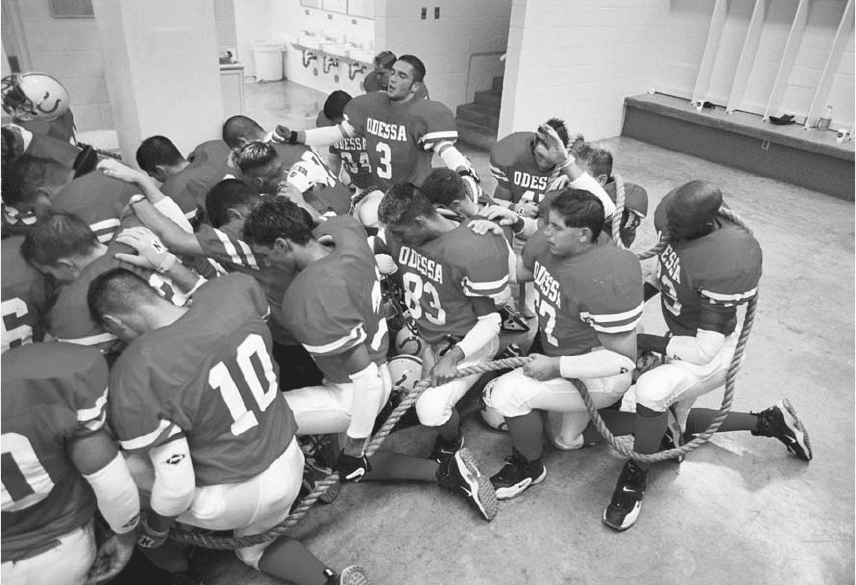
Football players at Odessa High School in Odessa, Texas, pray in their locker room, September 1, 2000, in an
unsanctioned prayer session. On June 19, 2000, the Supreme Court handed down a ruling banning school-
sanctioned pregame prayer.
(Joe Raedle/Newsmakers)
school prayer 649
vi+904_EofUSConsti-v2.indd 649 3/20/09 2:18:36 PM
allowable prayer in school situations that remain
unresolved in the courts.
Several advocacy groups exist on both the
separationist and accommodationist side of the
school prayer issue. The most visible and vocal
separationist groups include Americans United for
Separation of Church and State and the Ameri-
can Civil Liberties Union. Accommodation-
ist groups have included the Christian Coalition
and the Eagle Forum, among others. Among
religious denominations, “mainline” Protestant
groups, Jews, Unitarians, and many Roman Cath-
olics oppose school prayer, while fundamentalists
and evangelicals would prefer some type of for-
mal prayer or prayer time. While many Baptists,
particularly in the South, fall in the latter group,
others—in the Roger Williams tradition—have
endorsed the Court’s school prayer decisions.
School prayer cases keep coming into the Court
because, with changing personnel, it is impossible
to know what the Court will allow, and because
accommodationists keep seeking ways to circum-
vent or defy previous rulings. For example, there
has not yet been a defi nitive Supreme Court rul-
ing on voluntary prayers by students at gradua-
tion (analogous to what the Court struck down in
Santa Fe), and this continues to cause confl ict in
schools. Recent high school graduations have seen
students “spontaneously” begin reciting the Lord’s
Prayer at a prearranged point in the ceremony.
School prayer is an issue that resonates emo-
tionally with large segments of the population.
Polls have consistently shown that a majority of the
public wants some type of formal school prayer;
thus the topic has provided a handy “political foot-
ball” for politicians. Many members of Congress,
presidential candidates, and other elected offi cials
have touted school prayer as a “quick fi x” to the
problems of youth, have resurrected it in election
campaigns, and have proposed legislation. In so
doing, they have been accused of distracting vot-
ers from more serious public policy issues. Local
offi cials, sometimes against the advice of their own
attorneys, have risked costly litigation by either
ignoring or seeking to circumvent Court rulings.
A series of constitutional amendments have been
proposed ever since the 1960s, but none received
the necessary two-thirds vote in each House of
Congress that would bring them before the states
for ratifi cation. One reason is that even some sup-
porters of “school prayer” shy away from tamper-
ing in this way with the First Amendment,
something that has never been done.
The establishment clause in general is in a
period of transition along with changing Court
personnel, and it is possible that future “school
prayer” rulings will lower the “wall of separation”
in public schools. However, with an increasingly
diverse population, including not only the non-
religious but also many non-Christians with their
own prayer traditions, a lowering of the “wall” is
likely to meet with some resistance.
For more information: Alley, Robert S. Without
a Prayer: Religious Expression in Public Schools.
Amherst, N.Y.: Prometheus Books, 1996; Fen-
wick, Lynda Beck. Should the Children Pray?: A
Historical, Judicial, and Political Examination of
Public School Prayer. Waco, Tex.: Markham Press
Fund of Baylor University Press, 1989; Ravitch,
Frank S. School Prayer and Discrimination: The
Civil Rights of Religious Minorities and Dissent-
ers. Boston: Northeastern University Press, 2001.
—Jane G. Rainey and Rick A. Swanson
school vouchers
Government fi nancial aid provided to parents to
partially or completely defray the cost of educat-
ing their children at a public or non-public school
of their choice.
Supporters argue that voucher programs give
individuals the ability to seek out superior schools
and escape inferior ones. From this view, vouchers
fuel a healthy competition among public and reli-
gious and nonreligious private schools, promoting
educational diversity while gradually weeding out
poorly performing institutions. It is also argued
that low-income families, who might not other-
wise be able to afford private school tuition, would
particularly benefit. In the face of a global and
fiercely competitive job marketplace, vouchers
level the playing fi eld by providing more educa-
tional options to every child.
650 school vouchers
vi+904_EofUSConsti-v2.indd 650 3/20/09 2:18:36 PM
School voucher opponents attack the programs
on two broad fronts. First, vouchers divert funds
from an already beleaguered public school sys-
tem, making their poor performances relative to
private schools a self-fulfi lling prophecy. Public
schools are put at another disadvantage because
they legally have to accept all students who apply,
while private schools can “cherry pick” the better
students. Vouchers therefore unnecessarily hobble
public education and give private schools unfair
advantages.
Supporters decry the current system as unfair
because it imposes a “double tax” on those parents
who pay tuition to private schools as well as school
taxes to support the public school system. Voucher
opponents justify this burden by claiming that the
benefi ts of a common education rebound to the
community as a whole. All property owners pay
school taxes, whether they have children in the
school system—or even have children—but the
product of a public education is a more law-abid-
ing, employable citizenry. If government is will-
ing to provide an education to all, it should not
feel compelled to compensate those who choose
go outside the system. From this perspective, the
state should not have to put its own school system
at a disadvantage by providing monetary incen-
tives to its competition.
A second criticism leveled against vouchers
is not directed at all private schools, but only
at vouchers that are given to religious schools.
Many separationists argue that the establish-
ment clause of the First Amendment forbids
state support of religion. Even if aid fi rst goes to
parents, religious schools are the ultimate bene-
fi ciaries. Even more egregious, many voucher pro-
grams favor only a few religious schools or even a
single religious denomination, or provide aid to a
few private secular schools.
An attempt by government to be evenhanded
among religious schools may be even more prob-
lematic. Because of this nation’s considerable
religious diversity, efforts to equitably fund all
religious schools might lead to bitter sectarian
quarrels and administrative headaches. Also,
vouchers may require greater regulation of reli-
gious schools as a condition for participating in
such programs, something voucher supporters
might fi nd objectionable.
Supporters argue that denying religious schools
funding is discrimination, not government neu-
trality. Denying vouchers to religious schools
would also threaten the survival of some of the
best schools in the community.
This debate over the constitutionality and
appropriateness of government fi nancial support
for religious schools has a long history.
Prominent men from the founding era such as
Thomas Jefferson were opposed to government
money going to any religious institution—even if
a taxpayer ended up supporting her own house
of worship. Others, like Patrick Henry, believed
that government should support religious bodies
and even restrict such largesse to Protestant insti-
tutions. Language in the Northwest Ordinance
of 1789 also seemed to indicate that government
support for religious schools was important for
promoting morality.
Prior to the First Amendment’s incorporation
to the states in the middle of the 20th century,
they were free to subsidize religious schools, and
even houses of worship, and many did so until the
middle of the 19th century.
Arguments that the establishment clause fore-
closed subsidization were seemingly belied by a
campaign in the early 1800s to pass a constitu-
tional amendment that would explicitly prohibit
all funding of religious schools—whether through
parental choice or direct subsidization of religious
schools. This fear grew up in response to the enor-
mous infl ux of Catholic immigration at that time
and the immigrants’ desire to educate their chil-
dren in their own parochial schools. Many Catho-
lics felt, with some justifi cation, that the public
school system was biased toward Protestantism.
The effort to amend the U.S. Constitution
ultimately fell short of votes. However, 37 states
eventually passed amendments to their own con-
stitutions, prohibiting the funding of religious
schools. Most of these “Blaine Amendments,”
named after James Blaine, the man who spear-
headed the campaign, are still in force today.
The fi rst Supreme Court case to deal with fund-
ing of religious schools did not occur until 1947 in
school vouchers 651
vi+904_EofUSConsti-v2.indd 651 3/20/09 2:18:36 PM