
Schultz D. Encyclopedia of the United States Constitution
Подождите немного. Документ загружается.

judicial sentencing. The Court decided that Con-
gress’s delegation of its law-making power to an
independent agency did not violate the separation
of powers clause of the U.S. Constitution.
More recent cases—Blakely v. Washington, 124
S. Ct. 2531 (2004), U
NITED STATES V. BOOKER, 125 S.
Ct. 738 (2005), and United States v. Fanfan, 125 S.
Ct. 738 (2005)—have addressed individual rights
concerns in upward departure decisions within
sentencing guidelines. An upward departure allows
a judge to increase the sentence above the particu-
lar guideline range maximum. Guideline depar-
tures offer the most probable opportunity for the
exercise of discretion and the existence of dispar-
ity because the restrictions on such decisions are
loosely defi ned.
In Blakely v. Washington (2004), the sentence
was raised above the maximum of the prescribed
sentencing guideline range by a preponderance
of the evidence. Relying on precedents set by
Apprendi v. New Jersey, 530 U.S. 466 (2000), the
Supreme Court found that this upward departure
decided by a judge by a preponderance of the evi-
dence violated the defendant’s Sixth Amend-
ment right to a jury trial and the right to have facts
against him be proven beyond a reasonable doubt.
In United States v. Booker (2005), a mandatory
enhancement was applied by the judge in a federal
case. The Supreme Court in United States v. Booker
(2005) considered whether the federal sentencing
guidelines’ mandatory enhancements, which were
based on facts not proven by a jury beyond a rea-
sonable doubt, violated the Sixth Amendment right
to a jury. A case consolidated with Booker, United
States v. Fanfan (2005), considered the possible
remedy if the Court in Booker were to fi nd that
the Sixth Amendment was violated.
The Court examined Congress’s language and
the intent of that language. The federal sentenc-
ing guidelines were mandatory and binding on all
judges and, thereby, operated as a statute because
they “have the force and effect of laws” (United
States v. Booker, 2005, p. 742). The Supreme Court,
therefore, found that these enhancements did vio-
late the right to jury trial protected by the Sixth
Amendment. The Supreme Court in United States
v. Fanfan (2005) suggested that the remedy for this
error was to eliminate the mandatory nature of the
federal sentencing guidelines; the Court ruled that
the guidelines are now simply advisory.
In the fi rst part of the 21st century, the United
States Supreme Court drastically changed the
face of sentencing guidelines. Although the Court
in Mistretta v. United States ruled that the sen-
tencing guidelines did not violate the separation
of powers clause of the United States Constitu-
tion, the Supreme Court later decided that a judge
could not depart above the prescribed guideline
range maximum in state jurisdictions (Blakely v.
Washington, 124 S. Ct. 2531 [2004]) or in the fed-
eral jurisdiction (United States v. Booker, 125 S.
Ct. 738 [2005], and United States v. Fanfan, 125
S. Ct. 738 [2005]).
For more information: Spohn, C. How Do
Judges Decide?: The Quest for Fairness and Jus-
tice in Sentencing. Thousand Oaks, Calif.: Pine
Forge Press, 2002; Stith, K., and J. A. Cabranes,
Fear of Judging: Sentencing Guidelines in the
Federal Courts. Chicago: University of Chicago
Press, 1998; Tonry, M. Sentencing Matters. New
York: Oxford University Press, 1996; Ulmer, J. T.
Social Worlds of Sentencing: Court Communities
under Sentencing Guidelines. Albany: State Uni-
versity of New York Press, 1997.
—Jeremy D. Ball
separation of powers
The phrase separation of powers is generally
representative of the idea that the framers of the
Constitution created three coequal branches of
government. Article I of the U.S. Constitu-
tion defines the legislative branch and creates
two houses of Congress: the House of Repre-
sentatives and the Senate, charging them with
specifi c responsibilities. Article II of the U.S.
Constitution identifi es the executive branch,
naming the president as its leader, while identi-
fying the vice president and executive depart-
ments as members of the branch responsible in
some way for administering the laws. Article III
of the U.S. Constitution identifi es the judi-
cial branch as the Supreme Court and inferior fed-
662 separation of powers
vi+904_EofUSConsti-v2.indd 662 3/20/09 2:18:39 PM
eral courts having charge over deciding individual
cases and controversies in law or equity.
However, the phrase “separation of powers” is
not enumerated in the seven articles of the Con-
stitution. So where does the phrase come from?
While proponents look to the writings of the fram-
ers in the Federalist Papers, such as those of James
Madison or Alexander Hamilton, separation
of powers is an idea that emerged centuries before
the Convention of 1787 and has many variations.
The common theme is that governmental func-
tions are not concentrated in a single authority
but those responsibilities, along with the political
power associated with them, are dispersed among
branches of government. By so doing, this encour-
ages individual liberty—freedom from govern-
ment oppression (commentators refer to this as
ancient or ordered liberty) and freedom to enjoy
the benefits of and participate in an organized
society (modern liberty). Philosophers such as
Aristotle, Montesquieu, Locke, and Constant are
often quoted when discussing these ideas. While
there are many permutations of separation of
powers, commentators tend to fall into two basic
schools of thought about what the phrase means:
formalists and functionalists.
Generally, formalists view the fact that the
framers drafted three distinct articles with enu-
merated duties as an implicit signal that the three
branches are to behave in “watertight compart-
ments.” Justice Southerland represented this view
in 1928 when he said, “It may be stated then, as
a general rule inherent in the American consti-
tutional system, that, unless otherwise expressly
provided or incidental to the powers conferred,
the Legislature cannot exercise either executive
or judicial power; the judiciary cannot exercise
either executive or legislative power. The exis-
tence in the various Constitutions of occasional
provisions expressly giving to one of the depart-
ments powers which by their nature otherwise
would fall within the general scope of the author-
ity of another department emphasizes, rather than
casts doubt upon, the generally inviolate character
of this basic rule.” A simplifi ed characterization of
this view is: The legislature makes, the executive
executes, and the judiciary construes the law.
On the other side of the understanding of sepa-
ration of powers are the functionalists. Function-
alists suggest that the framers must have rejected
the idea of “watertight compartments” because
of the lack of the phrase “separation of powers”
in the Constitution. Instead, as articulated by
Justice Oliver Wendell Holmes’s dissent in
that same 1928 case: “The great ordinances of the
Constitution do not establish and divide fi elds of
black and white. Even the more specifi c of them
are found to terminate in a penumbra shading
gradually from one extreme to the other. . . . To
make the rule of conduct applicable to an indi-
vidual who but for such action would be free from
it is to legislate—yet it is what judges do whenever
they determine which of two competing principles
of policy shall prevail. . . . It does not seem to need
argument to show that however we may disguise
it by veiling words we do not and cannot carry out
the distinction between legislative and executive
action with mathematical precision and divide the
branches into watertight compartments. . . .”
Instead, as Justice Joseph Story suggests of
functionalists: “When we speak of a separation of
the three great departments of government, and
maintain that that separation is indispensable to
public liberty, we are to understand this maxim in
a limited sense. It is not meant to affi rm that they
must be kept wholly and entirely distinct, and have
no common link of connection or dependence,
the one upon the other, in the slightest degree.
The true meaning is, that the whole power of one
of these departments should not be exercised by
the same hands which possess the whole power
of either of the other departments; and that such
exercise of the whole would subvert the principles
of a free Constitution. Indeed, there is not a single
constitution of any state in the Union, which does
not practically embrace some acknowledgement of
the maxim, and at the same time some admixture
of powers constituting an exception to it.”
One of the primary examples of the function-
alist theory at work is the advent of the admin-
istrative agency. While housed in the executive
branch to administer the day-to-day activities of
those who are regulated, as well as to create rules
that govern their behavior, Congress provides
separation of powers 663
vi+904_EofUSConsti-v2.indd 663 3/20/09 2:18:40 PM
the funds and the legislative authority for these
bodies to execute those duties. The courts ensure
that the administration of the law neither unduly
encroaches upon nor curtails the liberties of those
being regulated.
This then gives rise to the argument that the
framers embraced the principle of checks and
balances rather than an exclusive separation of
powers. Support for this position is found in the
framers’ enumeration of many specifi c methods by
which one of the branches can curtail the activi-
ties of another branch. For example, the executive
can veto legislation, while the veto can be over-
ridden by the Congress; the Supreme Court can
declare a particular act unconstitutional, while
Congress can regulate the manner in which cases
come before federal courts.
One can conclude that, so long as government
is focused on providing for only as much govern-
ment as is appropriate (a political question) and
on ensuring to the most practical degree the over-
all public’s health, safety, and welfare by using its
enumerated powers, then individual liberty can
be maximized by each separate branch discharg-
ing its respective responsibilities concomitant
with the checks and balances put in place by the
framers.
For more information: Breyer, Stephen. Active
Liberty: Interpreting Our Democratic Constitu-
tion. New York: Knopf, 2005; Brown, Rebecca.
“Separated Powers and Ordered Liberty.” Univer-
sity of Pennsylvania Law Review 139, no. 1513
(1991): 315–320; Elliott, E. Donald. “Why Our
Separation of Powers Jurisprudence Is So Abys-
mal.” George Washington Law Review 57, no. 506
(1989): 515–518.
—Cleveland Ferguson III
September 11 attacks and the Constitution
The terrorist attacks of September 11, 2001, forever
changed the United States. Within weeks of these
attacks, Congress passed the Authorization for
the Use of Military Force (Public Law 107–40)—
directing the president to “use all necessary and
proper force against those nations, organizations,
or persons he determines planned, authorized,
committed, or aided the terrorist attacks”—and
the PATRIOT Act (Public Law 107–56) designed
to “deter and punish terrorist acts in the United
States and around the world.” With these pieces
of legislation from Congress, combined with the
presidential authority as commander in chief
listed in Article II of the U.S. Constitution,
the federal government enacted new programs
and initiatives to combat global terrorism. At the
outset, many of these initiatives were viewed as
necessary to protect the national security of the
United States. However, as time progressed, these
same programs and initiatives received additional
scrutiny, and questions arose pertaining to the
nature of constitutional authority and the protec-
tion of civil liberties.
In the several months immediately following
the September 11 attacks, the federal government
detained thousands of individuals in the United
States who might have been linked to, or might
have possessed information about, the terrorists’
plot. One such individual was Rabih Haddad,
accused of operating an Islamic charity and fun-
neling contributions to suspected terrorist organi-
zations. Haddad’s family, friends, and the media
sought to attend his hearing, but were informed
that the proceedings were closed to the public and
the press. This procedure raised constitutional
questions about whether Haddad could receive a
fair, impartial, and unbiased hearing without pub-
lic scrutiny. Writing for a unanimous panel, Sixth
District Court of Appeals Judge Keith stated,
“The public’s interests are best served by open
proceedings. A true democracy is one that oper-
ates on faith—faith that government offi cials are
forthcoming and honest, and faith that informed
citizens will arrive at logical conclusions. This is a
vital reciprocity that America should not discard
in these troubling times. Without question, the
events of September 11, 2001, left an indelible
mark on our nation, but we as a people are united
in the wake of the destruction to demonstrate to
the world that we are a country deeply commit-
ted to preserving the rights and freedoms guar-
anteed by our democracy” (Detroit Free Press v.
Ashcroft, 303 F. 3d 681 [2002]). Following these
664 September 11 attacks and the Constitution
vi+904_EofUSConsti-v2.indd 664 3/20/09 2:18:40 PM
statements, the panel affirmed the lower court
decision and supported the civil liberties chal-
lenge to the government.
In contrast to this decision is a ruling by the
Third Circuit. The case was a response by New
Jersey newspapers to repeated denials by the
immigration courts of docket information and
access to deportation hearings. According to the
majority opinion, written by Judge Becker, “This
case arises in the wake of September 11, 2001, a
day on which American life changed drastically
and dramatically. The era that dawned on Sep-
tember 11, and the war against terrorism that has
pervaded the sinews of our national life since that
day, are refl ected in thousands of ways in legis-
lative and national policy, the habits of daily liv-
ing, and our collective psyches. Since the primary
national policy must be self-preservation, it seems
elementary that, to the extent open deportation
hearings might impair national security, that secu-
rity is implicated in the logic test” (North Jersey
Media Group, Inc. v. Ashcroft, U.S. App. LEXIS
21032 [2002]). The Third Circuit ruled against
civil liberties, concluding that the federal govern-
ment had justifi ed its request for secret deporta-
tion hearings, given the importance of preserving
national security.
These two cases demonstrate the confusion
facing federal judges as they attempt to resolve
immigration and deportation disputes. On the one
hand, judges are ordering public trials consistent
with the practice before September 11. However,
some other judges acknowledge that the terrorist
attacks changed many aspects of the law and, con-
sequently, in the name of national security, some
trials must be closed to public scrutiny.
While the cases involving secret deportation
hearings received a fair amount of media cover-
age, the vast share of public attention focused
on the war on terror and, in particular, on the
detainment of individuals labeled “enemy com-
batants.” The fi rst of these cases, R
ASUL V. BUSH,
542 U.S. 466 (2004), focused on complaints
brought on behalf of individuals detained in
Guantánamo Bay, Cuba. As the record indicates,
the petitioners were citizens of Australia and
Kuwait and were captured by the U.S. military
during its armed confrontation with the Taliban
regime in Afghanistan. They brought habeas
corpus suits against the United States in protest
of an executive order authorizing the indefi nite
detention of individuals suspected of terrorist
actions. Writing for the majority, Justice John
Paul Stevens ruled in favor of the detainees at
Guantánamo Bay. He stated that the individuals
“have never been afforded access to any tribu-
nal, much less charged and convicted of wrong-
doing; and for more than two years they have
been imprisoned in territory over which the
United States exercises exclusive jurisdiction.”
Justice Stevens concluded that these individuals
therefore were entitled to bring their disputes
before U.S. courts to challenge the “enemy com-
batant” label.
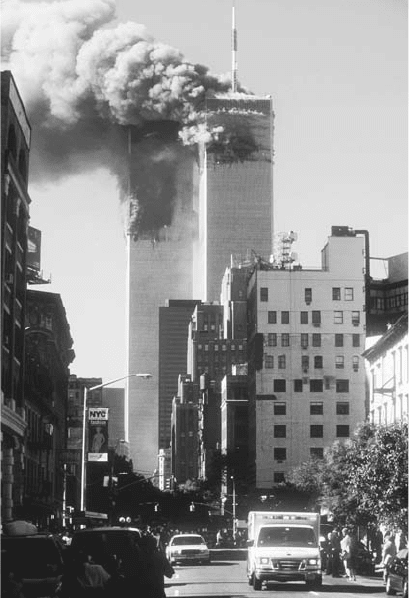
Smoke billows from the World Trade Center’s twin
towers after they are struck by commercial airliners
that had been hijacked by terrorists.
(Shaw/Getty)
September 11 attacks and the Constitution 665
vi+904_EofUSConsti-v2.indd 665 3/20/09 2:18:40 PM
A second case involved allegations by the fed-
eral government against Jose Padilla, a U.S. citi-
zen apprehended at Chicago’s O’Hare airport for
potentially conspiring with the al-Qaeda terrorist
network. During the course of a grand jury inves-
tigation in New York, President Bush signed an
executive order directing Secretary of Defense
Rumsfeld to designate Padilla an “enemy com-
batant.” Rumsfeld complied and Padilla was sent
to a military detention facility in South Carolina.
His attorney brought a habeas corpus suit against
Rumsfeld to challenge the president’s authority
to designate U.S. citizens as “enemy combatants.”
Chief Justice William Hubbs Rehnquist’s
opinion overturned an appeals court decision that
had invalidated the executive order (R
UMSFELD V.
PADILLA, 542 U.S. 426 [2004]). However, this was
accomplished by claiming that Padilla fi led his law-
suit against the wrong party. Rehnquist indicated
that the habeas corpus statute, passed by Congress
over 100 years earlier, specifi cally indicated that
lawsuits should proceed against the individual in
immediate custody. As such, Commander Marr of
the South Carolina military detention facility, not
Secretary Rumsfeld, was Padilla’s custodian and
the proper respondent to the habeas petition.
The third case decided that same year by the
Supreme Court involved the detention of a U.S.
citizen, taken from the fi eld of combat in Afghani-
stan. Yaser Hamdi was seized by Northern Alli-
ance forces and turned over to the U.S. military
shortly after Congress adopted a resolution entitled
the Authorization for the Use of Military Force to
the president. Writing on behalf of the majority
in the case of HAMDI V. RUMSFELD, 542 U.S. 507
(2004), Justice Sandra Day O’Connor rejected
the government’s claim that federal courts had no
authority to review the status of American citizens
labeled “enemy combatants.” She stated, “we have
long made clear that a state of war is not a blank
check for the President when it comes to the rights
of the Nation’s citizens.”
Another “enemy combatant” case involved
another detainee at Guantánamo Bay, Cuba. Fol-
lowing the Supreme Court’s decision in Rasul
v. Bush, the federal government established a
series of military tribunals where detainees could
challenge the “enemy combatant” status. Yet,
because these tribunals were established under
military regulations, many of the constitutional
safeguards that would otherwise operate in civil-
ian courts did not exist. Salim Ahmed Hamdan
was captured in Afghanistan and transported to
Guantánamo Bay. Because of his close affi liation
to Osama bin Laden, President Bush announced
that Hamdan was an “enemy combatant.” In
challenging this classifi cation, Hamdan and his
military-appointed attorney encountered sev-
eral signifi cant obstacles placed by the military
tribunal. Consequently, he fi led a habeas corpus
petition in federal court for a determination of his
status. In writing for the majority, Justice Stevens
announced that these military tribunals violated
both the Uniform Code of Military Justice and
aspects of international law that are codifi ed in
the Geneva Conventions (Hamdan v. Rumsfeld,
126 S. Ct. 2749 [2006]). He noted that, “even
assuming that Hamden is a dangerous individual
who would cause great harm or death to innocent
civilians given the opportunity, the Executive
nevertheless must comply with the prevailing rule
of law in undertaking to try him and subject him
to criminal punishment.”
These cases indicate that the status of “enemy
combatant” places individuals in a constitutional
limbo, and the Supreme Court has had diffi culty
announcing clear defi nitions of the rights and priv-
ileges afforded to these individuals. The justices
seem to state that the federal government can-
not bypass the fundamental protections afforded
by the Constitution, but they also allow the gov-
ernment tremendous leeway in the handling of
“enemy combatants.”
The terrorist attacks of September 11, 2001,
may have profoundly altered certain aspects of the
Constitution. At this point in time, it is extremely
difficult to determine precisely which aspects
have changed. Since we rely on judges to interpret
the Constitution, their opinions are essential to
help clarify its meaning. In the two areas of secret
deportation hearings and “enemy combatants,”
the courts have issued mixed, and sometimes
contradictory, opinions. And more constitutional
questions keep emerging. For example, the news
666 September 11 attacks and the Constitution
vi+904_EofUSConsti-v2.indd 666 3/20/09 2:18:40 PM
media recently announced a program from the
National Security Agency to eavesdrop on com-
munications in the United States without a search
warrant or judicial oversight. Advocates of civil
liberties claim this program is a violation of the
Fourth Amendment, while the other side of the
debate claims the program is essential to protect
the national security of the United States by pre-
venting future terrorist attacks. Which side is cor-
rect? Only federal judges (and ultimately Supreme
Court justices) can decide, from a constitutional
standpoint.
For more information: Cohen, David B., and
John W. Wells, eds. American National Security
and Civil Liberties in an Era of Terrorism. New
York: Palgrave Macmillan, 2004; Whitehead, John
W., and Steven H. Aden. “Forfeiting ‘Enduring
Freedom’ for ‘Homeland Security’: A Constitu-
tional Analysis of the USA PATRIOT Act and the
Justice Department’s Anti-Terrorism Initiatives.”
American University Law Review 51 (August
2002): 1,081–1,133.
—Kirk A. Randazzo
Serrano v. Priest 487 P.2d 1241 (1971)
In Serrano v. Priest, in a 6 to 1 decision, the
California Supreme Court held that the state’s
school fi nance system violated the Fourteenth
Amendment to the U.S. Constitution.
Like school fi nance systems in virtually all states
in the late 1960s, California’s system relied heavily
on local property taxes to fund education. Thus,
property-rich districts could tax at low rates and
spend at high levels, while property-poor districts
had to tax at high rates and spend at low levels.
The Serrano reform lawyers attacked this sys-
tem as discriminatory. Following the logic of the
U.S. Supreme Court’s equal protection clause
jurisprudence, they argued that district wealth
was a “suspect classifi cation” (just like race), and
that education was a “fundamental right” (just like
the right to vote). The California high court
agreed. The state bore a heavy burden of justifi ca-
tion for its fi nance policies, which the high court
found that it could not meet.
Serrano was a landmark case, for it was the fi rst
time that a court had invalidated a state’s school
finance policies as unconstitutional. While the
California court’s interpretation of the federal
equal protection clause would not survive the
U.S. Supreme Court’s decision in San Antonio
v. Rodriguez (1973), Serrano itself survived as a
central part of a national trend that saw reformers
challenging school fi nance policies in state courts
on state constitutional grounds.
In Serrano II, 557 P.2d 929 (1976), in a 4 to 3
decision, the California Supreme Court reaffi rmed
its earlier ruling, this time by relying on its own
constitution’s equal protection provisions. The high
court also affi rmed a trial court ruling requiring
that “wealth-related disparities” (that is, differ-
ences in local spending attributable to unequal
property tax bases) in per pupil expenditures for
basic education across school districts be reduced
to “less than $100.00” within six years (557 P.2d
929, at 940, nt. 21). The dissenters in Serrano II
argued that relying less on local property taxes and
making the state pick up more of the tab might
well undermine overall public support for educa-
tion (557 P.2d 929, at 964, Clark, J., dissenting).
In June 1978, less than a year after the legis-
lature had passed a new fi nance law, California
voters endorsed Proposition 13, a state constitu-
tional amendment adopted through the initiative
process. Proposition 13 placed strict limits on the
ability of local governments and school districts to
raise local revenues by rolling back assessments
to 1 percent of value. Over the next several years,
the state came to fi nance about 80 percent of the
total costs for public education. In 1986, a state
appellate court found that the state had complied
with Serrano. It determined that wealth-related
revenue differences had been reduced to “insig-
nifi cant amounts” for 93 percent of all school dis-
tricts (Serrano III, 226 Cal. Rept. 584, at 614 [Ct.
of App., 2nd App. Dist., Div. Two] [1986]).
Current observers generally agree that much
more equality in tax rates and spending across
districts was achieved. However, there was much
more leveling down than leveling up. Serrano, in
conjunction with Proposition 13, also produced
a precipitous decline in overall public support
Serrano v. Priest 667
vi+904_EofUSConsti-v2.indd 667 3/20/09 2:18:41 PM
for education spending. Although California had
ranked among the top 10 states in per pupil spend-
ing in the late 1960s, it placed among the bottom
10 states in that late 1990s.
For more information: Elmore, Richard F., and
Milbrey W. McLaughlin. Reform and Retrench-
ment: The Politics of California School Finance.
Cambridge, Mass.: Ballanger Publishing, 1982;
Martin, Isaac. “Does School Finance Litigation
Cause Taxpayer Revolt?” Law and Society Review
40, no. 4 (September 2006): 525–558; Schrag, Peter.
Final Test: The Battle for Adequacy in America’s
Schools. New York: New Press, 2003; Sonstelie,
Jon, Eric Brunner, and Kenneth Ardon. For Bet-
ter or For Worse?: School Finance Reform in Cali-
fornia. Public Policy Institute of California, 2000.
Available online. URL: http://www.ppic.org/main/
publication.asp?i=65. Accessed 15 May 2008.
—Michael Paris
Seventeenth Amendment
The Seventeenth Amendment, adopted on May
31, 1913, provides for popular election of United
States senators. Prior to this, senators had been
selected by action of their respective state legisla-
tures, not by direct voter participation. With this
amendment, the Constitution’s original Article
II, Section 3 language of “chosen by the legisla-
tures thereof” was replaced with the more demo-
cratic “elected by the people thereof.”
The successful passage and adoption of the
Seventeenth Amendment is attributable as much
to Progressive Era attitudes toward greater
democratization and public participation, as to
less well-known but just as significant changes:
the increased importance of the Senate and the
growing power of political parties.
In the early days of the republic, the House
of Representatives was popularly viewed and
functioned as the more important chamber. It was
not uncommon for sitting senators to resign their
posts, sometimes with several years remaining in
their terms, to run for House seats. In the run-up
to the Civil War, and even more dramatically fol-
lowing it, the Senate emerged on a parity with the
House or, arguably, as the more important, visible,
and infl uential chamber.
Recognizing the growing infl uence that senators
(and senatorial candidates alike) had within their
states, state party organizations learned that their
senators could further their objectives and rally
local organizations like no other offi cial. Taking
advantage of this situation, parties began to select,
promote, and organize around particular senato-
rial candidates prior to their offi cial election by
the legislature. Initially known as “endorsements”
and “canvassing the public,” these tactics short-cir-
cuited the framers’ original selection process and
presaged the modern direct primary. Among early
canvasses, and certainly the best known, was the
1858 Lincoln-Douglas contest wherein Abraham
Lincoln reshaped the Republican Party and won
the popular vote, but lost the Senate seat because
the Illinois legislature remained Democratic and
sent Douglas to Washington.
As the Senate became a body where critical
issues affecting the nation and its future were
shaped, and state political party machines became
more pronounced, the very process of choosing
senators grew more contentious and protracted.
Deadlocks wherein legislatures were completely
unable to agree on a senatorial candidate became
commonplace. Deadlocks had become enough
of a problem by 1866 that Congress passed a
law designed to remedy the situation. The well-
intentioned statute, proscribing daily balloting,
common sessions, and concurrent majorities only
made matters worse.
Between 1891 and 1905, 45 deadlocks were
recorded. They lasted from a week to a record of
114 days, in 20 different states, with states accept-
ing vacancies in the U.S. Senate as a consequence
of their inability to decide. Delaware’s experience
is the most extreme: Between 1899 and 1901 it
had only one senator in Washington, and between
1901 and 1903 it had none. Acrimonious charges
of bribery, corruption, backroom dealing, and
senators beholden to narrow financial interests
clouded these proceedings even further. Modern
journalists and students seeking historical exam-
ples of legislatures acting badly need look no fur-
ther than this pre-Seventeenth Amendment era to
668 Seventeenth Amendment
vi+904_EofUSConsti-v2.indd 668 3/20/09 2:18:41 PM
fi nd wonderfully colorful stories of pandemonium
and bizarre behavior as state legislatures squab-
bled over choosing their U.S. senators.
Throughout the country, multiple strategies
were implemented to respond in one way or another
to these crises. Deadlocks were addressed through
state-by-state reforms. Beginning with Illinois in
1890, several forms of direct senatorial primaries
(advisory in nature and not legally binding upon the
legislature) were approved so that, by 1910, 28 states
had them. In 1901, Oregon added a “pledge” to its
primary regimen, one that required state legislative
candidates to indicate their support for the sena-
torial candidate who won the popular vote. Other
states followed suit. In 1900, the national Demo-
cratic Party initiated quadrennial presidential plat-
form advocacy of a constitutional amendment for
direct election of senators. The GOP joined the
chorus in 1908. By 1910, more than 30 states (at
that time, more than the suffi cient three-fourths
necessary to approve a constitutional amendment)
had asked Congress to call a national convention on
the subject or to pass an amendment to that effect.
Responding to these local pressures, the House
of Representatives had, between 1893 and 1902,
considered such an amendment fi ve times and had
twice passed them with the necessary two-thirds
majority, only to have them ignored in the Senate.
A decade later, in a Senate changed by the
attitude of members who had themselves been
selected by these reformed and more popular
forms of elections, the House for the third time
sent a direct election amendment to the Sen-
ate; following a diffi cult Senate resolution of yet
another fraudulent senatorial election, the Senate
quickly ratifi ed the new amendment. The states
that had long been “ahead” of the Congress on
this issue promptly gave their approval and the
amendment became law.
For more information: Haynes, George H. The
Senate of the United States. New York: Russell &
Russell, 1960; Hoebeke, C. H. The Road to Mass
Democracy: Original Intent and the Seventeenth
Amendment. New Brunswick, N.J.: Transaction
Publishers, 1995.
—George Peery
Seventh Amendment
The Seventh Amendment to the Constitution
guarantees individuals a right to a trial by jury
when the value in dispute is in excess of $20. This
amendment is one of the original 10 in the Bill of
Rights, which amended the Constitution in 1791;
it was originally proposed by James Madison.
Both the Sixth and Seventh Amendments were
adopted to provide for jury trials for defendants
facing accusations. However, while the Sixth
Amendment right to a jury trial applies to crimi-
nal trials, the Seventh Amendment involves civil
cases or issues. Additionally, while the Sixth
Amendment has been incorporated in its entirety
to apply to the states, the Supreme Court has
declined to do the same for the Seventh Amend-
ment. This puts it, along with the Second and
Third Amendments, among the only ones that
do not in whole or in part limit state action.
The Supreme Court in Baltimore & Carolina
Line v. Redman, 295 U.S. 654 (1935), declared
that the general purpose of the Seventh Amend-
ment is to preserve the common law right to a
jury trial. Yet in Colegrove v. Battin, 413 U.S. 149
(1973), the Court ruled that this federal right did
not mandate a 12-person jury and that instead a
six-person jury would be acceptable. Finally, even
though the Seventh Amendment does not apply
to state proceedings, state law matters adjudicated
in federal court, such as under diversity juris-
diction, would be required to follow the require-
ments of this amendment.
For more information: Stone, Geoffrey R.,
Richard A. Epstein, and Cass R. Sunstein. The Bill
of Rights in the Modern State. Chicago: University
of Chicago Press, 1992.
—David Schultz
Shapiro v. Thompson 394 U.S. 618 (1969)
In Shapiro v. Thompson, the Supreme Court
ruled that a state’s imposition of a one-year waiting
period for eligibility for welfare benefi ts discrimi-
nated against individuals on the basis of length of
residency and interfered with the fundamental
right to travel from one state to another.
Shapiro v. Thompson 669
vi+904_EofUSConsti-v2.indd 669 3/20/09 2:18:41 PM
The 6-3 ruling, written by Justice William
J. Brennan, Jr., was a major first step in the
Supreme Court’s rethinking of the status of gov-
ernment benefits under the Constitution. The
process continued two years later in G
OLDBERG
V. KELLY, 397 U.S. 254 (1970), when the Supreme
Court ruled that cutting off or denying welfare
benefi ts required the protection of due process
notice and a chance to be heard.
The ruling also marked a significant step in
constitutional analysis, as Justice Brennan for the
first time held that government discrimination
in the exercise of a fundamental right required a
“compelling” justifi cation. Brennan imported this
tough standard from free speech analysis and gave
new bite to the equal protection clause.
Shapiro involved the consolidation of cases
from Connecticut, Pennsylvania, and the Dis-
trict of Columbia. Each jurisdiction had a
one-year waiting period for eligibility for welfare
benefi ts, with the Aid for Families with Depen-
dent Children (AFDC) program involved in the
cases. Lower federal courts held the waiting period
unconstitutional, and state offi cials appealed to
the Supreme Court.
Justice Brennan set the tone for the opinion by
noting that the line between residence in a state
for more than a year and less than a year could
determine arbitrarily which families were able “to
obtain the very means to subsist—food, shelter,
and other necessities of life.”
The Court said the main purpose of the
restriction was to keep poor people from moving
into a state and becoming a burden on the fi scal
resources of the state. Justice Brennan said that
was not a constitutionally valid goal because the
Constitution protects the fundamental rights
of people to travel from one state to another. He
also rejected the argument by states that they
were trying to prevent individuals from relocating
in order to seek higher welfare benefi ts; he said
such a goal was no more valid than would be a ban
on persons moving to a state to take advantage of
a good school system.
The Court also rejected the argument that
Congress specifically encouraged the states to
adopt waiting periods. This portion of the decision
prompted a dissent by Chief Justice Earl Warren,
usually a close ally of Justice Brennan. Warren
argued that Congress specifi cally authorized and
encouraged states to adopt residency periods. He
also warned that the Court’s rejection of welfare
residency waiting periods would have ramifica-
tions for voting, in-state tuition, and the practice
of some professions. Justice Hugo L. Black joined
Warren’s dissent.
Justice John M. Harlan also dissented and
warned that the Court was interfering too much
with state and federal legislative processes. In a
strong critique of what he deemed to be the lib-
eral excesses of the Court, he criticized what he
described as “the current notion that this Court
possesses a peculiar wisdom all its own whose
capacity to lead this Nation out of its present trou-
bles is contained only by the limits of judicial inge-
nuity in contriving new constitutional principles to
meet each problem as it arises.”
For more information: Michelman, Frank I.
“Forward: On Protecting the Poor through the
Fourteenth Amendment.” Harvard Law Review
83, no. 7 (1969): 14–15; Schwartz, Bernard. “How
Justice Brennan Changed America.” In Reason
and Passion: Justice Brennan’s Enduring Infl u-
ence. New York: W.W. Norton, 1997.
—Stephen Wermiel
Shaw v. Reno 509 U.S. 630 (1993)
In Shaw v. Reno the Supreme Court invalidated
a redistricting plan developed under the Voting
Rights Act to enhance minority representa-
tion, arguing that it violated the Fourteenth
Amendment’s equal protection clause. The
decision was important because it represented a
Rehnquist Court criticism of the use of race to
remedy discrimination in reapportionment issues.
North Carolina is a state where the bulk of the
black population is found in counties covered by
Section 5 of the Voting Right Act of 1965. In 1990,
the state had no black congressional districts, and
the last black member elected to Congress was
during the Reconstruction era. Following the
1990 census, North Carolina acquired its 12th
670 Shaw v. Reno
vi+904_EofUSConsti-v2.indd 670 3/20/09 2:18:42 PM
congressional seat. In 1991, a congressional plan
enacted by the North Carolina state legislature
created one majority-black district to comply with
Section 5 of the Voting Rights Act, which prohibits
a covered jurisdiction from implementing changes
in a “standard, practice, or procedure with respect
to voting” without federal authorization. This plan
was rejected by the Department of Justice, fi rst on
the grounds that the state failed to demonstrate
that it did not have the purpose or effect of dilut-
ing minority voting strength. This was followed by
suggestions that a second majority black district
be drawn in the southeastern portion of the state.
In response to the Department of Justice’s
order, the state instead produced a new plan with
a second majority-black congressional district else-
where in the state. The lines of the new district
stretched for approximately 160 miles along Inter-
state 85, with much of its length no wider than
the highway’s corridor. Five white residents from
North Carolina fi led suit against the state and the
Department of Justice on the grounds that the
plan unconstitutionally distinguished between
voters according to their race. The two major-
ity-black districts created by the state legislature
constituted, they claimed, an unconstitutional
racial gerrymander in violation of the Fourteenth
Amendment. Furthermore, they said that the two
districts concentrated the majority of black vot-
ers arbitrarily without regard to contiguity, com-
pactness, geographical boundaries, or respect
for political subdivisions for the sole purpose of
creating congressional districts along racial lines
to guarantee the election of two black representa-
tives. A three-judge district court dismissed the
complaint by a 2-1 vote for the following reasons:
(1) lack of subject matter jurisdiction over the fed-
eral government and the state, (2) failure to state
an equal protection claim, since favoring minor-
ity voters is not an invidious discrimination in the
constitutional sense, and (3) the redistricting plan
did not lead to proportional underrepresentation
of white voters statewide.
On certiorari, the Supreme Court was pre-
sented with variations of the same issues. The
fi rst was whether the revised plan, which contains
district boundary lines of dramatically irregular
shape, constituted an unconstitutional gerryman-
dering and therefore presented a cognizable claim
for resolution. The second question was whether
redistricting legislation that is so bizarre on its
face that it is unexplainable on grounds other than
race demands the same close scrutiny given to
other state actions that classify citizens by race.
Summarily, do claims that the North Carolina
legislature created a racially gerrymandered dis-
trict raise a valid constitutional issue under the
equal protection clause, and if so are the stated
objectives narrowly tailored to further a com-
pelling governmental interest? Justice
Sandra Day O’Connor delivered the 5-4 opin-
ion of the Court. Chief Justice William Hubbs
Rehnquist and Justices Antonin Gregory
Scalia, Anthony M. Kennedy, and Clar-
ence Thomas joined, while Justice White fi led
a dissenting opinion in which Justices Blackmun
and John Paul Stevens joined, with Blackmun,
Stevens, and David H. Souter also posting sepa-
rate dissenting opinions.
Writing for the majority in a decision that
reversed and remanded the case to the district
court, Justice O’Connor ruled as follows: First,
that the district court properly dismissed the claim
against the Department of Justice. Second, while
the lack of compactness, per se, is not a constitu-
tional violation, equal protection is violated when
and if a redistricting legislation, though race-neu-
tral on its face, is so extremely irregular that it
cannot rationally be understood as anything other
than an effort by the legislature to segregate vot-
ers into separates districts on the basis of race and
for purposes of voting. This, O’Connor reasoned,
is especially acute when such redistricting is done
without regard for traditional districting princi-
ples, and more importantly, without a suffi ciently
compelling state justifi cation. If, on remand, the
allegations of a racial gerrymander are not con-
tradicted, the Court observed, the district court
must determine whether the plan is narrowly tai-
lored to further a compelling governmental inter-
est. Addressing compliance under Section 5 of the
Voting Right Act of 1965, the Court observed fur-
ther that “a covered jurisdiction’s interest in creat-
ing majority-minority districts in order to comply
Shaw v. Reno 671
vi+904_EofUSConsti-v2.indd 671 3/20/09 2:18:42 PM