
Schultz D. Encyclopedia of the United States Constitution
Подождите немного. Документ загружается.

inferiority, Indians should be considered similar
to Aristotle’s “natural slaves.” In consequence of
their being ruled by passions rather than reason,
Indians were born to be slaves. As men ruled over
women, and adults ruled over children, so infe-
rior races should be subordinated to the will of
superior races. This allowed for the enslavement
of indigenous peoples and Africans.
Puritan settlers in North America took the
same stance as Sepúlveda, and resorted to natu-
ral law to validate the claim that religious conver-
sion could not change the legal status of African
slaves or Indians. Their status would instead be
anchored to biological, and thus inalterable, attri-
butes, which justifi ed hereditary slavery and per-
petual bondage for African Americans and Native
Americans. Because their status was equivalent
to that of a domestic animal or an infant, slaves
enjoyed no legal protection: Only their commer-
cial value shielded them from the structural vio-
lence of a society that regarded them as less than
human. Slavery was described as a necessary evil,
not the result of greed, callousness, or “human
parasitism.”
In 1700, Indians accounted for one-fourth of
all South Carolina’s slaves, and in 1790, when
the Naturalization Act was introduced, which
restricted American citizenship to “free white per-
sons,” nearly one-third of the people living in the
American South were black slaves. The paradox of
a society fi ghting for freedom and for individual
rights and granting juridical personality to cor-
porations, ships, and states, but at the same time
tolerant that 20 percent of the population was
subject to chattel slavery, is epitomized by John
Adams’s protest against the English yoke in 1765:
“We won’t be their Negroes.”
Even though they may have expressed doubts
about the morality of slave ownership, George
Washington, James Madison, and Thomas Jef-
ferson profi ted from it and were evidently pre-
pared to live with it. When Southern delegates
refused to support a government and a Consti-
tution hostile to their economic and political
interests, Northern delegates sought all sorts of
compromises to avoid confl ict. Abolitionist Wil-
liam Lloyd Garrison called the fi nal draft of the
Constitution “a covenant with death, and an agree-
ment with hell.” Indeed, consensus was bought at
the highest price: the constitutional sanctioning
of slavery, an institution irreconcilable with the
libertarian spirit of the Constitution, but comfort-
able with its protection and promotion of private
property and enterprise. These compromises
included passage of the three-fi fths law in Arti-
cle I, Section 2, Clause 3, which determined
how slaves would be counted for the purpose of
states being awarded representatives in Congress.
This clause counted fi ve slaves as the equivalent
of three free individuals. This greatly augmented
the political power of the Southern states. As a
result, 12 out of the fi rst 16 American presidents
were Southern slaveholders, even though, by
1804, slavery had been substantially abolished
in the Northern states, where an inclusive civic
nationalism had taken root.
In addition, the “fugitive slave clause” of Arti-
cle IV of the Constitution prevented slaves who
had escaped and reached an abolitionist state
from being freed. Thus, for all intents and pur-
poses, it may be said that the American Consti-
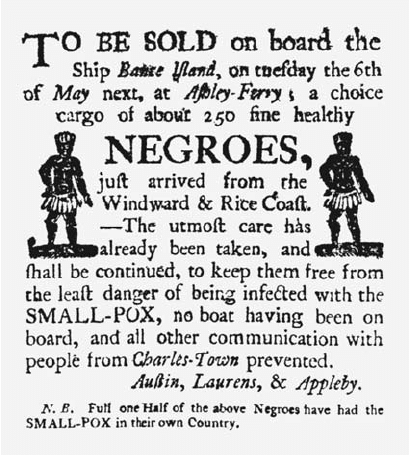
A 1780s broadside advertising a slave auction
(Library of Congress)
682 slavery and the Constitution
vi+904_EofUSConsti-v2.indd 682 3/20/09 2:18:45 PM
tution protected the peculiar institution and the
Southern caste society until the outbreak of the
Civil War.
In Dred Scott v. Sandford, 60 U.S. (19 How.)
393 (1857), Roger Brooke Taney (1777–1864),
chief justice from 1836 until his death in 1864, a
Catholic and a former slave-owner, played a sig-
nifi cant role in furthering the sectional interests of
those who interpreted the meaning of the Consti-
tution as precluding the federal government from
applying restrictions to the citizens’ right to prop-
erty. This would include the property of slaves,
which was protected by the due process clause
of the Fifth Amendment. Echoing Sepúlveda’s
arguments, he maintained that, in 1787, at the
time of the writing of the Constitution, blacks
were not expected to become citizens and to exer-
cise the associated rights, for they were considered
as “a subordinate and inferior class of beings, who
had been subjugated by the dominant race, and,
whether emancipated or not, yet remained subject
to their authority, and had no rights or privileges
but such as those who held the power and the gov-
ernment might choose to grant them.”
This infamous, though formally and historically
not incongruous, decision, which foreshadowed a
future Supreme Court ruling nullifying the abolition
of slavery in the North, strengthened the resolve of
abolitionists. Eight years and over 600,000 casual-
ties afterward, institutional racial slavery and invol-
untary servitude offi cially ended with the passage
of the Thirteenth Amendment.
Even though slavery was abolished after the
Civil War, freed African Americans faced a vari-
ety of restrictions on employment, housing, and
in politics for another century. It was not until the
Civil Rights movement of the 1950s and 1960s
that many of these laws were abolished or declared
unconstitutional. Since the 1960s, African Ameri-
cans continue to deal with discrimination, and
remedies, such as affirmative action, remain
constitutionally controversial.
For more information: Bush, Michael L. Serf-
dom and Slavery: Studies in Legal Bondage. Lon-
don and New York: Longman, 1996; Graber, Mark
A. Dred Scott and the Problem of Constitutional
Evil. New York: Cambridge University Press,
2006.
—Stefano Fait
Smith v. Allwright 321 U.S. 649 (1944)
In Smith v. Allwright, the Supreme Court ruled
that a political party could not exclude African
Americans. This was an important decision affi rm-
ing the political rights of African Americans over
the First Amendment rights of parties. Smith v.
Allwright is part of what is known as the “White
Primary” cases.
In one-party states, the result of a primary
election amounts to a win in the general election.
Although the Fifteenth Amendment (1870)
protects the right to vote for African Ameri-
cans, most Southern states restricted and limited
that right of black voters only to general elec-
tions. They did so by using different tactics, chief
amongst which was the so-called white primaries.
Thus, since African Americans were denied suf-
frage in primary elections by law, their participa-
tion in general elections was reduced to ratifying
white-approved candidates in the general elec-
tions. For over 30 years, civil rights groups labored
unsuccessfully to strike down white primary elec-
tion laws, but initial litigation seemed to be inef-
fective in reforming an electoral system fraught
with deep and egregious racial discrimination.
The white-only primaries system would collapse
only over a 17-year period—1927 to 1944—during
which the Supreme Court considered four Texas
cases involving statutes that barred blacks from
voting. Among those key cases was Smith v. All-
wright, decided in 1944.
The issue in Smith v. Allwright was whether
a state statute that provided for a private third-
party organization of primary elections by con-
vention constituted a “state action” and therefore
a violation of the Fifteenth Amendment. Writ-
ing for the Court’s 8-1 majority and reversing
Grovey v. Townsend (1935), Justice Reed held
that state statutes providing for a private third-
party organization of primary election for U.S.
senators, congressmen, and state offi cers consti-
tutes a state action and therefore a violation of
Smith v. Allwright 683
vi+904_EofUSConsti-v2.indd 683 3/20/09 2:18:46 PM
the Fifteenth Amendment of the U.S. Constitu-
tion. Lonnie E. Smith, an African American, had
sued S. E. Allwright, a county election offi cial,
challenging a Texas state statute that provided
for a primary election for senators, congressmen,
and state offi cers to be administered by a private
organization.
In Texas, the Democratic Party, which the
Texas Supreme Court called a “voluntary associa-
tion,” had adopted in a state convention a resolu-
tion permitting white citizens only to participate
in Democratic primary elections. After a failed
attempt to mount a challenge at the district and
Fifth Circuit Court of Appeals, Lonnie Smith
appealed to the Supreme Court. His suit raised
the issue of whether the Texas resolution consti-
tuted a state action and, if so, whether it violated
the Fifth Amendment. Thus, Mr. Smith asked
the Court to consider whether such an indirect
exclusion of the right to vote in primary elections
by a voluntary association violates the Fifteenth
Amendment.
Speaking for the Court’s majority, Justice Reed
reasoned that, even though the Democratic Party
was a voluntary organization, the facts—that
Texas statutes governed the selection of county-
level party leaders, to include Mr. Allwright; that
the party conducted primary elections under state
statutory authority; and that state courts were
given exclusive original jurisdiction over
contested elections—meant that the state had
to guarantee blacks the right to vote in prima-
ries. Thus Allwright, according to the Court, had
engaged in a state action abridging Smith’s right
to vote because of his race. A state, Justice Reed
summed, cannot permit a private organization to
practice racial discrimination in elections.
Setting aside Grovey v. Townsend, 295 U.S.
45 (1941), which had made legal the practice of
“white primary,” the Supreme Court held that
the restrictions against blacks in primary elec-
tions are unconstitutional. The Court observed
that the right of a citizen of the United States
to vote for the nomination of candidates for the
United States Senate and House of Repre-
sentatives in a primary, which is an integral
part of the elective process, is a right secured by
the federal Constitution. This right, the major-
ity argued, “may not be abridged by the State
on account of his race or color.” With specific
reference to the scheme instituted in Texas, the
Supreme Court noted that “whether the exclu-
sion of citizens from voting on account of their
race or color has been effected by action of the
State rather than of individuals or of a political
party is a question upon which the decision of
the courts of the State is not binding on the fed-
eral courts, but which the latter must determine
for themselves.”
Dissenting in Smith, Justice Robert, quoting
Mahnich v. Southern Steamship (1944), disagreed
with respect to what he termed “the Court’s pol-
icy to freely disregard and to overrule considered
decisions and rules of law announced in those
decisions.” This tendency, he noted “seems to . . .
indicate an intolerance for what those who have
composed this court in the past have conscien-
tiously and deliberately concluded, and involves
an assumption that knowledge and wisdom reside
in us which was denied to our predecessors. I shall
not repeat what I there said, for I consider it fully
applicable to the instant decision, which but points
the moral anew.”
In summary, Smith v. Allwright stands for
the proposition that, where a state convention of
Democrats establishes a rule that only whites can
vote in a primary election, such a racial restriction
violates the Fifteenth Amendment prohibition
against denial of right to vote on account of race.
Although the precise rationale for the Smith case
was then unclear, the Court held that (1) under
Texas law, the primary is an integral part of the
election scheme; (2) the running of elections is a
governmental function; and (3) therefore, the run-
ning of primaries is a governmental function, even
where the task of doing so is delegated by the state
to a private party.
These private parties, according to the Supreme
Court, are an agency of the state and are therefore
prevented from excluding blacks from voting in
the primary. Nine years later, in Terry v. Adams,
345 U.S. 461 (1953), extending the Smith prohi-
bition to “pre-primary elections,” the Supreme
Court held that a state action is racially restrictive
684 Smith v. Allwright
vi+904_EofUSConsti-v2.indd 684 3/20/09 2:18:47 PM
where a “pre-primary” election is held by the Jay-
bird Democratic Association, a group whose can-
didate almost always won the ensuing Democratic
primary, especially when running unopposed.
While there was no majority opinion in Terry, the
prevailing rationale appeared to be that the state,
by inaction, had permitted this unoffi cial preelec-
tion to usurp the role of the offi cial primary elec-
tion, which, under Smith, was itself an integral
part of the election process. Several of the justices
seemed to rely on the fact that the state tolerance
of private discrimination refl ected a purposeful
decision to maintain a racially discriminatory sys-
tem of elections.
Lastly, conceptually it is not clear how broadly
applicable the rationale of the white primary cases
should be understood, since it does not seem likely
that all or most other conduct by political parties
will be deemed to be state actions. For instance,
the selection of party chairmen would probably
not be held to be a public function. Nor is it clear
that discrimination based on grounds other than
race, even in the primary process, would neces-
sarily be held to be state action, since the white
primary cases were founded on the Fifteenth
Amendment, which applies only to racial discrim-
ination. Thus, it is possible that a party that limits
its membership solely to men, or solely to Protes-
tants, might well be found not to be engaged in
state action. In the end, the Supreme Court, in
articulating a “public function” doctrine in Smith
v. Allwright, holds that when a private individual
(or group) is entrusted by the state with the per-
formance of functions that are governmental in
nature, that group or person becomes an agent
of the state and its acts constitute a state action.
The Smith v. Allwright case on white-only pri-
maries, and those cases before, stand for the view
that the exclusion of African Americans from vot-
ing in primary elections violates the Fifteenth
Amendment.
For more information: Ryden, David K. The
U.S. Supreme Court and the Electoral Process.
Washington, D.C.: Georgetown University Press,
2002.
—Mark Pufong
Smith v. City of Jackson 544 U.S. 228 (2005)
In Smith v. City of Jackson, the Supreme Court
upheld a “disparate-impact claim”—a lawsuit
claiming there was unintentional discrimina-
tion—under the Age Discrimination in Employ-
ment Act of 1967 (ADEA). The significance of
Smith v. City of Jackson is that it allows persons
adversely affected by age discrimination at work
to sue their employer under this federal statute,
even when age discrimination was not intended.
However, the Court also ruled that the employees
in Smith failed to prove an adverse affect on older
workers, or that the city’s plan was impermissibly
based on age.
Azel P. Smith and other older municipal police
offi cers brought this suit against the city of Jack-
son, Mississippi, claiming that a city pay plan dis-
criminated by age. The city had adopted a pay
plan for all city employees in 1998 to “attract and
retain qualifi ed people.” In 1999, the city revised
the plan to bring up starting salaries of police offi -
cers to the regional average. Offi cers with less than
fi ve years’ service received proportionately greater
raises than those with more seniority. Most offi -
cers over age 40 had more than fi ve years’ service.
Thus, salary increases were less generous to police
offi cers over age 40 than to younger offi cers. Smith
and other older offi cers sued the city under the
ADEA in two claims: deliberate age discrimina-
tion by the city against them (a “disparate-treat-
ment” claim) and adverse affect of unintentional
age discrimination by the city’s actions (a “dispa-
rate-impact” claim).
The district court ruled by summary judgment
in favor of the city on both claims. The court of
appeals sent back the “disparate-treatment” case
for more hearings on allegations of deliberate
discrimination. However, it dismissed the unin-
tentional discrimination claim, ruling that “dis-
parate-impact claims are categorically unavailable
under the ADEA.” The Supreme Court affi rmed
the court of appeals, because the older offi cers did
not set forth a valid disparate-impact claim. How-
ever, the Court ruled that disparate-impact claims
were available under the ADEA.
In an 8-0 decision, Justice John Paul Stevens
wrote for a four-person plurality, joined by Justices
Smith v. City of Jackson 685
vi+904_EofUSConsti-v2.indd 685 3/20/09 2:18:47 PM
David H. Souter, Ginsburg, and Stephen G.
Breyer. First, Stevens relied on GRIGGS V. DUKE
POWER, 401 U.S. 424 (1971), where the Court fi rst
authorized a disparate-impact claim of uninten-
tional employment discrimination under Title
VII of the Civil Rights Act of 1964. Justice Ste-
vens found that the language of the ADEA was vir-
tually identical to Title VII, except that the ADEA
allowed some types of employment discrimination
based on reasonable factors other than age. Thus,
the ADEA did authorize disparate-impact claims
of unintentional age discrimination like the Griggs
case. Second, however, Justice Stevens’s plurality
opinion found that the older offi cers did not state
a valid disparate-impact claim in this case. Unlike
the unintentional race discrimination in Griggs,
unintentional discrimination by age may be allowed
when it is based on reasonable factors other than
age. ADEA protections against age discrimina-
tion are more narrow than prohibitions against
race discrimination. The record showed that the
city’s pay plan was based on other reasonable fac-
tors. Finally, for the above reasons, and by Equal
Employment Opportunity Commission (EEOC)
authority and regulation, disparate-impact claims
are available under the ADEA.
In a separate concurring opinion, Justice Anto-
nin Gregory Scalia agreed with the decision
of the plurality, but reasoned the Court should
simply defer to the reasonable view of the EEOC
that disparate-impact claims were available under
the ADEA.
In a separate concurring opinion, Justice San-
dra Day O’Connor (joined by Justices Anthony
M. Kennedy and Clarence Thomas) agreed
with the decision of the plurality, but reasoned
that disparate-impact claims were not available
under the ADEA.
For more information: Langran, Robert W.
The Supreme Court: A Concise History. New
York: Peter Lang, 2004; MacNichol, John. Age
Discrimination: An Historical and Contempo-
rary Analysis. New York: Cambridge University
Press, 2006.
—Bradley Chilton
Smith v. Doe 538 U.S. 84 (2003)
In Smith v. Doe, the Supreme Court ruled that
a state law that required individuals to register
with a sexual offender list after their conviction
for a sex crime did not violate the Constitution’s
ex post facto clause.
This case, originating from Alaska, dealt with
one of the ex post facto clauses of the U.S. Consti-
tution, which contains two such clauses: Article
I, Section 9, Clause 3, and Article I, Section 10,
Clause 1. Article I, Section 9, Clause 3 makes it
illegal for Congress to pass an ex post facto law,
whereas Article I, Section 10, Clause 1 notes that
states shall pass no ex post facto law. This case
focused on the latter clause. Provisions of the
Alaska Sex Offender Registration Act focused on
sex offenders and child kidnappers incarcerated
in the states. The issue in Smith was whether the
registration law for sex offenders was an ex post
facto law.
Two convicted sex offenders in this case, John
Doe I and John Doe II, were convicted prior to
the passage of the Alaska Sex Offender Registra-
tion Act and, by the law, were covered by the act.
They brought suit claiming the act was unconsti-
tutional because it violated Article I, Section 10,
Clause 1 (ex post facto). The district court ruled
against the plaintiffs, and they appealed to the
Court of Appeals for the Ninth Circuit. The court
of appeals reversed the lower court decision, cit-
ing that the act was punitive and therefore violated
the ex post facto clause.
The Court heard oral arguments on November
12, 2002, and announced its decision on March 5,
2003. In a 6-3 decision, which Justice Anthony
M. Kennedy delivered, the Court ruled that the
act was not punitive and did not violate the ex post
facto clause of the Constitution.
The Court reversed and remanded the case. The
three dissenting justices noted the ex post facto
nature of the law. Justice John Paul Stevens
posited that the act could apply only to those indi-
viduals who committed an offense after the effec-
tive date of the act or it would violate the ex post
facto clause. The other two dissenting justices—
Ginsburg and Stephen G. Breyer—added that
686 Smith v. Doe
vi+904_EofUSConsti-v2.indd 686 3/20/09 2:18:47 PM
the act was punitive in nature and its retroactive
aspect violated the ex post facto clause.
For more information: Cann, Steven J. Admin-
istrative Law. 4th ed. Thousand Oaks, Calif.: Sage
Publications, 2006.
—Dan Krejci
Souter, David H. (1939– ) Supreme Court
justice
David H. Souter became an associate justice of the
U.S. Supreme Court on October 9, 1990, after a
career in the state attorney general’s offi ce and in
the state courts of New Hampshire. He replaced
William J. Brennan, Jr., on the Supreme
Court.
He was born in Melrose, Massachusetts, on
September 17, 1939, but he spent much of his
youth in the small New Hampshire town of
Weare, where his grandparents lived. He gradu-
ated from Harvard University, earned a degree at
Oxford University as a Rhodes scholar, and then
received his law degree at Harvard Law school.
After two years in private practice, he joined the
state attorney general’s offi ce headed by Warren
B. Rudman, who would later become a U.S. sen-
ator and Souter’s chief advocate for a Supreme
Court seat. In 1976, Souter succeeded Rudman
as New Hampshire attorney general. In 1978 he
became a state court judge and in 1983 a justice
of the state supreme court. Just eight weeks after
taking a seat on the U.S. Court of Appeals for the
First Circuit in May 1990, Souter was nominated
by President George H. W. Bush to succeed Jus-
tice Brennan on the Supreme Court.
Souter’s nomination was intended by the fi rst
president Bush to add to a growing conservative
majority under the leadership of Chief Justice
William H. Rehnquist. But Souter disap-
pointed conservatives and proved to be the mod-
erate, independent thinker that his friends, like
Rudman, expected him to be. He became a con-
sistent member of the Court’s moderate-to-liberal
wing, which included Justices John Paul Ste-
vens, Ruth Bader Ginsburg, and Stephen G.
Breyer, and which from time to time attained
a Supreme Court majority with the support
of Justice Sandra Day O’Connor or Justice
Anthony M. Kennedy.
Souter’s views came through most strongly
when he felt that the Supreme Court majority was
manipulating history to achieve incorrect results.
Thus, he dissented strongly from a number of deci-
sions curtailing the ability of Congress to regulate
interstate commerce or fi nding that Congress
was encroaching on the power of state govern-
ments. In one such dissent, he relied on the intent
of the Constitutional Convention to argue
forcefully that the Court was wrong to restrict the
ability of Congress to open up the states to citizen
lawsuits for damages. The case, Seminole Tribe
of Florida v. Florida, 517 U.S. 44 (1996), ruled
that Congress could not use its commerce power
to waive the Eleventh Amendment, sovereign
immunity of the states. Citizens should be able to
“enforce federal rights in a way that Congress pro-
vides,” Souter wrote.
He objected to a number of rulings that he said
were breaking down the separation of church and
state under the First Amendment. Writing for
the majority in MCCREARY COUNTY V. AMERICAN
CIVIL LIBERTIES UNION, 545 U.S. 844 (2005), Souter
held unconstitutional the display of the Ten Com-
mandments in two Kentucky courthouses. He
used the occasion to defend the Court’s decades-
old test for church-state separation in LEMON V.
KURTZMAN, 403 U.S. 602 (1971).
He was highly critical of the limitations placed
by the Court on the use of race to draw legislative
districts to try to increase minority representation.
He played a lead role in preserving women’s access
to abortion in Planned Parenthood v. Casey,
505 U.S. 833 (1992), and then voted to retain that
access in subsequent cases.
Throughout his tenure on the Court, Souter
has remained an enigma. He rarely makes public
appearances or gives interviews and prefers to lead
a cloistered life that he believes is most appropriate
for a Supreme Court justice. While by all accounts
he interacts well with his fellow justices and is well
liked and respected, he has no interest in being a
Souter, David H. 687
vi+904_EofUSConsti-v2.indd 687 3/20/09 2:18:48 PM
visible fi gure in Washington and believes that the
views of justices should be voiced through their
written opinions.
For more information: Yarbrough, Tinsley E.
David Hackett Souter: Traditional Republican on
the Rehnquist Court. New York: Oxford Univer-
sity Press, 2005.
—Stephen Wermiel
South Carolina v. Katzenbach 383 U.S. 301
(1966)
In South Carolina v. Katzenbach, the Supreme
Court upheld Congress’s authority to enforce the
Fifteenth Amendment’s ban on racial discrim-
ination in voting. This broadening of congressional
powers occurred largely within the framework of
voting-rights measures adopted during the 1960s,
for which the amendment’s historical context is
worth appreciating to understand the Court’s rul-
ing in South Carolina v. Katzenbach.
Historically, Reconstruction-era efforts by
Congress to eradicate racial discrimination in
voting in the South were only marginally success-
ful, and most enacted statutory provisions were
repealed in 1894. Meanwhile, many Southern
states enacted literacy tests and other tests that
were often used to deny blacks the franchise. The
Fifteenth Amendment was theoretically available
for relief in these situations, but litigation under
it was generally time consuming and difficult.
Even when states or counties were ordered by the
courts to eliminate one discriminatory practice
or another, they were often able to devise some
new scheme by which to perpetuate racial dis-
crimination in voting. Initial statutory efforts by
Congress in 1957, 1960, and 1964 proved largely
ineffective. Thusly, Congress enacted the Voting
Rights Act of 1965 for the express purpose
of eradicating racial discrimination in voting by
dealing with it prophylactically rather than on a
case-by-case basis. The most important aspect of
the act, from the perspective of Congress’s power
to enforce the Fifteenth Amendment, was its
treatment of literacy tests and other voter eligibil-
ity standards.
Briefl y, the act suspended, for a period of fi ve
years, literacy and similar voting tests in any state
or political subdivision from which the following
administrative fi ndings were made as of Novem-
ber 1964: (a) the jurisdiction maintained or had
used a “test or device” for voter eligibility (includ-
ing not only literacy tests, but also requirements of
good moral character or knowledge of particular
subject matter); and (b) less than 50 percent vot-
ing-age residents were registered to vote. Accord-
ingly, these fi ndings were not judicially reviewable.
The only way a jurisdiction found to fall within the
act’s prohibitions could escape coverage was by
obtaining a declaratory judgment from the federal
district court for the District of Columbia
confi rming that it had not used tests or devices
for the purpose of racial discrimination in the pre-
vious fi ve years. Thus, the statutory scheme pro-
vided was one of administrative fact fi nding, with
no requirement that those fi ndings include dis-
criminatory intent. Only thereafter did the juris-
diction have the right to seek judicial review in
Washington, in a proceeding in which it, not the
federal government, bore the burden of proof.
Thus, in South Carolina v. Katzenbach (1966),
the state of South Carolina invoked the Supreme
Court’s original jurisdiction under Article
III, Section 2 and sought to have the Court rule
on the constitutionality of the various provisions
of the Voting Rights Act of 1965, which prohib-
its the use of “tests” as a qualifi cation for voting.
South Carolina contended that this act was a viola-
tion of the Tenth Amendment that prohibits Con-
gress from passing legislation that violates states’
rights to implement and control elections. Reject-
ing South Carolina’s claim that the Voting Rights
Act of 1965 prohibitions violated the state’s Tenth
Amendment rights and writing for an 8-1 court,
Chief Justice Warren broadly construed the power
of Congress to enforce the Fifteenth Amendment
and ruled that any “rational means” could be used
to enforce the act’s ban on racial discrimination
in voting. In doing so, the Court upheld the lower
courts’ decisions and rejected South Carolina’s
argument that Congress may do no more than to
forbid violations of the Fifteenth Amendment in
general terms.
688 South Carolina v. Katzenbach
vi+904_EofUSConsti-v2.indd 688 3/20/09 2:18:48 PM
The task of fashioning specifi c remedies or of
applying them to particular localities, the chief
justice reasoned, must necessarily be left to the
courts. The decision observed that diffi culties pre-
viously encountered with the case-by-case judicial
enforcement of the amendment amply justified
the remedies chosen by Congress. Thus, according
to Chief Justice Warren, where there is evidence
of racial discrimination in voting, the particular
scheme chosen by Congress to ban tests or devices
(coinciding with less-than-50 percent registration)
satisfi es the rationality standard. The use of tests
or devices therefore furnishes a clear means of
carrying out racial discrimination, and low regis-
tration fi gures were, indeed, an obvious symptom
of such discrimination. In the end, South Caro-
lina v. Katzenbach demonstrated that Congress’s
enforcement power under Section 2 of the Fif-
teenth Amendment permits it to outlaw practices
that the Court would not on its own fi nd to vio-
late Section 1 of that amendment. Congress, the
Court reasoned, is authorized to enforce the pro-
hibitions of the Fifth Amendment by appropriate
legislation. Congress therefore has full remedial
powers to effectuate the constitutional prohibi-
tion against racial discrimination in voting. Cit-
ing Chief Justice John Marshall in yet another
specifi c legislative authorization in the Constitu-
tion, Chief Justice Warren noted that “this power,
like all others vested in Congress, is complete in
itself, may be exercised to its utmost extent, and
acknowledges no limitations, other than are pre-
scribed in the Constitution.”
In a more decisive concurring opinion, Justice
Fortas reiterated the view that the Fifth Amend-
ment is an unequivocal command to the states and
the federal government that no citizen shall have
his right to vote denied or abridged because
of race or color. This amendment, Justice Hugo
Black argued, unmistakably gives Congress
specifi c powers to go further and pass appropri-
ate legislation to protect the right to vote against
any method of abridgment, no matter how subtle.
Departing from the ruling and dissenting from
the majority opinion of the Court, Justice Black
observed that one of the most basic premises upon
which our structure of government was founded
was that the federal government was to have cer-
tain specific and limited powers and no others,
and all other power was to be reserved either “to
the States respectively, or to the people.”
In the end, and by an 8-1 margin, the Supreme
Court swept aside all arguments questioning the
validity of the Voting Rights Act of 1965 in South
Carolina v. Katzenbach. It upheld the lower court’s
decision and rejected South Carolina’s argument
that Congress may do no more than to forbid vio-
lations of the 15th Amendment, a decision that
allowed Congress to adopt enforcement legisla-
tion. While the Voting Rights Act is best known
for attacking racial discrimination against blacks
in the South, another facet of the act dealt with
Puerto Ricans disenfranchised in New York City.
In Katzenbach v. Morgan, 384 U.S. 641 (1966),
the Supreme Court reaffi rmed Section 4(e) of the
Voting Rights Act. Relying instead on congres-
sional authority to enforce the equal protec-
tion clause of the Fourteenth Amendment
against New York, Justice William J. Bren-
nan, Jr., speaking for the Court, in a sentence
that evoked stunning possibilities, wrote, “More
specifi cally, 4(e) may be viewed as a measure to
secure for the Puerto Rican community residing
in New York City nondiscriminatory treatment
by government—both in the imposition of voting
qualifi cations and the provision or administration
of governmental service, such as public schools,
housing and law enforcement.”
For more information: Finkelman, Paul. Afri-
can Americans and the Right to Vote. New York:
Garland, 1992; Hasen, Richard. The Supreme
Court and Election Law: Judging Equality from
Baker v. Carr to Bush v. Gore. New York: New
York University Books, 2003.
—Marc G. Pufong and Sean Evans
South Dakota v. Dole 483 U.S. 203 (1987)
In South Dakota v. Dole, the Supreme Court
ruled that the National Minimum Drinking Age
Amendment (23 U.S.C. § 158) is a valid use of
Congress’s spending power under Article I, Sec-
tion 8, Clause 1 of the U.S. Constitution. The Dole
South Dakota v. Dole 689
vi+904_EofUSConsti-v2.indd 689 3/20/09 2:18:48 PM
decision is signifi cant because it details a four-part
test defi ning when Congress can put conditions on
federal funding for state projects.
Conditions are strings attached to a state’s
receipt of federal money. They are very differ-
ent from directives on how to spend the money.
Conditions extend the reach of the federal gov-
ernment into states’ rights by indirectly legislating
what a state can or cannot do in order to receive
funding. The National Minimum Drinking Age
Amendment put a condition on the receipt of fed-
eral highway money. Every state receiving federal
highway funds had to have a minimum drinking
age of 21 before it could receive 100 percent of its
allocation.
In the Dole decision, South Dakota fought
the conditions. The state did not want to change
its drinking age from 19 to 21, but it also did not
want to lose 10 percent of its highway funding. In
the lawsuit, South Dakota asserted that Section 2
of the Twenty-first Amendment of the U.S.
Constitution grants states the power to set mini-
mum drinking ages, and it is unconstitutional for
the federal government to usurp this power with a
condition on its funding.
Chief Justice William Hubbs Rehnquist
wrote the seven-person majority opinion favor-
ing the federal government. Rehnquist focused on
four criteria that a condition must meet to be con-
stitutionally valid. First, the federal funds must be
spent on the general welfare of the public. Sec-
ond, the condition must be unambiguous. Third,
the condition should relate to the federal interest.
Fourth, the condition cannot ask states to engage
in unconstitutional activities. This is referred to
in the opinion as the “independent constitutional
bar.” It is a key issue the Court focused on.
The Court declared that states cannot be
induced to act unconstitutionally, but the Court
agreed that Congress can indirectly induce
state action. Congress can achieve its objectives
through use of its spending power, even if the
Twenty-first Amendment bars it from directly
achieving the same objectives. Congress is barred
by the Twenty-fi rst Amendment from directly tell-
ing a state it must have a minimum drinking age
of 21. Congress is not barred by the Twenty-fi rst
Amendment from telling a state it must have a
minimum drinking age of 21 before it can receive
100 percent of its federal highway funding.
The Court also stated that Congress cannot be
coercive with its conditions on federal funds. This
is a check on Congress’s ability to set conditions
as part of its spending power. But it is not a strong
check because coercion is not defi ned. Dole clari-
fies only that withholding 10 percent of federal
highway funds is not coercive.
Justices William J. Brennan, Jr., and
Sandra Day O’Connor dissented. In Justice
O’Connor’s dissenting opinion, she did not agree
that a state’s drinking age was suffi ciently related
to the federal government’s interest in highway
construction, which is what the funds were going
to be spent on in South Dakota. She agreed that
Congress can attach conditions to its money, but
the conditions have to be reasonably related to
the money’s purpose. Otherwise, “Congress could
effectively regulate almost any area of a State’s
social, political, or economic life.” Her dissent
is important because the Court since Dole has
tended to rule in favor of states’ rights.
Dole is an important case for its four-part test
regarding Congress’s ability to attach conditions to
its funding. It is also important for the dissent’s
discussion of relatedness. The issue could easily
come before the Court again, and it might just go
in favor of the states next time.
For more information: Beer, Samuel H. To
Make a Nation: The Rediscovery of American
Federalism. Cambridge, Mass.: Belknap Press of
Harvard University Press, 1993.
—R. Reid LeBeau
Southern Pacifi c Company v. Arizona 325
U.S. 761
(1945)
In Southern Pacific Company v. Arizona, the
Supreme Court ruled that a state law regulating
the length of trains violated Article I, Section 8,
Clause 3 of the commerce clause.
The case addressed the question: Does a law
enacted by the state of Arizona (the Arizona Train
Limit Law of May 15, 1912, Arizona Code Ann.,
690 Southern Pacifi c Company v. Arizona
vi+904_EofUSConsti-v2.indd 690 3/20/09 2:18:49 PM
1039, §69–119) place a burden on interstate
commerce, therefore making the law unconstitu-
tional? The Arizona law made it unlawful for any
entity to operate “within the state a railroad train
of more than fourteen passenger cars or seventy
freight cars, and authorizes the state to recover a
money penalty for each violation of the Act.”
The state of Arizona, in 1940, brought suit
in Arizona Superior Court against the Southern
Pacific Company in order to recover penalties
for operating a train of more than 14 cars and a
freight train of more than 70 cars. The South-
ern Pacifi c Company admitted to the facts in the
case, yet offered the defense that the Arizona law
“offends against the commerce clause (Article I,
Section 8, Clause 3) and the due process of the
Fourteenth Amendment, and confl icts with
federal legislation.” The Arizona Superior Court
found for the defendant (Southern Pacifi c Com-
pany) and the state of Arizona appealed the case
to the Supreme Court of Arizona, which reversed
the decision of the lower court. Southern Pacifi c
Company appealed the case to the Supreme
Court. Chief Justice Stone delivered the opinion
of the Court, Justice Rutledge concurred, and Jus-
tice Hugo Black dissented.
The Court determined that the law created a
burden on interstate commerce and imposed a
stiff economic burden on the railroad. Based on
the Arizona law, Southern Pacifi c had to operate
more trains in the state and at a cost of several
million more dollars a year. The Court noted
that
The findings show that the operation of long
trains . . . trains of more than fourteen passenger
and more than seventy freight cars, is standard
practice over the main lines of the railroads of
the United States, and that, if the length of trains
is to be regulated at all, national uniformity in
the regulation adopted, such as only Congress
can prescribe, is practically indispensable to the
operation of an effi cient and economical national
railway system.
The Court reversed the decision of the Supreme
Court of Arizona.
Southern Pacific Company v. Arizona is an
important case that found that even though states
may occasionally claim that they are adopting laws
to protect the health, safety, or welfare of their
citizens, these laws may nonetheless violate the
commerce clause.
For more information: Farber, Daniel A., Wil-
liam N. Eskridge, Jr., and Philip P. Frickey. Cases
and Materials on Constitutional Law: Themes for
the Constitution’s Third Century. St. Paul, Minn.:
West Publishing, 1993.
—Dan Krejci
speech and government funding
At least since the expansion of the grant-in-aid
programs of the New Deal and Great Society eras,
there has been a persistent question of the proper
role of government in regulating speech through
federal administrative action. As government
policy and funding expanded in the 20th century
to almost every area of society, the constitutional
balance between questions of free speech rights
for individuals have been increasingly weighed
against government interest in properly regulat-
ing speech.
The Administrative Procedures Act (APA), 5
U.S.C. § 500, of 1946 formally established legis-
lative limits on federal regulatory agencies. The
APA’s primary purpose was to ensure due pro-
cess for citizens affected by the agency regula-
tions. Due process was protected by requiring
publication of rules (552) and providing stan-
dards and procedures (553), uniform hearing
processes (556–557), and judicial review of
fi nal decisions where applicable (702). The indi-
vidual states also followed the federal government
and passed APAs of their own. It is through these
legislative delegations of power that the admin-
istrative agencies developed standards for rule
making, hearing procedures, and judicial review;
through judicial challenges to either legislative or
executive action, the courts have adjudicated the
meaning of “speech” and addressed its protec-
tion from government regulation. However, the
courts have also recognized the substantive rights
speech and government funding 691
vi+904_EofUSConsti-v2.indd 691 3/20/09 2:18:49 PM