
Smith R., Minton R. Calculus
Подождите немного. Документ загружается.


P1: IOP
MHDQ256-APP-A MHDQ256-Smith-v1.cls January 10, 2011 11:23
LT (Late Transcendental)
CONFIRMING PAGES
A-3 APPENDIX A
..
Proofs of Selected Theorems 3
Notice that the first term in (A.4) is slightly more complicated, as we must also estimate
the size of |g(x)|. Notice that
|g(x)|=|g(x) − L
2
+ L
2
|≤|g(x) − L
2
|+|L
2
|. (A.6)
Since lim
x→a
g(x) = L
2
, there is a number δ
3
> 0, such that
|g(x) − L
2
| < 1, whenever 0 < |x − a| <δ
3
.
From (A.6), we now have that
|g(x)|≤|g(x) − L
2
|+|L
2
| < 1 +|L
2
|.
Returning to the first term in (A.4), we have that for 0 < |x − a| <δ
3
,
| f (x) − L
1
||g(x)| < | f (x) − L
1
|(1 +|L
2
|). (A.7)
Now, since lim
x→a
f (x) = L
1
, given any ε>0, there is a number δ
1
> 0 such that for
0 < |x − a| <δ
1
,
| f (x) − L
1
| <
ε
2(1 +|L
2
|)
.
From (A.7), we then have
| f (x) − L
1
||g(x)| < | f (x) − L
1
|(1 +|L
2
|)
<
ε
2(1 +|L
2
|)
(1 +|L
2
|)
=
ε
2
,
whenever0 < |x − a| <δ
1
and 0 < |x − a| <δ
3
.Togetherwith (A.4)and(A.5),this tells
us that for δ = min{δ
1
,δ
2
,δ
3
},if0< |x − a| <δ, then
| f (x)g(x) − L
1
L
2
|≤|f (x) − L
1
||g(x)|+|L
1
||g(x) − L
2
|
<
ε
2
+
ε
2
= ε,
which proves (iii).
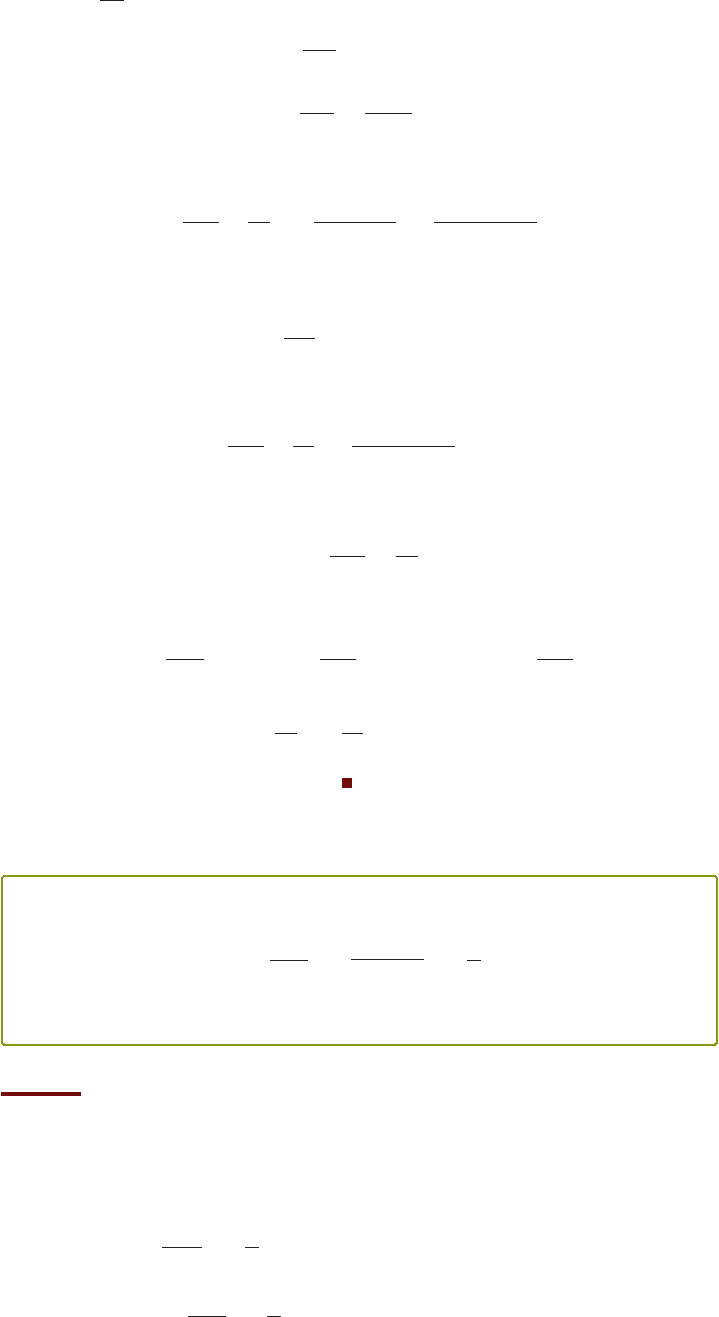
(iv) We first show that
lim
x→a
1
g(x)
=
1
L
2
,
for L
2
= 0. Notice that in this case, we need to show that we can make
1
g(x)
−
1
L
2
as small
as desired. We have
1
g(x)
−
1
L
2
=
L
2
− g(x)
L
2
g(x)
. (A.8)
Of course, since lim
x→a
g(x) = L
2
, we can make the numerator of the fraction on the right-
hand side as small as needed. We must also consider what happens to the denominator,
though. Recall that given any ε
2
> 0, there is a δ
2
> 0 such that
|g(x) − L
2
| <ε
2
, whenever 0 < |x − a| <δ
2
.
In particular, for ε
2
=
|L
2
|
2
, this says that
|g(x) − L
2
| <
|L
2
|
2
.
Notice that by the triangle inequality, we can now say that
|L
2
|=|L
2
− g(x) + g(x)|≤|L
2
− g(x)|+|g(x)| <
|L
2
|
2
+|g(x)|.
P1: IOP
MHDQ256-APP-A MHDQ256-Smith-v1.cls January 10, 2011 11:23
LT (Late Transcendental)
CONFIRMING PAGES
4 APPENDIX A
..
Proofs of Selected Theorems A-4
Subtracting
|L
2
|
2
from both sides now gives us
|L
2
|
2
< |g(x)|,
so that
2
|L
2
|
>
1
|g(x)|
.
From (A.8), we now have that for 0 < |x − a| <δ
2
,
1
g(x)
−
1
L
2
=
L
2
− g(x)
L
2
g(x)
<
2|L
2
− g(x)|
L
2
2
. (A.9)
Further, given any ε>0, there is a δ
3
> 0 so that
|L
2
− g(x)| <
εL
2
2
2
, whenever 0 < |x − a| <δ
3
.
From (A.9), we now have that for δ = min{δ
2
,δ
3
},
1
g(x)
−
1
L
2
<
2|L
2
− g(x)|
L
2
2
<ε,
whenever 0 < |x − a| <δ, as desired. We have now established that
lim
x→a
1
g(x)
=
1
L
2
.
From (iii), we now have that
lim
x→a
f (x)
g(x)
= lim
x→a
f (x)
1
g(x)
=
lim
x→a
f (x)
lim
x→a
1
g(x)
= L
1
1
L
2
=
L
1
L
2
,
which proves the last part of the theorem.
The following result appeared as Theorem 3.3 in section 1.3.
THEOREM A.2
Suppose that lim
x→a
f (x) = L and n is any positive integer. Then,
lim
x→a
n
f (x) =
n
lim
x→a
f (x) =
n
√
L,
where for n even, we assume that L > 0.
PROOF
(i) We first give the proof for the case where L > 0. Since lim
x→a
f (x) = L, we know that
given any ε
1
> 0, there is a δ
1
> 0, so that
| f (x) − L| <ε
1
, whenever 0 < |x − a| <δ
1
.
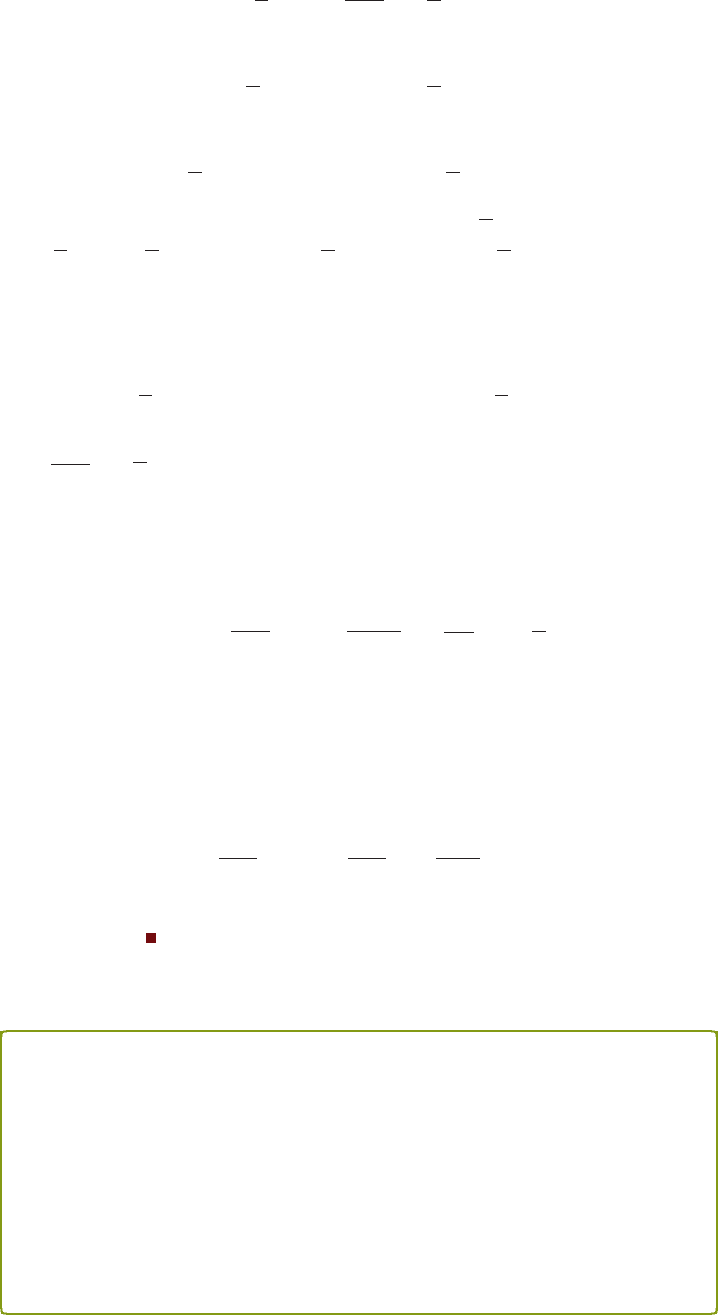
To show that lim
x→a
n
f (x) =
n
√
L, we need to show that given any ε>0, there is a δ>0
such that
n
f (x) −
n
√
L
<ε,whenever 0 < |x −a| <δ.
P1: IOP
MHDQ256-APP-A MHDQ256-Smith-v1.cls January 10, 2011 11:23
LT (Late Transcendental)
CONFIRMING PAGES
A-5 APPENDIX A
..
Proofs of Selected Theorems 5
Notice that this is equivalent to having
n
√
L − ε<
n
f (x) <
n
√
L + ε.
Now, raising all sides to the nth power, we have
n
√
L − ε
n
< f (x) <
n
√
L + ε
n
.
Subtracting L from all terms gives us
n
√
L − ε
n
− L < f (x) − L <
n
√
L + ε
n
− L.
Since ε is taken to be small, we now assume that ε<
n
√
L. Observe that in this case,
0 <
n
√
L − ε<
n
√
L. Let ε
1
= min
n
√
L + ε
n
− L, L −
n
√
L − ε
n
> 0. Then, since
lim
x→a
f (x) = L, we know that there is a number δ>0, so that
−ε
1
< f (x) − L <ε
1
, whenever 0 < |x − a| <δ.
It then follows that
(
n
√
L − ε)
n
− L ≤−ε
1
< f (x) − L <ε
1
≤ (
n
√
L + ε)
n
− L,
whenever 0 < |x − a| <δ. Reversing the above sequence of steps gives us
lim
x→a
n
√
f (x) =
n
√
L, as desired.
(ii) If L < 0 and n is odd and lim
x→a
f (x) = L < 0, then
lim
x→a
[− f (x)] =−L > 0.
It then follows from part (i) that
−lim
x→a
n
f (x) = lim
x→a
n
− f (x) =
n
√
−L =−
n
√
L,
from which the result follows.
(iii) If L = 0 and n isodd and lim
x→a
f (x) = L = 0, then we have that givenany ε
1
> 0,
there is a δ>0 so that
| f (x)| <ε
1
, whenever 0 < |x −a| <δ.
It follows that
n
f (x) −0
=
n
f (x)
=
n
| f (x)| <ε
if and only if | f (x)| <ε
n
. Taking ε
1
= ε
n
gives us the result whenever
0 < |x − a| <δ.
The following result appeared in section 1.3, as Theorem 3.5.
THEOREM A.3 (Squeeze Theorem)
Suppose that
f (x) ≤ g(x) ≤ h(x), (A.10)
for all x in some interval (c, d), except possibly at the point a ∈ (c, d) and that
lim
x→a
f (x) = lim
x→a
h(x) = L,
for some number L. Then, it follows that
lim
x→a
g(x) = L, also.

P1: IOP
MHDQ256-APP-A MHDQ256-Smith-v1.cls January 10, 2011 11:23
LT (Late Transcendental)
CONFIRMING PAGES
6 APPENDIX A
..
Proofs of Selected Theorems A-6
PROOF
To show that lim
x→a
g(x) = L, we must prove that given any ε>0, there is a δ>0, such that
|g(x) − L| <ε, whenever 0 < |x − a| <δ.
Since lim
x→a
f (x) = L, we have that given any ε>0, there is a δ
1
> 0, such that
| f (x) − L| <ε, whenever 0 < |x − a| <δ
1
.
Likewise, since lim
x→a
h(x) = L, we have that given any ε>0, there is a δ
2
> 0, such that
|h(x) − L| <ε, whenever 0 < |x − a| <δ
2
.
Now, choose δ = min{δ
1
,δ
2
}. Then, if 0 < |x −a| <δ, it follows that 0 < |x − a| <δ
1
and 0 < |x − a| <δ
2
, so that
| f (x) − L| <ε and |h(x) − L| <ε.
Equivalently, we can say that
L − ε< f (x) < L +ε and L −ε<h(x) < L +ε. (A.11)
It now follows from (A.10) and (A.11) that if 0 < |x −a| <δ, then
L − ε< f (x) ≤ g(x) ≤ h(x) < L +ε,
which gives us
L − ε<g(x) < L +ε
or |g(x) − L| <εand it follows that lim
x→a
g(x) = L, as desired.
The following result appeared as Theorem 4.3 in section 1.4.
THEOREM A.4
Suppose lim
x→a
g(x) = L and f is continuous at L. Then,
lim
x→a
f (g(x)) = f
lim
x→a
g(x)
= f (L).
PROOF
To prove the result, we must show that given any number ε>0, there is a number δ>0
for which
| f (g(x)) − f (L)| <ε, whenever 0 < |x −a| <δ.
Since f is continuous at L, we know that lim
t→L
f (t) = f (L). Consequently, given any ε>0,
there is a δ
1
> 0 for which
| f (t) − f (L)| <ε, whenever 0 < |t − L| <δ
1
.
Further, since lim
x→a
g(x) = L, we can make g(x) as close to L as desired, simply by making x
sufficientlyclosetoa.Inparticular,theremustbeanumberδ>0 forwhich|g(x) − L| <δ
1
whenever 0 < |x −a| <δ. It now follows that if 0 < |x −a| <δ, then |g(x) − L| <δ
1
,
so that
| f (g(x)) − f (L)| <ε,
as desired.

P1: IOP
MHDQ256-APP-A MHDQ256-Smith-v1.cls January 10, 2011 11:23
LT (Late Transcendental)
CONFIRMING PAGES
A-7 APPENDIX A
..
Proofs of Selected Theorems 7
The following result appeared as Theorem 5.1 in section 1.5.
THEOREM A.5
For any rational number t > 0,
lim
x→±∞
1
x
t
= 0,
where for the case where x →−∞, we assume that t =
p
q
, where q is odd.
PROOF
We first prove that lim
x→∞
1
x
t
= 0. To do so, we must show that given any ε>0, there is
an M > 0 for which
1
x
t
− 0
<ε, whenever x > M. Since x →∞, we can take x to be
positive, so that
1
x
t
− 0
=
1
x
t
<ε,
which is equivalent to
1
x
<ε
1/t
or
1
ε
1/t
< x.
Notice that taking M to be any number greater than
1
ε
1/t
, we will have
1
x
t
− 0
<εwhen-
ever x > M, as desired.
For the case lim
x→−∞
1
x
t
= 0, we must show that given any ε>0, there is an N < 0 for
which
1
x
t
− 0
<ε, whenever x < N. Since x →−∞, we can take x to be negative, so
that
1
x
t
− 0
=
1
|x
t
|
<ε,
which is equivalent to
1
|x|
<ε
1/t
or
1
ε
1/t
< |x|=−x,
since x < 0. Multiplying both sides of the inequality by −1, we get
−
1
ε
1/t
> x.
NoticethattakingN tobeanynumberlessthan−
1
ε
1/t
,wewillhave
1
x
t
− 0
<ε,whenever
x < N, as desired.
In section 2.8, we presented Rolle’s Theorem (Theorem 8.1), but only gave a graphical
idea of the proof. Now, with the addition of the Extreme Value Theorem, we can give a
complete proof of this result.
THEOREM A.6 (Rolle’s Theorem)
Suppose that f is continuous on the interval [a, b], differentiable on the interval
(a, b) and f (a) = f (b). Then there is a number c ∈ (a, b) such that f
(c) = 0.

P1: IOP
MHDQ256-APP-A MHDQ256-Smith-v1.cls January 10, 2011 11:23
LT (Late Transcendental)
CONFIRMING PAGES
8 APPENDIX A
..
Proofs of Selected Theorems A-8
PROOF
There are three cases to be considered here.
(i) If f (x) is constant on [a, b], then, f
(x) = 0 throughout (a, b).
(ii) Suppose that f (x) < f (a), for some x ∈ (a, b). Since f is continuous on [a, b],
we have by the Extreme Value Theorem (Theorem 2.1 in section 3.2) that f attains
an absolute minimum on [a, b]. Since f (x) < f (a) = f (b), for some x ∈ (a, b), the
absolute minimum occurs at some point c ∈ (a, b). Then by Fermat’s Theorem (Theo-
rem 2.2 in section 3.2), c must be a critical number of f . Finally, since f is differentiable
on (a, b), we must have f
(c) = 0.
(iii) Similarly, suppose that f (x) > f (a), for some x ∈ (a, b). Then as in (ii), we
have by the Extreme Value Theorem that f attains an absolute maximum on [a, b]. Since
f (x) > f (a) = f (b), for some x ∈ (a, b), the absolute maximum occurs at some point
c ∈ (a, b). Then, by Fermat’s Theorem, we must have f
(c) = 0.
In section 7.6, we prove l’Hˆopital’s Rule only for a special case. Here, we present a
general proof for the
0
0
case. First, we need the following generalization of the Mean Value
Theorem.
THEOREM A.7 (Generalized Mean Value Theorem)
Suppose that f and g are continuous on the interval [a, b] and differentiable on
the interval (a, b) and that g
(x) = 0, for all x on (a, b). Then, there is a number
z ∈ (a, b), such that
f (b) − f (a)
g(b) − g(a)
=
f
(z)
g
(z)
.
Notice that the Mean Value Theorem (Theorem 8.4in section 2.8) is simply thespecial
case of Theorem A.7 where g(x) = x.
PROOF
First, observe that since g
(x) = 0, for all x on (a, b), we must have that g(b) − g(a) = 0.
This follows from Rolle’s Theorem (Theorem A.6), since if g(a) = g(b), there would be
some number c ∈ (a, b) for which g
(c) = 0. Now, define
h(x) = [ f (b) − f (a)]g(x) − [g(b) − g(a)] f (x).
Notice that h is continuous on [a, b] and differentiable on (a, b), since both f and g are
continuous on [a, b] and differentiable on (a, b). Further, we have
h(a) = [ f (b) − f (a)]g(a) −[g(b) − g(a)] f (a)
= f (b)g(a) − g(b) f (a)
and h(b) = [ f (b) − f (a)]g(b) −[g(b) − g(a)] f (b)
= g(a) f (b) − f (a)g(b),
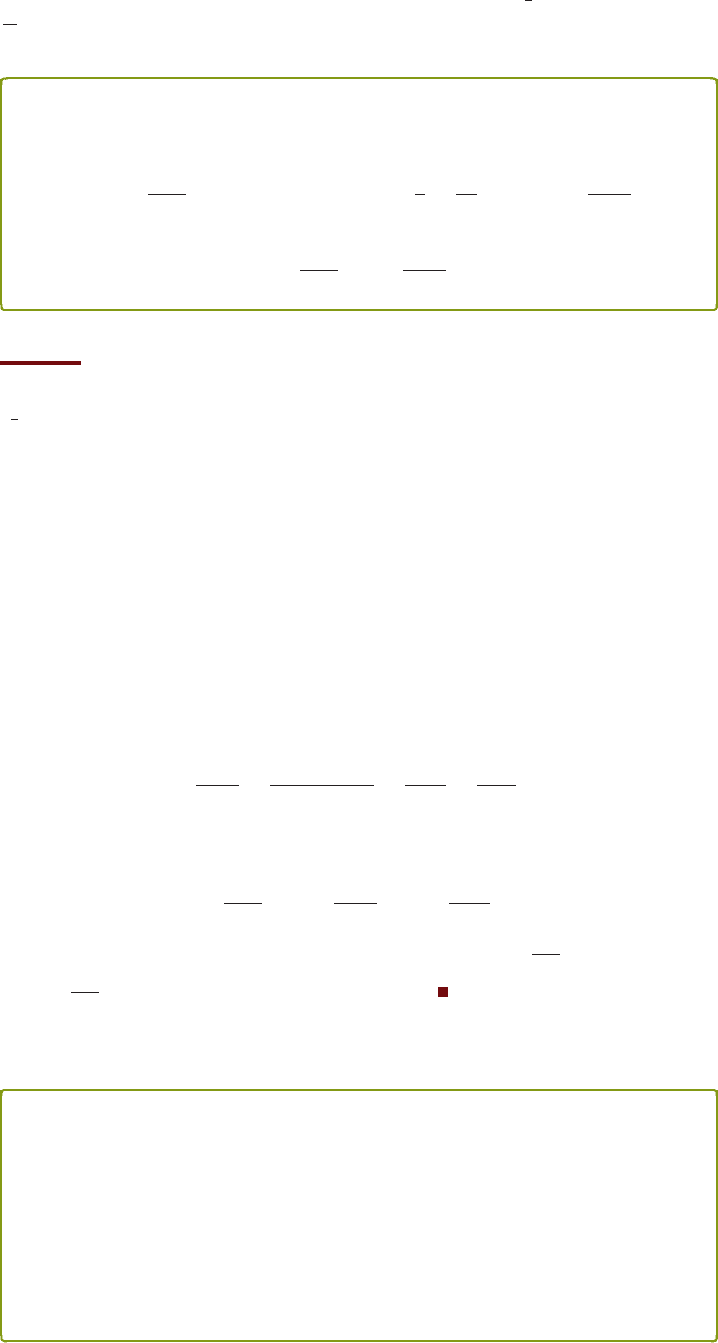
so that h(a) = h(b). In view of this, Rolle’s Theorem says that there must be a number
z ∈ (a, b) for which
0 = h
(z) = [ f (b) − f (a)]g
(z) − [g(b) − g(a)] f
(z)
or
f (b) − f (a)
g(b) − g(a)
=
f
(z)
g
(z)
,
as desired.
P1: IOP
MHDQ256-APP-A MHDQ256-Smith-v1.cls January 10, 2011 11:23
LT (Late Transcendental)
CONFIRMING PAGES
A-9 APPENDIX A
..
Proofs of Selected Theorems 9
We can now give a general proof of l’Hˆopital’s Rule for the
0
0
case. The proof of the
∞
∞
case can be found in a more advanced text.
THEOREM A.8 (l’H
ˆ
opital’s Rule)
Suppose that f and g are differentiable on the interval (a, b), except possibly at some
fixed point c ∈ (a, b) and that g
(x) = 0, on (a, b), except possibly at x = c. Suppose
further that lim
x→c
f (x)
g(x)
has the indeterminate form
0
0
or
∞
∞
and that lim
x→c
f
(x)
g
(x)
= L
(or ±∞). Then,
lim
x→c
f (x)
g(x)
= lim
x→c
f
(x)
g
(x)
.
PROOF
0
0
case
In this case, we have that lim
x→c
f (x) = lim
x→c
g(x) = 0. Define
F(x) =
f (x)ifx = c
0ifx = c
and G(x) =
g(x)ifx = c
0ifx = c
.
Notice that lim
x→c
F(x) = lim
x→c
f (x) = 0 = F(c)
and lim
x→c
G(x) = lim
x→c
g(x) = 0 = G(c),
so that both F and G are continuous on all of (a, b). Further, observe that for x = c,
F
(x) = f
(x) and G
(x) = g
(x) and so, both F and G are differentiable on each of the
intervals (a, c) and (c, b). We first consider the interval (c, b). Notice that F and G are
continuous on [c, b] and differentiable on (c, b) and so, by the Generalized Mean Value
Theorem,forany x ∈ (c, b),we havethat there is some number z, withc < z < x, for which
F
(z)
G
(z)
=
F(x) − F(c)
G(x) − G(c)
=
F(x)
G(x)
=
f (x)
g(x)
,
where we have used the fact that F(c) = G(c) = 0. Notice that as x → c
+
, z → c
+
, also,
since c < z < x. Taking the limit as x → c
+
,wenowhave
lim
x→c
+
f (x)
g(x)
= lim
z→c
+
F
(z)
G
(z)
= lim
z→c
+
f
(z)
g
(z)
= L.
Similarly, by focusing on the interval (a, c), we can show that lim
x→c
−
f (x)
g(x)
= L, which proves
that lim
x→c
f (x)
g(x)
= L (since both one-sided limits agree).
The following theorem corresponds to Theorem 6.1 in section 9.6.
THEOREM A.9
Given any power series,
∞
k=0
b
k
(x − c)
k
, there are exactly three possibilities:
(i) the series converges for all x ∈ (−∞, ∞) and the radius of convergence is
r =∞;
(ii) the series converges only for x = c (and diverges for all other values of x)
and the radius of convergence is r = 0or
(iii) the series converges for x ∈ (c −r, c +r) and diverges for x < c −r and for
x > c +r, for some number r with 0 < r < ∞.

P1: IOP
MHDQ256-APP-A MHDQ256-Smith-v1.cls January 10, 2011 11:23
LT (Late Transcendental)
CONFIRMING PAGES
10 APPENDIX A
..
Proofs of Selected Theorems A-10
In order to prove Theorem A.9, we first introduce and prove two simpler results.
THEOREM A.10
(i) If the power series
∞
k=0
b
k
x
k
converges for x = a = 0, then it also converges for
all x with |x| < |a|.
(ii) If the power series
∞
k=0
b
k
x
k
diverges for x = d, then it also diverges for all x
with |x| > |d|.
PROOF
(i) Suppose that
∞
k=0
b
k
a
k
converges. Then, by Theorem 2.2 in section 9.2, lim
k→∞
b
k
a
k
= 0.
For this to occur, we must be able to make |b
k
a
k
| as small as desired, just by making k
sufficiently large. In particular, there must be a number N > 0, such that |b
k
a
k
| < 1, for all
k > N. So, for k > N, we must have
|b
k
x
k
|=
b
k
a
k
x
k
a
k
=
b
k
a
k
x
a
k
<
x
a
k
.
If |x| < |a|, then
x
a
< 1 and so,
∞
k=0
x
a
k
is a convergent geometric series. It then follows
from the Comparison Test (Theorem 3.3 in section 9.3) that
∞
k=0
|b
k
x
k
|converges and hence,
∞
k=0
b
k
x
k
converges absolutely.
(ii) Suppose that
∞
k=0
b
k
d
k
diverges. Notice that if x is any number with |x| > |d|, then
∞
k=0
b
k
x
k
must diverge, since if it converged, we would have by part (i) that
∞
k=0
b
k
d
k
would
also converge, which contradicts our assumption.
Next, we state and prove a slightly simpler version of Theorem A.9.
THEOREM A.11
Given any power series,
∞
k=0
b
k
x
k
, there are exactly three possibilities:
(i) the series converges for all x ∈ (−∞, ∞) and the radius of convergence is
r =∞;
(ii) the series converges only for x = 0 (and diverges for all other values of x)
and the radius of convergence is r = 0or
(iii) the series converges for x ∈ (−r, r) and diverges for x < −r and x > r, for
some number r with 0 < r < ∞.
PROOF
If neither (i) nor (ii) is true, then there must be nonzero numbers a and d such that the series
converges for x = a and diverges for x = d. From Theorem A.10, observe that
∞
k=0
b
k
x
k
diverges for all values of x with |x| > |d|. Define the set S to be the set of all values of x for

P1: IOP
MHDQ256-APP-A MHDQ256-Smith-v1.cls January 10, 2011 11:23
LT (Late Transcendental)
CONFIRMING PAGES
A-11 APPENDIX A
..
Proofs of Selected Theorems 11
which the series converges. Since the series converges for x = a, S is nonempty. Further,
|d|is an upper bound on S, since the series diverges for all values of x with |x| > |d|. By the
Completeness Axiom (see section 9.1), S must have a least upper bound r. So, if |x| > r,
then
∞
k=0
b
k
x
k
diverges. Further, if |x| < r, then |x| is not an upper bound for S and there
must be a number t in S with |x| < t.Since t ∈ S,
∞
k=0
b
k
t
k
converges and by Theorem A.10,
∞
k=0
b
k
x
k
converges since |x| < t ≤|t|. This proves the result.
We can now prove the original result (Theorem A.9).
PROOF OF THEOREM A.9
Let t = x − c and the power series
∞
k=0
b
k
(x − c)
k
becomes simply
∞
k=0
b
k
t
k
. By Theo-
rem A.11, we know that either the series converges for all t (i.e., for all x) or only for t = 0
(i.e., only for x = c) or there is a number r > 0 such that the series converges for |t| < r
(i.e., for |x − c| < r)and divergesfor |t| > r (i.e., for |x −c| > r).This provesthe original
result.
This page intentionally left blank