
Smith R., Minton R. Calculus
Подождите немного. Документ загружается.

P1: OSO/OVY P2: OSO/OVY QC: OSO/OVY T1: OSO
MHDQ256-Ch16 MHDQ256-Smith-v1.cls January 7, 2011 11:30
LT (Late Transcendental)
CONFIRMING PAGES
16-31 SECTION 16.4
..
Power Series Solutions of Differential Equations 1103
More generally, we now have
a
2n+1
=
(−1)
n
2
2n
n!
(2n + 1)!
a
1
,
for n = 0, 1, 2....
2.5 5
0.25
0.5
0.75
2.550
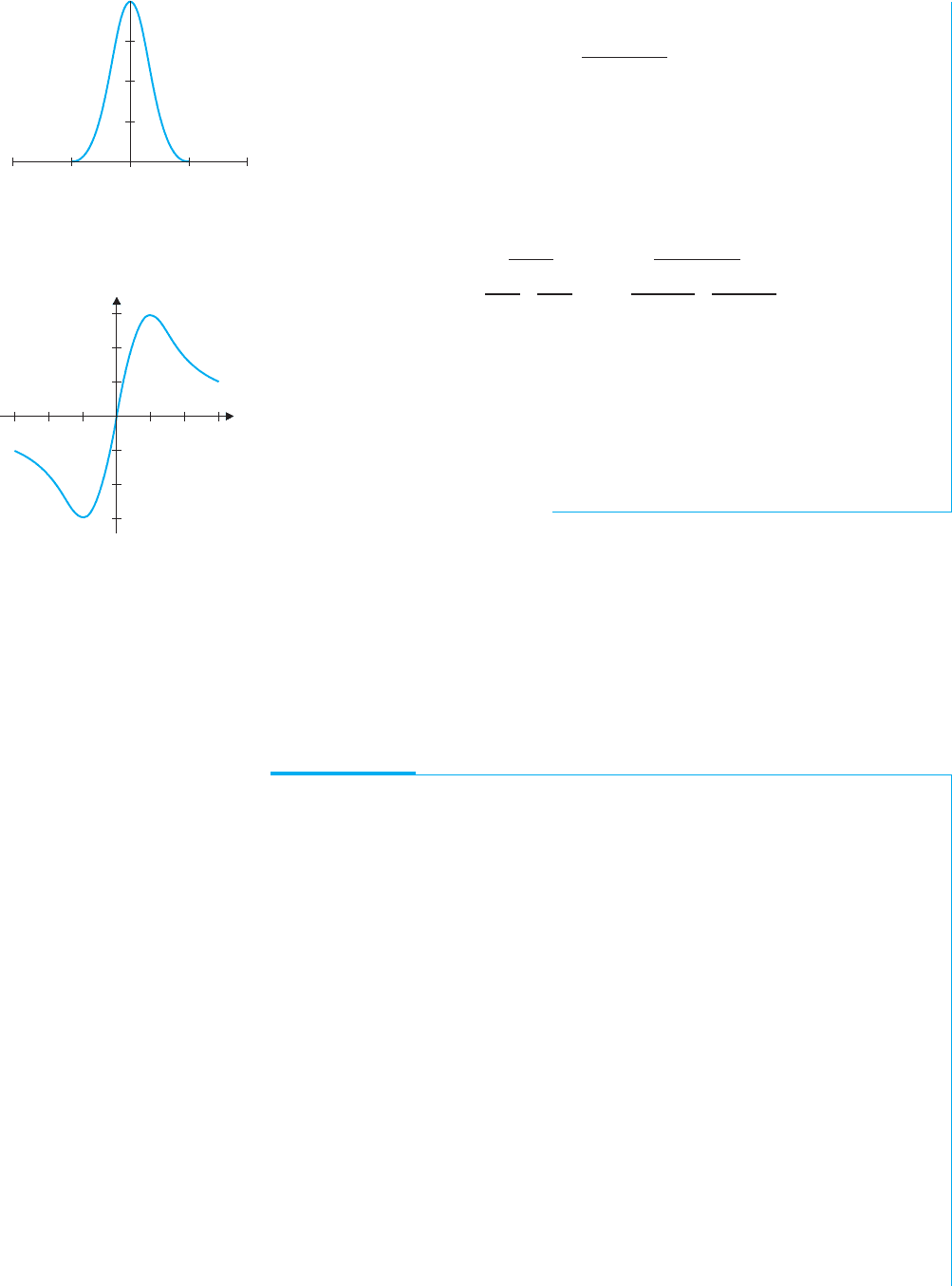
FIGURE 16.16a
y = y
1
(x) = e
−x
2
y
x
1
0.2
0.2
0.4
0.6
0.4
0.6
2323
1
FIGURE 16.16b
10-term approximation to y = y
2
(x)
Now that we have expressions for all of the coefficients, we can write the solution
of the differential equation as
y =
∞
n=0
a
n
x
n
=
∞
n=0
(a
2n
x
2n
+ a
2n+1
x
2n+1
)
= a
0
∞
n=0
(−1)
n
n!
x
2n
y
1
(x)
+a
1
∞
n=0
(−1)
n
2
2n
n!
(2n + 1)!
x
2n+1
y
2
(x)
= a
0
y
1
(x) +a
1
y
2
(x),
where y
1
and y
2
are two power series solutions of the differential equation. We leave it
as an exercise to use the Ratio Test to show that both of these series converge absolutely
for all x. You might recognize y
1
(x) as the Maclaurin series expansion for e
−x
2
, but in
practice, recognizing series solutions as power series of familiar functions is rather
unlikely. To give you an idea of the behavior of these functions, we draw a graph of
y
1
(x) in Figure 16.16a and of y
2
(x) in Figure 16.16b. We obtained the graph of y
2
(x)by
plotting a partial sum of the series.
From examples 4.1 and 4.2, you might get the idea that if you look for a series solu-
tion, you can always recognize the pattern of the coefficients and write the pattern down
succinctly. Unfortunately, the pattern is most often difficult to see and even more difficultto
write down compactly. Still, series solutions are a valuable means of solving a differential
equation. In the worst case, you can always compute a number of the coefficients of the
series from the recurrence relation and then use the first so many terms of the series as an
approximation to the actual solution.
In example 4.3, we illustrate the more common case where the coefficients are a bit
more challenging to find.
EXAMPLE 4.3 A Series Solution Where the Coefficients
Are Harder to Find
Use a power series to find the general solution of Airy’s equation
y
− xy = 0.
Solution As before, we assume that we may write the solution as a power series
y =
∞
n=0
a
n
x
n
.
Again, we have
y
=
∞
n=1
na
n
x
n−1
and
y
=
∞
n=2
n(n −1)a
n
x
n−2
.
Subsituting these power series into the equation, we get
0 = y
− xy =
∞
n=2
n(n −1)a
n
x
n−2
− x
∞
n=0
a
n
x
n
=
∞
n=2
n(n −1)a
n
x
n−2
−
∞
n=0
a
n
x
n+1
.

P1: OSO/OVY P2: OSO/OVY QC: OSO/OVY T1: OSO
MHDQ256-Ch16 MHDQ256-Smith-v1.cls January 7, 2011 11:30
LT (Late Transcendental)
CONFIRMING PAGES
1104 CHAPTER 16
..
Second-Order Differential Equations 16-32
In order to combine the two preceding series, we must rewrite one or both series so
that they both have the same power of x. For simplicity, we rewrite the first series only.
We have
0 =
∞
n=2
n(n −1)a
n
x
n−2
−
∞
n=0
a
n
x
n+1
=
∞
n=−1
(n + 3)(n + 2)a
n+3
x
n+1
−
∞
n=0
a
n
x
n+1
= (2)(1)a
2
+
∞
n=0
(n + 3)(n + 2)a
n+3
x
n+1
−
∞
n=0
a
n
x
n+1
= 2a
2
+
∞
n=0
[(n + 3)(n + 2)a
n+3
− a
n
]x
n+1
,
where we wrote out the first term of the first series and then combined the two series,
once both had an index that started with n = 0. Again, this is a power series expansion
of the zero function and so, all of the coefficients must be zero. That is,
0 = 2a
2
(4.7)
and
0 = (n + 3)(n + 2)a
n+3
− a
n
, (4.8)
for n = 0, 1, 2,.... Equation (4.7) says that a
2
= 0 and (4.8) gives us the recurrence
relation
a
n+3
=
1
(n + 3)(n + 2)
a
n
, (4.9)
for n = 0, 1, 2,.... Notice that here, instead of having all of the even-indexed
coefficients related to a
0
and all of the odd-indexed coefficients related to a
1
, (4.9) tells
us that every third coefficient is related. In particular, notice that since a
2
= 0, (4.9) now
says that
a
5
=
1
5 · 4
a
2
= 0,
a
8
=
1
8 · 7
a
5
= 0
and so on. So, every third coefficient starting with a
2
is zero. But, how do we concisely
write down something like this? Think about the notation a
2n
and a
2n+1
that we have
used previously. You can view a
2n
as a representation of every second coefficient
starting with a
0
. Likewise, a
2n+1
represents every second coefficient starting with a
1
.
In the present case, if we want to write down every third coefficient starting with a
2
,
we write a
3n+2
. We can now observe that
a
3n+2
= 0,
for n = 0, 1, 2,.... Continuing on with the remaining coefficients, we have from (4.9)
that
a
3
=
1
3 · 2
a
0
,
a
6
=
1
6 · 5
a
3
=
1
6 · 5 · 3 · 2
a
0
,
a
9
=
1
9 · 8
a
6
=
1
9 · 8 · 6 · 5 · 3 · 2
a
0
and so on. Hopefully, you see the pattern that’s developing for these coefficients. The
trouble here is that it’s not as easy to write down this pattern as it was in the first two
examples. Notice that the denominator in the expression for a
9
is almost 9!, but with

P1: OSO/OVY P2: OSO/OVY QC: OSO/OVY T1: OSO
MHDQ256-Ch16 MHDQ256-Smith-v1.cls January 7, 2011 11:30
LT (Late Transcendental)
CONFIRMING PAGES
16-33 SECTION 16.4
..
Power Series Solutions of Differential Equations 1105
every third factor in the product deleted. Since we don’t have a way of succinctly
writing this down, we write the coefficients by indicating the pattern, as follows:
a
3n
=
(3n − 2)(3n − 5)···7 ·4 · 1
(3n)!
a
0
,
where this is not intended as a literal formula, as explicit substitution of n = 0orn = 1
would result in negative values. Rather, this is an indication of the general pattern.
Similarly, the recurrence relation gives us
a
4
=
1
4 · 3
a
1
,
a
7
=
1
7 · 6
a
4
=
1
7 · 6 · 4 · 3
a
1
,
a
10
=
1
10 · 9
a
7
=
1
10 · 9 · 7 · 6 · 4 · 3
a
1
and so on. More generally, we can establish the pattern:
a
3n+1
=
(3n − 1)(3n − 4)···8 ·5 · 2
(3n + 1)!
a
1
,
where again, this is not intended as a literal formula.
Now that we have found all of the coefficients, we can write down the solution, by
separately writing out every third term of the series, as follows:
y =
∞
n=0
a
n
x
n
=
∞
n=0
a
3n
x
3n
+ a
3n+1
x
3n+1
+ a
3n+2
x
3n+2
= a
0
∞
n=0
(3n − 2)(3n − 5)···7 ·4 · 1
(3n)!
x
3n
y
1
(x)
+a
1
∞
n=0
(3n − 1)(3n − 4)···8 ·5 · 2
(3n + 1)!
x
3n+1
y
2
(x)
= a
0
y
1
(x) +a
1
y
2
(x).
We leave it as an exercise to use the Ratio Test to show that the power series defining y
1
and y
2
are absolutely convergent for all x.
You may have noticed that in all three of our examples, we assumed that there was a
solution of the form
y =
∞
n=0
a
n
x
n
= a
0
+ a
1
x +a
2
x
2
+···,
only to arrive at the general solution
y = a
0
y
1
(x) +a
1
y
2
(x),
where y
1
and y
2
were power series solutions of the equation. This is in fact not coincidental.
One can show that (at least forcertain equations) this is always the case. One clue as to why
this might be so lies in the following.
Suppose that we want to solve the initial value problem consisting of a second-
order differential equation and the initial conditions y(0) = A and y
(0) = B. Taking
y(x) =
∞
n=0
a
n
x
n
gives us
y
(x) =
∞
n=0
na
n
x
n−1
= a
1
+ 2a
2
x +3a
3
x
2
+···.

P1: OSO/OVY P2: OSO/OVY QC: OSO/OVY T1: OSO
MHDQ256-Ch16 MHDQ256-Smith-v1.cls January 7, 2011 11:30
LT (Late Transcendental)
CONFIRMING PAGES
1106 CHAPTER 16
..
Second-Order Differential Equations 16-34
So, imposing the initial conditions, we have
A = y(0) = a
0
+ a
1
(0) + a
2
(0)
2
+···=a
0
and
B = y
(0) = a
1
+ 2a
2
(0) + 3a
3
(0)
2
+···=a
1
.
So, irrespective of the particular equation we’re solving, we always have y(0) = a
0
and
y
(0) = a
1
.
You might ask what you’d do if the initial conditions were specified at some point other
than at x = 0, say at x = x
0
. In this case, we look for a power series solution of the form
y =
∞
n=0
a
n
(x − x
0
)
n
.
It’s easy to show that in this case, we still have y(x
0
) = a
0
and y
(x
0
) = a
1
.
In the exercises, we explore finding series solutions about a variety of different points.
BEYOND FORMULAS
This section connects two important threads of calculus: solutions of differential equa-
tions and infinite series. In Chapter 9, we expressed known functions like sin x and
cos x as power series. Here, we just extend that idea to unknown solutions of differen-
tial equations. For second-order homogeneous equations, keep in mind that the general
solution has the format c
1
y
1
(x) +c
2
y
2
(x). You should think about the problems in this
section as following this strategy: write the solution as a power series, substitute into
the differential equation and find relationships between the coefficients of the power
series, remembering that two of the coefficients will be left as arbitrary constants.
EXERCISES 16.4
WRITING EXERCISES
1. After substituting a power series representation into a differ-
ential equation, the next step is always to rewrite one or more
of the series, so that all series have the same exponent. (Typi-
cally, we want x
n
.) Explain why this is an important step. For
example, what would we be unableto do if the exponents were
not the same?
2. The recurrence relation is typically solved for the coeffi-
cient with the largest index. Explain why this is an important
step.
3. Explain why you can’t solve equations with nonconstant coef-
ficients, such as
y
+ 2xy
+ 2y = 0,
by looking for a solution in the form y = e
rx
.
4. The differential equations solved in this section are actually
of a special type, where we find power series solutions cen-
tered at what is called an ordinary point. For the equation
x
2
y
+ y
+ 2y = 0, the point x = 0 is not an ordinary point.
Discuss what goes wrong here if you look for a power series
solution of the form
∞
n=0
a
n
x
n
.
In exercises 1–8, find the recurrence relation and general power
series solution of the form
∞
n0
a
n
x
n
.
1. y
+ 2xy
+ 4y = 0 2. y
+ 4xy
+ 8y = 0
3. y
− xy
− y = 0 4. y
− xy
− 2y = 0
5. y
− xy
= 0 6. y
+ 2xy = 0
7. y
− x
2
y
= 0 8. y
+ xy
− 2y = 0
............................................................
9. Find a series solution of y
+ (1 − x)y
− y = 0 in the form
y =
∞
n=0
a
n
(x − 1)
n
.
10. Find a series solution of y
+ y
+ (x − 2)y = 0 in the form
∞
n=0
a
n
(x − 2)
n
.
11. Find a series solution of Airy’s equation y
− xy = 0inthe
form
∞
n=0
a
n
(x − 1)
n
. [Hint: First rewrite the equation in the
form y
− (x − 1)y − y = 0.]
12. Find a series solution of Airy’s equation y
− xy = 0inthe
form
∞
n=0
a
n
(x − 2)
n
.

P1: OSO/OVY P2: OSO/OVY QC: OSO/OVY T1: OSO
MHDQ256-Ch16 MHDQ256-Smith-v1.cls January 7, 2011 11:30
LT (Late Transcendental)
CONFIRMING PAGES
16-35 CHAPTER 16
..
Review Exercises 1107
13. Solve the initial value problem y
+ 2xy
+ 4y = 0,
y(0) = 5, y
(0) =−7. (See exercise 1.)
14. Solvethe initial valueproblem y
+ 4xy
+ 8y = 0, y(0) = 2,
y
(0) = π. (See exercise 2.)
15. Solve the initial value problem y
+(1−x)y
− y = 0,
y(1) =−3, y
(1) = 12. (See exercise 9.)
16. Solve the initial value problem y
+ y
+(x −2)y = 0,
y(2) = 1, y
(2) =−1. (See exercise 10.)
17. Determine the radius of convergence of the power series solu-
tions about x
0
= 0ofy
− xy
− y = 0. (See exercise 3.)
18. Determine the radius of convergence of the power series solu-
tions about x
0
= 0ofy
− xy
− 2y = 0. (See exercise 4.)
19. Determine the radius of convergence of the power series solu-
tionsaboutx
0
= 1ofy
+ (1 − x)y
− y = 0.(Seeexercise9.)
20. Determine the radius of convergence of the power series solu-
tions about x
0
= 1ofy
− xy = 0. (See exercise 11.)
21. Find a series solution of the form y =
∞
n=0
a
n
x
n
to the equation
x
2
y
+ xy
+ x
2
y = 0 (Bessel’s equation of order 0).
22. Find a series solution of the form y =
∞
n=0
a
n
x
n
to the equation
x
2
y
+ xy
+ (x
2
− 1)y = 0 (Bessel’s equation of order 1).
23. Determine the radius of convergence of the series solution
found in example 4.3.
24. Determine the radius of convergence of the series solution
found in exercise 12.
25. For the initial value problem y
+2xy
−xy =0, y(0) = 2,
y
(0) =−5, substitute in x = 0 and show that
y
(0) = 0. Then take y
=−2xy
+ xy and show that
y
=−2xy
+ (x − 2)y
+ y. Conclude that y
(0) = 12.
Then compute y
(4)
(x) and find y
(4)
(0). Finally, compute y
(5)
(x)
and find y
(5)
(0). Write out the fifth-degree Taylor polyno-
mial for the solution, P
5
(x) = y(0) + y
(0)x + y
(0)
x
2
2
+
y
(0)
x
3
3!
+ y
(4)
(0)
x
4
4!
+ y
(5)
(0)
x
5
5!
.
26. Use the technique of exercise 25 to find the fifth-degree
Taylor polynomial for the solution of the initial value
problem y
+ x
2
y
− (cos x)y = 0, y(0) = 3, y
(0) = 2.
27. Use the technique of exercise 25 to find the fifth-degree
Taylor polynomial for the solution of the initial value
problem y
+ e
x
y
− (sin x)y = 0, y(0) =−2, y
(0) = 1.
28. Use the technique of exercise 25 to find the fifth-degree
Taylor polynomial for the solution of the initial value
problem y
+ y
− (e
x
)y = 0, y(0) = 2, y
(0) = 0.
29. Use the technique of exercise 25 to find the fifth-degree
Taylor polynomial for the solution of the initial value
problem y
+ xy
+ (sin x)y = 0, y(π ) = 0, y
(π) = 4.
30. Use the technique of exercise 25 to find the fifth-degree
Taylor polynomial for the solution of the initial value
problem y
+ (cos x)y
+ xy = 0, y(
π
2
) = 3, y
(
π
2
) = 0.
EXPLORATORY EXERCISES
1. The equation y
− 2xy
+ 2ky = 0 for some integer k ≥ 0is
known as Hermite’s equation. Following our procedure for
findingseries solutions in powersof x, showthat, in fact, one of
the series solutions is simply a polynomial of degree k. For this
polynomial solution, choose the arbitrary constant such that
the leading term of the polynomial is 2
k
x
k
. The polynomial
is called the Hermite polynomial H
k
(x). Find the Hermite
polynomials H
0
(x), H
1
(x),..., H
5
(x).
2. The Chebyshev polynomials are polynomial solutions of the
equation (1 − x
2
)y
− xy
+ k
2
y = 0, for some integerk ≥ 0.
Find polynomial solutions for k = 0, 1, 2 and 3.
Review Exercises
WRITING EXERCISES
The following list includes terms that are defined and theorems that
arestatedin this chapter. Foreach term or theorem,(1) givea precise
definition or statement, (2) state in general terms what it means and
(3) describe the types of problems with which it is associated.
Nonhomogeneous Method of undetermined Resonance
equation coefficients Recurrence
Second-order Damping relation
differential equation
TRUE OR FALSE
State whether each statement is true or false and briefly explain
why. If the statement is false, try to “fix it” by modifying the given
statement to a new statement that is true.
1. The form of the solution of ay
+ by
+ cy = 0 depends on
the value of b
2
− 4ac.
2. The current in an electrical circuit satisfies the same differen-
tial equation as the displacement function for a mass attached
to a spring.

P1: OSO/OVY P2: OSO/OVY QC: OSO/OVY T1: OSO
MHDQ256-Ch16 MHDQ256-Smith-v1.cls January 7, 2011 11:30
LT (Late Transcendental)
CONFIRMING PAGES
1108 CHAPTER 16
..
Second-Order Differential Equations 16-36
Review Exercises
3. The particular solution of a nonhomogeneous equation
mu
+ ku
+ cu = F has the same form as the forcing
function F.
4. Resonance cannot occur if there is damping.
5. A recurrence relation can always be solved to find the solution
of a differential equation.
In exercises 1–6, find the general solution of the differential
equation.
1. y
+ y
− 12y = 0 2. y
+ 4y
+ 4y = 0
3. y
+ y
+ 3y = 0 4. y
+ 3y
− 8y = 0
5. y
− y
− 6y = e
3t
+ t
2
+ 1
6. y
− 4y = 2e
2t
+ 16cos2t
............................................................
In exercises 7–10, solve the initial value problem.
7. y
+ 2y
− 8y = 0, y(0) = 5, y
(0) =−2
8. y
+ 2y
+ 5y = 0, y(0) = 2, y
(0) = 0
9. y
+ 4y = 3cost, y(0) = 1, y
(0) = 2
10. y
− 4y = 2e
2t
+ 16cos2t, y(0) = 0, y
(0) =
1
/
2
............................................................
11. A spring is stretched 4 inches by a 4-pound weight. The weight
is then pulled down an additional 2 inches and released. Ne-
glect damping. Find an equation for the position of the weight
at any time t and graph the position function.
12. Inexercise11,if an externalforce of 4cosωt pounds is applied
totheweight,find the valueof ω thatwouldproduceresonance.
If instead ω = 10, find and graph the position of the weight.
13. A series circuit has an inductor of 0.2 henry, a resistor of
160 ohms and a capacitor of 10
−2
farad. The initial charge
on the capacitor is 10
−4
coulomb and there is no initial current.
Find the charge on the capacitor and the current at any time t.
14. In exercise 13, if the resistor is removedand an impressed volt-
ageof2sin ωt voltsisapplied,findthe valueofω that produces
resonance. In this case, what would happen to the circuit?
............................................................
In exercises 15 and 16, determine the form of a particular
solution.
15. u
+ 2u
+ 5u = 2e
−t
sin2t + 4t
3
− 2cos2t
16. u
+ 2u
− 3u = (3t
2
+ 1)e
t
− e
−3t
cos2t
............................................................
17. A spring is stretched 4 inches by a 4-pound weight. The weight
is then pulled down an additional 2 inches and set in motion
with a downward velocity of 2 ft/s. A damping force equal
to 0.4u
slows the motion of the spring. An external force of
magnitude 2 sin 2t pounds is applied. Completely set up the
initial value problem and then find the steady-state motion of
the spring.
18. Aspringisstretched2inchesbyan8-poundweight.Theweight
is then pushed up 3 inches and set in motion with an upward
velocity of 1 ft/s. A damping force equal to 0.2u
slows the
motion of the spring. An external force of magnitude 2 cos3t
pounds is applied. Completely set up the initial value problem
and then find the steady-state motion of the spring.
............................................................
In exercises 19 and 20, find the recurrencerelation and a general
power series solution of the form
∞
n0
a
n
x
n
.
19. y
− 2xy
− 4y = 0 20. y
+ (x − 1)y
= 0
............................................................
In exercises 21 and 22, find the recurrencerelation and a general
power series solution of the form
∞
n0
a
n
(x − 1)
n
.
21. y
− 2xy
− 4y = 0 22. y
+ (x − 1)y
= 0
............................................................
In exercises 23 and 24, solve the initial value problem.
23. y
− 2xy
− 4y = 0, y(0) = 4, y
(0) = 2
24. y
− 2xy
− 4y = 0, y(1) = 2, y
(1) = 4
EXPLORATORY EXERCISES
1. A pendulum that is free to rotate through 360 degrees has two
equilibrium points. One is hangingstraight down and the other
is pointing straight up. The θ = π equilibrium is unstable and
is classified as a saddle point. This means that for most but
not all initial conditions, solutions that start near θ = π will
get farther away. Explain why with initialconditions θ(0) = π
and θ
(0) = 0, the solution is exactly θ(t) = π. However, ex-
plain why initial conditions θ(0) = 3.1 and θ
(0) = 0 would
have a solution that gets farther from θ = π. For the model
θ
(t) +
g
L
θ(t) = 0, showthat if v = π
g
L
,then the initial con-
ditions θ (0) = 0 and θ
(0) = v produce a solution that reaches
the state θ = π andθ
= 0. Physically, explain why the pendu-
lum would remain at θ = π and then explain why the solution
of our model does not get “stuck” at θ = π . Explain why for
any starting angle θ, there exist two initial angular velocities
that will balance the pendulum at θ = π. The undamped pen-
dulummodelθ
(t) +
g
L
sinθ(t) = 0 is equivalenttothe system
of equations (with y
1
= θ and y
2
= θ
)
y
1
= y
2
,
y
2
=−
g
L
sin y
1
.
Use a CAS to sketch the phase portrait of this system of equa-
tions near the equilibrium point (π, 0). Explain why the phase
portrait shows an unstable equilibrium point with a small set
of initial conditions that lead to the equilibrium point.

P1: OSO/OVY P2: OSO/OVY QC: OSO/OVY T1: OSO
MHDQ256-Ch16 MHDQ256-Smith-v1.cls January 7, 2011 11:30
LT (Late Transcendental)
CONFIRMING PAGES
16-37 CHAPTER 16
..
Review Exercises 1109
Review Exercises
2. In exploratory exercise 2 of section 16.3, we investigate the
motion of a ball dropped in a hole drilled through a non-
rotating Earth. Here, we investigate the motion taking into
account the Earth’s rotation. (See Andrew Simoson’s arti-
cle in the June 2004 Mathematics Magazine.) We describe
the motion in polar coordinates with respect to a fixed plane
throughtheequator.Defineunitvectorsu
r
=cosθ,sinθand
u
θ
=−sinθ,cos θ . If the ball has position vector ru
r
, show
that its acceleration is given by
[rθ
(t) +2r
(t)θ
(t)]u
θ
+{r
(t) −r(t)[θ
(t)]
2
}u
r
.
Since gravity acts in the radial direction only,
rθ
(t) +2r
(t)θ
(t) = 0. Show that this implies that
r
2
(t)θ
(t) = k for some constant k. (This is the law of con-
servation of angular momentum.) If the acceleration due to
gravity is f (r)u
r
for some function f, show that
r
(t) −
k
2
r
3
= f (r).
Initial conditions are r(0) = R, r
(0) = 0,θ(0) = 0 and
θ
(0) =
2π
Q
. Here, Q is the period of one revolution of the
Earth and we assume that the ball inherits the initial angular
velocity from the rotation of the Earth. For the gravitational
force f (r) =−c
2
r, show that a solution is
r(t) =
R
2
cos
2
ct +
k
2
c
2
R
2
sin
2
ct
or r(θ) =
1
1
R
2
cos
2
θ +
c
2
R
2
k
2
sin
2
θ
.
Show that this converts to
x
2
R
2
+
y
2
(k/Rc)
2
= 1
and describe the path of the ball.
This page intentionally left blank

P1: IOP
MHDQ256-APP-A MHDQ256-Smith-v1.cls January 10, 2011 11:23
LT (Late Transcendental)
CONFIRMING PAGES
Appendix A
PROOFS OF SELECTED THEOREMS
In this appendix, we provide the proofs of selected theorems from the body of the text.
These are results that were not proved in the body of the text for one reason or another.
The first several results require the formal (ε-δ) definition of limit, which was not
discussed until section 1.6. Given what we’ve done in section 1.6, we are now in a position
to prove these results. The first of these results concerns our routine rules for calculating
limits and appeared as Theorem 3.1 in section 1.3.
THEOREM A.1
Suppose that lim
x→a
f (x) and lim
x→a
g(x) both exist and let c be any constant. The
following then apply:
(i) lim
x→a
[c · f (x)] = c · lim
x→a
f (x),
(ii) lim
x→a
[ f (x) ± g(x)] = lim
x→a
f (x) ± lim
x→a
g(x),
(iii) lim
x→a
[ f (x) · g(x)] =
lim
x→a
f (x)
lim
x→a
g(x)
and
(iv) lim
x→a
f (x)
g(x)
=
lim
x→a
f (x)
lim
x→a
g(x)
if lim
x→a
g(x) = 0
.
PROOF
(i) Given that lim
x→a
f (x) = L
1
, we know by the precise definition of limit that given any
number ε
1
> 0, there is a number δ
1
> 0 for which
| f (x) − L
1
| <ε
1
, whenever 0 < |x − a| <δ
1
. (A.1)
In order to show that lim
x→a
[cf(x)] = c lim
x→a
f (x), we need to demonstrate that we can
make cf(x) as close to cL
1
as desired. First, note that
|cf(x) − cL
1
|=|c|| f (x) − L
1
|.
We already know that we can make | f (x) − L
1
|as small as desired. Specifically, given any
number ε
1
> 0, there is a number δ
1
> 0 for which
|cf(x) − cL
1
|=|c|| f (x) − L
1
| < |c|ε
1
, whenever 0 < |x − a| <δ
1
.
Taking ε
1
=
ε
|c|
and δ = δ
1
,weget
|cf(x) − cL
1
| < |c|ε
1
=|c|
ε
|c|
= ε, whenever 0 < |x −a| <δ.
This says that lim
x→a
[cf(x)] = cL
1
, as desired.
A-1

P1: IOP
MHDQ256-APP-A MHDQ256-Smith-v1.cls January 10, 2011 11:23
LT (Late Transcendental)
CONFIRMING PAGES
2 APPENDIX A
..
Proofs of Selected Theorems A-2
(ii) Likewise, given lim
x→a
g(x) = L
2
, we know that given any number ε
2
> 0, there is
a number δ
2
> 0 for which
|g(x) − L
2
| <ε
2
, whenever 0 < |x − a| <δ
2
. (A.2)
Now, in order to verify that
lim
x→a
[ f (x) + g(x)] = L
1
+ L
2
,
we must show that, given any number ε>0, there is a number δ>0 such that
|[ f (x) + g(x)] − (L
1
+ L
2
)| <ε, whenever 0 < |x −a| <δ.
Notice that |[ f (x) + g(x)] −(L
1
+ L
2
)|=|[ f (x) − L
1
] + [g(x) − L
2
]|
≤|f (x) − L
1
|+|g(x) − L
2
|, (A.3)
by the triangle inequality. Of course, both terms on the right-hand side of (A.3) can be
made arbitrarily small, from (A.1) and (A.2). In particular, if we take ε
1
= ε
2
=
ε
2
, then as
long as
0 < |x − a| <δ
1
and 0 < |x −a| <δ
2
,
we get from (A.1), (A.2) and (A.3) that
|[ f (x) + g(x)] − (L
1
+ L
2
)|≤|f (x) − L
1
|+|g(x) − L
2
|
<
ε
2
+
ε
2
= ε,
as desired. This will occur if we take
0 < |x − a| <δ= min{δ
1
,δ
2
},
where taking δ = min{δ
1
,δ
2
}simply means to pick δ to be the smaller of δ
1
and δ
2
. (Recog-
nize that if 0 < |x − a| <δ= min{δ
1
,δ
2
}, then 0 < |x − a| <δ
1
and 0 < |x − a| <δ
2
.)
(iii) In this case, we need to show that for any given ε>0, we can find a δ>0,
such that
| f (x)g(x) − L
1
L
2
| <ε, whenever 0 < |x − a| <δ.
The object, then, is to make |f (x)g(x) − L
1
L
2
| as small as needed. Notice that we have
| f (x)g(x) − L
1
L
2
|=|f (x)g(x) − g(x)L
1
+ g(x)L
1
− L
1
L
2
|
=|[ f (x) − L
1
]g(x) + L
1
[g(x) − L
2
]|
≤|f (x) − L
1
||g(x)|+|L
1
||g(x) − L
2
|, (A.4)
by the triangle inequality. Now, notice that we can make | f (x) − L
1
| and |g(x) − L
2
| as
small as we like. If we make both of the terms in (A.4) less than
ε
2
, then the sum will be
less than ε, as desired. In particular, we know that there is a number δ
2
> 0, such that
|g(x) − L
2
| <
ε
2|L
1
|
, whenever 0 < |x − a| <δ
2
,
assuming L
1
= 0, so that
|L
1
||g(x) − L
2
| < |L
1
|
ε
2|L
1
|
=
ε
2
.
If L
1
= 0, then |L
1
||g(x) − L
2
|=0 <
ε
2
.
So, no matter the value of L
1
, we have that
|L
1
||g(x) − L
2
| <
ε
2
, whenever 0 < |x − a| <δ
2
. (A.5)